HUMAN HEALTH • ENVIRONMENTAL HEALTH
Hyphenated Thermal Analysis Techniques
March 8 2015
Kevin P Menard
PerkinElmer LAS
2
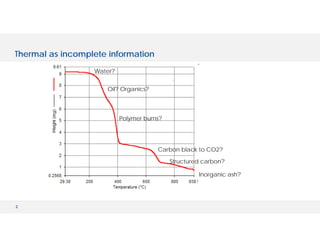
Thermal as incomplete information
Water?
Oil? Organics?
Polymer burns?
Carbon black to CO2?
Inorganic ash?
Structured carbon?
3
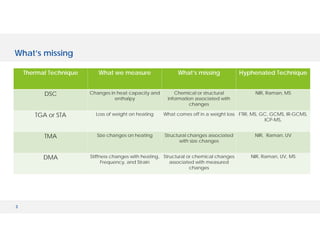
What’s missing
Thermal Technique What we measure What’s missing Hyphenated Technique
DSC Changes in heat capacity and
enthalpy
Chemical or structural
information associated with
changes
NIR, Raman, MS
TGA or STA Loss of weight on heating What comes off in a weight loss FTIR, MS, GC, GCMS, IR-GCMS,
ICP-MS,
TMA Size changes on heating Structural changes associated
with size changes
NIR, Raman, UV
DMA Stiffness changes with heating,
Frequency, and Strain
Structural or chemical changes
associated with measured
changes
NIR, Raman, UV, MS
4
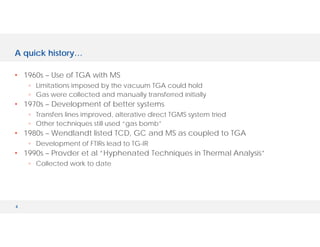
A quick history…
• 1960s – Use of TGA with MS
◦ Limitations imposed by the vacuum TGA could hold
◦ Gas were collected and manually transferred initially
• 1970s – Development of better systems
◦ Transfers lines improved, alterative direct TGMS system tried
◦ Other techniques still used “gas bomb”
• 1980s – Wendlandt listed TCD, GC and MS as coupled to TGA
◦ Development of FTIRs lead to TG-IR
• 1990s – Provder et al “Hyphenated Techniques in Thermal Analysis”
◦ Collected work to date
5
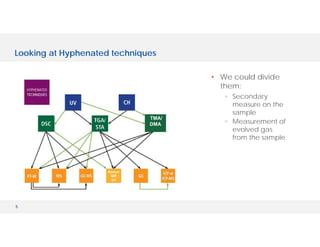
Looking at Hyphenated techniques
• We could divide
them:
◦ Secondary
measure on the
sample
◦ Measurement of
evolved gas
from the sample
TMA/
DMA
Raman
NIR
UV
6
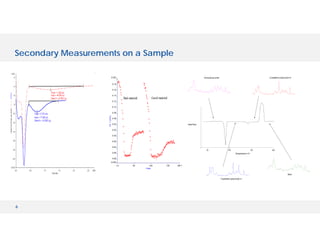
Secondary Measurements on a Sample
1.0 50 100 150 184.7
-0.093
-0.08
-0.06
-0.04
-0.02
0.00
0.02
0.04
0.06
0.08
0.10
0.12
0.14
0.16
0.18
0.203
Index
PC1(75%)
xxxx
x
x
xx
x
x
x
x
x
x
x
x
x
x
x
x
x
xx
xxxxxxxxxxxxxxx
x
x
x
x
x
x
xx
xxxxx
x
xx
x
x
x
xx
x
xxx
xxxxxxxxxxxxxx
x
x
x
xxx
x
x
x
x
xx
x
x
x
x
x
x
x
x
x
xxxxxxxxx
x
xxx
xx
x
xxx
x
x
xx
xxx
xxxx
xxx
xx
xxx
xxxxxx
xxxx
xxxx
xxxxx
xxx
x
xx
xx
x
x
x
xx
Bad material Good material
Amorphous solid
Melt
Crystalline polymorph II
Crystalline polymorph III
100 150 20050
Heat flow
Temperature /oC
7
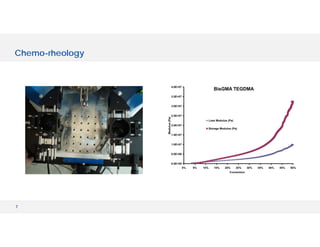
Chemo-rheology
BisGMA TEGDMA
0.0E+00
5.0E+06
1.0E+07
1.5E+07
2.0E+07
2.5E+07
3.0E+07
3.5E+07
4.0E+07
0% 5% 10% 15% 20% 25% 30% 35% 40% 45% 50%
Conversion
Modulus(Pa)
Loss Modulus (Pa)
Storage Modulus (Pa)
8
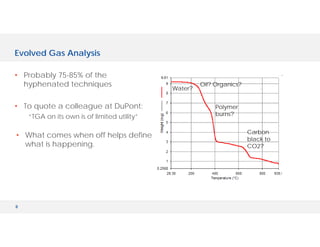
Evolved Gas Analysis
• Probably 75-85% of the
hyphenated techniques
• To quote a colleague at DuPont:
“TGA on its own is of limited utility”
• What comes when off helps define
what is happening.
Water?
Oil? Organics?
Polymer
burns?
Carbon
black to
CO2?
9
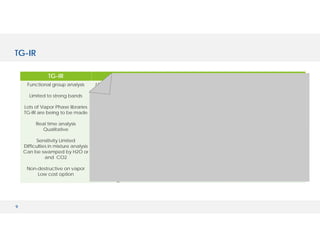
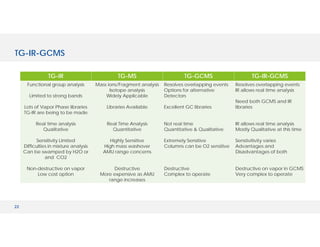
TG-IR TG-MS TG-GCMS TG-IR-GCMS
Functional group analysis
Limited to strong bands
Lots of Vapor Phase libraries
TG-IR are being to be made
Real time analysis
Qualitative
Sensitivity Limited
Difficulties in mixture analysis
Can be swamped by H2O or
and CO2
Non-destructive on vapor
Low cost option
Mass ions/Fragment analysis
Isotope analysis
Widely Applicable
Libraries Available but more
limited
Real Time Analysis
Quantitative
Highly Sensitive
High mass washover
AMU range concerns
Destructive
More expensive as AMU
range increases
Resolves overlapping events
Options for alternative
Detectors
Excellent GC libraries
Not real time
Quantitative & Qualitative
Extremely Sensitive
Columns can be O2 sensitive
Destructive
Complex to operate
Resolves overlapping events
IR allows real time analysis
Need both GCMS and IR
libraries
IR allows real time analysis
Mostly Qualitative at this time
Senstivitivity varies
Advantages and
Disadvantages of both
Destructive on vapor in GCMS
Very complex to operate
TG-IR
10
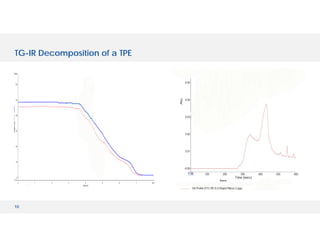
TG-IR Decomposition of a TPE
11
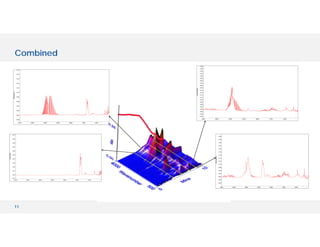
Combined
-0.01
0.00
0.01
0.02
0.03
0.04
0.05
0.06
0.07
0.08
0.09
0.10
Absorbance
1000150020002500300035004000
TFS
-0.02
0.00
0.02
0.04
0.06
0.08
0.10
0.12
0.14
0.16
0.18
0.20
Absorbance
1000150020002500300035004000
-0.04
-0.02
0.00
0.02
0.04
0.06
0.08
0.10
0.12
0.14
0.16
0.18
0.20
0.22
0.24
0.26
0.28
0.30
0.32
0.34
0.36
0.38
Absorbance
1000150020002500300035004000
-0.02
0.00
0.02
0.04
0.06
0.08
0.10
0.12
0.14
0.16
0.18
0.20
0.22
0.24
0.26
0.28
Absorbance
1000150020002500300035004000
12
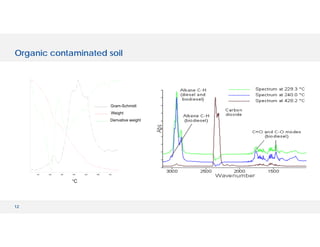
Organic contaminated soil
Gram-Schmidt
Weight
Derivative weight
100 200 300 400 500 600 700
°C
13
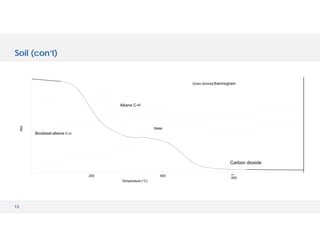
Soil (con’t)
Gram-Schmidt thermogram
Alkane C-H
Biodiesel alkene C-H
Carbon dioxide
Water
200 400 600
600
Temperature (°C)
Abs
14
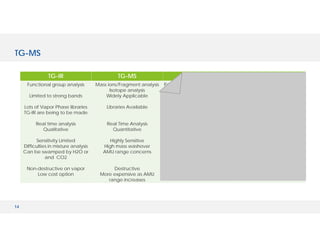
TG-IR TG-MS TG-GCMS TG-IR-GCMS
Functional group analysis
Limited to strong bands
Lots of Vapor Phase libraries
TG-IR are being to be made
Real time analysis
Qualitative
Sensitivity Limited
Difficulties in mixture analysis
Can be swamped by H2O or
and CO2
Non-destructive on vapor
Low cost option
Mass ions/Fragment analysis
Isotope analysis
Widely Applicable
Libraries Available
Real Time Analysis
Quantitative
Highly Sensitive
High mass washover
AMU range concerns
Destructive
More expensive as AMU
range increases
Resolves overlapping events
Options for alternative
Detectors
Excellent GC libraries
Not real time
Quantitative & Qualitative
Extremely Sensitive
Columns can be O2 sensitive
Destructive
Complex to operate
Resolves overlapping events
IR allows real time analysis
Need both GCMS and IR
libraries
IR allows real time analysis
Mostly Qualitative at this time
Senstivitivity varies
Advantages and
Disadvantages of both
Destructive on vapor in GCMS
Very complex to operate
TG-MS
15
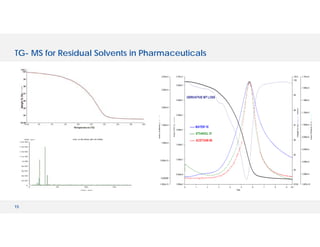
TG- MS for Residual Solvents in Pharmaceuticals
16
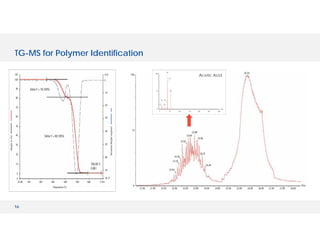
TG-MS for Polymer Identification
Acetic Acid
17
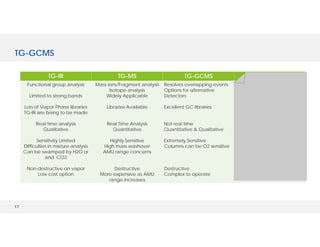
TG-IR TG-MS TG-GCMS TG-IR-GCMS
Functional group analysis
Limited to strong bands
Lots of Vapor Phase libraries
TG-IR are being to be made
Real time analysis
Qualitative
Sensitivity Limited
Difficulties in mixture analysis
Can be swamped by H2O or
and CO2
Non-destructive on vapor
Low cost option
Mass ions/Fragment analysis
Isotope analysis
Widely Applicable
Libraries Available
Real Time Analysis
Quantitative
Highly Sensitive
High mass washover
AMU range concerns
Destructive
More expensive as AMU
range increases
Resolves overlapping events
Options for alternative
Detectors
Excellent GC libraries
Not real time
Quantitative & Qualitative
Extremely Sensitive
Columns can be O2 sensitive
Destructive
Complex to operate
Resolves overlapping events
IR allows real time analysis
Need both GCMS and IR
libraries
IR allows real time analysis
Mostly Qualitative at this time
Senstivitivity varies
Advantages and
Disadvantages of both
Destructive on vapor in GCMS
Very complex to operate
TG-GCMS
18
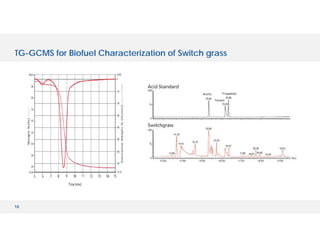
TG-GCMS for Biofuel Characterization of Switch grass
19
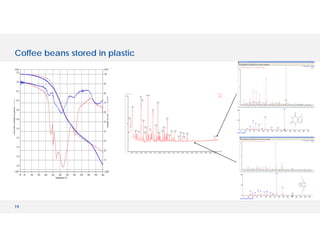
Coffee beans stored in plastic
(replib) Caffeine
0 20 40 60 80 100 120 140 160 180 200 220 240 260 280 300
0
50
100
27
42
55
67
82
94
109
137 165
194
N
N
N
N
O
O
(replib) Diethyl Phthalate
0 20 40 60 80 100 120 140 160 180 200 220 240 260 280 300
0
50
100
29
39
50
65
76 93 105
121
132
149
177
222
O
O
O
O
20
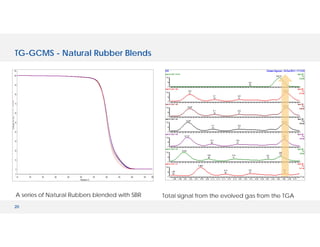
TG-GCMS - Natural Rubber Blends
A series of Natural Rubbers blended with SBR Total signal from the evolved gas from the TGA
21
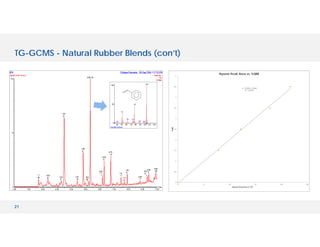
TG-GCMS - Natural Rubber Blends (con’t)
y = 0.2055x - 0.0442
R² = 0.9979
0
0.5
1
1.5
2
2.5
3
3.5
4
4.5
5
0 5 10 15 20 25
%SBR
Styrene Peak Area (x 106)
Styrene Peak Area vs. %SBR
(mainlib) Styrene
40 50 60 70 80 90 100 110 120
0
50
100
40
51
63 74
78
89 98
104
22
TG-IR-GCMS
TG-IR TG-MS TG-GCMS TG-IR-GCMS
Functional group analysis
Limited to strong bands
Lots of Vapor Phase libraries
TG-IR are being to be made
Real time analysis
Qualitative
Sensitivity Limited
Difficulties in mixture analysis
Can be swamped by H2O or
and CO2
Non-destructive on vapor
Low cost option
Mass ions/Fragment analysis
Isotope analysis
Widely Applicable
Libraries Available
Real Time Analysis
Quantitative
Highly Sensitive
High mass washover
AMU range concerns
Destructive
More expensive as AMU
range increases
Resolves overlapping events
Options for alternative
Detectors
Excellent GC libraries
Not real time
Quantitative & Qualitative
Extremely Sensitive
Columns can be O2 sensitive
Destructive
Complex to operate
Resolves overlapping events
IR allows real time analysis
Need both GCMS and IR
libraries
IR allows real time analysis
Mostly Qualitative at this time
Senstivitivity varies
Advantages and
Disadvantages of both
Destructive on vapor in GCMS
Very complex to operate
23
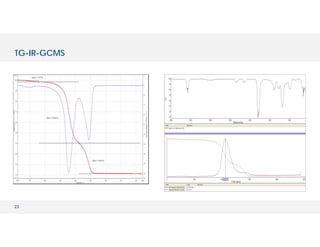
TG-IR-GCMS
24
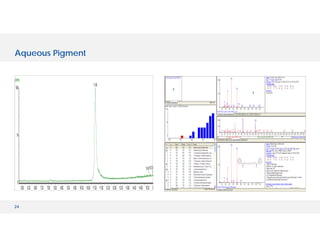
Aqueous Pigment
,
5.82 6.32 6.82 7.32 7.82 8.32 8.82 9.32 9.82 10.32 10.82 11.32 11.82 12.32 12.82 13.32 13.82 14.32 14.82 15.32 1
0
100
%
jcolors
11.36
15.7315.47
25
Thanks to:
• Veritas Testing & Consulting for the
TG-IR data on TPE
• Dr. J. Stansbury of U. Colorado
Dental School for UV-DMA-NIR
• PerkinElmer Staff:
◦ Ben Perston (Soil – Diesel)
◦ Tiffany Kang (Rubber)
◦ Richard Spragg (DSC-Raman)
◦ Maria Garavaglia (Dye)
◦ Bill Goodman (Coffee Beans)
• Some References:
◦ R. Schwenker Jr. and P. Garn,
Thermal Analysis, Academic Press,
1969
◦ W. Wendlandt, Thermal Analysis #rd
Edition, John Wiley & Sons, 1986
◦ T. Provder et al, Hyphenated
Techniques in Polymer
Characterization, ACS Symposium
Series 581, ACS Publishing, 1994
◦ W. Groenewund, Characterization
of Polymers by Thermal Analysis,
Elsevier Science, 2001.

26th John L Waters Symposium - Hyphenated Techniques in Thermal Analysis

  • 1.
    HUMAN HEALTH •ENVIRONMENTAL HEALTH Hyphenated Thermal Analysis Techniques March 8 2015 Kevin P Menard PerkinElmer LAS
  • 2.
    2 Thermal as incompleteinformation Water? Oil? Organics? Polymer burns? Carbon black to CO2? Inorganic ash? Structured carbon?
  • 3.
    3 What’s missing Thermal TechniqueWhat we measure What’s missing Hyphenated Technique DSC Changes in heat capacity and enthalpy Chemical or structural information associated with changes NIR, Raman, MS TGA or STA Loss of weight on heating What comes off in a weight loss FTIR, MS, GC, GCMS, IR-GCMS, ICP-MS, TMA Size changes on heating Structural changes associated with size changes NIR, Raman, UV DMA Stiffness changes with heating, Frequency, and Strain Structural or chemical changes associated with measured changes NIR, Raman, UV, MS
  • 4.
    4 A quick history… •1960s – Use of TGA with MS ◦ Limitations imposed by the vacuum TGA could hold ◦ Gas were collected and manually transferred initially • 1970s – Development of better systems ◦ Transfers lines improved, alterative direct TGMS system tried ◦ Other techniques still used “gas bomb” • 1980s – Wendlandt listed TCD, GC and MS as coupled to TGA ◦ Development of FTIRs lead to TG-IR • 1990s – Provder et al “Hyphenated Techniques in Thermal Analysis” ◦ Collected work to date
  • 5.
    5 Looking at Hyphenatedtechniques • We could divide them: ◦ Secondary measure on the sample ◦ Measurement of evolved gas from the sample TMA/ DMA Raman NIR UV
  • 6.
    6 Secondary Measurements ona Sample 1.0 50 100 150 184.7 -0.093 -0.08 -0.06 -0.04 -0.02 0.00 0.02 0.04 0.06 0.08 0.10 0.12 0.14 0.16 0.18 0.203 Index PC1(75%) xxxx x x xx x x x x x x x x x x x x x xx xxxxxxxxxxxxxxx x x x x x x xx xxxxx x xx x x x xx x xxx xxxxxxxxxxxxxx x x x xxx x x x x xx x x x x x x x x x xxxxxxxxx x xxx xx x xxx x x xx xxx xxxx xxx xx xxx xxxxxx xxxx xxxx xxxxx xxx x xx xx x x x xx Bad material Good material Amorphous solid Melt Crystalline polymorph II Crystalline polymorph III 100 150 20050 Heat flow Temperature /oC
  • 7.
    7 Chemo-rheology BisGMA TEGDMA 0.0E+00 5.0E+06 1.0E+07 1.5E+07 2.0E+07 2.5E+07 3.0E+07 3.5E+07 4.0E+07 0% 5%10% 15% 20% 25% 30% 35% 40% 45% 50% Conversion Modulus(Pa) Loss Modulus (Pa) Storage Modulus (Pa)
  • 8.
    8 Evolved Gas Analysis •Probably 75-85% of the hyphenated techniques • To quote a colleague at DuPont: “TGA on its own is of limited utility” • What comes when off helps define what is happening. Water? Oil? Organics? Polymer burns? Carbon black to CO2?
  • 9.
    9 TG-IR TG-MS TG-GCMSTG-IR-GCMS Functional group analysis Limited to strong bands Lots of Vapor Phase libraries TG-IR are being to be made Real time analysis Qualitative Sensitivity Limited Difficulties in mixture analysis Can be swamped by H2O or and CO2 Non-destructive on vapor Low cost option Mass ions/Fragment analysis Isotope analysis Widely Applicable Libraries Available but more limited Real Time Analysis Quantitative Highly Sensitive High mass washover AMU range concerns Destructive More expensive as AMU range increases Resolves overlapping events Options for alternative Detectors Excellent GC libraries Not real time Quantitative & Qualitative Extremely Sensitive Columns can be O2 sensitive Destructive Complex to operate Resolves overlapping events IR allows real time analysis Need both GCMS and IR libraries IR allows real time analysis Mostly Qualitative at this time Senstivitivity varies Advantages and Disadvantages of both Destructive on vapor in GCMS Very complex to operate TG-IR
  • 10.
  • 11.
  • 12.
  • 13.
    13 Soil (con’t) Gram-Schmidt thermogram AlkaneC-H Biodiesel alkene C-H Carbon dioxide Water 200 400 600 600 Temperature (°C) Abs
  • 14.
    14 TG-IR TG-MS TG-GCMSTG-IR-GCMS Functional group analysis Limited to strong bands Lots of Vapor Phase libraries TG-IR are being to be made Real time analysis Qualitative Sensitivity Limited Difficulties in mixture analysis Can be swamped by H2O or and CO2 Non-destructive on vapor Low cost option Mass ions/Fragment analysis Isotope analysis Widely Applicable Libraries Available Real Time Analysis Quantitative Highly Sensitive High mass washover AMU range concerns Destructive More expensive as AMU range increases Resolves overlapping events Options for alternative Detectors Excellent GC libraries Not real time Quantitative & Qualitative Extremely Sensitive Columns can be O2 sensitive Destructive Complex to operate Resolves overlapping events IR allows real time analysis Need both GCMS and IR libraries IR allows real time analysis Mostly Qualitative at this time Senstivitivity varies Advantages and Disadvantages of both Destructive on vapor in GCMS Very complex to operate TG-MS
  • 15.
    15 TG- MS forResidual Solvents in Pharmaceuticals
  • 16.
    16 TG-MS for PolymerIdentification Acetic Acid
  • 17.
    17 TG-IR TG-MS TG-GCMSTG-IR-GCMS Functional group analysis Limited to strong bands Lots of Vapor Phase libraries TG-IR are being to be made Real time analysis Qualitative Sensitivity Limited Difficulties in mixture analysis Can be swamped by H2O or and CO2 Non-destructive on vapor Low cost option Mass ions/Fragment analysis Isotope analysis Widely Applicable Libraries Available Real Time Analysis Quantitative Highly Sensitive High mass washover AMU range concerns Destructive More expensive as AMU range increases Resolves overlapping events Options for alternative Detectors Excellent GC libraries Not real time Quantitative & Qualitative Extremely Sensitive Columns can be O2 sensitive Destructive Complex to operate Resolves overlapping events IR allows real time analysis Need both GCMS and IR libraries IR allows real time analysis Mostly Qualitative at this time Senstivitivity varies Advantages and Disadvantages of both Destructive on vapor in GCMS Very complex to operate TG-GCMS
  • 18.
    18 TG-GCMS for BiofuelCharacterization of Switch grass
  • 19.
    19 Coffee beans storedin plastic (replib) Caffeine 0 20 40 60 80 100 120 140 160 180 200 220 240 260 280 300 0 50 100 27 42 55 67 82 94 109 137 165 194 N N N N O O (replib) Diethyl Phthalate 0 20 40 60 80 100 120 140 160 180 200 220 240 260 280 300 0 50 100 29 39 50 65 76 93 105 121 132 149 177 222 O O O O
  • 20.
    20 TG-GCMS - NaturalRubber Blends A series of Natural Rubbers blended with SBR Total signal from the evolved gas from the TGA
  • 21.
    21 TG-GCMS - NaturalRubber Blends (con’t) y = 0.2055x - 0.0442 R² = 0.9979 0 0.5 1 1.5 2 2.5 3 3.5 4 4.5 5 0 5 10 15 20 25 %SBR Styrene Peak Area (x 106) Styrene Peak Area vs. %SBR (mainlib) Styrene 40 50 60 70 80 90 100 110 120 0 50 100 40 51 63 74 78 89 98 104
  • 22.
    22 TG-IR-GCMS TG-IR TG-MS TG-GCMSTG-IR-GCMS Functional group analysis Limited to strong bands Lots of Vapor Phase libraries TG-IR are being to be made Real time analysis Qualitative Sensitivity Limited Difficulties in mixture analysis Can be swamped by H2O or and CO2 Non-destructive on vapor Low cost option Mass ions/Fragment analysis Isotope analysis Widely Applicable Libraries Available Real Time Analysis Quantitative Highly Sensitive High mass washover AMU range concerns Destructive More expensive as AMU range increases Resolves overlapping events Options for alternative Detectors Excellent GC libraries Not real time Quantitative & Qualitative Extremely Sensitive Columns can be O2 sensitive Destructive Complex to operate Resolves overlapping events IR allows real time analysis Need both GCMS and IR libraries IR allows real time analysis Mostly Qualitative at this time Senstivitivity varies Advantages and Disadvantages of both Destructive on vapor in GCMS Very complex to operate
  • 23.
  • 24.
    24 Aqueous Pigment , 5.82 6.326.82 7.32 7.82 8.32 8.82 9.32 9.82 10.32 10.82 11.32 11.82 12.32 12.82 13.32 13.82 14.32 14.82 15.32 1 0 100 % jcolors 11.36 15.7315.47
  • 25.
    25 Thanks to: • VeritasTesting & Consulting for the TG-IR data on TPE • Dr. J. Stansbury of U. Colorado Dental School for UV-DMA-NIR • PerkinElmer Staff: ◦ Ben Perston (Soil – Diesel) ◦ Tiffany Kang (Rubber) ◦ Richard Spragg (DSC-Raman) ◦ Maria Garavaglia (Dye) ◦ Bill Goodman (Coffee Beans) • Some References: ◦ R. Schwenker Jr. and P. Garn, Thermal Analysis, Academic Press, 1969 ◦ W. Wendlandt, Thermal Analysis #rd Edition, John Wiley & Sons, 1986 ◦ T. Provder et al, Hyphenated Techniques in Polymer Characterization, ACS Symposium Series 581, ACS Publishing, 1994 ◦ W. Groenewund, Characterization of Polymers by Thermal Analysis, Elsevier Science, 2001.