Multiplying
the Power of Taxonomy
with Granular, Structured Content
<div property="author">
<span
property="sameAs"
href="https://twitter.com/joepairman">
Joe Pairman
</span>
</div>
<author keyref=”JoePairman"/>
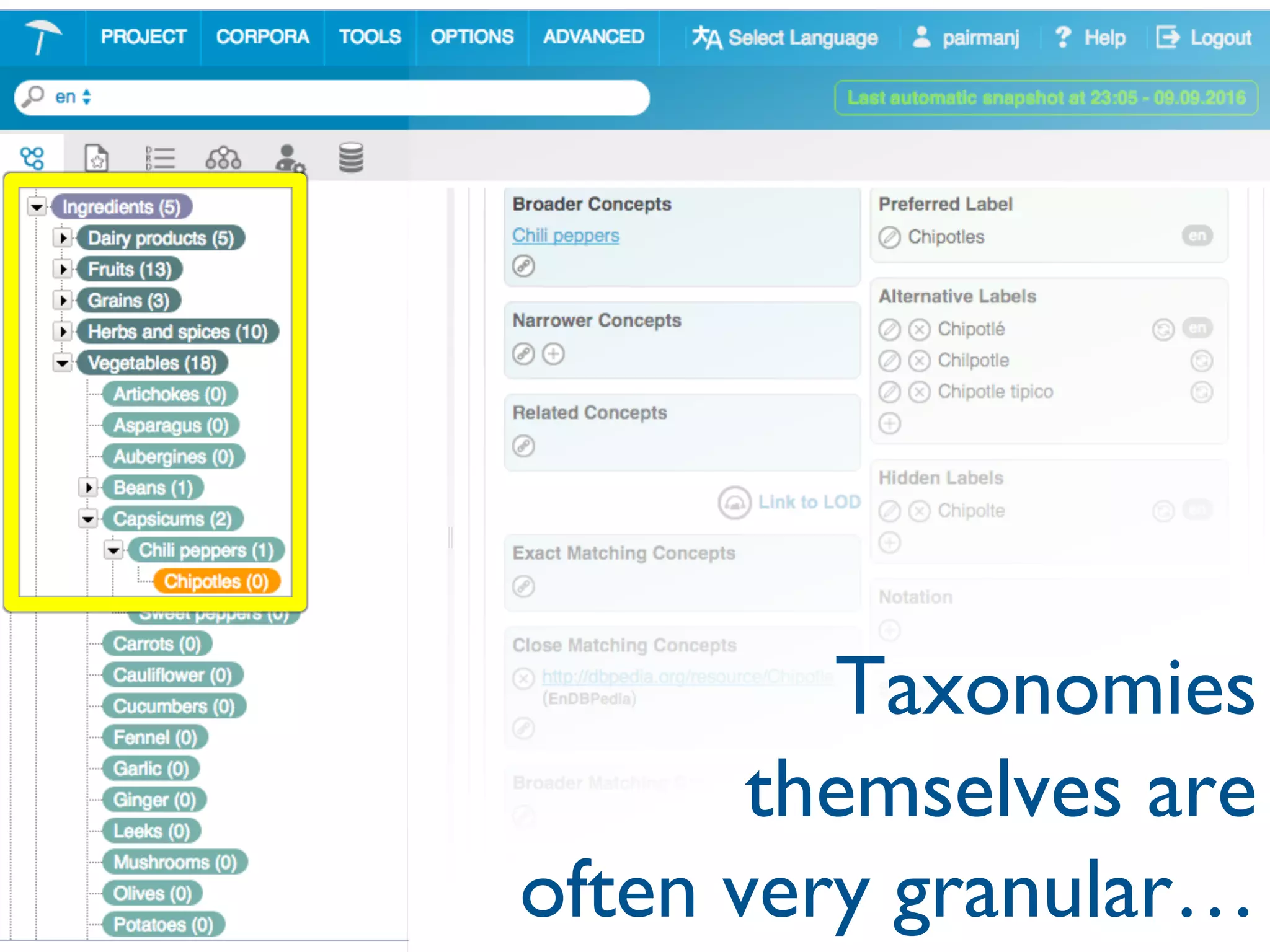
Taxonomies
themselves are
often very granular…
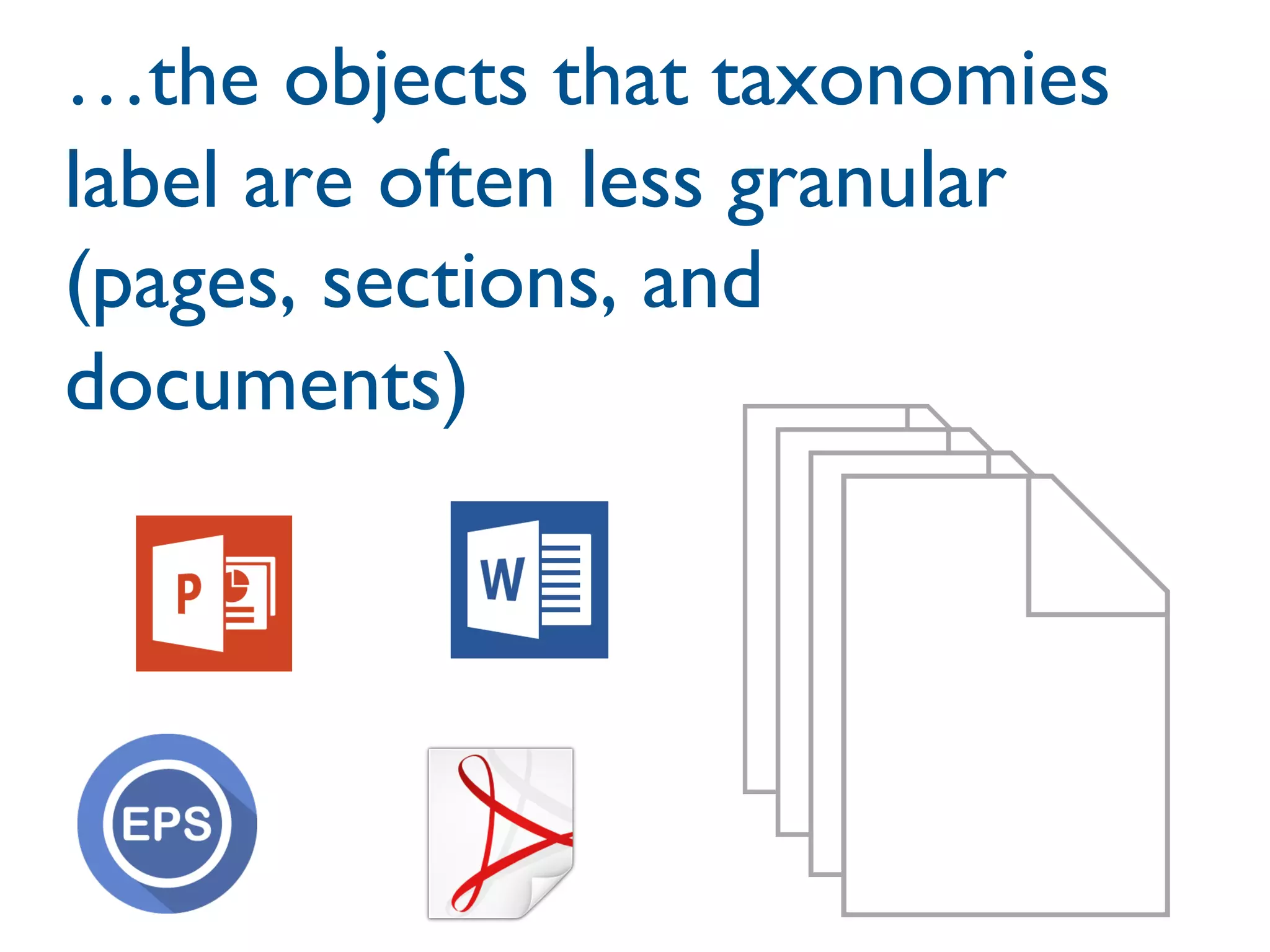
…the objects that taxonomies
label are often less granular
(pages, sections, and
documents)
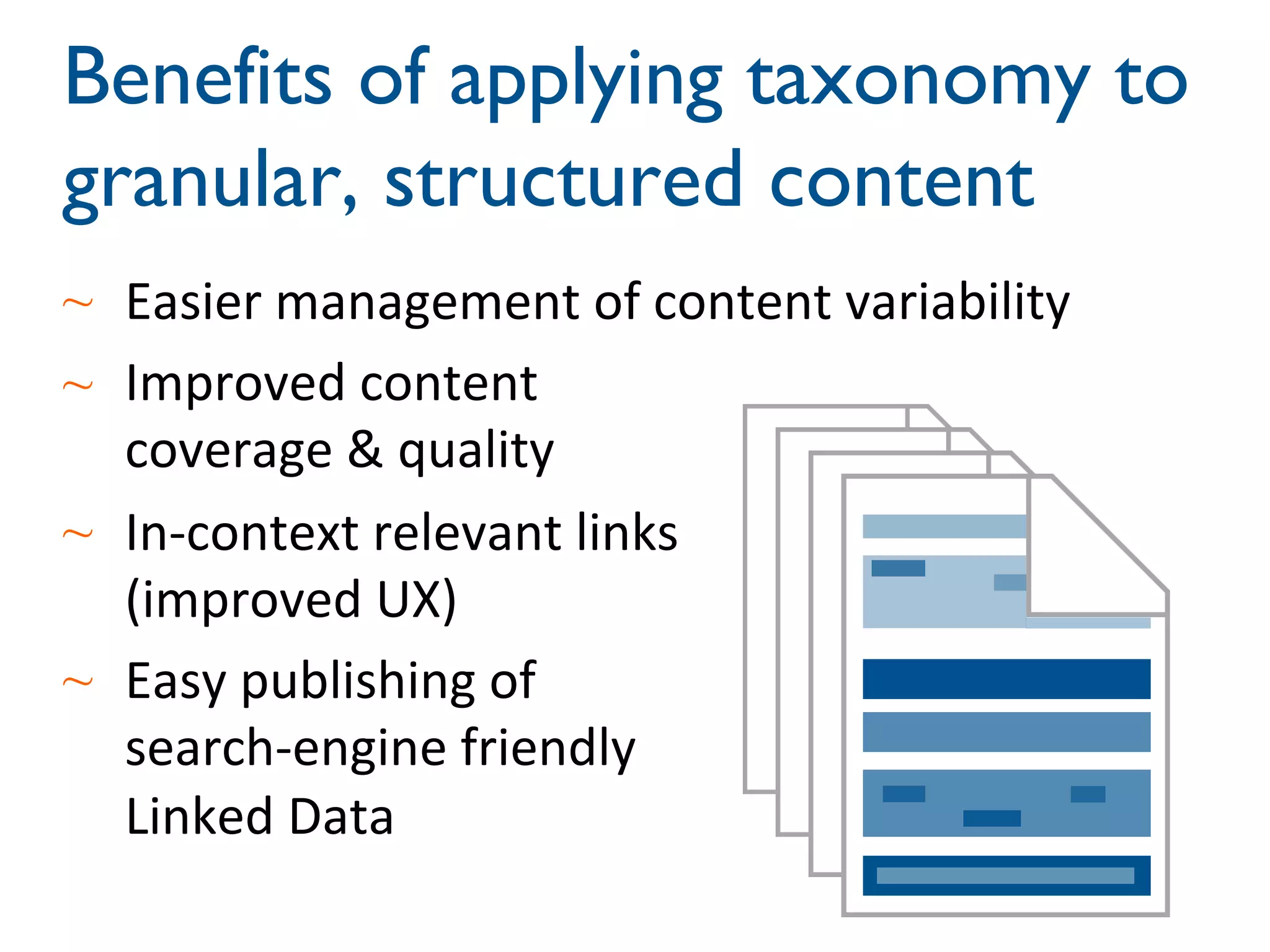
Benefits of applying taxonomy to
granular, structured content
~ Easier	management	of	content	variability
~ Improved	content	
coverage	&	quality
~ In-context	relevant	links	
(improved	UX)
~ Easy	publishing	of	
search-engine	friendly	
Linked	Data
How I cut my teeth in
structured content…
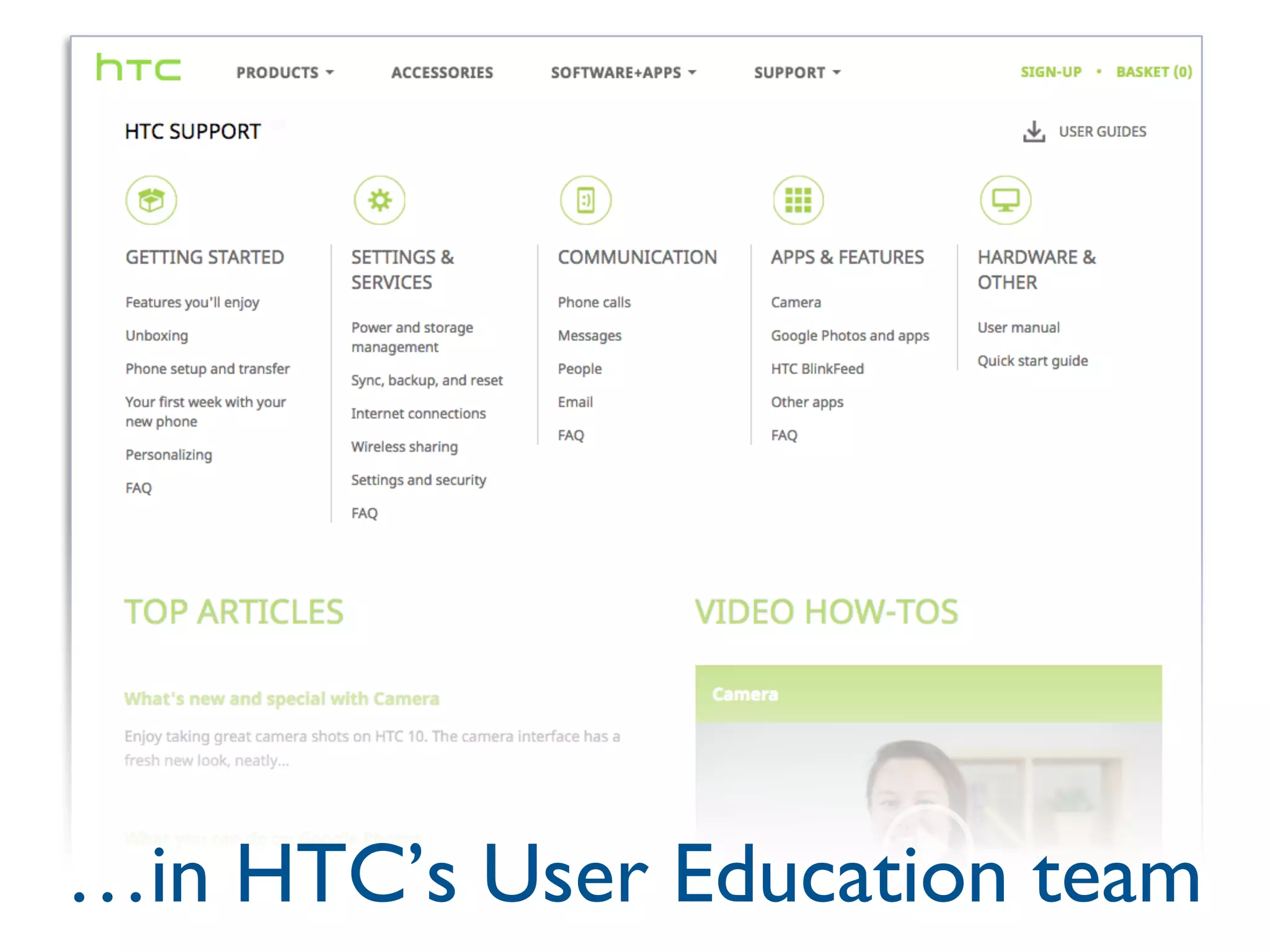
…in HTC’s User Education team
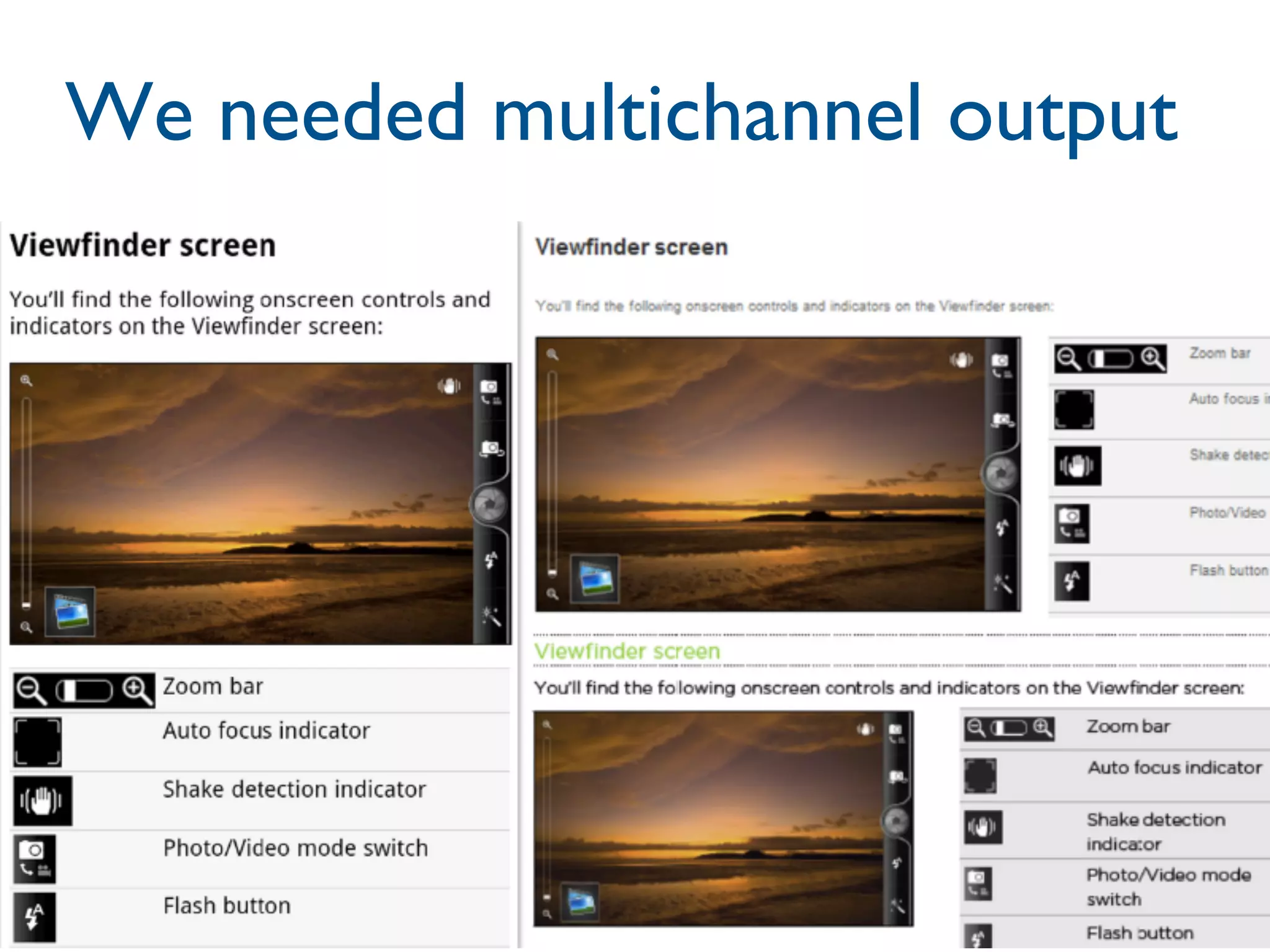
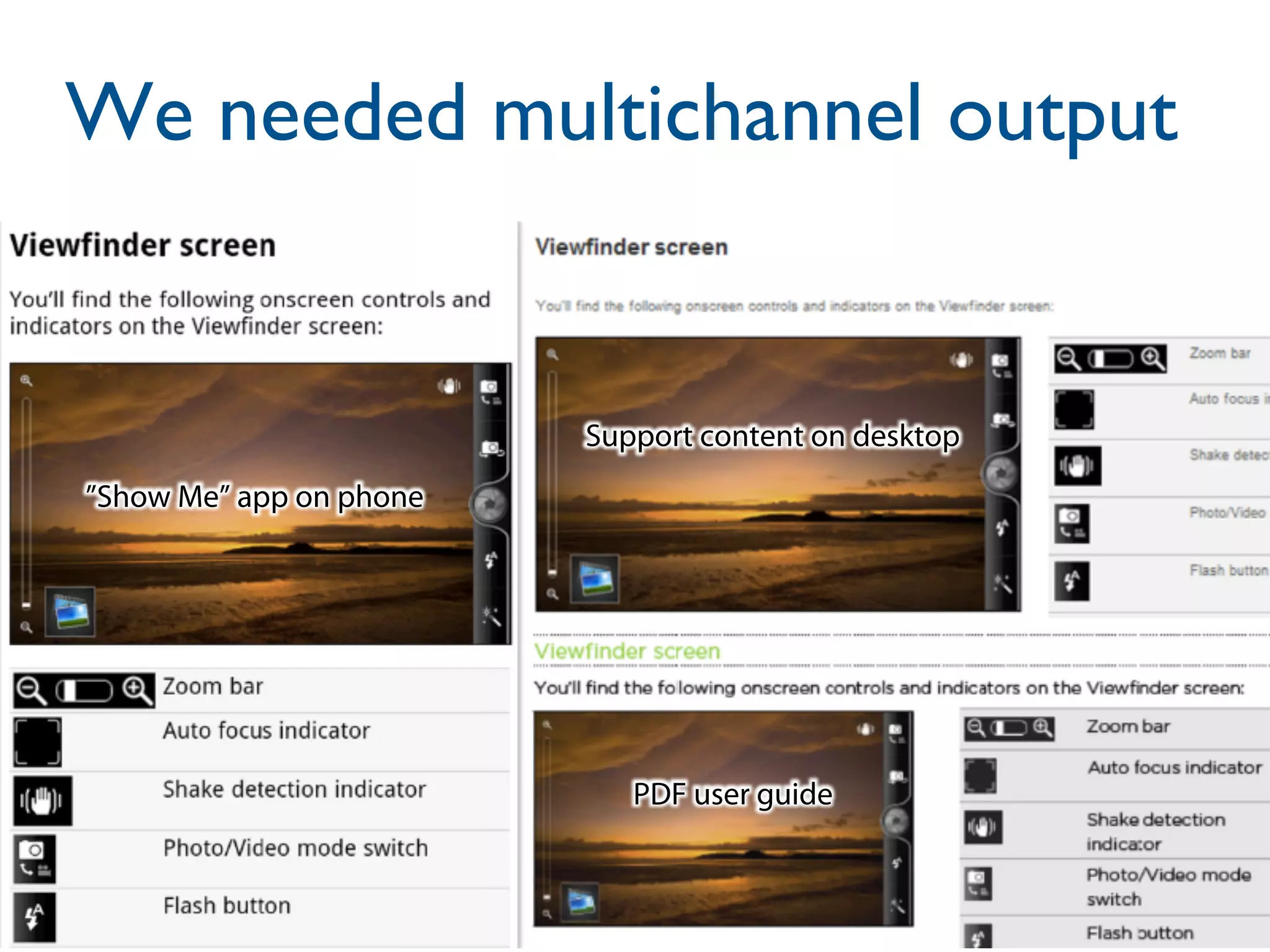
We needed multichannel output
”Show Me” app on phone
Support content on desktop
PDF user guide
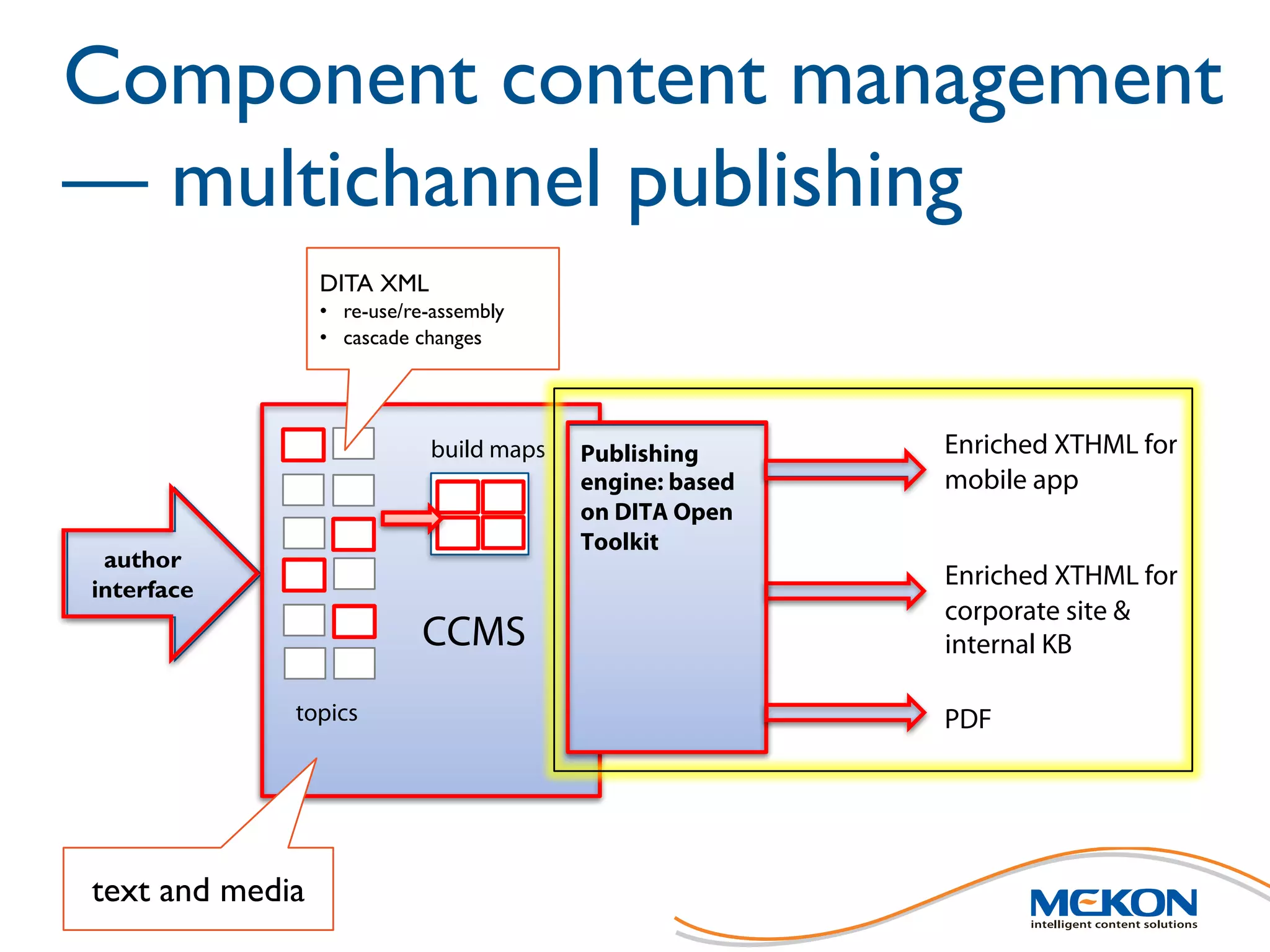
We needed multichannel output
PDF
Enriched XTHML for
mobile app
author
interface
CCMS
topics
build maps
text and media
Publishing
engine: based
on DITA Open
Toolkit
DITA XML
• re-use/re-assembly
• cascade changes
Enriched XTHML for
corporate site &
internal KB
Component content management
— multichannel publishing
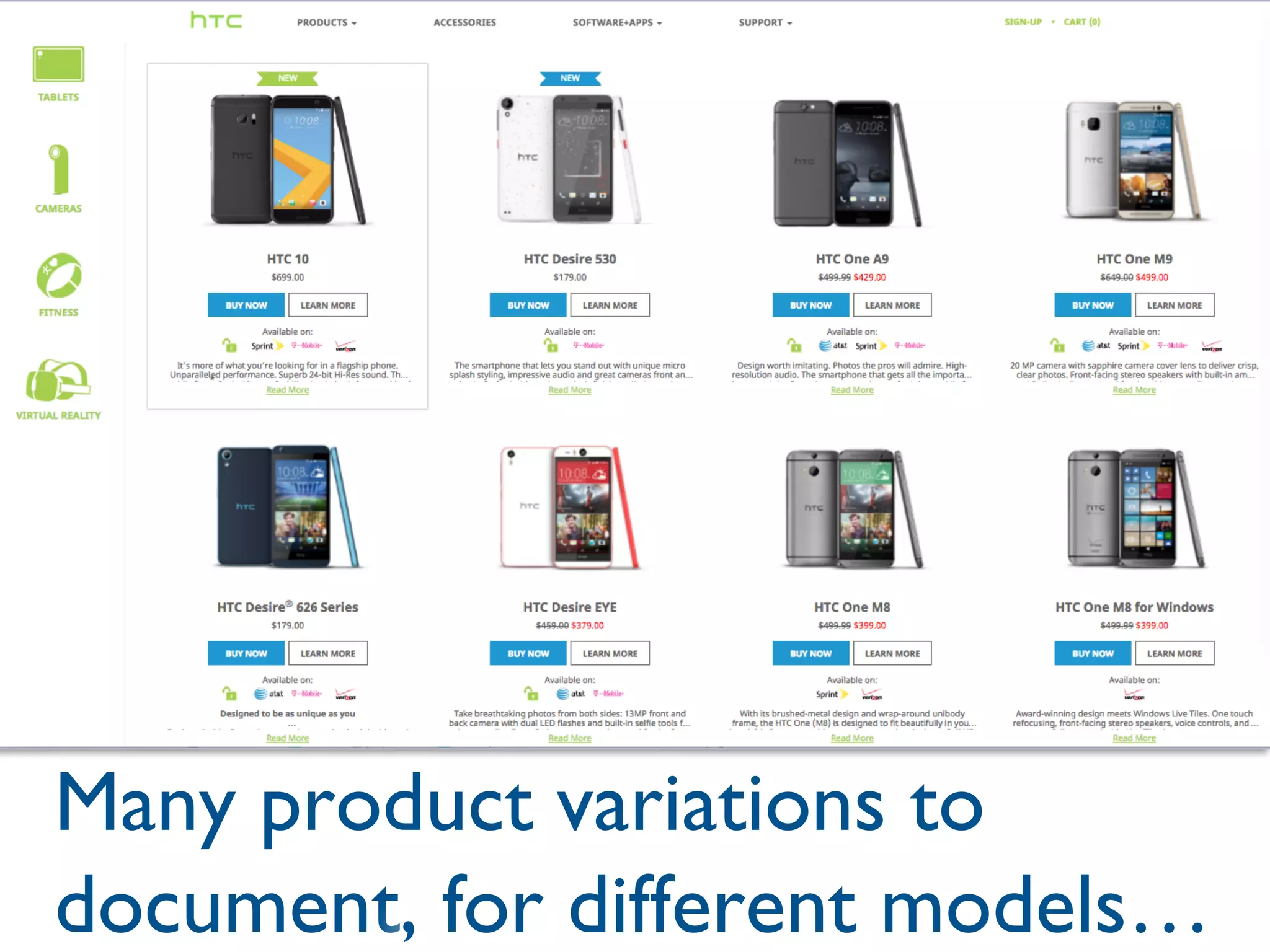
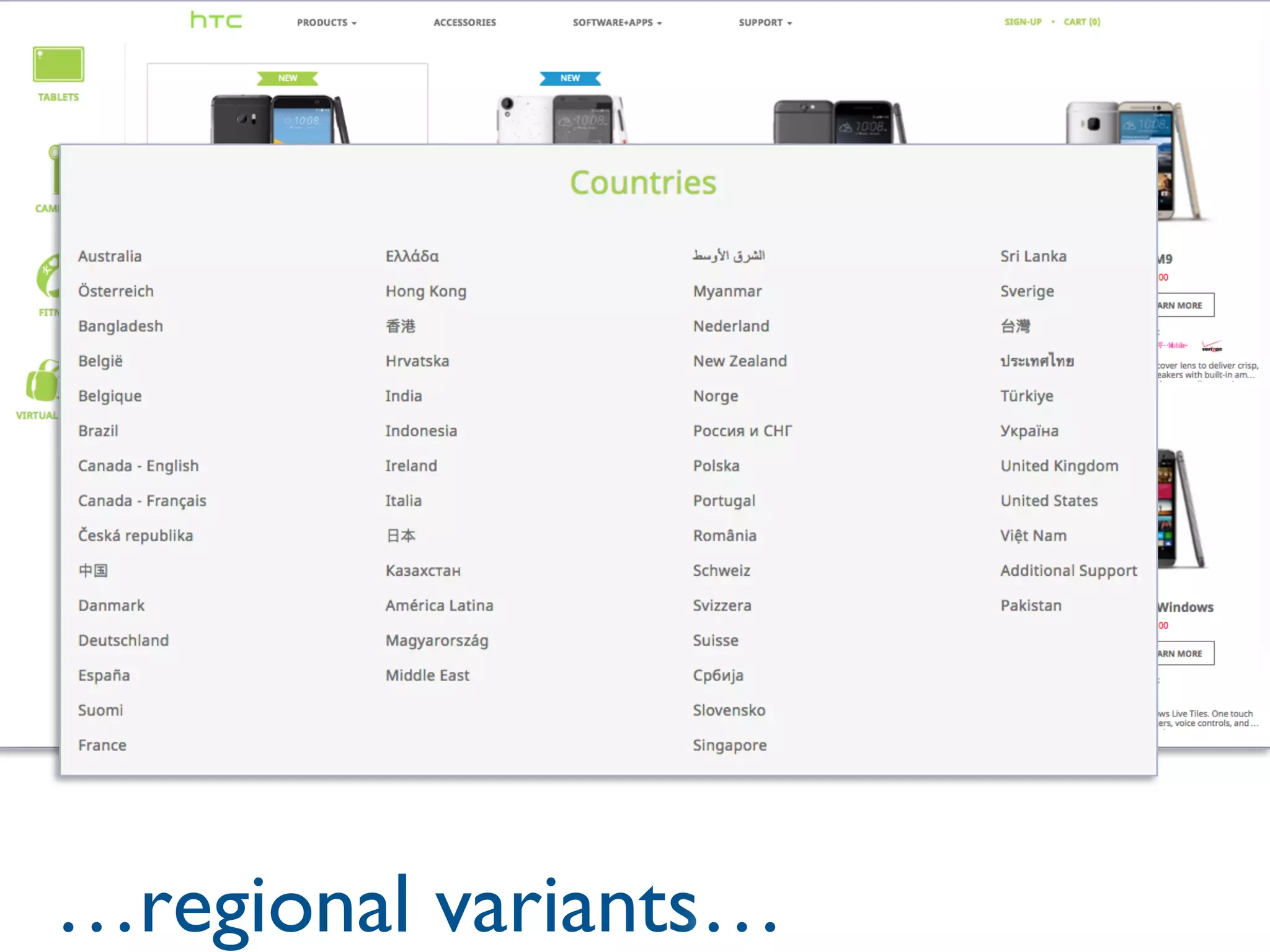
Many product variations to
document, for different models…
…regional variants…
…and customizations.
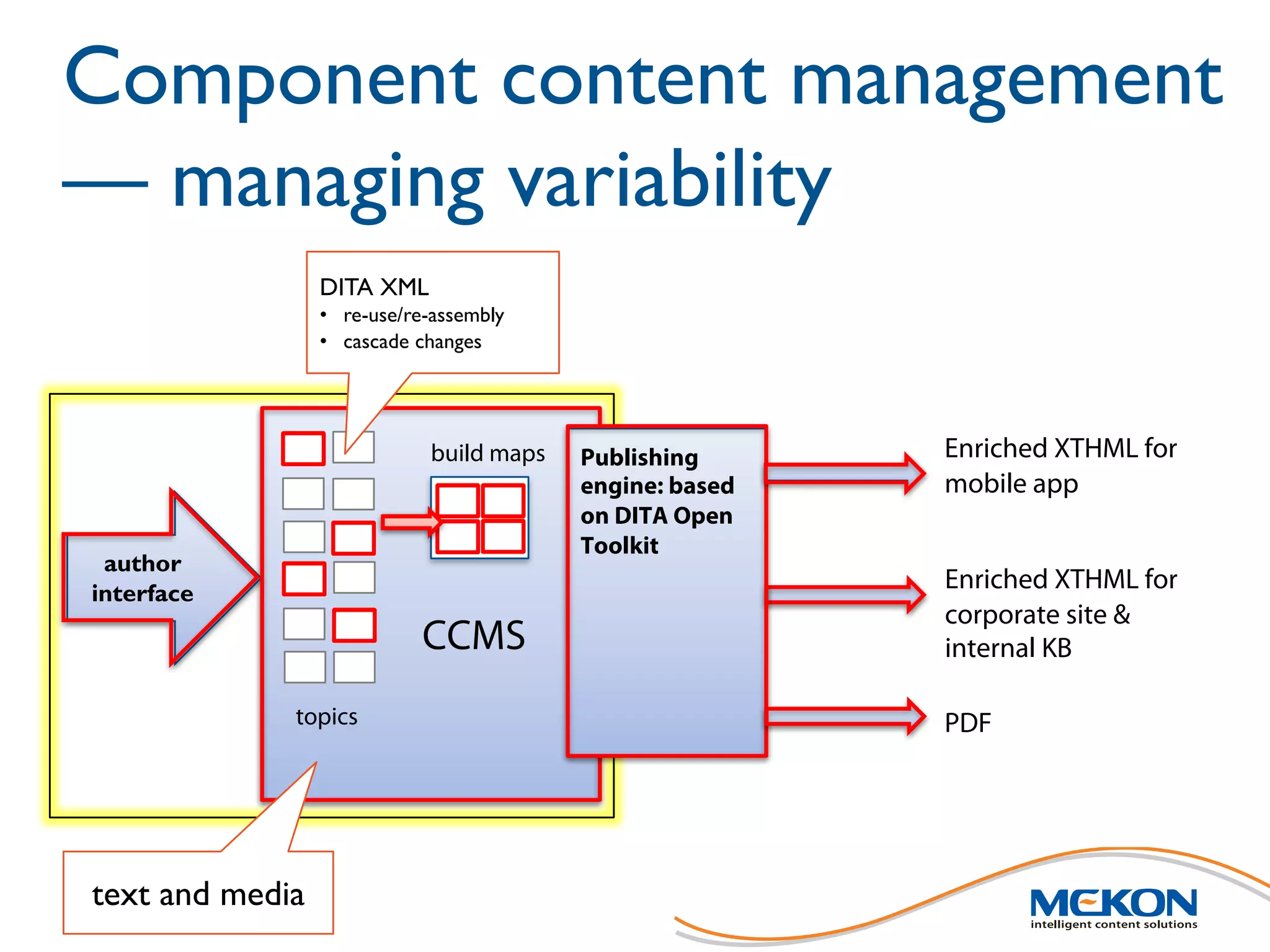
PDF
Enriched XTHML for
mobile app
author
interface
CCMS
topics
build maps
text and media
Publishing
engine: based
on DITA Open
Toolkit
DITA XML
• re-use/re-assembly
• cascade changes
Enriched XTHML for
corporate site &
internal KB
Component content management
— managing variability
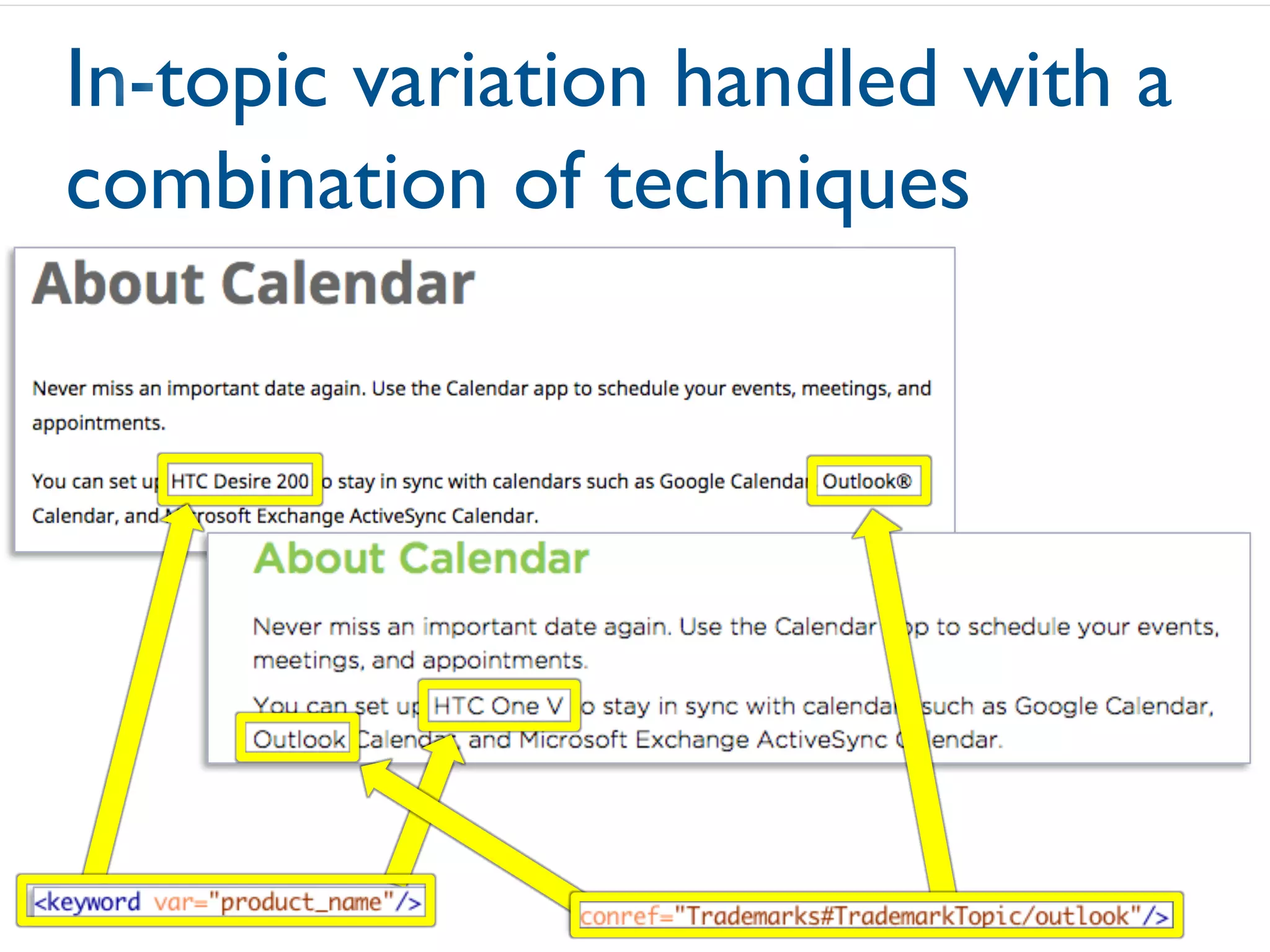
In-topic variation handled with a
combination of techniques
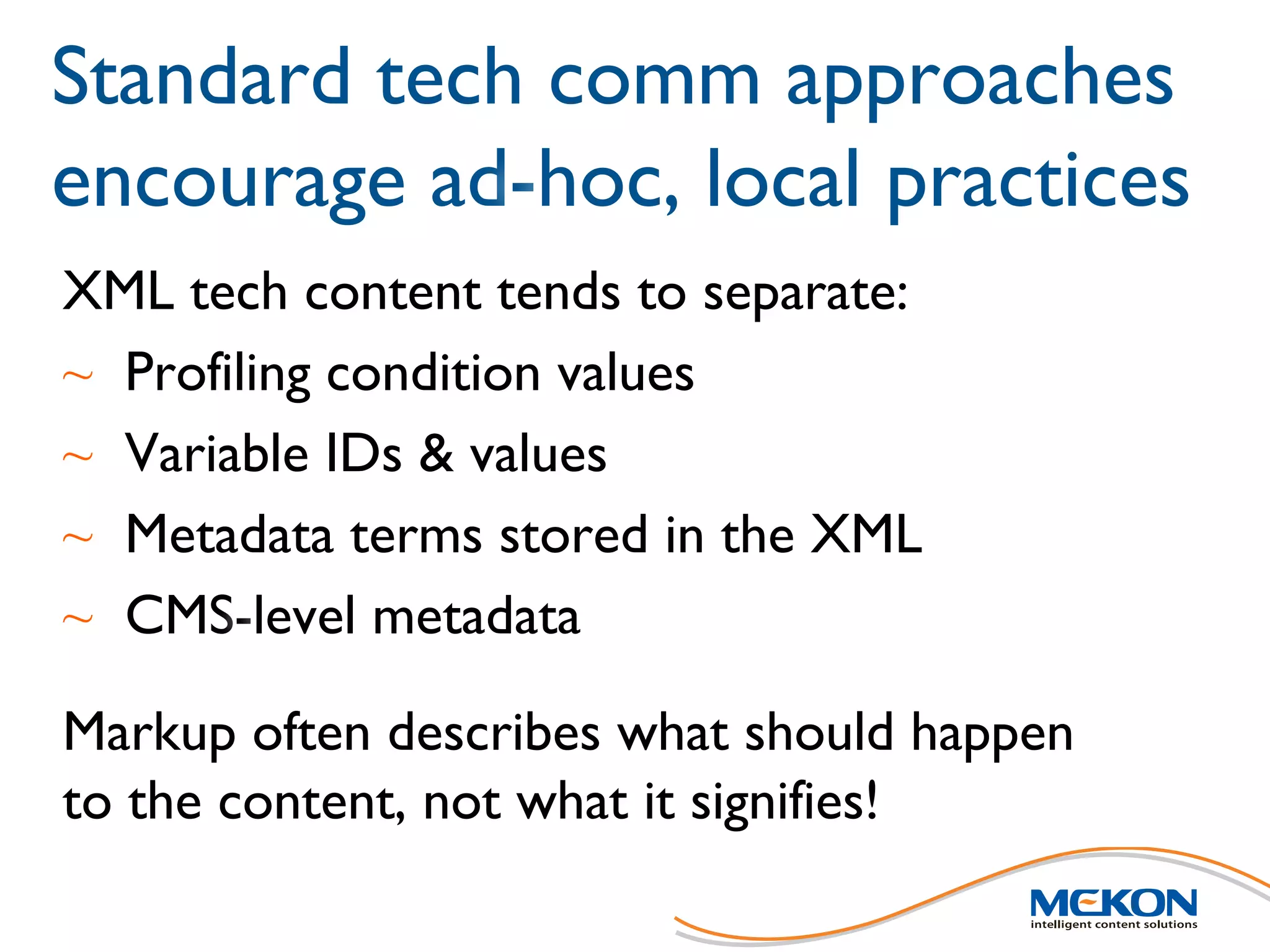
Standard tech comm approaches
encourage ad-hoc, local practices
XML tech content tends to separate:
~ Profiling condition values
~ Variable IDs & values
~ Metadata terms stored in the XML
~ CMS-level metadata
Markup often describes what should happen
to the content, not what it signifies!
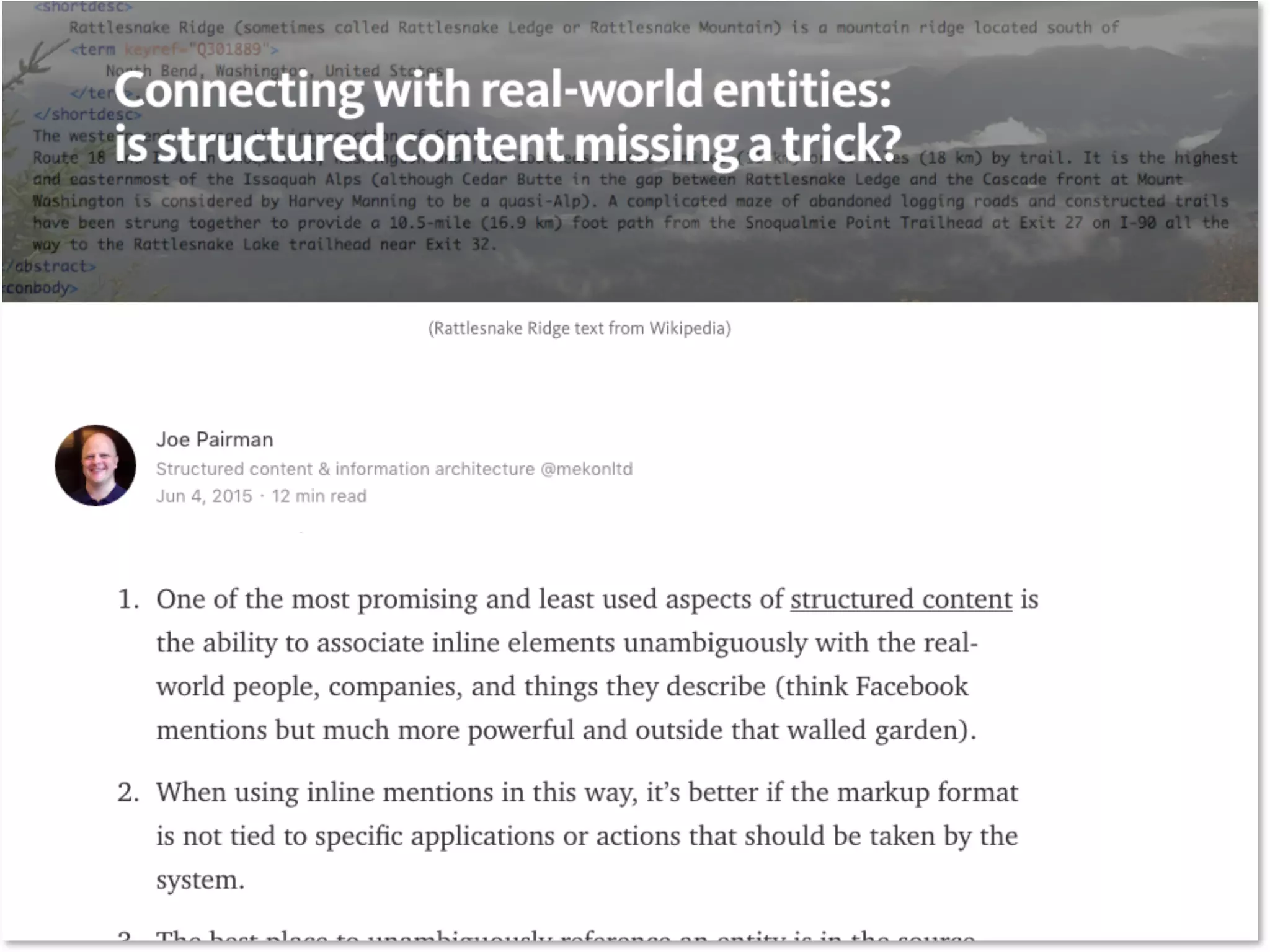
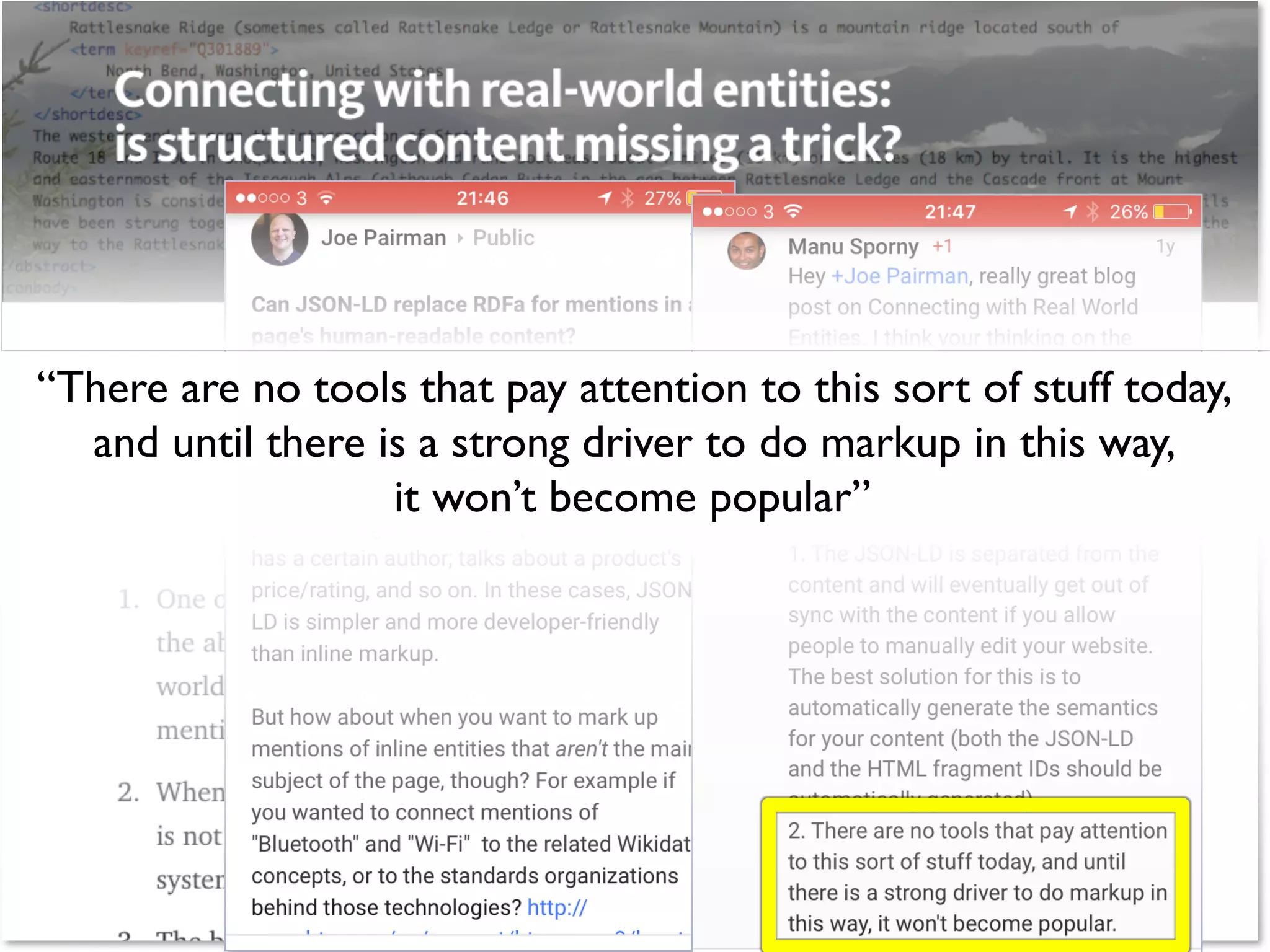
“There are no tools that pay attention to this sort of stuff today,
and until there is a strong driver to do markup in this way,
it won’t become popular”
Since then,
several things
have come
together…
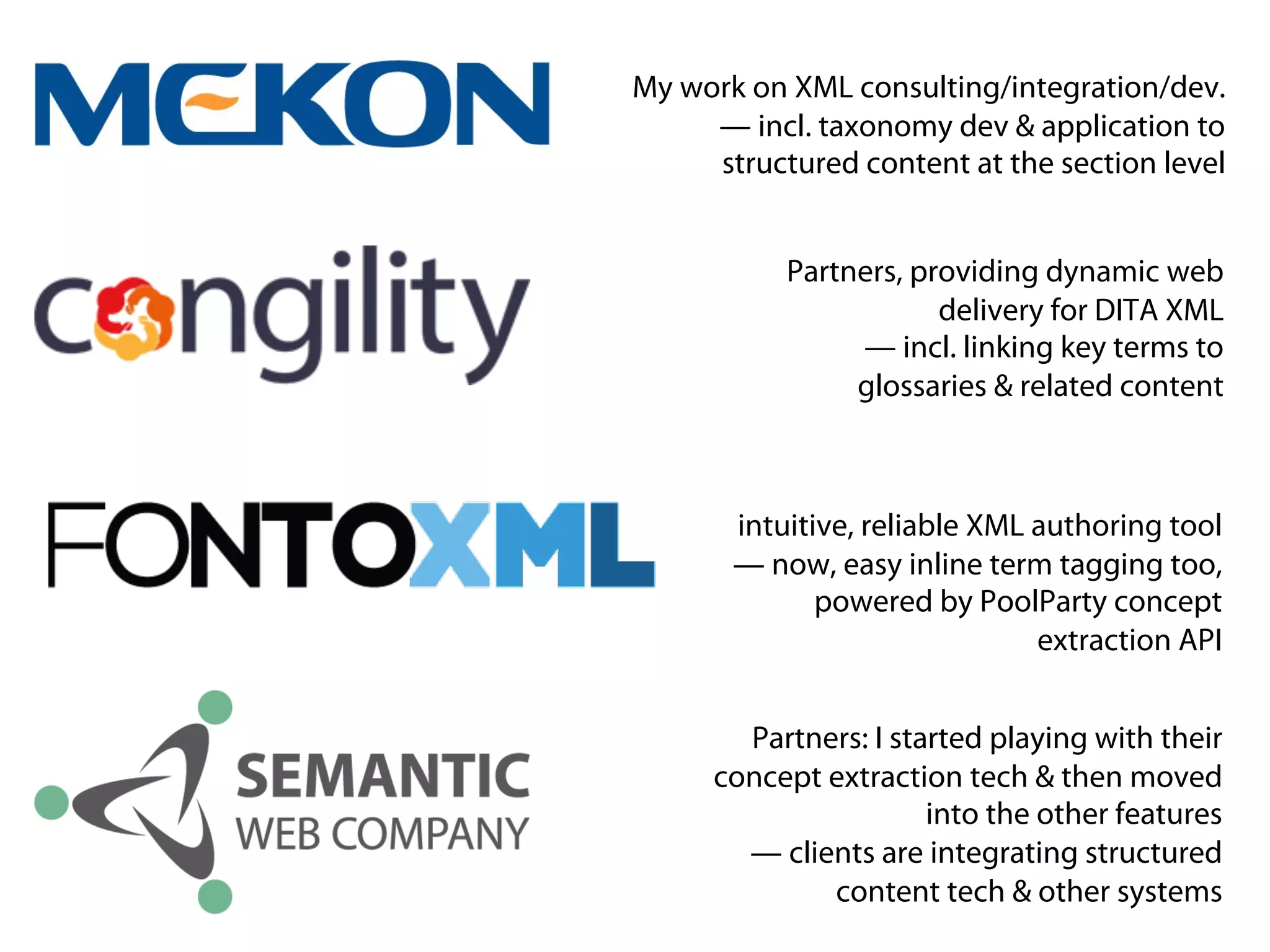
My work on XML consulting/integration/dev.
— incl. taxonomy dev & application to
structured content at the section level
Partners, providing dynamic web
delivery for DITA XML
— incl. linking key terms to
glossaries & related content
intuitive, reliable XML authoring tool
— now, easy inline term tagging too,
powered by PoolParty concept
extraction API
Partners: I started playing with their
concept extraction tech & then moved
into the other features
— clients are integrating structured
content tech & other systems
Next:
Mekon’s demo
to illustrate the
power of
structured
content /
semantic tech
combined
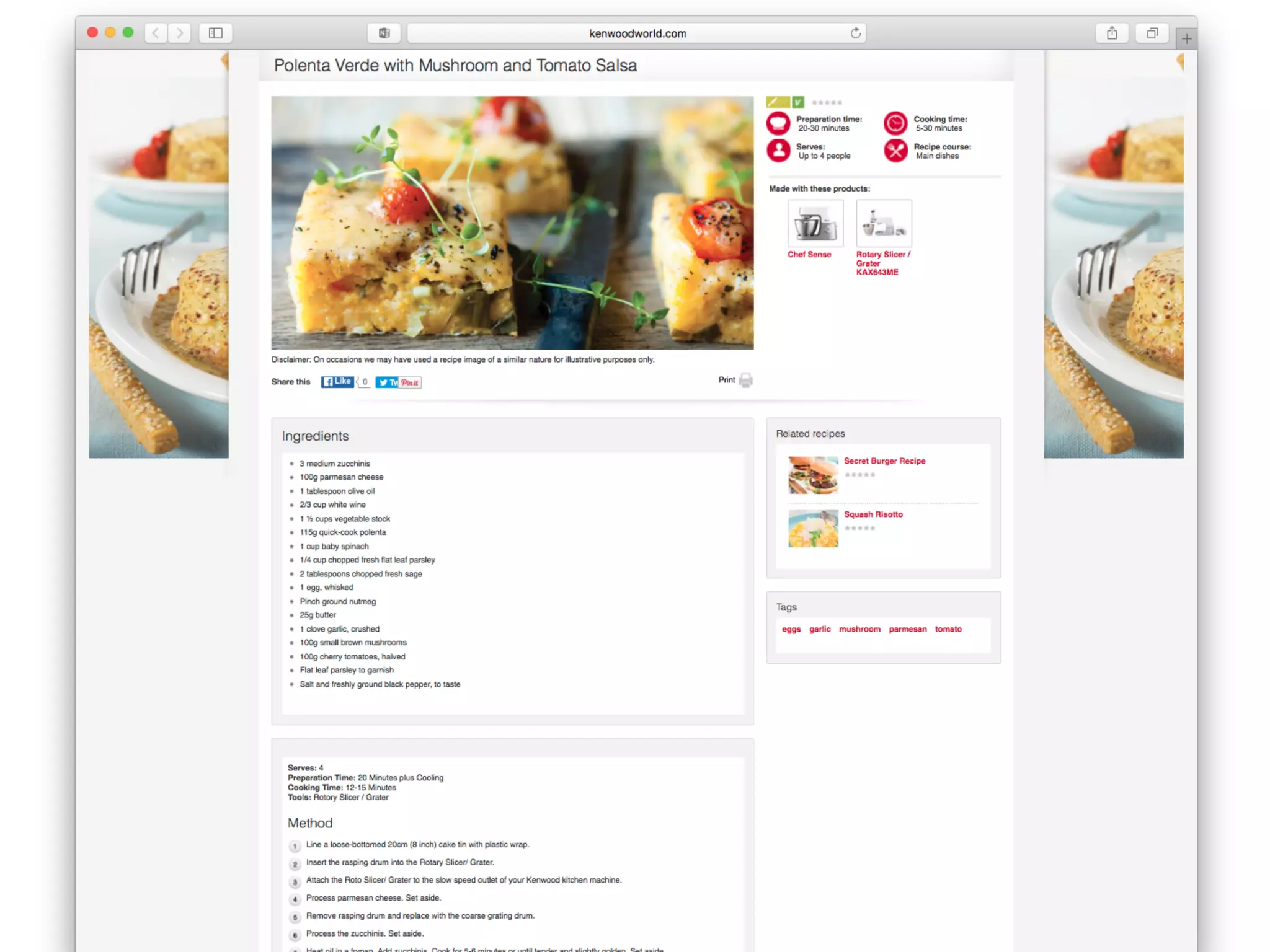
Content Marketing case study
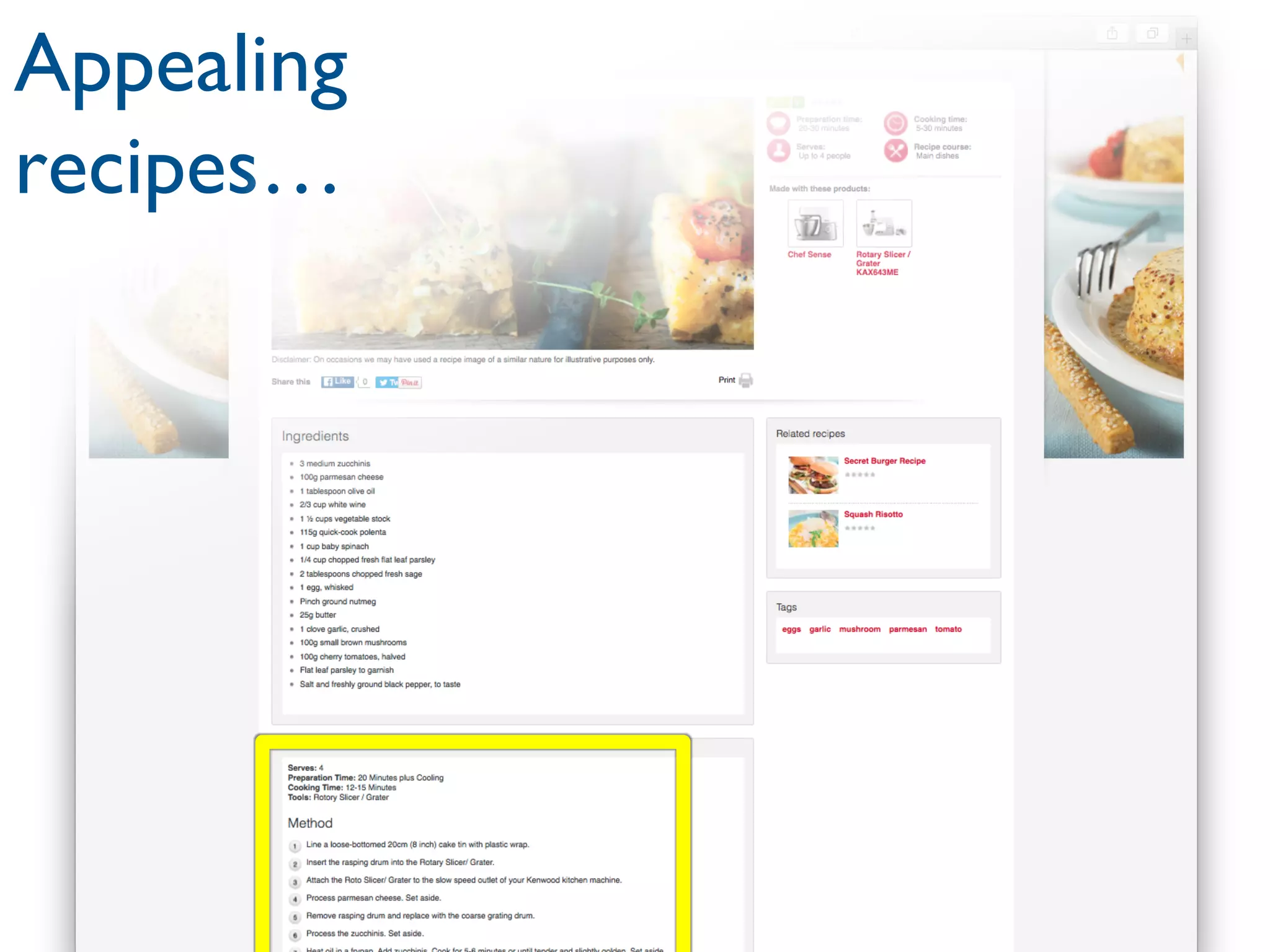
Appealing
recipes…
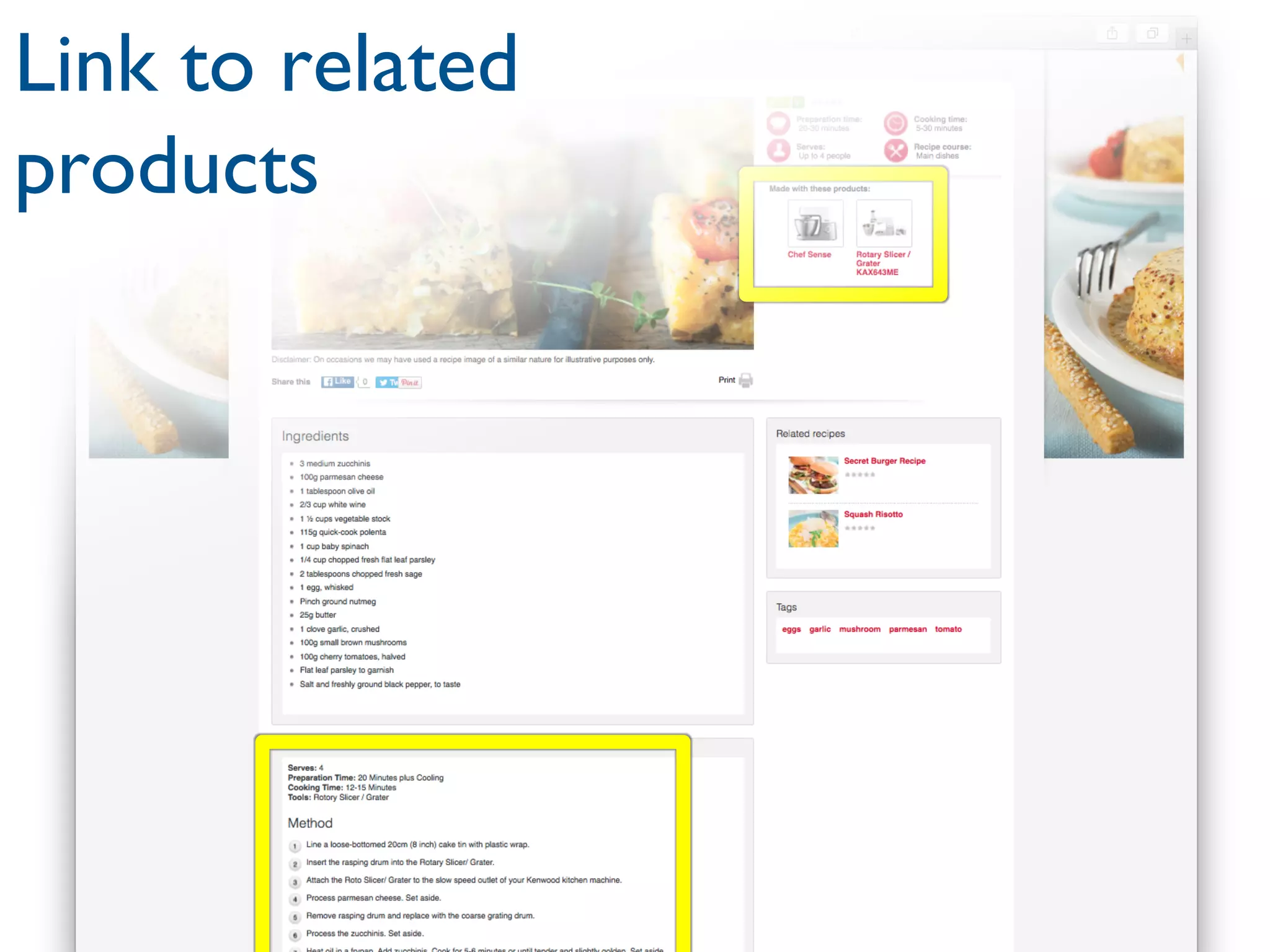
Link to related
products
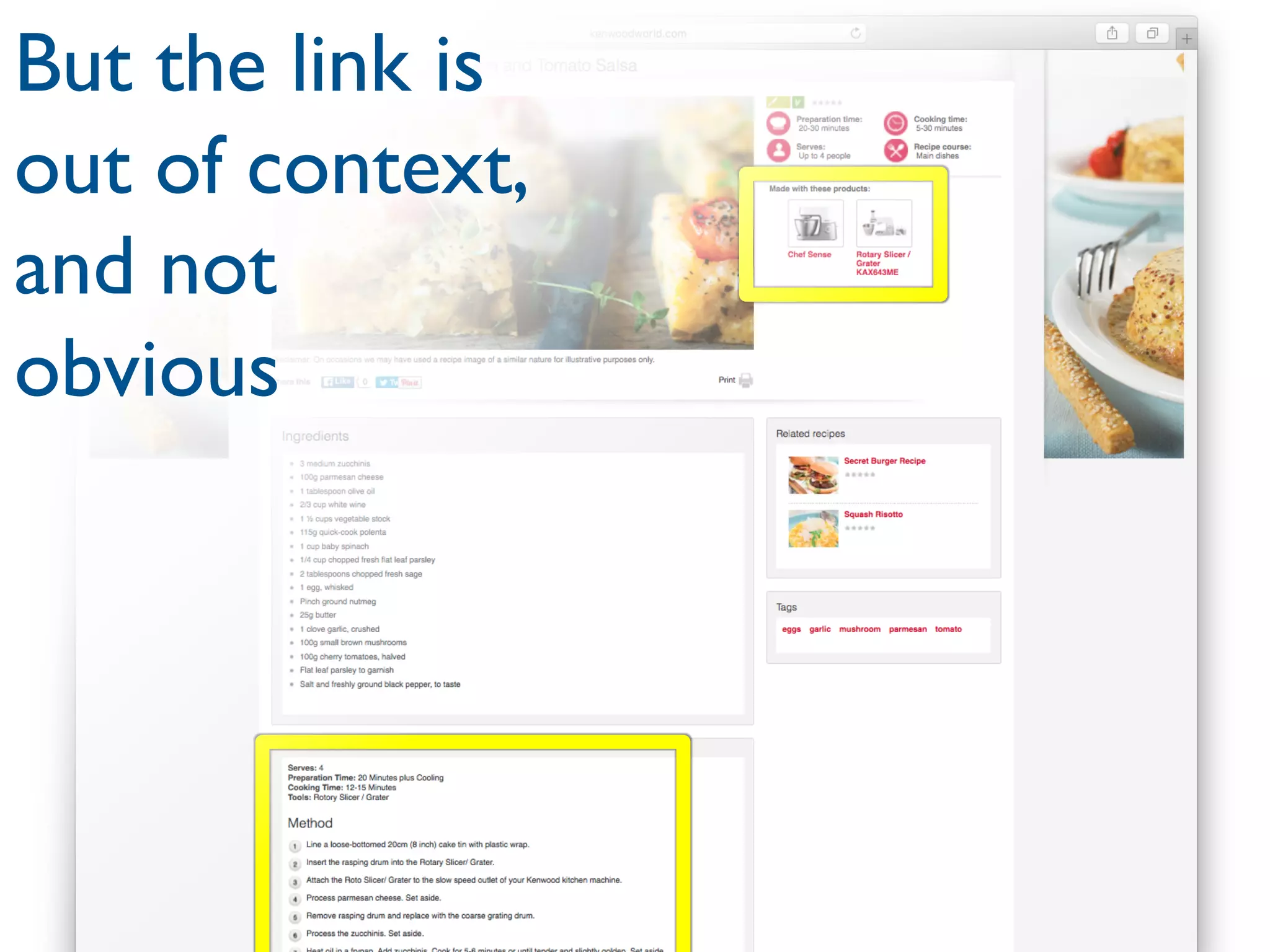
But the link is
out of context,
and not
obvious
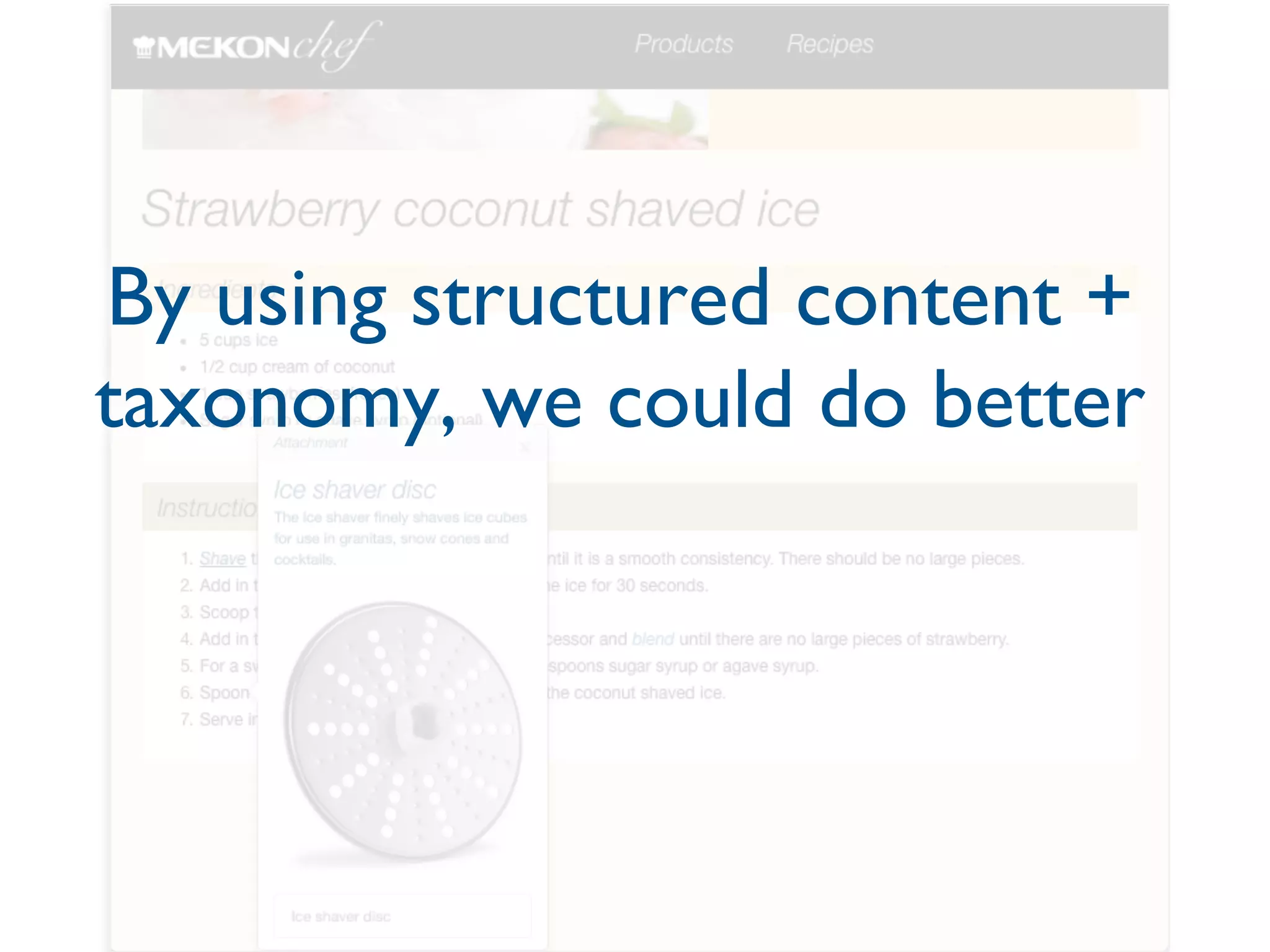
By using structured content +
taxonomy, we could do better
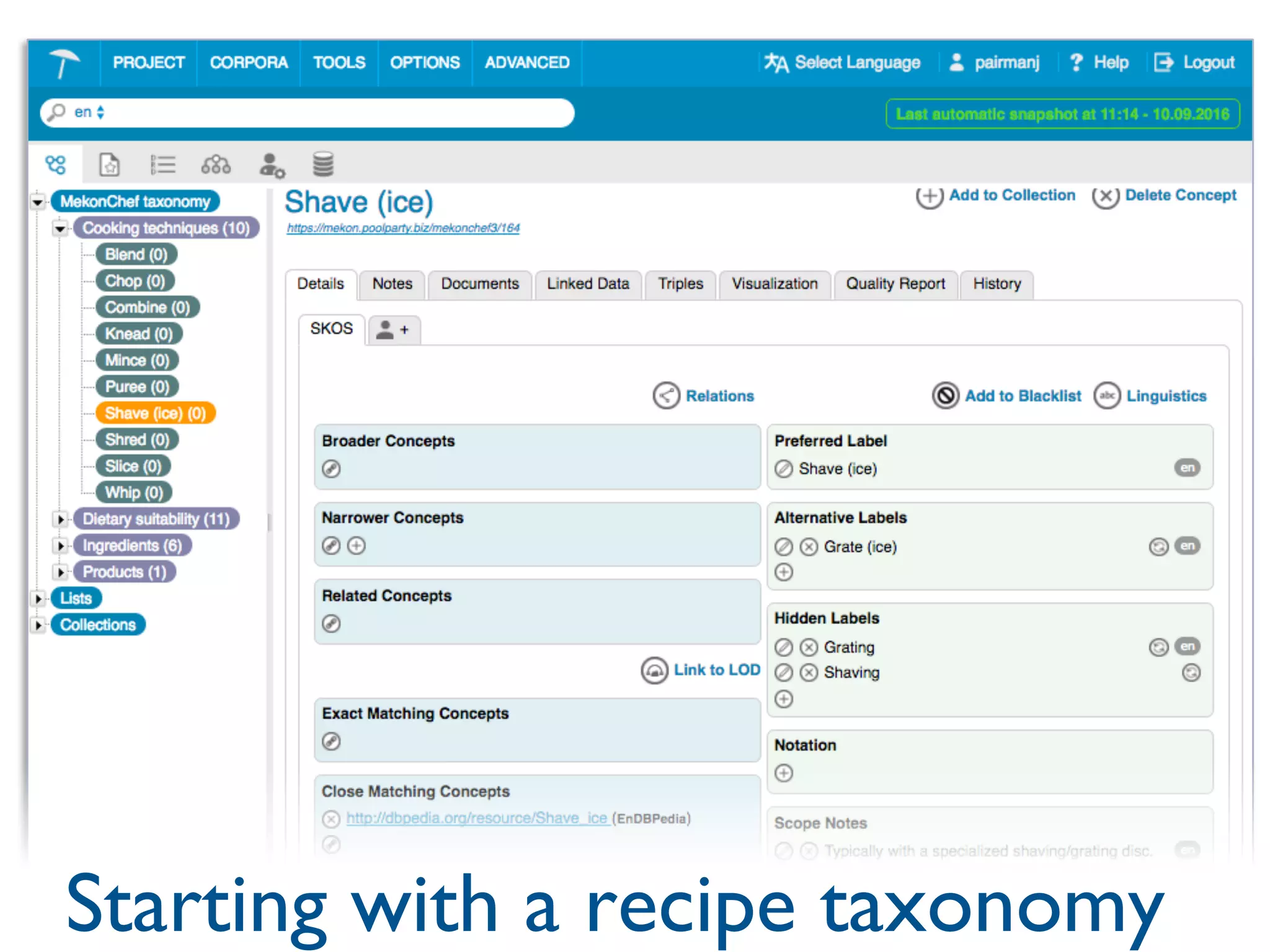
Starting with a recipe taxonomy
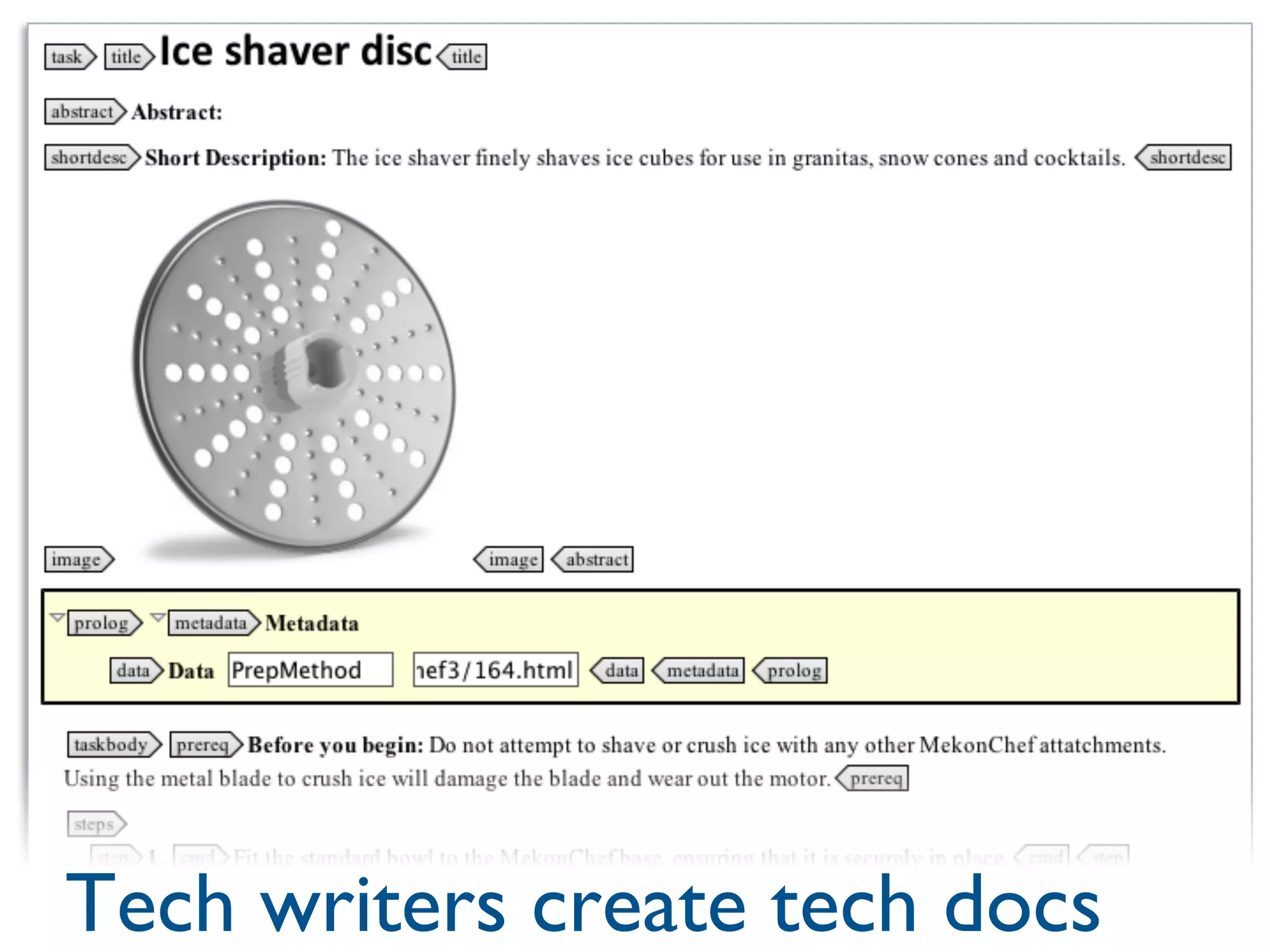
Tech writers create tech docs
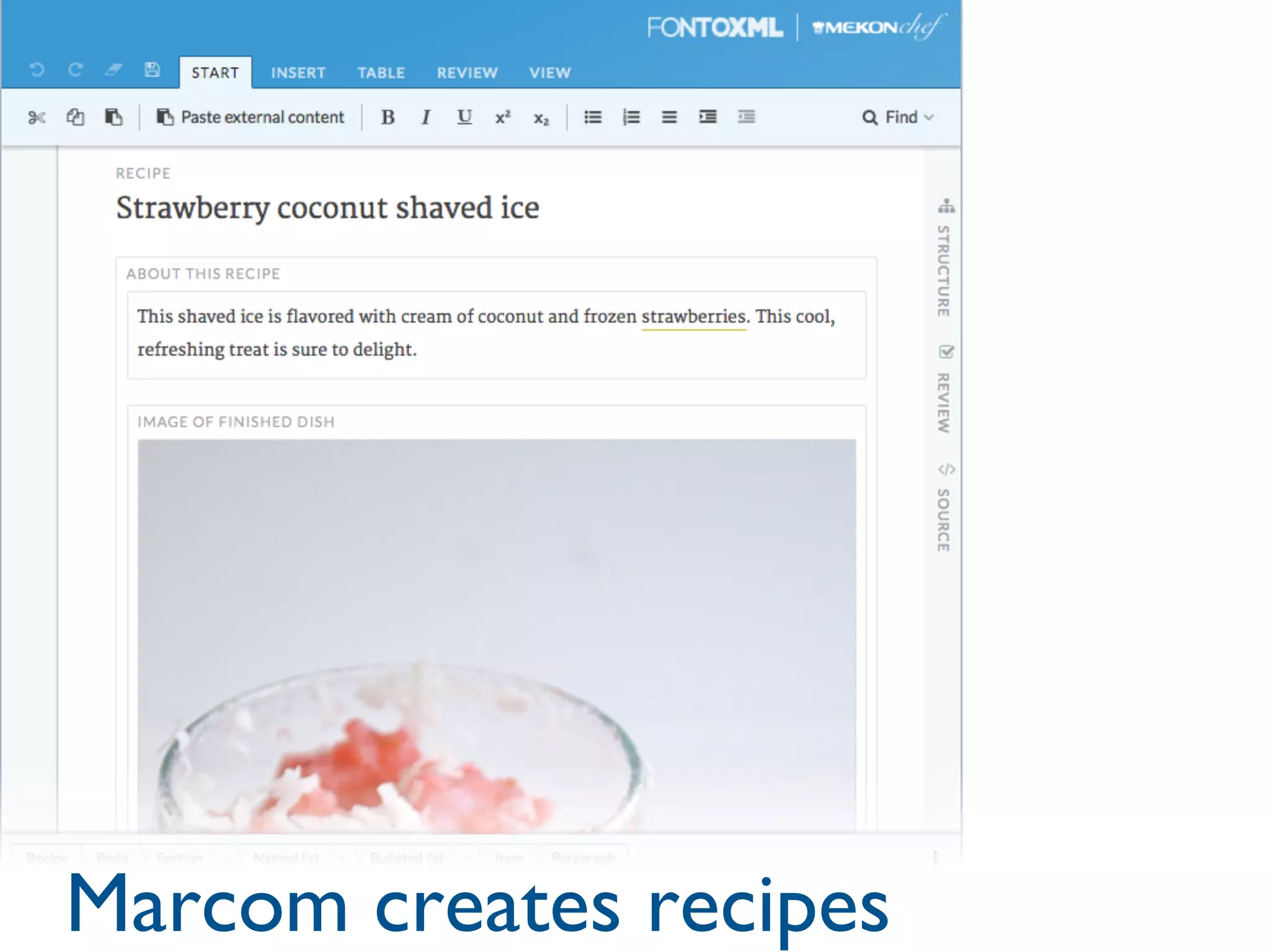
Marcom creates recipes
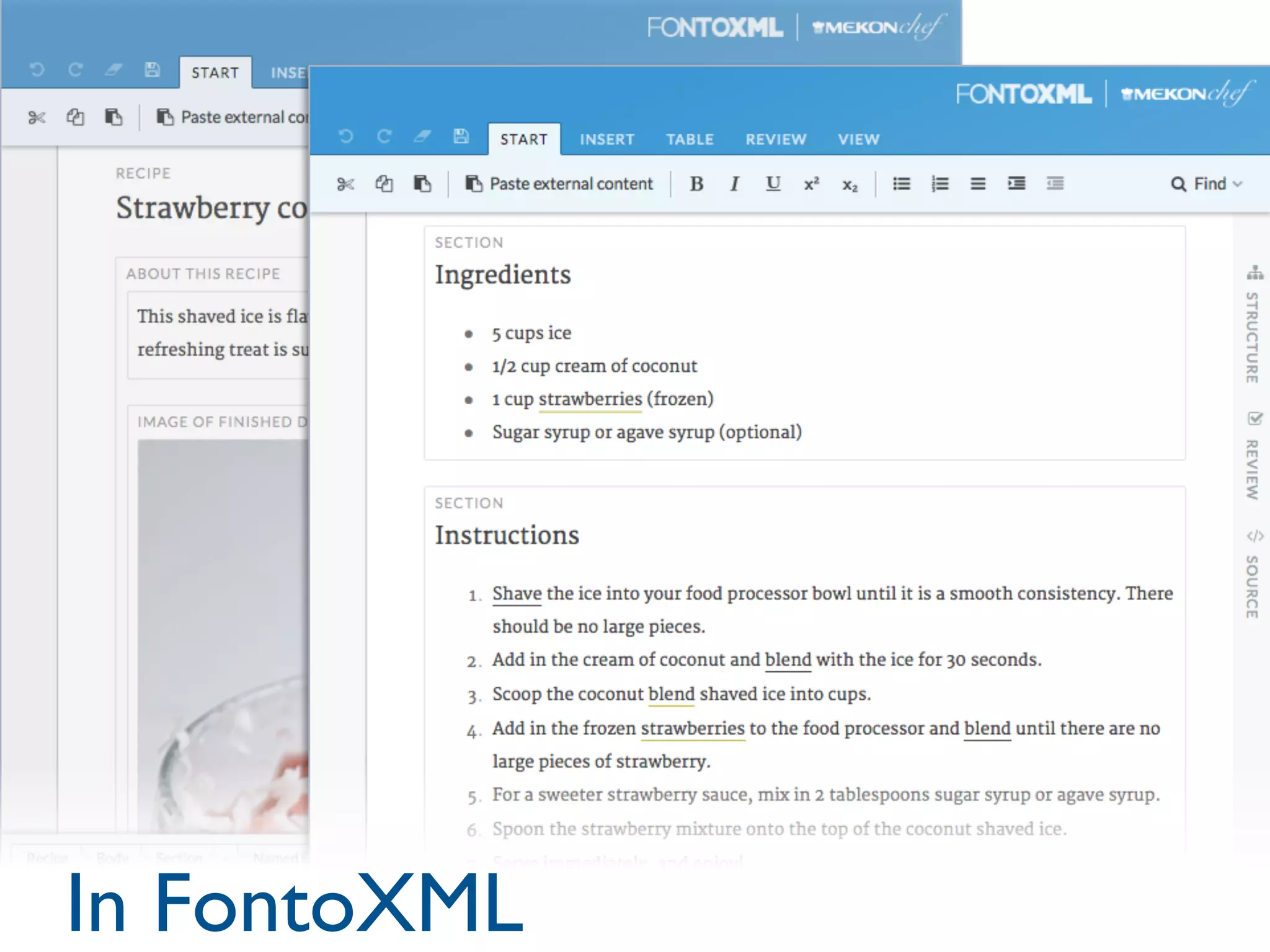
In FontoXML
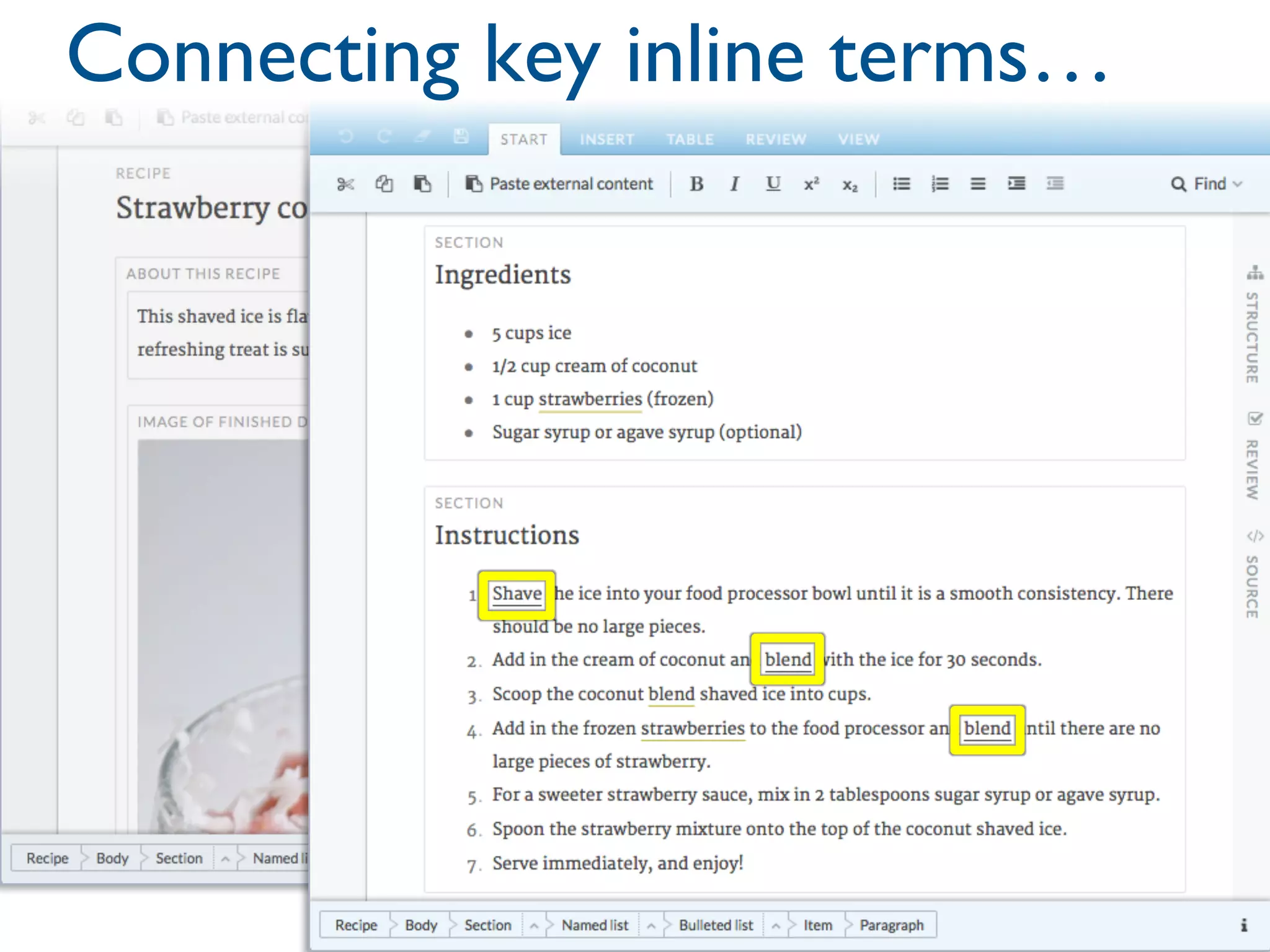
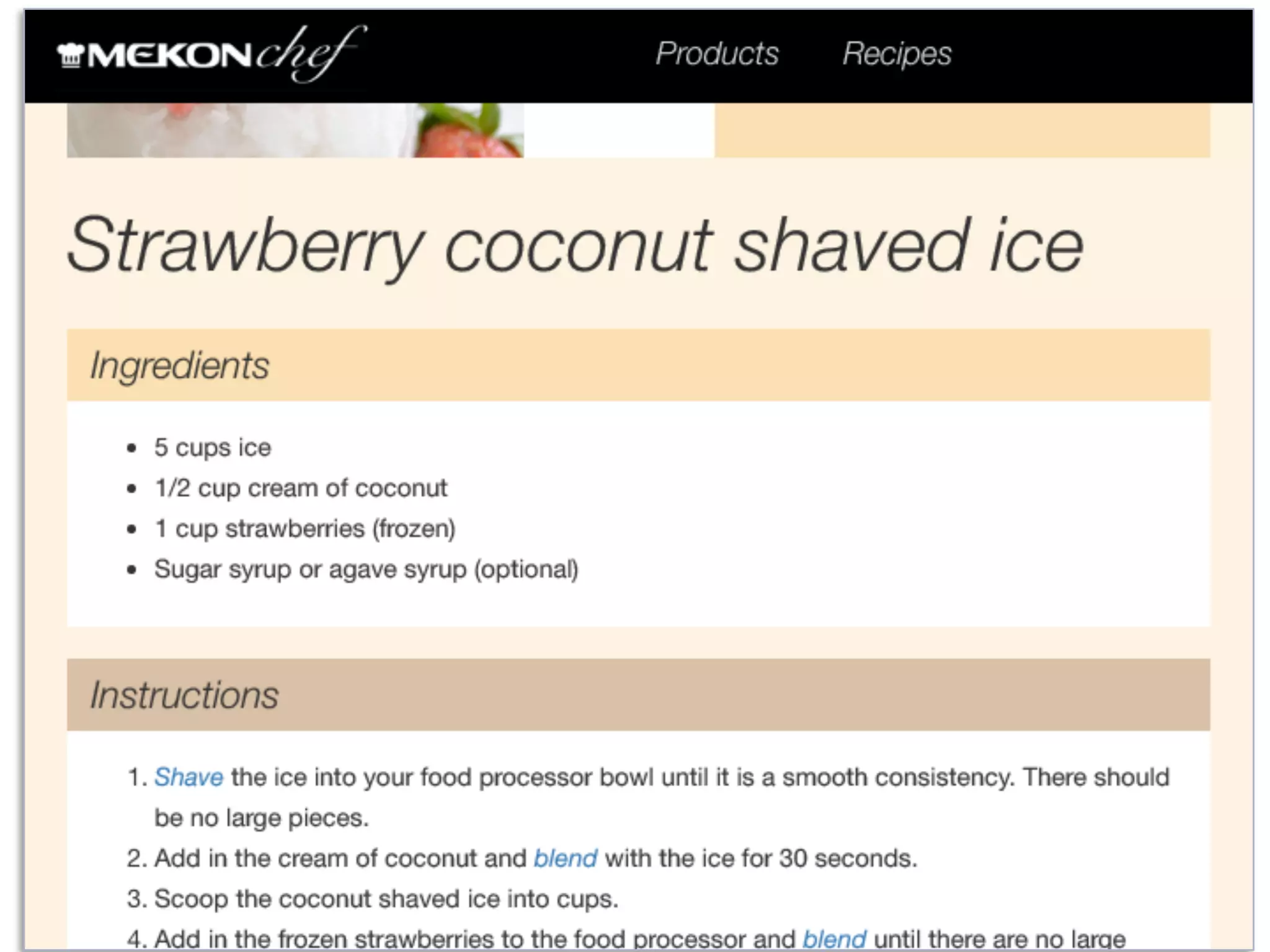
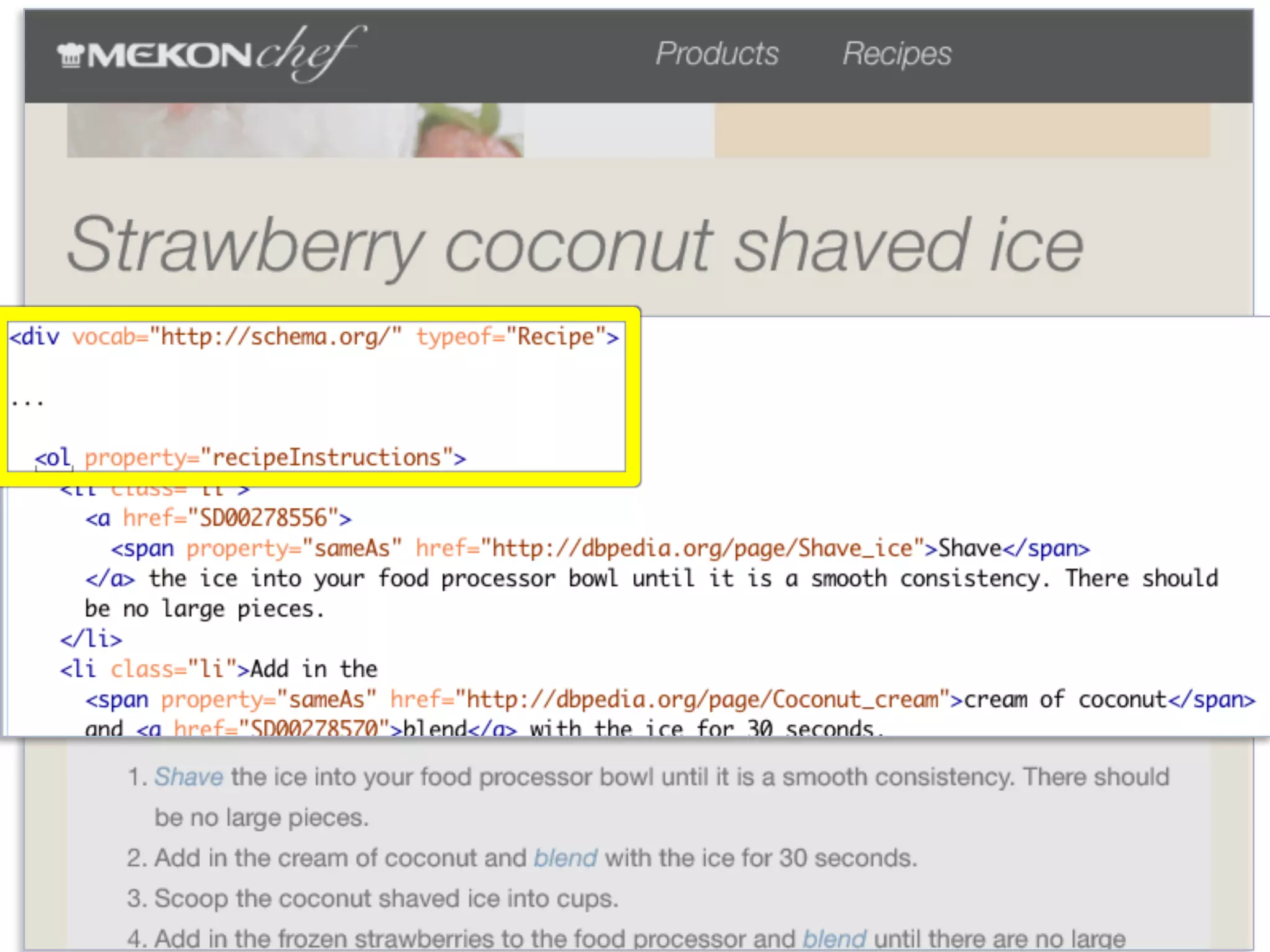
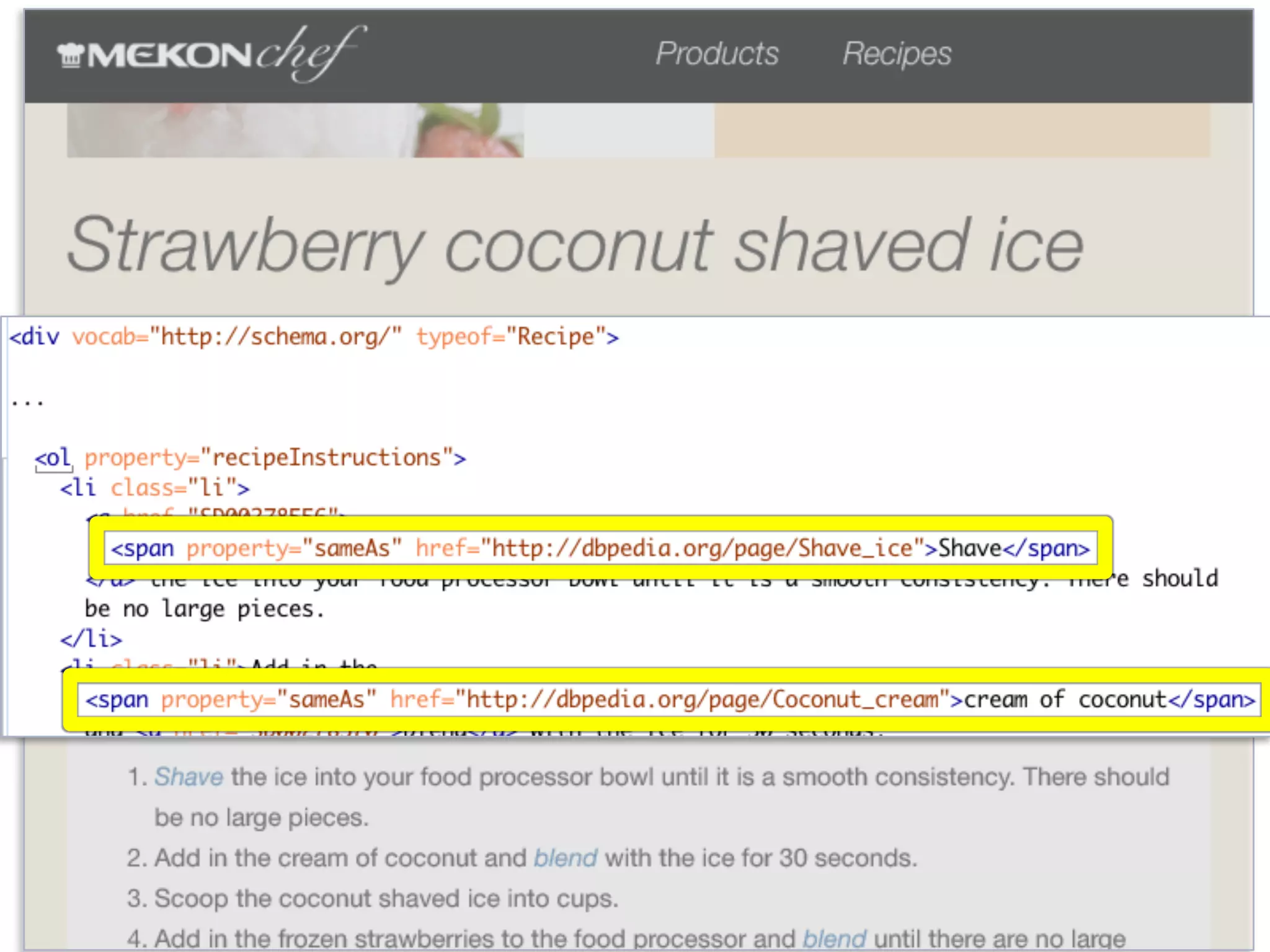
Connecting key inline terms…
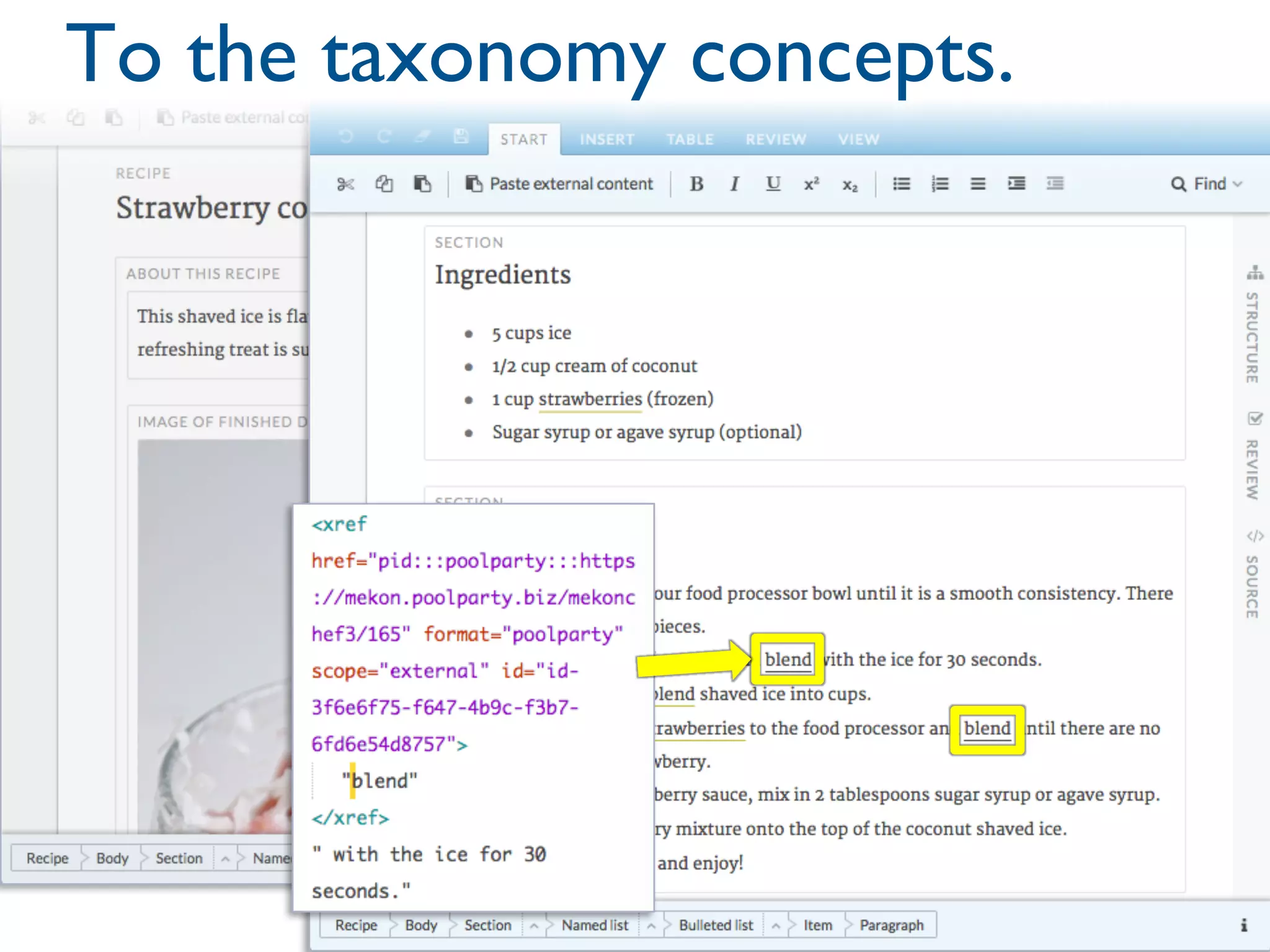
To the taxonomy concepts.
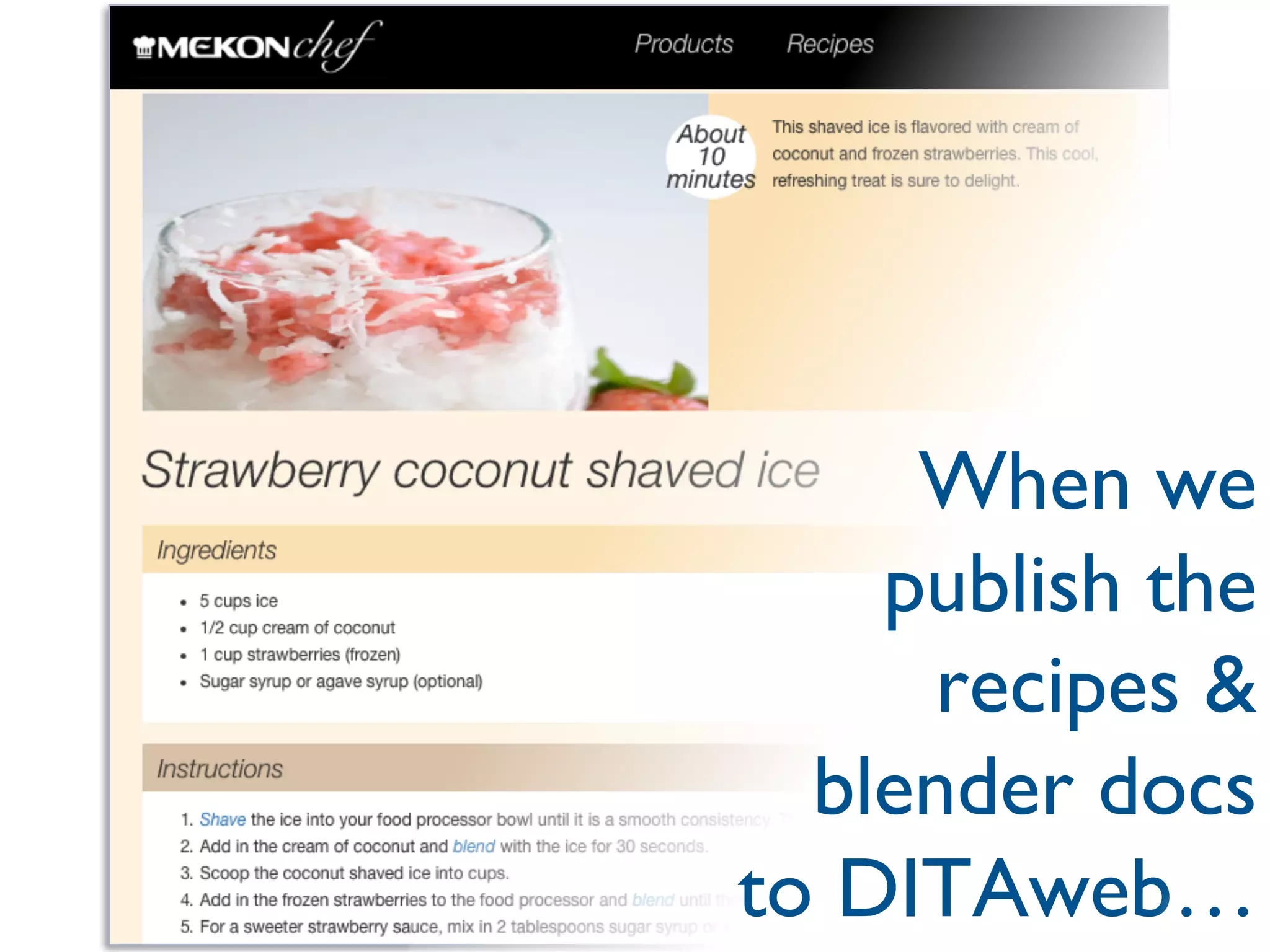
When we
publish the
recipes &
blender docs
to DITAweb…
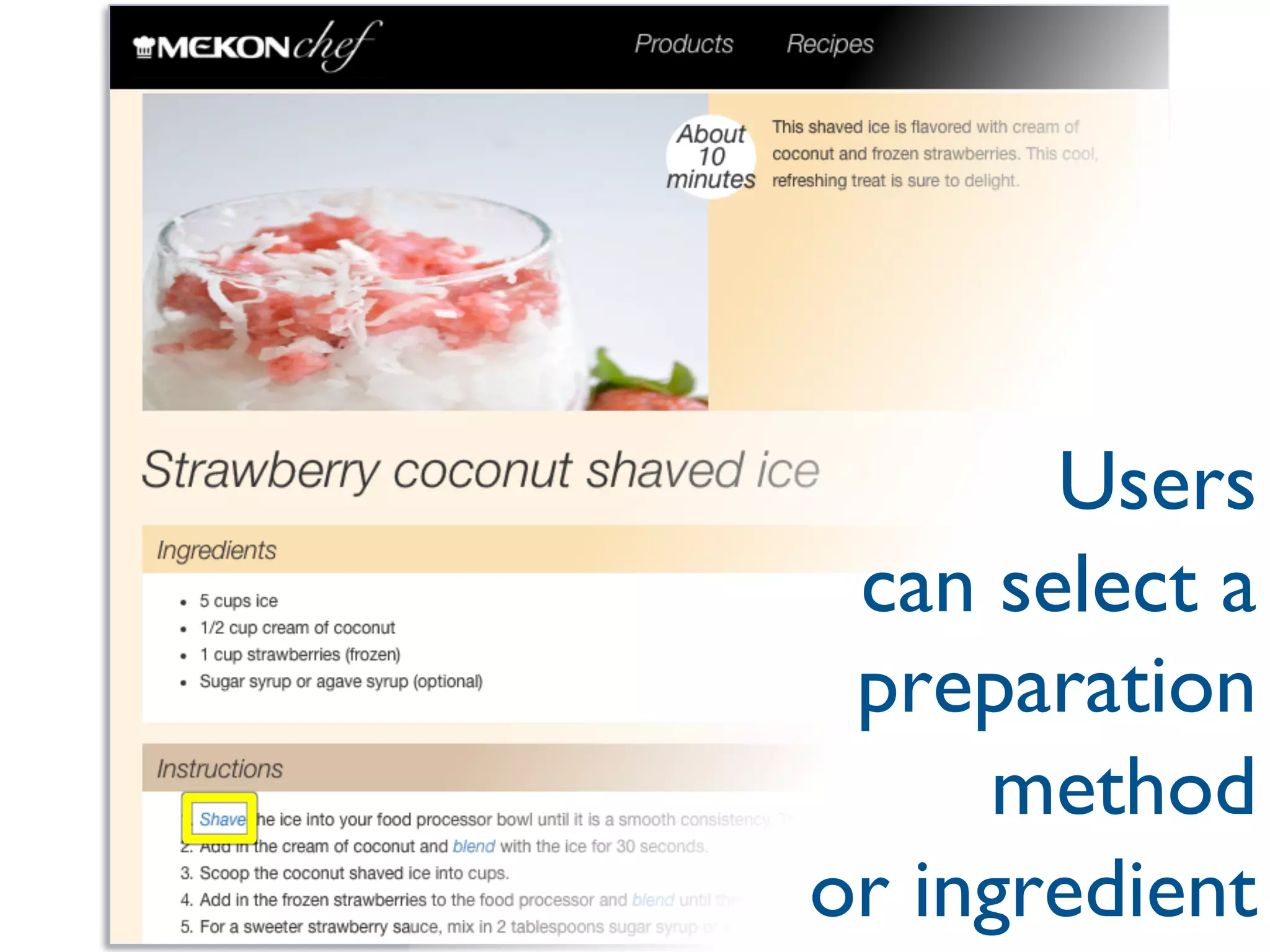
Users
can select a
preparation
method
or ingredient
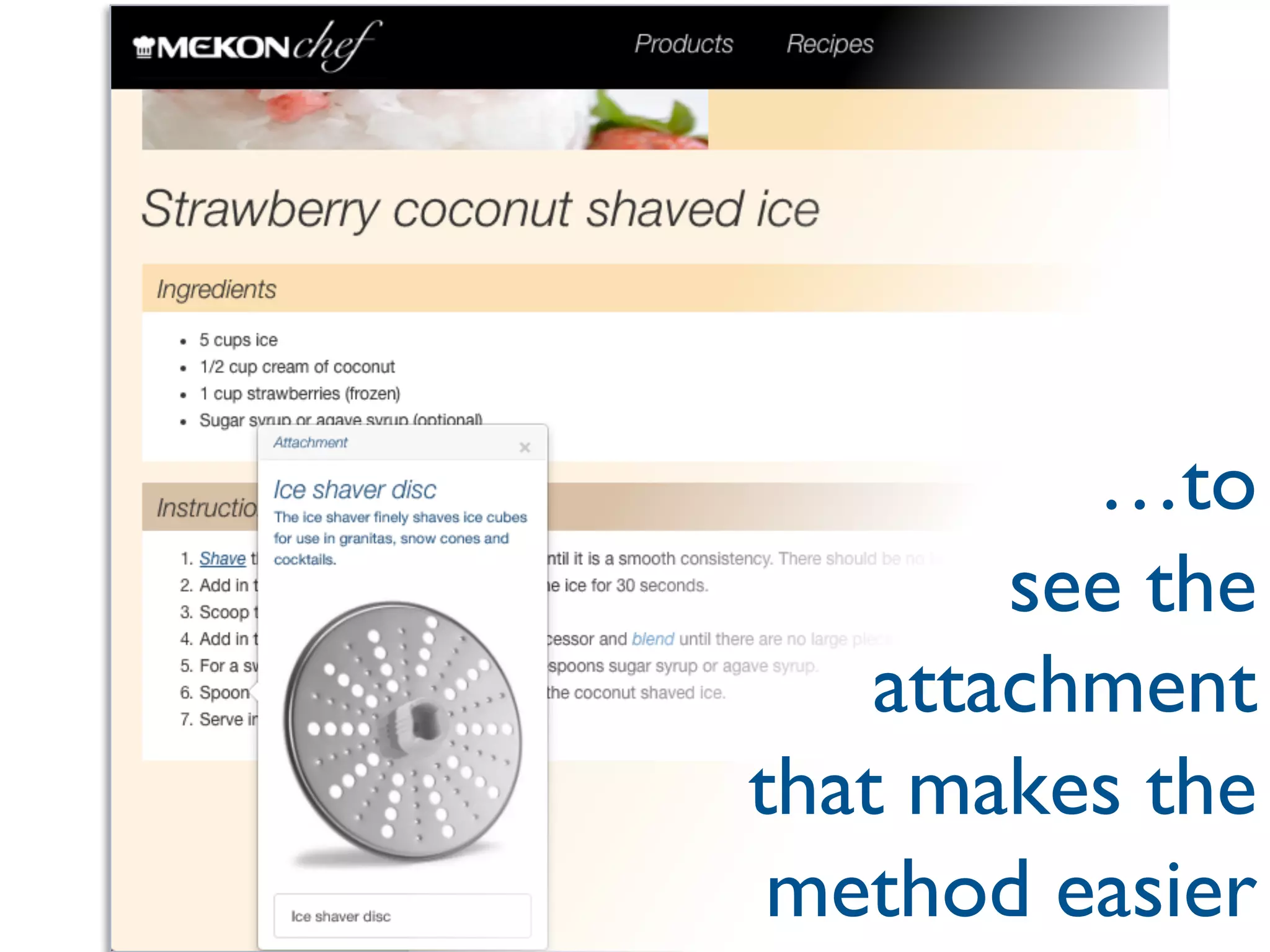
…to
see the
attachment
that makes the
method easier
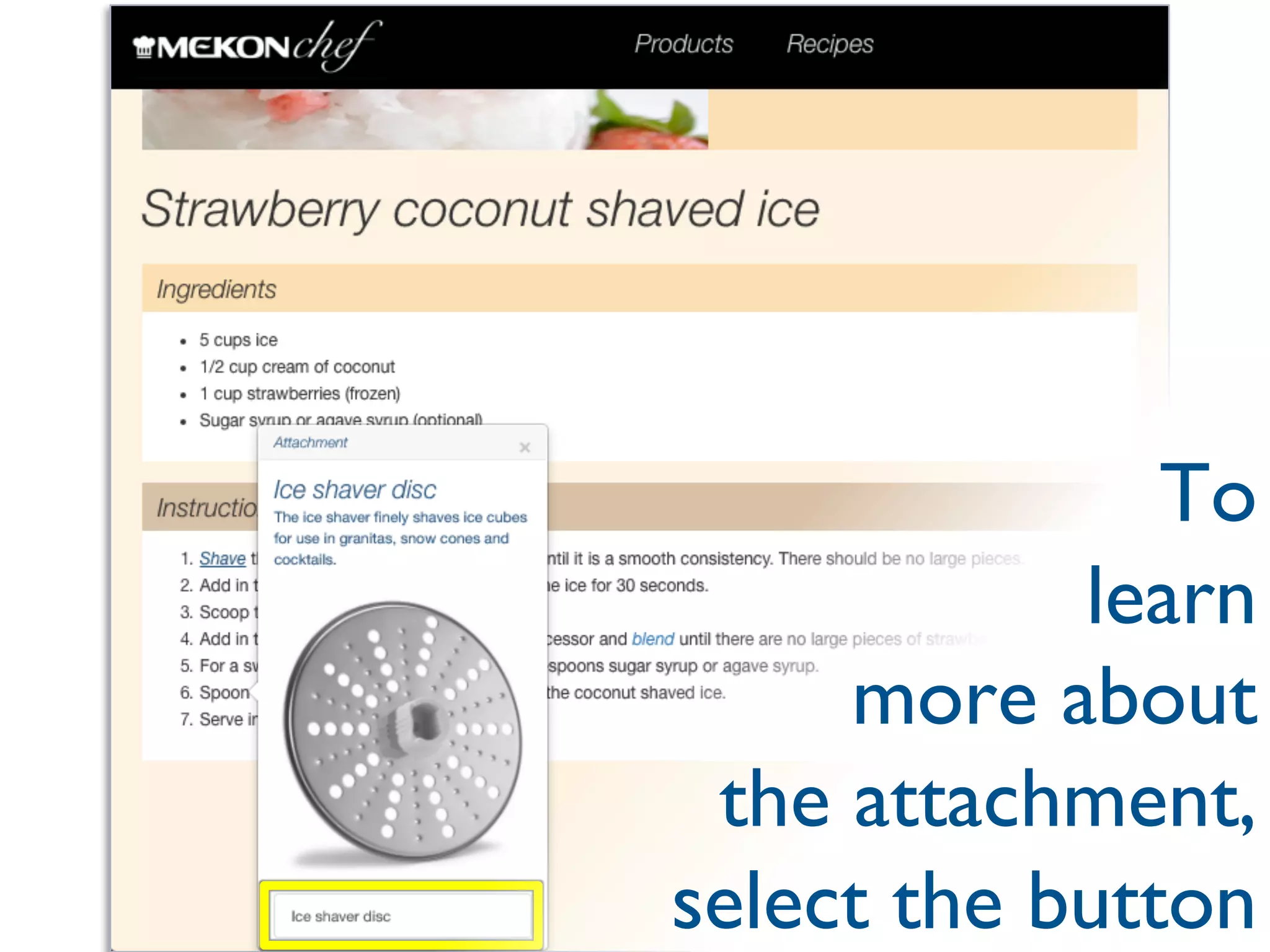
To
learn
more about
the attachment,
select the button
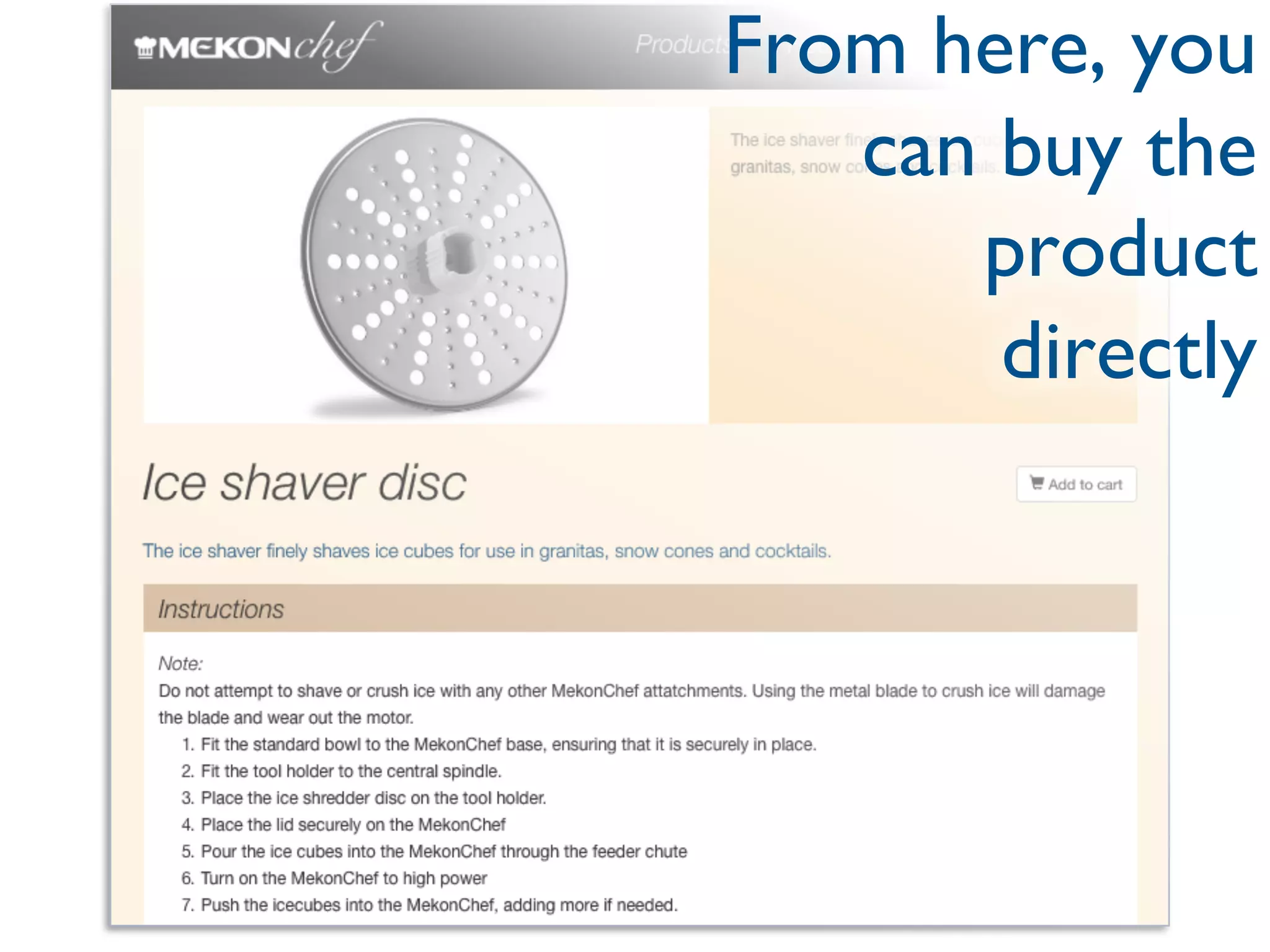
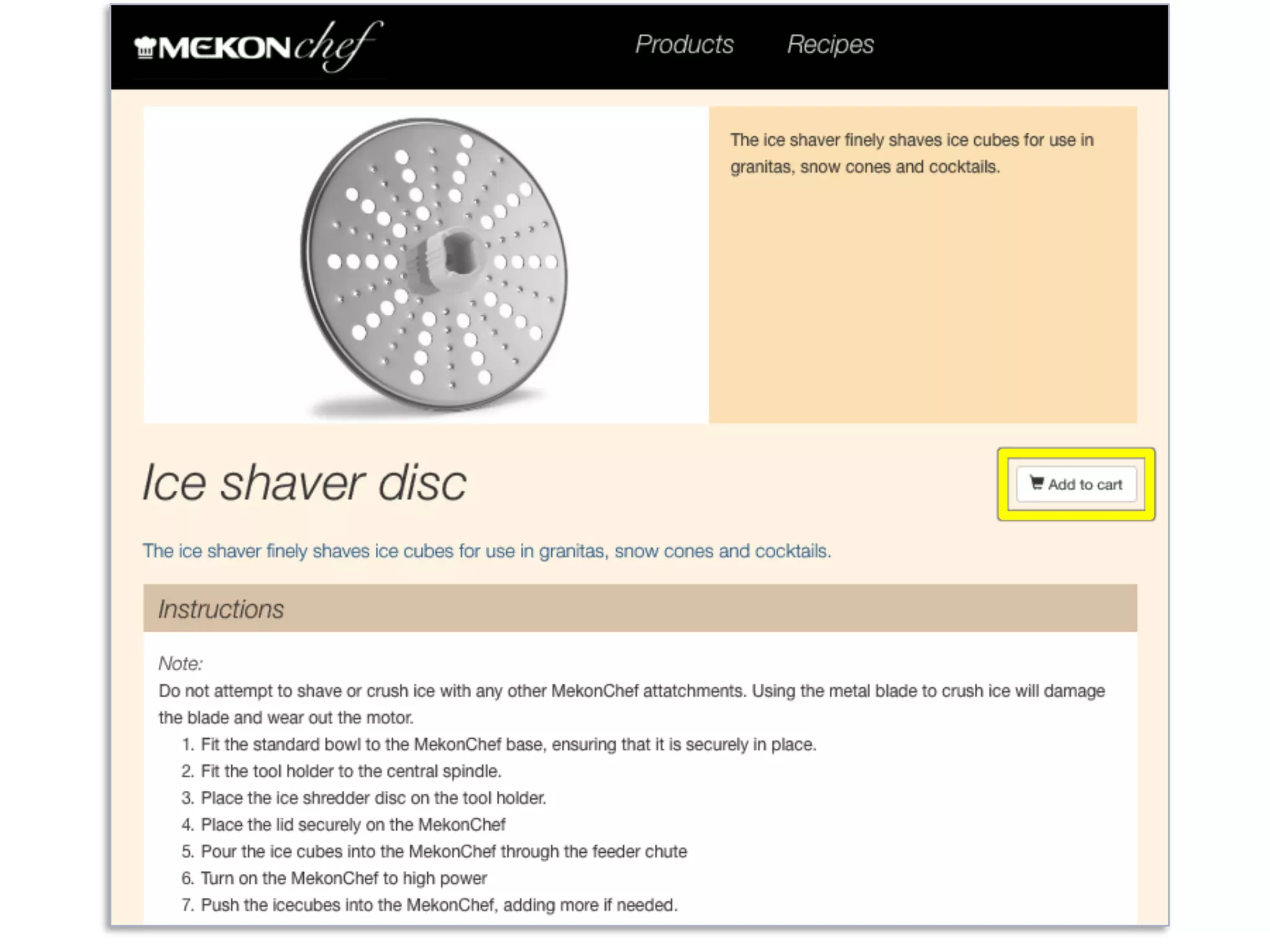
From here, you
can buy the
product
directly
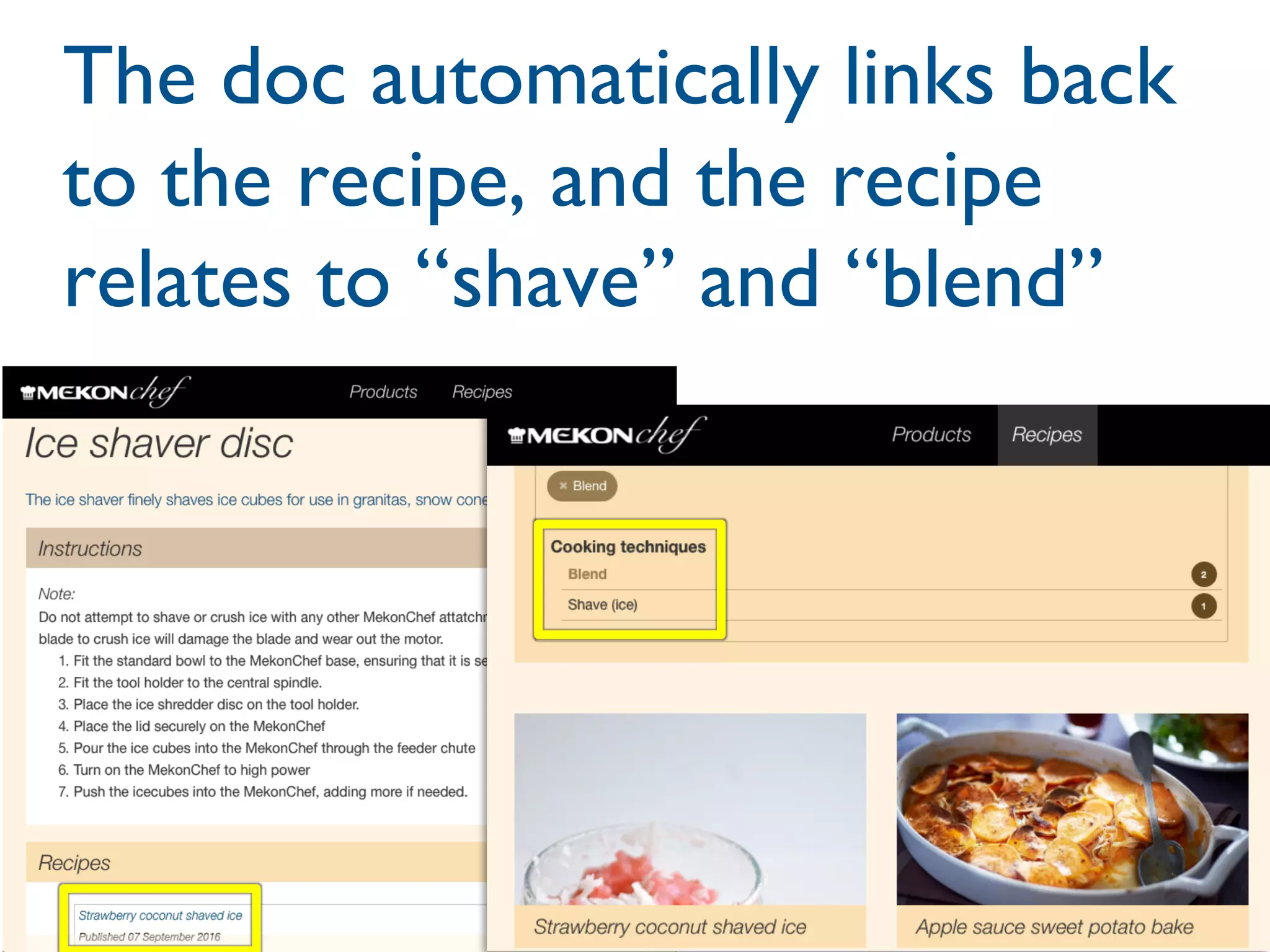
The doc automatically links back
to the recipe, and the recipe
relates to “shave” and “blend”
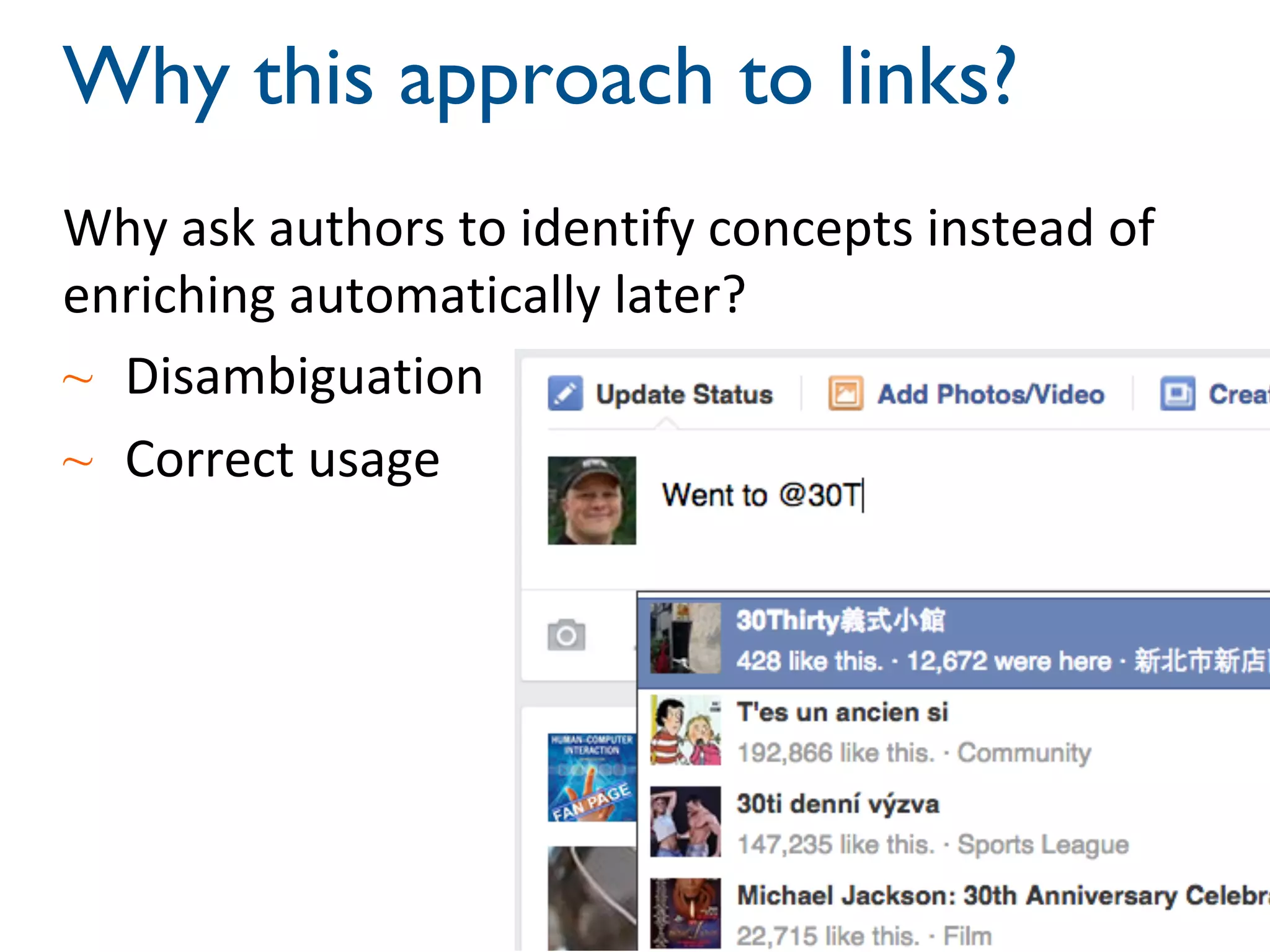
Why this approach to links?
Why	ask	authors	to	identify	concepts	instead	of	
enriching	automatically	later?
~ Disambiguation
~ Correct	usage
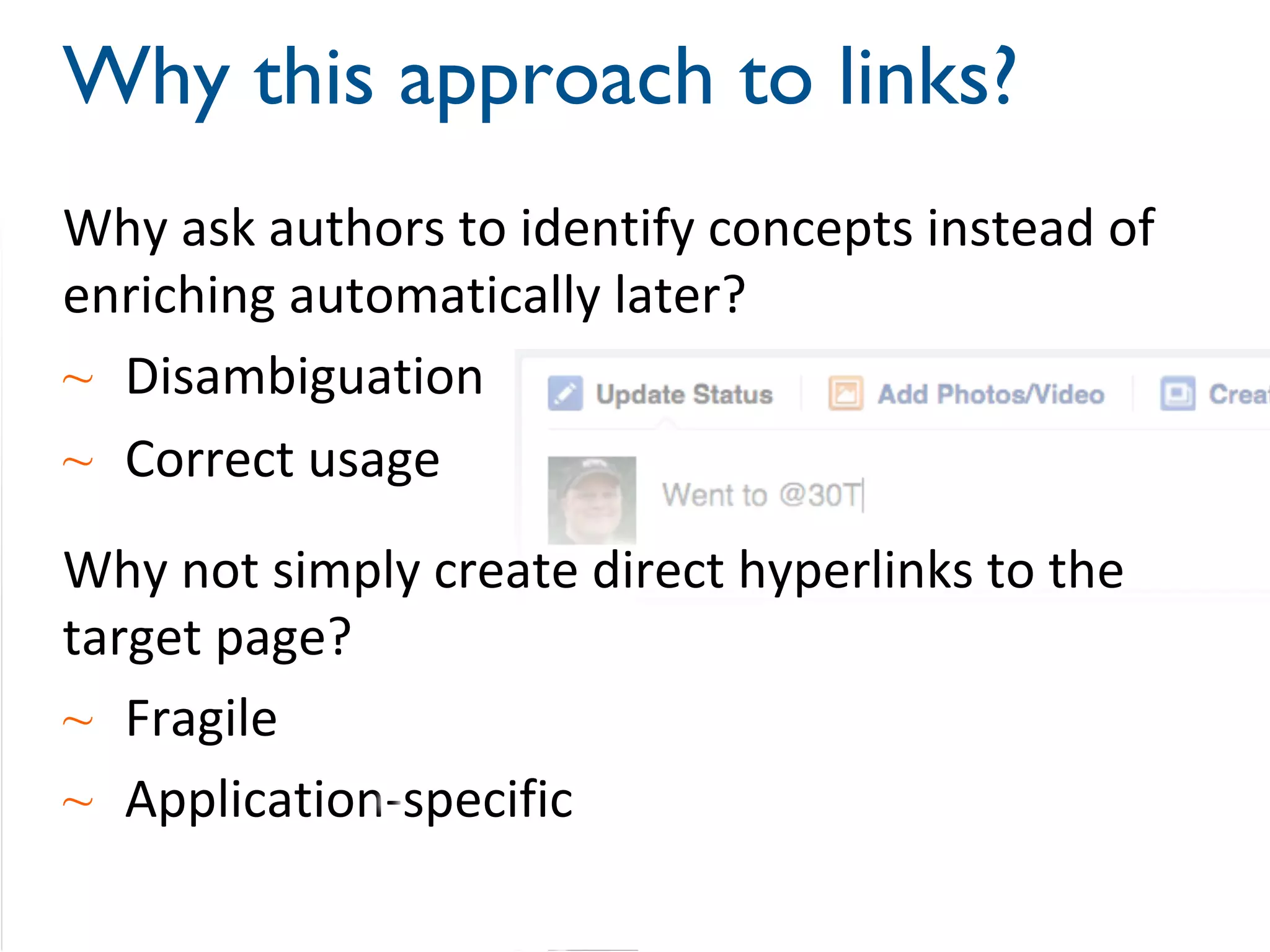
Why this approach to links?
Why	ask	authors	to	identify	concepts	instead	of	
enriching	automatically	later?
~ Disambiguation
~ Correct	usage
Why	not	simply	create	direct	hyperlinks	to	the	
target	page?
~ Fragile
~ Application-specific
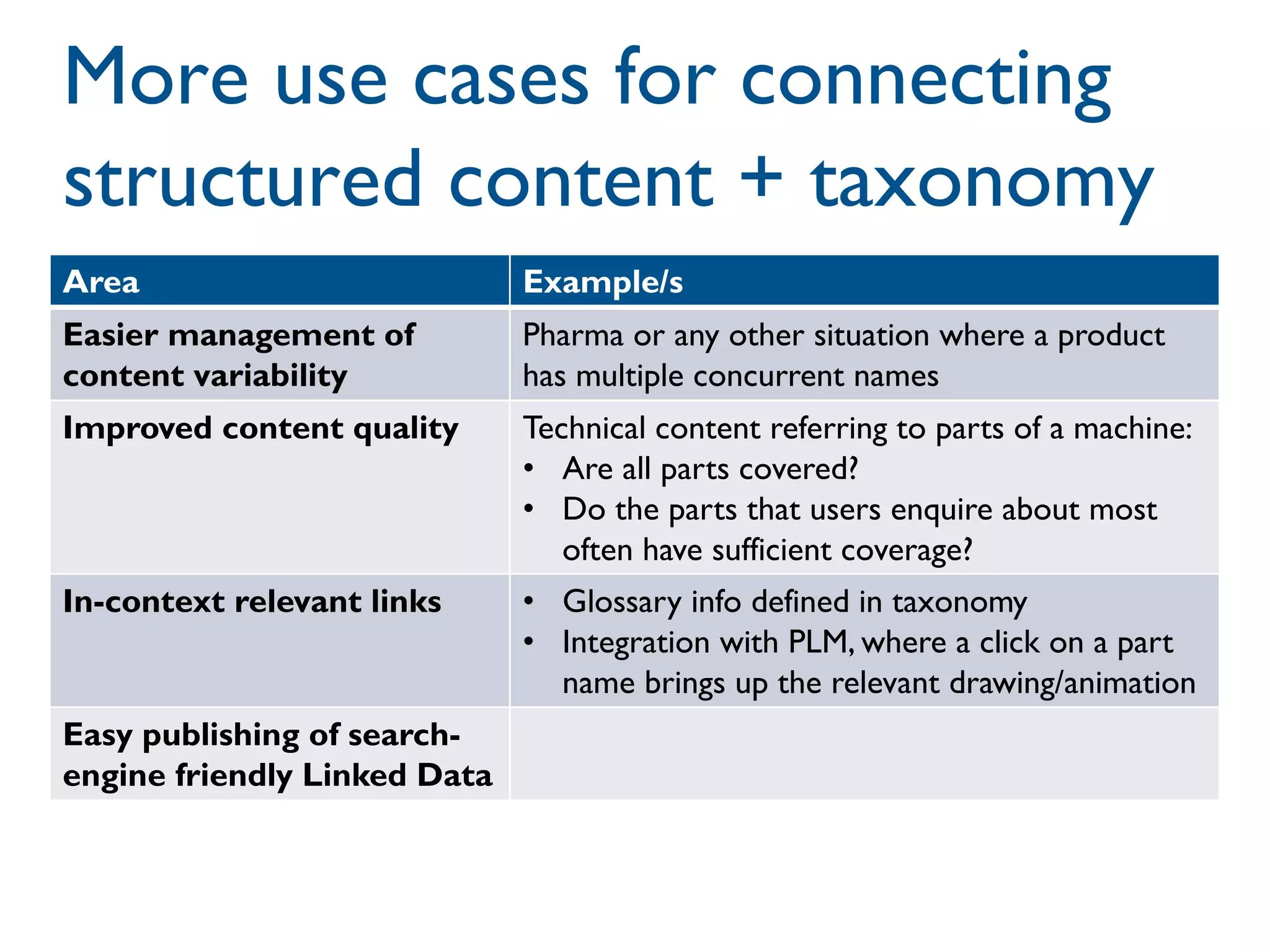
More use cases for connecting
structured content + taxonomy
Area Example/s
Easier management of
content variability
Pharma or any other situation where a product
has multiple concurrent names
Improved content quality Technical content referring to parts of a machine:
• Are all parts covered?
• Do the parts that users enquire about most
often have sufficient coverage?
In-context relevant links • Glossary info defined in taxonomy
• Integration with PLM, where a click on a part
name brings up the relevant drawing/animation
Easy publishing of search-
engine friendly Linked Data
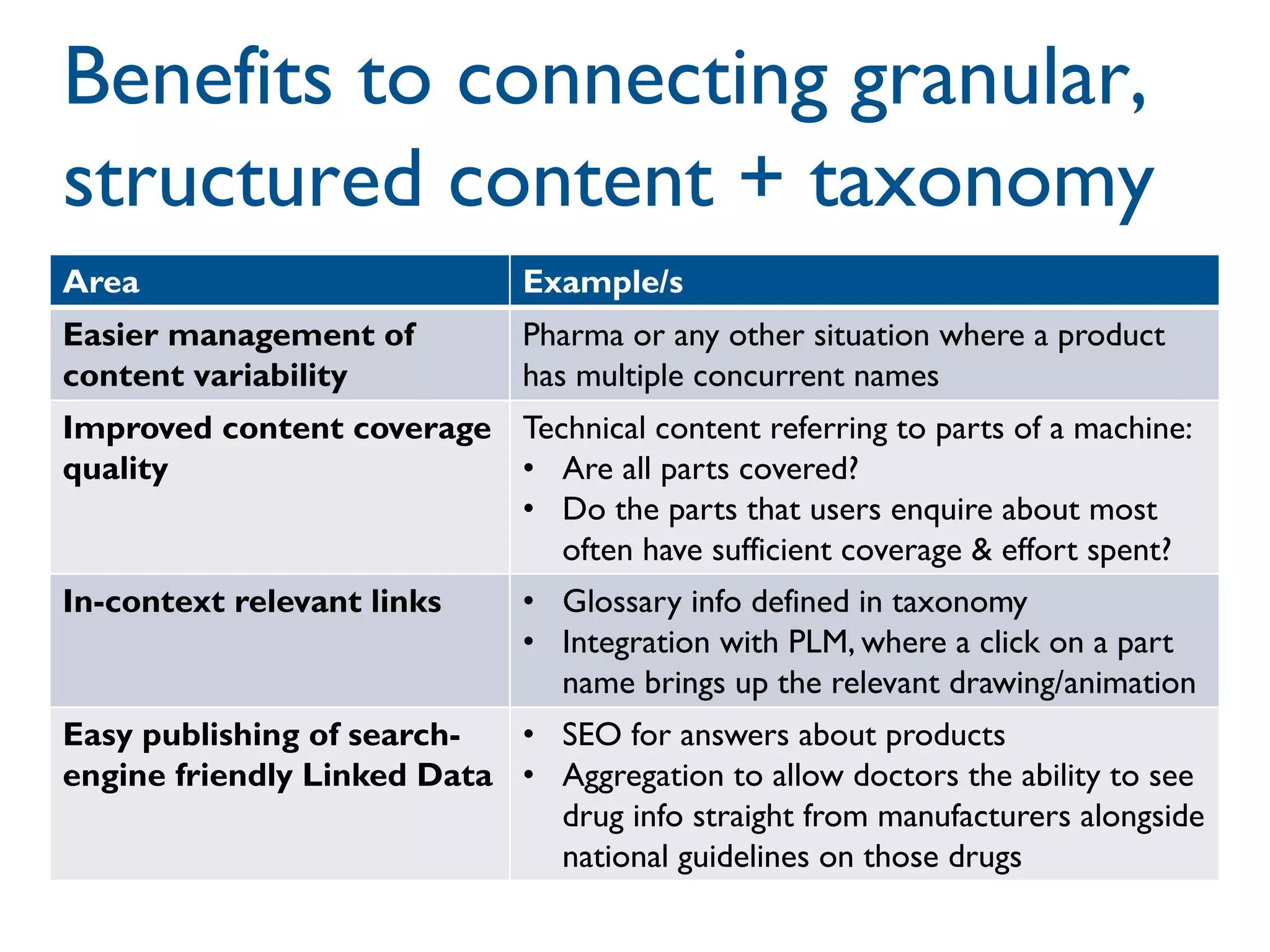
Benefits to connecting granular,
structured content + taxonomy
Area Example/s
Easier management of
content variability
Pharma or any other situation where a product
has multiple concurrent names
Improved content coverage
quality
Technical content referring to parts of a machine:
• Are all parts covered?
• Do the parts that users enquire about most
often have sufficient coverage & effort spent?
In-context relevant links • Glossary info defined in taxonomy
• Integration with PLM, where a click on a part
name brings up the relevant drawing/animation
Easy publishing of search-
engine friendly Linked Data
• SEO for answers about products
• Aggregation to allow doctors the ability to see
drug info straight from manufacturers alongside
national guidelines on those drugs
Thoughts? Questions?
Need a demo?
Get in touch:
~ joe.pairman@mekon.com
~ @joepairman on Twitter

Joe Pairman | Multiplying the Power of Taxonomy with Granular, Structured Content

  • 1.
    Multiplying the Power ofTaxonomy with Granular, Structured Content <div property="author"> <span property="sameAs" href="https://twitter.com/joepairman"> Joe Pairman </span> </div> <author keyref=”JoePairman"/>
  • 2.
  • 3.
    …the objects thattaxonomies label are often less granular (pages, sections, and documents)
  • 4.
    Benefits of applyingtaxonomy to granular, structured content ~ Easier management of content variability ~ Improved content coverage & quality ~ In-context relevant links (improved UX) ~ Easy publishing of search-engine friendly Linked Data
  • 5.
    How I cutmy teeth in structured content…
  • 6.
    …in HTC’s UserEducation team
  • 7.
  • 8.
    ”Show Me” appon phone Support content on desktop PDF user guide We needed multichannel output
  • 9.
    PDF Enriched XTHML for mobileapp author interface CCMS topics build maps text and media Publishing engine: based on DITA Open Toolkit DITA XML • re-use/re-assembly • cascade changes Enriched XTHML for corporate site & internal KB Component content management — multichannel publishing
  • 10.
    Many product variationsto document, for different models…
  • 11.
  • 12.
  • 13.
    PDF Enriched XTHML for mobileapp author interface CCMS topics build maps text and media Publishing engine: based on DITA Open Toolkit DITA XML • re-use/re-assembly • cascade changes Enriched XTHML for corporate site & internal KB Component content management — managing variability
  • 14.
    In-topic variation handledwith a combination of techniques
  • 15.
    Standard tech commapproaches encourage ad-hoc, local practices XML tech content tends to separate: ~ Profiling condition values ~ Variable IDs & values ~ Metadata terms stored in the XML ~ CMS-level metadata Markup often describes what should happen to the content, not what it signifies!
  • 17.
    “There are notools that pay attention to this sort of stuff today, and until there is a strong driver to do markup in this way, it won’t become popular”
  • 18.
  • 19.
    My work onXML consulting/integration/dev. — incl. taxonomy dev & application to structured content at the section level Partners, providing dynamic web delivery for DITA XML — incl. linking key terms to glossaries & related content intuitive, reliable XML authoring tool — now, easy inline term tagging too, powered by PoolParty concept extraction API Partners: I started playing with their concept extraction tech & then moved into the other features — clients are integrating structured content tech & other systems
  • 20.
    Next: Mekon’s demo to illustratethe power of structured content / semantic tech combined
  • 21.
  • 23.
  • 24.
  • 25.
    But the linkis out of context, and not obvious
  • 26.
    By using structuredcontent + taxonomy, we could do better
  • 27.
    Starting with arecipe taxonomy
  • 28.
  • 29.
  • 30.
  • 31.
  • 32.
    To the taxonomyconcepts.
  • 33.
    When we publish the recipes& blender docs to DITAweb…
  • 34.
  • 35.
  • 36.
  • 37.
    From here, you canbuy the product directly
  • 39.
    The doc automaticallylinks back to the recipe, and the recipe relates to “shave” and “blend”
  • 40.
    Why this approachto links? Why ask authors to identify concepts instead of enriching automatically later? ~ Disambiguation ~ Correct usage
  • 41.
    Why this approachto links? Why ask authors to identify concepts instead of enriching automatically later? ~ Disambiguation ~ Correct usage Why not simply create direct hyperlinks to the target page? ~ Fragile ~ Application-specific
  • 42.
    More use casesfor connecting structured content + taxonomy Area Example/s Easier management of content variability Pharma or any other situation where a product has multiple concurrent names Improved content quality Technical content referring to parts of a machine: • Are all parts covered? • Do the parts that users enquire about most often have sufficient coverage? In-context relevant links • Glossary info defined in taxonomy • Integration with PLM, where a click on a part name brings up the relevant drawing/animation Easy publishing of search- engine friendly Linked Data
  • 46.
    Benefits to connectinggranular, structured content + taxonomy Area Example/s Easier management of content variability Pharma or any other situation where a product has multiple concurrent names Improved content coverage quality Technical content referring to parts of a machine: • Are all parts covered? • Do the parts that users enquire about most often have sufficient coverage & effort spent? In-context relevant links • Glossary info defined in taxonomy • Integration with PLM, where a click on a part name brings up the relevant drawing/animation Easy publishing of search- engine friendly Linked Data • SEO for answers about products • Aggregation to allow doctors the ability to see drug info straight from manufacturers alongside national guidelines on those drugs
  • 47.
    Thoughts? Questions? Need ademo? Get in touch: ~ joe.pairman@mekon.com ~ @joepairman on Twitter