Job Less Growth in India after
Liberalization
Suryakant
Ashwani Vohra
Sachin Gupta
Amit Pal
Contents
 Introduction
 Job growth scenario from 1956 to 2012
 Reasons of Jobless Growth
 Proposed Solution
2
What is Jobless Growth ?
A jobless recovery or jobless growth is an economic
phenomenon in which a macroeconomic
experiences growth while maintaining or decreasing
its level of employment. The first documented use
of the term was in the New York Times in 1935
3
Is Job Less Growth Exist in India ?
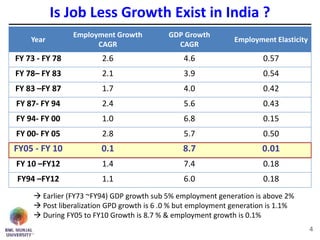
 Earlier (FY73 ~FY94) GDP growth sub 5% employment generation is above 2%
 Post liberalization GPD growth is 6 .0 % but employment generation is 1.1%
 During FY05 to FY10 Growth is 8.7 % & employment growth is 0.1%
4
Year
Employment Growth
CAGR
GDP Growth
CAGR
Employment Elasticity
FY 73 - FY 78 2.6 4.6 0.57
FY 78– FY 83 2.1 3.9 0.54
FY 83 –FY 87 1.7 4.0 0.42
FY 87- FY 94 2.4 5.6 0.43
FY 94- FY 00 1.0 6.8 0.15
FY 00- FY 05 2.8 5.7 0.50
FY05 - FY 10 0.1 8.7 0.01
FY 10 –FY12 1.4 7.4 0.18
FY94 –FY12 1.1 6.0 0.18
Contents
 Introduction
 Job growth scenario from 1956 to 2012
 Reasons of Jobless Growth
 Proposed Solution
5
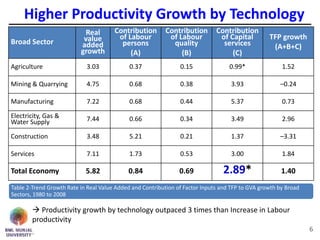
Higher Productivity Growth by Technology
 Productivity growth by technology outpaced 3 times than Increase in Labour
productivity
6
Broad Sector
Real
value
added
growth
Contribution
of Labour
persons
(A)
Contribution
of Labour
quality
(B)
Contribution
of Capital
services
(C)
TFP growth
(A+B+C)
Agriculture 3.03 0.37 0.15 0.99* 1.52
Mining & Quarrying 4.75 0.68 0.38 3.93 –0.24
Manufacturing 7.22 0.68 0.44 5.37 0.73
Electricity, Gas &
Water Supply 7.44 0.66 0.34 3.49 2.96
Construction 3.48 5.21 0.21 1.37 –3.31
Services 7.11 1.73 0.53 3.00 1.84
Total Economy 5.82 0.84 0.69 2.89* 1.40
Table 2-Trend Growth Rate in Real Value Added and Contribution of Factor Inputs and TFP to GVA growth by Broad
Sectors, 1980 to 2008
Contents
 Introduction
 Job growth scenario from 1956 to 2012
 Reasons of Jobless Growth
 Proposed Solution
7
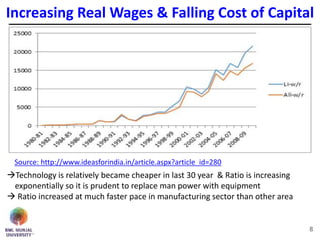
Increasing Real Wages & Falling Cost of Capital
Technology is relatively became cheaper in last 30 year & Ratio is increasing
exponentially so it is prudent to replace man power with equipment
 Ratio increased at much faster pace in manufacturing sector than other area
Source: http://www.ideasforindia.in/article.aspx?article_id=280
8
Lower Labour productivity of Indian Labour
9
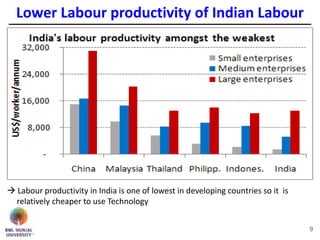
 Labour productivity in India is one of lowest in developing countries so it is
relatively cheaper to use Technology
Service Sector Led Growth
10
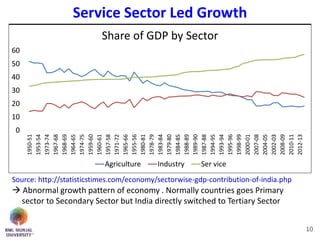
 Abnormal growth pattern of economy . Normally countries goes Primary
sector to Secondary Sector but India directly switched to Tertiary Sector
0
10
20
30
40
50
60
1950-51
1953-54
1973-74
1967-68
1968-69
1964-65
1974-75
1959-60
1960-61
1957-58
1971-72
1965-66
1955-56
1980-81
1978-79
1983-84
1979-80
1984-85
1988-89
1989-90
1987-88
1994-95
1993-94
1995-96
1998-99
2000-01
2007-08
2004-05
2002-03
2008-09
2010-11
2012-13
Share of GDP by Sector
Agriculture Industry Ser vice
Source: http://statisticstimes.com/economy/sectorwise-gdp-contribution-of-india.php
Higher Productivity Growth in Service Sector
11
Source: https://rbi.org.in/Scripts/PublicationReportDetails.aspx?ID=785
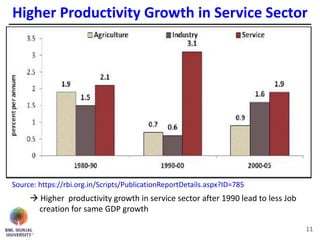
 Higher productivity growth in service sector after 1990 lead to less Job
creation for same GDP growth
Unequal Geographical Growth
12
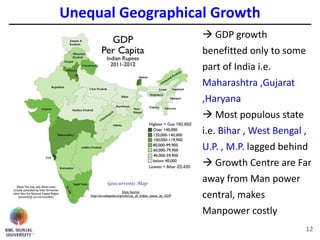
 GDP growth
benefitted only to some
part of India i.e.
Maharashtra ,Gujarat
,Haryana
 Most populous state
i.e. Bihar , West Bengal ,
U.P. , M.P. lagged behind
 Growth Centre are Far
away from Man power
central, makes
Manpower costly
Free Transferability of Cheap Foreign Capital
13
 Due to liberalization, there is a Free transferability of
capital/technology but labor movement is subject to
restriction (VISA).
 Cheap funding of capital for Technology up gradation
by developed world (USA/JAPAN /IMF) to India.
 Investment in technology is capital expenditure & One
time cost so there is more certainty of expenses .Wages
are revenue expenditure & repetitive in nature .It is
inflationary in nature .So expenses are uncertain .
Businessman reduce uncertainty by replacing man with
equipment.
Old Labour Law & Poor Product Quality
14
 Indian Labour law & Industry regulation are decade
long .These law promotes Red-Tapism , Corruption &
unnecessary delay in processes . These law makes
Hire & Fire of Labour makes difficult So Industry is
avoiding Man power with Machines /Automation
 Out put from manual Labour is non standardized &
poor quality. We get standardized output & superior
quality by Machine. This encourage usage of
technology in place of man power .
Contents
 Introduction
 Job growth scenario from 1956 to 2012
 Reasons of Jobless Growth
 Proposed Solution
15
Proposed Solutions for Job Creation
16
 Focus on Skill Development –Skill development
improved productivity & makes export of our goods &
services competitive in international & domestic
market
 Reform Old Labour Law –Indian Labour laws are
decade old .These laws hinder Employment Growth
 Promote Labour Intensive Sector –Promote Labour
intensive sector (Manufacturing ,Construction ,
Tourism).
17
 Focus on MSME Sector–MSME sector has a
tremendous potential of employment generation .
Sector doesn’t focus on state of technology .
 Set up industry in Populous state – Provide tax
incentive to setup industry in most populous state (U.P.
, Bihar ,Bengal )
 Support for free movement of Labour –Developed
countries advocating for Free Trade So third world
countries to jointly support for Free movement of
Labour
Proposed Solutions for Job Creation
18
 Linking MANREGA to capacity creation- Government
should link MANREGA to create capacity & to boost
future growth potential of economy .
 Diverting Saving to Financial Asset– Currently people
are investing their saving into Real Estate & Gold .By
diverting these saving to Financial asset, we can
increase GDP growth & Employment
 Circular Economy Concept -Industry should think of
circular economy .If people don’t have Job. There will
be no demand for Goods so business man must create
Job for their own Growth.
Proposed Solutions for Job Creation
19
 Stable Policy Regime –Provide stable Rules, Regulations
& Policy Regime for FII/FDI investment .In past few
years there were lot of problems i.e. Retrospective Tax ,
Court ruling in Telecom & Coal . These cases affected
the investment friendly image of the country .
 Make In India Initiative
Proposed Solutions for Job Creation
Thanks!
Suggestions are Most Welcome...
20

Job less growth 29 Jan16

  • 1.
    Job Less Growthin India after Liberalization Suryakant Ashwani Vohra Sachin Gupta Amit Pal
  • 2.
    Contents  Introduction  Jobgrowth scenario from 1956 to 2012  Reasons of Jobless Growth  Proposed Solution 2
  • 3.
    What is JoblessGrowth ? A jobless recovery or jobless growth is an economic phenomenon in which a macroeconomic experiences growth while maintaining or decreasing its level of employment. The first documented use of the term was in the New York Times in 1935 3
  • 4.
    Is Job LessGrowth Exist in India ?  Earlier (FY73 ~FY94) GDP growth sub 5% employment generation is above 2%  Post liberalization GPD growth is 6 .0 % but employment generation is 1.1%  During FY05 to FY10 Growth is 8.7 % & employment growth is 0.1% 4 Year Employment Growth CAGR GDP Growth CAGR Employment Elasticity FY 73 - FY 78 2.6 4.6 0.57 FY 78– FY 83 2.1 3.9 0.54 FY 83 –FY 87 1.7 4.0 0.42 FY 87- FY 94 2.4 5.6 0.43 FY 94- FY 00 1.0 6.8 0.15 FY 00- FY 05 2.8 5.7 0.50 FY05 - FY 10 0.1 8.7 0.01 FY 10 –FY12 1.4 7.4 0.18 FY94 –FY12 1.1 6.0 0.18
  • 5.
    Contents  Introduction  Jobgrowth scenario from 1956 to 2012  Reasons of Jobless Growth  Proposed Solution 5
  • 6.
    Higher Productivity Growthby Technology  Productivity growth by technology outpaced 3 times than Increase in Labour productivity 6 Broad Sector Real value added growth Contribution of Labour persons (A) Contribution of Labour quality (B) Contribution of Capital services (C) TFP growth (A+B+C) Agriculture 3.03 0.37 0.15 0.99* 1.52 Mining & Quarrying 4.75 0.68 0.38 3.93 –0.24 Manufacturing 7.22 0.68 0.44 5.37 0.73 Electricity, Gas & Water Supply 7.44 0.66 0.34 3.49 2.96 Construction 3.48 5.21 0.21 1.37 –3.31 Services 7.11 1.73 0.53 3.00 1.84 Total Economy 5.82 0.84 0.69 2.89* 1.40 Table 2-Trend Growth Rate in Real Value Added and Contribution of Factor Inputs and TFP to GVA growth by Broad Sectors, 1980 to 2008
  • 7.
    Contents  Introduction  Jobgrowth scenario from 1956 to 2012  Reasons of Jobless Growth  Proposed Solution 7
  • 8.
    Increasing Real Wages& Falling Cost of Capital Technology is relatively became cheaper in last 30 year & Ratio is increasing exponentially so it is prudent to replace man power with equipment  Ratio increased at much faster pace in manufacturing sector than other area Source: http://www.ideasforindia.in/article.aspx?article_id=280 8
  • 9.
    Lower Labour productivityof Indian Labour 9  Labour productivity in India is one of lowest in developing countries so it is relatively cheaper to use Technology
  • 10.
    Service Sector LedGrowth 10  Abnormal growth pattern of economy . Normally countries goes Primary sector to Secondary Sector but India directly switched to Tertiary Sector 0 10 20 30 40 50 60 1950-51 1953-54 1973-74 1967-68 1968-69 1964-65 1974-75 1959-60 1960-61 1957-58 1971-72 1965-66 1955-56 1980-81 1978-79 1983-84 1979-80 1984-85 1988-89 1989-90 1987-88 1994-95 1993-94 1995-96 1998-99 2000-01 2007-08 2004-05 2002-03 2008-09 2010-11 2012-13 Share of GDP by Sector Agriculture Industry Ser vice Source: http://statisticstimes.com/economy/sectorwise-gdp-contribution-of-india.php
  • 11.
    Higher Productivity Growthin Service Sector 11 Source: https://rbi.org.in/Scripts/PublicationReportDetails.aspx?ID=785  Higher productivity growth in service sector after 1990 lead to less Job creation for same GDP growth
  • 12.
    Unequal Geographical Growth 12 GDP growth benefitted only to some part of India i.e. Maharashtra ,Gujarat ,Haryana  Most populous state i.e. Bihar , West Bengal , U.P. , M.P. lagged behind  Growth Centre are Far away from Man power central, makes Manpower costly
  • 13.
    Free Transferability ofCheap Foreign Capital 13  Due to liberalization, there is a Free transferability of capital/technology but labor movement is subject to restriction (VISA).  Cheap funding of capital for Technology up gradation by developed world (USA/JAPAN /IMF) to India.  Investment in technology is capital expenditure & One time cost so there is more certainty of expenses .Wages are revenue expenditure & repetitive in nature .It is inflationary in nature .So expenses are uncertain . Businessman reduce uncertainty by replacing man with equipment.
  • 14.
    Old Labour Law& Poor Product Quality 14  Indian Labour law & Industry regulation are decade long .These law promotes Red-Tapism , Corruption & unnecessary delay in processes . These law makes Hire & Fire of Labour makes difficult So Industry is avoiding Man power with Machines /Automation  Out put from manual Labour is non standardized & poor quality. We get standardized output & superior quality by Machine. This encourage usage of technology in place of man power .
  • 15.
    Contents  Introduction  Jobgrowth scenario from 1956 to 2012  Reasons of Jobless Growth  Proposed Solution 15
  • 16.
    Proposed Solutions forJob Creation 16  Focus on Skill Development –Skill development improved productivity & makes export of our goods & services competitive in international & domestic market  Reform Old Labour Law –Indian Labour laws are decade old .These laws hinder Employment Growth  Promote Labour Intensive Sector –Promote Labour intensive sector (Manufacturing ,Construction , Tourism).
  • 17.
    17  Focus onMSME Sector–MSME sector has a tremendous potential of employment generation . Sector doesn’t focus on state of technology .  Set up industry in Populous state – Provide tax incentive to setup industry in most populous state (U.P. , Bihar ,Bengal )  Support for free movement of Labour –Developed countries advocating for Free Trade So third world countries to jointly support for Free movement of Labour Proposed Solutions for Job Creation
  • 18.
    18  Linking MANREGAto capacity creation- Government should link MANREGA to create capacity & to boost future growth potential of economy .  Diverting Saving to Financial Asset– Currently people are investing their saving into Real Estate & Gold .By diverting these saving to Financial asset, we can increase GDP growth & Employment  Circular Economy Concept -Industry should think of circular economy .If people don’t have Job. There will be no demand for Goods so business man must create Job for their own Growth. Proposed Solutions for Job Creation
  • 19.
    19  Stable PolicyRegime –Provide stable Rules, Regulations & Policy Regime for FII/FDI investment .In past few years there were lot of problems i.e. Retrospective Tax , Court ruling in Telecom & Coal . These cases affected the investment friendly image of the country .  Make In India Initiative Proposed Solutions for Job Creation
  • 20.