International Journal of Advanced Scientific Research & Development (IJASRD)
ISSN: 2394 – 8906
www.ijasrd.org, Pp: 37 – 41
Two Day National Seminar on “Make in India: How Get the Manufacturing Going” 37 | P a g e
R.V.S. College of Arts & Science, Karaikal
Youth Unemployment in India - Present Scenario
Mr. M. Irudhayaraj 1
, Dr. A. Xavior Selvakumar 2
ABSTRACT: Young Indians face major barriers because of poverty and low levels of human
capital. Though educational attainment has risen quickly in recent years, gaining a foothold
in the labour market remains elusive for many young Indians. In rural and urban areas,
young males are usually employed in casual jobs, while their female counterparts tend to be
self-employed. Although a large proportion of young rural women are employed in
agriculture, rural males are increasingly turning to the non-farm sector. In comparison,
young urban males are largely working in the services sector. This paper highlights youth
unemployment in India - present scenario.
Youth unemployment and underemployment is prevalent around the world because
young people lack skills, work experience, job search abilities and the financial resources to
find employment. In developing countries, this situation is exacerbated by poverty and the
competitive pressures that result from a rapidly growing labour force. Moreover, the
inadequacy of social protection schemes and active labour market policies means that young
people in such economies have little support outside their family and friends. Globally, young
people are, therefore, more likely to be unemployed or employed on more precarious
contracts or in the informal sector.
This is the case even during good economic times. In the midst of a severe recession,
youth find it increasingly difficult to both acquire a job as a new entrant in the labour market,
particularly as a consequence of hiring freezes, and remain employed, since they are more
likely to be laid off than workers with more seniority. According to ILO’s Global Trends
Report 2012 on Youth, nearly 75 million young people are unemployed across the world,
which represents an increase of more than 4 million since 2007. These challenges are evident
in India, which has the largest youth population in the world with around 66 per cent of the
total population under the age of 35. According to 2010 population figures, one in five young
people in the world is an Indian.1 In this context, much is often said about a ‘demographic
dividend’; that is, the share of the working-age population increases resulting in a fall in the
dependency ratio (the number of children and elderly being supported by workers). This has
been a feature of the development success stories of countries such as those in East Asia that
grew rapidly in the latter half of the 20th century. However, failing to provide opportunities
for this bulge of young people as they enter the labour market risks a ‘demographic disaster’.
Challenges of Youth Employment
India faces a paradoxical situation where, on the one hand, youth is looking for job
and on the other hand industry is suffering from availability of skilled workers. This skill
mismatch makes youth unemployable. This is a result of supply driven and not demand
driven education system due to lack of interface among different stakeholders viz., policy
makers, industry, training providers and educational institutions. The training institutes need
to educate as per industry’s requirements so that demographic dividend can be tapped
fruitfully.
1
Ph.D, Research Scholar, Department of Commerce, T.B.M.L College, Porayar.
2
Assistant Professor and Research Advisor, Department of Commerce, T.B.M.L College, Porayar.
International Journal of Advanced Scientific Research & Development (IJASRD)
ISSN: 2394 – 8906
www.ijasrd.org, Pp: 37 – 41
Two Day National Seminar on “Make in India: How Get the Manufacturing Going” 38 | P a g e
R.V.S. College of Arts & Science, Karaikal
Employment Scenario
To understand the context of the employment planning initiatives in India, a glance at
the employment behaviour vis a vis the urban labour force and the share of the key sectors is
a good starting point for the discussion on employment generation in poverty alleviation.
India possesses one of the largest labour pools in the world. Out of 1 billion populations, 43.6
per cent belongs to the labour force and 41.6 per cent are employed. First, the employment
growth rate is lower than the labour force rate and second, the divide between these two has
grown over the period, the employment growth rate being less than one per cent during the
major part of the last decade and third, the share of organized sector employment in the total
is less than 10 per cent and has decreased over time, pointing out the imperatives of
employment generation in the informal sector.
Employment profile across sectors
Young women are engaged more in the agriculture sector compared to males in rural
areas. However, it is interesting to note that, among young men and women, the share of the
secondary sector exceeds that of the tertiary sector in rural locations. The Mahatma Gandhi
National Rural Employment Guarantee Scheme (MGNREGS), which involves construction
activities, may be an explanation for the dominance of the secondary sector over the tertiary
in rural areas. In other words, rural industrialization does not seem to be the force behind this
phenomenon as own-account worker; in household enterprises (self-employed) as an
employer; and in household enterprises (self-employed) as helper. Casual labour =
individuals working as: casual wage labour in public works other than Mahatma Gandhi
NREGS public works; casual wage labour in Mahatma Gandhi NREGS public works; and
casual wage labour in other types of works. Indeed, looking at more disaggregated figures
shows that the employment share for the construction sector is 13.9 per cent for young men
(aged 15-29) in rural areas compared with 8.6 per cent for the manufacturing sector.5 In the
case of young women, the situation is reversed: the sectorial share for the manufacturing
sector is 10.8 per cent, while it is just 4.6 per cent for the construction sector.
Need for employment policy
The certain inherent strengths that can be utilized to improve the income of its people
and to provide gainful employment opportunities on sustainable basis, which are:
 Strong base of traditional skills not found elsewhere;
 Untapped natural resource;
 A natural environment which has been very profitably utilized by other countries for
high income- environment friendly tourism industry.
In order to sustain growth and employment in its economy, the State Government should
articulate an Employment Policy focusing on:
The policy would need to incorporate the following objectives:
 To exploit the full growth potential of the sectors and sub-sectors which are important
to the state’s Economy.
 To create necessary infrastructure and extension services for diversification of
agriculture and setting up new enterprises in manufacturing or services sector.
International Journal of Advanced Scientific Research & Development (IJASRD)
ISSN: 2394 – 8906
www.ijasrd.org, Pp: 37 – 41
Two Day National Seminar on “Make in India: How Get the Manufacturing Going” 39 | P a g e
R.V.S. College of Arts & Science, Karaikal
 To rehabilitate people who have suffered loss in employment due to the slowdown in
the economy.
 To assist the self-employed workers to upgrade themselves through provision of
credit, marketing, technological and training facilities.
 To improve prospects of long term growth by creating physical infrastructure such as
transport and communication services.
 To improve the efficiency of utilization of resources already invested in electricity,
irrigation and transport sectors.
 To carry out reforms in delivery of education, health, civic and other community
services.
Approach towards Employment Generation
This would require giving fillip to the economic activities that have traditionally been
the mainstay of the State’s economy and continue to hold significant potential for growth and
employment. Such activities include Agriculture (including Horticulture), Food Processing,
Handicrafts and Handlooms, Tourism etc. It would be equally necessary to ensure
diversification of the State economy, especially expanding the industrial base by promoting
private capital inflows into the State through various incentives and concessions in the initial
stage. The special industrial package announced for Jammu and Kashmir has been a step in
the right direction. The government is taking all possible steps and making all possible efforts
in providing gainful employment to the unemployed youth of the state, but it may not be
possible for the government to provide government jobs to the educated unemployed the
graph of which is increasing at a very faster pace. Under these circumstances possibilities
have to be explored for absorbing the youth by way of creating work opportunities in the
private sector as well. In this direction the following sectors of economy have been identified
for generation of gainful employment opportunities in the state on sustainable basis:-
 Agriculture (including Horticulture, Floriculture, Food Processing and Animal
Husbandry),
 Handlooms and Handicrafts,
 Industries (including Small Scale industries and Rural industries)
 Tourism & travels,
 Education & health,
 Large infrastructure projects (Roads & Railways),
 Information Technology & Telecommunication,
 Construction Sector.
Employment of Women in Organized Sector
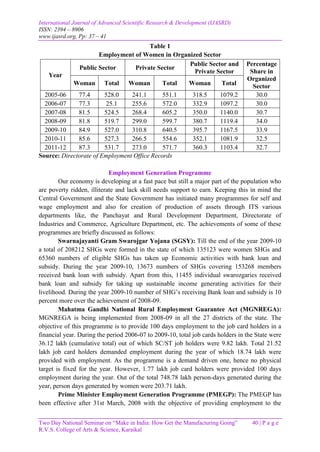
The employment of women in organized sector of the State was 360.3 thousand
during 2011-12 accounting for 32.7 percent of the total employment. In the year 2010-11 the
number of women employee was 352.1 thousand showing a share of around 32.5 percent to
total employment.
International Journal of Advanced Scientific Research & Development (IJASRD)
ISSN: 2394 – 8906
www.ijasrd.org, Pp: 37 – 41
Two Day National Seminar on “Make in India: How Get the Manufacturing Going” 40 | P a g e
R.V.S. College of Arts & Science, Karaikal
Table 1
Employment of Women in Organized Sector
Year
Public Sector Private Sector
Public Sector and
Private Sector
Percentage
Share in
Organized
SectorWoman Total Woman Total Woman Total
2005-06 77.4 528.0 241.1 551.1 318.5 1079.2 30.0
2006-07 77.3 25.1 255.6 572.0 332.9 1097.2 30.0
2007-08 81.5 524.5 268.4 605.2 350.0 1140.0 30.7
2008-09 81.8 519.7 299.0 599.7 380.7 1119.4 34.0
2009-10 84.9 527.0 310.8 640.5 395.7 1167.5 33.9
2010-11 85.6 527.3 266.5 554.6 352.1 1081.9 32.5
2011-12 87.3 531.7 273.0 571.7 360.3 1103.4 32.7
Source: Directorate of Employment Office Records
Employment Generation Programme
Our economy is developing at a fast pace but still a major part of the population who
are poverty ridden, illiterate and lack skill needs support to earn. Keeping this in mind the
Central Government and the State Government has initiated many programmes for self and
wage employment and also for creation of production of assets through ITS various
departments like, the Panchayat and Rural Development Department, Directorate of
Industries and Commerce, Agriculture Department, etc. The achievements of some of these
programmes are briefly discussed as follows:
Swarnajayanti Gram Swarojgar Yojana (SGSY): Till the end of the year 2009-10
a total of 208212 SHGs were formed in the state of which 135123 were women SHGs and
65360 numbers of eligible SHGs has taken up Economic activities with bank loan and
subsidy. During the year 2009-10, 13673 numbers of SHGs covering 153268 members
received bank loan with subsidy. Apart from this, 11455 individual swarozgaries received
bank loan and subsidy for taking up sustainable income generating activities for their
livelihood. During the year 2009-10 number of SHG’s receiving Bank loan and subsidy is 10
percent more over the achievement of 2008-09.
Mahatma Gandhi National Rural Employment Guarantee Act (MGNREGA):
MGNREGA is being implemented from 2008-09 in all the 27 districts of the state. The
objective of this programme is to provide 100 days employment to the job card holders in a
financial year. During the period 2006-07 to 2009-10, total job cards holders in the State were
36.12 lakh (cumulative total) out of which SC/ST job holders were 9.82 lakh. Total 21.52
lakh job card holders demanded employment during the year of which 18.74 lakh were
provided with employment. As the programme is a demand driven one, hence no physical
target is fixed for the year. However, 1.77 lakh job card holders were provided 100 days
employment during the year. Out of the total 748.78 lakh person-days generated during the
year, person days generated by women were 203.71 lakh.
Prime Minister Employment Generation Programme (PMEGP): The PMEGP has
been effective after 31st March, 2008 with the objective of providing employment to the
International Journal of Advanced Scientific Research & Development (IJASRD)
ISSN: 2394 – 8906
www.ijasrd.org, Pp: 37 – 41
Two Day National Seminar on “Make in India: How Get the Manufacturing Going” 41 | P a g e
R.V.S. College of Arts & Science, Karaikal
educated unemployed youth. The scheme facilitates self-employment through setting up of
industries/ service and business ventures. The KVIC is implementing the PMEGP schemes as
the nodal agency at the national level and at the State level the scheme is implemented by the
State KVIC Directorate, State KVIB and District Industries and Commerce Centers and
Banks. The total physical target set by the agencies for the year 2009-10 was 1292 nos. with a
margin money target of `1550.00 lakh against which physical achievement was 2440 number
with a financial involvement of `1899.71 lakh. The Government subsidy under the scheme is
being routed by the KVIC through the identified banks.
Assam Bikash Yojana: The Government of Assam has launched a unique self-
employment scheme called “Chief Minister Self Employment and Vocational Training”
under Assam Bikash Yojana in place of CMSY from 2008-09. There are two sectors of the
scheme one is CMSS and the other is Vocational Training. Under the CMSS the educated
unemployed youth of the State are sent for 6 months training in reputed Industrial Units and
Commercial houses throughout the Country. During the period of training, stipend Rs. 4500/
only per month is paid to the trainees by the Government of Assam. While the accepting
organizations get the service of the trainees free of cost, the trainees gain practical experience
by working for 6 months in the said Industrial venture. Under the Vocational training sector
the unemployed youths are provided one month industrial training within the State on their
interested field. The Assam Government fully bears the cost of the training.
Conclusion
The aim of this paper is to provide a profile of youth employment and unemployment
in India. A major long-term challenge in India is that many youth, because of poverty and
poor human capital endowment, participate in the labour market at an early stage. They
cannot afford to remain unemployed for long and, hence, pick up activities characterized by
low labour productivity. In rural and urban areas, among the early labour market entrants,
males are usually in casual wage employment, while their female counterparts tend to be self-
employed.
References
Majumudar,N. A & Lall, Vinay D, 1993: Financial System for Informal Sector: Satellite Banking
Network and Micro Business Development Corporation, SDS
Bhatnagar, K.K, 1992, Informal Baazar in Sikkim, SDS
Lall, Stuti, 1994 Credit to the Decentralised Sector: Constraints and Rationalization of Delivery
System. SDS
Planning Commission, GOI – First Five Year Plan (1951-56), Second Five Year Plan (1961-71), Fifth
Five Year Plan ( 1974-79), Sixth Five Year Plan (1980-85), Seventh Five Year Plan (1985-
90) Vol. 1, Eighth Five year Plan (1992-97) Vol. 1 & Ministry of Urban Affairs &
Employment, 1995, A Compendium of Central Schemes for Urban Employment, Poverty
Alleviation And Housing.

Youth Unemployment in India - Present Scenario

  • 1.
    International Journal ofAdvanced Scientific Research & Development (IJASRD) ISSN: 2394 – 8906 www.ijasrd.org, Pp: 37 – 41 Two Day National Seminar on “Make in India: How Get the Manufacturing Going” 37 | P a g e R.V.S. College of Arts & Science, Karaikal Youth Unemployment in India - Present Scenario Mr. M. Irudhayaraj 1 , Dr. A. Xavior Selvakumar 2 ABSTRACT: Young Indians face major barriers because of poverty and low levels of human capital. Though educational attainment has risen quickly in recent years, gaining a foothold in the labour market remains elusive for many young Indians. In rural and urban areas, young males are usually employed in casual jobs, while their female counterparts tend to be self-employed. Although a large proportion of young rural women are employed in agriculture, rural males are increasingly turning to the non-farm sector. In comparison, young urban males are largely working in the services sector. This paper highlights youth unemployment in India - present scenario. Youth unemployment and underemployment is prevalent around the world because young people lack skills, work experience, job search abilities and the financial resources to find employment. In developing countries, this situation is exacerbated by poverty and the competitive pressures that result from a rapidly growing labour force. Moreover, the inadequacy of social protection schemes and active labour market policies means that young people in such economies have little support outside their family and friends. Globally, young people are, therefore, more likely to be unemployed or employed on more precarious contracts or in the informal sector. This is the case even during good economic times. In the midst of a severe recession, youth find it increasingly difficult to both acquire a job as a new entrant in the labour market, particularly as a consequence of hiring freezes, and remain employed, since they are more likely to be laid off than workers with more seniority. According to ILO’s Global Trends Report 2012 on Youth, nearly 75 million young people are unemployed across the world, which represents an increase of more than 4 million since 2007. These challenges are evident in India, which has the largest youth population in the world with around 66 per cent of the total population under the age of 35. According to 2010 population figures, one in five young people in the world is an Indian.1 In this context, much is often said about a ‘demographic dividend’; that is, the share of the working-age population increases resulting in a fall in the dependency ratio (the number of children and elderly being supported by workers). This has been a feature of the development success stories of countries such as those in East Asia that grew rapidly in the latter half of the 20th century. However, failing to provide opportunities for this bulge of young people as they enter the labour market risks a ‘demographic disaster’. Challenges of Youth Employment India faces a paradoxical situation where, on the one hand, youth is looking for job and on the other hand industry is suffering from availability of skilled workers. This skill mismatch makes youth unemployable. This is a result of supply driven and not demand driven education system due to lack of interface among different stakeholders viz., policy makers, industry, training providers and educational institutions. The training institutes need to educate as per industry’s requirements so that demographic dividend can be tapped fruitfully. 1 Ph.D, Research Scholar, Department of Commerce, T.B.M.L College, Porayar. 2 Assistant Professor and Research Advisor, Department of Commerce, T.B.M.L College, Porayar.
  • 2.
    International Journal ofAdvanced Scientific Research & Development (IJASRD) ISSN: 2394 – 8906 www.ijasrd.org, Pp: 37 – 41 Two Day National Seminar on “Make in India: How Get the Manufacturing Going” 38 | P a g e R.V.S. College of Arts & Science, Karaikal Employment Scenario To understand the context of the employment planning initiatives in India, a glance at the employment behaviour vis a vis the urban labour force and the share of the key sectors is a good starting point for the discussion on employment generation in poverty alleviation. India possesses one of the largest labour pools in the world. Out of 1 billion populations, 43.6 per cent belongs to the labour force and 41.6 per cent are employed. First, the employment growth rate is lower than the labour force rate and second, the divide between these two has grown over the period, the employment growth rate being less than one per cent during the major part of the last decade and third, the share of organized sector employment in the total is less than 10 per cent and has decreased over time, pointing out the imperatives of employment generation in the informal sector. Employment profile across sectors Young women are engaged more in the agriculture sector compared to males in rural areas. However, it is interesting to note that, among young men and women, the share of the secondary sector exceeds that of the tertiary sector in rural locations. The Mahatma Gandhi National Rural Employment Guarantee Scheme (MGNREGS), which involves construction activities, may be an explanation for the dominance of the secondary sector over the tertiary in rural areas. In other words, rural industrialization does not seem to be the force behind this phenomenon as own-account worker; in household enterprises (self-employed) as an employer; and in household enterprises (self-employed) as helper. Casual labour = individuals working as: casual wage labour in public works other than Mahatma Gandhi NREGS public works; casual wage labour in Mahatma Gandhi NREGS public works; and casual wage labour in other types of works. Indeed, looking at more disaggregated figures shows that the employment share for the construction sector is 13.9 per cent for young men (aged 15-29) in rural areas compared with 8.6 per cent for the manufacturing sector.5 In the case of young women, the situation is reversed: the sectorial share for the manufacturing sector is 10.8 per cent, while it is just 4.6 per cent for the construction sector. Need for employment policy The certain inherent strengths that can be utilized to improve the income of its people and to provide gainful employment opportunities on sustainable basis, which are:  Strong base of traditional skills not found elsewhere;  Untapped natural resource;  A natural environment which has been very profitably utilized by other countries for high income- environment friendly tourism industry. In order to sustain growth and employment in its economy, the State Government should articulate an Employment Policy focusing on: The policy would need to incorporate the following objectives:  To exploit the full growth potential of the sectors and sub-sectors which are important to the state’s Economy.  To create necessary infrastructure and extension services for diversification of agriculture and setting up new enterprises in manufacturing or services sector.
  • 3.
    International Journal ofAdvanced Scientific Research & Development (IJASRD) ISSN: 2394 – 8906 www.ijasrd.org, Pp: 37 – 41 Two Day National Seminar on “Make in India: How Get the Manufacturing Going” 39 | P a g e R.V.S. College of Arts & Science, Karaikal  To rehabilitate people who have suffered loss in employment due to the slowdown in the economy.  To assist the self-employed workers to upgrade themselves through provision of credit, marketing, technological and training facilities.  To improve prospects of long term growth by creating physical infrastructure such as transport and communication services.  To improve the efficiency of utilization of resources already invested in electricity, irrigation and transport sectors.  To carry out reforms in delivery of education, health, civic and other community services. Approach towards Employment Generation This would require giving fillip to the economic activities that have traditionally been the mainstay of the State’s economy and continue to hold significant potential for growth and employment. Such activities include Agriculture (including Horticulture), Food Processing, Handicrafts and Handlooms, Tourism etc. It would be equally necessary to ensure diversification of the State economy, especially expanding the industrial base by promoting private capital inflows into the State through various incentives and concessions in the initial stage. The special industrial package announced for Jammu and Kashmir has been a step in the right direction. The government is taking all possible steps and making all possible efforts in providing gainful employment to the unemployed youth of the state, but it may not be possible for the government to provide government jobs to the educated unemployed the graph of which is increasing at a very faster pace. Under these circumstances possibilities have to be explored for absorbing the youth by way of creating work opportunities in the private sector as well. In this direction the following sectors of economy have been identified for generation of gainful employment opportunities in the state on sustainable basis:-  Agriculture (including Horticulture, Floriculture, Food Processing and Animal Husbandry),  Handlooms and Handicrafts,  Industries (including Small Scale industries and Rural industries)  Tourism & travels,  Education & health,  Large infrastructure projects (Roads & Railways),  Information Technology & Telecommunication,  Construction Sector. Employment of Women in Organized Sector The employment of women in organized sector of the State was 360.3 thousand during 2011-12 accounting for 32.7 percent of the total employment. In the year 2010-11 the number of women employee was 352.1 thousand showing a share of around 32.5 percent to total employment.
  • 4.
    International Journal ofAdvanced Scientific Research & Development (IJASRD) ISSN: 2394 – 8906 www.ijasrd.org, Pp: 37 – 41 Two Day National Seminar on “Make in India: How Get the Manufacturing Going” 40 | P a g e R.V.S. College of Arts & Science, Karaikal Table 1 Employment of Women in Organized Sector Year Public Sector Private Sector Public Sector and Private Sector Percentage Share in Organized SectorWoman Total Woman Total Woman Total 2005-06 77.4 528.0 241.1 551.1 318.5 1079.2 30.0 2006-07 77.3 25.1 255.6 572.0 332.9 1097.2 30.0 2007-08 81.5 524.5 268.4 605.2 350.0 1140.0 30.7 2008-09 81.8 519.7 299.0 599.7 380.7 1119.4 34.0 2009-10 84.9 527.0 310.8 640.5 395.7 1167.5 33.9 2010-11 85.6 527.3 266.5 554.6 352.1 1081.9 32.5 2011-12 87.3 531.7 273.0 571.7 360.3 1103.4 32.7 Source: Directorate of Employment Office Records Employment Generation Programme Our economy is developing at a fast pace but still a major part of the population who are poverty ridden, illiterate and lack skill needs support to earn. Keeping this in mind the Central Government and the State Government has initiated many programmes for self and wage employment and also for creation of production of assets through ITS various departments like, the Panchayat and Rural Development Department, Directorate of Industries and Commerce, Agriculture Department, etc. The achievements of some of these programmes are briefly discussed as follows: Swarnajayanti Gram Swarojgar Yojana (SGSY): Till the end of the year 2009-10 a total of 208212 SHGs were formed in the state of which 135123 were women SHGs and 65360 numbers of eligible SHGs has taken up Economic activities with bank loan and subsidy. During the year 2009-10, 13673 numbers of SHGs covering 153268 members received bank loan with subsidy. Apart from this, 11455 individual swarozgaries received bank loan and subsidy for taking up sustainable income generating activities for their livelihood. During the year 2009-10 number of SHG’s receiving Bank loan and subsidy is 10 percent more over the achievement of 2008-09. Mahatma Gandhi National Rural Employment Guarantee Act (MGNREGA): MGNREGA is being implemented from 2008-09 in all the 27 districts of the state. The objective of this programme is to provide 100 days employment to the job card holders in a financial year. During the period 2006-07 to 2009-10, total job cards holders in the State were 36.12 lakh (cumulative total) out of which SC/ST job holders were 9.82 lakh. Total 21.52 lakh job card holders demanded employment during the year of which 18.74 lakh were provided with employment. As the programme is a demand driven one, hence no physical target is fixed for the year. However, 1.77 lakh job card holders were provided 100 days employment during the year. Out of the total 748.78 lakh person-days generated during the year, person days generated by women were 203.71 lakh. Prime Minister Employment Generation Programme (PMEGP): The PMEGP has been effective after 31st March, 2008 with the objective of providing employment to the
  • 5.
    International Journal ofAdvanced Scientific Research & Development (IJASRD) ISSN: 2394 – 8906 www.ijasrd.org, Pp: 37 – 41 Two Day National Seminar on “Make in India: How Get the Manufacturing Going” 41 | P a g e R.V.S. College of Arts & Science, Karaikal educated unemployed youth. The scheme facilitates self-employment through setting up of industries/ service and business ventures. The KVIC is implementing the PMEGP schemes as the nodal agency at the national level and at the State level the scheme is implemented by the State KVIC Directorate, State KVIB and District Industries and Commerce Centers and Banks. The total physical target set by the agencies for the year 2009-10 was 1292 nos. with a margin money target of `1550.00 lakh against which physical achievement was 2440 number with a financial involvement of `1899.71 lakh. The Government subsidy under the scheme is being routed by the KVIC through the identified banks. Assam Bikash Yojana: The Government of Assam has launched a unique self- employment scheme called “Chief Minister Self Employment and Vocational Training” under Assam Bikash Yojana in place of CMSY from 2008-09. There are two sectors of the scheme one is CMSS and the other is Vocational Training. Under the CMSS the educated unemployed youth of the State are sent for 6 months training in reputed Industrial Units and Commercial houses throughout the Country. During the period of training, stipend Rs. 4500/ only per month is paid to the trainees by the Government of Assam. While the accepting organizations get the service of the trainees free of cost, the trainees gain practical experience by working for 6 months in the said Industrial venture. Under the Vocational training sector the unemployed youths are provided one month industrial training within the State on their interested field. The Assam Government fully bears the cost of the training. Conclusion The aim of this paper is to provide a profile of youth employment and unemployment in India. A major long-term challenge in India is that many youth, because of poverty and poor human capital endowment, participate in the labour market at an early stage. They cannot afford to remain unemployed for long and, hence, pick up activities characterized by low labour productivity. In rural and urban areas, among the early labour market entrants, males are usually in casual wage employment, while their female counterparts tend to be self- employed. References Majumudar,N. A & Lall, Vinay D, 1993: Financial System for Informal Sector: Satellite Banking Network and Micro Business Development Corporation, SDS Bhatnagar, K.K, 1992, Informal Baazar in Sikkim, SDS Lall, Stuti, 1994 Credit to the Decentralised Sector: Constraints and Rationalization of Delivery System. SDS Planning Commission, GOI – First Five Year Plan (1951-56), Second Five Year Plan (1961-71), Fifth Five Year Plan ( 1974-79), Sixth Five Year Plan (1980-85), Seventh Five Year Plan (1985- 90) Vol. 1, Eighth Five year Plan (1992-97) Vol. 1 & Ministry of Urban Affairs & Employment, 1995, A Compendium of Central Schemes for Urban Employment, Poverty Alleviation And Housing.