BS VI Solutions for LD, LDD and HDD
Satoshi Sumiya
Johnson Matthey Japan GK
ECT 2016: Emission Control Technology for Sustainable Growth
9 – 10 November 2016 at IHC, New Delhi
1
Gasoline
2
Gasoline
- Global Trend
1. TWC (Three Way Catalyst)
• Still mainstream of aftertreatment system.
• Continuous development is required to meet stringent emission legislations
with optimized PGM usage.
• Activities at low temperature, both light-off and steady state conversion, are
needed.
• Meeting tight OBD requirements is a key development target
• TWC for HEV (Hybrid Electric Vehicle) is an interesting area and Japanese
OEs prefer gasoline hybrid at this moment.
• RDE (Real Driving Emission) will require high conversion efficiencies across
a larger part of the engine map, so better systems will be needed – more
TWC activity and amended calibrations
2. GPF (gasoline Particulate Filter)
• The technology is required for EU and China from 2017 to meet the PN
legislation, so the activities in customers are increasing. US market will
follow because a stringent PM legislation will be implemented.
• TWC advances can apply to GPF washcoats and lower backpressure is a
key aim.
3
Gasoline
- Global Trend
3. Lean burn engine after treatment
• NSC (NOx Storage Catalyst) is a possible technology. But PGM cost is
high and it has calibration complexity.
• Reduction of N2O emission and improvement of S tolerance are
challenging.
4. Others
• Hydrocarbon trap: Can be applied with advanced TWC technology.
• Developing gCSC technology.
4
Gasoline
- BS VI solutions
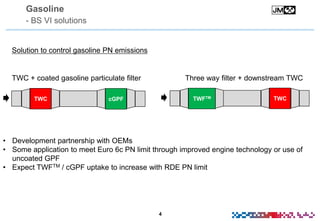
SCRF®
TWC cGPF
SCRF®
TWFTM TWC
Solution to control gasoline PN emissions
TWC + coated gasoline particulate filter Three way filter + downstream TWC
• Development partnership with OEMs
• Some application to meet Euro 6c PN limit through improved engine technology or use of
uncoated GPF
• Expect TWFTM / cGPF uptake to increase with RDE PN limit
5
Light Duty Diesel (LDD)
Confidential 6
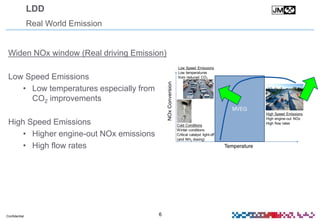
Real World Emission
Widen NOx window (Real driving Emission)
Low Speed Emissions
• Low temperatures especially from
CO2 improvements
High Speed Emissions
• Higher engine-out NOx emissions
• High flow rates
LDD
Confidential 7
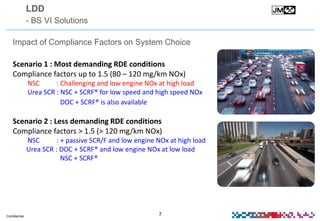
Scenario 1 : Most demanding RDE conditions
Compliance factors up to 1.5 (80 – 120 mg/km NOx)
NSC : Challenging and low engine NOx at high load
Urea SCR : NSC + SCRF® for low speed and high speed NOx
DOC + SCRF® is also available
Scenario 2 : Less demanding RDE conditions
Compliance factors > 1.5 (> 120 mg/km NOx)
NSC : + passive SCR/F and low engine NOx at high load
Urea SCR : DOC + SCRF® and low engine NOx at low load
NSC + SCRF®
LDD
- BS VI Solutions
Impact of Compliance Factors on System Choice
Confidential 8
- BS VI Solutions : Introduction of NOx Control Catalysts
LDD
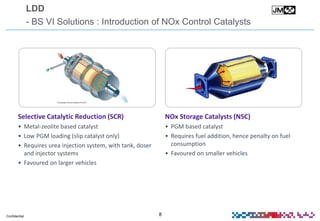
Selective Catalytic Reduction (SCR)
• Metal-zeolite based catalyst
• Low PGM loading (slip catalyst only)
• Requires urea injection system, with tank, doser
and injector systems
• Favoured on larger vehicles
NOx Storage Catalysts (NSC)
• PGM based catalyst
• Requires fuel addition, hence penalty on fuel
consumption
• Favoured on smaller vehicles
Confidential
9
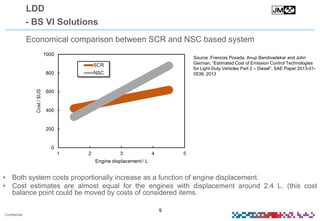
• Both system costs proportionally increase as a function of engine displacement.
• Cost estimates are almost equal for the engines with displacement around 2.4 L. (this cost
balance point could be moved by costs of considered items.
Economical comparison between SCR and NSC based system
Source :Francois Posada, Anup Bandivadekar and John
German, “Estimated Cost of Emission Control Technologies
for Light-Duty Vehicles Part 2 – Diesel”, SAE Paper 2013-01-
0539, 2013
- BS VI Solutions
LDD
Confidential
10
- BS VI Solutions
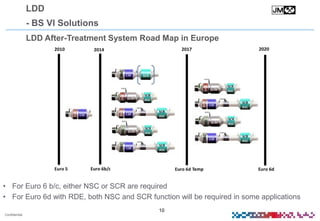
LDD After-Treatment System Road Map in Europe
• For Euro 6 b/c, either NSC or SCR are required
• For Euro 6d with RDE, both NSC and SCR function will be required in some applications
LDD
11
Heavy Duty Diesel (HDD)
12
HDD
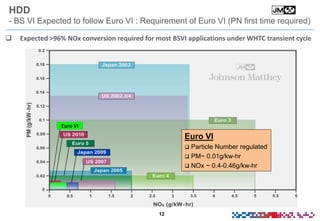
- BS VI Expected to follow Euro VI : Requirement of Euro VI (PN first time required)
Euro VI
 Particle Number regulated
 PM~ 0.01g/kw-hr
 NOx ~ 0.4-0.46g/kw-hr
Euro VI
 Expected >96% NOx conversion required for most BSVI applications under WHTC transient cycle
13
HDD
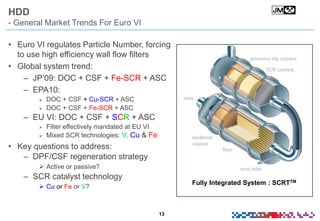
- General Market Trends For Euro VI
• Euro VI regulates Particle Number, forcing
to use high efficiency wall flow filters
• Global system trend:
– JP’09: DOC + CSF + Fe-SCR + ASC
– EPA10:
 DOC + CSF + Cu-SCR + ASC
 DOC + CSF + Fe-SCR + ASC
– EU VI: DOC + CSF + SCR + ASC
 Filter effectively mandated at EU VI
 Mixed SCR technologies: V, Cu & Fe
• Key questions to address:
– DPF/CSF regeneration strategy
 Active or passive?
– SCR catalyst technology
 Cu or Fe or V?
Fully Integrated System : SCRTTM
14
HDD
- Indian Engine and Drive Cycle Applications for BS VI
• Engines can have lower power ratings with large displacement (e.g., 6 L with 135
Hp)
• This can result in cooler exhaust temperature
• Further problem under WHTC testing
• May require engine downsizing (use 4 L engine for 135 hp)
• Indian drive cycles can have prolonged low speed operation
• Low speed operation can create exhaust temperature issue
• Concern about real world emissions if temperature too low for SCR
• May require thermal management
15
0
50
100
150
200
250
300
350
400
450
500
0 300 600 900 1200 1500 1800
Temperature(°C)
Time (Sec)
HDD
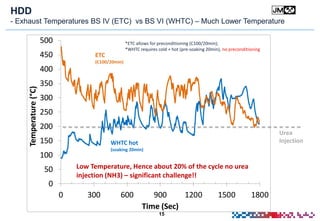
- Exhaust Temperatures BS IV (ETC) vs BS VI (WHTC) – Much Lower Temperature
ETC
(C100/20min)
WHTC hot
(soaking 20min)
Urea
Injection
Low Temperature, Hence about 20% of the cycle no urea
injection (NH3) – significant challenge!!
*ETC allows for preconditioning (C100/20min);
*WHTC requires cold + hot (pre-soaking 20min), no preconditioning
16
HDD
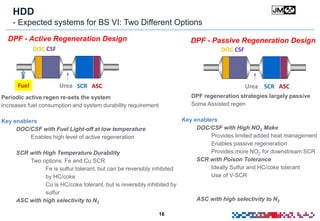
- Expected systems for BS VI: Two Different Options
DOC (C)DPF
SCR AOC*Urea SCR ASC
DOC CSF
Urea
DPF - Active Regeneration Design DPF - Passive Regeneration Design
Periodic active regen re-sets the system
Increases fuel consumption and system durability requirement
Key enablers
DOC/CSF with Fuel Light-off at low temperature
Enables high level of active regeneration
SCR with High Temperature Durability
Two options: Fe and Cu SCR
Fe is sulfur tolerant, but can be reversibly inhibited
by HC/coke
Cu is HC/coke tolerant, but is reversibly inhibited by
sulfur
ASC with high selectivity to N2
DPF regeneration strategies largely passive
Some Assisted regen
Key enablers
DOC/CSF with High NO2 Make
Provides limited added heat management
Enables passive regeneration
Provides more NO2 for downstream SCR
SCR with Poison Tolerance
Ideally Sulfur and HC/coke tolerant
Use of V-SCR
ASC with high selectivity to N2
DOC (C)DPF
SCR AOC*Urea SCR ASC
DOC CSF
UreaFuel
17
HDD
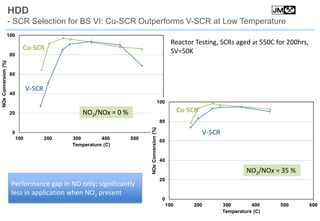
- SCR Selection for BS VI: Cu-SCR Outperforms V-SCR at Low Temperature
Cu-SCR
V-SCR
NO2/NOx = 0 % Cu-SCR
V-SCR
NO2/NOx = 35 %
Performance gap in NO only; significantly
less in application when NO2 present
Reactor Testing, SCRs aged at 550C for 200hrs,
SV=50K
18
HDD
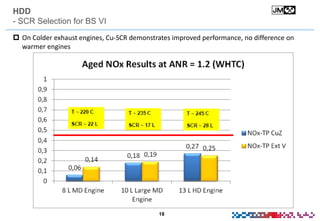
- SCR Selection for BS VI
 On Colder exhaust engines, Cu-SCR demonstrates improved performance, no difference on
warmer engines

Jm bs vi

  • 1.
    BS VI Solutionsfor LD, LDD and HDD Satoshi Sumiya Johnson Matthey Japan GK ECT 2016: Emission Control Technology for Sustainable Growth 9 – 10 November 2016 at IHC, New Delhi
  • 2.
  • 3.
    2 Gasoline - Global Trend 1.TWC (Three Way Catalyst) • Still mainstream of aftertreatment system. • Continuous development is required to meet stringent emission legislations with optimized PGM usage. • Activities at low temperature, both light-off and steady state conversion, are needed. • Meeting tight OBD requirements is a key development target • TWC for HEV (Hybrid Electric Vehicle) is an interesting area and Japanese OEs prefer gasoline hybrid at this moment. • RDE (Real Driving Emission) will require high conversion efficiencies across a larger part of the engine map, so better systems will be needed – more TWC activity and amended calibrations 2. GPF (gasoline Particulate Filter) • The technology is required for EU and China from 2017 to meet the PN legislation, so the activities in customers are increasing. US market will follow because a stringent PM legislation will be implemented. • TWC advances can apply to GPF washcoats and lower backpressure is a key aim.
  • 4.
    3 Gasoline - Global Trend 3.Lean burn engine after treatment • NSC (NOx Storage Catalyst) is a possible technology. But PGM cost is high and it has calibration complexity. • Reduction of N2O emission and improvement of S tolerance are challenging. 4. Others • Hydrocarbon trap: Can be applied with advanced TWC technology. • Developing gCSC technology.
  • 5.
    4 Gasoline - BS VIsolutions SCRF® TWC cGPF SCRF® TWFTM TWC Solution to control gasoline PN emissions TWC + coated gasoline particulate filter Three way filter + downstream TWC • Development partnership with OEMs • Some application to meet Euro 6c PN limit through improved engine technology or use of uncoated GPF • Expect TWFTM / cGPF uptake to increase with RDE PN limit
  • 6.
  • 7.
    Confidential 6 Real WorldEmission Widen NOx window (Real driving Emission) Low Speed Emissions • Low temperatures especially from CO2 improvements High Speed Emissions • Higher engine-out NOx emissions • High flow rates LDD
  • 8.
    Confidential 7 Scenario 1: Most demanding RDE conditions Compliance factors up to 1.5 (80 – 120 mg/km NOx) NSC : Challenging and low engine NOx at high load Urea SCR : NSC + SCRF® for low speed and high speed NOx DOC + SCRF® is also available Scenario 2 : Less demanding RDE conditions Compliance factors > 1.5 (> 120 mg/km NOx) NSC : + passive SCR/F and low engine NOx at high load Urea SCR : DOC + SCRF® and low engine NOx at low load NSC + SCRF® LDD - BS VI Solutions Impact of Compliance Factors on System Choice
  • 9.
    Confidential 8 - BSVI Solutions : Introduction of NOx Control Catalysts LDD Selective Catalytic Reduction (SCR) • Metal-zeolite based catalyst • Low PGM loading (slip catalyst only) • Requires urea injection system, with tank, doser and injector systems • Favoured on larger vehicles NOx Storage Catalysts (NSC) • PGM based catalyst • Requires fuel addition, hence penalty on fuel consumption • Favoured on smaller vehicles
  • 10.
    Confidential 9 • Both systemcosts proportionally increase as a function of engine displacement. • Cost estimates are almost equal for the engines with displacement around 2.4 L. (this cost balance point could be moved by costs of considered items. Economical comparison between SCR and NSC based system Source :Francois Posada, Anup Bandivadekar and John German, “Estimated Cost of Emission Control Technologies for Light-Duty Vehicles Part 2 – Diesel”, SAE Paper 2013-01- 0539, 2013 - BS VI Solutions LDD
  • 11.
    Confidential 10 - BS VISolutions LDD After-Treatment System Road Map in Europe • For Euro 6 b/c, either NSC or SCR are required • For Euro 6d with RDE, both NSC and SCR function will be required in some applications LDD
  • 12.
  • 13.
    12 HDD - BS VIExpected to follow Euro VI : Requirement of Euro VI (PN first time required) Euro VI  Particle Number regulated  PM~ 0.01g/kw-hr  NOx ~ 0.4-0.46g/kw-hr Euro VI  Expected >96% NOx conversion required for most BSVI applications under WHTC transient cycle
  • 14.
    13 HDD - General MarketTrends For Euro VI • Euro VI regulates Particle Number, forcing to use high efficiency wall flow filters • Global system trend: – JP’09: DOC + CSF + Fe-SCR + ASC – EPA10:  DOC + CSF + Cu-SCR + ASC  DOC + CSF + Fe-SCR + ASC – EU VI: DOC + CSF + SCR + ASC  Filter effectively mandated at EU VI  Mixed SCR technologies: V, Cu & Fe • Key questions to address: – DPF/CSF regeneration strategy  Active or passive? – SCR catalyst technology  Cu or Fe or V? Fully Integrated System : SCRTTM
  • 15.
    14 HDD - Indian Engineand Drive Cycle Applications for BS VI • Engines can have lower power ratings with large displacement (e.g., 6 L with 135 Hp) • This can result in cooler exhaust temperature • Further problem under WHTC testing • May require engine downsizing (use 4 L engine for 135 hp) • Indian drive cycles can have prolonged low speed operation • Low speed operation can create exhaust temperature issue • Concern about real world emissions if temperature too low for SCR • May require thermal management
  • 16.
    15 0 50 100 150 200 250 300 350 400 450 500 0 300 600900 1200 1500 1800 Temperature(°C) Time (Sec) HDD - Exhaust Temperatures BS IV (ETC) vs BS VI (WHTC) – Much Lower Temperature ETC (C100/20min) WHTC hot (soaking 20min) Urea Injection Low Temperature, Hence about 20% of the cycle no urea injection (NH3) – significant challenge!! *ETC allows for preconditioning (C100/20min); *WHTC requires cold + hot (pre-soaking 20min), no preconditioning
  • 17.
    16 HDD - Expected systemsfor BS VI: Two Different Options DOC (C)DPF SCR AOC*Urea SCR ASC DOC CSF Urea DPF - Active Regeneration Design DPF - Passive Regeneration Design Periodic active regen re-sets the system Increases fuel consumption and system durability requirement Key enablers DOC/CSF with Fuel Light-off at low temperature Enables high level of active regeneration SCR with High Temperature Durability Two options: Fe and Cu SCR Fe is sulfur tolerant, but can be reversibly inhibited by HC/coke Cu is HC/coke tolerant, but is reversibly inhibited by sulfur ASC with high selectivity to N2 DPF regeneration strategies largely passive Some Assisted regen Key enablers DOC/CSF with High NO2 Make Provides limited added heat management Enables passive regeneration Provides more NO2 for downstream SCR SCR with Poison Tolerance Ideally Sulfur and HC/coke tolerant Use of V-SCR ASC with high selectivity to N2 DOC (C)DPF SCR AOC*Urea SCR ASC DOC CSF UreaFuel
  • 18.
    17 HDD - SCR Selectionfor BS VI: Cu-SCR Outperforms V-SCR at Low Temperature Cu-SCR V-SCR NO2/NOx = 0 % Cu-SCR V-SCR NO2/NOx = 35 % Performance gap in NO only; significantly less in application when NO2 present Reactor Testing, SCRs aged at 550C for 200hrs, SV=50K
  • 19.
    18 HDD - SCR Selectionfor BS VI  On Colder exhaust engines, Cu-SCR demonstrates improved performance, no difference on warmer engines