A Media Plan by
Dominique Falcone Jillian Koehnken Anh Pham Kasey Speth
“We’ll take ya there.”
Table of Contents
Executive Summary.....................................................................................3
Situational Analysis......................................................................................5
Brand Analysis.........................................................................................5
Target Audience Analysis.......................................................................9
Competitive Analysis.............................................................................12
SWOT & Key Insight...............................................................................17
Media Objectives and Strategies...........................................................18
Big Idea.....................................................................................18
Target Audience & Media Mix................................................................18
Reach, Frequency, & GRPs....................................................................19
Scheduling and Timing..........................................................................20
Media Budget.........................................................................................21
Geography...............................................................................................22
Appendix..........................................................................................................23
A. Agency Biographies...........................................................................23
B. GRP & Timing Chart...........................................................................25
C. Budget Chart .....................................................................................26
D. CPM Chart..........................................................................................27
E. Indexes................................................................................................28
F. References...........................................................................................30
2
Executive Summary
Background
JetBlue is an airline company founded by David Neeleman in 1999 in Long Island City, New
York. JetBlue looks to bring the humanity back to air travel.
Major competitors of JetBlue include Southwest, American, Delta and United Airways. To
differentiate JetBlue, Neeleman wanted to focus on secondary airports away from the main
hubs where consumers could jet to their designations without having to drive through busy
metropolitan areas and deal with frequent flight delays.
Objectives
To differentiate the JetBlue brand and build a top-of-the-mind awareness, we must increase
passenger seat miles by 5% in select cities beyond offshore markets for business women
age 25-34 and retirees age 55-64, and increase share of vacation travelers by 5% from last
year with a 25% increase in revenue and advertising for vacation travel during the spring and
summer months.
Target Audiences
Our primary target audience are females ages 25-34, mainly Asian or White. These women
have attended graduate school and have an income upwards of $75,000. They are either single
or married with no children in their households, and employed in high professional positions in
fields such as psychology, law, or business management. These women would live in a county
size A.
Our secondary target are both men and women ages 55-64, also predominantly Asian
or White. These individuals have graduated from college and have incomes upwards of
$75,000. They are married with no children left in their households, and are employed in high
professional positions in fields such as psychology, law, or business management. They may
be retiring or about to retire, living in county size A or B.
Media Budget
We extended our budget to $9 million in order to exceed our reach and frequency goals. We
are allocating 55% of the budget to be spent on digital media which will amount to $4,924,418.
We plan to spend 25% on television, 10% on magazines, 4% on outdoor ads, and 1% on spot
radio. 50% of the budget will be spent in January, 25% in February, and 25% in March.
3
Campaign Details
The campaign will run from January to March following the holiday season, suggesting an
escape from the winter weather. We kick off our campaign in January with a high reach and a
moderate frequency. Reach and frequency will then decrease slightly in February and March
due to the already high awareness created in the first month.
JetBlue has created a sharp competitive edge by offering premium inflight entertainment and
comfort to its flyers for prices lower than most of its competitors. This will allow them to attract
upper class and business people, who can afford to go on more vacations, by offering them
the same luxury they expect from taking business flights while also saving them money to
spend on the rest of their vacations. The challenge will be to convince them that JetBlue is not
just another bargain brand airline without amenities and entertainment.
BIG IDEA
JetBlue offfers the highest quality flights for the
lowest price so flyers can spend more money on their
vacations and not their flights.
Media Mix
Our main focus for our target audience was on digital media. Within the digital media spectrum
we will be utilizing targeted sites, video networks, user generated video networks, paid social
media, and mobile app ads. We will also be using Magazines and Television for traditional
media. And as for spot, we will be utilizing Television, Outdoor and Radio Media.
4
Situational Analysis
Brand Analysis
Analysis of Marketing Objectives
To differentiate the JetBlue brand and build a top-of-the-mind awareness, we must increase
passenger seat miles by 5% in select cities beyond offshore markets for business women
age 25-34 and retirees age 55-64, and increase share of vacation travelers by 5% from last
year with a 25% increase in revenue and advertising for vacation travel during the spring and
summer months. The suggested budget for this campaign is $6 million.
Analysis of Four P’s
Product: JetBlue’s fleet of about 140 aircraft consists mainly of Airbus A320s but also
includes Embraer 190s.
Price: The company offers low fare flights without making its customers sacrifice comfort
features.
Place: The carrier offers one-class service -- to about 55 cities in more than 20 states and
in Mexico, Colombia, and the Caribbean (including Puerto Rico, the Bahamas, and the
Dominican Republic). The majority of JetBlue’s flights arrive or depart from one of five key
markets: Boston; Orlando and Fort Lauderdale, Florida; Long Beach, California; and New York.
Promotion: JetBlue’s most recent advertising campaign is the “Air on the Side of Humanity”
campaign featuring pigeons reflecting the reality of today’s flight conditions and promoting
JetBlue’s competitive features, such as free unlimited snacks and the most legroom in coach.
The ads run on major network morning news shows, late-night shows, sports programs,
cable, and in new-media executions including homepage advertisements, branded Spotify
playlists, and interactive mobile games (Rooney, 2014). The company also uses newspaper,
magazine and outdoor billboard ads.
JetBlue values the importance of relationship marketing by being very active on its social
media channels. The brand uses social media not only to promote its deals and updates,
but also to respond to customers’ concerns and to try to improve itself through received
feedbacks.
5
Category Analysis: Scheduled Passenger Airline Travel
Total revenue for the scheduled passenger airline travel industry has been exponentially
increasing since 2010, and in 2012 had reached its highest point of about 1.73 trillion dollars
(“Revenue by Industry”, 2014). Growth had slowed down around 2008 due to the economic
recession, but passenger airline travel is now back with a boom. According to the International
Air Transport Association (IATA), airlines can expect an increase in passenger demand of 31%
by 2017. Because of this increase in business, competition has become fierce and airlines are
expected to amp up their marketing, customer relations, technology, and environmentalism.
Marketing teams are shifting focus towards social networking in order to relate more to their
target audiences (“Air Transportation”, 2014)
Brand History
JetBlue Airways Corporation, often stylized as JetBlue, is an American airline company
founded by David Neeleman in 1999. In Neeleman’s words, JetBlue looks “to bring humanity
back to air travel.” The company is headquartered in Long Island City in Queens, New York.
In September 1999, the airline was awarded 75 initial take off/landing slots at John F. Kennedy
International Airport, and received formal U.S. authorization in February 2000. It started
operations on February 11, 2000, with service to Buffalo and Ft. Lauderdale. On October
22, 2008 JetBlue opened its new primary location at John F. Kennedy International Airport,
Terminal 5.
Neeleman wanted to focus on secondary airports away from the main hubs where consumers
could jet to their designations without having to drive through busy metros and deal with
frequent flight delays. The carrier offers one-class service to about 55 cities in more than 20
states and in Mexico, Colombia and the Caribbean. The majority of JetBlue flights arrives or
departs from one of five key markets: Boston; Orlando and Fort Lauderdale, Florida; Long
Beach, California; and New York.
JetBlue Positioning
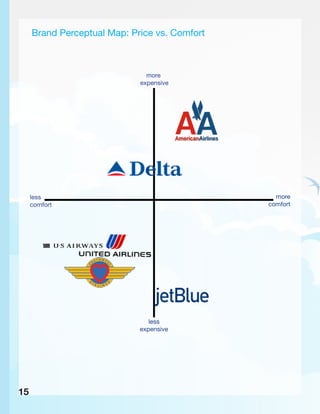
JetBlue is considered a less expensive airline option, however it offers some of the same
comfort and entertainment options as the more expensive airlines, adding more value to its
product. The price allows the product to be more affordable, while the comfort levels maintain
an amount of luxury that flyers desire during their trips.
6
Product Life Cycle
JetBlue would fall within the growth phase since it is still a young company, but it has also
experienced a lot of business growth over the years. JetBlue continues to increase its market
share, number of flight destinations, number of aircrafts, and employment opportunities.
Purchase Cycle/Seasonality
In the Spring and Summer months it is important to take note that business travel decreases
by 10% overall and vacation air travel increases by 30% overall. This shift in travel is most
likely due to our target audience taking time off of work to go on leisure vacations instead of
having business travel obligations. Therefore, JetBlue plans to increase its share of vacation
travelers by 5% over last year’s volume and focus all advertising copy exclusively on vacation
travel.
Geography
According to MRI data, people from the Southwest, West Central, and New England are
the most likely to go on vacation 3 times a year or more. Despite that fact, people in the
Southwest and West Central are very unlikely to choose JetBlue for their flights. The index
shows that people traveling from the Southwest are 64% less likely to choose JetBlue even
though they are 19% more like to go on vacations 3 or more times a year, and people in the
West Central area are 73% less likely choose JetBlue even though they are 24% more likely to
go on vacation (MRI Doublebase, 2009).
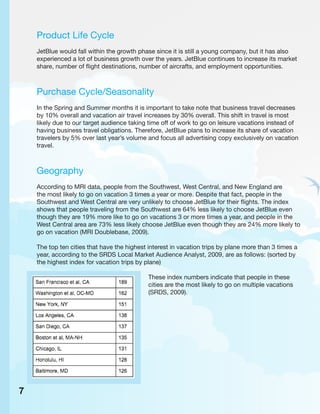
The top ten cities that have the highest interest in vacation trips by plane more than 3 times a
year, according to the SRDS Local Market Audience Analyst, 2009, are as follows: (sorted by
the highest index for vacation trips by plane)
These index numbers indicate that people in these
cities are the most likely to go on multiple vacations
(SRDS, 2009).
7
Competitive Advantage
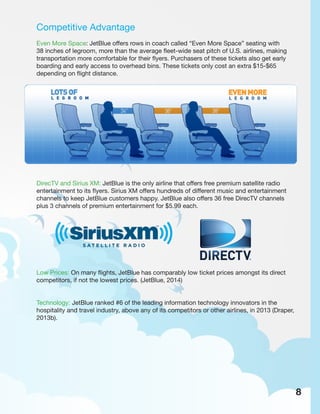
Even More Space: JetBlue offers rows in coach called “Even More Space” seating with
38 inches of legroom, more than the average fleet-wide seat pitch of U.S. airlines, making
transportation more comfortable for their flyers. Purchasers of these tickets also get early
boarding and early access to overhead bins. These tickets only cost an extra $15-$65
depending on flight distance.
Low Prices: On many flights, JetBlue has comparably low ticket prices amongst its direct
competitors, if not the lowest prices. (JetBlue, 2014)
Technology: JetBlue ranked #6 of the leading information technology innovators in the
hospitality and travel industry, above any of its competitors or other airlines, in 2013 (Draper,
2013b).
DirecTV and Sirius XM: JetBlue is the only airline that offers free premium satellite radio
entertainment to its flyers. Sirius XM offers hundreds of different music and entertainment
channels to keep JetBlue customers happy. JetBlue also offers 36 free DirecTV channels
plus 3 channels of premium entertainment for $5.99 each.
8
Target Audience Analysis
Primary Target Demographics
Females aged 25-34, predominantly Asian or White. These women have attended graduate
school, and have incomes of $75,000 and up. They are either single or married with no children
in their households, and employed in high professional positions in fields such as psychology,
law, or business management. These women would live in a county size A.
Secondary Target Demogrpahics
Men and women aged 55-64, predominantly Asian or White. These people have graduated
from college and have incomes of $75,000 and up. They are married with no children left in their
households, and are employed in high professional positions in fields such as psychology, law,
or business management. They may be retiring or about to retire, living in county size A or B.
Psychographics
Primary Target:
JetBlue’s primary target is made up of women who consider themselves to be more brave and
sophisticated than the average person. They work hard but are family oriented, and like to take 3
to 5 vacations a year that will differentiate them from their friends. As frequent fliers, they are not
as brand loyal, because they look for the best deals to save money for fun activities during their
vacations. They are also spontaneous and prefer to go out rather than spend a quiet evening at
home. (Simmons OneView, 2014)
Secondary Target:
Our secondary target is more brave, courageous, daring and adventurous than average.
They are more self-assured, confident, self-sufficient and secure. They are more efficient and
organized than average and more work oriented. They are more likely than average to travel for
pleasure instead of business. They are slightly more likely to travel within the US 3-5 times a
year, rather than vacationing abroad in a foreign country. They are more likely to go sightseeing
and to participate in outdoor activities and indoor activities than average. (Simmons OneView,
2014)
See Appendix E for more detail on the indexes used.
9
Slice of Life
Primary Target: Go-Getters
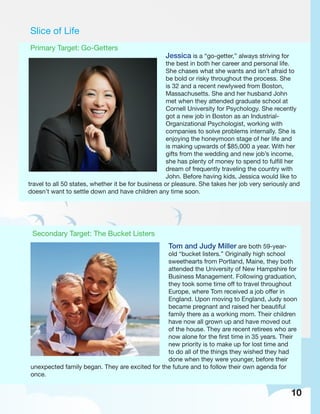
Jessica is a “go-getter,” always striving for
the best in both her career and personal life.
She chases what she wants and isn’t afraid to
be bold or risky throughout the process. She
is 32 and a recent newlywed from Boston,
Massachusetts. She and her husband John
met when they attended graduate school at
Cornell University for Psychology. She recently
got a new job in Boston as an Industrial-
Organizational Psychologist, working with
companies to solve problems internally. She is
enjoying the honeymoon stage of her life and
is making upwards of $85,000 a year. With her
gifts from the wedding and new job’s income,
she has plenty of money to spend to fulfill her
dream of frequently traveling the country with
John. Before having kids, Jessica would like to
travel to all 50 states, whether it be for business or pleasure. She takes her job very seriously and
doesn’t want to settle down and have children any time soon.
Secondary Target: The Bucket Listers
Tom and Judy Miller are both 59-year-
old “bucket listers.” Originally high school
sweethearts from Portland, Maine, they both
attended the University of New Hampshire for
Business Management. Following graduation,
they took some time off to travel throughout
Europe, where Tom received a job offer in
England. Upon moving to England, Judy soon
became pregnant and raised her beautiful
family there as a working mom. Their children
have now all grown up and have moved out
of the house. They are recent retirees who are
now alone for the first time in 35 years. Their
new priority is to make up for lost time and
to do all of the things they wished they had
done when they were younger, before their
unexpected family began. They are excited for the future and to follow their own agenda for
once.
10
Audience Media Mix
Primary Target:
After doing some research we found that our target audience’s top media choice is the Internet.
They are more likely to use the Internet while at work than any other media outlet. Following
close behind, our targets were very likely to be found on social media, use the Internet at home,
or read magazines. They were less likely than the average person to be found using media
vehicles such as radio or TV, but overall newspapers had the lowest percentage of media usage
among our target (Simmons OneView, 2014)
Secondary Target:
Our secondary audience, much like our primary, is more likely to use the Internet while at work
than any other media at any other time. They are also slightly more likely than the average
person to use social media, use the Internet while at home, or listen to the radio while driving.
Our secondary target is an average viewer of television, but they are less likely than average to
read magazines or the newspaper (Simmons OneView, 2014).
According to the indexes we studied, both target audiences are more likely to use the Internet
and social media as opposed to accessing other media sources. Our primary target audience is
even more likely than our secondary target audience to do so.
See Appendix E for more detail on the indexes used.
11
Major Competitors
There are over 40 major airlines in the airline industry that pull in revenues of $1 billion or
more. JetBlue is a part of this category along with Southwest, Delta, American-US, and
United.
Competitive Analysis
• 133,978,000 passengers in 2012 (Draper, 2013a, p. 43).
• $17.7 billion in 2013 revenue (“Revenue by Company,” 2014).
• Ranked fourth best US airline in 2013*.
• Largest competitor in the low-price airline sector.
• 1% market share.
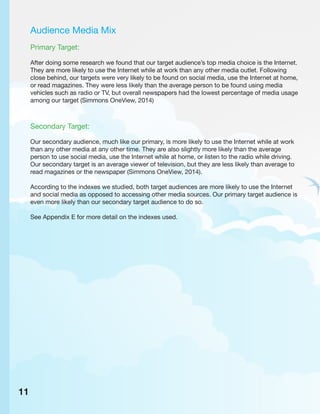
Southwest is positioning their “love of people” as the company’s top quality in 2014
(Southwest Airlines Co., 2014).
12
• 164,571,000 passengers in 2012 (Draper, 2013a, p. 43).
• $37.8 billion in 2013 revenue (“Revenue by Company,” 2014)
• Ranked second best major US airline in 2013*.
• 2% market share.
• 86,335,000 passengers in 2012 (Draper, 2013a, p. 43)
• $25.8 billion in 2013 revenue (“Revenue by Company,” 2014).
• Ranked sixth best major US airline in 2013*.
• 1.5% market share.
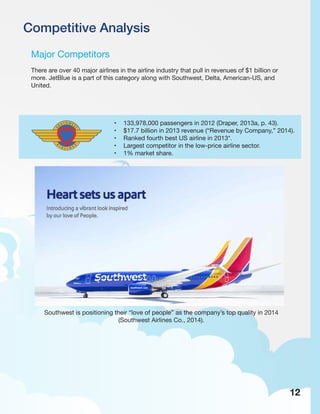
Delta’s goal in 2014 “is to make your trip
one less thing to worry about” (Delta,
2014).
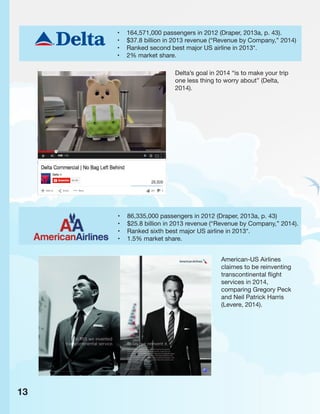
American-US Airlines
claimes to be reinventing
transcontinental flight
services in 2014,
comparing Gregory Peck
and Neil Patrick Harris
(Levere, 2014).
13
• 93,595,000 passengers in 2012 (Draper, 2013a, p. 43).
• $38.3 billion in 2013 revenue (“Revenue by Company,” 2014).
• Ranked ninth best major US airline in 2013*.
• 0.6% market share.
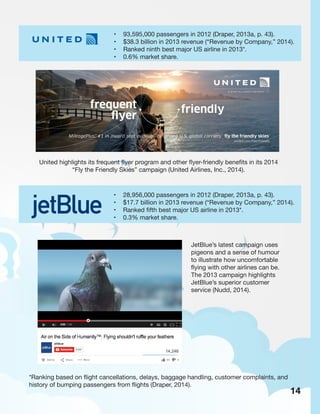
United highlights its frequent flyer program and other flyer-friendly benefits in its 2014
“Fly the Friendly Skies” campaign (United Airlines, Inc., 2014).
• 28,956,000 passengers in 2012 (Draper, 2013a, p. 43).
• $17.7 billion in 2013 revenue (“Revenue by Company,” 2014).
• Ranked fifth best major US airline in 2013*.
• 0.3% market share.
JetBlue’s latest campaign uses
pigeons and a sense of humour
to illustrate how uncomfortable
flying with other airlines can be.
The 2013 campaign highlights
JetBlue’s superior customer
service (Nudd, 2014).
*Ranking based on flight cancellations, delays, baggage handling, customer complaints, and
history of bumping passengers from flights (Draper, 2014).
14
Brand Perceptual Map: Price vs. Comfort
more
expensive
less
expensive
less
comfort
more
comfort
15
Share of Voice
Airlines as a category spent about $5,706,739,000 in advertising in 2010. The advertising dollars
were spread between brands as follows:
Southwest: 33%
American: 10%
Delta: 5%
United: 1%
JetBlue: 3%
Almost none of the airlines spend ad dollars on network television, however Southwest spent
59% of its budget on it, creating a 99% share of voice for network TV. Southwest also had a
60% share of voice for spot television, a 100% share of voice in SLN TV, and a 34% share of
voice for cable. JetBlue hardly invested in television ads, with only a 2% share of voice for spot
television and a 4% share of voice for cable.
JetBlue invested the largest portion of its ad dollars into Internet advertising (a 5% share of voice
for 24% of its budget) and outdoor ads (a 12% share of voice for 21% of its budget) (Kantar
Media, 2010).
16
SWOT Analysis
Strengths
• Customer accommodation
• Website for optimal round-trip planning (hotels, flights, cars, cruises)
• Baggage rates (First Bag Free)
• Amenities on airplanes (Deluxe TV and satellite radio)
• Rewards offered for preferred customers for frequent fliers (TrueBlue)
• Employee satisfaction (many Southwest Airline employees now work for JetBlue)
• Preferred and trusted airline in the US
• Spacious seating for increased passenger comfort
• Free unlimited snacks on flights`
(JetBlue, 2014)
Weaknesses
• Low fares and high costs create low efficiency and reduce the brand’s competitive power
• Lack of concentration into any market segment
• No significant innovation
Opportunities
• An increase in flights and services for passengers
• Expand to more destinations nationally and internationally
• Link up with other carriers in order to increase passenger volume
• Technological advances that increase fuel efficiency
Threats
• Risks related to unforeseen circumstances, such as plane crashes
• Increasing fuel price
• Increased security due to health and safety risks, such as Ebola and ISIS terrorist threats
Key Insight
JetBlue has created a sharp competitive edge by offering premium inflight entertainment and
comfort to its flyers for prices lower than most of its competitors. This will allow them to attract
upper class and business people, who can afford to go on more vacations, by offering them the
same luxury they expect from taking business flights while also saving them money to spend on
the rest of their vacations. The challenge will be convincing them that JetBlue is not just another
bargain brand airline without amenities and entertainment.
17
Media Objectives &
Strategies
Target Audience & Media Mix
Objectives
The target audience objective for this campaign is to increase flights with JetBlue among women
aged 24-35 by 5%. The campaign will reach women nationally, with spot heavy ups in 6 cities:
San Francisco, CA; Washington, DC; New York City, NY; Los Angeles, CA; Boston, MA; and
Chicago, IL, using social media, Internet display and pre-roll, magazines, television, spot radio,
and out of home.
Strategies
For network and cable television, JetBlue ads will run during Jimmy Fallon on NBC, Saturday
Night Live on NBC, American Idol on Fox, The Daily Show on Comedy Central and Conan on
TBS. These shows were chosen because they run during times that members of the target
audience would be home from work and looking to unwind with an entertaining television show.
Some of our primetime show ads will be run more in spot locations. With the purpose of gaining
more reach, we decided to run ads in four different magazines over the three months. We
choose Brides and Travel & Leisure for January, Cosmopolitan for February, and Vanity Fair for
March. Brides and Travel & Leisure were specifically chosen for January to reach all of the newly
engaged women after New Years who will want to start planning their wedding and honeymoon
straight away. Cosmopolitan was placed in February to reach all of the women seeking ideas
for Valentines Day plans. Vanity Fair was chosen due to our target’s very high likelihood of
readership (Simmons OneView, 2014). For the out of home medium, we decided to run spot ads
in subways, on the sides of buses, and on supermarket shopping carts in our selected markets
of San Francisco, CA; Washington, DC; New York City, NY; Los Angeles, CA; Boston, MA; and
Chicago, IL. This will reach our audience while they are surrounded by the hustle and bustle of
everyday life, reminding them that they may need a vacation soon. We will also place spot ads
during drive times on local radio stations in our six markets to increase frequency and recall of
the ad message.
Big Idea
JetBlue offfers the highest quality flights for the lowest price so
flyers can spend more money on their vacations and not their
flights.
18
Reach, Frequency, & GRPs
Objectives
Our national campaign will reach 85% during the kick-off month of January with an average
frequency of 8, this will lead to 680 GRPs. In February and March the campaign will have a reach
of 75% with an average frequency of 5 (375 GRPs). We will also implement a spot campaign
with a reach of 90% and a frequency of 12 during January which will lead to 1080 GRPs. In
February and March we will attain a reach of 85% and a frequency of 10 which will lead fo 850
GRPs.
Strategies
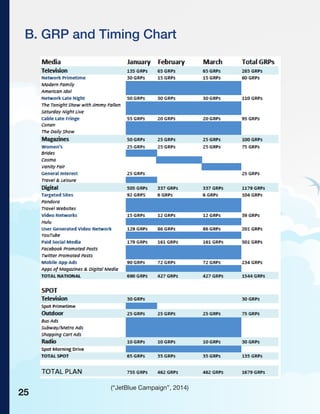
During the month of January, digital media will allow us to reach 690 GRPs. In January we
will use 135 GRPs allocated to Television. Network Primetime will take 30 GRPs, airing during
Modern Family and American Idol. Network Late Night will make up 50 GRPs airing during The
Tonight Show with Jimmy Fallon and Saturday Night Live. Cable Fringe will make up 55 GRPs,
and we will run our campaign in during Conan and The Daily Show during this time. Magazines
will make up 50 GRPs of our media for January. 25 of these GRPs be reached with Brides,
a women’s magazine. The other 25 GRPs will be reached with Travel and Leisure, a general
interest magazine. Digital will make up 505 GRPs of our media plan. Targeted Sites will take
up 92 GRPs with Pandora and Travel Websites. Video Networks will take up 15 GRPs using
Hulu. User Generated Video Network will use 129 GRPs and will include YouTube. The Paid
Social Media will account for 179 GRPs and will include Facebook Promoted Posts and Twitter
Promoted Posts. And lastly, 90 GRPs will go to Mobile App Ads such as Apps of Magazines &
Digital Media.
As for our Spot media in January, 30 GRPS will be allocated to Television, specifically spot Prime
Time. Outdoor will kick off with 25 GRPs with media such as Bus Ads, Subway/Metro Ads, and
Shopping Cart Ads. And finally for January, Radio will use 10 GRPs allocated to Spot Morning
Drive. Spot media will remain the same for February and March as well.
In addition, we will make digital advertising the main focus of this plan because our primary and
secondary targets are more likely to spend a great amount of time on the Internet every day
(Simmons OneView, 2014). Starting on January 1st, video pre-roll ads will be used on YouTube
and Hulu. At the same time, we will target our audiences through contextual ads on Facebook,
Pandora and different travel sites such as Travelocity, Priceline and so on. Also, promoted posts
by JetBlue on the social media outlets Twitter and Facebook will be used during the campaign.
The ads for JetBlue will also be run on the mobile apps or mobile version of each magazine,
website, and other outlets that we chose.
We believe that all of the chosen mediums will fit in with the lifestyle of our target.
19
Scheduling and Timing
Objectives
Our campaign will start with a bang in January, with a higher reach and frequency than in
the later months of the campaign. February and March will feature reductions in reach and
frequency. We will begin with many different media outlets in January and drop some for
February and March.
Strategies
We will run ads during January, February, and March following the holiday season. We believe
this is the perfect time to begin placing ads because people fantasize about the escape of
going somewhere warm on vacation after a frigid winter.
According to our research, our target audience watches TV mostly during the Late Night
daypart, so we have chosen to advertise during shows like The Tonight Show with Jimmy
Fallon, Saturday Night Live, The Daily Show, and Conan (Simmons OneView, 2014). Since
our target is made up of working women who come home from a hard day’s work looking to
unwind, we have also decided to place our ads on TV during prime time between popular
shows such as Modern Family and American Idol. Our TV ads will run during all three months,
with higher GRPs in January than in February or March.
On the Internet we will play video pre-roll ads on YouTube and Hulu beginning January first.
We will also place contextual ads on Facebook, Pandora and different travel sites, lessening
in quantity in February and March. Promoted posts by JetBlue on social media sites such
as Twitter and Facebook will be bought for a few days each month, but more so in January.
The ads for JetBlue will also be run on the mobile apps or mobile version of each magazine,
website, and other outlets that we chose.
As for the months of February and March, 65 GRPs will be allocated to Television. Network
Primetime will take 15 GRPs and that will include the shows Modern Family and American
Idol. Network Late Night will make up 30 GRPs and that will include the shows The Tonight
Show with Jimmy Fallon and Saturday Night Live. Cable Fringe will use 20 GRPs with shows
Conan and The Daily Show during this time. Like last month, Magazines will make up 50 GRPs
of our media for Feburary and March. 25 of these GRPs will make up Women’s Magazines
such as Brides, Cosmo and Vanity Fair. The other 25 GRPs will be allotted to General Interest
Magazines such as Travel and Leisure, New York Magazine, and Entertainment Weekly. Digital
will make up 337 GRPs of our media plan. Targeted Sites will take up 6 GRPs with Pandora
and Travel Websites. Video Networks will take up 12 GRPs using Hulu. User Generated Video
Network will use 86 GRPs and will include YouTube. The Paid Social Media will account for
161 GRPs and will include Facebook Promoted Posts and Twitter Promoted Posts. And lastly,
72 GRPs will go to Mobile App Ads such as Apps of Magazines & Digital Media.
See Appendix B for more detailed information.
20
Media Budget
Objectives
JetBlue has a budget of $6 million, 90% of which will be spent on a national campaign with
an additional 10% spent on some spot heavy up in 6 cities. 60% of the budget will be spent
on digital media, 25% on television, 10% on magazines, 4% on outdoor ads, and 1% on spot
radio. 50% of the budget will be spent in January, 25% in February, and 25% in March.
Strategies
Due to our goals for reach and frequency, we decided to go over the original budget of $6
million.We extended our budget to $9 million in order to exceed our reach and frequency goals
in some months while still staying slightly under budget. In this case, our campaign would cost
a total of $8,958,003.
We will use a larger percentage of the budget on social media and internet advertising because
our target audience is 15% more likely than average to use the internet at work, 4% more
likely than average to use the Internet at home, and 11% more likely than average to use social
media. In addition, Our secondary audience is 3% more likely than average to use the Internet
at home and 1% more likely than average to use social media. (Simmons OneView, 2014).
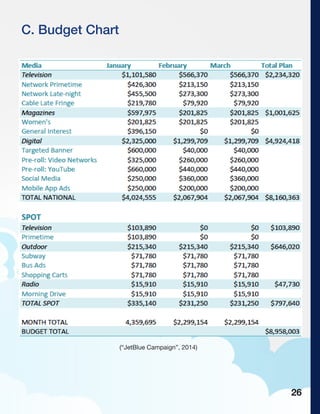
Based off of this information, 55% of the budget ($4,924,418), will be spent on digital media.
National television has a large reach, and is essential to accomplishing our goal of 85% reach
in January and 75% reach in February and March. In order to attain these results, we will spend
$2,234,320 on national television, 25% of our total budget. We will also spend $103,890 on
spot television in January to increase frequency in our target markets, which will be about 1%
of our total budget.
The next largest portion of our budget, 11%, will be allocated towards magazine ads. For a
total of $1,001,625, we will buy ad space in four different magazines throughout the campaign.
The rest of our budget will go towards the spot portion of our campaign, allocating $646,020
(7%) towards outdoor ads, and $47,730 (1%) towards spot radio.
21
Ads will be placed in magazines every month, with one women’s magazine and one general
interest in January, and only one women’s magazine a month in both February and March.
Magazines will change every month to increase reach and frequency.
Our spot campaign featuring out of home and local radio ads will remain continuous
throughout the three months with the exception of spot primetime television ads used in
January.
See Appendix B for more detailed information.
Geography
Objectives
This will be a national campaign. There will be heavier television, radio, and out of home ad
placements in 6 cities whose populations are highly likely to take more than 3 vacations a year.
Strategies
We will run our campaign nationally through network television, national magazine and digital
platform. We also will focus more on 6 big markets which show the highest interest in going
on vacation 3 times a year: San Francisco, CA; Washington, DC; New York City, NY; Los
Angeles, CA; Boston, MA; and Chicago, IL (Simmons OneView, 2014). For those markets only,
spot television, spot morning drive radio, and outdoor advertisements will be used for more
effective reach and frequency. Outdoor ads will be placed on subways, on the sides of buses,
and on shopping carts in big supermarkets and shopping centers in each market.
22
49% of the budget will be spent in January to create a high awareness of the campaign
that will only need to be slightly maintained in the later two months. This will come out to be
$4,359,695 in total, with $4,0224,555 spent on the national campaign and $335,140 spent
on spot. February and March evenly split the rest of the budget, costing a total of $2,229,154
each month. Each individual month will consume 25.5% of the budget, with $2,067,904 going
towards the national campaign and $231,250 going towards spot.
See Appendix C for more detailed information.
Appendix
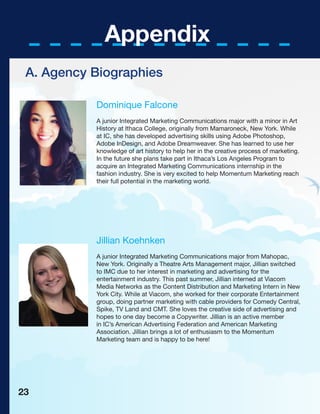
Dominique Falcone
A junior Integrated Marketing Communications major with a minor in Art
History at Ithaca College, originally from Mamaroneck, New York. While
at IC, she has developed advertising skills using Adobe Photoshop,
Adobe InDesign, and Adobe Dreamweaver. She has learned to use her
knowledge of art history to help her in the creative process of marketing.
In the future she plans take part in Ithaca’s Los Angeles Program to
acquire an Integrated Marketing Communications internship in the
fashion industry. She is very excited to help Momentum Marketing reach
their full potential in the marketing world.
Jillian Koehnken
A junior Integrated Marketing Communications major from Mahopac,
New York. Originally a Theatre Arts Management major, Jillian switched
to IMC due to her interest in marketing and advertising for the
entertainment industry. This past summer, Jillian interned at Viacom
Media Networks as the Content Distribution and Marketing Intern in New
York City. While at Viacom, she worked for their corporate Entertainment
group, doing partner marketing with cable providers for Comedy Central,
Spike, TV Land and CMT. She loves the creative side of advertising and
hopes to one day become a Copywriter. Jillian is an active member
in IC’s American Advertising Federation and American Marketing
Association. Jillian brings a lot of enthusiasm to the Momentum
Marketing team and is happy to be here!
A. Agency Biographies
23
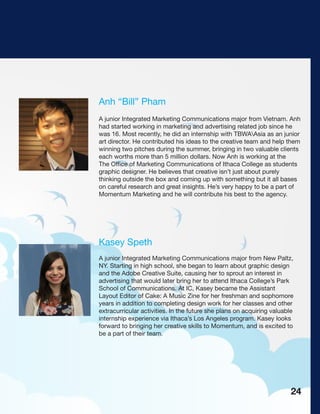
Anh “Bill” Pham
A junior Integrated Marketing Communications major from Vietnam. Anh
had started working in marketing and advertising related job since he
was 16. Most recently, he did an internship with TBWAAsia as an junior
art director. He contributed his ideas to the creative team and help them
winning two pitches during the summer, bringing in two valuable clients
each worths more than 5 million dollars. Now Anh is working at the
The Office of Marketing Communications of Ithaca College as students
graphic designer. He believes that creative isn’t just about purely
thinking outside the box and coming up with something but it all bases
on careful research and great insights. He’s very happy to be a part of
Momentum Marketing and he will contribute his best to the agency.
Kasey Speth
A junior Integrated Marketing Communications major from New Paltz,
NY. Starting in high school, she began to learn about graphic design
and the Adobe Creative Suite, causing her to sprout an interest in
advertising that would later bring her to attend Ithaca College’s Park
School of Communications. At IC, Kasey became the Assistant
Layout Editor of Cake: A Music Zine for her freshman and sophomore
years in addition to completing design work for her classes and other
extracurricular activities. In the future she plans on acquiring valuable
internship experience via Ithaca’s Los Angeles program. Kasey looks
forward to bringing her creative skills to Momentum, and is excited to
be a part of their team.
24
B. GRP and Timing Chart
(“JetBlue Campaign”, 2014)
25
C. Budget Chart
(“JetBlue Campaign”, 2014)
26
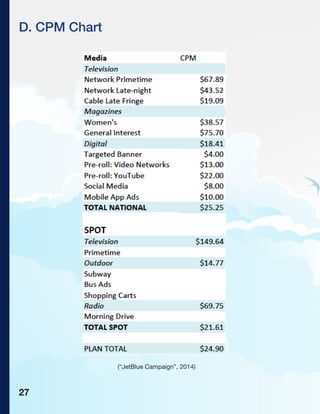
D. CPM Chart
(“JetBlue Campaign”, 2014)
27
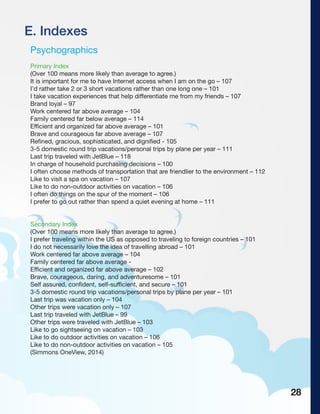
E. Indexes
Psychographics
Primary Index
(Over 100 means more likely than average to agree.)
It is important for me to have Internet access when I am on the go – 107
I’d rather take 2 or 3 short vacations rather than one long one – 101
I take vacation experiences that help differentiate me from my friends – 107
Brand loyal – 97
Work centered far above average – 104
Family centered far below average – 114
Efficient and organized far above average – 101
Brave and courageous far above average – 107
Refined, gracious, sophisticated, and dignified - 105
3-5 domestic round trip vacations/personal trips by plane per year – 111
Last trip traveled with JetBlue – 118
In charge of household purchasing decisions – 100
I often choose methods of transportation that are friendlier to the environment – 112
Like to visit a spa on vacation – 107
Like to do non-outdoor activities on vacation – 106
I often do things on the spur of the moment – 106
I prefer to go out rather than spend a quiet evening at home – 111
Secondary Index
(Over 100 means more likely than average to agree.)
I prefer traveling within the US as opposed to traveling to foreign countries – 101
I do not necessarily love the idea of travelling abroad – 101
Work centered far above average – 104
Family centered far above average -
Efficient and organized far above average – 102
Brave, courageous, daring, and adventuresome – 101
Self assured, confident, self-sufficient, and secure – 101
3-5 domestic round trip vacations/personal trips by plane per year – 101
Last trip was vacation only – 104
Other trips were vacation only – 107
Last trip traveled with JetBlue – 99
Other trips were traveled with JetBlue – 103
Like to go sightseeing on vacation – 103
Like to do outdoor activities on vacation – 106
Like to do non-outdoor activities on vacation – 105
(Simmons OneView, 2014)
28
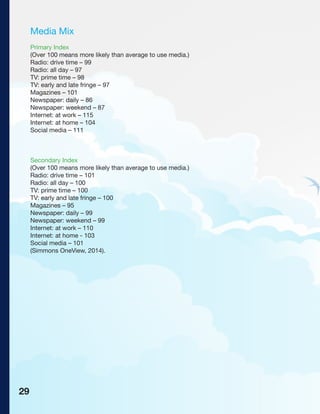
Media Mix
Primary Index
(Over 100 means more likely than average to use media.)
Radio: drive time – 99
Radio: all day – 97
TV: prime time – 98
TV: early and late fringe – 97
Magazines – 101
Newspaper: daily – 86
Newspaper: weekend – 87
Internet: at work – 115
Internet: at home – 104
Social media – 111
Secondary Index
(Over 100 means more likely than average to use media.)
Radio: drive time – 101
Radio: all day – 100
TV: prime time – 100
TV: early and late fringe – 100
Magazines – 95
Newspaper: daily – 99
Newspaper: weekend – 99
Internet: at work – 110
Internet: at home - 103
Social media – 101
(Simmons OneView, 2014).
29
E. References
Air transportation. (2014). Encyclopedia of Global Industries. Retrieved from Business Insights:
Essentials database.
American airlines. (2014). Retrieved October 22, 2014, from http://www.aa.com/homePage.do
Delta. (2014). Retrieved October 22, 2014, from http://www.delta.com/
Delta. (2014, September 22). Delta commercial no bag left behind [Video file]. Retrieved from
https://www.youtube.com/watch?v=U1vsRezK7v0
Draper, D. J. (2013). Leading information technology innovators in the hospitality and travel
industry, 2013. Business Rankings Annual, (September). Retrieved from Business Insights:
Essentials database.
Draper, D. J. (2013). Top North American airlines by passengers, 2012. Business Rankings
Annual, (July), 43. Retrieved from Business Insights: Essentials database.
Draper, D. J. (2014). Best major U.S. airlines, 2013. Business Rankings Annual, (January).
Retrieved from Business Insights: Essentials database.
Fall 2011 NHCS adult study 06-month [Chart]. (2014, October 22). Retrieved from Simmons
OneView database.
JetBlue. (2014). Retrieved October 22, 2014, from http://www.jetblue.com/
JetBlue campaign [Table]. (2014, December 7). Retrieved from Media Flight Plan database.
Kantar Media. (2010). Airline advertising by medium [Chart].
Levere, J. L. (2014, March 17). American Airlines focuses on the glory days of flying. Retrieved
December 7, 2014, from http://www.nytimes.com/2014/03/17/business/media/american-
airlines-focuses-on-the-glory-days-of-flying.html?_r=1
MRI Doublebase. (2009). JetBlue case MRI data [Table].
Nudd, T. (2014, April 23). JetBlue’s pigeon reflects on human foibles in web series from funny
or die. Retrieved December 7, 2014, from http://www.adweek.com/adfreak/jetblues-pigeon-
reflects-human-foibles-web-series-funny-or-die-157205
Revenue by company [Chart]. (2014). Retrieved from Business Insights: Essentials database.
Revenue by industry [Chart]. (2014). Retrieved from Business Insights: Essentials database.
30
Rooney, J. (2014, April 2). Pigeons take flight in JetBlue’s new campaign. Retrieved
October 22, 2014, from http://www.forbes.com/sites/jenniferrooney/2014/04/02/
pigeons-take-flight-in-jetblues-new-campaign/
Southwest airlines. (2014). Retrieved October 22, 2014, from https://www.southwest.
com/
Southwest Airlines Co. (2014). Southwest heart. Retrieved December 7, 2014, from
http://www.southwest-heart.com/
SRDS. (2009). Lifestyle analysis reports: market potential report [Chart].
United airlines. (2014). Retrieved October 22, 2014, from https://www.united.com/web/
en-US/default.aspx?root=1
United Airlines, Inc. (2014). United hub. Retrieved December 7, 2014, from https://hub.
united.com/en-us/flyerfriendly/pages/default.aspx
US airways. (2014). Retrieved October 22, 2014, from http://www.usairways.com/
default.aspx
31
Thank you!
JetBlue Media Plan

JetBlue Media Plan

  • 1.
  • 2.
    Dominique Falcone JillianKoehnken Anh Pham Kasey Speth “We’ll take ya there.”
  • 3.
    Table of Contents ExecutiveSummary.....................................................................................3 Situational Analysis......................................................................................5 Brand Analysis.........................................................................................5 Target Audience Analysis.......................................................................9 Competitive Analysis.............................................................................12 SWOT & Key Insight...............................................................................17 Media Objectives and Strategies...........................................................18 Big Idea.....................................................................................18 Target Audience & Media Mix................................................................18 Reach, Frequency, & GRPs....................................................................19 Scheduling and Timing..........................................................................20 Media Budget.........................................................................................21 Geography...............................................................................................22 Appendix..........................................................................................................23 A. Agency Biographies...........................................................................23 B. GRP & Timing Chart...........................................................................25 C. Budget Chart .....................................................................................26 D. CPM Chart..........................................................................................27 E. Indexes................................................................................................28 F. References...........................................................................................30 2
  • 4.
    Executive Summary Background JetBlue isan airline company founded by David Neeleman in 1999 in Long Island City, New York. JetBlue looks to bring the humanity back to air travel. Major competitors of JetBlue include Southwest, American, Delta and United Airways. To differentiate JetBlue, Neeleman wanted to focus on secondary airports away from the main hubs where consumers could jet to their designations without having to drive through busy metropolitan areas and deal with frequent flight delays. Objectives To differentiate the JetBlue brand and build a top-of-the-mind awareness, we must increase passenger seat miles by 5% in select cities beyond offshore markets for business women age 25-34 and retirees age 55-64, and increase share of vacation travelers by 5% from last year with a 25% increase in revenue and advertising for vacation travel during the spring and summer months. Target Audiences Our primary target audience are females ages 25-34, mainly Asian or White. These women have attended graduate school and have an income upwards of $75,000. They are either single or married with no children in their households, and employed in high professional positions in fields such as psychology, law, or business management. These women would live in a county size A. Our secondary target are both men and women ages 55-64, also predominantly Asian or White. These individuals have graduated from college and have incomes upwards of $75,000. They are married with no children left in their households, and are employed in high professional positions in fields such as psychology, law, or business management. They may be retiring or about to retire, living in county size A or B. Media Budget We extended our budget to $9 million in order to exceed our reach and frequency goals. We are allocating 55% of the budget to be spent on digital media which will amount to $4,924,418. We plan to spend 25% on television, 10% on magazines, 4% on outdoor ads, and 1% on spot radio. 50% of the budget will be spent in January, 25% in February, and 25% in March. 3
  • 5.
    Campaign Details The campaignwill run from January to March following the holiday season, suggesting an escape from the winter weather. We kick off our campaign in January with a high reach and a moderate frequency. Reach and frequency will then decrease slightly in February and March due to the already high awareness created in the first month. JetBlue has created a sharp competitive edge by offering premium inflight entertainment and comfort to its flyers for prices lower than most of its competitors. This will allow them to attract upper class and business people, who can afford to go on more vacations, by offering them the same luxury they expect from taking business flights while also saving them money to spend on the rest of their vacations. The challenge will be to convince them that JetBlue is not just another bargain brand airline without amenities and entertainment. BIG IDEA JetBlue offfers the highest quality flights for the lowest price so flyers can spend more money on their vacations and not their flights. Media Mix Our main focus for our target audience was on digital media. Within the digital media spectrum we will be utilizing targeted sites, video networks, user generated video networks, paid social media, and mobile app ads. We will also be using Magazines and Television for traditional media. And as for spot, we will be utilizing Television, Outdoor and Radio Media. 4
  • 6.
    Situational Analysis Brand Analysis Analysisof Marketing Objectives To differentiate the JetBlue brand and build a top-of-the-mind awareness, we must increase passenger seat miles by 5% in select cities beyond offshore markets for business women age 25-34 and retirees age 55-64, and increase share of vacation travelers by 5% from last year with a 25% increase in revenue and advertising for vacation travel during the spring and summer months. The suggested budget for this campaign is $6 million. Analysis of Four P’s Product: JetBlue’s fleet of about 140 aircraft consists mainly of Airbus A320s but also includes Embraer 190s. Price: The company offers low fare flights without making its customers sacrifice comfort features. Place: The carrier offers one-class service -- to about 55 cities in more than 20 states and in Mexico, Colombia, and the Caribbean (including Puerto Rico, the Bahamas, and the Dominican Republic). The majority of JetBlue’s flights arrive or depart from one of five key markets: Boston; Orlando and Fort Lauderdale, Florida; Long Beach, California; and New York. Promotion: JetBlue’s most recent advertising campaign is the “Air on the Side of Humanity” campaign featuring pigeons reflecting the reality of today’s flight conditions and promoting JetBlue’s competitive features, such as free unlimited snacks and the most legroom in coach. The ads run on major network morning news shows, late-night shows, sports programs, cable, and in new-media executions including homepage advertisements, branded Spotify playlists, and interactive mobile games (Rooney, 2014). The company also uses newspaper, magazine and outdoor billboard ads. JetBlue values the importance of relationship marketing by being very active on its social media channels. The brand uses social media not only to promote its deals and updates, but also to respond to customers’ concerns and to try to improve itself through received feedbacks. 5
  • 7.
    Category Analysis: ScheduledPassenger Airline Travel Total revenue for the scheduled passenger airline travel industry has been exponentially increasing since 2010, and in 2012 had reached its highest point of about 1.73 trillion dollars (“Revenue by Industry”, 2014). Growth had slowed down around 2008 due to the economic recession, but passenger airline travel is now back with a boom. According to the International Air Transport Association (IATA), airlines can expect an increase in passenger demand of 31% by 2017. Because of this increase in business, competition has become fierce and airlines are expected to amp up their marketing, customer relations, technology, and environmentalism. Marketing teams are shifting focus towards social networking in order to relate more to their target audiences (“Air Transportation”, 2014) Brand History JetBlue Airways Corporation, often stylized as JetBlue, is an American airline company founded by David Neeleman in 1999. In Neeleman’s words, JetBlue looks “to bring humanity back to air travel.” The company is headquartered in Long Island City in Queens, New York. In September 1999, the airline was awarded 75 initial take off/landing slots at John F. Kennedy International Airport, and received formal U.S. authorization in February 2000. It started operations on February 11, 2000, with service to Buffalo and Ft. Lauderdale. On October 22, 2008 JetBlue opened its new primary location at John F. Kennedy International Airport, Terminal 5. Neeleman wanted to focus on secondary airports away from the main hubs where consumers could jet to their designations without having to drive through busy metros and deal with frequent flight delays. The carrier offers one-class service to about 55 cities in more than 20 states and in Mexico, Colombia and the Caribbean. The majority of JetBlue flights arrives or departs from one of five key markets: Boston; Orlando and Fort Lauderdale, Florida; Long Beach, California; and New York. JetBlue Positioning JetBlue is considered a less expensive airline option, however it offers some of the same comfort and entertainment options as the more expensive airlines, adding more value to its product. The price allows the product to be more affordable, while the comfort levels maintain an amount of luxury that flyers desire during their trips. 6
  • 8.
    Product Life Cycle JetBluewould fall within the growth phase since it is still a young company, but it has also experienced a lot of business growth over the years. JetBlue continues to increase its market share, number of flight destinations, number of aircrafts, and employment opportunities. Purchase Cycle/Seasonality In the Spring and Summer months it is important to take note that business travel decreases by 10% overall and vacation air travel increases by 30% overall. This shift in travel is most likely due to our target audience taking time off of work to go on leisure vacations instead of having business travel obligations. Therefore, JetBlue plans to increase its share of vacation travelers by 5% over last year’s volume and focus all advertising copy exclusively on vacation travel. Geography According to MRI data, people from the Southwest, West Central, and New England are the most likely to go on vacation 3 times a year or more. Despite that fact, people in the Southwest and West Central are very unlikely to choose JetBlue for their flights. The index shows that people traveling from the Southwest are 64% less likely to choose JetBlue even though they are 19% more like to go on vacations 3 or more times a year, and people in the West Central area are 73% less likely choose JetBlue even though they are 24% more likely to go on vacation (MRI Doublebase, 2009). The top ten cities that have the highest interest in vacation trips by plane more than 3 times a year, according to the SRDS Local Market Audience Analyst, 2009, are as follows: (sorted by the highest index for vacation trips by plane) These index numbers indicate that people in these cities are the most likely to go on multiple vacations (SRDS, 2009). 7
  • 9.
    Competitive Advantage Even MoreSpace: JetBlue offers rows in coach called “Even More Space” seating with 38 inches of legroom, more than the average fleet-wide seat pitch of U.S. airlines, making transportation more comfortable for their flyers. Purchasers of these tickets also get early boarding and early access to overhead bins. These tickets only cost an extra $15-$65 depending on flight distance. Low Prices: On many flights, JetBlue has comparably low ticket prices amongst its direct competitors, if not the lowest prices. (JetBlue, 2014) Technology: JetBlue ranked #6 of the leading information technology innovators in the hospitality and travel industry, above any of its competitors or other airlines, in 2013 (Draper, 2013b). DirecTV and Sirius XM: JetBlue is the only airline that offers free premium satellite radio entertainment to its flyers. Sirius XM offers hundreds of different music and entertainment channels to keep JetBlue customers happy. JetBlue also offers 36 free DirecTV channels plus 3 channels of premium entertainment for $5.99 each. 8
  • 10.
    Target Audience Analysis PrimaryTarget Demographics Females aged 25-34, predominantly Asian or White. These women have attended graduate school, and have incomes of $75,000 and up. They are either single or married with no children in their households, and employed in high professional positions in fields such as psychology, law, or business management. These women would live in a county size A. Secondary Target Demogrpahics Men and women aged 55-64, predominantly Asian or White. These people have graduated from college and have incomes of $75,000 and up. They are married with no children left in their households, and are employed in high professional positions in fields such as psychology, law, or business management. They may be retiring or about to retire, living in county size A or B. Psychographics Primary Target: JetBlue’s primary target is made up of women who consider themselves to be more brave and sophisticated than the average person. They work hard but are family oriented, and like to take 3 to 5 vacations a year that will differentiate them from their friends. As frequent fliers, they are not as brand loyal, because they look for the best deals to save money for fun activities during their vacations. They are also spontaneous and prefer to go out rather than spend a quiet evening at home. (Simmons OneView, 2014) Secondary Target: Our secondary target is more brave, courageous, daring and adventurous than average. They are more self-assured, confident, self-sufficient and secure. They are more efficient and organized than average and more work oriented. They are more likely than average to travel for pleasure instead of business. They are slightly more likely to travel within the US 3-5 times a year, rather than vacationing abroad in a foreign country. They are more likely to go sightseeing and to participate in outdoor activities and indoor activities than average. (Simmons OneView, 2014) See Appendix E for more detail on the indexes used. 9
  • 11.
    Slice of Life PrimaryTarget: Go-Getters Jessica is a “go-getter,” always striving for the best in both her career and personal life. She chases what she wants and isn’t afraid to be bold or risky throughout the process. She is 32 and a recent newlywed from Boston, Massachusetts. She and her husband John met when they attended graduate school at Cornell University for Psychology. She recently got a new job in Boston as an Industrial- Organizational Psychologist, working with companies to solve problems internally. She is enjoying the honeymoon stage of her life and is making upwards of $85,000 a year. With her gifts from the wedding and new job’s income, she has plenty of money to spend to fulfill her dream of frequently traveling the country with John. Before having kids, Jessica would like to travel to all 50 states, whether it be for business or pleasure. She takes her job very seriously and doesn’t want to settle down and have children any time soon. Secondary Target: The Bucket Listers Tom and Judy Miller are both 59-year- old “bucket listers.” Originally high school sweethearts from Portland, Maine, they both attended the University of New Hampshire for Business Management. Following graduation, they took some time off to travel throughout Europe, where Tom received a job offer in England. Upon moving to England, Judy soon became pregnant and raised her beautiful family there as a working mom. Their children have now all grown up and have moved out of the house. They are recent retirees who are now alone for the first time in 35 years. Their new priority is to make up for lost time and to do all of the things they wished they had done when they were younger, before their unexpected family began. They are excited for the future and to follow their own agenda for once. 10
  • 12.
    Audience Media Mix PrimaryTarget: After doing some research we found that our target audience’s top media choice is the Internet. They are more likely to use the Internet while at work than any other media outlet. Following close behind, our targets were very likely to be found on social media, use the Internet at home, or read magazines. They were less likely than the average person to be found using media vehicles such as radio or TV, but overall newspapers had the lowest percentage of media usage among our target (Simmons OneView, 2014) Secondary Target: Our secondary audience, much like our primary, is more likely to use the Internet while at work than any other media at any other time. They are also slightly more likely than the average person to use social media, use the Internet while at home, or listen to the radio while driving. Our secondary target is an average viewer of television, but they are less likely than average to read magazines or the newspaper (Simmons OneView, 2014). According to the indexes we studied, both target audiences are more likely to use the Internet and social media as opposed to accessing other media sources. Our primary target audience is even more likely than our secondary target audience to do so. See Appendix E for more detail on the indexes used. 11
  • 13.
    Major Competitors There areover 40 major airlines in the airline industry that pull in revenues of $1 billion or more. JetBlue is a part of this category along with Southwest, Delta, American-US, and United. Competitive Analysis • 133,978,000 passengers in 2012 (Draper, 2013a, p. 43). • $17.7 billion in 2013 revenue (“Revenue by Company,” 2014). • Ranked fourth best US airline in 2013*. • Largest competitor in the low-price airline sector. • 1% market share. Southwest is positioning their “love of people” as the company’s top quality in 2014 (Southwest Airlines Co., 2014). 12
  • 14.
    • 164,571,000 passengersin 2012 (Draper, 2013a, p. 43). • $37.8 billion in 2013 revenue (“Revenue by Company,” 2014) • Ranked second best major US airline in 2013*. • 2% market share. • 86,335,000 passengers in 2012 (Draper, 2013a, p. 43) • $25.8 billion in 2013 revenue (“Revenue by Company,” 2014). • Ranked sixth best major US airline in 2013*. • 1.5% market share. Delta’s goal in 2014 “is to make your trip one less thing to worry about” (Delta, 2014). American-US Airlines claimes to be reinventing transcontinental flight services in 2014, comparing Gregory Peck and Neil Patrick Harris (Levere, 2014). 13
  • 15.
    • 93,595,000 passengersin 2012 (Draper, 2013a, p. 43). • $38.3 billion in 2013 revenue (“Revenue by Company,” 2014). • Ranked ninth best major US airline in 2013*. • 0.6% market share. United highlights its frequent flyer program and other flyer-friendly benefits in its 2014 “Fly the Friendly Skies” campaign (United Airlines, Inc., 2014). • 28,956,000 passengers in 2012 (Draper, 2013a, p. 43). • $17.7 billion in 2013 revenue (“Revenue by Company,” 2014). • Ranked fifth best major US airline in 2013*. • 0.3% market share. JetBlue’s latest campaign uses pigeons and a sense of humour to illustrate how uncomfortable flying with other airlines can be. The 2013 campaign highlights JetBlue’s superior customer service (Nudd, 2014). *Ranking based on flight cancellations, delays, baggage handling, customer complaints, and history of bumping passengers from flights (Draper, 2014). 14
  • 16.
    Brand Perceptual Map:Price vs. Comfort more expensive less expensive less comfort more comfort 15
  • 17.
    Share of Voice Airlinesas a category spent about $5,706,739,000 in advertising in 2010. The advertising dollars were spread between brands as follows: Southwest: 33% American: 10% Delta: 5% United: 1% JetBlue: 3% Almost none of the airlines spend ad dollars on network television, however Southwest spent 59% of its budget on it, creating a 99% share of voice for network TV. Southwest also had a 60% share of voice for spot television, a 100% share of voice in SLN TV, and a 34% share of voice for cable. JetBlue hardly invested in television ads, with only a 2% share of voice for spot television and a 4% share of voice for cable. JetBlue invested the largest portion of its ad dollars into Internet advertising (a 5% share of voice for 24% of its budget) and outdoor ads (a 12% share of voice for 21% of its budget) (Kantar Media, 2010). 16
  • 18.
    SWOT Analysis Strengths • Customeraccommodation • Website for optimal round-trip planning (hotels, flights, cars, cruises) • Baggage rates (First Bag Free) • Amenities on airplanes (Deluxe TV and satellite radio) • Rewards offered for preferred customers for frequent fliers (TrueBlue) • Employee satisfaction (many Southwest Airline employees now work for JetBlue) • Preferred and trusted airline in the US • Spacious seating for increased passenger comfort • Free unlimited snacks on flights` (JetBlue, 2014) Weaknesses • Low fares and high costs create low efficiency and reduce the brand’s competitive power • Lack of concentration into any market segment • No significant innovation Opportunities • An increase in flights and services for passengers • Expand to more destinations nationally and internationally • Link up with other carriers in order to increase passenger volume • Technological advances that increase fuel efficiency Threats • Risks related to unforeseen circumstances, such as plane crashes • Increasing fuel price • Increased security due to health and safety risks, such as Ebola and ISIS terrorist threats Key Insight JetBlue has created a sharp competitive edge by offering premium inflight entertainment and comfort to its flyers for prices lower than most of its competitors. This will allow them to attract upper class and business people, who can afford to go on more vacations, by offering them the same luxury they expect from taking business flights while also saving them money to spend on the rest of their vacations. The challenge will be convincing them that JetBlue is not just another bargain brand airline without amenities and entertainment. 17
  • 19.
    Media Objectives & Strategies TargetAudience & Media Mix Objectives The target audience objective for this campaign is to increase flights with JetBlue among women aged 24-35 by 5%. The campaign will reach women nationally, with spot heavy ups in 6 cities: San Francisco, CA; Washington, DC; New York City, NY; Los Angeles, CA; Boston, MA; and Chicago, IL, using social media, Internet display and pre-roll, magazines, television, spot radio, and out of home. Strategies For network and cable television, JetBlue ads will run during Jimmy Fallon on NBC, Saturday Night Live on NBC, American Idol on Fox, The Daily Show on Comedy Central and Conan on TBS. These shows were chosen because they run during times that members of the target audience would be home from work and looking to unwind with an entertaining television show. Some of our primetime show ads will be run more in spot locations. With the purpose of gaining more reach, we decided to run ads in four different magazines over the three months. We choose Brides and Travel & Leisure for January, Cosmopolitan for February, and Vanity Fair for March. Brides and Travel & Leisure were specifically chosen for January to reach all of the newly engaged women after New Years who will want to start planning their wedding and honeymoon straight away. Cosmopolitan was placed in February to reach all of the women seeking ideas for Valentines Day plans. Vanity Fair was chosen due to our target’s very high likelihood of readership (Simmons OneView, 2014). For the out of home medium, we decided to run spot ads in subways, on the sides of buses, and on supermarket shopping carts in our selected markets of San Francisco, CA; Washington, DC; New York City, NY; Los Angeles, CA; Boston, MA; and Chicago, IL. This will reach our audience while they are surrounded by the hustle and bustle of everyday life, reminding them that they may need a vacation soon. We will also place spot ads during drive times on local radio stations in our six markets to increase frequency and recall of the ad message. Big Idea JetBlue offfers the highest quality flights for the lowest price so flyers can spend more money on their vacations and not their flights. 18
  • 20.
    Reach, Frequency, &GRPs Objectives Our national campaign will reach 85% during the kick-off month of January with an average frequency of 8, this will lead to 680 GRPs. In February and March the campaign will have a reach of 75% with an average frequency of 5 (375 GRPs). We will also implement a spot campaign with a reach of 90% and a frequency of 12 during January which will lead to 1080 GRPs. In February and March we will attain a reach of 85% and a frequency of 10 which will lead fo 850 GRPs. Strategies During the month of January, digital media will allow us to reach 690 GRPs. In January we will use 135 GRPs allocated to Television. Network Primetime will take 30 GRPs, airing during Modern Family and American Idol. Network Late Night will make up 50 GRPs airing during The Tonight Show with Jimmy Fallon and Saturday Night Live. Cable Fringe will make up 55 GRPs, and we will run our campaign in during Conan and The Daily Show during this time. Magazines will make up 50 GRPs of our media for January. 25 of these GRPs be reached with Brides, a women’s magazine. The other 25 GRPs will be reached with Travel and Leisure, a general interest magazine. Digital will make up 505 GRPs of our media plan. Targeted Sites will take up 92 GRPs with Pandora and Travel Websites. Video Networks will take up 15 GRPs using Hulu. User Generated Video Network will use 129 GRPs and will include YouTube. The Paid Social Media will account for 179 GRPs and will include Facebook Promoted Posts and Twitter Promoted Posts. And lastly, 90 GRPs will go to Mobile App Ads such as Apps of Magazines & Digital Media. As for our Spot media in January, 30 GRPS will be allocated to Television, specifically spot Prime Time. Outdoor will kick off with 25 GRPs with media such as Bus Ads, Subway/Metro Ads, and Shopping Cart Ads. And finally for January, Radio will use 10 GRPs allocated to Spot Morning Drive. Spot media will remain the same for February and March as well. In addition, we will make digital advertising the main focus of this plan because our primary and secondary targets are more likely to spend a great amount of time on the Internet every day (Simmons OneView, 2014). Starting on January 1st, video pre-roll ads will be used on YouTube and Hulu. At the same time, we will target our audiences through contextual ads on Facebook, Pandora and different travel sites such as Travelocity, Priceline and so on. Also, promoted posts by JetBlue on the social media outlets Twitter and Facebook will be used during the campaign. The ads for JetBlue will also be run on the mobile apps or mobile version of each magazine, website, and other outlets that we chose. We believe that all of the chosen mediums will fit in with the lifestyle of our target. 19
  • 21.
    Scheduling and Timing Objectives Ourcampaign will start with a bang in January, with a higher reach and frequency than in the later months of the campaign. February and March will feature reductions in reach and frequency. We will begin with many different media outlets in January and drop some for February and March. Strategies We will run ads during January, February, and March following the holiday season. We believe this is the perfect time to begin placing ads because people fantasize about the escape of going somewhere warm on vacation after a frigid winter. According to our research, our target audience watches TV mostly during the Late Night daypart, so we have chosen to advertise during shows like The Tonight Show with Jimmy Fallon, Saturday Night Live, The Daily Show, and Conan (Simmons OneView, 2014). Since our target is made up of working women who come home from a hard day’s work looking to unwind, we have also decided to place our ads on TV during prime time between popular shows such as Modern Family and American Idol. Our TV ads will run during all three months, with higher GRPs in January than in February or March. On the Internet we will play video pre-roll ads on YouTube and Hulu beginning January first. We will also place contextual ads on Facebook, Pandora and different travel sites, lessening in quantity in February and March. Promoted posts by JetBlue on social media sites such as Twitter and Facebook will be bought for a few days each month, but more so in January. The ads for JetBlue will also be run on the mobile apps or mobile version of each magazine, website, and other outlets that we chose. As for the months of February and March, 65 GRPs will be allocated to Television. Network Primetime will take 15 GRPs and that will include the shows Modern Family and American Idol. Network Late Night will make up 30 GRPs and that will include the shows The Tonight Show with Jimmy Fallon and Saturday Night Live. Cable Fringe will use 20 GRPs with shows Conan and The Daily Show during this time. Like last month, Magazines will make up 50 GRPs of our media for Feburary and March. 25 of these GRPs will make up Women’s Magazines such as Brides, Cosmo and Vanity Fair. The other 25 GRPs will be allotted to General Interest Magazines such as Travel and Leisure, New York Magazine, and Entertainment Weekly. Digital will make up 337 GRPs of our media plan. Targeted Sites will take up 6 GRPs with Pandora and Travel Websites. Video Networks will take up 12 GRPs using Hulu. User Generated Video Network will use 86 GRPs and will include YouTube. The Paid Social Media will account for 161 GRPs and will include Facebook Promoted Posts and Twitter Promoted Posts. And lastly, 72 GRPs will go to Mobile App Ads such as Apps of Magazines & Digital Media. See Appendix B for more detailed information. 20
  • 22.
    Media Budget Objectives JetBlue hasa budget of $6 million, 90% of which will be spent on a national campaign with an additional 10% spent on some spot heavy up in 6 cities. 60% of the budget will be spent on digital media, 25% on television, 10% on magazines, 4% on outdoor ads, and 1% on spot radio. 50% of the budget will be spent in January, 25% in February, and 25% in March. Strategies Due to our goals for reach and frequency, we decided to go over the original budget of $6 million.We extended our budget to $9 million in order to exceed our reach and frequency goals in some months while still staying slightly under budget. In this case, our campaign would cost a total of $8,958,003. We will use a larger percentage of the budget on social media and internet advertising because our target audience is 15% more likely than average to use the internet at work, 4% more likely than average to use the Internet at home, and 11% more likely than average to use social media. In addition, Our secondary audience is 3% more likely than average to use the Internet at home and 1% more likely than average to use social media. (Simmons OneView, 2014). Based off of this information, 55% of the budget ($4,924,418), will be spent on digital media. National television has a large reach, and is essential to accomplishing our goal of 85% reach in January and 75% reach in February and March. In order to attain these results, we will spend $2,234,320 on national television, 25% of our total budget. We will also spend $103,890 on spot television in January to increase frequency in our target markets, which will be about 1% of our total budget. The next largest portion of our budget, 11%, will be allocated towards magazine ads. For a total of $1,001,625, we will buy ad space in four different magazines throughout the campaign. The rest of our budget will go towards the spot portion of our campaign, allocating $646,020 (7%) towards outdoor ads, and $47,730 (1%) towards spot radio. 21 Ads will be placed in magazines every month, with one women’s magazine and one general interest in January, and only one women’s magazine a month in both February and March. Magazines will change every month to increase reach and frequency. Our spot campaign featuring out of home and local radio ads will remain continuous throughout the three months with the exception of spot primetime television ads used in January. See Appendix B for more detailed information.
  • 23.
    Geography Objectives This will bea national campaign. There will be heavier television, radio, and out of home ad placements in 6 cities whose populations are highly likely to take more than 3 vacations a year. Strategies We will run our campaign nationally through network television, national magazine and digital platform. We also will focus more on 6 big markets which show the highest interest in going on vacation 3 times a year: San Francisco, CA; Washington, DC; New York City, NY; Los Angeles, CA; Boston, MA; and Chicago, IL (Simmons OneView, 2014). For those markets only, spot television, spot morning drive radio, and outdoor advertisements will be used for more effective reach and frequency. Outdoor ads will be placed on subways, on the sides of buses, and on shopping carts in big supermarkets and shopping centers in each market. 22 49% of the budget will be spent in January to create a high awareness of the campaign that will only need to be slightly maintained in the later two months. This will come out to be $4,359,695 in total, with $4,0224,555 spent on the national campaign and $335,140 spent on spot. February and March evenly split the rest of the budget, costing a total of $2,229,154 each month. Each individual month will consume 25.5% of the budget, with $2,067,904 going towards the national campaign and $231,250 going towards spot. See Appendix C for more detailed information.
  • 24.
    Appendix Dominique Falcone A juniorIntegrated Marketing Communications major with a minor in Art History at Ithaca College, originally from Mamaroneck, New York. While at IC, she has developed advertising skills using Adobe Photoshop, Adobe InDesign, and Adobe Dreamweaver. She has learned to use her knowledge of art history to help her in the creative process of marketing. In the future she plans take part in Ithaca’s Los Angeles Program to acquire an Integrated Marketing Communications internship in the fashion industry. She is very excited to help Momentum Marketing reach their full potential in the marketing world. Jillian Koehnken A junior Integrated Marketing Communications major from Mahopac, New York. Originally a Theatre Arts Management major, Jillian switched to IMC due to her interest in marketing and advertising for the entertainment industry. This past summer, Jillian interned at Viacom Media Networks as the Content Distribution and Marketing Intern in New York City. While at Viacom, she worked for their corporate Entertainment group, doing partner marketing with cable providers for Comedy Central, Spike, TV Land and CMT. She loves the creative side of advertising and hopes to one day become a Copywriter. Jillian is an active member in IC’s American Advertising Federation and American Marketing Association. Jillian brings a lot of enthusiasm to the Momentum Marketing team and is happy to be here! A. Agency Biographies 23
  • 25.
    Anh “Bill” Pham Ajunior Integrated Marketing Communications major from Vietnam. Anh had started working in marketing and advertising related job since he was 16. Most recently, he did an internship with TBWAAsia as an junior art director. He contributed his ideas to the creative team and help them winning two pitches during the summer, bringing in two valuable clients each worths more than 5 million dollars. Now Anh is working at the The Office of Marketing Communications of Ithaca College as students graphic designer. He believes that creative isn’t just about purely thinking outside the box and coming up with something but it all bases on careful research and great insights. He’s very happy to be a part of Momentum Marketing and he will contribute his best to the agency. Kasey Speth A junior Integrated Marketing Communications major from New Paltz, NY. Starting in high school, she began to learn about graphic design and the Adobe Creative Suite, causing her to sprout an interest in advertising that would later bring her to attend Ithaca College’s Park School of Communications. At IC, Kasey became the Assistant Layout Editor of Cake: A Music Zine for her freshman and sophomore years in addition to completing design work for her classes and other extracurricular activities. In the future she plans on acquiring valuable internship experience via Ithaca’s Los Angeles program. Kasey looks forward to bringing her creative skills to Momentum, and is excited to be a part of their team. 24
  • 26.
    B. GRP andTiming Chart (“JetBlue Campaign”, 2014) 25
  • 27.
    C. Budget Chart (“JetBlueCampaign”, 2014) 26
  • 28.
    D. CPM Chart (“JetBlueCampaign”, 2014) 27
  • 29.
    E. Indexes Psychographics Primary Index (Over100 means more likely than average to agree.) It is important for me to have Internet access when I am on the go – 107 I’d rather take 2 or 3 short vacations rather than one long one – 101 I take vacation experiences that help differentiate me from my friends – 107 Brand loyal – 97 Work centered far above average – 104 Family centered far below average – 114 Efficient and organized far above average – 101 Brave and courageous far above average – 107 Refined, gracious, sophisticated, and dignified - 105 3-5 domestic round trip vacations/personal trips by plane per year – 111 Last trip traveled with JetBlue – 118 In charge of household purchasing decisions – 100 I often choose methods of transportation that are friendlier to the environment – 112 Like to visit a spa on vacation – 107 Like to do non-outdoor activities on vacation – 106 I often do things on the spur of the moment – 106 I prefer to go out rather than spend a quiet evening at home – 111 Secondary Index (Over 100 means more likely than average to agree.) I prefer traveling within the US as opposed to traveling to foreign countries – 101 I do not necessarily love the idea of travelling abroad – 101 Work centered far above average – 104 Family centered far above average - Efficient and organized far above average – 102 Brave, courageous, daring, and adventuresome – 101 Self assured, confident, self-sufficient, and secure – 101 3-5 domestic round trip vacations/personal trips by plane per year – 101 Last trip was vacation only – 104 Other trips were vacation only – 107 Last trip traveled with JetBlue – 99 Other trips were traveled with JetBlue – 103 Like to go sightseeing on vacation – 103 Like to do outdoor activities on vacation – 106 Like to do non-outdoor activities on vacation – 105 (Simmons OneView, 2014) 28
  • 30.
    Media Mix Primary Index (Over100 means more likely than average to use media.) Radio: drive time – 99 Radio: all day – 97 TV: prime time – 98 TV: early and late fringe – 97 Magazines – 101 Newspaper: daily – 86 Newspaper: weekend – 87 Internet: at work – 115 Internet: at home – 104 Social media – 111 Secondary Index (Over 100 means more likely than average to use media.) Radio: drive time – 101 Radio: all day – 100 TV: prime time – 100 TV: early and late fringe – 100 Magazines – 95 Newspaper: daily – 99 Newspaper: weekend – 99 Internet: at work – 110 Internet: at home - 103 Social media – 101 (Simmons OneView, 2014). 29
  • 31.
    E. References Air transportation.(2014). Encyclopedia of Global Industries. Retrieved from Business Insights: Essentials database. American airlines. (2014). Retrieved October 22, 2014, from http://www.aa.com/homePage.do Delta. (2014). Retrieved October 22, 2014, from http://www.delta.com/ Delta. (2014, September 22). Delta commercial no bag left behind [Video file]. Retrieved from https://www.youtube.com/watch?v=U1vsRezK7v0 Draper, D. J. (2013). Leading information technology innovators in the hospitality and travel industry, 2013. Business Rankings Annual, (September). Retrieved from Business Insights: Essentials database. Draper, D. J. (2013). Top North American airlines by passengers, 2012. Business Rankings Annual, (July), 43. Retrieved from Business Insights: Essentials database. Draper, D. J. (2014). Best major U.S. airlines, 2013. Business Rankings Annual, (January). Retrieved from Business Insights: Essentials database. Fall 2011 NHCS adult study 06-month [Chart]. (2014, October 22). Retrieved from Simmons OneView database. JetBlue. (2014). Retrieved October 22, 2014, from http://www.jetblue.com/ JetBlue campaign [Table]. (2014, December 7). Retrieved from Media Flight Plan database. Kantar Media. (2010). Airline advertising by medium [Chart]. Levere, J. L. (2014, March 17). American Airlines focuses on the glory days of flying. Retrieved December 7, 2014, from http://www.nytimes.com/2014/03/17/business/media/american- airlines-focuses-on-the-glory-days-of-flying.html?_r=1 MRI Doublebase. (2009). JetBlue case MRI data [Table]. Nudd, T. (2014, April 23). JetBlue’s pigeon reflects on human foibles in web series from funny or die. Retrieved December 7, 2014, from http://www.adweek.com/adfreak/jetblues-pigeon- reflects-human-foibles-web-series-funny-or-die-157205 Revenue by company [Chart]. (2014). Retrieved from Business Insights: Essentials database. Revenue by industry [Chart]. (2014). Retrieved from Business Insights: Essentials database. 30
  • 32.
    Rooney, J. (2014,April 2). Pigeons take flight in JetBlue’s new campaign. Retrieved October 22, 2014, from http://www.forbes.com/sites/jenniferrooney/2014/04/02/ pigeons-take-flight-in-jetblues-new-campaign/ Southwest airlines. (2014). Retrieved October 22, 2014, from https://www.southwest. com/ Southwest Airlines Co. (2014). Southwest heart. Retrieved December 7, 2014, from http://www.southwest-heart.com/ SRDS. (2009). Lifestyle analysis reports: market potential report [Chart]. United airlines. (2014). Retrieved October 22, 2014, from https://www.united.com/web/ en-US/default.aspx?root=1 United Airlines, Inc. (2014). United hub. Retrieved December 7, 2014, from https://hub. united.com/en-us/flyerfriendly/pages/default.aspx US airways. (2014). Retrieved October 22, 2014, from http://www.usairways.com/ default.aspx 31
  • 33.