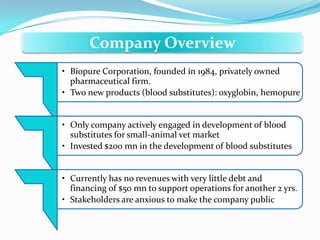
• Biopure Corporation, founded in 1984, privately owned
pharmaceutical firm.
• Two new products (blood substitutes): oxyglobin, hemopure
• Only company actively engaged in development of blood
substitutes for small-animal vet market
• Invested $200 mn in the development of blood substitutes
• Currently has no revenues with very little debt and
financing of $50 mn to support operations for another 2 yrs.
• Stakeholders are anxious to make the company public
Company Overview
Market Overview
1. Human blood market
 Around 14 mn units of RBCs are available from donation
 RBCs: Low rate of donation and short shelf life, thus periodic
shortages
 Demand of RBCs is expected to rise by 2030
 Donated RBCs has a lot of limitations:
 need of exact blood type matching
 reduced O2 carrying efficiency
 limited shelf life
 need of refrigeration
 risk of disease transmission
Market Overview (contd.)
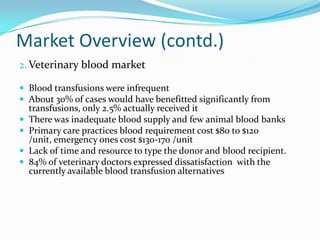
2.Veterinary blood market
 Blood transfusions were infrequent
 About 30% of cases would have benefitted significantly from
transfusions, only 2.5% actually received it
 There was inadequate blood supply and few animal blood banks
 Primary care practices blood requirement cost $80 to $120
/unit, emergency ones cost $130-170 /unit
 Lack of time and resource to type the donor and blood recipient.
 84% of veterinary doctors expressed dissatisfaction with the
currently available blood transfusion alternatives
Competitors for blood substitutes
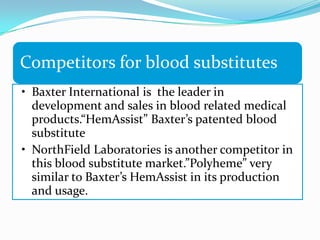
• Baxter International is the leader in
development and sales in blood related medical
products.“HemAssist” Baxter’s patented blood
substitute
• NorthField Laboratories is another competitor in
this blood substitute market.”Polyheme” very
similar to Baxter’s HemAssist in its production
and usage.
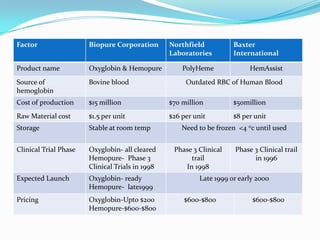
Competitors
Factor Biopure Corporation Northfield
Laboratories
Baxter
International
Product name Oxyglobin & Hemopure PolyHeme HemAssist
Source of
hemoglobin
Bovine blood Outdated RBC of Human Blood
Cost of production $15 million $70 million $50million
Raw Material cost $1.5 per unit $26 per unit $8 per unit
Storage Stable at room temp Need to be frozen <4 0c until used
Clinical Trial Phase Oxyglobin- all cleared
Hemopure- Phase 3
Clinical Trials in 1998
Phase 3 Clinical
trail
In 1998
Phase 3 Clinical trail
in 1996
Expected Launch Oxyglobin- ready
Hemopure- late1999
Late 1999 or early 2000
Pricing Oxyglobin-Upto $200
Hemopure-$600-$800
$600-$800 $600-$800
Problem Statement
Whether Oxyglobin should be launched right
now or wait till Hemopure gets FDA approval.
AND
If Oxyglobin is Launched then How.
?
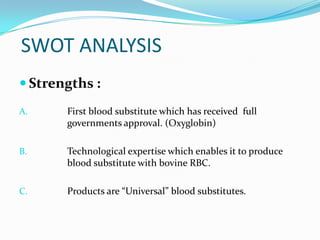
SWOT ANALYSIS
 Strengths :
A. First blood substitute which has received full
governments approval. (Oxyglobin)
B. Technological expertise which enables it to produce
blood substitute with bovine RBC.
C. Products are “Universal” blood substitutes.
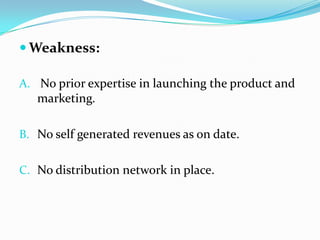
 Weakness:
A. No prior expertise in launching the product and
marketing.
B. No self generated revenues as on date.
C. No distribution network in place.
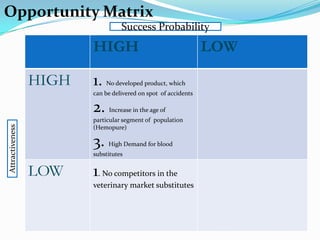
HIGH LOW
HIGH 1. No developed product, which
can be delivered on spot of accidents
2. Increase in the age of
particular segment of population
(Hemopure)
3. High Demand for blood
substitutes
LOW 1. No competitors in the
veterinary market substitutes
Success Probability
AttractivenessOpportunity Matrix
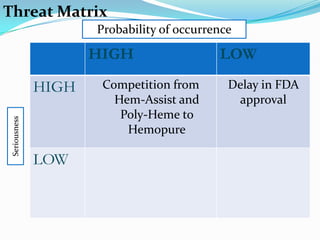
HIGH LOW
HIGH Competition from
Hem-Assist and
Poly-Heme to
Hemopure
Delay in FDA
approval
LOW
Probability of occurrence
SeriousnessThreat Matrix
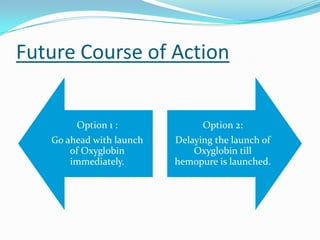
Future Course of Action
Option 1 :
Go ahead with launch
of Oxyglobin
immediately.
Option 2:
Delaying the launch of
Oxyglobin till
hemopure is launched.
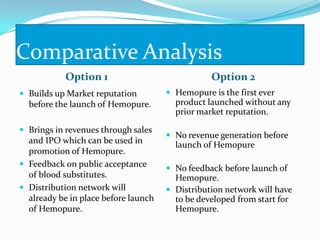
Comparative Analysis
Option 1 Option 2
 Builds up Market reputation
before the launch of Hemopure.
 Brings in revenues through sales
and IPO which can be used in
promotion of Hemopure.
 Feedback on public acceptance
of blood substitutes.
 Distribution network will
already be in place before launch
of Hemopure.
 Hemopure is the first ever
product launched without any
prior market reputation.
 No revenue generation before
launch of Hemopure
 No feedback before launch of
Hemopure.
 Distribution network will have
to be developed from start for
Hemopure.
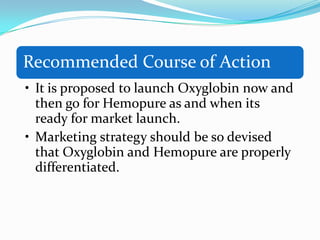
Recommended Course of Action
• It is proposed to launch Oxyglobin now and
then go for Hemopure as and when its
ready for market launch.
• Marketing strategy should be so devised
that Oxyglobin and Hemopure are properly
differentiated.
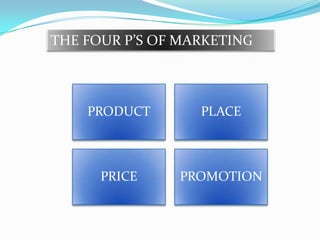
PRODUCT PLACE
PRICE PROMOTION
THE FOUR P’S OF MARKETING
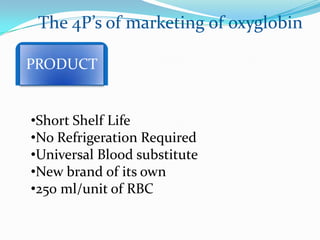
PRODUCT
•Short Shelf Life
•No Refrigeration Required
•Universal Blood substitute
•New brand of its own
•250 ml/unit of RBC
The 4P’s of marketing of oxyglobin
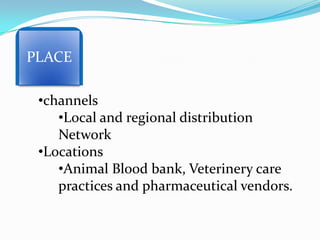
PLACE
•channels
•Local and regional distribution
Network
•Locations
•Animal Blood bank, Veterinery care
practices and pharmaceutical vendors.
 Less initial price
1) Product is new
2) $80-120/unit at primary care centre and $200-
$1000 at emergency
 High initial price
1) Many advantages of new product
2) Very difficult to increase later
3) May not generate expected revenues
 So Price should be between $130-170
PRICE
 Promotions targeting hospitals and doctors
 Differentiating Hemopure and Oxyglobin
 Awareness sessions for doctors
 Training sessions for sales representatives
 Trade publications and trade shows
PROMOTION
Today.....
 The company developed two products: Hemopure for
human use, and Oxyglobin for veterinary use. As of
April 2001, Hemopure was approved for commercial
sale in South Africa for treatment of acute anemia in
general surgery.
 However, Hemopure has not been able to gain
approval in the U.K. or the U.S.
 Biopure ceased operations in 2009 and its assets were
purchased by OPK Biotech LLC in September of 2009.
THANK YOU

Biopure

  • 2.
    • Biopure Corporation,founded in 1984, privately owned pharmaceutical firm. • Two new products (blood substitutes): oxyglobin, hemopure • Only company actively engaged in development of blood substitutes for small-animal vet market • Invested $200 mn in the development of blood substitutes • Currently has no revenues with very little debt and financing of $50 mn to support operations for another 2 yrs. • Stakeholders are anxious to make the company public Company Overview
  • 3.
    Market Overview 1. Humanblood market  Around 14 mn units of RBCs are available from donation  RBCs: Low rate of donation and short shelf life, thus periodic shortages  Demand of RBCs is expected to rise by 2030  Donated RBCs has a lot of limitations:  need of exact blood type matching  reduced O2 carrying efficiency  limited shelf life  need of refrigeration  risk of disease transmission
  • 4.
    Market Overview (contd.) 2.Veterinaryblood market  Blood transfusions were infrequent  About 30% of cases would have benefitted significantly from transfusions, only 2.5% actually received it  There was inadequate blood supply and few animal blood banks  Primary care practices blood requirement cost $80 to $120 /unit, emergency ones cost $130-170 /unit  Lack of time and resource to type the donor and blood recipient.  84% of veterinary doctors expressed dissatisfaction with the currently available blood transfusion alternatives
  • 5.
    Competitors for bloodsubstitutes • Baxter International is the leader in development and sales in blood related medical products.“HemAssist” Baxter’s patented blood substitute • NorthField Laboratories is another competitor in this blood substitute market.”Polyheme” very similar to Baxter’s HemAssist in its production and usage.
  • 6.
    Competitors Factor Biopure CorporationNorthfield Laboratories Baxter International Product name Oxyglobin & Hemopure PolyHeme HemAssist Source of hemoglobin Bovine blood Outdated RBC of Human Blood Cost of production $15 million $70 million $50million Raw Material cost $1.5 per unit $26 per unit $8 per unit Storage Stable at room temp Need to be frozen <4 0c until used Clinical Trial Phase Oxyglobin- all cleared Hemopure- Phase 3 Clinical Trials in 1998 Phase 3 Clinical trail In 1998 Phase 3 Clinical trail in 1996 Expected Launch Oxyglobin- ready Hemopure- late1999 Late 1999 or early 2000 Pricing Oxyglobin-Upto $200 Hemopure-$600-$800 $600-$800 $600-$800
  • 7.
    Problem Statement Whether Oxyglobinshould be launched right now or wait till Hemopure gets FDA approval. AND If Oxyglobin is Launched then How. ?
  • 8.
    SWOT ANALYSIS  Strengths: A. First blood substitute which has received full governments approval. (Oxyglobin) B. Technological expertise which enables it to produce blood substitute with bovine RBC. C. Products are “Universal” blood substitutes.
  • 9.
     Weakness: A. Noprior expertise in launching the product and marketing. B. No self generated revenues as on date. C. No distribution network in place.
  • 10.
    HIGH LOW HIGH 1.No developed product, which can be delivered on spot of accidents 2. Increase in the age of particular segment of population (Hemopure) 3. High Demand for blood substitutes LOW 1. No competitors in the veterinary market substitutes Success Probability AttractivenessOpportunity Matrix
  • 11.
    HIGH LOW HIGH Competitionfrom Hem-Assist and Poly-Heme to Hemopure Delay in FDA approval LOW Probability of occurrence SeriousnessThreat Matrix
  • 12.
    Future Course ofAction Option 1 : Go ahead with launch of Oxyglobin immediately. Option 2: Delaying the launch of Oxyglobin till hemopure is launched.
  • 13.
    Comparative Analysis Option 1Option 2  Builds up Market reputation before the launch of Hemopure.  Brings in revenues through sales and IPO which can be used in promotion of Hemopure.  Feedback on public acceptance of blood substitutes.  Distribution network will already be in place before launch of Hemopure.  Hemopure is the first ever product launched without any prior market reputation.  No revenue generation before launch of Hemopure  No feedback before launch of Hemopure.  Distribution network will have to be developed from start for Hemopure.
  • 14.
    Recommended Course ofAction • It is proposed to launch Oxyglobin now and then go for Hemopure as and when its ready for market launch. • Marketing strategy should be so devised that Oxyglobin and Hemopure are properly differentiated.
  • 15.
    PRODUCT PLACE PRICE PROMOTION THEFOUR P’S OF MARKETING
  • 16.
    PRODUCT •Short Shelf Life •NoRefrigeration Required •Universal Blood substitute •New brand of its own •250 ml/unit of RBC The 4P’s of marketing of oxyglobin
  • 17.
    PLACE •channels •Local and regionaldistribution Network •Locations •Animal Blood bank, Veterinery care practices and pharmaceutical vendors.
  • 18.
     Less initialprice 1) Product is new 2) $80-120/unit at primary care centre and $200- $1000 at emergency  High initial price 1) Many advantages of new product 2) Very difficult to increase later 3) May not generate expected revenues  So Price should be between $130-170 PRICE
  • 19.
     Promotions targetinghospitals and doctors  Differentiating Hemopure and Oxyglobin  Awareness sessions for doctors  Training sessions for sales representatives  Trade publications and trade shows PROMOTION
  • 20.
    Today.....  The companydeveloped two products: Hemopure for human use, and Oxyglobin for veterinary use. As of April 2001, Hemopure was approved for commercial sale in South Africa for treatment of acute anemia in general surgery.  However, Hemopure has not been able to gain approval in the U.K. or the U.S.  Biopure ceased operations in 2009 and its assets were purchased by OPK Biotech LLC in September of 2009.
  • 21.