FUTURE OF COMPETITION POLICY International Institute of Communications TELECOMMUNICATIONS AND MEDIA FORUM Brussels, 29 April 2010
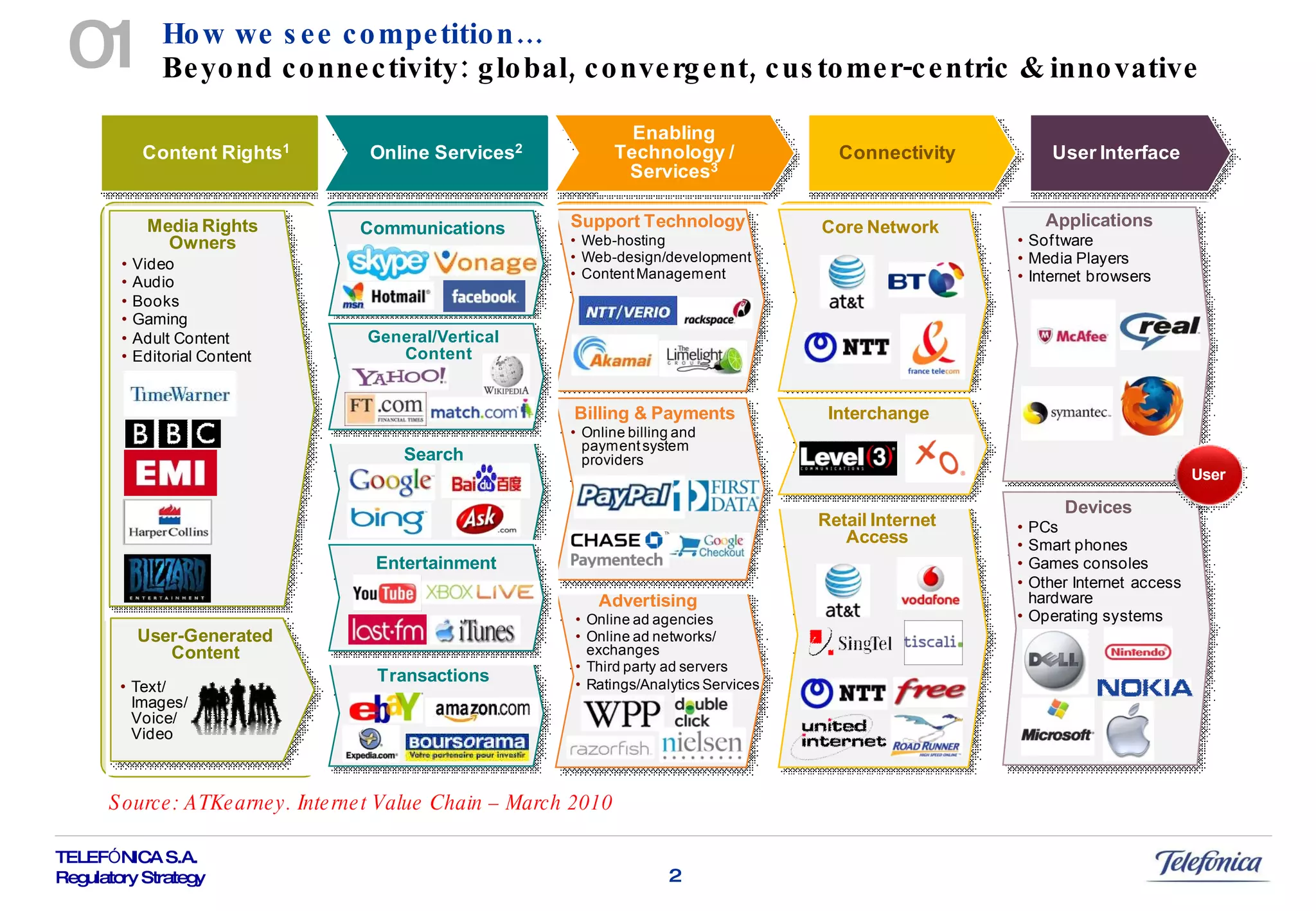
How we see competition… Beyond connectivity: global, convergent, customer-centric & innovative 01 Source: ATKearney. Internet Value Chain – March 2010
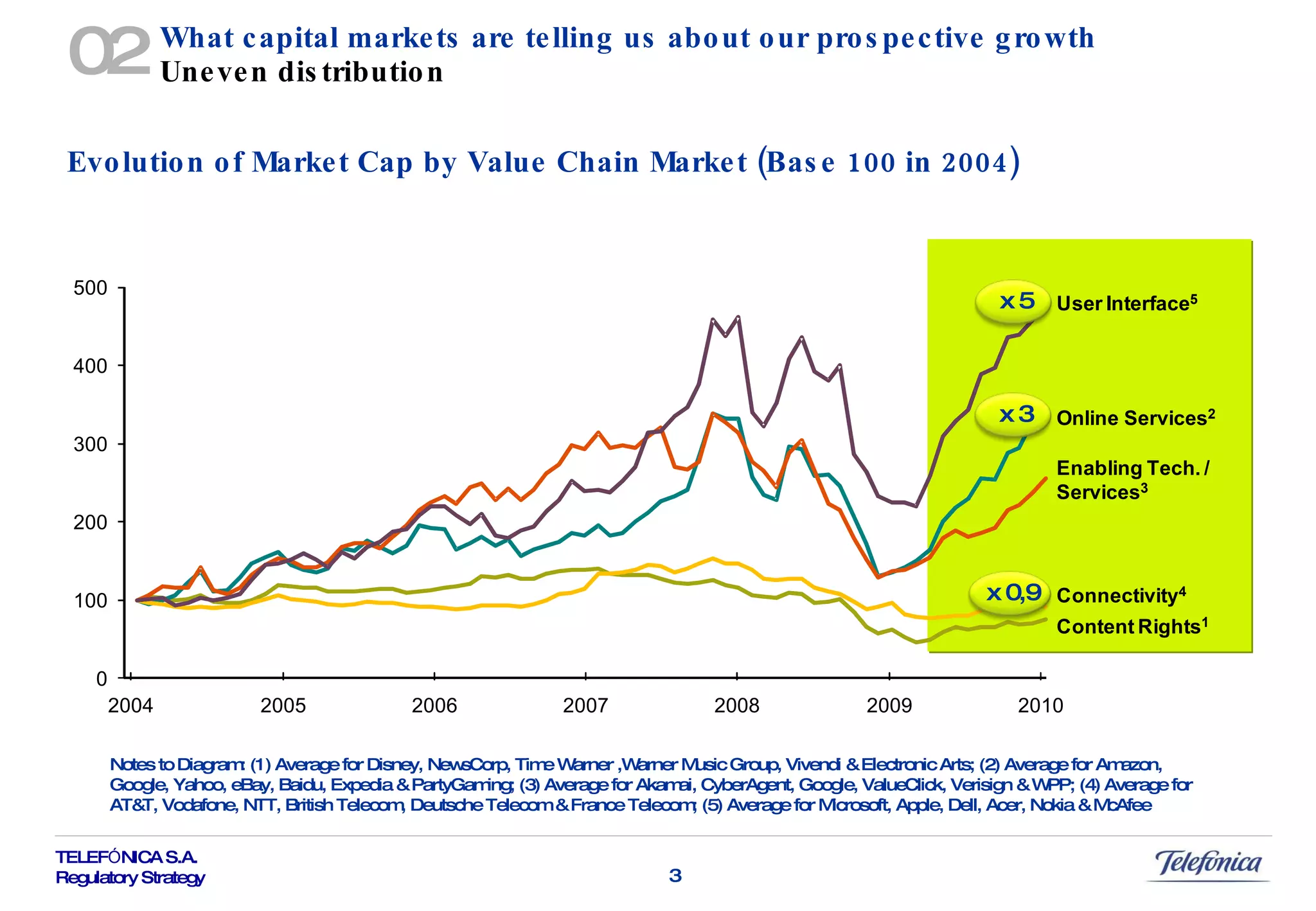
What capital markets are telling us about our prospective growth Uneven distribution Evolution of Market Cap by Value Chain Market (Base 100 in 2004) Notes to Diagram: (1) Average for Disney, NewsCorp, Time Warner ,Warner Music Group, Vivendi & Electronic Arts; (2) Average for Amazon, Google, Yahoo, eBay, Baidu, Expedia & PartyGaming; (3) Average for Akamai, CyberAgent, Google, ValueClick, Verisign & WPP; (4) Average for AT&T, Vodafone, NTT, British Telecom, Deutsche Telecom & France Telecom; (5) Average for Microsoft, Apple, Dell, Acer, Nokia & McAfee 02 x 5 x 0,9 x 3
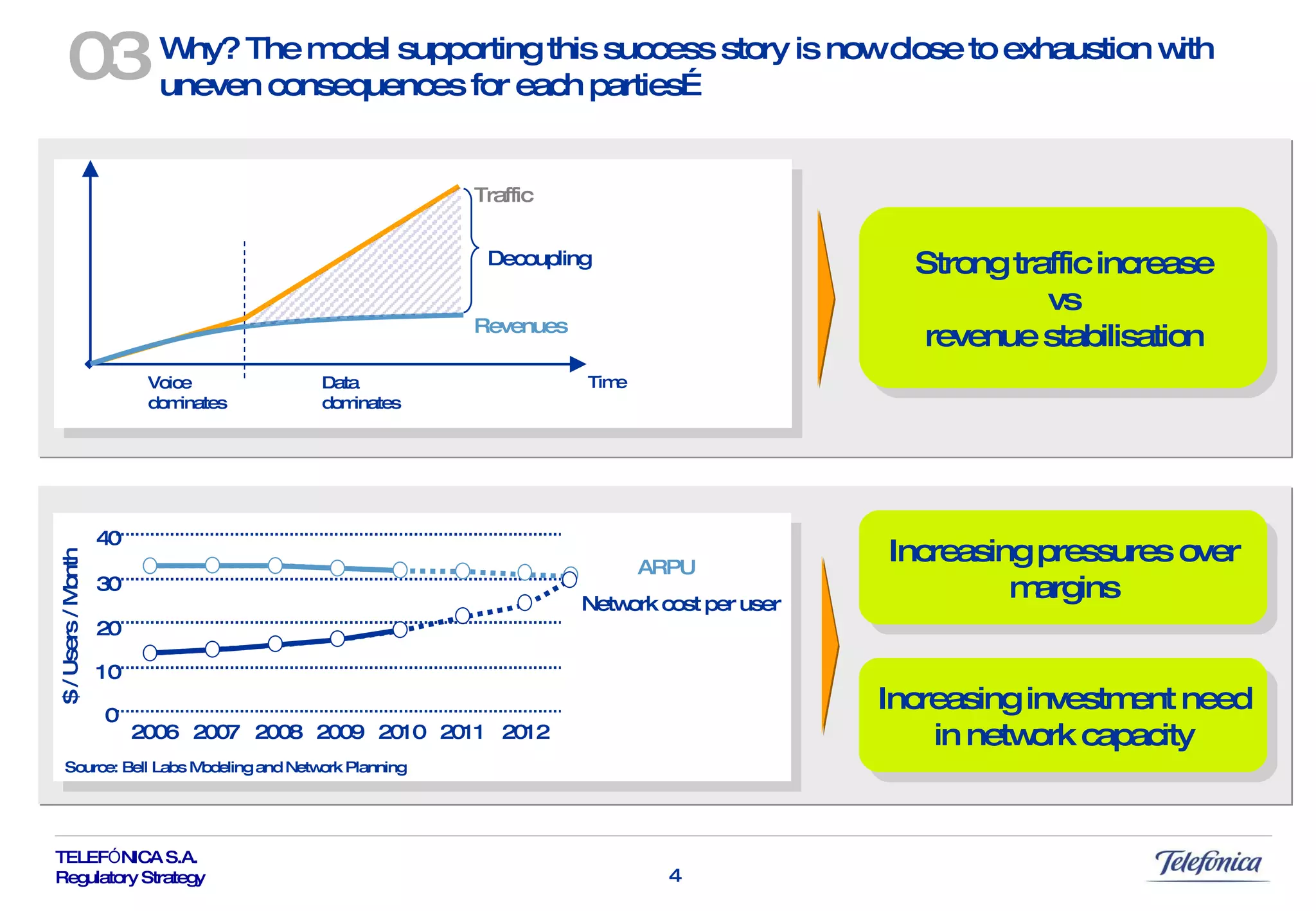
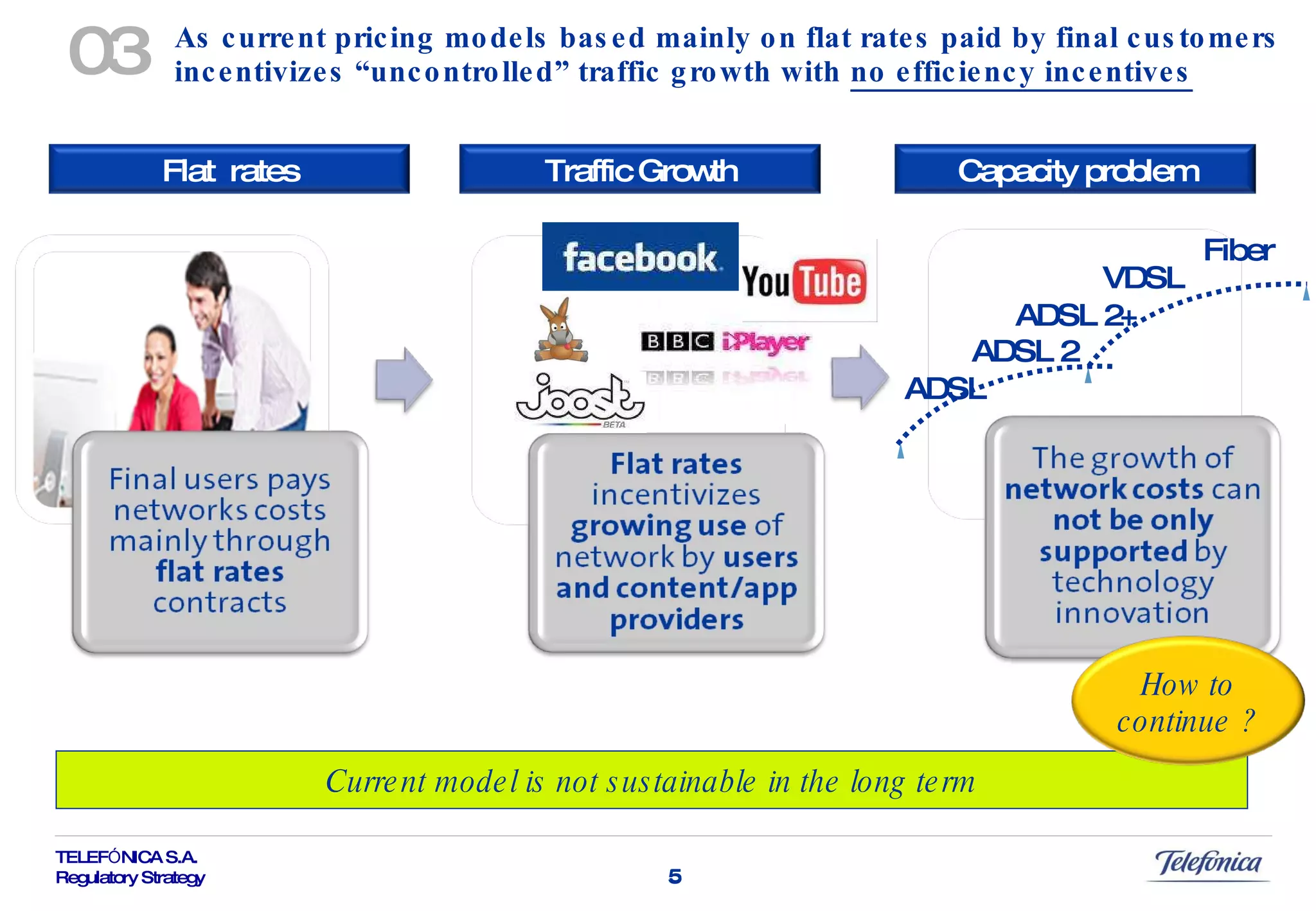
Increasing pressures over margins Strong traffic increase vs revenue stabilisation  Increasing investment need in network capacity Why? The model supporting this success story is now close to exhaustion with uneven consequences for each parties… 03 ARPU Network cost per user $ / Users / Month 0 10 20 30 40 2006 2008 2010 2012 2007 2009 2011 Source: Bell Labs Modeling and Network Planning Time Revenues Voice dominates Data dominates Traffic Decoupling
As current pricing models based mainly on flat rates paid by final customers incentivizes “uncontrolled” traffic growth with  no efficiency incentives ADSL ADSL 2 ADSL 2+ VDSL Fiber Current model is not sustainable in the long term 03 How to continue ? Flat  rates Traffic Growth Capacity problem
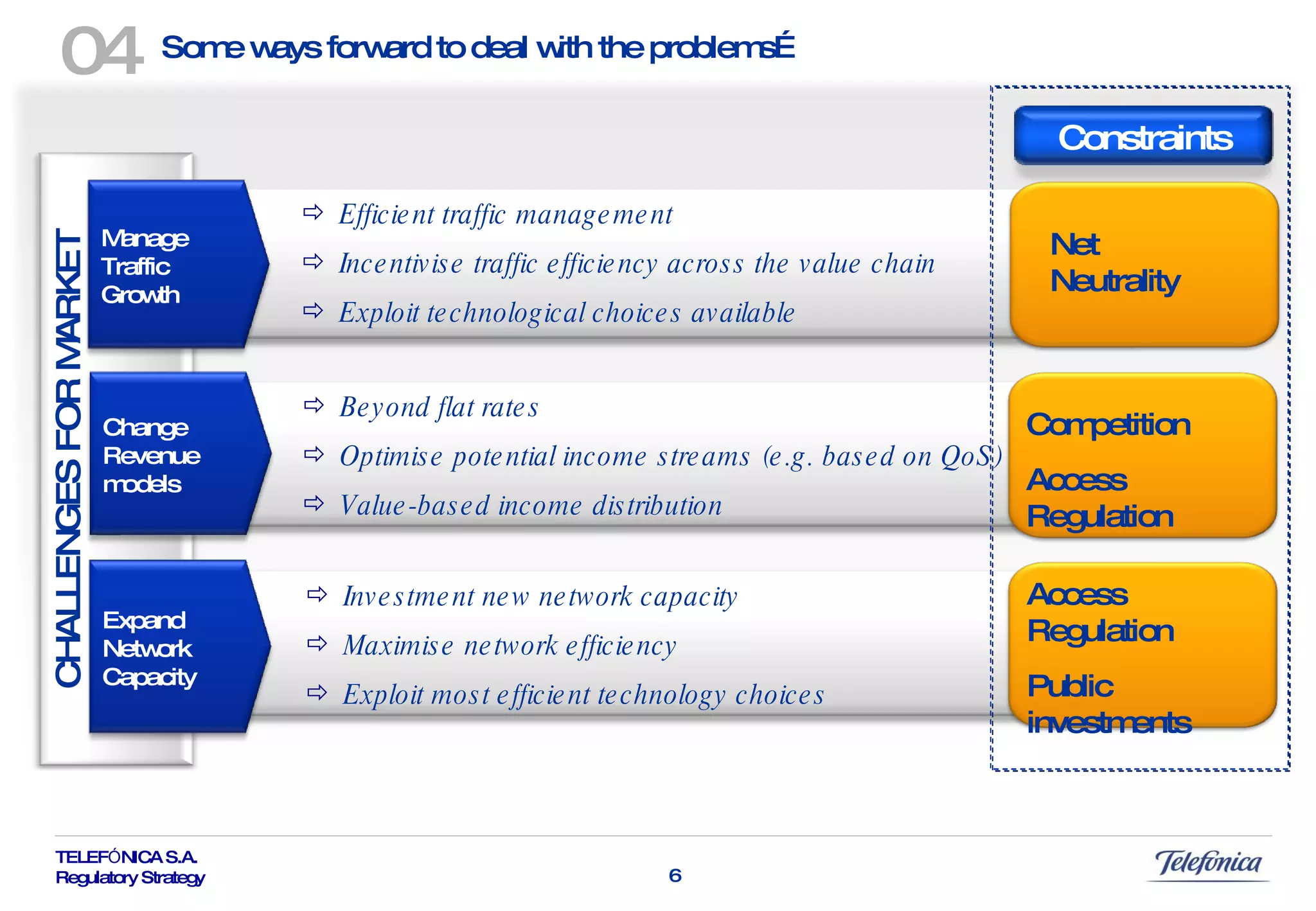
Some ways forward to deal with the problems… 04 Access Regulation Public investments Competition Access Regulation Net Neutrality CHALLENGES FOR MARKET PLAYERS Efficient traffic management Incentivise traffic efficiency across the value chain Exploit technological choices available Beyond flat rates Optimise potential income streams (e.g. based on QoS) Value-based income distribution Change  Revenue  models Investment new network capacity Maximise network efficiency Exploit most efficient technology choices Expand Network  Capacity Manage Traffic Growth Constraints
What about [Competition & Regulatory] Policy ? Competition policy and telecom regulation should play an enabling role while protecting consumers from abuse First and Foremost, see the wood for the trees: Frame the policy challenge in the right context Understand what the problems are and what they are not Second, be consistent with the challenges we need to face: Challenge nº1:   Expand the market Challenge nº2:  Set win-win relationships amongst players in the new Internet ecosystem, i.e. solving current conflicts (decoupling, investment incentives, etc). 05 Revenues Generated by the Internet Industry (2008) Source: ATKearney. Internet Value Chain – March 2010 Both challenges are yet unmet !
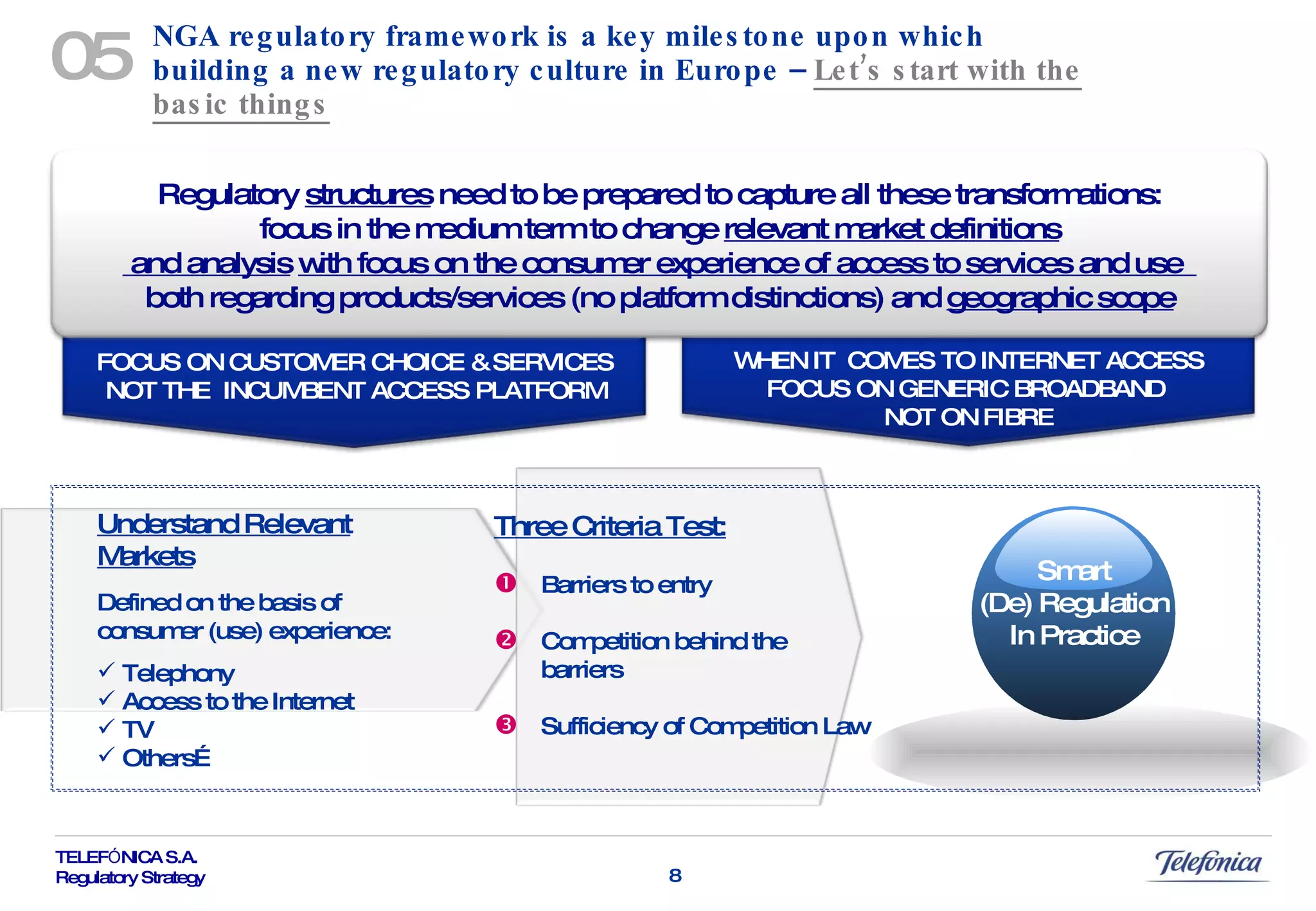
NGA regulatory framework is a key milestone upon which building a new regulatory culture in Europe –  Let’s start with the basic things 05 FOCUS ON CUSTOMER CHOICE & SERVICES NOT THE  INCUMBENT ACCESS PLATFORM WHEN IT  COMES TO INTERNET ACCESS FOCUS ON GENERIC BROADBAND  NOT ON FIBRE Understand Relevant Markets Defined on the basis of consumer (use) experience: Telephony Access to the Internet TV Others… Smart (De) Regulation In Practice Three Criteria Test: Barriers to entry Competition behind the barriers Sufficiency of Competition Law Regulatory  structures  need to be prepared to capture all these transformations: focus in the medium term to change  relevant market definitions and analysis   with focus on the consumer experience of access to services and use  both regarding products/services (no platform distinctions) and  geographic scope
“ The measure of success is not whether you have a tough problem to deal with, but whether it is the same problem you had last year.” John Foster Dulles, US Secretary of State 1953-1959
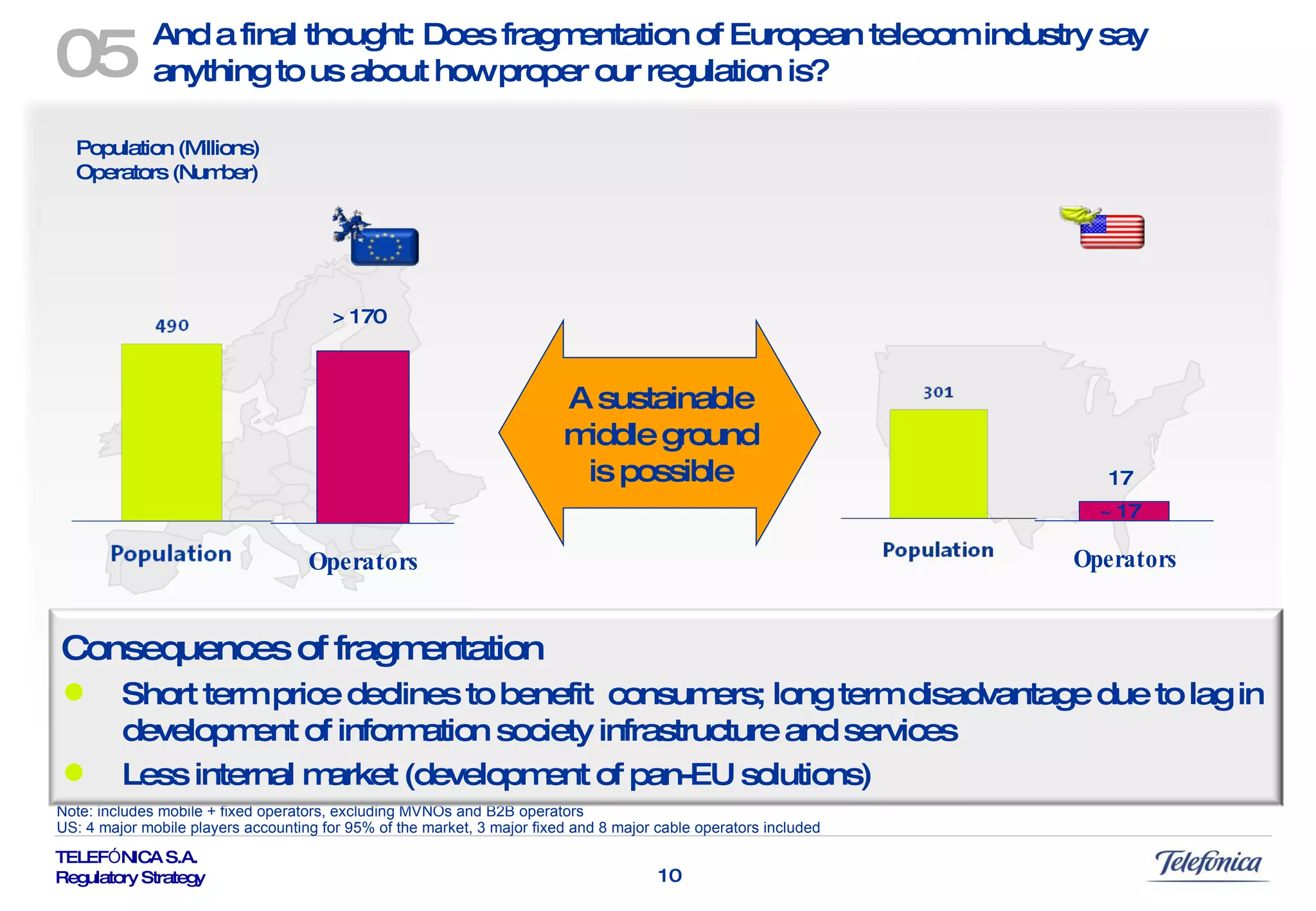
And a final thought: Does fragmentation of European telecom industry say anything to us about how proper our regulation is?  Population (Millions) Operators (Number) Note: includes mobile + fixed operators, excluding MVNOs and B2B operators US: 4 major mobile players accounting for 95% of the market, 3 major fixed and 8 major cable operators included A sustainable middle ground is possible 05 ~ 17 17 > 170 Consequences of fragmentation Short term price declines to benefit  consumers; long term disadvantage due to lag in development of information society infrastructure and services  Less internal market (development of pan-EU solutions)
No grand idea was ever born in a conference, but a lot of foolish ideas have died there ” F. Scott Fitzgerald Q&A
Many Thanks for your attention ! Jerónimo González E:  [email_address] M: + 34 669856098

Jeronimo gonzalez brussels 2010

  • 1.
    FUTURE OF COMPETITIONPOLICY International Institute of Communications TELECOMMUNICATIONS AND MEDIA FORUM Brussels, 29 April 2010
  • 2.
    How we seecompetition… Beyond connectivity: global, convergent, customer-centric & innovative 01 Source: ATKearney. Internet Value Chain – March 2010
  • 3.
    What capital marketsare telling us about our prospective growth Uneven distribution Evolution of Market Cap by Value Chain Market (Base 100 in 2004) Notes to Diagram: (1) Average for Disney, NewsCorp, Time Warner ,Warner Music Group, Vivendi & Electronic Arts; (2) Average for Amazon, Google, Yahoo, eBay, Baidu, Expedia & PartyGaming; (3) Average for Akamai, CyberAgent, Google, ValueClick, Verisign & WPP; (4) Average for AT&T, Vodafone, NTT, British Telecom, Deutsche Telecom & France Telecom; (5) Average for Microsoft, Apple, Dell, Acer, Nokia & McAfee 02 x 5 x 0,9 x 3
  • 4.
    Increasing pressures overmargins Strong traffic increase vs revenue stabilisation Increasing investment need in network capacity Why? The model supporting this success story is now close to exhaustion with uneven consequences for each parties… 03 ARPU Network cost per user $ / Users / Month 0 10 20 30 40 2006 2008 2010 2012 2007 2009 2011 Source: Bell Labs Modeling and Network Planning Time Revenues Voice dominates Data dominates Traffic Decoupling
  • 5.
    As current pricingmodels based mainly on flat rates paid by final customers incentivizes “uncontrolled” traffic growth with no efficiency incentives ADSL ADSL 2 ADSL 2+ VDSL Fiber Current model is not sustainable in the long term 03 How to continue ? Flat rates Traffic Growth Capacity problem
  • 6.
    Some ways forwardto deal with the problems… 04 Access Regulation Public investments Competition Access Regulation Net Neutrality CHALLENGES FOR MARKET PLAYERS Efficient traffic management Incentivise traffic efficiency across the value chain Exploit technological choices available Beyond flat rates Optimise potential income streams (e.g. based on QoS) Value-based income distribution Change Revenue models Investment new network capacity Maximise network efficiency Exploit most efficient technology choices Expand Network Capacity Manage Traffic Growth Constraints
  • 7.
    What about [Competition& Regulatory] Policy ? Competition policy and telecom regulation should play an enabling role while protecting consumers from abuse First and Foremost, see the wood for the trees: Frame the policy challenge in the right context Understand what the problems are and what they are not Second, be consistent with the challenges we need to face: Challenge nº1: Expand the market Challenge nº2: Set win-win relationships amongst players in the new Internet ecosystem, i.e. solving current conflicts (decoupling, investment incentives, etc). 05 Revenues Generated by the Internet Industry (2008) Source: ATKearney. Internet Value Chain – March 2010 Both challenges are yet unmet !
  • 8.
    NGA regulatory frameworkis a key milestone upon which building a new regulatory culture in Europe – Let’s start with the basic things 05 FOCUS ON CUSTOMER CHOICE & SERVICES NOT THE INCUMBENT ACCESS PLATFORM WHEN IT COMES TO INTERNET ACCESS FOCUS ON GENERIC BROADBAND NOT ON FIBRE Understand Relevant Markets Defined on the basis of consumer (use) experience: Telephony Access to the Internet TV Others… Smart (De) Regulation In Practice Three Criteria Test: Barriers to entry Competition behind the barriers Sufficiency of Competition Law Regulatory structures need to be prepared to capture all these transformations: focus in the medium term to change relevant market definitions and analysis with focus on the consumer experience of access to services and use both regarding products/services (no platform distinctions) and geographic scope
  • 9.
    “ The measureof success is not whether you have a tough problem to deal with, but whether it is the same problem you had last year.” John Foster Dulles, US Secretary of State 1953-1959
  • 10.
    And a finalthought: Does fragmentation of European telecom industry say anything to us about how proper our regulation is? Population (Millions) Operators (Number) Note: includes mobile + fixed operators, excluding MVNOs and B2B operators US: 4 major mobile players accounting for 95% of the market, 3 major fixed and 8 major cable operators included A sustainable middle ground is possible 05 ~ 17 17 > 170 Consequences of fragmentation Short term price declines to benefit consumers; long term disadvantage due to lag in development of information society infrastructure and services Less internal market (development of pan-EU solutions)
  • 11.
    No grand ideawas ever born in a conference, but a lot of foolish ideas have died there ” F. Scott Fitzgerald Q&A
  • 12.
    Many Thanks foryour attention ! Jerónimo González E: [email_address] M: + 34 669856098