Public funding for broadband  and State aid rules Norbert GAAL DG Competition – State Aid Directorate Information, Communication and Media European Commission CONFERENCE of the European State Aid Law Institute The King‘s College, London 27 November 2009
Outline The role of State aid control Broadband Guidelines The role of public authorities
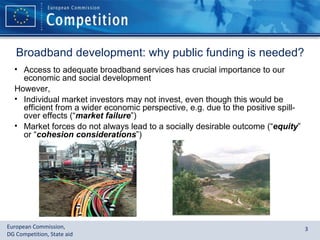
Broadband development: why public funding is needed? Access to adequate broadband services has crucial importance to our economic and social development However,  Individual market investors may not invest, even though this would be efficient from a wider economic perspective, e.g. due to the positive spill-over effects (“ market failure ”) Market forces do not always lead to a socially desirable outcome (“ equity ” or “ cohesion considerations ”)
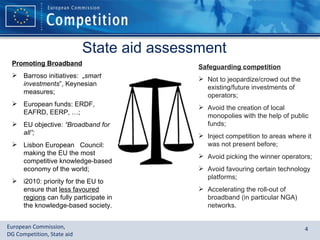
State aid assessment Promoting Broadband Barroso initiatives:  „ smart investments ”, Keynesian measures; European funds: ERDF, EAFRD, EERP, …; EU objective:  “Broadband for all”; Lisbon European  Council: making the EU the most competitive knowledge-based economy of the world; i2010: priority for the EU to ensure that  less favoured regions  can fully participate in the knowledge-based society. Safeguarding competition Not to jeopardize/crowd out the existing/future investments of operators; Avoid the creation of local monopolies with the help of public funds; Inject competition to areas where it was not present before; Avoid picking the winner operators; Avoid favouring certain technology platforms; Accelerating the roll-out of broadband (in particular NGA) networks.
Outline The role of State aid control Broadband Guidelines The role of public authorities
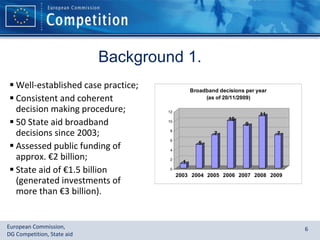
Background 1. Well-established case practice; Consistent and coherent decision making procedure; 50 State aid broadband decisions since 2003; Assessed public funding of approx. €2 billion;  State aid of €1.5 billion (generated investments of more than €3 billion).
Background 2. Economic developments Broadband is on the top of the agenda of the European Commission; “ Smart investments ” are able to bring short term (employment) benefits and long term (economic) gains; Increased public funding is available to broadband networks; The Commission earmarked  € 1 billion as part of European Economic Recovery Plans for broadband. Market developments Major technology shift is under way (roll-out of Next Generation Access networks); Investments to NGA networks require billions of euros of investment; The size of “white NGA areas” will be much larger as comapred with traditional broadband.
Adoption procedure 19 May 2009 - Publication of the draft Broadband Guidelines and start of public consultation; 22 June 2009 - Multilateral meeting with Member States and closing of consultation period; Almost 100 comments received during public consultation; 17 September 2009 – The Commission adopts the Guidelines; 30 September 2009 - Publication in the EU Official Journal.
Objectives of the Guidelines Increase transparency in the Commission’s decision making procedure;  Provide clarity for stakeholders and guidance to local authorities; Accelerate Commission decision-making procedure; Introduction of new State aid procedures: Simplified procedure; Accelerate NGA/broadband investment Central document for public authorities NGA investment timeframe of 3 years
Outline Introduction The role of State aid control Broadband Guidelines The role of public authorities
Role of public authorities Different degrees of market intervention to accelerate NGA deployment. Non aid (administrative/regulatory) measures to foster NGA deployment of commercial operators If no such plans, public authorities may finance open access networks
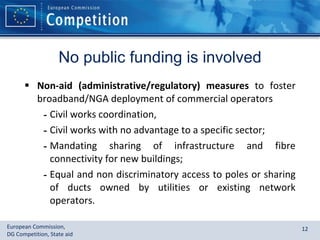
No public funding is involved Non-aid (administrative/regulatory) measures  to foster broadband/NGA deployment of commercial operators Civil works coordination,  Civil works with no advantage to a specific sector; Mandating sharing of infrastructure and fibre connectivity for new buildings; Equal and non discriminatory access to poles or sharing of ducts owned by utilities or existing network operators.
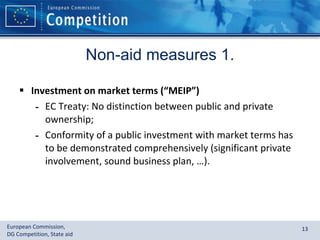
Non-aid measures 1. Investment on market terms (“MEIP”) EC Treaty: No distinction between public and private ownership; Conformity of a public investment with market terms has to be demonstrated comprehensively (significant private involvement, sound business plan, …).
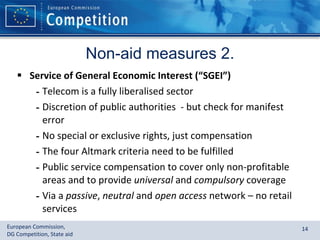
Non-aid measures 2. Service of General Economic Interest (“SGEI”) Telecom is a fully liberalised sector Discretion of public authorities  - but check for manifest error No special or exclusive rights, just compensation The four Altmark criteria need to be fulfilled Public service compensation to cover only non-profitable areas and to provide  universal  and  compulsory  coverage Via a  passive ,  neutral  and  open access  network – no retail services
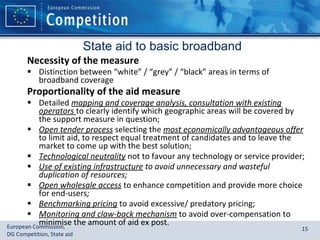
State aid to basic broadband Necessity of the measure Distinction between “white” / “grey” / “black” areas in terms of broadband coverage Proportionality of the aid measure Detailed   mapping and coverage analysis, consultation with existing operators  to clearly identify which geographic areas will be covered by the support measure in question; Open tender process  selecting the  most economically advantageous offer   to limit aid, to respect equal treatment of candidates and to leave the market to come up with the best solution; Technological neutrality   not to favour any technology or service provider;  Use of existing infrastructure  to avoid unnecessary and wasteful duplication of resources; Open wholesale access   to enhance competition and provide more choice for end-users ; Benchmarking pricing   to avoid excessive/ predatory pricing; Monitoring and claw-back mechanism   to avoid over-compensation to minimise the amount of aid ex post.
State aid to NGA networks Necessity of the measure No credible private NGA investment within 3 years could justify public intervention Additional proportionality criteria Core safeguards Access obligation imposed should also include access to passive and not only active infrastructure NRAs shall be consulted in setting the conditions for wholesale network access (prices, compliance with the open access provisions, …) The network architecture that will benefit from State aid, should support effective and full unbundling and satisfy all different types of network access that operators may seek
* For individual aid measures if the scheme was approved by the Commission - until the end of 2010 Simplified overview No SA notification Presence of State aid? Small amount of aid? “ White areas”? “ Grey areas”? Simplified procedure Standard SA assessment State aid yes No/ not applicable no yes yes SA notification SGEI / MEIP “ De minimis” no yes GBER / TF* “ Black areas?” no Incompatible SA yes Administrative and regulatory measures no Distortion of competition
THANK YOU FOR YOUR ATTENTION!

20091127 Ec Gaal Estali 2

  • 1.
    Public funding forbroadband and State aid rules Norbert GAAL DG Competition – State Aid Directorate Information, Communication and Media European Commission CONFERENCE of the European State Aid Law Institute The King‘s College, London 27 November 2009
  • 2.
    Outline The roleof State aid control Broadband Guidelines The role of public authorities
  • 3.
    Broadband development: whypublic funding is needed? Access to adequate broadband services has crucial importance to our economic and social development However, Individual market investors may not invest, even though this would be efficient from a wider economic perspective, e.g. due to the positive spill-over effects (“ market failure ”) Market forces do not always lead to a socially desirable outcome (“ equity ” or “ cohesion considerations ”)
  • 4.
    State aid assessmentPromoting Broadband Barroso initiatives: „ smart investments ”, Keynesian measures; European funds: ERDF, EAFRD, EERP, …; EU objective: “Broadband for all”; Lisbon European Council: making the EU the most competitive knowledge-based economy of the world; i2010: priority for the EU to ensure that less favoured regions can fully participate in the knowledge-based society. Safeguarding competition Not to jeopardize/crowd out the existing/future investments of operators; Avoid the creation of local monopolies with the help of public funds; Inject competition to areas where it was not present before; Avoid picking the winner operators; Avoid favouring certain technology platforms; Accelerating the roll-out of broadband (in particular NGA) networks.
  • 5.
    Outline The roleof State aid control Broadband Guidelines The role of public authorities
  • 6.
    Background 1. Well-establishedcase practice; Consistent and coherent decision making procedure; 50 State aid broadband decisions since 2003; Assessed public funding of approx. €2 billion; State aid of €1.5 billion (generated investments of more than €3 billion).
  • 7.
    Background 2. Economicdevelopments Broadband is on the top of the agenda of the European Commission; “ Smart investments ” are able to bring short term (employment) benefits and long term (economic) gains; Increased public funding is available to broadband networks; The Commission earmarked € 1 billion as part of European Economic Recovery Plans for broadband. Market developments Major technology shift is under way (roll-out of Next Generation Access networks); Investments to NGA networks require billions of euros of investment; The size of “white NGA areas” will be much larger as comapred with traditional broadband.
  • 8.
    Adoption procedure 19May 2009 - Publication of the draft Broadband Guidelines and start of public consultation; 22 June 2009 - Multilateral meeting with Member States and closing of consultation period; Almost 100 comments received during public consultation; 17 September 2009 – The Commission adopts the Guidelines; 30 September 2009 - Publication in the EU Official Journal.
  • 9.
    Objectives of theGuidelines Increase transparency in the Commission’s decision making procedure; Provide clarity for stakeholders and guidance to local authorities; Accelerate Commission decision-making procedure; Introduction of new State aid procedures: Simplified procedure; Accelerate NGA/broadband investment Central document for public authorities NGA investment timeframe of 3 years
  • 10.
    Outline Introduction Therole of State aid control Broadband Guidelines The role of public authorities
  • 11.
    Role of publicauthorities Different degrees of market intervention to accelerate NGA deployment. Non aid (administrative/regulatory) measures to foster NGA deployment of commercial operators If no such plans, public authorities may finance open access networks
  • 12.
    No public fundingis involved Non-aid (administrative/regulatory) measures to foster broadband/NGA deployment of commercial operators Civil works coordination, Civil works with no advantage to a specific sector; Mandating sharing of infrastructure and fibre connectivity for new buildings; Equal and non discriminatory access to poles or sharing of ducts owned by utilities or existing network operators.
  • 13.
    Non-aid measures 1.Investment on market terms (“MEIP”) EC Treaty: No distinction between public and private ownership; Conformity of a public investment with market terms has to be demonstrated comprehensively (significant private involvement, sound business plan, …).
  • 14.
    Non-aid measures 2.Service of General Economic Interest (“SGEI”) Telecom is a fully liberalised sector Discretion of public authorities - but check for manifest error No special or exclusive rights, just compensation The four Altmark criteria need to be fulfilled Public service compensation to cover only non-profitable areas and to provide universal and compulsory coverage Via a passive , neutral and open access network – no retail services
  • 15.
    State aid tobasic broadband Necessity of the measure Distinction between “white” / “grey” / “black” areas in terms of broadband coverage Proportionality of the aid measure Detailed mapping and coverage analysis, consultation with existing operators to clearly identify which geographic areas will be covered by the support measure in question; Open tender process selecting the most economically advantageous offer to limit aid, to respect equal treatment of candidates and to leave the market to come up with the best solution; Technological neutrality not to favour any technology or service provider; Use of existing infrastructure to avoid unnecessary and wasteful duplication of resources; Open wholesale access to enhance competition and provide more choice for end-users ; Benchmarking pricing to avoid excessive/ predatory pricing; Monitoring and claw-back mechanism to avoid over-compensation to minimise the amount of aid ex post.
  • 16.
    State aid toNGA networks Necessity of the measure No credible private NGA investment within 3 years could justify public intervention Additional proportionality criteria Core safeguards Access obligation imposed should also include access to passive and not only active infrastructure NRAs shall be consulted in setting the conditions for wholesale network access (prices, compliance with the open access provisions, …) The network architecture that will benefit from State aid, should support effective and full unbundling and satisfy all different types of network access that operators may seek
  • 17.
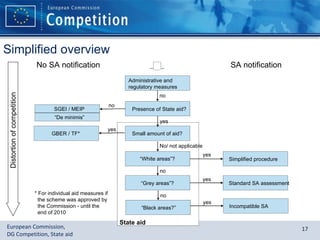
    * For individualaid measures if the scheme was approved by the Commission - until the end of 2010 Simplified overview No SA notification Presence of State aid? Small amount of aid? “ White areas”? “ Grey areas”? Simplified procedure Standard SA assessment State aid yes No/ not applicable no yes yes SA notification SGEI / MEIP “ De minimis” no yes GBER / TF* “ Black areas?” no Incompatible SA yes Administrative and regulatory measures no Distortion of competition
  • 18.
    THANK YOU FORYOUR ATTENTION!

Editor's Notes

  • #2 European Commission, DG Competition [Directorate], [Unit]
  • #3 European Commission, DG Competition [Directorate], [Unit]
  • #4 European Commission, DG Competition [Directorate], [Unit]
  • #5 European Commission, DG Competition [Directorate], [Unit] 12/08/06
  • #6 European Commission, DG Competition [Directorate], [Unit]
  • #7 European Commission, DG Competition [Directorate], [Unit]
  • #11 European Commission, DG Competition [Directorate], [Unit]
  • #16 European Commission, DG Competition [Directorate], [Unit]
  • #18 European Commission, DG Competition [Directorate], [Unit]
  • #19 European Commission, DG Competition [Directorate], [Unit]