Daniel Arias Director, Regulatory Affairs, Latin America Telefónica  Internacional SA 1st. December 2009 Considering intervention in BB markets in Latin America
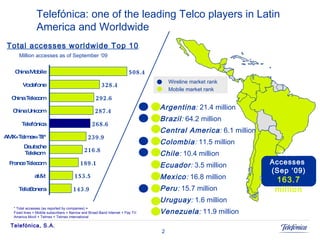
Telefónica: one of the leading Telco players in Latin America and Worldwide * Total accesses (as reported by companies) = Fixed lines + Mobile subscribers + Narrow and Broad Band Internet + Pay TV. America Movil + Telmex + Telmex international Total accesses worldwide Top 10 Million accesses as of September ‘09 Total Accesses  (Sep ‘09) 163.7 million Argentina :  21.4 million Brazil :  64.2 million Central America :  6.1 million Colombia :  11.5 million Chile :  10.4 million Ecuador :  3.5 million   Mexico :  16.8 million Peru :  15.7 million Uruguay :  1.6 million Venezuela :  11.9 million 2 1 1 2 2 1 1 1 2 2 1 1 1 2 2 Wireline market rank  Mobile market rank
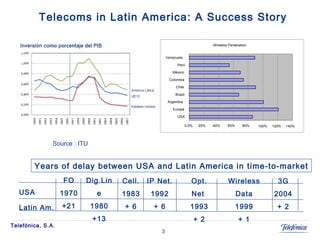
Telecoms in Latin America: A Success Story Years of delay between USA and Latin America in time-to-market USA Latin Am. FO 1970 +21 Dig.Line 1980 +13 Cell. 1983 + 6 IP Net. 1992 + 6 Opt. Net  1993 + 2 Wireless Data 1999 + 1 3G 2004 + 2 Source : ITU Wireless Penetration 0,0% 20% 40% 60% 80% 100% 120% 140% USA Europa Argentina Brasil Chile  Colombia México Perú Venezuela
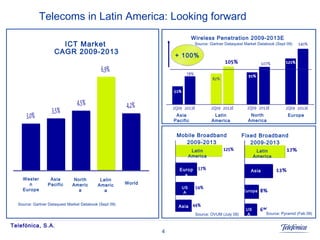
Telecoms in Latin America: Looking forward ICT Market CAGR 2009-2013 Western Europe Asia Pacific North America Latin America World Source: Gartner Dataquest Market Databook (Sept 09) Source: Gartner Dataquest Market Databook (Sept 09) Asia Pacific Latin America North America Europe + 100% Wireless Penetration 2009-2013E Mobile Broadband 2009-2013 Fixed Broadband 2009-2013 Latin America Latin America Europa Asia Europa USA USA Asia Source: OVUM (July 09) Source: Pyramid (Feb 09)
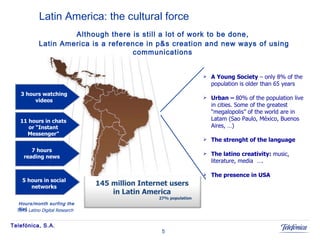
Latin America: the cultural force Although there is still a lot of work to be done,  Latin America is a reference in p&s creation and new ways of using communications  Hours/month surfing the Net Terra Latino Digital Research 3 hours watching videos 11 hours in chats or “Instant Messenger” 7 hours reading news 5 hours in social networks A Young Society  – only 8% of the population is older than 65 years Urban –  80% of the population live in cities. Some of the greatest  “megalopolis” of the world are in Latam (Sao Paulo, México, Buenos Aires, …) The strenght of the language The latino creativity:  music, literature, media  …. The presence in USA 145 million Internet users in Latin America 27% population
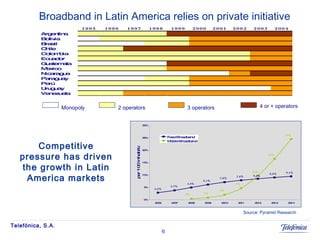
Broadband in Latin America relies on private initiative Monopoly 2 operators 3 operators 4 or + operators Competitive pressure has driven the growth in Latin America markets Source: Pyramid Research
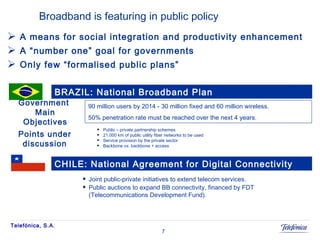
Broadband is featuring in public policy A means for social integration and productivity enhancement A “number one” goal for governments Only few “formalised public plans”  BRAZIL: National Broadband Plan 90 million users by 2014 - 30 million fixed and 60 million wireless.  50% penetration rate must be reached over the next 4 years.  Government  Main Objectives Public – private partnership schemes 21,000 km of public utility fiber networks to be used  Service provision by the private sector Backbone vs. backbone + access  Points under discussion CHILE:  National Agreement for Digital Connectivity Joint public-private initiatives to extend telecom services. Public auctions to expand BB connectivity, financed by FDT (Telecommunications Development Fund).
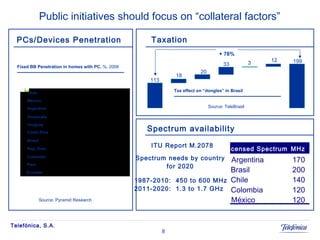
Public initiatives should focus on “collateral factors” PCs/Devices Penetration Chile México Argentina Venezuela Uruguay Costa Rica Brasil Rep. Dom. Colombia Peru Ecuador Source: Pyramid Research Taxation Spectrum availability + 76% 113 33 18 20 3 12 199 Source: TeleBrasil Licensed Spectrum  MHz Argentina 170 Brasil 200 Chile 140 Colombia 120 México 120 ITU Report M.2078 Spectrum needs by country for 2020 1987-2010:  450 to 600 MHz 2011-2020:  1.3 to 1.7 GHz Fixed BB Penetration in homes with PC,  %, 2008 Tax effect on “dongles” in Brasil
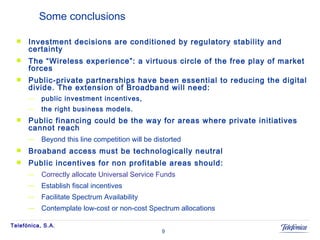
Some conclusions Investment decisions are conditioned by regulatory stability and certainty The “Wireless experience”: a virtuous circle of the free play of market forces Public-private partnerships have been essential to reducing the digital divide. The extension of Broadband will need:  public investment incentives, the right business models. Public financing could be the way for areas where private initiatives cannot reach Beyond this line competition will be distorted Broaband access must be technologically neutral Public incentives for non profitable areas should: Correctly allocate Universal Service Funds Establish fiscal incentives Facilitate Spectrum Availability Contemplate low-cost or non-cost Spectrum allocations
 

Latin American broadband policymaking

  • 1.
    Daniel Arias Director,Regulatory Affairs, Latin America Telefónica Internacional SA 1st. December 2009 Considering intervention in BB markets in Latin America
  • 2.
    Telefónica: one ofthe leading Telco players in Latin America and Worldwide * Total accesses (as reported by companies) = Fixed lines + Mobile subscribers + Narrow and Broad Band Internet + Pay TV. America Movil + Telmex + Telmex international Total accesses worldwide Top 10 Million accesses as of September ‘09 Total Accesses (Sep ‘09) 163.7 million Argentina : 21.4 million Brazil : 64.2 million Central America : 6.1 million Colombia : 11.5 million Chile : 10.4 million Ecuador : 3.5 million Mexico : 16.8 million Peru : 15.7 million Uruguay : 1.6 million Venezuela : 11.9 million 2 1 1 2 2 1 1 1 2 2 1 1 1 2 2 Wireline market rank Mobile market rank
  • 3.
    Telecoms in LatinAmerica: A Success Story Years of delay between USA and Latin America in time-to-market USA Latin Am. FO 1970 +21 Dig.Line 1980 +13 Cell. 1983 + 6 IP Net. 1992 + 6 Opt. Net 1993 + 2 Wireless Data 1999 + 1 3G 2004 + 2 Source : ITU Wireless Penetration 0,0% 20% 40% 60% 80% 100% 120% 140% USA Europa Argentina Brasil Chile Colombia México Perú Venezuela
  • 4.
    Telecoms in LatinAmerica: Looking forward ICT Market CAGR 2009-2013 Western Europe Asia Pacific North America Latin America World Source: Gartner Dataquest Market Databook (Sept 09) Source: Gartner Dataquest Market Databook (Sept 09) Asia Pacific Latin America North America Europe + 100% Wireless Penetration 2009-2013E Mobile Broadband 2009-2013 Fixed Broadband 2009-2013 Latin America Latin America Europa Asia Europa USA USA Asia Source: OVUM (July 09) Source: Pyramid (Feb 09)
  • 5.
    Latin America: thecultural force Although there is still a lot of work to be done, Latin America is a reference in p&s creation and new ways of using communications Hours/month surfing the Net Terra Latino Digital Research 3 hours watching videos 11 hours in chats or “Instant Messenger” 7 hours reading news 5 hours in social networks A Young Society – only 8% of the population is older than 65 years Urban – 80% of the population live in cities. Some of the greatest “megalopolis” of the world are in Latam (Sao Paulo, México, Buenos Aires, …) The strenght of the language The latino creativity: music, literature, media …. The presence in USA 145 million Internet users in Latin America 27% population
  • 6.
    Broadband in LatinAmerica relies on private initiative Monopoly 2 operators 3 operators 4 or + operators Competitive pressure has driven the growth in Latin America markets Source: Pyramid Research
  • 7.
    Broadband is featuringin public policy A means for social integration and productivity enhancement A “number one” goal for governments Only few “formalised public plans” BRAZIL: National Broadband Plan 90 million users by 2014 - 30 million fixed and 60 million wireless. 50% penetration rate must be reached over the next 4 years. Government Main Objectives Public – private partnership schemes 21,000 km of public utility fiber networks to be used Service provision by the private sector Backbone vs. backbone + access Points under discussion CHILE: National Agreement for Digital Connectivity Joint public-private initiatives to extend telecom services. Public auctions to expand BB connectivity, financed by FDT (Telecommunications Development Fund).
  • 8.
    Public initiatives shouldfocus on “collateral factors” PCs/Devices Penetration Chile México Argentina Venezuela Uruguay Costa Rica Brasil Rep. Dom. Colombia Peru Ecuador Source: Pyramid Research Taxation Spectrum availability + 76% 113 33 18 20 3 12 199 Source: TeleBrasil Licensed Spectrum MHz Argentina 170 Brasil 200 Chile 140 Colombia 120 México 120 ITU Report M.2078 Spectrum needs by country for 2020 1987-2010: 450 to 600 MHz 2011-2020: 1.3 to 1.7 GHz Fixed BB Penetration in homes with PC, %, 2008 Tax effect on “dongles” in Brasil
  • 9.
    Some conclusions Investmentdecisions are conditioned by regulatory stability and certainty The “Wireless experience”: a virtuous circle of the free play of market forces Public-private partnerships have been essential to reducing the digital divide. The extension of Broadband will need: public investment incentives, the right business models. Public financing could be the way for areas where private initiatives cannot reach Beyond this line competition will be distorted Broaband access must be technologically neutral Public incentives for non profitable areas should: Correctly allocate Universal Service Funds Establish fiscal incentives Facilitate Spectrum Availability Contemplate low-cost or non-cost Spectrum allocations
  • 10.