BEST PRACTICES IN
BUSINESS WRITING
& COMMUNICATION
Terri Jensen
ORG536 – Contemporary Business Writing and Communication
Colorado State University – Global Campus
Dr. Robert Olszewski
June 1, 2014
Introduction
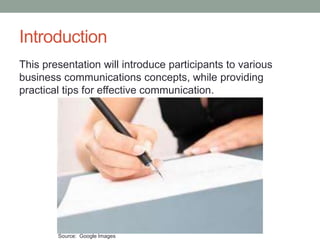
This presentation will introduce participants to various
business communications concepts, while providing
practical tips for effective communication.
Source: Google Images
Today’s Topics
• Enhancing the workplace through effective communication
• Communicating effectively
• Communication tools
ENHANCING THE
WORKPLACE THROUGH
EFFECTIVE COMMUNICATION
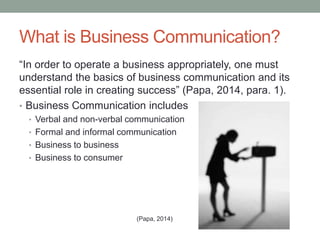
What is Business Communication?
“In order to operate a business appropriately, one must
understand the basics of business communication and its
essential role in creating success” (Papa, 2014, para. 1).
• Business Communication includes
• Verbal and non-verbal communication
• Formal and informal communication
• Business to business
• Business to consumer
(Papa, 2014)
Effective Business Communication
Communication Process
• Sender encodes an idea
• Message travels over
channel
• Receiver decodes
message
• Feedback travels back to
sender
Miscommunication
• Bypassing: misinterpret
meaning
• Differing frames of
reference
• Lack of language skills
• Distractions
(Smith, 2013)
(Smith, 2013)
Ethical Communication
Think through the audience reaction to any message sent.
• Ethical Communications Goals
• Follow the laws of relevant industry
• Tell the truth
• Label opinions
• Be objective
• Use inclusive language
• Cite resources
(Guffey & Loewy, 2011)
Doing the Right Thing
Never do anything that
you wouldn’t want to
read about on the
front page of the
New York Times
(MacDonald, 2010)
Business leaders are often on the news for unethical behavior. Be sure to
follow the New York Times Rule.
Source: Google Images
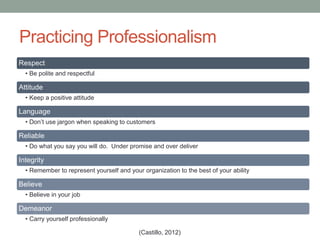
Practicing Professionalism
Respect
• Be polite and respectful
Attitude
• Keep a positive attitude
Language
• Don’t use jargon when speaking to customers
Reliable
• Do what you say you will do. Under promise and over deliver
Integrity
• Remember to represent yourself and your organization to the best of your ability
Believe
• Believe in your job
Demeanor
• Carry yourself professionally
(Castillo, 2012)
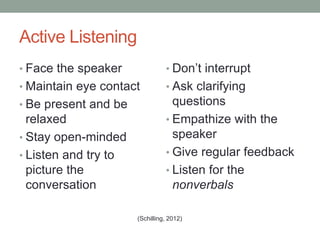
Active Listening
• Face the speaker
• Maintain eye contact
• Be present and be
relaxed
• Stay open-minded
• Listen and try to
picture the
conversation
• Don’t interrupt
• Ask clarifying
questions
• Empathize with the
speaker
• Give regular feedback
• Listen for the
nonverbals
(Schilling, 2012)
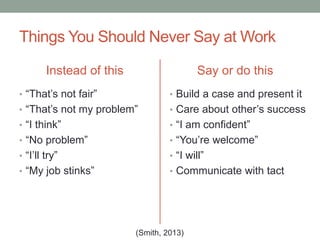
Things You Should Never Say at Work
Instead of this
• “That’s not fair”
• “That’s not my problem”
• “I think”
• “No problem”
• “I’ll try”
• “My job stinks”
Say or do this
• Build a case and present it
• Care about other’s success
• “I am confident”
• “You’re welcome”
• “I will”
• Communicate with tact
(Smith, 2013)
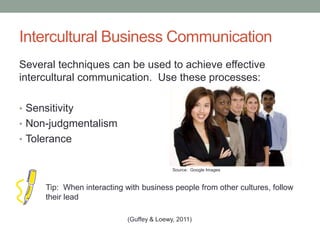
Intercultural Business Communication
Several techniques can be used to achieve effective
intercultural communication. Use these processes:
• Sensitivity
• Non-judgmentalism
• Tolerance
Tip: When interacting with business people from other cultures, follow
their lead
(Guffey & Loewy, 2011)
Source: Google Images
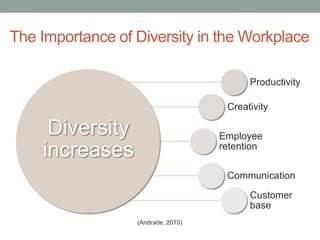
The Importance of Diversity in the Workplace
Diversity
increases
Productivity
Creativity
Employee
retention
Communication
Customer
base
(Andrade, 2010)
COMMUNICATING
EFFECTIVELY
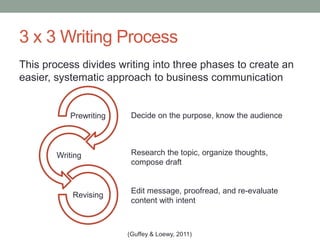
3 x 3 Writing Process
This process divides writing into three phases to create an
easier, systematic approach to business communication
Prewriting
Writing
Revising
Decide on the purpose, know the audience
Research the topic, organize thoughts,
compose draft
Edit message, proofread, and re-evaluate
content with intent
(Guffey & Loewy, 2011)
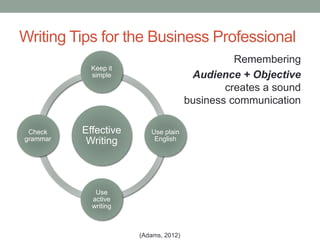
Writing Tips for the Business Professional
Remembering
Audience + Objective
creates a sound
business communication
Effective
Writing
Keep it
simple
Use plain
English
Use
active
writing
Check
grammar
(Adams, 2012)
Positive Messaging
Use the 3 x 3 writing process to create positive messages
in emails, interoffice memos, or business letters.
• Positive messages convey:
• Goodwill
• Uplifting news
• Conversation replies
• Requests for information
(Guffey & Loewy, 2011)
Negative Messaging
Establish goals in communicating negative news.
1. Explain message clearly and completely
2. Project a professional image
3. Convey empathy and sensitivity
4. Be fair
5. Maintain friendly relations
(Guffey & Loewy, 2011)
Tip: Avoid legal liability. Avoid abusive or careless language,
COMMUNICATION TOOLS
Using Electronic Messages and Digital
Media for Business Communication
• Email
• Instant messaging
• Text messaging
• Blogs
• Wikis
• Podcasts
• Social media
Tip: Electronic communication is still communication. Know your
audience and your objective to ensure effective communication
(Feigenbaum, 2014)
Today’s business professionals have many choices for
electronic communication.
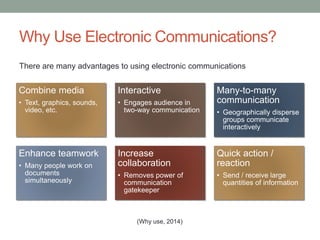
Why Use Electronic Communications?
Combine media
• Text, graphics, sounds,
video, etc.
Interactive
• Engages audience in
two-way communication
Many-to-many
communication
• Geographically disperse
groups communicate
interactively
Enhance teamwork
• Many people work on
documents
simultaneously
Increase
collaboration
• Removes power of
communication
gatekeeper
Quick action /
reaction
• Send / receive large
quantities of information
(Why use, 2014)
There are many advantages to using electronic communications
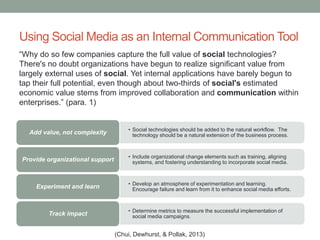
Using Social Media as an Internal Communication Tool
• Social technologies should be added to the natural workflow. The
technology should be a natural extension of the business process.Add value, not complexity
• Include organizational change elements such as training, aligning
systems, and fostering understanding to incorporate social media.Provide organizational support
• Develop an atmosphere of experimentation and learning.
Encourage failure and learn from it to enhance social media efforts.Experiment and learn
• Determine metrics to measure the successful implementation of
social media campaigns.Track impact
“Why do so few companies capture the full value of social technologies?
There's no doubt organizations have begun to realize significant value from
largely external uses of social. Yet internal applications have barely begun to
tap their full potential, even though about two-thirds of social's estimated
economic value stems from improved collaboration and communication within
enterprises.” (para. 1)
(Chui, Dewhurst, & Pollak, 2013)
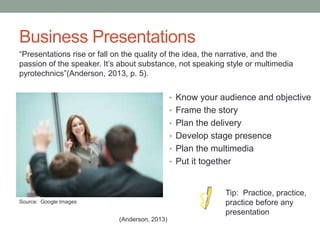
Business Presentations
• Know your audience and objective
• Frame the story
• Plan the delivery
• Develop stage presence
• Plan the multimedia
• Put it together
“Presentations rise or fall on the quality of the idea, the narrative, and the
passion of the speaker. It’s about substance, not speaking style or multimedia
pyrotechnics”(Anderson, 2013, p. 5).
(Anderson, 2013)
Source: Google Images
Tip: Practice, practice,
practice before any
presentation
Formal vs. Informal Reports
Businesses use formal and informal communication as
essential tools.
• Formal reports are more structured, offering greater detail and
analysis.
• Informal reports have a more relaxed structure, providing specific
details for the report topic.
(Guffey & Loewy, 2011)
Source: Google Images
Informal Proposals
Introduction
•Purpose of proposal
•Writer qualifications
Background
•Problem statement
•Project goals
Proposal
•Project plan
•Resource requirements
Budget
Request for approval
(Guffey & Loewy, 2011)
Formal Proposals
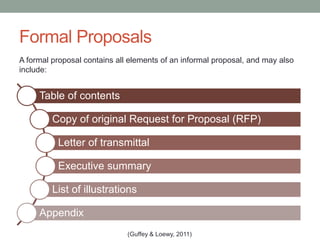
Table of contents
Copy of original Request for Proposal (RFP)
Letter of transmittal
Executive summary
List of illustrations
Appendix
(Guffey & Loewy, 2011)
A formal proposal contains all elements of an informal proposal, and may also
include:
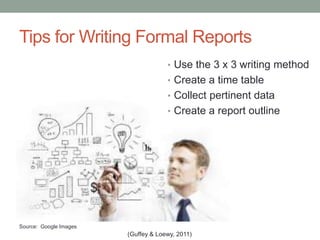
Tips for Writing Formal Reports
(Guffey & Loewy, 2011)
Source: Google Images
• Use the 3 x 3 writing method
• Create a time table
• Collect pertinent data
• Create a report outline
Conclusion
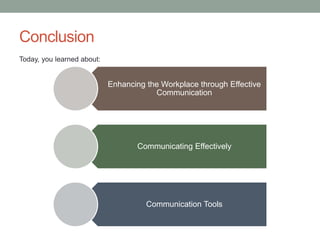
Enhancing the Workplace through Effective
Communication
Communicating Effectively
Communication Tools
Today, you learned about:
Conclusion
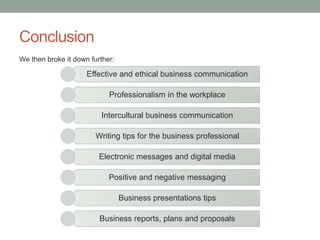
Effective and ethical business communication
Professionalism in the workplace
Intercultural business communication
Writing tips for the business professional
Electronic messages and digital media
Positive and negative messaging
Business presentations tips
Business reports, plans and proposals
We then broke it down further:
References
Adams, S. (2012). Ten Tips For Better Business Writing. Forbes.Com, 80.
Anderson, C. (2013). How to Give a Killer Presentation. Retrieved from http://hbr.org/2013/06/how-to-give-a-
killer-presentation/ar/1
Andrade, S. (2010). 6 advantages of workplace diversity. Retrieved from
http://saharconsulting.wordpress.com/2010/03/26/6-advantages-of-workplace-diversity/
Castillo, M. (2012). Practicing Professionalism. Health Care Registration: The Newsletter For Health Care
Registration Professionals, 21(12), 8-9.
Chui, M., Dewhurst, M., & Pollak, L. (2013). Building the social enterprise. Mckinsey Quarterly, (4), 8-11.
Feigenbaum, E. (2014) Electronic methods of communication in business. Retrieved from
http://smallbusiness.chron.com/electronic-methods-communication-business-2934.html
Guffey, M.E., & Loewy, D. (2011). Business Communication: Process and Product. (7th ed.). Mason: South-
Western Cengage.
MacDonald, C. (2010). Business ethics and the “New York Times” rule. Retrieved from
http://businessethicsblog.com/2010/12/08/business-ethics-and-the-new-york-times-rule/
Morino Institute. (2014). Why use electronic communications? Retrieved from
http://knowledgeway.org/living/communications/homepage.html
Papa, J. (2014). What Is Business Communication? Retrieved from http://smallbusiness.chron.com/business-
communication-43167.html
Schilling, D. (2012). 10 steps to effective listening. Retrieved from
http://www.forbes.com/sites/womensmedia/2012/11/09/10-steps-to-effective-listening/
Smith, J. (2013). 13 things you should never say at work. Forbes. Retrieved from
http://www.forbes.com/sites/jacquelynsmith/2013/02/15/13-things-you-should-never-say-at-work/

Best Practices in Business Writing and Commucication

  • 1.
    BEST PRACTICES IN BUSINESSWRITING & COMMUNICATION Terri Jensen ORG536 – Contemporary Business Writing and Communication Colorado State University – Global Campus Dr. Robert Olszewski June 1, 2014
  • 2.
    Introduction This presentation willintroduce participants to various business communications concepts, while providing practical tips for effective communication. Source: Google Images
  • 3.
    Today’s Topics • Enhancingthe workplace through effective communication • Communicating effectively • Communication tools
  • 4.
  • 5.
    What is BusinessCommunication? “In order to operate a business appropriately, one must understand the basics of business communication and its essential role in creating success” (Papa, 2014, para. 1). • Business Communication includes • Verbal and non-verbal communication • Formal and informal communication • Business to business • Business to consumer (Papa, 2014)
  • 6.
    Effective Business Communication CommunicationProcess • Sender encodes an idea • Message travels over channel • Receiver decodes message • Feedback travels back to sender Miscommunication • Bypassing: misinterpret meaning • Differing frames of reference • Lack of language skills • Distractions (Smith, 2013) (Smith, 2013)
  • 7.
    Ethical Communication Think throughthe audience reaction to any message sent. • Ethical Communications Goals • Follow the laws of relevant industry • Tell the truth • Label opinions • Be objective • Use inclusive language • Cite resources (Guffey & Loewy, 2011)
  • 8.
    Doing the RightThing Never do anything that you wouldn’t want to read about on the front page of the New York Times (MacDonald, 2010) Business leaders are often on the news for unethical behavior. Be sure to follow the New York Times Rule. Source: Google Images
  • 9.
    Practicing Professionalism Respect • Bepolite and respectful Attitude • Keep a positive attitude Language • Don’t use jargon when speaking to customers Reliable • Do what you say you will do. Under promise and over deliver Integrity • Remember to represent yourself and your organization to the best of your ability Believe • Believe in your job Demeanor • Carry yourself professionally (Castillo, 2012)
  • 10.
    Active Listening • Facethe speaker • Maintain eye contact • Be present and be relaxed • Stay open-minded • Listen and try to picture the conversation • Don’t interrupt • Ask clarifying questions • Empathize with the speaker • Give regular feedback • Listen for the nonverbals (Schilling, 2012)
  • 11.
    Things You ShouldNever Say at Work Instead of this • “That’s not fair” • “That’s not my problem” • “I think” • “No problem” • “I’ll try” • “My job stinks” Say or do this • Build a case and present it • Care about other’s success • “I am confident” • “You’re welcome” • “I will” • Communicate with tact (Smith, 2013)
  • 12.
    Intercultural Business Communication Severaltechniques can be used to achieve effective intercultural communication. Use these processes: • Sensitivity • Non-judgmentalism • Tolerance Tip: When interacting with business people from other cultures, follow their lead (Guffey & Loewy, 2011) Source: Google Images
  • 13.
    The Importance ofDiversity in the Workplace Diversity increases Productivity Creativity Employee retention Communication Customer base (Andrade, 2010)
  • 14.
  • 15.
    3 x 3Writing Process This process divides writing into three phases to create an easier, systematic approach to business communication Prewriting Writing Revising Decide on the purpose, know the audience Research the topic, organize thoughts, compose draft Edit message, proofread, and re-evaluate content with intent (Guffey & Loewy, 2011)
  • 16.
    Writing Tips forthe Business Professional Remembering Audience + Objective creates a sound business communication Effective Writing Keep it simple Use plain English Use active writing Check grammar (Adams, 2012)
  • 17.
    Positive Messaging Use the3 x 3 writing process to create positive messages in emails, interoffice memos, or business letters. • Positive messages convey: • Goodwill • Uplifting news • Conversation replies • Requests for information (Guffey & Loewy, 2011)
  • 18.
    Negative Messaging Establish goalsin communicating negative news. 1. Explain message clearly and completely 2. Project a professional image 3. Convey empathy and sensitivity 4. Be fair 5. Maintain friendly relations (Guffey & Loewy, 2011) Tip: Avoid legal liability. Avoid abusive or careless language,
  • 19.
  • 20.
    Using Electronic Messagesand Digital Media for Business Communication • Email • Instant messaging • Text messaging • Blogs • Wikis • Podcasts • Social media Tip: Electronic communication is still communication. Know your audience and your objective to ensure effective communication (Feigenbaum, 2014) Today’s business professionals have many choices for electronic communication.
  • 21.
    Why Use ElectronicCommunications? Combine media • Text, graphics, sounds, video, etc. Interactive • Engages audience in two-way communication Many-to-many communication • Geographically disperse groups communicate interactively Enhance teamwork • Many people work on documents simultaneously Increase collaboration • Removes power of communication gatekeeper Quick action / reaction • Send / receive large quantities of information (Why use, 2014) There are many advantages to using electronic communications
  • 22.
    Using Social Mediaas an Internal Communication Tool • Social technologies should be added to the natural workflow. The technology should be a natural extension of the business process.Add value, not complexity • Include organizational change elements such as training, aligning systems, and fostering understanding to incorporate social media.Provide organizational support • Develop an atmosphere of experimentation and learning. Encourage failure and learn from it to enhance social media efforts.Experiment and learn • Determine metrics to measure the successful implementation of social media campaigns.Track impact “Why do so few companies capture the full value of social technologies? There's no doubt organizations have begun to realize significant value from largely external uses of social. Yet internal applications have barely begun to tap their full potential, even though about two-thirds of social's estimated economic value stems from improved collaboration and communication within enterprises.” (para. 1) (Chui, Dewhurst, & Pollak, 2013)
  • 23.
    Business Presentations • Knowyour audience and objective • Frame the story • Plan the delivery • Develop stage presence • Plan the multimedia • Put it together “Presentations rise or fall on the quality of the idea, the narrative, and the passion of the speaker. It’s about substance, not speaking style or multimedia pyrotechnics”(Anderson, 2013, p. 5). (Anderson, 2013) Source: Google Images Tip: Practice, practice, practice before any presentation
  • 24.
    Formal vs. InformalReports Businesses use formal and informal communication as essential tools. • Formal reports are more structured, offering greater detail and analysis. • Informal reports have a more relaxed structure, providing specific details for the report topic. (Guffey & Loewy, 2011) Source: Google Images
  • 25.
    Informal Proposals Introduction •Purpose ofproposal •Writer qualifications Background •Problem statement •Project goals Proposal •Project plan •Resource requirements Budget Request for approval (Guffey & Loewy, 2011)
  • 26.
    Formal Proposals Table ofcontents Copy of original Request for Proposal (RFP) Letter of transmittal Executive summary List of illustrations Appendix (Guffey & Loewy, 2011) A formal proposal contains all elements of an informal proposal, and may also include:
  • 27.
    Tips for WritingFormal Reports (Guffey & Loewy, 2011) Source: Google Images • Use the 3 x 3 writing method • Create a time table • Collect pertinent data • Create a report outline
  • 28.
    Conclusion Enhancing the Workplacethrough Effective Communication Communicating Effectively Communication Tools Today, you learned about:
  • 29.
    Conclusion Effective and ethicalbusiness communication Professionalism in the workplace Intercultural business communication Writing tips for the business professional Electronic messages and digital media Positive and negative messaging Business presentations tips Business reports, plans and proposals We then broke it down further:
  • 30.
    References Adams, S. (2012).Ten Tips For Better Business Writing. Forbes.Com, 80. Anderson, C. (2013). How to Give a Killer Presentation. Retrieved from http://hbr.org/2013/06/how-to-give-a- killer-presentation/ar/1 Andrade, S. (2010). 6 advantages of workplace diversity. Retrieved from http://saharconsulting.wordpress.com/2010/03/26/6-advantages-of-workplace-diversity/ Castillo, M. (2012). Practicing Professionalism. Health Care Registration: The Newsletter For Health Care Registration Professionals, 21(12), 8-9. Chui, M., Dewhurst, M., & Pollak, L. (2013). Building the social enterprise. Mckinsey Quarterly, (4), 8-11. Feigenbaum, E. (2014) Electronic methods of communication in business. Retrieved from http://smallbusiness.chron.com/electronic-methods-communication-business-2934.html Guffey, M.E., & Loewy, D. (2011). Business Communication: Process and Product. (7th ed.). Mason: South- Western Cengage. MacDonald, C. (2010). Business ethics and the “New York Times” rule. Retrieved from http://businessethicsblog.com/2010/12/08/business-ethics-and-the-new-york-times-rule/ Morino Institute. (2014). Why use electronic communications? Retrieved from http://knowledgeway.org/living/communications/homepage.html Papa, J. (2014). What Is Business Communication? Retrieved from http://smallbusiness.chron.com/business- communication-43167.html Schilling, D. (2012). 10 steps to effective listening. Retrieved from http://www.forbes.com/sites/womensmedia/2012/11/09/10-steps-to-effective-listening/ Smith, J. (2013). 13 things you should never say at work. Forbes. Retrieved from http://www.forbes.com/sites/jacquelynsmith/2013/02/15/13-things-you-should-never-say-at-work/