Best Practices in Business Writing
and Communication
January 31, 2014
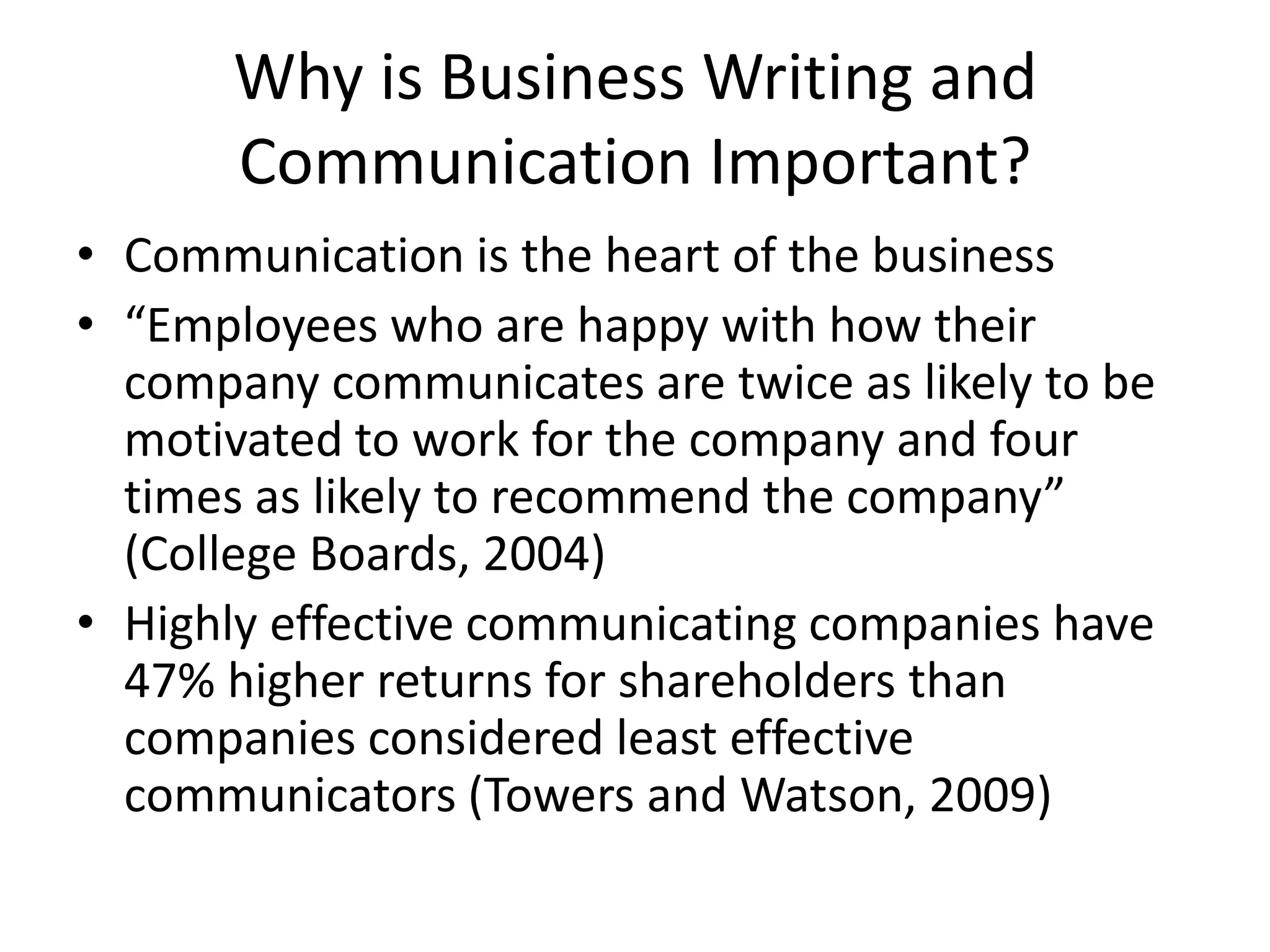
Why is Business Writing and
Communication Important?
• Communication is the heart of the business
• “Employees who are happy with how their
company communicates are twice as likely to be
motivated to work for the company and four
times as likely to recommend the company”
(College Boards, 2004)
• Highly effective communicating companies have
47% higher returns for shareholders than
companies considered least effective
communicators (Towers and Watson, 2009)
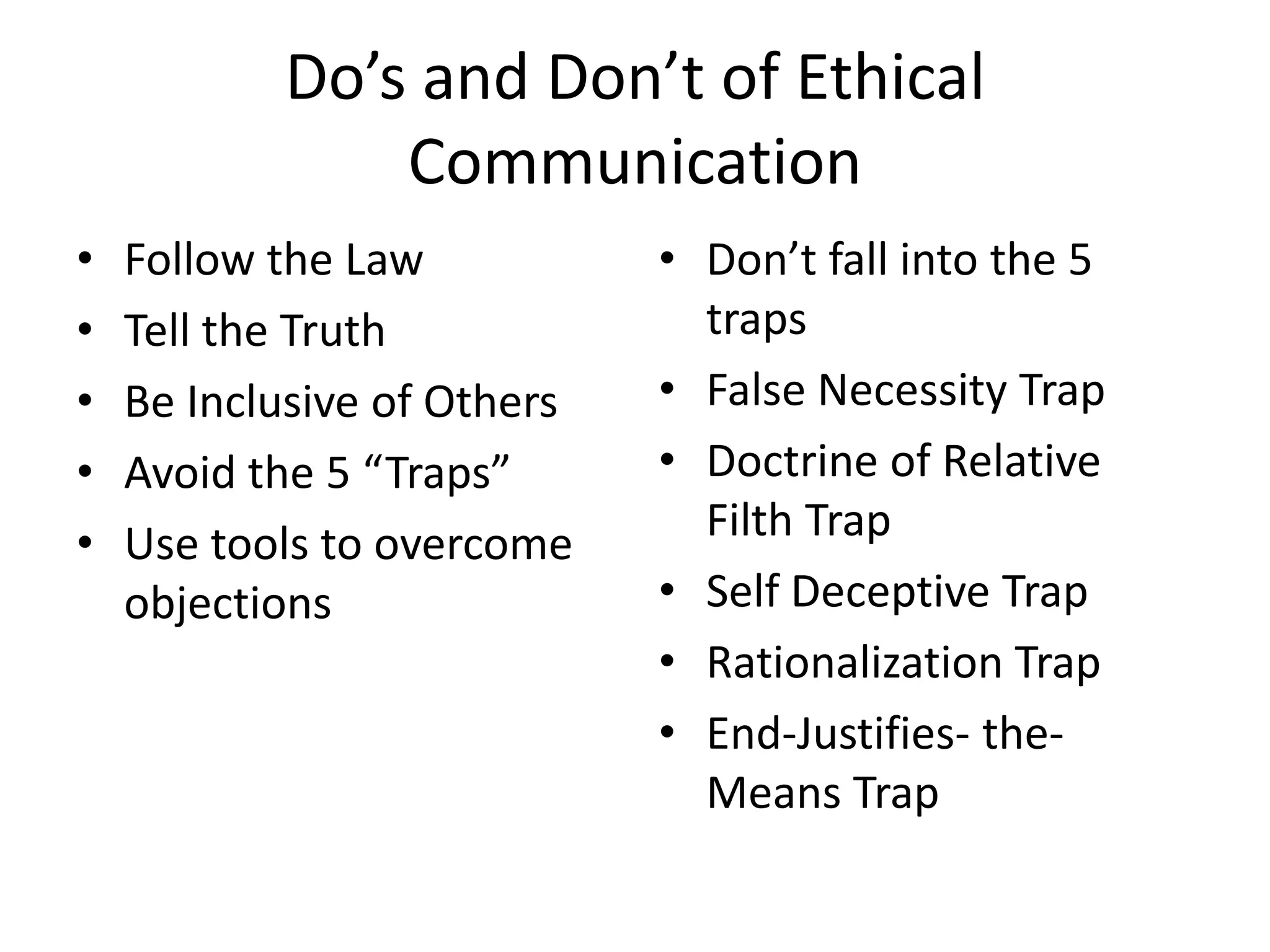
Do’s and Don’t of Ethical
Communication
•
•
•
•
•

Follow the Law
Tell the Truth
Be Inclusive of Others
Avoid the 5 “Traps”
Use tools to overcome
objections

• Don’t fall into the 5
traps
• False Necessity Trap
• Doctrine of Relative
Filth Trap
• Self Deceptive Trap
• Rationalization Trap
• End-Justifies- theMeans Trap
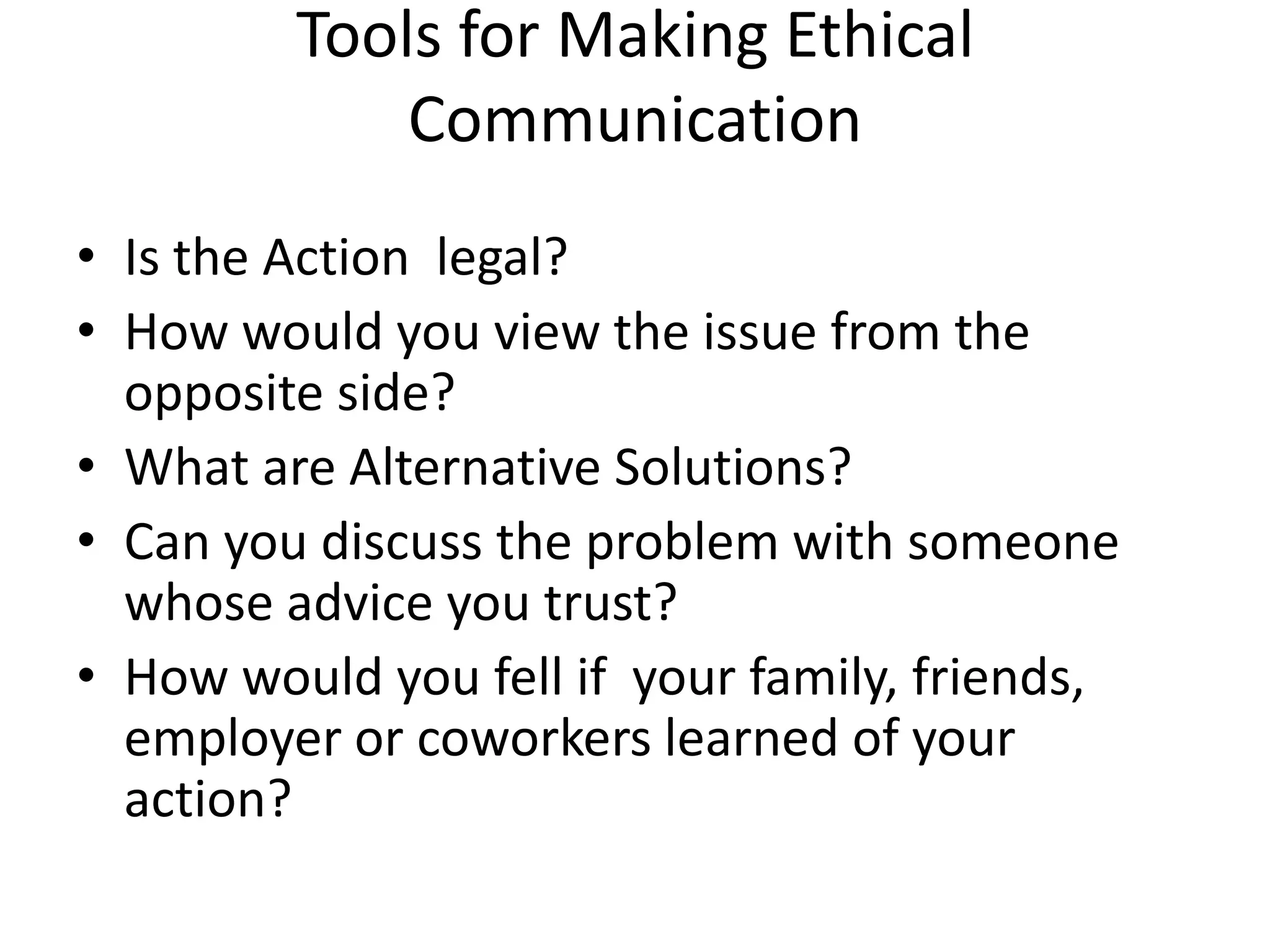
Tools for Making Ethical
Communication
• Is the Action legal?
• How would you view the issue from the
opposite side?
• What are Alternative Solutions?
• Can you discuss the problem with someone
whose advice you trust?
• How would you fell if your family, friends,
employer or coworkers learned of your
action?
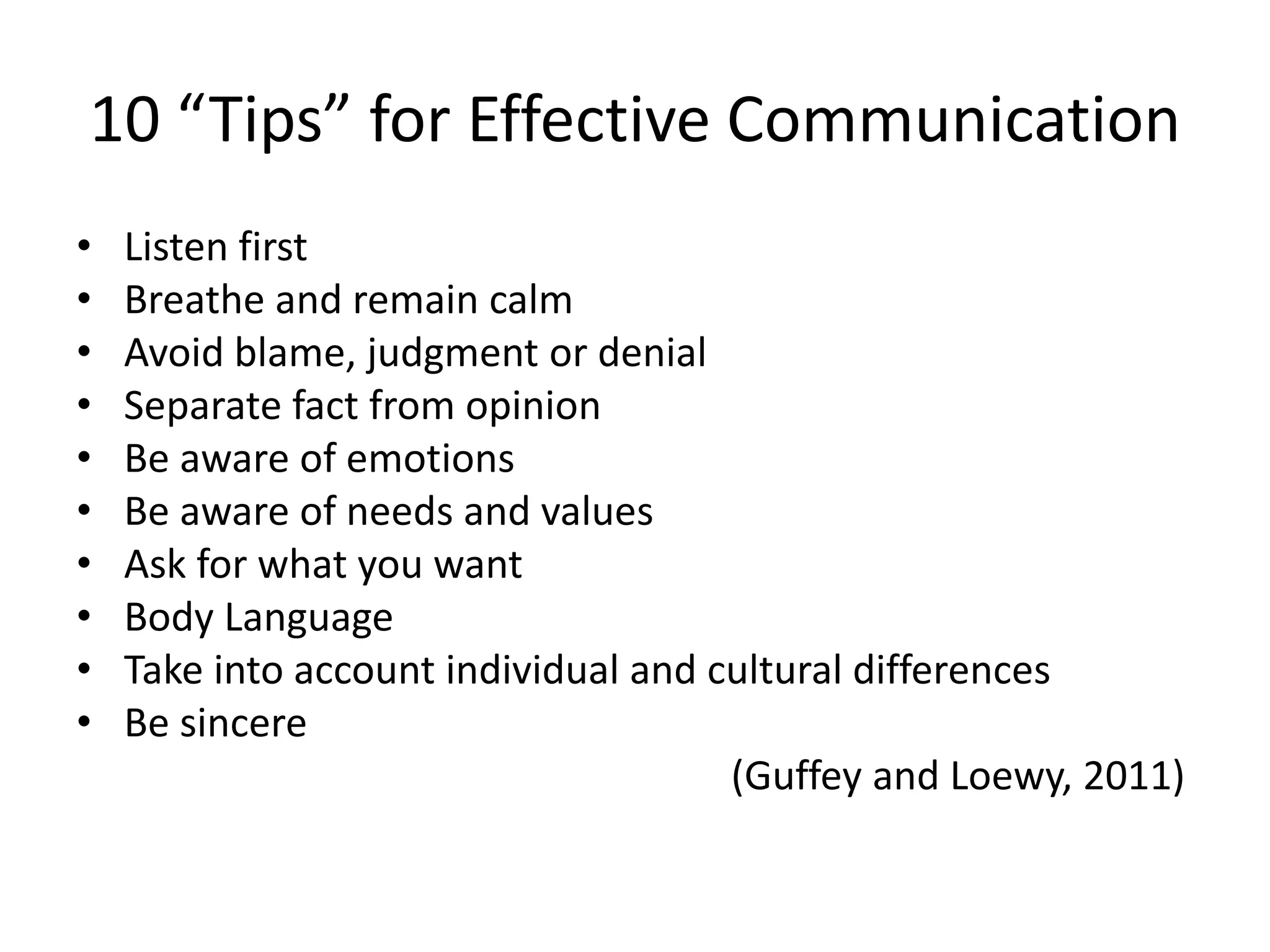
10 “Tips” for Effective Communication
•
•
•
•
•
•
•
•
•
•

Listen first
Breathe and remain calm
Avoid blame, judgment or denial
Separate fact from opinion
Be aware of emotions
Be aware of needs and values
Ask for what you want
Body Language
Take into account individual and cultural differences
Be sincere
(Guffey and Loewy, 2011)
Importance of Intercultural
Communication
• Business today is more and more global
• The US population is expected to grow 50% over
the next 50 years. Half of the new employees will
be immigrants from different cultures (Newman
& Ober, 2012)
• Working together with many different cultures
will become the norm
• To succeed in a culture rich society, you will need
to improve your communication skill and
technique.
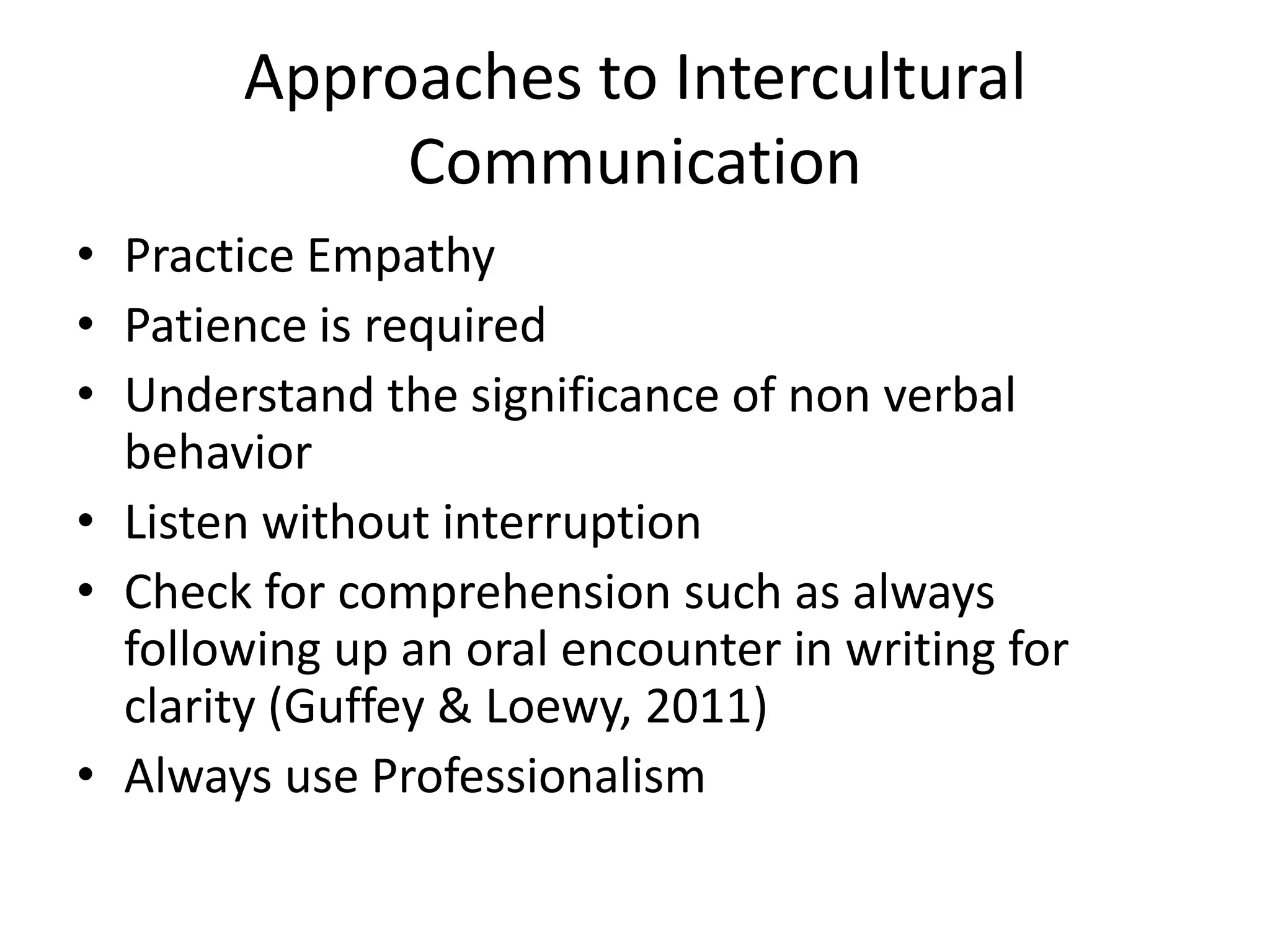
Approaches to Intercultural
Communication
• Practice Empathy
• Patience is required
• Understand the significance of non verbal
behavior
• Listen without interruption
• Check for comprehension such as always
following up an oral encounter in writing for
clarity (Guffey & Loewy, 2011)
• Always use Professionalism
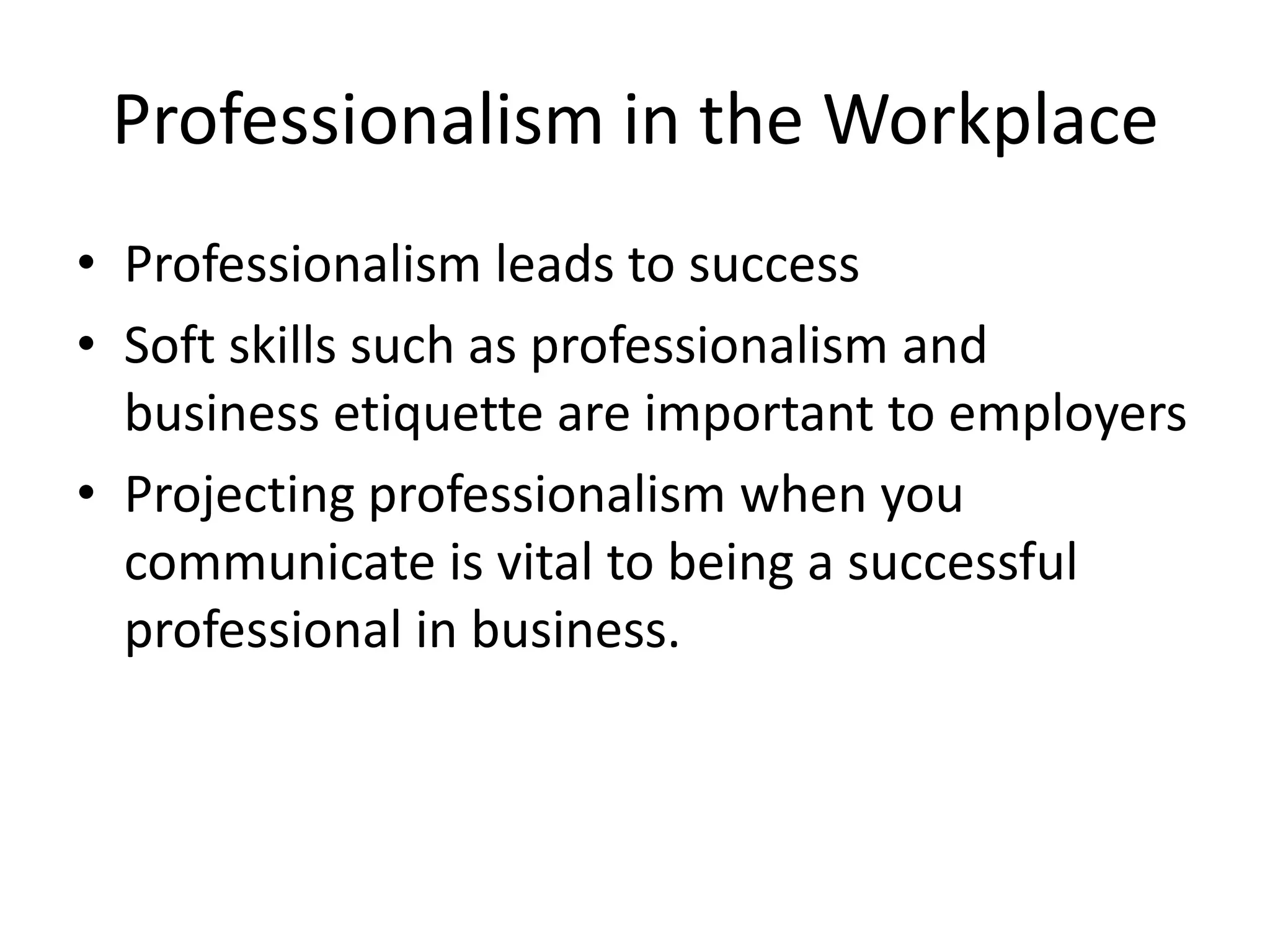
Professionalism in the Workplace
• Professionalism leads to success
• Soft skills such as professionalism and
business etiquette are important to employers
• Projecting professionalism when you
communicate is vital to being a successful
professional in business.
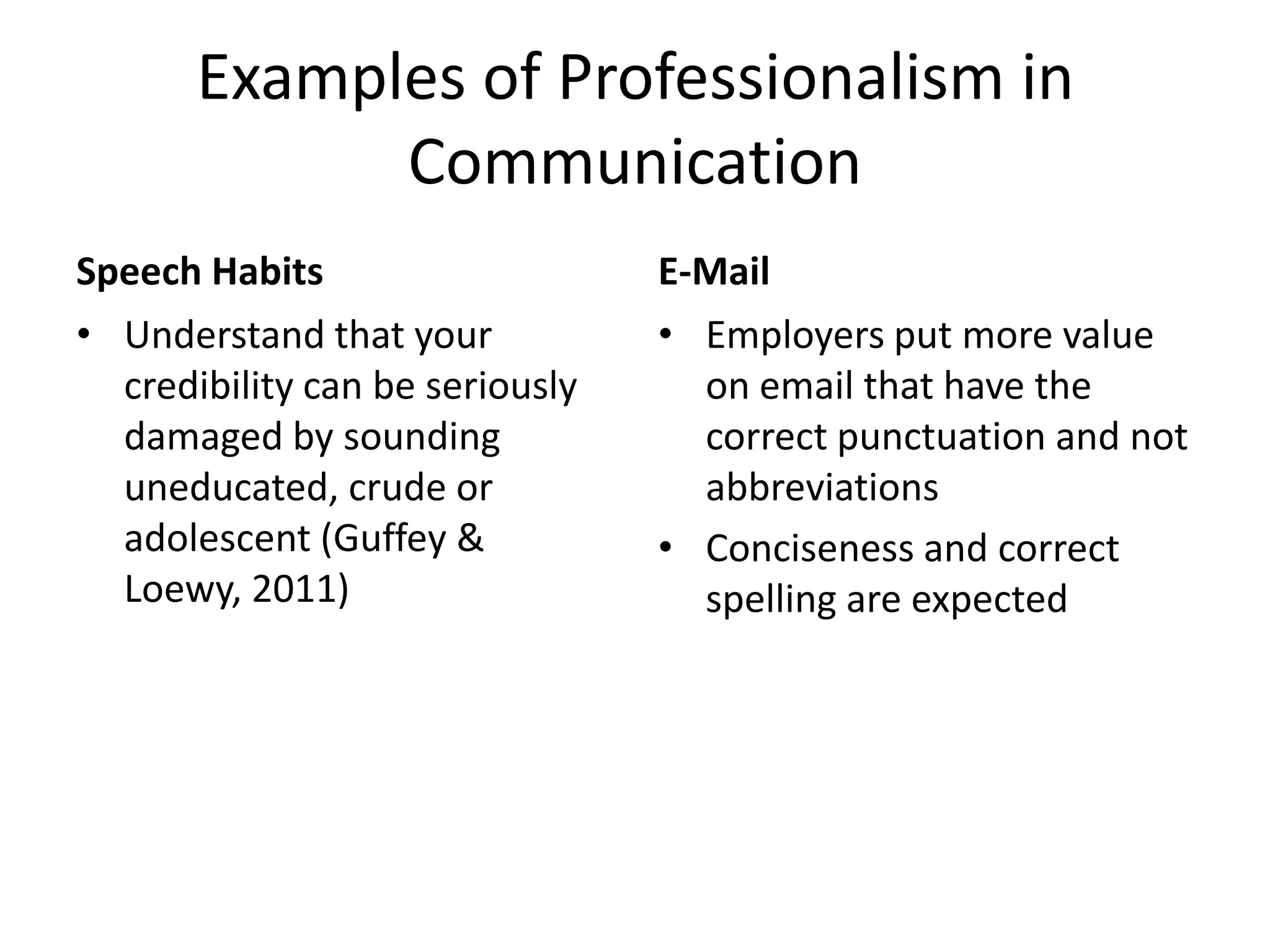
Examples of Professionalism in
Communication
Speech Habits
• Understand that your
credibility can be seriously
damaged by sounding
uneducated, crude or
adolescent (Guffey &
Loewy, 2011)

E-Mail
• Employers put more value
on email that have the
correct punctuation and not
abbreviations
• Conciseness and correct
spelling are expected
More Examples of Professionalism in
Communication
Internet and texting
• An email address should be
a full relevant name and not
a cute nickname
• Sending appropriate
business text only when
necessary (Guffey & Loewy,
2011)

Telephone and Voicemail
• Keep the background quiet
when you are answering the
phone
• An outgoing message on
your voicemail states your
name or phone number and
provides instructions for
leaving a message
Writing Tips for the Business
Professional
• Understanding that business writing involves a
process is key to great writing
• Purpose- you need a defined purpose for writing
• Persuasive- You want your audience to accept
and believe your message
• Economical- Clear and concise, length is not
important
• Audience- know your audience and look from
their perspective over yours
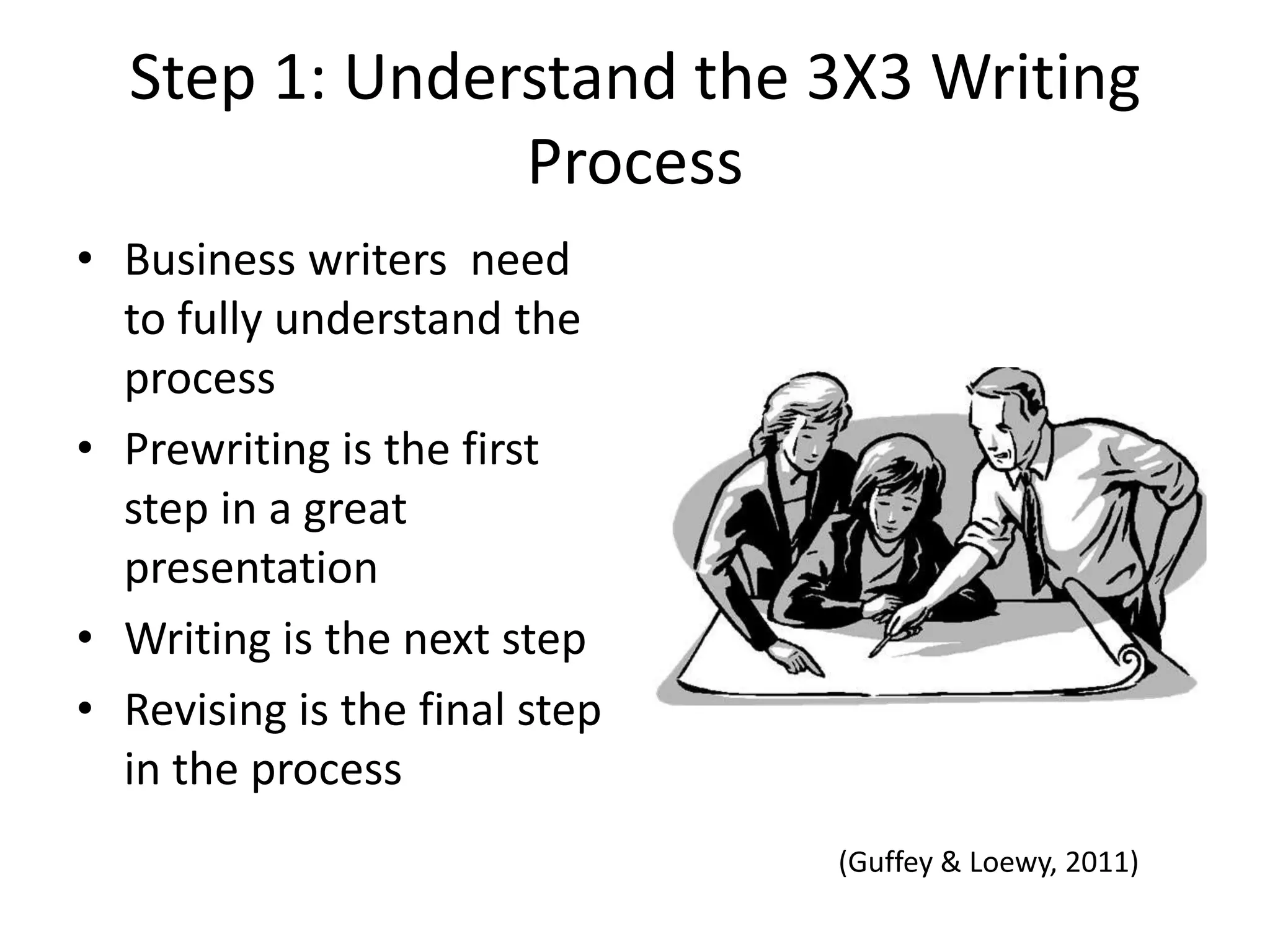
Step 1: Understand the 3X3 Writing
Process
• Business writers need
to fully understand the
process
• Prewriting is the first
step in a great
presentation
• Writing is the next step
• Revising is the final step
in the process
(Guffey & Loewy, 2011)
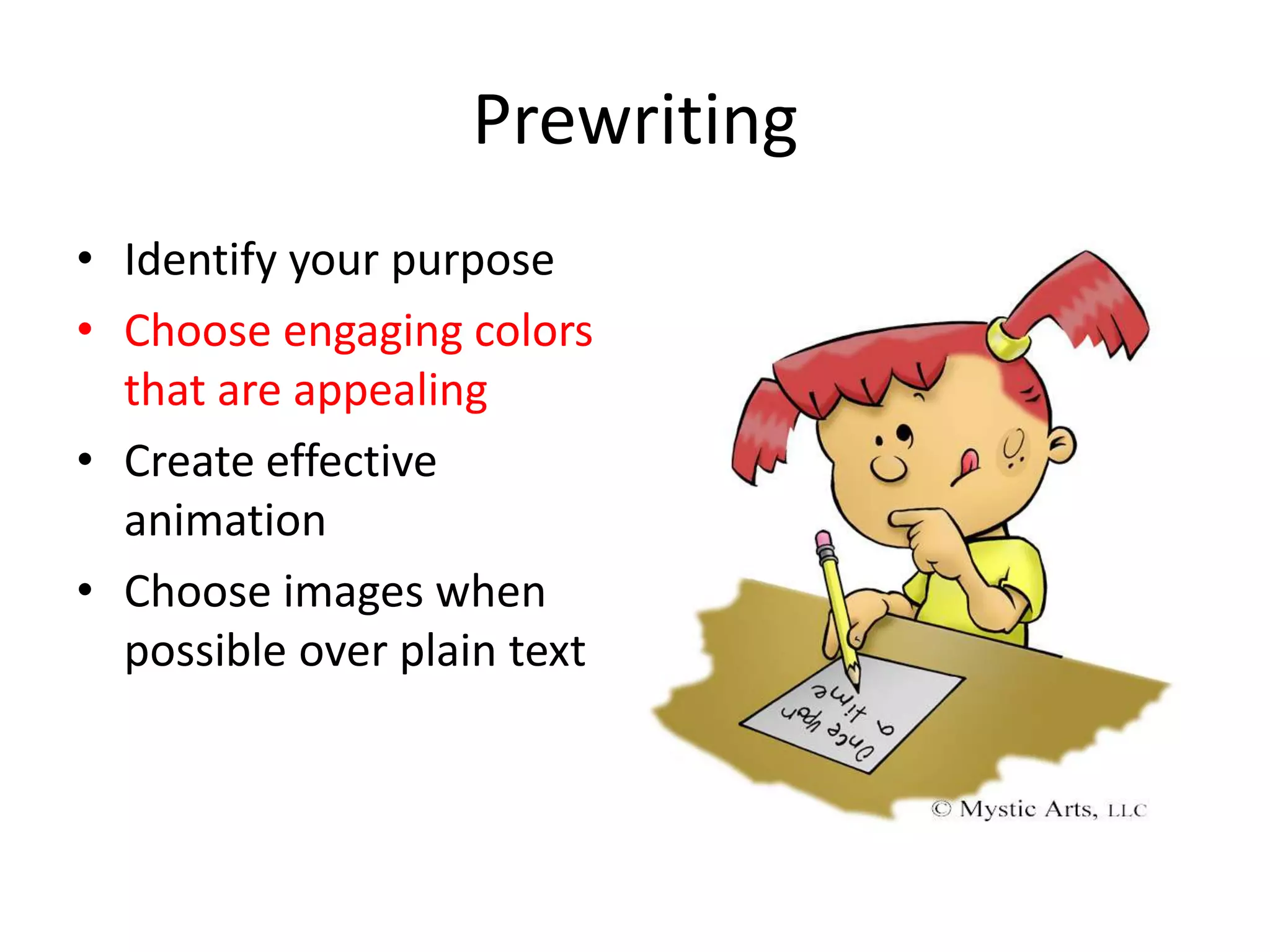
Prewriting
• Identify your purpose
• Choose engaging colors
that are appealing
• Create effective
animation
• Choose images when
possible over plain text
Writing
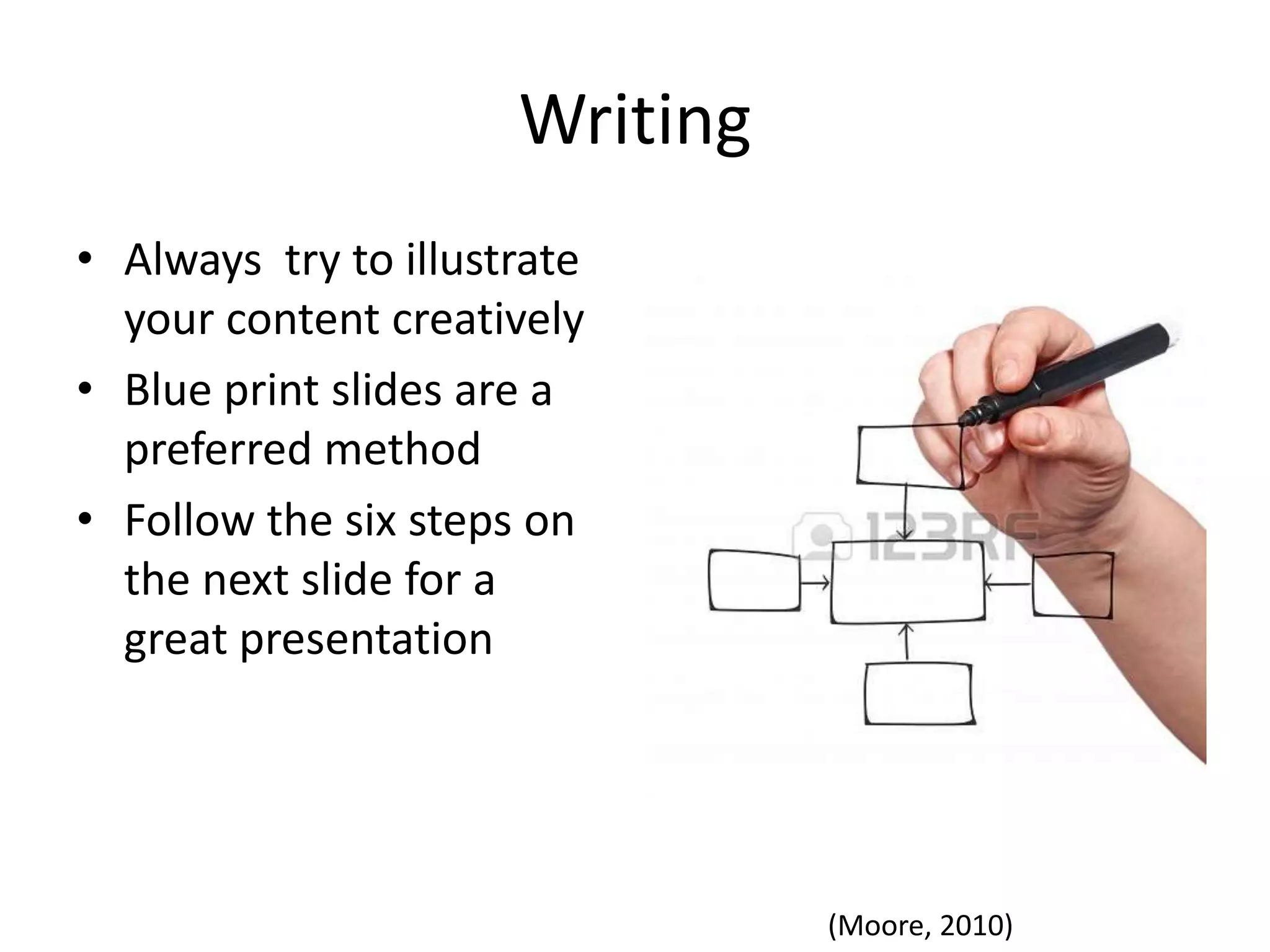
• Always try to illustrate
your content creatively
• Blue print slides are a
preferred method
• Follow the six steps on
the next slide for a
great presentation

(Moore, 2010)
Revising
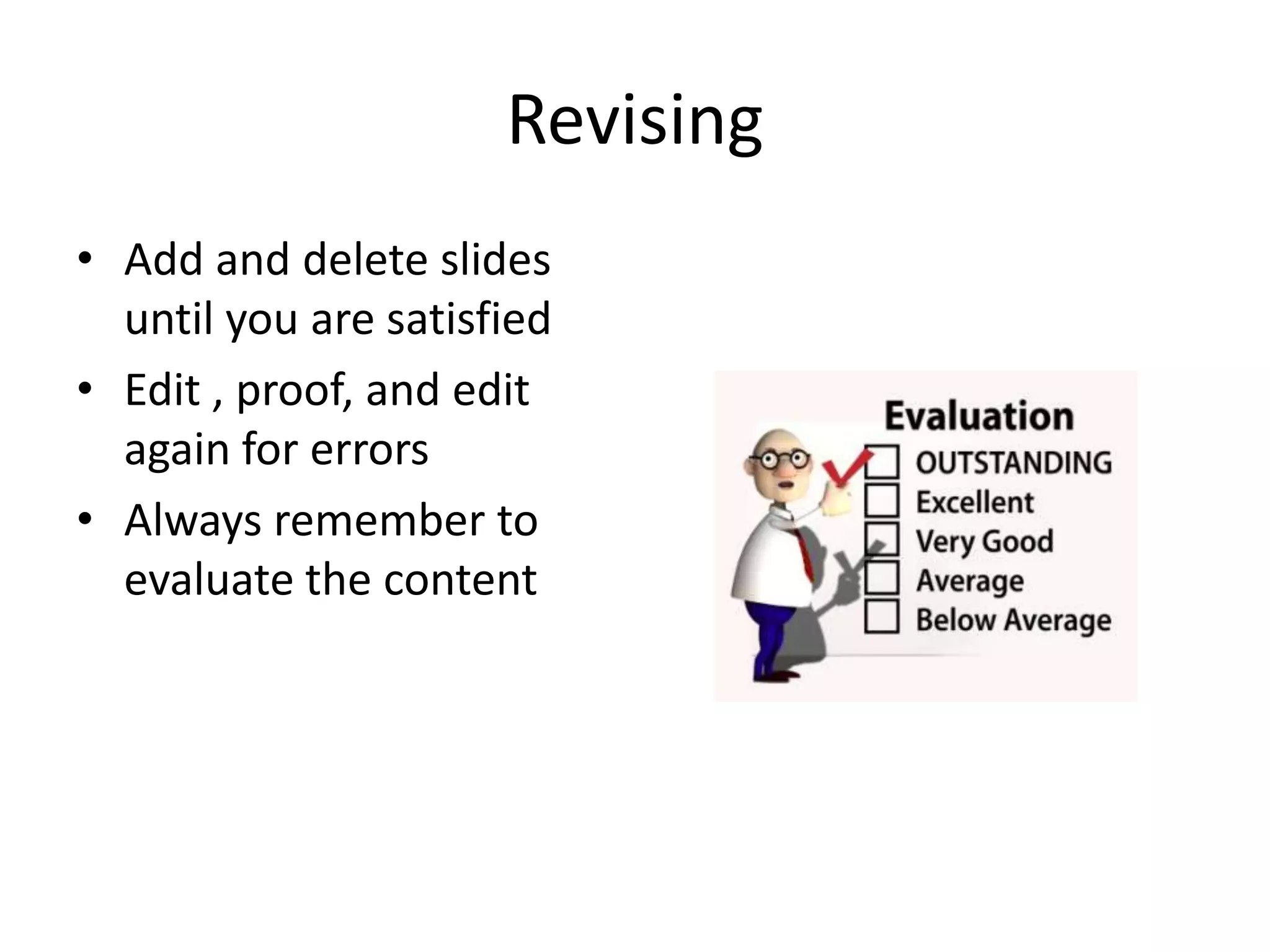
• Add and delete slides
until you are satisfied
• Edit , proof, and edit
again for errors
• Always remember to
evaluate the content
Use of Electronic Message and Digital
Media for Presentations
• Always analyze the
content
• Subject line
• Opening
• Body
• Closing
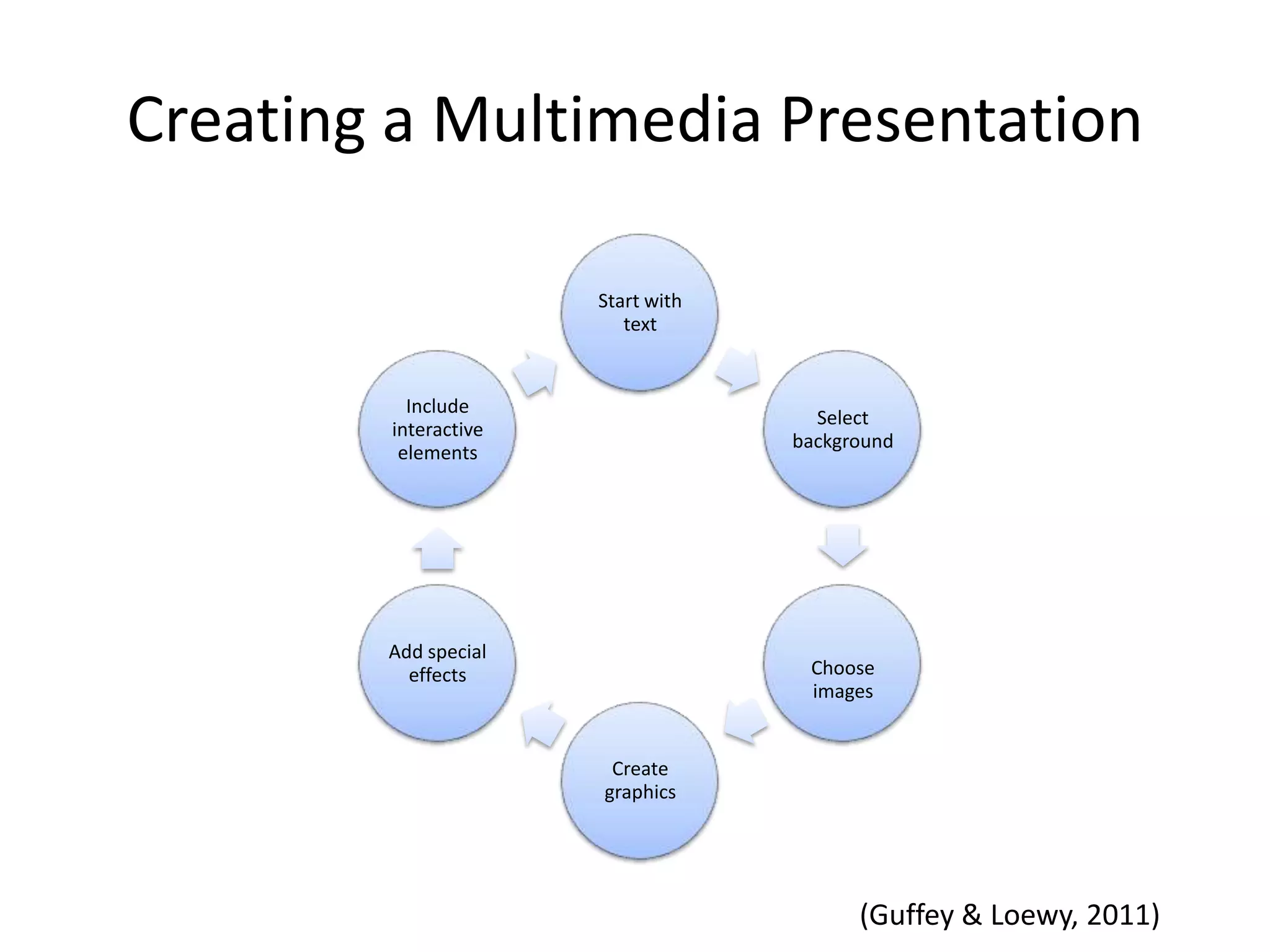
Creating a Multimedia Presentation
Start with
text

Include
interactive
elements

Select
background

Add special
effects

Choose
images

Create
graphics

(Guffey & Loewy, 2011)
Construct Content with Templates

(Guffey & Loewy, 2011)
Slides must have a Purpose
•
•
•
•
•
•

Appeal visually to audience
Create memory points
Review key points
Provide transitions
Illustrate ideas
Try to simply a complex concept for audience
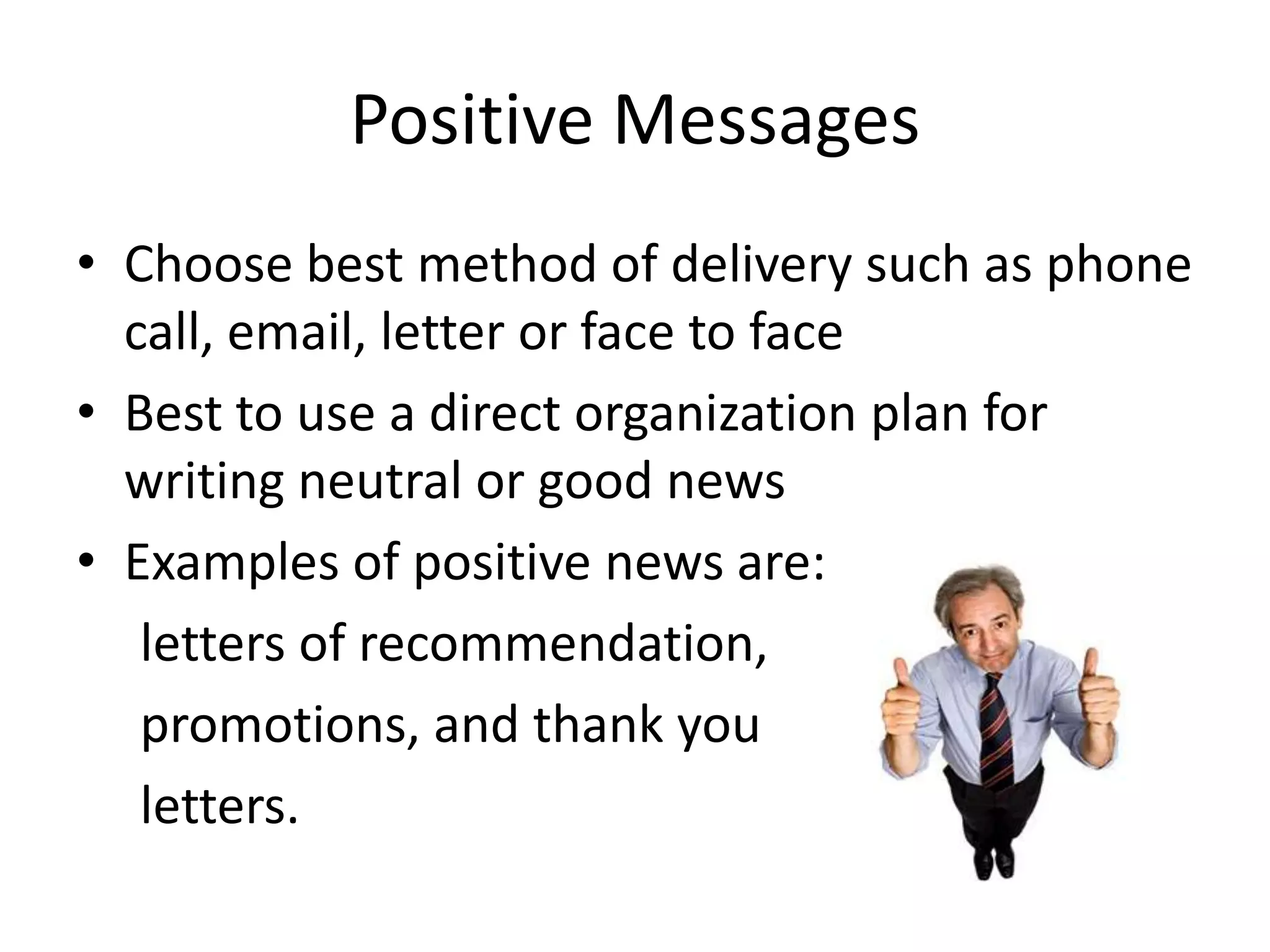
Positive Messages
• Choose best method of delivery such as phone
call, email, letter or face to face
• Best to use a direct organization plan for
writing neutral or good news
• Examples of positive news are:
letters of recommendation,
promotions, and thank you
letters.
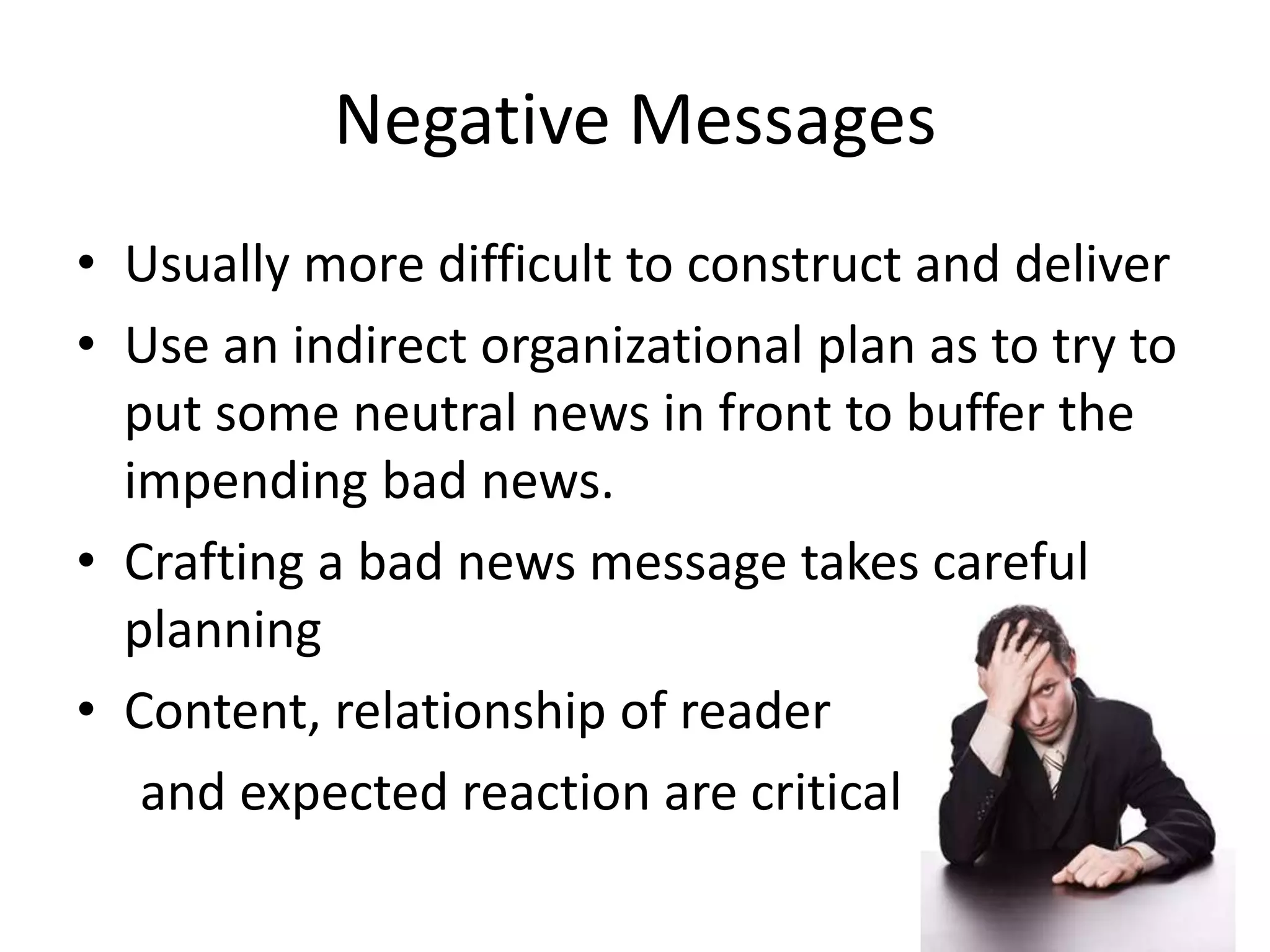
Negative Messages
• Usually more difficult to construct and deliver
• Use an indirect organizational plan as to try to
put some neutral news in front to buffer the
impending bad news.
• Crafting a bad news message takes careful
planning
• Content, relationship of reader
and expected reaction are critical
Business Presentations
• Preparation is the key to any successful
business presentation
• The planning and preparing is similar to a
business report with the addition of public
speaking
• Improving business speaking and
presentations can vastly improve your
standing in business as most are afraid of
public speaking
How to Create an Effective Business
Presentation
• Know your purpose
• Know your audience
• Capture attention in the
introduction
• Provide strong
organization in the body
of the presentation
• Summarize in the
conclusion
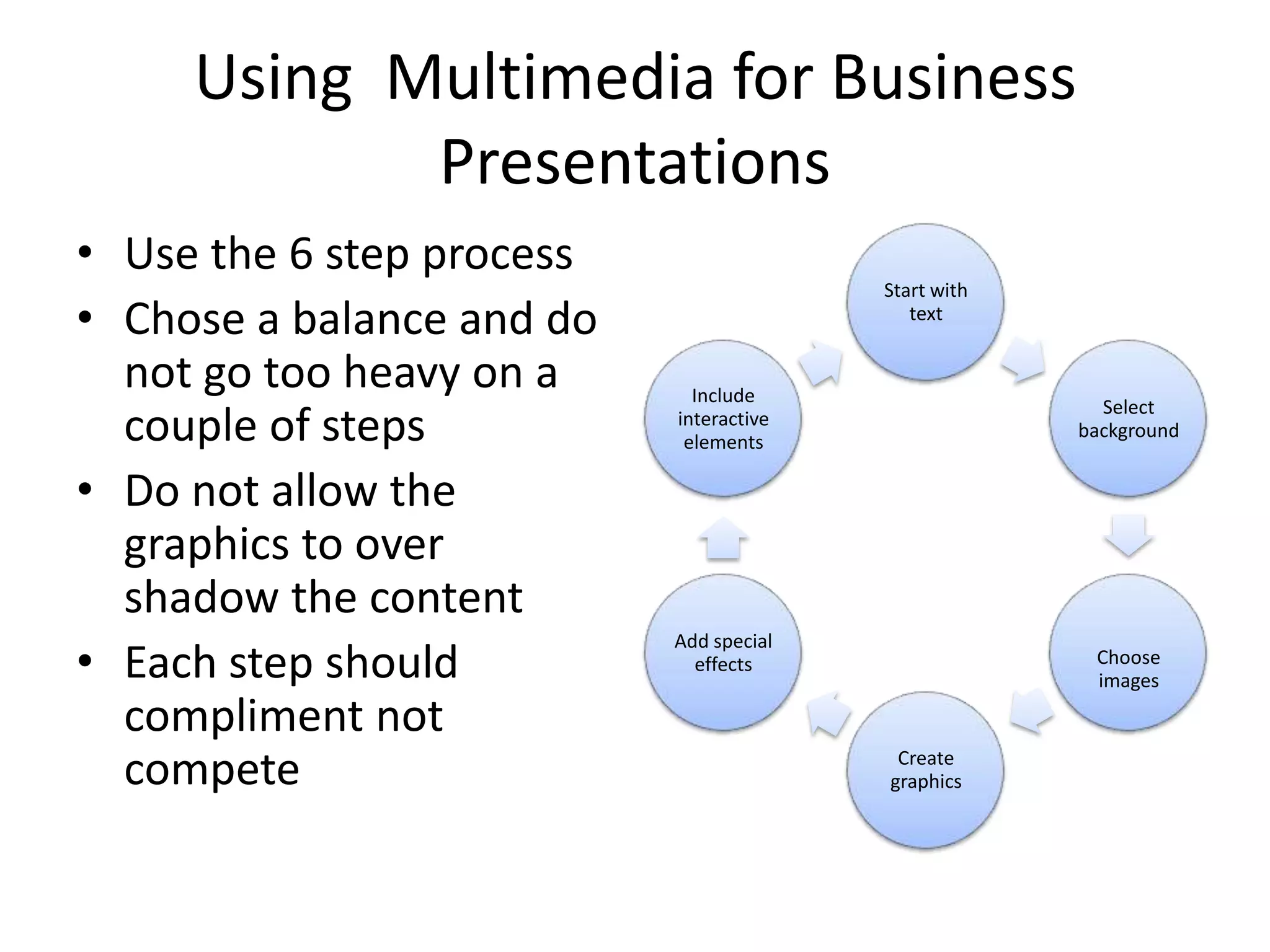
Using Multimedia for Business
Presentations
• Use the 6 step process
• Chose a balance and do
not go too heavy on a
couple of steps
• Do not allow the
graphics to over
shadow the content
• Each step should
compliment not
compete

Start with
text

Include
interactive
elements

Select
background

Add special
effects

Choose
images

Create
graphics
Business Reports, Plans and Proposals
Informal Business Reports
• Usually less formal
• Shorter in length than
formal reporting
• Provide informational and
or analytics
• Common examples of
informal business reports
are activity reports,
progress reports, and
yardstick reports

Formal Business Reports
• Formal as the name suggest
• Usually has a table of
contents
• Provides more in depth
analysis and commentary
• Common examples are
economic impact studies,
consultants business case
study, and government
hearings and findings
reports.
Conclusion
• Business Writing is a process
• The 3 X 3 process is a proven successful
method
• Practice makes Perfect- No one is born with
the natural ability to write and present
flawlessly
• Professional etiquette always enhances great
business writing and presentations
References
College Boards (2004). Writing: A ticket to work… or a ticket out
Retrieved from http://www.collegeboard.com/prod
download/writing.com/writing-ticket-to-work/pdf
Guffey, M. & Loewy, D. (2011). Business communication: Process
and product (7th ed.). Independence, KY: Cengage.
Moore, R. (2010). Writing matters: A handbook for writing and
research. New York, NY: Mc-Graw-Hill.
Newman, A,, & Ober, S. (2012). Business communication: In print
in person, online (8th ed.). Cincinnatti, OH: South-Western.
Towers Watson (2009). 2009/2010 Communications ROI Study Report.
Capitalizing on effective communication. Retrieved from
http://www.towerswatson.com/research/670

Best practices in business writing and communication

  • 1.
    Best Practices inBusiness Writing and Communication January 31, 2014
  • 2.
    Why is BusinessWriting and Communication Important? • Communication is the heart of the business • “Employees who are happy with how their company communicates are twice as likely to be motivated to work for the company and four times as likely to recommend the company” (College Boards, 2004) • Highly effective communicating companies have 47% higher returns for shareholders than companies considered least effective communicators (Towers and Watson, 2009)
  • 3.
    Do’s and Don’tof Ethical Communication • • • • • Follow the Law Tell the Truth Be Inclusive of Others Avoid the 5 “Traps” Use tools to overcome objections • Don’t fall into the 5 traps • False Necessity Trap • Doctrine of Relative Filth Trap • Self Deceptive Trap • Rationalization Trap • End-Justifies- theMeans Trap
  • 4.
    Tools for MakingEthical Communication • Is the Action legal? • How would you view the issue from the opposite side? • What are Alternative Solutions? • Can you discuss the problem with someone whose advice you trust? • How would you fell if your family, friends, employer or coworkers learned of your action?
  • 5.
    10 “Tips” forEffective Communication • • • • • • • • • • Listen first Breathe and remain calm Avoid blame, judgment or denial Separate fact from opinion Be aware of emotions Be aware of needs and values Ask for what you want Body Language Take into account individual and cultural differences Be sincere (Guffey and Loewy, 2011)
  • 6.
    Importance of Intercultural Communication •Business today is more and more global • The US population is expected to grow 50% over the next 50 years. Half of the new employees will be immigrants from different cultures (Newman & Ober, 2012) • Working together with many different cultures will become the norm • To succeed in a culture rich society, you will need to improve your communication skill and technique.
  • 7.
    Approaches to Intercultural Communication •Practice Empathy • Patience is required • Understand the significance of non verbal behavior • Listen without interruption • Check for comprehension such as always following up an oral encounter in writing for clarity (Guffey & Loewy, 2011) • Always use Professionalism
  • 8.
    Professionalism in theWorkplace • Professionalism leads to success • Soft skills such as professionalism and business etiquette are important to employers • Projecting professionalism when you communicate is vital to being a successful professional in business.
  • 9.
    Examples of Professionalismin Communication Speech Habits • Understand that your credibility can be seriously damaged by sounding uneducated, crude or adolescent (Guffey & Loewy, 2011) E-Mail • Employers put more value on email that have the correct punctuation and not abbreviations • Conciseness and correct spelling are expected
  • 10.
    More Examples ofProfessionalism in Communication Internet and texting • An email address should be a full relevant name and not a cute nickname • Sending appropriate business text only when necessary (Guffey & Loewy, 2011) Telephone and Voicemail • Keep the background quiet when you are answering the phone • An outgoing message on your voicemail states your name or phone number and provides instructions for leaving a message
  • 11.
    Writing Tips forthe Business Professional • Understanding that business writing involves a process is key to great writing • Purpose- you need a defined purpose for writing • Persuasive- You want your audience to accept and believe your message • Economical- Clear and concise, length is not important • Audience- know your audience and look from their perspective over yours
  • 12.
    Step 1: Understandthe 3X3 Writing Process • Business writers need to fully understand the process • Prewriting is the first step in a great presentation • Writing is the next step • Revising is the final step in the process (Guffey & Loewy, 2011)
  • 13.
    Prewriting • Identify yourpurpose • Choose engaging colors that are appealing • Create effective animation • Choose images when possible over plain text
  • 14.
    Writing • Always tryto illustrate your content creatively • Blue print slides are a preferred method • Follow the six steps on the next slide for a great presentation (Moore, 2010)
  • 15.
    Revising • Add anddelete slides until you are satisfied • Edit , proof, and edit again for errors • Always remember to evaluate the content
  • 16.
    Use of ElectronicMessage and Digital Media for Presentations • Always analyze the content • Subject line • Opening • Body • Closing
  • 17.
    Creating a MultimediaPresentation Start with text Include interactive elements Select background Add special effects Choose images Create graphics (Guffey & Loewy, 2011)
  • 18.
    Construct Content withTemplates (Guffey & Loewy, 2011)
  • 19.
    Slides must havea Purpose • • • • • • Appeal visually to audience Create memory points Review key points Provide transitions Illustrate ideas Try to simply a complex concept for audience
  • 20.
    Positive Messages • Choosebest method of delivery such as phone call, email, letter or face to face • Best to use a direct organization plan for writing neutral or good news • Examples of positive news are: letters of recommendation, promotions, and thank you letters.
  • 21.
    Negative Messages • Usuallymore difficult to construct and deliver • Use an indirect organizational plan as to try to put some neutral news in front to buffer the impending bad news. • Crafting a bad news message takes careful planning • Content, relationship of reader and expected reaction are critical
  • 22.
    Business Presentations • Preparationis the key to any successful business presentation • The planning and preparing is similar to a business report with the addition of public speaking • Improving business speaking and presentations can vastly improve your standing in business as most are afraid of public speaking
  • 23.
    How to Createan Effective Business Presentation • Know your purpose • Know your audience • Capture attention in the introduction • Provide strong organization in the body of the presentation • Summarize in the conclusion
  • 24.
    Using Multimedia forBusiness Presentations • Use the 6 step process • Chose a balance and do not go too heavy on a couple of steps • Do not allow the graphics to over shadow the content • Each step should compliment not compete Start with text Include interactive elements Select background Add special effects Choose images Create graphics
  • 25.
    Business Reports, Plansand Proposals Informal Business Reports • Usually less formal • Shorter in length than formal reporting • Provide informational and or analytics • Common examples of informal business reports are activity reports, progress reports, and yardstick reports Formal Business Reports • Formal as the name suggest • Usually has a table of contents • Provides more in depth analysis and commentary • Common examples are economic impact studies, consultants business case study, and government hearings and findings reports.
  • 26.
    Conclusion • Business Writingis a process • The 3 X 3 process is a proven successful method • Practice makes Perfect- No one is born with the natural ability to write and present flawlessly • Professional etiquette always enhances great business writing and presentations
  • 27.
    References College Boards (2004).Writing: A ticket to work… or a ticket out Retrieved from http://www.collegeboard.com/prod download/writing.com/writing-ticket-to-work/pdf Guffey, M. & Loewy, D. (2011). Business communication: Process and product (7th ed.). Independence, KY: Cengage. Moore, R. (2010). Writing matters: A handbook for writing and research. New York, NY: Mc-Graw-Hill. Newman, A,, & Ober, S. (2012). Business communication: In print in person, online (8th ed.). Cincinnatti, OH: South-Western. Towers Watson (2009). 2009/2010 Communications ROI Study Report. Capitalizing on effective communication. Retrieved from http://www.towerswatson.com/research/670