Expansion of Oyster Pilot Study 
within Jamaica Bay 
John McLaughlin 
October 15, 2014 
Jamaica Bay Task Force
2 
Jamaica Bay Watershed Protection Plan 
• Original Watershed Protection 
Plan identified 127 Strategies 
intended to improve water 
quality, ecology and public 
access to the bay 
• 2014 Update released on 
October 1st 
• http://www.nyc.gov/html/dep/p 
df/jamaica_bay/jbwpp_update 
_10012014.pdf
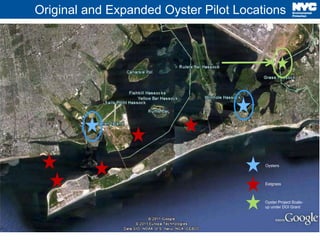
Original and Expanded Oyster Pilot Locations 
3 
Oysters 
Eelgrass 
Oyster Project Scale-up 
under DOI Grant
4 
Project Goals 
GOALS: 
• Demonstrate effectiveness of water quality and ecological benefits from 
oyster habitats 
• Demonstrate effectiveness of safeguards to avoid “attractive nuisance” 
• Develop information to restore a significant habitat type that once thrived in 
Jamaica Bay 
o Measure growth 
o Survival 
o Reproduction and Recruitment 
Under real environmental conditions (e.g., predators, environmental 
stressors)
5 
Dubos Point 
Dubos Point - Reef Bed 
 10’ X 15” near-shore 
 Spat on Shell (SOS) over surf 
clam shell 
 2 feet off bottom at 4 foot MLW
6 
Gerritsen Creek 
Gerritsen Creek - Reef Balls 
 12 reef balls placed together 
 2.5 ft width x 1.75 ft height 
 Spatted in separate tank (CCE) 
 Near shore, on bottom at 5 foot MLW
7 
Pilot Conclusions 
 Generally adequate conditions for life 
functions 
 Extensive predation observed (drills & 
crabs) 
 Percent survival > on reef balls vs. reef 
bed 
 Low incidence of Disease 
 Growth rates comparable to east coast 
estuaries 
 Gonadal development found 
 Reproduction not directly observed 
 No recruitment observed
8 
Oyster Growth 
DP & GC 2012 avr & max shell height
Improved Habitat 
Baseline 6 months 
Post Construction 
12 months 
Post Construction 
9 Frequently Observed Macrobenthic Species
10 
Lessons Learned 
 Scale 
 Although provided, difficult 
to actually measure water 
quality improvements - 
made more difficult due to 
small scale 
 No buffering capacity from 
disturbances 
 Reef Balls very successful 
 Reef Bed not stable 
 Requires lower energy, 
greater depth and/or 
structural protection
11 
Oyster Pilot Expansion 
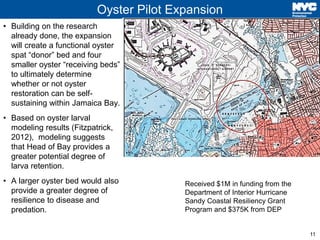
• Building on the research 
already done, the expansion 
will create a functional oyster 
spat “donor” bed and four 
smaller oyster “receiving beds” 
to ultimately determine 
whether or not oyster 
restoration can be self-sustaining 
within Jamaica Bay. 
• Based on oyster larval 
modeling results (Fitzpatrick, 
2012), modeling suggests 
that Head of Bay provides a 
greater potential degree of 
larva retention. 
• A larger oyster bed would also 
provide a greater degree of 
resilience to disease and 
predation. 
Received $1M in funding from the 
Department of Interior Hurricane 
Sandy Coastal Resiliency Grant 
Program and $375K from DEP
12 
Location of Larva Release Points 
Slide credit: HDR
13 
Recruitment Results 
Spat Release Locations near 
Head of Bay 
Slide credit: HDR
14
Partners 
15 
Design/Installation 
• New York Harbor School 
• Cornell University Cooperative Extension 
• Hudson River Foundation 
Permitting 
• NYSDEC 
• USACE
16 
Thank You 
John 
Mclaughlin 
NYCDEP 
718-595-4458 
jmclaughlin@dep.nyc.gov 
www.nyc.gov.dep

Jbtf oyster presentation

  • 1.
    Expansion of OysterPilot Study within Jamaica Bay John McLaughlin October 15, 2014 Jamaica Bay Task Force
  • 2.
    2 Jamaica BayWatershed Protection Plan • Original Watershed Protection Plan identified 127 Strategies intended to improve water quality, ecology and public access to the bay • 2014 Update released on October 1st • http://www.nyc.gov/html/dep/p df/jamaica_bay/jbwpp_update _10012014.pdf
  • 3.
    Original and ExpandedOyster Pilot Locations 3 Oysters Eelgrass Oyster Project Scale-up under DOI Grant
  • 4.
    4 Project Goals GOALS: • Demonstrate effectiveness of water quality and ecological benefits from oyster habitats • Demonstrate effectiveness of safeguards to avoid “attractive nuisance” • Develop information to restore a significant habitat type that once thrived in Jamaica Bay o Measure growth o Survival o Reproduction and Recruitment Under real environmental conditions (e.g., predators, environmental stressors)
  • 5.
    5 Dubos Point Dubos Point - Reef Bed  10’ X 15” near-shore  Spat on Shell (SOS) over surf clam shell  2 feet off bottom at 4 foot MLW
  • 6.
    6 Gerritsen Creek Gerritsen Creek - Reef Balls  12 reef balls placed together  2.5 ft width x 1.75 ft height  Spatted in separate tank (CCE)  Near shore, on bottom at 5 foot MLW
  • 7.
    7 Pilot Conclusions  Generally adequate conditions for life functions  Extensive predation observed (drills & crabs)  Percent survival > on reef balls vs. reef bed  Low incidence of Disease  Growth rates comparable to east coast estuaries  Gonadal development found  Reproduction not directly observed  No recruitment observed
  • 8.
    8 Oyster Growth DP & GC 2012 avr & max shell height
  • 9.
    Improved Habitat Baseline6 months Post Construction 12 months Post Construction 9 Frequently Observed Macrobenthic Species
  • 10.
    10 Lessons Learned  Scale  Although provided, difficult to actually measure water quality improvements - made more difficult due to small scale  No buffering capacity from disturbances  Reef Balls very successful  Reef Bed not stable  Requires lower energy, greater depth and/or structural protection
  • 11.
    11 Oyster PilotExpansion • Building on the research already done, the expansion will create a functional oyster spat “donor” bed and four smaller oyster “receiving beds” to ultimately determine whether or not oyster restoration can be self-sustaining within Jamaica Bay. • Based on oyster larval modeling results (Fitzpatrick, 2012), modeling suggests that Head of Bay provides a greater potential degree of larva retention. • A larger oyster bed would also provide a greater degree of resilience to disease and predation. Received $1M in funding from the Department of Interior Hurricane Sandy Coastal Resiliency Grant Program and $375K from DEP
  • 12.
    12 Location ofLarva Release Points Slide credit: HDR
  • 13.
    13 Recruitment Results Spat Release Locations near Head of Bay Slide credit: HDR
  • 14.
  • 15.
    Partners 15 Design/Installation • New York Harbor School • Cornell University Cooperative Extension • Hudson River Foundation Permitting • NYSDEC • USACE
  • 16.
    16 Thank You John Mclaughlin NYCDEP 718-595-4458 jmclaughlin@dep.nyc.gov www.nyc.gov.dep

Editor's Notes

  • #4 Sites subject to different environmental conditions, salinities, temperature Two sites: Different salinities & treatments Both easy access for bi-weekly monitoring