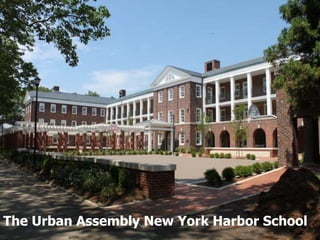
The Urban Assembly New York Harbor School
Oyster Restoration and
Research Project
The Urban Assembly New York Harbor
School
Advanced Aquaculture Class
Fall 2010
Harbor School Loves Oysters
Harbor School’s Oyster History
• Harbor School and Baykeeper have been working
together to restore oysters to the Harbor since the
school’s inception
• 2003 Harbor School Students clean and monitor
oyster gardens at The South Street Seaport
Museum.
• 2005: Harbor Corps begins patrolling the city to
work on about 30 different oyster gardens
• 2008 Bart Chezar of the Bay Ridge Flats Oyster
Project starts working with the Harbor School Dive
team on his groundbreaking reef on the Bay Ridge
Flats
• 2008: First generation Floating
Upweller System built, 100,000 oysters
on Governors Island
• 2009: The new Eco-dock was in place
on Governors Island holding 500,000
oysters
• 2010: Harbor School joins the Oyster
Restoration and Research Partnership
Harbor School Oyster Work
Why Oysters?
• Filtration of water and concentration of
biodeposits.
• Oysters provide habitat for fish (as well as
other vertebrates and invertebrates) in the
benthic zone.
• Stabilizes the benthic and/or intertidal
habitat
• Increases landscape diversity
Oysters and our CTE Department
• Oysters, and oyster projects are excellent
platforms for our Career Training classes
• We hope to have all of our CTE classes working
together on this project
• To date Aquaculture, Advanced Vessel
Operations and the Student Scientific Divers
have collaborated in building and monitoring our
reefs
• In the future we hope to include Marine
Engineering’s remote operated vehicles and
Marine Policy’s young writers
Oyster Restoration Research
Project
• Project Overview
• Remote Setting
• Nursery/Growout
• Reef Construction
• Monitoring
Partners!
Oyster Restoration Research Project Partners include, the
Hudson River Foundation, NY/NJ Baykeeper, US Army
Corps of Engineers, The Urban Assembly New York
Harbor School, The New York Harbor Foundation, The US
Environmental Protection Agency, The Trust for Governors
Island, NY-NJ Harbor Estuary Program, NY City
Department of Parks and Recreation, NY City Department
of Environmental Protection, New York State Department
of Environmental Conservation – Hudson River Program,
Hudson River Park Trust, NOAA Restoration Center, Bart
Chezar (Bay Ridge Flats Oyster Project), Rocking the
Boat.
Reef Sites
Dive Sites:
Governors Island, Bay
Ridge Flats and Staten
Island (not shown)
Wading Sites:
Hastings and Soundview
Park
Eco-dock, pier 101
Remote Setting and Clam
Shell Storage, Lima Pier
Remote Setting Facility on Lima Pier
Filter Pump Head Tank Setting Tanks Pier
2mm Spat On Shell
800 Watt heating element
Mesh bag with shell
4mm Spat on Shell
Remote Setting Results
• NYHS Performed 2 sets of oyster larvae
• Set 1: 3 million larvae on 30,000 shells
• Set 2: 6 million larvae in 50,000 shells
• Result: 80,000 shells each with an
average of 25 oysters
• 2,000,000 oysters
Remote Setting Lessons Learned
1.Cleaner shells will result in a higher
setting rate
2.Better access to our facility would
allow for more control over
conditions in the tanks
3.A Higher quality water supply would
also be beneficial
Nursery and Growout
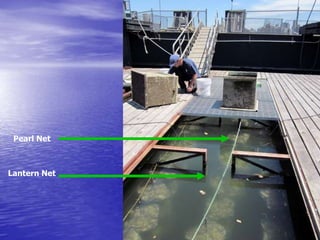
Pearl Net
Lantern Net
Spat on Shell
Ready for
Deployment
Grow out Results
• Approximately 70,000 shells
• Each shell containing between 10 and 20
live oysters
• Oysters ranged in size from 15 to 60mm
Growout lessons learned
• Start with fewer oysters in each net
• Reduce handling whenever possible
Reef Design
Each Reef Consists of…
• 23 cubic yards of rock
• 9 tons of clam shell
• 50,000 oysters on anywhere from 2,500-
5,000 shells
US Army Corps of Engineers install
the rock and shell on the Bay Ridge
Flats Reef
Harvesting Techniques and Monitoring
• Extract oysters from eco-dock
• Empty oysters into crates and buckets
• Clean oysters
• Count and measure oysters in buckets
Distribution
• Oysters travel to reef sites in Harbor School
vessels
• Oysters are distributed on reefs using buckets
and quadrants for reference
• On dive sites, Bay Ridge Flats, Governors Island
and Staten Island distribution is carried out by
SCUBA teams
• Wading sites Aquaculture students and
volunteers do the distribution being very careful
not to step on the oysters
Harvesting and Spat on Shell Deployment
Diving Safely in New York
Harbor
• SCUBA instructors Joe Gessert and Liv
Dillon organized a Dive control Board
made up of commercial divers
• This led to new protocols including full
face masks, tethered dives, and safety
divers ready at all times
• Currently Harbor School is in the process
of becoming a scientific diver training
facility
• This project would not have been possible
without the dedication of our divers
• Students and teachers routinely arrived on
Governors Island hours before school,
often while it was still dark
• Despite air temperatures below 40° and
water temperatures below 50° all 250,000
oysters are down
Buckets as Standard
Oyster presentationfor epa

Oyster presentationfor epa

  • 1.
    The Urban AssemblyNew York Harbor School
  • 2.
    Oyster Restoration and ResearchProject The Urban Assembly New York Harbor School Advanced Aquaculture Class Fall 2010
  • 3.
  • 4.
    Harbor School’s OysterHistory • Harbor School and Baykeeper have been working together to restore oysters to the Harbor since the school’s inception • 2003 Harbor School Students clean and monitor oyster gardens at The South Street Seaport Museum. • 2005: Harbor Corps begins patrolling the city to work on about 30 different oyster gardens • 2008 Bart Chezar of the Bay Ridge Flats Oyster Project starts working with the Harbor School Dive team on his groundbreaking reef on the Bay Ridge Flats
  • 5.
    • 2008: Firstgeneration Floating Upweller System built, 100,000 oysters on Governors Island • 2009: The new Eco-dock was in place on Governors Island holding 500,000 oysters • 2010: Harbor School joins the Oyster Restoration and Research Partnership Harbor School Oyster Work
  • 6.
    Why Oysters? • Filtrationof water and concentration of biodeposits. • Oysters provide habitat for fish (as well as other vertebrates and invertebrates) in the benthic zone. • Stabilizes the benthic and/or intertidal habitat • Increases landscape diversity
  • 7.
    Oysters and ourCTE Department • Oysters, and oyster projects are excellent platforms for our Career Training classes • We hope to have all of our CTE classes working together on this project • To date Aquaculture, Advanced Vessel Operations and the Student Scientific Divers have collaborated in building and monitoring our reefs • In the future we hope to include Marine Engineering’s remote operated vehicles and Marine Policy’s young writers
  • 8.
    Oyster Restoration Research Project •Project Overview • Remote Setting • Nursery/Growout • Reef Construction • Monitoring
  • 9.
    Partners! Oyster Restoration ResearchProject Partners include, the Hudson River Foundation, NY/NJ Baykeeper, US Army Corps of Engineers, The Urban Assembly New York Harbor School, The New York Harbor Foundation, The US Environmental Protection Agency, The Trust for Governors Island, NY-NJ Harbor Estuary Program, NY City Department of Parks and Recreation, NY City Department of Environmental Protection, New York State Department of Environmental Conservation – Hudson River Program, Hudson River Park Trust, NOAA Restoration Center, Bart Chezar (Bay Ridge Flats Oyster Project), Rocking the Boat.
  • 10.
    Reef Sites Dive Sites: GovernorsIsland, Bay Ridge Flats and Staten Island (not shown) Wading Sites: Hastings and Soundview Park
  • 11.
    Eco-dock, pier 101 RemoteSetting and Clam Shell Storage, Lima Pier
  • 12.
  • 13.
    Filter Pump HeadTank Setting Tanks Pier
  • 19.
    2mm Spat OnShell 800 Watt heating element Mesh bag with shell
  • 21.
  • 22.
    Remote Setting Results •NYHS Performed 2 sets of oyster larvae • Set 1: 3 million larvae on 30,000 shells • Set 2: 6 million larvae in 50,000 shells • Result: 80,000 shells each with an average of 25 oysters • 2,000,000 oysters
  • 23.
    Remote Setting LessonsLearned 1.Cleaner shells will result in a higher setting rate 2.Better access to our facility would allow for more control over conditions in the tanks 3.A Higher quality water supply would also be beneficial
  • 24.
  • 26.
  • 30.
    Spat on Shell Readyfor Deployment
  • 32.
    Grow out Results •Approximately 70,000 shells • Each shell containing between 10 and 20 live oysters • Oysters ranged in size from 15 to 60mm
  • 33.
    Growout lessons learned •Start with fewer oysters in each net • Reduce handling whenever possible
  • 34.
  • 35.
    Each Reef Consistsof… • 23 cubic yards of rock • 9 tons of clam shell • 50,000 oysters on anywhere from 2,500- 5,000 shells
  • 38.
    US Army Corpsof Engineers install the rock and shell on the Bay Ridge Flats Reef
  • 40.
    Harvesting Techniques andMonitoring • Extract oysters from eco-dock • Empty oysters into crates and buckets • Clean oysters • Count and measure oysters in buckets
  • 41.
    Distribution • Oysters travelto reef sites in Harbor School vessels • Oysters are distributed on reefs using buckets and quadrants for reference • On dive sites, Bay Ridge Flats, Governors Island and Staten Island distribution is carried out by SCUBA teams • Wading sites Aquaculture students and volunteers do the distribution being very careful not to step on the oysters
  • 42.
    Harvesting and Spaton Shell Deployment
  • 43.
    Diving Safely inNew York Harbor • SCUBA instructors Joe Gessert and Liv Dillon organized a Dive control Board made up of commercial divers • This led to new protocols including full face masks, tethered dives, and safety divers ready at all times • Currently Harbor School is in the process of becoming a scientific diver training facility
  • 44.
    • This projectwould not have been possible without the dedication of our divers • Students and teachers routinely arrived on Governors Island hours before school, often while it was still dark • Despite air temperatures below 40° and water temperatures below 50° all 250,000 oysters are down
  • 45.