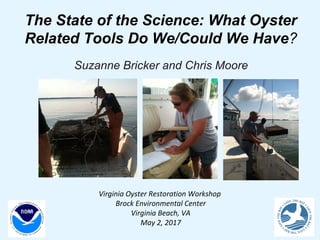
The State of the Science: What Oyster
Related Tools Do We/Could We Have?
Suzanne Bricker and Chris Moore
Virginia Oyster Restoration Workshop
Brock Environmental Center
Virginia Beach, VA
May 2, 2017
Chesapeake Bay Program Partnership
Water Quality Assurance Process
Best Management Practices
CBP-approved practices or
technologies are approved
for credit toward achieving
WIP commitments
Watershed
Implementation Plan
States and local partners
develop plans to achieve
pollutant reductions
ChesBay TMDL / Model
A plan was developed to
reduce nitrogen, phosphorus,
and sediment loads.
End Goal:
Meet Water
Quality
Standards
Water Quality Assessment
2010 Chesapeake Bay did not meet
nitrogen, phosphorus, and sediment
water quality standards
Nutrients cause water quality degradation:
Too much of a good thing
Potomac River, MD
Florida Bay, FL
Caloosahatchee Bay, FL
Corsica River, MD
Excessive algal blooms
Low dissolved oxygen  fish kills
Harmful
Algal
Blooms
Loss of
seagrasses due
to loss of light
penetration
Qiangdao, China
What is a Best Management Practice?
BMPs are practices / technologies used by the
Chesapeake Bay Partnership to reduce nutrient pollution
to help meet water quality goals.
• Structural BMP: runoff diversions, silt fence, stream
buffers, groundcover vegetation, and oysters!
• Non-structural / programmatic BMP: preharvest
planning/nutrient application management, manure
transport, stormwater management.
Approved BMPS are given ‘credits’ for the amount of
nutrients they remove.
BMPS are tools for nutrient reductions
Why the interest in nutrient BMPs?
65% of US estuaries have moderate to high level degradation
from nutrients
From: Bricker et al. 2007. Effects of Nutrient Enrichment in the Nation’s Estuaries:
A Decade of Change, National Estuarine Eutrophication Assessment Update
• Biological removal of
nutrients directly from
the water through
filtration by shellfish,
removes algae and
particulates –
improves water
quality
Oysters as BMPs?
Eastern Oyster,
Crassostrea virginica
Source: Screenshots from Chesapeake Bay
Foundation time-lapsed video of a reef
Filter Feeders Influence Water
Quality
The Stars of our Show: The Mighty Bivalve
Eastern Oyster,
Crassostrea virginica Northern Quahog
Mercenaria mercenaria
Ribbed Mussel
Geukensia demissa
Blue Mussel
Mytilus edulis
Geoduck clam
Panopea generosa
Sampling on Chesapeake MD oyster farms
providing water quality data and oysters
Map of oyster aquaculture
study sites in Maryland
Ongoing study (Parker and
Bricker) to estimate the
ecosystem service of
(potential) nutrient removal
capability of oysters, and
the value represented by
the service being provided
by oysters
Site 6
Single oyster bottom cage
Single oyster floating cage
Spat on shell bottom
Previous studies
Study sites
Research to help determine oyster related
nutrient removal at local scale
Current Current
Width
Depth
Chl a
POM
Chl a
POM
Sections
1 2 3 n-1 n
Finfish, shellfish, algae
POM
(Ferreira et al., 2007)
algae
algae
particulates particulates
particulates
Models for a single oyster farm estimate production and
nutrient removal
Parker and Bricker data used to calibrate to Chesapeake Bay
Simulations to determine potential
impact of oyster reef and
aquaculture removal of nutrients in
the entire waterbody
Shows feasibility and potential for
using oysters as BMP
Research to determine impact of oyster
nutrient removal at waterbody scale
System Wide Eutrophication Model
2300 boxes
EcoWin2000 grid
42 boxes
Approved
Conditional
Restricted
Prohibited
Chesapeake Bay
13,000 boxes
Long Island Sound
Oyster Calculator:
A tool developed from research and modeling
http://oceanwealth.org/tools/oyster-calculator/
Determines water filtration based on area of reef, size and density
of oysters. Determines associated fish production.
Current conditions and desired conditions – set goals
Oyster reef restoration
(want to add aquaculture
of oysters and kelp)
James River, VAJames River, VA
Using bivalve shellfish to improve water quality
Chesapeake Bay Partnership Program convened
Oyster BMP Expert Panel in 2015
Best Management Practices
CBP-approved practices or
technologies are approved
for credit toward achieving
WIP commitments
Watershed
Implementation Plan
States and local partners
develop plans to achieve
pollutant reductions
ChesBay TMDL / Model
A plan was developed to
reduce nitrogen, phosphorus,
and sediment loads.
End Goal:
Meet Water
Quality
Standards
Water Quality Assessment
2010 Chesapeake Bay did not meet
nitrogen, phosphorus, and sediment
water quality standards
Oyster BMP Expert Panel
Evaluates reduction
effectiveness of proposed
BMPs following the CBP
BMP Review Protocol
Oyster nutrient and sediment removal
processes under evaluation
1.Tissue and shell nutrient content
2.Denitrification rates associated with oyster
reefs
3.Burial in sediment
•First focus was nutrients removed via tissue of
oysters harvested from private oyster
aquaculture practices.
•Panel reviewed existing studies and data to
determine tissue nitrogen and phosphorus
content.
Oyster BMP Expert Panel First
Recommendations released December 19,
2016• Decision framework illustrating the process by which
nutrient removal recommendations will be generated.
• Recommended amounts of nutrient removal to be
credited by the Chesapeake Bay Program for oyster
tissue:
• Off-bottom private oyster aquaculture using
hatchery-produced oysters
• On-bottom private oyster aquaculture using
hatchery-produced oysters
• On-bottom private oyster aquaculture using
substrate addition
(Under discussion whether reefs will be allowed
• Derived from oyster growth data from Chesapeake Bay locations.
• Determined five size class ranges based on shell height.
The Panel also recommended a methodology to determine
site-specific estimates.
BMP Name
Lbs N Reduced/
millionmillion Oysters
Harvested
Lbs P Reduced/
millionmillion Oysters
Harvested
Diploid Oyster Aquaculture 2.25 Inch 110 22
Diploid Oyster Aquaculture 3.0 Inch 198 22
Diploid Oyster Aquaculture 4.0 Inch 331 44
Diploid Oyster Aquaculture 5.0 Inch 485 44
Diploid Oyster Aquaculture ≥ 5.5 Inch 683 66
Triploid Oyster Aquaculture 2.25 Inch 132 22
Triploid Oyster Aquaculture 3.0 Inch 287 22
Triploid Oyster Aquaculture 4.0 Inch 573 66
Triploid Oyster Aquaculture 5.0 Inch 970 110
Triploid Oyster Aquaculture ≥ 5.5 Inch 1,477 154
Recommended Default Estimates for Nutrient Credits
Triploid oysters have greater nutrient tissue content than diploid oysters
of same shell height because they have greater tissue biomass.
What does this mean for water quality
management programs ?
• Research and sampling support development and
improvement of tools for successful water quality
management
• States can now use harvested oyster tissue from
aquaculture as a nutrient BMP in Watershed
Implementation Plans, can pursue inclusion in nutrient
trading programs
• Models (FARM, Chesapeake Bay Model, Oyster Calculator)
for predicting ecosystem services currently and with
increased aquaculture production or area of restored reefs –
assists setting restoration goals and forecasting results
• Oyster Calculator to be expanded for use in oyster related
nutrient restoration – reefs and farms
Acknowledgements – Thank You!!
•Don Webster and organizers of
Watermen’s Trade Show seminar
•Chesapeake Bay Partnership
• Oyster Recovery Partnership – Julie
Reichert and Ward Slacum
• Jeffrey Cornwell and other Oyster BMP
Panel Members
•Julie Rose, NOAA NMFS Milford Lab
•Oyster growers who contribute to research

Suzanne Bricker's Oyster Restoration Workshop Presentation

  • 1.
    The State ofthe Science: What Oyster Related Tools Do We/Could We Have? Suzanne Bricker and Chris Moore Virginia Oyster Restoration Workshop Brock Environmental Center Virginia Beach, VA May 2, 2017
  • 2.
    Chesapeake Bay ProgramPartnership Water Quality Assurance Process Best Management Practices CBP-approved practices or technologies are approved for credit toward achieving WIP commitments Watershed Implementation Plan States and local partners develop plans to achieve pollutant reductions ChesBay TMDL / Model A plan was developed to reduce nitrogen, phosphorus, and sediment loads. End Goal: Meet Water Quality Standards Water Quality Assessment 2010 Chesapeake Bay did not meet nitrogen, phosphorus, and sediment water quality standards
  • 3.
    Nutrients cause waterquality degradation: Too much of a good thing Potomac River, MD Florida Bay, FL Caloosahatchee Bay, FL Corsica River, MD Excessive algal blooms Low dissolved oxygen  fish kills Harmful Algal Blooms Loss of seagrasses due to loss of light penetration Qiangdao, China
  • 4.
    What is aBest Management Practice? BMPs are practices / technologies used by the Chesapeake Bay Partnership to reduce nutrient pollution to help meet water quality goals. • Structural BMP: runoff diversions, silt fence, stream buffers, groundcover vegetation, and oysters! • Non-structural / programmatic BMP: preharvest planning/nutrient application management, manure transport, stormwater management. Approved BMPS are given ‘credits’ for the amount of nutrients they remove. BMPS are tools for nutrient reductions
  • 5.
    Why the interestin nutrient BMPs? 65% of US estuaries have moderate to high level degradation from nutrients From: Bricker et al. 2007. Effects of Nutrient Enrichment in the Nation’s Estuaries: A Decade of Change, National Estuarine Eutrophication Assessment Update
  • 6.
    • Biological removalof nutrients directly from the water through filtration by shellfish, removes algae and particulates – improves water quality Oysters as BMPs? Eastern Oyster, Crassostrea virginica Source: Screenshots from Chesapeake Bay Foundation time-lapsed video of a reef Filter Feeders Influence Water Quality
  • 7.
    The Stars ofour Show: The Mighty Bivalve Eastern Oyster, Crassostrea virginica Northern Quahog Mercenaria mercenaria Ribbed Mussel Geukensia demissa Blue Mussel Mytilus edulis Geoduck clam Panopea generosa
  • 8.
    Sampling on ChesapeakeMD oyster farms providing water quality data and oysters Map of oyster aquaculture study sites in Maryland Ongoing study (Parker and Bricker) to estimate the ecosystem service of (potential) nutrient removal capability of oysters, and the value represented by the service being provided by oysters Site 6 Single oyster bottom cage Single oyster floating cage Spat on shell bottom Previous studies Study sites
  • 9.
    Research to helpdetermine oyster related nutrient removal at local scale Current Current Width Depth Chl a POM Chl a POM Sections 1 2 3 n-1 n Finfish, shellfish, algae POM (Ferreira et al., 2007) algae algae particulates particulates particulates Models for a single oyster farm estimate production and nutrient removal Parker and Bricker data used to calibrate to Chesapeake Bay
  • 10.
    Simulations to determinepotential impact of oyster reef and aquaculture removal of nutrients in the entire waterbody Shows feasibility and potential for using oysters as BMP Research to determine impact of oyster nutrient removal at waterbody scale System Wide Eutrophication Model 2300 boxes EcoWin2000 grid 42 boxes Approved Conditional Restricted Prohibited Chesapeake Bay 13,000 boxes Long Island Sound
  • 11.
    Oyster Calculator: A tooldeveloped from research and modeling http://oceanwealth.org/tools/oyster-calculator/ Determines water filtration based on area of reef, size and density of oysters. Determines associated fish production. Current conditions and desired conditions – set goals Oyster reef restoration (want to add aquaculture of oysters and kelp)
  • 12.
  • 13.
    Using bivalve shellfishto improve water quality
  • 14.
    Chesapeake Bay PartnershipProgram convened Oyster BMP Expert Panel in 2015 Best Management Practices CBP-approved practices or technologies are approved for credit toward achieving WIP commitments Watershed Implementation Plan States and local partners develop plans to achieve pollutant reductions ChesBay TMDL / Model A plan was developed to reduce nitrogen, phosphorus, and sediment loads. End Goal: Meet Water Quality Standards Water Quality Assessment 2010 Chesapeake Bay did not meet nitrogen, phosphorus, and sediment water quality standards Oyster BMP Expert Panel Evaluates reduction effectiveness of proposed BMPs following the CBP BMP Review Protocol
  • 15.
    Oyster nutrient andsediment removal processes under evaluation 1.Tissue and shell nutrient content 2.Denitrification rates associated with oyster reefs 3.Burial in sediment •First focus was nutrients removed via tissue of oysters harvested from private oyster aquaculture practices. •Panel reviewed existing studies and data to determine tissue nitrogen and phosphorus content.
  • 16.
    Oyster BMP ExpertPanel First Recommendations released December 19, 2016• Decision framework illustrating the process by which nutrient removal recommendations will be generated. • Recommended amounts of nutrient removal to be credited by the Chesapeake Bay Program for oyster tissue: • Off-bottom private oyster aquaculture using hatchery-produced oysters • On-bottom private oyster aquaculture using hatchery-produced oysters • On-bottom private oyster aquaculture using substrate addition (Under discussion whether reefs will be allowed
  • 17.
    • Derived fromoyster growth data from Chesapeake Bay locations. • Determined five size class ranges based on shell height. The Panel also recommended a methodology to determine site-specific estimates. BMP Name Lbs N Reduced/ millionmillion Oysters Harvested Lbs P Reduced/ millionmillion Oysters Harvested Diploid Oyster Aquaculture 2.25 Inch 110 22 Diploid Oyster Aquaculture 3.0 Inch 198 22 Diploid Oyster Aquaculture 4.0 Inch 331 44 Diploid Oyster Aquaculture 5.0 Inch 485 44 Diploid Oyster Aquaculture ≥ 5.5 Inch 683 66 Triploid Oyster Aquaculture 2.25 Inch 132 22 Triploid Oyster Aquaculture 3.0 Inch 287 22 Triploid Oyster Aquaculture 4.0 Inch 573 66 Triploid Oyster Aquaculture 5.0 Inch 970 110 Triploid Oyster Aquaculture ≥ 5.5 Inch 1,477 154 Recommended Default Estimates for Nutrient Credits Triploid oysters have greater nutrient tissue content than diploid oysters of same shell height because they have greater tissue biomass.
  • 18.
    What does thismean for water quality management programs ? • Research and sampling support development and improvement of tools for successful water quality management • States can now use harvested oyster tissue from aquaculture as a nutrient BMP in Watershed Implementation Plans, can pursue inclusion in nutrient trading programs • Models (FARM, Chesapeake Bay Model, Oyster Calculator) for predicting ecosystem services currently and with increased aquaculture production or area of restored reefs – assists setting restoration goals and forecasting results • Oyster Calculator to be expanded for use in oyster related nutrient restoration – reefs and farms
  • 19.
    Acknowledgements – ThankYou!! •Don Webster and organizers of Watermen’s Trade Show seminar •Chesapeake Bay Partnership • Oyster Recovery Partnership – Julie Reichert and Ward Slacum • Jeffrey Cornwell and other Oyster BMP Panel Members •Julie Rose, NOAA NMFS Milford Lab •Oyster growers who contribute to research

Editor's Notes

  • #3 Explain total maximum daily load Chesapeake Bay has had TMDLs for Nitrogen, Phosphorus, and Sediment since 2010
  • #5 BMPs are used by the Chesapeake Bay Program Partnership BMPs are tracked, verified, and reported by the jurisdictions for “credit” towards their watershed implementation plan (WIP) commitments and two-year milestones under the Chesapeake Bay Total Maximum Daily Loads (TMDL). WIPs are the roadmaps for how jurisdictions will achieve the pollutant reductions required by the Chesapeake Bay TMDL (more on this soon). From Ward Slacum WIPs-Roadmap for how the Bay jurisdictions (DE, MD, NY, PA, VA, WV, and D.C.), in partnership with federal and local governments, will achieve the Bay’s TMDL nutrient and sediment pollutant reductions, which includes the implementation of BMPs.
  • #6 BMPs as a tool for nutrient reductions
  • #7 Thanks you Julie Reichert!!
  • #8 Oysters are only one of several bivalve shellfish species that have been studied – note mussels used in Sweden / Denmark specifically for nutrient reduction They are a keystone species meaning they support complex community, perform essential functions are ecosystem engineers modifying environment to influence health of ecosystems
  • #12 SOME IMPORTANT CAVEATS This guide is not a replacement for post-project monitoring. Such monitoring is the only way to assess project performance and quantify the actual ecosystem services delivered as a result of a project. This document does provide a way to set science-based objective for the amount of restoration required to achieve the desired level of benefits and ecosystem services that motivate the restoration. Monitoring of the intended objective and adaptive management must also play a role in both project planning and assessing progress. This guide does not determine specific sites within an estuary where restoration is needed or should be undertaken. This is a critical next step after estuary level objectives for oyster restoration have been described (See Figure 1.). For further information on identifying specific sites suitable for oyster restoration projects, see Brumbaugh et al. (2006), and for further information on restoration design and monitoring please see Baggett et al. (2014).
  • #13 Current oyster calculator – restored reef only, oysters….calculates filtration and fish production associated with current and also simulated i.e. goal conditions wrt oyster size , density and reef area. To use the calculator, first select a bay location from our database. If using your own site, select the closest site within our database to load oyster mass formula and fish benefits data The calculator has 48 places that have pre-loaded data that can be used as a starting point. Filtration related drawdown is calculated, goals can be determined for filtration percentage, oyster size that will result in changes in estuary filtration.
  • #14 From Julie Reichert Nutrient Bioextraction Workshop-2009 workshop sponsored by NOAA and the Long Island Sound Study. Brought together a panel of policy, industry, and science subject matter experts to discuss new and innovative bioextractive technologies (i.e., shellfish and seaweed cultivation to remove nitrogen and other nutrients from the water) to address the management of eutrophication and hypoxia in the Long Island Sound. 2009 workshop above led to ribbed mussel pilot study in the Bronx River, NYC. Bivalve use in Europe-use of blue mussel farms to improve water quality. Why there is such an interest? Next slide ------- Workshop request to evaluate the science and provide recommendations on the use of oysters to reduce nutrients. Request for in situ nutrient remediation pilot between oyster farm and stormwater permittee Request to consider denitrification rates for a “sanctuary oyster reef” BMP From Julie Reichert Q1. Did STAC recommend nutrient reductions for harvested oysters? A1. Yes. After a thorough review of the existing science, STAC recommended that oysters harvested from aquaculture cages (intensive oyster aquaculture) could receive nutrient reduction benefits based upon the nutrient content of oyster tissue and shells. STAC found that on average: Can oyster-associated N, P, and suspended sediment reduction processes be used to quantify water quality improvement?
  • #16 Ecosystem-based management is an environmental management approach that recognizes the full array of interactions within an ecosystem, including humans, rather than considering single issues, species, or ecosystem services in isolation  Shellfish growth rates Nitrogen losses mediated by shellfish: Denitrification rates Harvest amounts well constrained - 1) shell and tissue content (location specific – Carmichael…spp and location), 2) filtration Burial not well known - Beseres Pollack, TX reef; Darrow, shell burial midden
  • #17 Julie Read slide
  • #18 Default estimates for recommended practices regardless of location and applied to diploid and triploid oysters based on tissue dry weight where: Average % Nitrogen Content in Oyster Tissue = 8.2% Average % Phosphorus Content in Oyster Tissue = 0.9% 2. Site-specific estimates are possible but need to be coordinated among growers, the state, and Chesapeake Bay Program Partnership using methods recommended by the panel
  • #19 Potential for additional income stream for growers Price and potential impact on farm profitability yet to be determined Potential positive impacts for marketing to generate higher prices or more sales depending on market or customer base
  • #20 Jeff Read slide