
Download to read offline


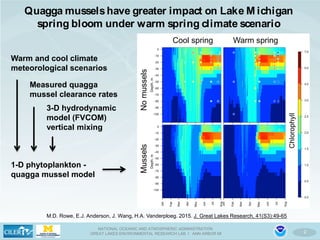
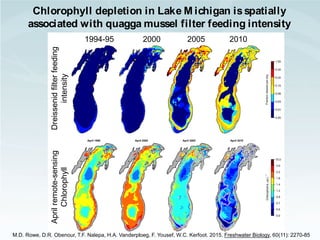
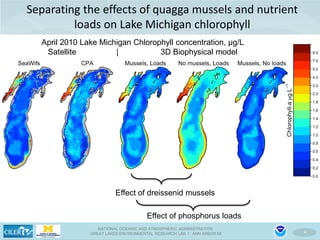
A 3D biophysical model was used to simulate the impact of quagga mussels on the spring phytoplankton bloom in Lake Michigan under different climate scenarios. The model results showed that quagga mussels had a greater suppressive effect on chlorophyll levels during a warm spring compared to a cool spring. Satellite data from 1994-2010 also demonstrated that chlorophyll depletion in Lake Michigan correlated spatially with areas of high quagga mussel filter feeding intensity. The same biophysical model was able to separate the effects of nutrient loads and dreissenid mussels on 2010 Lake Michigan chlorophyll levels when validated with satellite data.


