Team 3
Junior Achievement
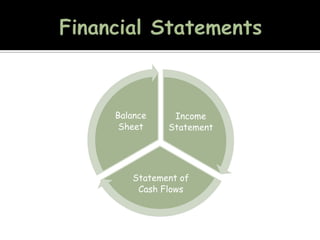
Balance    Income
 Sheet    Statement


   Statement of
    Cash Flows
These statements are the MOST important
part of the business plan. They provide valuable
information that is typically used by business
managers and investors. The entrepreneur
does not need to personally develop financial
statements. This is typically done by investors
and managers and these sheets tell the overall
financial health of the business.
   Balance Sheet is a financial snap shot of a
  company’s assets, liabilities, and stockholder’s
  equities.
 Income Statement Profit and Loss
   Statement of Cash Flows uses information the two
    other financial statements, the balance sheet (B/S) and the
    income statement (I/S), to develop a statement that explains
    changes in cash flows resulting from
    operations, investing, and financing activities
   Includes
     Cost of Goods Sold
     Gross
     Operating
     Net profits
   All should be in percent total of 100%
   Assets
      ▪ current
      ▪ long term
      ▪ tangible and intangible
   Liabilities
     current and long-term
   Equity
      ▪ stock-Common, preferred, etc
      ▪ retained earnings
Are on the balance sheet to determine a company’s
creditworthiness and solvency position
   Uses information from the two other financial
    statements, the balance sheet (B/S) and she
    Income Statement (I/S), to develop a
    statement that explains changes in cash flows
    resulting from operations, investing, and
    financing activities.
   Rogers, S. (2009). Entrepreneurial
    Finance . In S. Rogers, Entrepreneuial
    Finance (pp. 81-101). New York: McGraw
    Hill.

JApresentationzionteam3

  • 1.
  • 2.
    Balance Income Sheet Statement Statement of Cash Flows
  • 3.
    These statements arethe MOST important part of the business plan. They provide valuable information that is typically used by business managers and investors. The entrepreneur does not need to personally develop financial statements. This is typically done by investors and managers and these sheets tell the overall financial health of the business.
  • 4.
    Balance Sheet is a financial snap shot of a company’s assets, liabilities, and stockholder’s equities.  Income Statement Profit and Loss  Statement of Cash Flows uses information the two other financial statements, the balance sheet (B/S) and the income statement (I/S), to develop a statement that explains changes in cash flows resulting from operations, investing, and financing activities
  • 5.
    Includes  Cost of Goods Sold  Gross  Operating  Net profits  All should be in percent total of 100%
  • 6.
    Assets ▪ current ▪ long term ▪ tangible and intangible  Liabilities  current and long-term  Equity ▪ stock-Common, preferred, etc ▪ retained earnings Are on the balance sheet to determine a company’s creditworthiness and solvency position
  • 7.
    Uses information from the two other financial statements, the balance sheet (B/S) and she Income Statement (I/S), to develop a statement that explains changes in cash flows resulting from operations, investing, and financing activities.
  • 8.
    Rogers, S. (2009). Entrepreneurial Finance . In S. Rogers, Entrepreneuial Finance (pp. 81-101). New York: McGraw Hill.