Chapter 03
UNDERSTANDING FINANCIAL STATEMENTS
Prepared By:
Md. Kamruzzaman Didar
Sr. Lecturer of Finance
Department of Business Administration
What is a Financial Statement?
• A financial statement is a quantitative way of
showing how a company is doing.
• Financial statements provide the fundamental
information that we use to analyze and answer
valuation questions.
Primary Financial Statements
Basic financial statements:
Balance Sheet
Income Statement
 Statement of Owner’s Equity
Statement of Cash Flows
• Footnotes
• Summary of the financial position of a company at a
particular date
• Assets: cash, accounts receivable, inventory, land,
buildings, equipment and intangible items
• Liabilities: accounts payable, notes payable and
mortgages payable
• Owners’ Equity: net assets after all obligations have
been satisfied
The Balance Sheet
Accounting Equation
Assets = Liabilities + Owners’ Equity
Sources of Funding
Creditors’
claims
against
resources
= +
Owners’
claims
against
resources
Resources
Resources
to use to
generate
revenues
The Balance Sheet
Items Analysis and Discussion
• Aswath Damodaran-Chapter 03
• Merrill Lynch-Understanding Financial Reports
Balance Sheet Limitations
Assets recorded at historical value
Only recognizes assets that can be expressed in
monetary terms
Owners’ equity is usually less than the company’s
market value
The Income Statement
• Shows the results of a company’s operations over a period of
time.
• What goods were sold or services performed that provided
revenue for the company?
• What costs were incurred in normal operations to generate
these revenues?
• What are the earnings or company profit?
The Income Statement
Revenues
• Assets (cash or AR) created through business operations
Expenses
• Assets (cash or AP) consumed through business operations
Net Income or (Net Loss)
• Revenues - Expenses
The Example Company
Income Statement
For the Years Ended December 31, 2010 and 2011
2011 2010
Revenues:
Sales $100 $ 85
Other revenue 30 15
Total revenues $130 $100
Expenses:
Cost of goods sold $ 62 $ 58
Operating & admin. 16 12
Income tax 20 18
Total expenses $ 98 $ 88
Net Income $ 32 $ 12
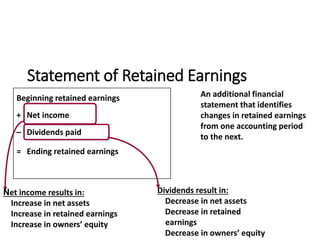
An additional financial
statement that identifies
changes in retained earnings
from one accounting period
to the next.
Statement of Retained Earnings
Beginning retained earnings
+ Net income
– Dividends paid
= Ending retained earnings
Net income results in:
Increase in net assets
Increase in retained earnings
Increase in owners’ equity
Dividends result in:
Decrease in net assets
Decrease in retained
earnings
Decrease in owners’ equity
Statement of Cash Flows
• Reports the amount of cash collected and paid out by a
company in operating, investing and financing activities for a
period of time.
• How did the company receive cash?
• How did the company use its cash?
• Complementary to the income statement.
• Indicates ability of a company to generate income in the
future.
Cash inflows
• Sell goods or services
• Sell other assets or by borrowing
• Receive cash from investments by owners
Cash outflows
• Pay operating expenses
• Expand operations, repay loans
• Pay owners a return on investment
Statement of Cash Flows
Match Classification of Cash Flows
• Operating activities – Transactions and events that enter into the
determination of net income.
• Investing activities – Transactions and events that involve the purchase
and sale of securities, property, plant, equipment, and other assets not
generally held for resale, and the making and collecting of loans.
• Financing activities – Transactions and events whereby resources and
obtained from, or
repaid to, owners and creditors.
Operating Activities
Cash Inflow
• Sale of goods or
services
• Sale of investments
in trading securities
• Interest revenue
• Dividend revenue
Cash Outflow
• Inventory payments
• Interest payments
• Wages
• Utilities, rent
• Taxes
Investing Activities
Cash Inflow
• Sale of plant assets
• Sale of securities, other
than trading securities
• Collection of principal
on loans
Cash Outflow
• Purchase of plant assets
• Purchase of securities,
other than trading
securities
• Making of loans to
other entities
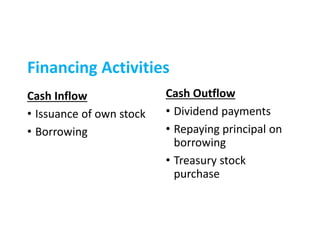
Financing Activities
Cash Inflow
• Issuance of own stock
• Borrowing
Cash Outflow
• Dividend payments
• Repaying principal on
borrowing
• Treasury stock
purchase
CASH
OUTFLOWS
Operating
Activities
Financing
Activities
Investing
Activities
CASH
INFLOWS
Financing
Activities
Operating
Activities
Investing
Activities
Statement of Cash Flows
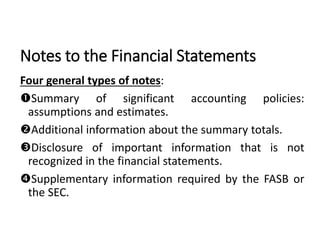
Notes to the Financial Statements
Four general types of notes:
Summary of significant accounting policies:
assumptions and estimates.
Additional information about the summary totals.
Disclosure of important information that is not
recognized in the financial statements.
Supplementary information required by the FASB or
the SEC.

Chapter 01 understanding financial statements (2)

  • 1.
    Chapter 03 UNDERSTANDING FINANCIALSTATEMENTS Prepared By: Md. Kamruzzaman Didar Sr. Lecturer of Finance Department of Business Administration
  • 2.
    What is aFinancial Statement? • A financial statement is a quantitative way of showing how a company is doing. • Financial statements provide the fundamental information that we use to analyze and answer valuation questions.
  • 3.
    Primary Financial Statements Basicfinancial statements: Balance Sheet Income Statement  Statement of Owner’s Equity Statement of Cash Flows • Footnotes
  • 4.
    • Summary ofthe financial position of a company at a particular date • Assets: cash, accounts receivable, inventory, land, buildings, equipment and intangible items • Liabilities: accounts payable, notes payable and mortgages payable • Owners’ Equity: net assets after all obligations have been satisfied The Balance Sheet
  • 5.
    Accounting Equation Assets =Liabilities + Owners’ Equity Sources of Funding Creditors’ claims against resources = + Owners’ claims against resources Resources Resources to use to generate revenues
  • 6.
    The Balance Sheet ItemsAnalysis and Discussion • Aswath Damodaran-Chapter 03 • Merrill Lynch-Understanding Financial Reports
  • 7.
    Balance Sheet Limitations Assetsrecorded at historical value Only recognizes assets that can be expressed in monetary terms Owners’ equity is usually less than the company’s market value
  • 8.
    The Income Statement •Shows the results of a company’s operations over a period of time. • What goods were sold or services performed that provided revenue for the company? • What costs were incurred in normal operations to generate these revenues? • What are the earnings or company profit?
  • 9.
    The Income Statement Revenues •Assets (cash or AR) created through business operations Expenses • Assets (cash or AP) consumed through business operations Net Income or (Net Loss) • Revenues - Expenses
  • 10.
    The Example Company IncomeStatement For the Years Ended December 31, 2010 and 2011 2011 2010 Revenues: Sales $100 $ 85 Other revenue 30 15 Total revenues $130 $100 Expenses: Cost of goods sold $ 62 $ 58 Operating & admin. 16 12 Income tax 20 18 Total expenses $ 98 $ 88 Net Income $ 32 $ 12
  • 11.
    An additional financial statementthat identifies changes in retained earnings from one accounting period to the next. Statement of Retained Earnings Beginning retained earnings + Net income – Dividends paid = Ending retained earnings Net income results in: Increase in net assets Increase in retained earnings Increase in owners’ equity Dividends result in: Decrease in net assets Decrease in retained earnings Decrease in owners’ equity
  • 12.
    Statement of CashFlows • Reports the amount of cash collected and paid out by a company in operating, investing and financing activities for a period of time. • How did the company receive cash? • How did the company use its cash? • Complementary to the income statement. • Indicates ability of a company to generate income in the future.
  • 13.
    Cash inflows • Sellgoods or services • Sell other assets or by borrowing • Receive cash from investments by owners Cash outflows • Pay operating expenses • Expand operations, repay loans • Pay owners a return on investment Statement of Cash Flows
  • 14.
    Match Classification ofCash Flows • Operating activities – Transactions and events that enter into the determination of net income. • Investing activities – Transactions and events that involve the purchase and sale of securities, property, plant, equipment, and other assets not generally held for resale, and the making and collecting of loans. • Financing activities – Transactions and events whereby resources and obtained from, or repaid to, owners and creditors.
  • 15.
    Operating Activities Cash Inflow •Sale of goods or services • Sale of investments in trading securities • Interest revenue • Dividend revenue Cash Outflow • Inventory payments • Interest payments • Wages • Utilities, rent • Taxes
  • 16.
    Investing Activities Cash Inflow •Sale of plant assets • Sale of securities, other than trading securities • Collection of principal on loans Cash Outflow • Purchase of plant assets • Purchase of securities, other than trading securities • Making of loans to other entities
  • 17.
    Financing Activities Cash Inflow •Issuance of own stock • Borrowing Cash Outflow • Dividend payments • Repaying principal on borrowing • Treasury stock purchase
  • 18.
  • 19.
    Notes to theFinancial Statements Four general types of notes: Summary of significant accounting policies: assumptions and estimates. Additional information about the summary totals. Disclosure of important information that is not recognized in the financial statements. Supplementary information required by the FASB or the SEC.