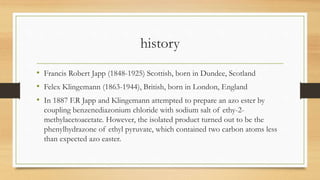
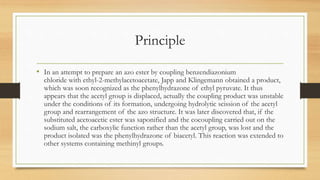
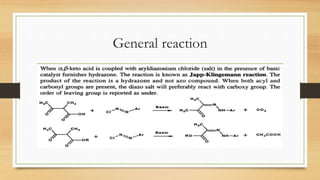
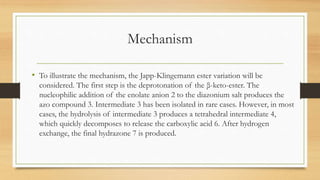
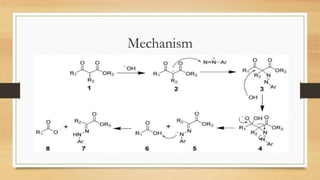
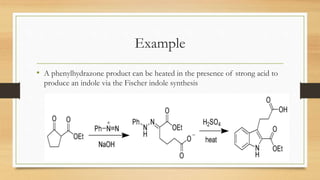
The document summarizes the Japp-Klingemann reaction, which was discovered in 1887 by Francis Robert Japp and Felix Klingemann. They attempted to prepare an azo ester by coupling benzenediazonium chloride with sodium salt of ethyl-2-methylacetoacetate, but instead produced the phenylhydrazone of ethyl pyruvate, which contained two fewer carbon atoms than expected. The reaction involves the deprotonation of a β-keto-ester followed by nucleophilic addition to the diazonium salt, producing an unstable azo compound that hydrolyzes to release the carboxylic acid. The Japp-Klingemann reaction is
![Applications
• =>Japp-Klingemann reaction used In synthesis of (-)-gillbertine.
• =>Japp-Klingemann reaction used in synthesis of Amoamine A.
• => Japp-Klingemann reaction used in synthesis of Lactone degradation
product of soraphen A.
• => Japp-Klingemann reaction used in synthesis of 5H,12H-[1]Benzoxepino
[4,3-b]indole-6-one.](https://image.slidesharecdn.com/jappklingemannreaction-150610140635-lva1-app6892/85/Japp-klingemann-reaction-9-320.jpg)


![HETEROGENOUS CATALYSIS [CHEMISTRY IS LOVE]](https://cdn.slidesharecdn.com/ss_thumbnails/50-191219085938-thumbnail.jpg?width=640&height=640&fit=bounds)


