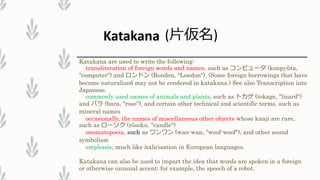
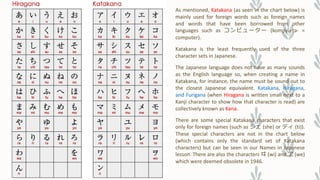
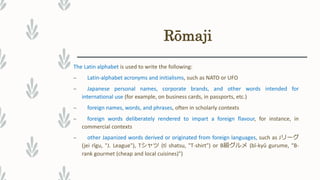
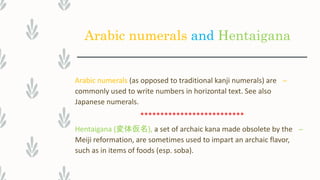
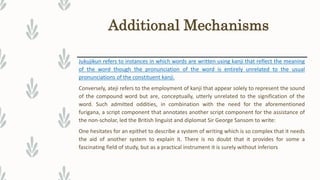
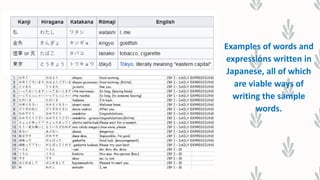
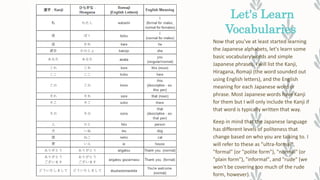
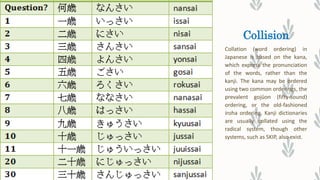
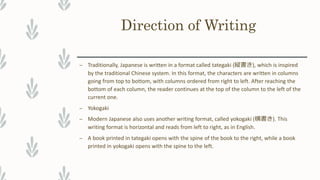
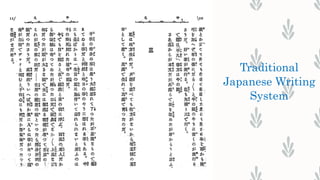
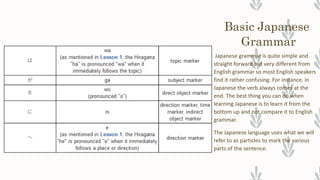
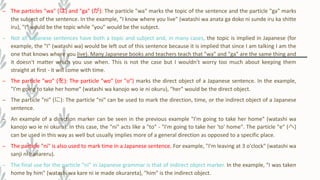
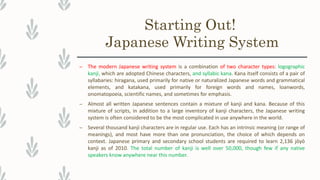
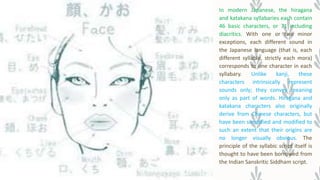
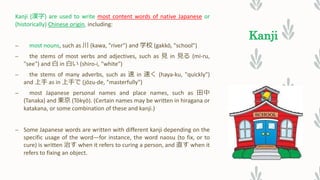
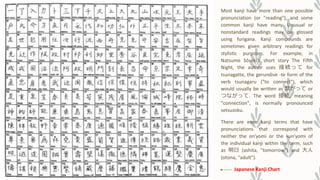
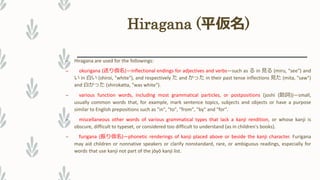
The modern Japanese writing system combines logographic kanji and syllabic kana, consisting of hiragana and katakana, creating a complex structure with thousands of kanji and two main phonetic scripts. Kanji represents most content words, while hiragana is used for grammatical elements and inflections, and katakana is reserved for foreign words and emphasis. Unique writing mechanisms such as jukujikun and ateji further illustrate the intricate nature of Japanese writing, as well as differences in sentence structure and grammar compared to English.

![There is also some flexibility for words with more
common kanji renditions to be instead written in
hiragana, depending on the individual author's
preference (all Japanese words can be spelled out
entirely in hiragana or katakana, even when they
are normally written using kanji). Some words are
colloquially written in hiragana and writing them
in kanji might give them a more formal tone,
while hiragana may impart a softer or more
emotional feeling.[6] For example, the Japanese
word "kawaii", the Japanese equivalent of "cute",
can be written entirely in hiragana as in かわいい,
or as the kanji term 可愛い.
Some lexical items that are normally written using
kanji have become grammaticalized in certain
contexts, where they are instead written in
hiragana. For example, the root of the verb 見る
(miru, "see") is normally written with the kanji 見.
However, when used as a suffix meaning "try
out", the whole verb is typically written in
hiragana as みる, as in 食べてみる (tabetemiru,
"try eating [it] and see").](https://image.slidesharecdn.com/japanese-180105091851/85/Japanese-Writing-System-9-320.jpg)