Year 11 Japanese Continuers
HIRAGANA AND KANJI
REVIEW
なまえ:________________
N
orthm
ead
C
A
PA
H
S
1
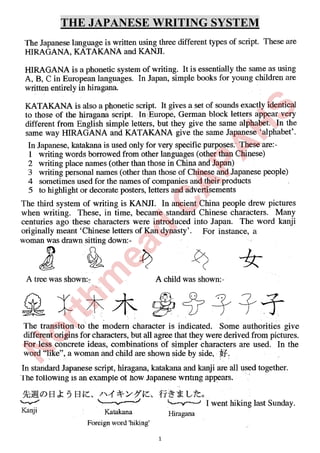
THE JAPANESE WRITING SYSTEM
N
orthm
ead
C
A
PA
H
S
2
HIRAGANA
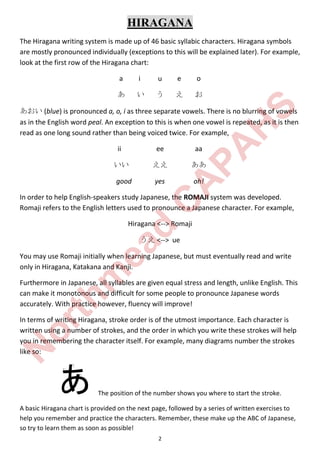
The Hiragana writing system is made up of 46 basic syllabic characters. Hiragana symbols
are mostly pronounced individually (exceptions to this will be explained later). For example,
look at the first row of the Hiragana chart:
a i u e o
あ い う え お
あおい (blue) is pronounced a, o, i as three separate vowels. There is no blurring of vowels
as in the English word peal. An exception to this is when one vowel is repeated, as it is then
read as one long sound rather than being voiced twice. For example,
ii ee aa
いい ええ ああ
good yes oh!
In order to help English-speakers study Japanese, the ROMAJI system was developed.
Romaji refers to the English letters used to pronounce a Japanese character. For example,
Hiragana <--> Romaji
うえ <--> ue
You may use Romaji initially when learning Japanese, but must eventually read and write
only in Hiragana, Katakana and Kanji.
Furthermore in Japanese, all syllables are given equal stress and length, unlike English. This
can make it monotonous and difficult for some people to pronounce Japanese words
accurately. With practice however, fluency will improve!
In terms of writing Hiragana, stroke order is of the utmost importance. Each character is
written using a number of strokes, and the order in which you write these strokes will help
you in remembering the character itself. For example, many diagrams number the strokes
like so:
The position of the number shows you where to start the stroke.
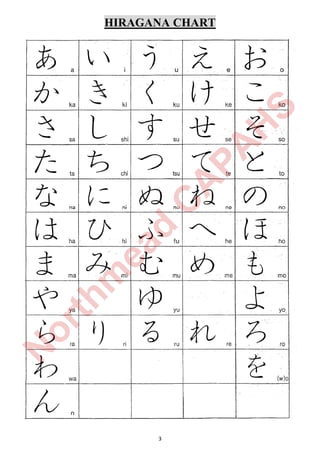
A basic Hiragana chart is provided on the next page, followed by a series of written exercises to
help you remember and practice the characters. Remember, these make up the ABC of Japanese,
so try to learn them as soon as possible!
N
orthm
ead
C
A
PA
H
S
3
HIRAGANA CHART
N
orthm
ead
C
A
PA
H
S
4
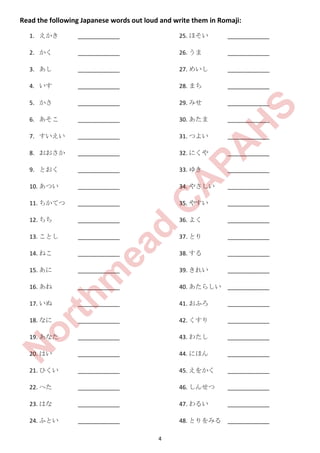
Read the following Japanese words out loud and write them in Romaji:
1. えかき _____________
2. かく _____________
3. あし _____________
4. いす _____________
5. かさ _____________
6. あそこ _____________
7. すいえい _____________
8. おおさか _____________
9. とおく _____________
10. あつい _____________
11. ちかてつ _____________
12. ちち _____________
13. ことし _____________
14. ねこ _____________
15. あに _____________
16. あね _____________
17. いぬ _____________
18. なに _____________
19. あなた _____________
20. はい _____________
21. ひくい _____________
22. へた _____________
23. はな _____________
24. ふとい _____________
25. ほそい _____________
26. うま _____________
27. めいし _____________
28. まち _____________
29. みせ _____________
30. あたま _____________
31. つよい _____________
32. にくや _____________
33. ゆき _____________
34. やさしい _____________
35. やすい _____________
36. よく _____________
37. とり _____________
38. する _____________
39. きれい _____________
40. あたらしい _____________
41. おふろ _____________
42. くすり _____________
43. わたし _____________
44. にほん _____________
45. えをかく _____________
46. しんせつ _____________
47. わるい _____________
48. とりをみる _____________
N
orthm
ead
C
A
PA
H
S
5
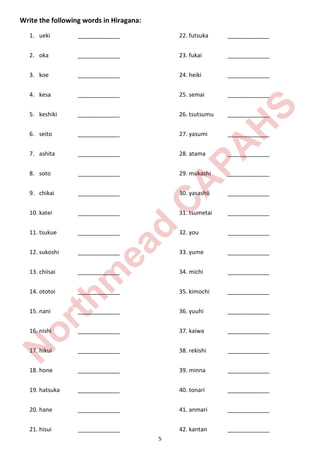
Write the following words in Hiragana:
1. ueki _____________
2. oka _____________
3. koe _____________
4. kesa _____________
5. keshiki _____________
6. seito _____________
7. ashita _____________
8. soto _____________
9. chikai _____________
10. katei _____________
11. tsukue _____________
12. sukoshi _____________
13. chiisai _____________
14. ototoi _____________
15. nani _____________
16. nishi _____________
17. hikui _____________
18. hone _____________
19. hatsuka _____________
20. hane _____________
21. hisui _____________
22. futsuka _____________
23. fukai _____________
24. heiki _____________
25. semai _____________
26. tsutsumu _____________
27. yasumi _____________
28. atama _____________
29. mukashi _____________
30. yasashii _____________
31. tsumetai _____________
32. you _____________
33. yume _____________
34. michi _____________
35. kimochi _____________
36. yuuhi _____________
37. kaiwa _____________
38. rekishi _____________
39. minna _____________
40. tonari _____________
41. anmari _____________
42. kantan _____________
N
orthm
ead
C
A
PA
H
S
6
Using a Japanese-English Dictionary
Notes:
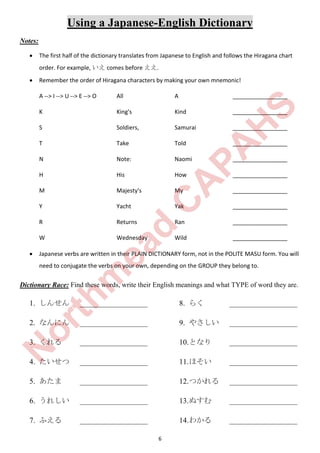
 The first half of the dictionary translates from Japanese to English and follows the Hiragana chart
order. For example, いえ comes before ええ.
 Remember the order of Hiragana characters by making your own mnemonic!
A --> I --> U --> E --> O All A _________________
K King's Kind _________________
S Soldiers, Samurai _________________
T Take Told _________________
N Note: Naomi _________________
H His How _________________
M Majesty's My _________________
Y Yacht Yak _________________
R Returns Ran _________________
W Wednesday Wild _________________
 Japanese verbs are written in their PLAIN DICTIONARY form, not in the POLITE MASU form. You will
need to conjugate the verbs on your own, depending on the GROUP they belong to.
Dictionary Race: Find these words, write their English meanings and what TYPE of word they are.
1. しんせん __________________
2. なんにん __________________
3. くれる __________________
4. たいせつ __________________
5. あたま __________________
6. うれしい __________________
7. ふえる __________________
8. らく __________________
9. やさしい __________________
10.となり __________________
11.ほそい __________________
12.つかれる __________________
13.ぬすむ __________________
14.わかる __________________
N
orthm
ead
C
A
PA
H
S
7
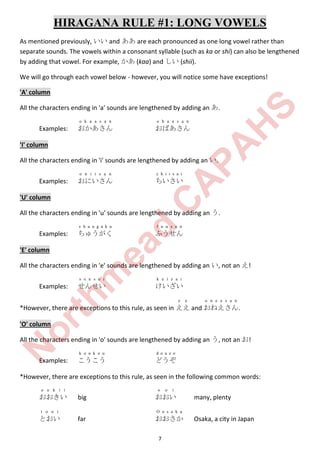
HIRAGANA RULE #1: LONG VOWELS
As mentioned previously, いい and ああ are each pronounced as one long vowel rather than
separate sounds. The vowels within a consonant syllable (such as ka or shi) can also be lengthened
by adding that vowel. For example, かあ (kaa) and しい (shii).
We will go through each vowel below - however, you will notice some have exceptions!
'A' column
All the characters ending in 'a' sounds are lengthened by adding an あ.
Examples: おかあさん
o k a a s a n
おばあさん
o b a a s a n
'I' column
All the characters ending in 'i' sounds are lengthened by adding an い.
Examples: おにいさん
o n i i s a n
ちいさい
c h i i s a i
'U' column
All the characters ending in 'u' sounds are lengthened by adding an う.
Examples: ちゅうがく
c h u u g a k u
ふうせん
f u u s e n
'E' column
All the characters ending in 'e' sounds are lengthened by adding an い, not an え!
Examples: せんせい
s e n s e i
けいざい
k e i z a i
*However, there are exceptions to this rule, as seen in ええ
e e
and おねえさん
o n e e s a n
.
'O' column
All the characters ending in 'o' sounds are lengthened by adding an う, not an お!
Examples: こうこう
k o u k o u
どうぞ
d o u z o
*However, there are exceptions to this rule, as seen in the following common words:
おおきい
o o k i i
big おおい
o o i
many, plenty
とおい
t o o i
far おおさか
O o s a k a
Osaka, a city in Japan
N
orthm
ead
C
A
PA
H
S
8
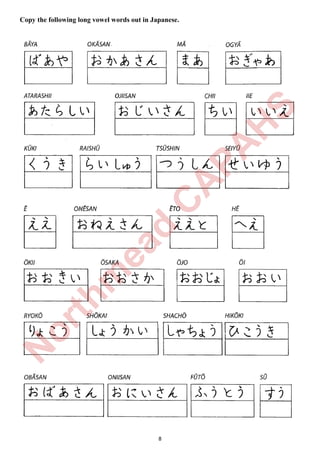
Copy the following long vowel words out in Japanese.
N
orthm
ead
C
A
PA
H
S
9
HIRAGANA RULE #2: DOUBLE CONSONANTS
Since there are no Hiragana syllables for a single consonant (besides 'N'), a special device is
needed to indicate a double consonant. This device is a small 'tsu' (っ). It is about half the size of a
regular sized 'tsu' (つ). Compare:
つ っ
When the small 'tsu' is used, it is NOT pronounced. Instead, it doubles the NEXT consonant in
Romaji and indicates a PAUSE in speaking.
Examples: きて
k i t e
- to come きって
k i t t e
- stamp
かこ
k a k o
- past かっこ
k a k k o
- brackets
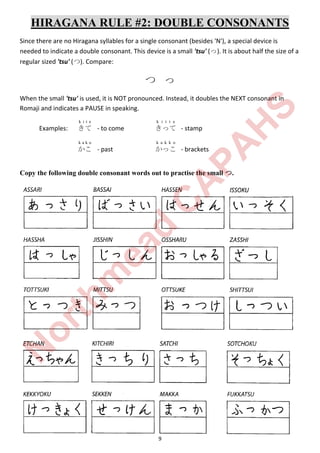
Copy the following double consonant words out to practise the small つ.
N
orthm
ead
C
A
PA
H
S
10
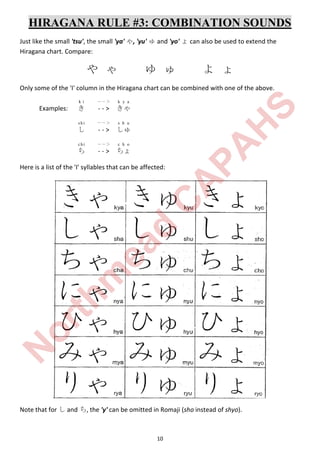
HIRAGANA RULE #3: COMBINATION SOUNDS
Just like the small 'tsu', the small 'ya' ゃ, 'yu' ゅ and 'yo' ょ can also be used to extend the
Hiragana chart. Compare:
や ゃ ゆ ゅ よ ょ
Only some of the 'I' column in the Hiragana chart can be combined with one of the above.
Examples: き
k i
- - >
-->
きゃ
k y a
し
sh i
- - >
-->
しゅ
s h u
ち
chi
- - >
-->
ちょ
c h o
Here is a list of the 'I' syllables that can be affected:
Note that for し and ち, the 'y' can be omitted in Romaji (sho instead of shyo).
N
orthm
ead
C
A
PA
H
S
11
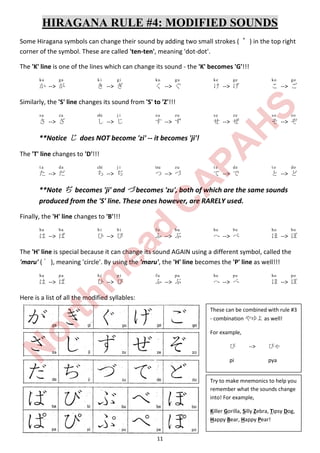
HIRAGANA RULE #4: MODIFIED SOUNDS
Some Hiragana symbols can change their sound by adding two small strokes ( ゛) in the top right
corner of the symbol. These are called 'ten-ten', meaning 'dot-dot'.
The 'K' line is one of the lines which can change its sound - the 'K' becomes 'G'!!!
か
ka
--> が
ga
き
k i
--> ぎ
gi
く
ku
--> ぐ
gu
け
ke
--> げ
ge
こ
ko
--> ご
go
Similarly, the 'S' line changes its sound from 'S' to 'Z'!!!
さ
sa
--> ざ
za
し
shi
--> じ
j i
す
su
--> ず
zu
せ
se
--> ぜ
ze
そ
so
--> ぞ
zo
**Notice じ does NOT become 'zi' -- it becomes 'ji'!
The 'T' line changes to 'D'!!!
た
t a
--> だ
da
ち
chi
--> ぢ
j i
つ
tsu
--> づ
zu
て
t e
--> で
de
と
t o
--> ど
do
**Note ぢ becomes 'ji' and づ becomes 'zu', both of which are the same sounds
produced from the 'S' line. These ones however, are RARELY used.
Finally, the 'H' line changes to 'B'!!!
は
ha
--> ば
ba
ひ
h i
--> び
b i
ふ
fu
--> ぶ
bu
へ
he
--> べ
be
ほ
ho
--> ぼ
bo
The 'H' line is special because it can change its sound AGAIN using a different symbol, called the
'maru' ( ゜), meaning 'circle'. By using the 'maru', the 'H' line becomes the 'P' line as well!!!
は
ha
--> ぱ
pa
ひ
h i
--> ぴ
p i
ふ
fu
--> ぷ
pu
へ
he
--> ぺ
pe
ほ
ho
--> ぽ
po
Here is a list of all the modified syllables:
These can be combined with rule #3
- combination やゆよ as well!
For example,
ぴ --> ぴゃ
pi pya
Try to make mnemonics to help you
remember what the sounds change
into! For example,
Killer Gorilla, Silly Zebra, Tipsy Dog,
Happy Bear, Happy Pear!
N
orthm
ead
C
A
PA
H
S
24
KANJI REVIEW
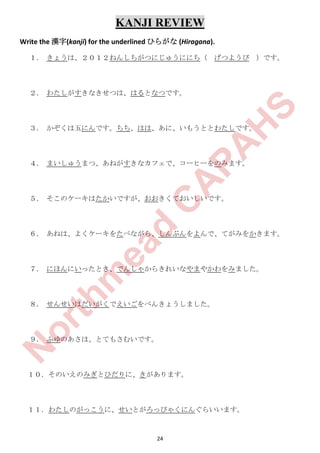
Write the 漢字(kanji) for the underlined ひらがな (Hiragana).
1. きょうは、2012ねんしちがつにじゅうににち( げつようび )です。
2. わたしがすきなきせつは、はるとなつです。
3. かぞくは五にんです。ちち、はは、あに、いもうととわたしです。
4. まいしゅうまつ、あねがすきなカフェで、コーヒーをのみます。
5. そこのケーキはたかいですが、おおきくておいしいです。
6. あねは、よくケーキをたべながら、しんぶんをよんで、てがみをかきます。
7. にほんにいったとき、でんしゃからきれいなやまやかわをみました。
8. せんせいはだいがくでえいごをべんきょうしました。
9. ふゆのあさは、とてもさむいです。
10.そのいえのみぎとひだりに、きがあります。
11.わたしのがっこうに、せいとがろっぴゃくにんぐらいいます。
N
orthm
ead
C
A
PA
H
S
25
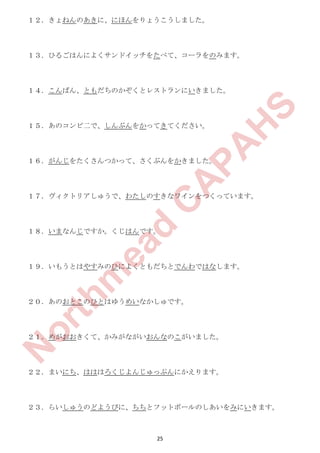
12.きょねんのあきに、にほんをりょうこうしました。
13.ひるごはんによくサンドイッチをたべて、コーラをのみます。
14.こんばん、ともだちのかぞくとレストランにいきました。
15.あのコンビ二で、しんぶんをかってきてください。
16.がんじをたくさんつかって、さくぶんをかきました。
17.ヴィクトリアしゅうで、わたしのすきなワインをつくっています。
18.いまなんじですか。くじはんです。
19.いもうとはやすみのひによくともだちとでんわではなします。
20.あのおとこのひとはゆうめいなかしゅです。
21.めがおおきくて、かみがながいおんなのこがいました。
22.まいにち、はははろくじよんじゅっぷんにかえります。
23.らいしゅうのどようびに、ちちとフットボールのしあいをみにいきます。
N
orthm
ead
C
A
PA
H
S
26
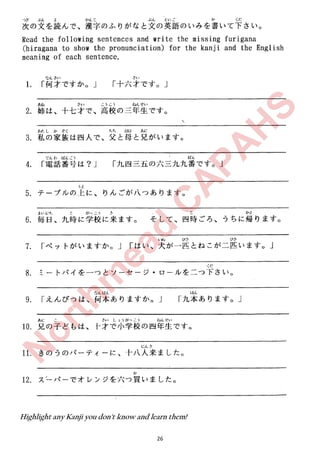
Highlight any Kanji you don't know and learn them!
N
orthm
ead
C
A
PA
H
S
27
KANJI I NEED TO WORK ON...
Reading(s):
Meaning:
Reading(s):
Meaning:
Reading(s):
Meaning:
Reading(s):
Meaning:
Reading(s):
Meaning:
Reading(s):
Meaning:
Reading(s):
Meaning:
Reading(s):
Meaning:
Reading(s):
Meaning:
Reading(s):
Meaning:
N
orthm
ead
C
A
PA
H
S
28
KANJI I NEED TO WORK ON...
Reading(s):
Meaning:
Reading(s):
Meaning:
Reading(s):
Meaning:
Reading(s):
Meaning:
Reading(s):
Meaning:
Reading(s):
Meaning:
Reading(s):
Meaning:
Reading(s):
Meaning:
Reading(s):
Meaning:
Reading(s):
Meaning:
N
orthm
ead
C
A
PA
H
S

Introduction to Japanese writing - Continuers

  • 1.
    Year 11 JapaneseContinuers HIRAGANA AND KANJI REVIEW なまえ:________________ N orthm ead C A PA H S
  • 2.
    1 THE JAPANESE WRITINGSYSTEM N orthm ead C A PA H S
  • 3.
    2 HIRAGANA The Hiragana writingsystem is made up of 46 basic syllabic characters. Hiragana symbols are mostly pronounced individually (exceptions to this will be explained later). For example, look at the first row of the Hiragana chart: a i u e o あ い う え お あおい (blue) is pronounced a, o, i as three separate vowels. There is no blurring of vowels as in the English word peal. An exception to this is when one vowel is repeated, as it is then read as one long sound rather than being voiced twice. For example, ii ee aa いい ええ ああ good yes oh! In order to help English-speakers study Japanese, the ROMAJI system was developed. Romaji refers to the English letters used to pronounce a Japanese character. For example, Hiragana <--> Romaji うえ <--> ue You may use Romaji initially when learning Japanese, but must eventually read and write only in Hiragana, Katakana and Kanji. Furthermore in Japanese, all syllables are given equal stress and length, unlike English. This can make it monotonous and difficult for some people to pronounce Japanese words accurately. With practice however, fluency will improve! In terms of writing Hiragana, stroke order is of the utmost importance. Each character is written using a number of strokes, and the order in which you write these strokes will help you in remembering the character itself. For example, many diagrams number the strokes like so: The position of the number shows you where to start the stroke. A basic Hiragana chart is provided on the next page, followed by a series of written exercises to help you remember and practice the characters. Remember, these make up the ABC of Japanese, so try to learn them as soon as possible! N orthm ead C A PA H S
  • 4.
  • 5.
    4 Read the followingJapanese words out loud and write them in Romaji: 1. えかき _____________ 2. かく _____________ 3. あし _____________ 4. いす _____________ 5. かさ _____________ 6. あそこ _____________ 7. すいえい _____________ 8. おおさか _____________ 9. とおく _____________ 10. あつい _____________ 11. ちかてつ _____________ 12. ちち _____________ 13. ことし _____________ 14. ねこ _____________ 15. あに _____________ 16. あね _____________ 17. いぬ _____________ 18. なに _____________ 19. あなた _____________ 20. はい _____________ 21. ひくい _____________ 22. へた _____________ 23. はな _____________ 24. ふとい _____________ 25. ほそい _____________ 26. うま _____________ 27. めいし _____________ 28. まち _____________ 29. みせ _____________ 30. あたま _____________ 31. つよい _____________ 32. にくや _____________ 33. ゆき _____________ 34. やさしい _____________ 35. やすい _____________ 36. よく _____________ 37. とり _____________ 38. する _____________ 39. きれい _____________ 40. あたらしい _____________ 41. おふろ _____________ 42. くすり _____________ 43. わたし _____________ 44. にほん _____________ 45. えをかく _____________ 46. しんせつ _____________ 47. わるい _____________ 48. とりをみる _____________ N orthm ead C A PA H S
  • 6.
    5 Write the followingwords in Hiragana: 1. ueki _____________ 2. oka _____________ 3. koe _____________ 4. kesa _____________ 5. keshiki _____________ 6. seito _____________ 7. ashita _____________ 8. soto _____________ 9. chikai _____________ 10. katei _____________ 11. tsukue _____________ 12. sukoshi _____________ 13. chiisai _____________ 14. ototoi _____________ 15. nani _____________ 16. nishi _____________ 17. hikui _____________ 18. hone _____________ 19. hatsuka _____________ 20. hane _____________ 21. hisui _____________ 22. futsuka _____________ 23. fukai _____________ 24. heiki _____________ 25. semai _____________ 26. tsutsumu _____________ 27. yasumi _____________ 28. atama _____________ 29. mukashi _____________ 30. yasashii _____________ 31. tsumetai _____________ 32. you _____________ 33. yume _____________ 34. michi _____________ 35. kimochi _____________ 36. yuuhi _____________ 37. kaiwa _____________ 38. rekishi _____________ 39. minna _____________ 40. tonari _____________ 41. anmari _____________ 42. kantan _____________ N orthm ead C A PA H S
  • 7.
    6 Using a Japanese-EnglishDictionary Notes:  The first half of the dictionary translates from Japanese to English and follows the Hiragana chart order. For example, いえ comes before ええ.  Remember the order of Hiragana characters by making your own mnemonic! A --> I --> U --> E --> O All A _________________ K King's Kind _________________ S Soldiers, Samurai _________________ T Take Told _________________ N Note: Naomi _________________ H His How _________________ M Majesty's My _________________ Y Yacht Yak _________________ R Returns Ran _________________ W Wednesday Wild _________________  Japanese verbs are written in their PLAIN DICTIONARY form, not in the POLITE MASU form. You will need to conjugate the verbs on your own, depending on the GROUP they belong to. Dictionary Race: Find these words, write their English meanings and what TYPE of word they are. 1. しんせん __________________ 2. なんにん __________________ 3. くれる __________________ 4. たいせつ __________________ 5. あたま __________________ 6. うれしい __________________ 7. ふえる __________________ 8. らく __________________ 9. やさしい __________________ 10.となり __________________ 11.ほそい __________________ 12.つかれる __________________ 13.ぬすむ __________________ 14.わかる __________________ N orthm ead C A PA H S
  • 8.
    7 HIRAGANA RULE #1:LONG VOWELS As mentioned previously, いい and ああ are each pronounced as one long vowel rather than separate sounds. The vowels within a consonant syllable (such as ka or shi) can also be lengthened by adding that vowel. For example, かあ (kaa) and しい (shii). We will go through each vowel below - however, you will notice some have exceptions! 'A' column All the characters ending in 'a' sounds are lengthened by adding an あ. Examples: おかあさん o k a a s a n おばあさん o b a a s a n 'I' column All the characters ending in 'i' sounds are lengthened by adding an い. Examples: おにいさん o n i i s a n ちいさい c h i i s a i 'U' column All the characters ending in 'u' sounds are lengthened by adding an う. Examples: ちゅうがく c h u u g a k u ふうせん f u u s e n 'E' column All the characters ending in 'e' sounds are lengthened by adding an い, not an え! Examples: せんせい s e n s e i けいざい k e i z a i *However, there are exceptions to this rule, as seen in ええ e e and おねえさん o n e e s a n . 'O' column All the characters ending in 'o' sounds are lengthened by adding an う, not an お! Examples: こうこう k o u k o u どうぞ d o u z o *However, there are exceptions to this rule, as seen in the following common words: おおきい o o k i i big おおい o o i many, plenty とおい t o o i far おおさか O o s a k a Osaka, a city in Japan N orthm ead C A PA H S
  • 9.
    8 Copy the followinglong vowel words out in Japanese. N orthm ead C A PA H S
  • 10.
    9 HIRAGANA RULE #2:DOUBLE CONSONANTS Since there are no Hiragana syllables for a single consonant (besides 'N'), a special device is needed to indicate a double consonant. This device is a small 'tsu' (っ). It is about half the size of a regular sized 'tsu' (つ). Compare: つ っ When the small 'tsu' is used, it is NOT pronounced. Instead, it doubles the NEXT consonant in Romaji and indicates a PAUSE in speaking. Examples: きて k i t e - to come きって k i t t e - stamp かこ k a k o - past かっこ k a k k o - brackets Copy the following double consonant words out to practise the small つ. N orthm ead C A PA H S
  • 11.
    10 HIRAGANA RULE #3:COMBINATION SOUNDS Just like the small 'tsu', the small 'ya' ゃ, 'yu' ゅ and 'yo' ょ can also be used to extend the Hiragana chart. Compare: や ゃ ゆ ゅ よ ょ Only some of the 'I' column in the Hiragana chart can be combined with one of the above. Examples: き k i - - > --> きゃ k y a し sh i - - > --> しゅ s h u ち chi - - > --> ちょ c h o Here is a list of the 'I' syllables that can be affected: Note that for し and ち, the 'y' can be omitted in Romaji (sho instead of shyo). N orthm ead C A PA H S
  • 12.
    11 HIRAGANA RULE #4:MODIFIED SOUNDS Some Hiragana symbols can change their sound by adding two small strokes ( ゛) in the top right corner of the symbol. These are called 'ten-ten', meaning 'dot-dot'. The 'K' line is one of the lines which can change its sound - the 'K' becomes 'G'!!! か ka --> が ga き k i --> ぎ gi く ku --> ぐ gu け ke --> げ ge こ ko --> ご go Similarly, the 'S' line changes its sound from 'S' to 'Z'!!! さ sa --> ざ za し shi --> じ j i す su --> ず zu せ se --> ぜ ze そ so --> ぞ zo **Notice じ does NOT become 'zi' -- it becomes 'ji'! The 'T' line changes to 'D'!!! た t a --> だ da ち chi --> ぢ j i つ tsu --> づ zu て t e --> で de と t o --> ど do **Note ぢ becomes 'ji' and づ becomes 'zu', both of which are the same sounds produced from the 'S' line. These ones however, are RARELY used. Finally, the 'H' line changes to 'B'!!! は ha --> ば ba ひ h i --> び b i ふ fu --> ぶ bu へ he --> べ be ほ ho --> ぼ bo The 'H' line is special because it can change its sound AGAIN using a different symbol, called the 'maru' ( ゜), meaning 'circle'. By using the 'maru', the 'H' line becomes the 'P' line as well!!! は ha --> ぱ pa ひ h i --> ぴ p i ふ fu --> ぷ pu へ he --> ぺ pe ほ ho --> ぽ po Here is a list of all the modified syllables: These can be combined with rule #3 - combination やゆよ as well! For example, ぴ --> ぴゃ pi pya Try to make mnemonics to help you remember what the sounds change into! For example, Killer Gorilla, Silly Zebra, Tipsy Dog, Happy Bear, Happy Pear! N orthm ead C A PA H S
  • 25.
    24 KANJI REVIEW Write the漢字(kanji) for the underlined ひらがな (Hiragana). 1. きょうは、2012ねんしちがつにじゅうににち( げつようび )です。 2. わたしがすきなきせつは、はるとなつです。 3. かぞくは五にんです。ちち、はは、あに、いもうととわたしです。 4. まいしゅうまつ、あねがすきなカフェで、コーヒーをのみます。 5. そこのケーキはたかいですが、おおきくておいしいです。 6. あねは、よくケーキをたべながら、しんぶんをよんで、てがみをかきます。 7. にほんにいったとき、でんしゃからきれいなやまやかわをみました。 8. せんせいはだいがくでえいごをべんきょうしました。 9. ふゆのあさは、とてもさむいです。 10.そのいえのみぎとひだりに、きがあります。 11.わたしのがっこうに、せいとがろっぴゃくにんぐらいいます。 N orthm ead C A PA H S
  • 26.
    25 12.きょねんのあきに、にほんをりょうこうしました。 13.ひるごはんによくサンドイッチをたべて、コーラをのみます。 14.こんばん、ともだちのかぞくとレストランにいきました。 15.あのコンビ二で、しんぶんをかってきてください。 16.がんじをたくさんつかって、さくぶんをかきました。 17.ヴィクトリアしゅうで、わたしのすきなワインをつくっています。 18.いまなんじですか。くじはんです。 19.いもうとはやすみのひによくともだちとでんわではなします。 20.あのおとこのひとはゆうめいなかしゅです。 21.めがおおきくて、かみがながいおんなのこがいました。 22.まいにち、はははろくじよんじゅっぷんにかえります。 23.らいしゅうのどようびに、ちちとフットボールのしあいをみにいきます。 N orthm ead C A PA H S
  • 27.
    26 Highlight any Kanjiyou don't know and learn them! N orthm ead C A PA H S
  • 28.
    27 KANJI I NEEDTO WORK ON... Reading(s): Meaning: Reading(s): Meaning: Reading(s): Meaning: Reading(s): Meaning: Reading(s): Meaning: Reading(s): Meaning: Reading(s): Meaning: Reading(s): Meaning: Reading(s): Meaning: Reading(s): Meaning: N orthm ead C A PA H S
  • 29.
    28 KANJI I NEEDTO WORK ON... Reading(s): Meaning: Reading(s): Meaning: Reading(s): Meaning: Reading(s): Meaning: Reading(s): Meaning: Reading(s): Meaning: Reading(s): Meaning: Reading(s): Meaning: Reading(s): Meaning: Reading(s): Meaning: N orthm ead C A PA H S