Communication  Bridges & Barriers Jan 15, 2008
Change of Reading Chapter 6 A Journal Article (will be given in class)
Communication Bridges Caring and Respect Trust Empathy  Confidentiality  Ethical Behavior Empowerment
Empowerment What does it mean to empower the client? Helping clients to take  a primary role  in the health care, by providing them with the knowledge, skills, and other resources. What does a primary role mean?
Five Features of Empowerment  Acceptance Affect Autonomy  Alliance Active Participation What is the significance of these components?
Acceptance Non-judgmental: refrain from condemning the lifestyle, self-control, appearance, attitudes of the clients Why?
Affect Explore not only the problem, but also the client’s feelings associated with the problem Why?
Autonomy  Client’s involvement and participation  What are the client’s responsibilities? What are the HCPs responsibilities? Why?
Alliance Work together with the client to tackle the health problem the allies? the enemy? Why?
Active Participation   HCPs need to practice active listening Why? “ Well…I’m not sure ar…I can’t make it on Tuesday morning, ar… oh yeah…actually I have to meet my son, Mark. It is his graduation day, ar…I mean …perhaps Wednesday… ar… actually ar…no, Thursday…ar… I’m going to …ar…to…ar.. The airport to pick up my daughter, Sussie.. ”
In summary Empowerment Helping the patients to identify what they want to change Help them to identify feelings associated with their health problem and to plan Establish commitment to change Explore possible barriers to change  of actions
Descriptive Study on Empowerment Kyngas et al, 1998 Procedures Ask adolescents to describe the HCPs  The description is classified into “routine” and “motivating” “ routine”:  HCPs ask the same questions every visit; ignore the adolescents’ opinions; make decisions according to their own choice “ motivating”:  ask, listen, take notice of the adolescents’ opinions, and make decisions together Results Adolescents in the “motivating” group are more likely to have good compliance and better “metabolic control”. What does this study show?
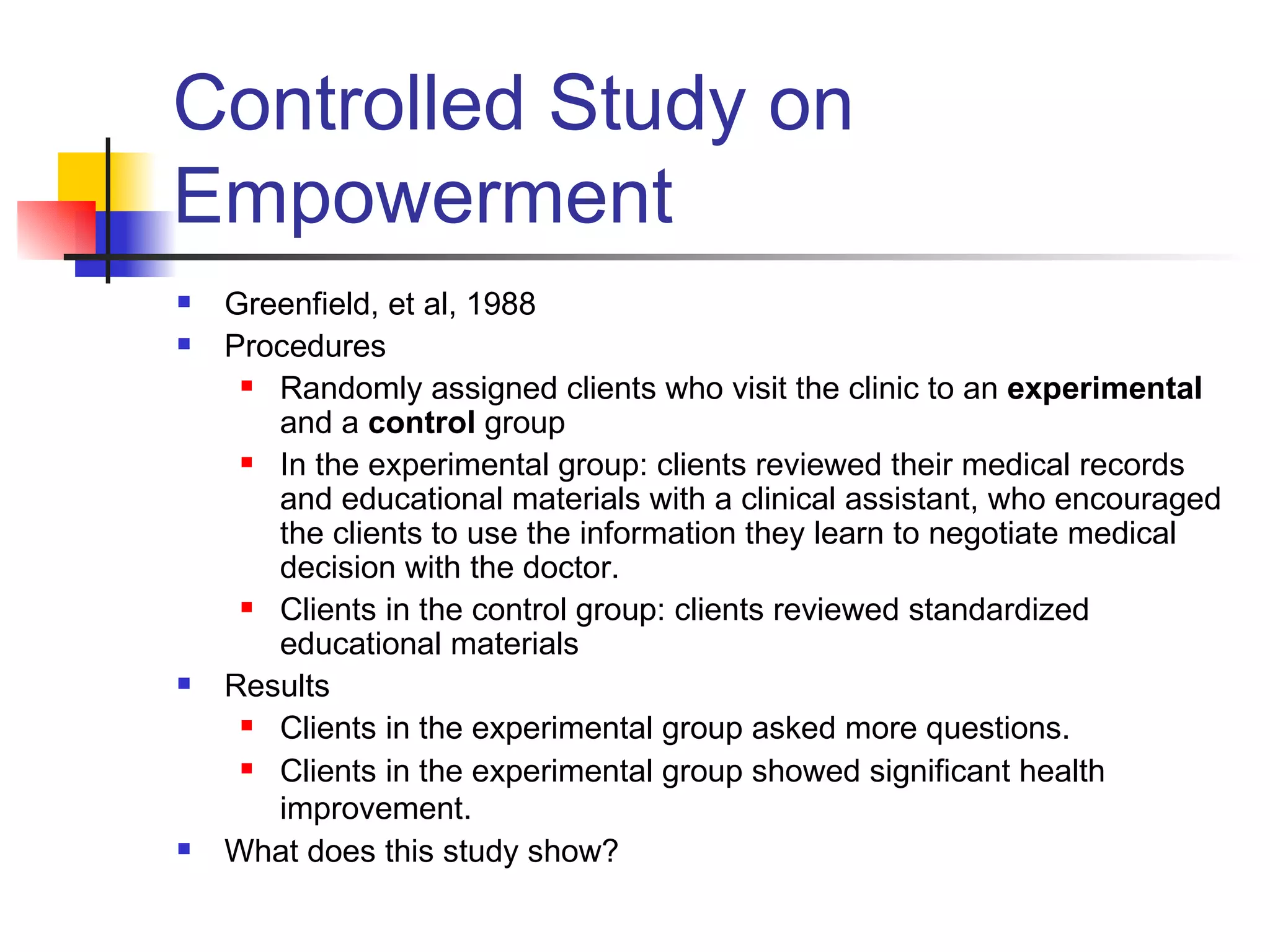
Controlled Study on Empowerment Greenfield, et al, 1988 Procedures Randomly assigned clients who visit the clinic to an  experimental  and a  control  group In the experimental group: clients reviewed their medical records and educational materials with a clinical assistant, who encouraged the clients to use the information they learn to negotiate medical decision with the doctor. Clients in the control group: clients reviewed standardized educational materials Results Clients in the experimental group asked more questions. Clients in the experimental group showed significant health improvement.   What does this study show?
Controlled Study on Empowerment Kinmonth and colleagues, 1998 Procedures Training HCPs to be more ‘client-centered’, i.e. active listening and negotiation. Patients recently diagnosed with diabetes are randomly assigned into the experimental and control group.  In the experimental group, patients received a booklet encouraging them to ask more questions; in the control group, patients were not given the booklet. Results Patients in the experimental group reported better communication with HCPs, greater treatment satisfaction, and better emotional well-being.   What does this study show?
Review Do you know: What are the 5 features of empowerment? Why are the 5 features important? Can you describe one of the studies on empowerment?  According to the findings of the health research, what are the benefits of empowering the clients?
Barriers to Therapeutic Relationship Stereotyping Anxiety  Space violation Confidentiality Violation
Stereotype A set of characteristics associated with a particular group of people;  the assumption that all members of the group possess those traits, to a degree. Examples of positive and negative stereotypes?
How do stereotypes operate? Stereotypes guide our perception Look for signs to confirms our stereotype Stereotyped actions are over-emphasized, non-stereotyped are under-emphasized. Stereotype is subsequently reinforced.
Illusion of outgroup homogeneity  What does it mean? Example: cross-racial facial identification What’s the cause of this illusion?
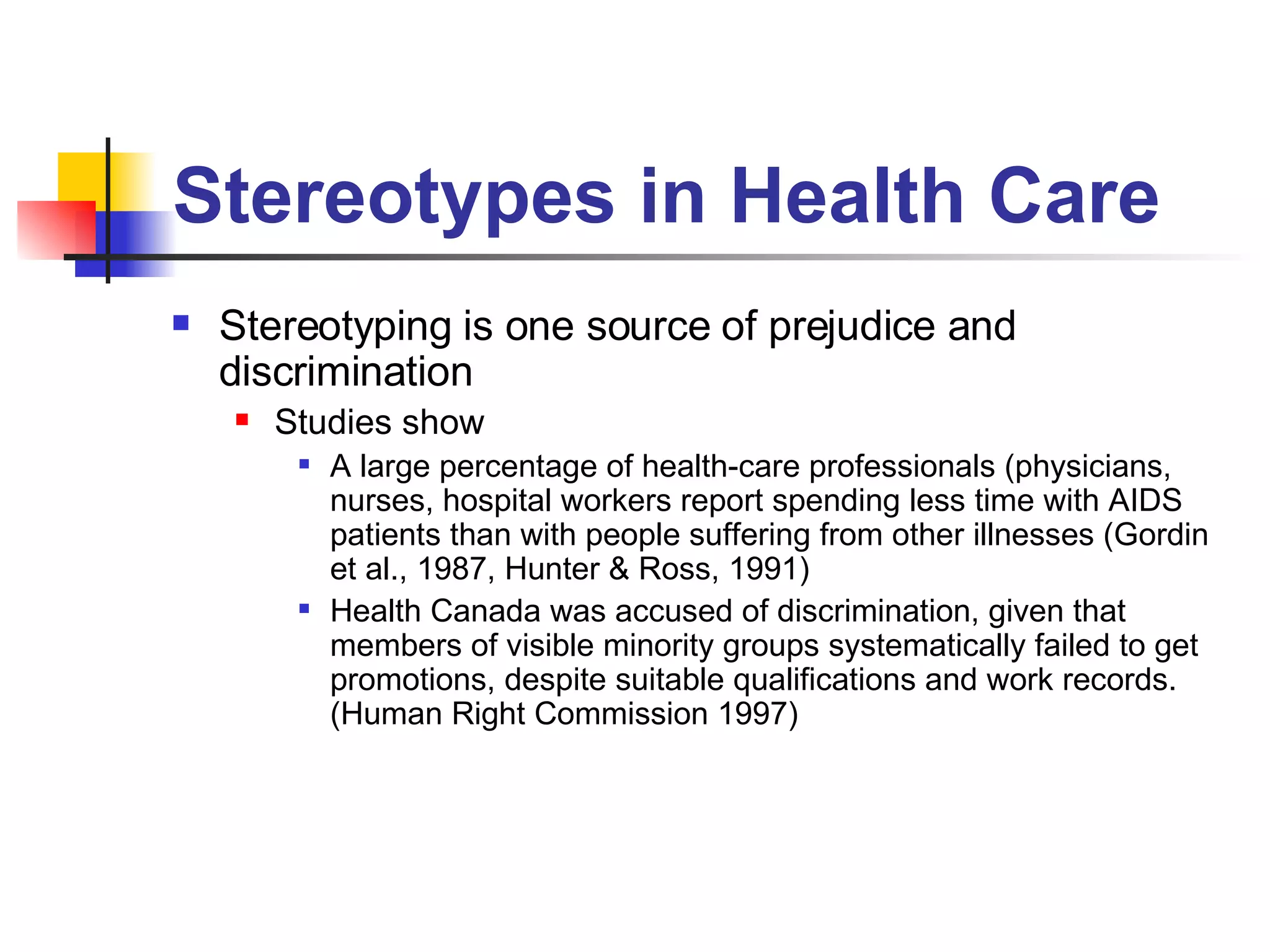
Stereotypes in Health Care Stereotyping is one source of prejudice and discrimination  Studies show A large percentage of health-care professionals (physicians, nurses, hospital workers report spending less time with AIDS patients than with people suffering from other illnesses (Gordin et al., 1987, Hunter & Ross, 1991) Health Canada was accused of discrimination, given that members of visible minority groups systematically failed to get promotions, despite suitable qualifications and work records. (Human Right Commission 1997)
Questions to Consider   How do stereotypes affect a HCP’s ability to provide a therapeutic relationship? (Hint: How does it affect the HCP’s acceptance, affect, respect for autonomy, active listening abilities, and forming alliance with patients?)  What is outgroup homogeneity? How does it relate to stereotypes? Why are stereotypes so hard to change?
Victim Responses to a Negative Stereotype Stereotype threat People who are targets of stereotypes perceived that they will be evaluated in negative terms The perceived threat can cause anxiety and affects task performance
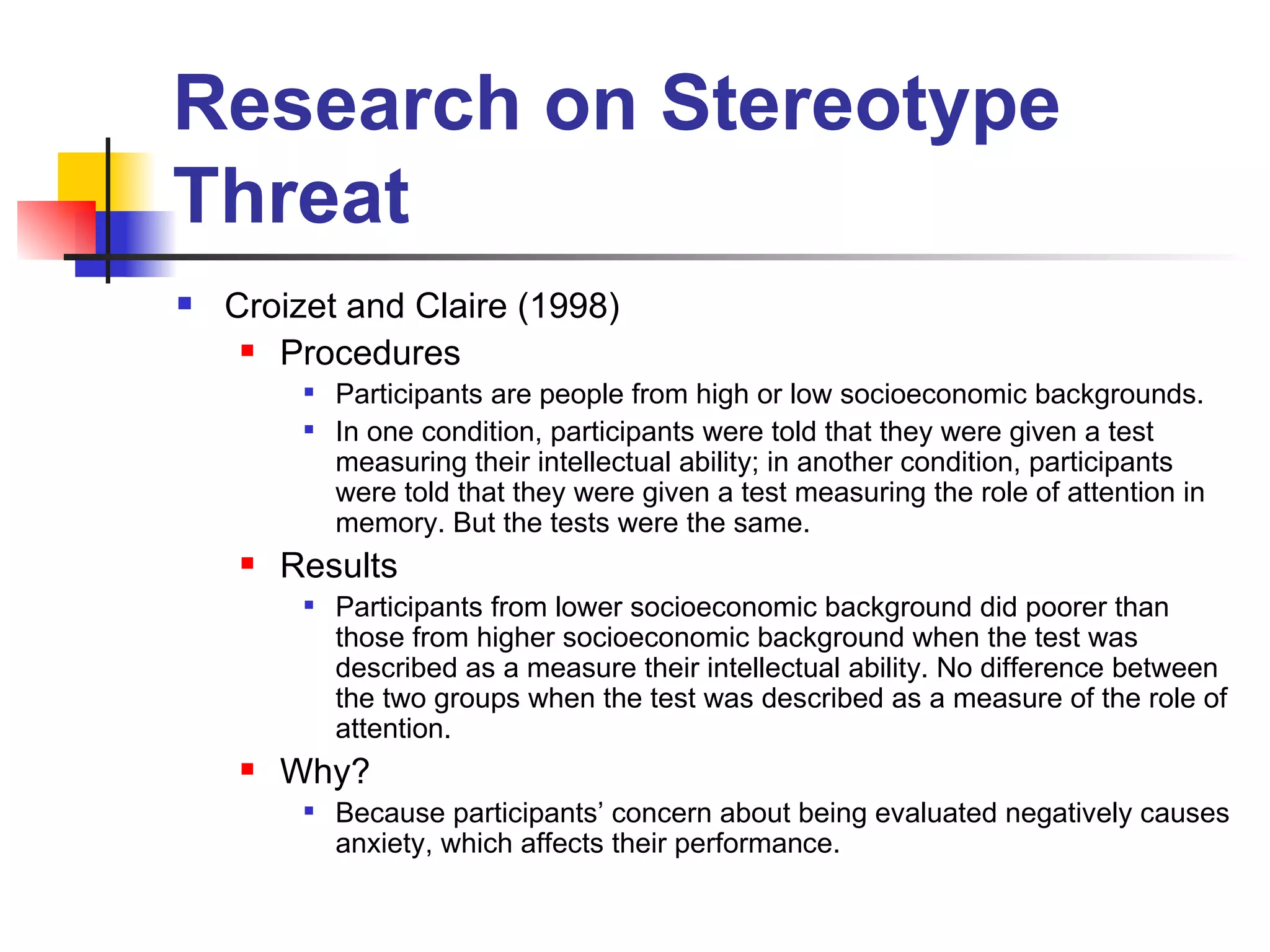
Research on Stereotype Threat Croizet and Claire (1998) Procedures Participants are people from high or low socioeconomic backgrounds. In one condition, participants were told that they were given a test measuring their intellectual ability; in another condition, participants were told that they were given a test measuring the role of attention in memory. But the tests were the same. Results Participants from lower socioeconomic background did poorer than those from higher socioeconomic background when the test was described as a measure their intellectual ability. No difference between the two groups when the test was described as a measure of the role of attention.  Why?  Because participants’ concern about being evaluated negatively causes anxiety, which affects their performance.
Threats of Stereotype and Prejudice in Health Care What might be some of your worries when you visit a doctor if you were: Someone from a visible minority group (African, Asian, Middle Eastern)  A gay man A young pregnant girl A prostitute  What can be done about stereotypes and prejudice in health care?
First Assignment Due Date: Jan 22 See Late Policy

Jan 15 Communication Bridges And Barriers

  • 1.
    Communication Bridges& Barriers Jan 15, 2008
  • 2.
    Change of ReadingChapter 6 A Journal Article (will be given in class)
  • 3.
    Communication Bridges Caringand Respect Trust Empathy Confidentiality Ethical Behavior Empowerment
  • 4.
    Empowerment What doesit mean to empower the client? Helping clients to take a primary role in the health care, by providing them with the knowledge, skills, and other resources. What does a primary role mean?
  • 5.
    Five Features ofEmpowerment Acceptance Affect Autonomy Alliance Active Participation What is the significance of these components?
  • 6.
    Acceptance Non-judgmental: refrainfrom condemning the lifestyle, self-control, appearance, attitudes of the clients Why?
  • 7.
    Affect Explore notonly the problem, but also the client’s feelings associated with the problem Why?
  • 8.
    Autonomy Client’sinvolvement and participation What are the client’s responsibilities? What are the HCPs responsibilities? Why?
  • 9.
    Alliance Work togetherwith the client to tackle the health problem the allies? the enemy? Why?
  • 10.
    Active Participation HCPs need to practice active listening Why? “ Well…I’m not sure ar…I can’t make it on Tuesday morning, ar… oh yeah…actually I have to meet my son, Mark. It is his graduation day, ar…I mean …perhaps Wednesday… ar… actually ar…no, Thursday…ar… I’m going to …ar…to…ar.. The airport to pick up my daughter, Sussie.. ”
  • 11.
    In summary EmpowermentHelping the patients to identify what they want to change Help them to identify feelings associated with their health problem and to plan Establish commitment to change Explore possible barriers to change of actions
  • 12.
    Descriptive Study onEmpowerment Kyngas et al, 1998 Procedures Ask adolescents to describe the HCPs The description is classified into “routine” and “motivating” “ routine”: HCPs ask the same questions every visit; ignore the adolescents’ opinions; make decisions according to their own choice “ motivating”: ask, listen, take notice of the adolescents’ opinions, and make decisions together Results Adolescents in the “motivating” group are more likely to have good compliance and better “metabolic control”. What does this study show?
  • 13.
    Controlled Study onEmpowerment Greenfield, et al, 1988 Procedures Randomly assigned clients who visit the clinic to an experimental and a control group In the experimental group: clients reviewed their medical records and educational materials with a clinical assistant, who encouraged the clients to use the information they learn to negotiate medical decision with the doctor. Clients in the control group: clients reviewed standardized educational materials Results Clients in the experimental group asked more questions. Clients in the experimental group showed significant health improvement. What does this study show?
  • 14.
    Controlled Study onEmpowerment Kinmonth and colleagues, 1998 Procedures Training HCPs to be more ‘client-centered’, i.e. active listening and negotiation. Patients recently diagnosed with diabetes are randomly assigned into the experimental and control group. In the experimental group, patients received a booklet encouraging them to ask more questions; in the control group, patients were not given the booklet. Results Patients in the experimental group reported better communication with HCPs, greater treatment satisfaction, and better emotional well-being. What does this study show?
  • 15.
    Review Do youknow: What are the 5 features of empowerment? Why are the 5 features important? Can you describe one of the studies on empowerment? According to the findings of the health research, what are the benefits of empowering the clients?
  • 16.
    Barriers to TherapeuticRelationship Stereotyping Anxiety Space violation Confidentiality Violation
  • 17.
    Stereotype A setof characteristics associated with a particular group of people; the assumption that all members of the group possess those traits, to a degree. Examples of positive and negative stereotypes?
  • 18.
    How do stereotypesoperate? Stereotypes guide our perception Look for signs to confirms our stereotype Stereotyped actions are over-emphasized, non-stereotyped are under-emphasized. Stereotype is subsequently reinforced.
  • 19.
    Illusion of outgrouphomogeneity What does it mean? Example: cross-racial facial identification What’s the cause of this illusion?
  • 20.
    Stereotypes in HealthCare Stereotyping is one source of prejudice and discrimination Studies show A large percentage of health-care professionals (physicians, nurses, hospital workers report spending less time with AIDS patients than with people suffering from other illnesses (Gordin et al., 1987, Hunter & Ross, 1991) Health Canada was accused of discrimination, given that members of visible minority groups systematically failed to get promotions, despite suitable qualifications and work records. (Human Right Commission 1997)
  • 21.
    Questions to Consider How do stereotypes affect a HCP’s ability to provide a therapeutic relationship? (Hint: How does it affect the HCP’s acceptance, affect, respect for autonomy, active listening abilities, and forming alliance with patients?) What is outgroup homogeneity? How does it relate to stereotypes? Why are stereotypes so hard to change?
  • 22.
    Victim Responses toa Negative Stereotype Stereotype threat People who are targets of stereotypes perceived that they will be evaluated in negative terms The perceived threat can cause anxiety and affects task performance
  • 23.
    Research on StereotypeThreat Croizet and Claire (1998) Procedures Participants are people from high or low socioeconomic backgrounds. In one condition, participants were told that they were given a test measuring their intellectual ability; in another condition, participants were told that they were given a test measuring the role of attention in memory. But the tests were the same. Results Participants from lower socioeconomic background did poorer than those from higher socioeconomic background when the test was described as a measure their intellectual ability. No difference between the two groups when the test was described as a measure of the role of attention. Why? Because participants’ concern about being evaluated negatively causes anxiety, which affects their performance.
  • 24.
    Threats of Stereotypeand Prejudice in Health Care What might be some of your worries when you visit a doctor if you were: Someone from a visible minority group (African, Asian, Middle Eastern) A gay man A young pregnant girl A prostitute What can be done about stereotypes and prejudice in health care?
  • 25.
    First Assignment DueDate: Jan 22 See Late Policy