1
Discovering The Healthcare Manager’s Perception of
Empowerment
Debra R. Wilson, PhD
Perfecting~Purpose.com
Certified Professional and Organizational Coach
Abstract. As expectations within public healthcare are changing, it is important to understand how managers in
various leadership capacities feel about their role in the empowerment process and how this perception plays a part
in their ability to empower their staff. While empowerment has been studied and discussed from an employee’s
perspective, it has not been addressed from the manager’s perspective. There is a gap in literature regarding how
the healthcare manager’s perception of empowerment influences how they construct their working worlds. The
literature review provides an opportunity for future research to discover how managers perceive empowerment and
how it is experienced working among their employees, specifically in a public health department.
Keywords: empowerment; empowerment theory; management; perception of empowerment.
Background
Empowerment is a concept used to describe an employee’s level of authority to make
autonomous decisions within an organization. Empowerment is a concept that dates back to the
1980’s and it is a construct that links individual’s strengths and competencies, natural helping
systems and proactive behaviors to social policy and social change (Rappaport, 1981, 1984).
The perception of empowerment influences job satisfaction and leads to job involvement to the
degree those employees feel empowered to handle job-related issues (Gill, Sharma, Mathur &
Bhutani, 2012). The goal of public service is to empower employees to contribute to the well-
being of the organization and to society (Paarlberg & Lavigna, 2010). Within the healthcare
work environment, the manager is only mentioned in the responsibility and accountability to
implement, promote and to assist employees in their quest for empowerment; however, the
managers’ perception of empowerment is missing in research and needs to be understood
(Gilbert, Laschinger & Leiter, 2010). An empowered workplace is considered important
although the benefits of empowerment are seldom realized by many organizations (Proenca,
2014). Proenca found that the degree of how management shows support and their commitment
to empowerment practices is influenced by the managers’ perception of empowerment. People
who join organizations with a commitment to service become frustrated when they are
constrained by institutional and organizational barriers (Paarlberg et al. 2010). Quality
improvements happen in public health delivery when leadership is committed to empowering
employees that are close to the issues to make changes (Davis, Mah, Joly, Zelek, Riley, Verma &
Fisher, 2014).
2
Statement of the Problem
Leadership within healthcare is shifting its focus to emphasize on skill and organizational
performance (Fulop, 2012). It is challenging for public health agencies to create a quality
improvement work culture due to perceptions about the lack of relevance, time, resources and the
leadership’s commitment to quality improvement (Davis et al., 2014). Employee’s perception of
leadership impacts their feelings about being empowered in doing their jobs (Gill et al., 2012).
A qualitative study explored the success factors related to the implementation of change
initiatives within healthcare organizations. The top success factors that surfaced were related to
(a) organizational culture and values, (b) business processes and (c) the engagement of people
(Kash, Spaulding, Johnson & Gamm, 2014).
Employee’s perception of an organization is related to job satisfaction, organizational
performance, and helps to protect the public perception of the organization to external
stakeholders (White, Vanc & Stafford, 2010). The importance of organizations establishing a
culture of openness and trust in order to empower employees was stressed by a study conducted
by Ghosh (2013). The study conducted by Gilbert et al. (2010), concluded that financial strain,
staffing deficiencies and healthcare restructuring play a vital role in the lack of empowerment
among staff. The healthcare manager is only mentioned in the responsibility and accountability
to implement, promote and to assist employees; however, the managers’ perception and
experience of empowerment is not clearly identified. Early research focused on empowerment
as a managerial practice of delegating authority. More resent research seeks to understand the
effect that leadership has on employee’s empowerment (Ravazadeh et al., 2013).
Literature Review
Literature confirms that leadership in a healthcare setting primarily emphasizes effectiveness
as it relates to skill and organizational performance (Fulop, 2012). The generic qualitative
research in this study investigated the healthcare manger’s perception of empowerment. It is
important to understand how the manager feels about their role in the empowerment process and
how this perception plays a part in their ability to empower staff. Management’s attitude about
employee empowerment has a vital impact in how empowerment is implemented within
organizations (Ghosh, Shuck, & Petrosko, 2012). Accordingly, this study sought to discover
how managers in various roles within a public sector health department perceive empowerment,
how their perception compares to that of their organization, and finally, how managers believe
empowerment influences performance and satisfaction.
Empowerment
Employee empowerment has been defined as leadership promoting task motivation among
employees in dimensions of meaningfulness, self-efficacy, autonomy and impact (Erkutlu &
Chafra, 2012). Empowerment is the planned and systematic process of shifting or transferring
power, and authority with responsibility and accountability from the manager to an employee at
a lower classification within an organization (Ghosh, 2013). Ravazadeh and Ravazadeh (2013)
confirmed that early research focused on empowerment as a managerial practice of delegating
authority. More resent research seeks to understand the effect that leadership has on employee’s
empowerment (Ravazadeh et al., 2013). Employee’s desire for empowerment is referred to as
3
the extent that an employee desires the autonomy to make decisions and to be responsible for the
outcome of their decisions (Gill et al. 2012).
The goal of public service is to empower employees to contribute to the well-being of the
organization and to society (Paarlberg et al. 2010). Further, people who join organizations with a
commitment to service become frustrated when they are constrained by institutional and
organizational barriers such as lack of communication, resources, and autonomy (Paarlberg et al.
2010). Empowerment is believed to be a business need for organizations to remain competitive,
relevant and cost effective (Ghosh, 2013). Employees desire to have a level of decision-making
autonomy to serve the public without having the challenge of organizational bureaucracy (Davis
et al., 2014). In the Ghosh (2013) study, several impediments to empowerment effectiveness
within an organization were discovered: (a) egos of the employee and the employer due to
entrenched patterns of mutual negativity, (b) the absence of motivation for professional
development by individuals who are comfortable with mediocracy, (c) an autocratic approach by
management due to lack of trust and confidence in subordinate staff, (d) power-centered
managers (e) lack eagerness by employees to improve their skill level, (f) exhausting process for
advancement within organizations, (g) the attitude and priorities of top management, (h)
unhealthy industrial relations that create negative feelings and perception about employee
activities, and (i) the organizational culture (Ghosh, 2013). Rather than looking at the
employee’s feelings about empowerment as previous studies have done, this study explored and
examined how empowerment is viewed from the managers’ perspective, specifically within the
public health arena.
Theory of Empowerment
Empowerment Theory conveys a psychological sense of personal control and actual social
influence, political power and legal rights (Rappaport, 1987). The concept of empowerment
dates back to the 1980’s and it is a theory that links an individual’s positive qualities, strengths,
abilities, and competencies, and work ethics, to social policy and social change (Rappaport,
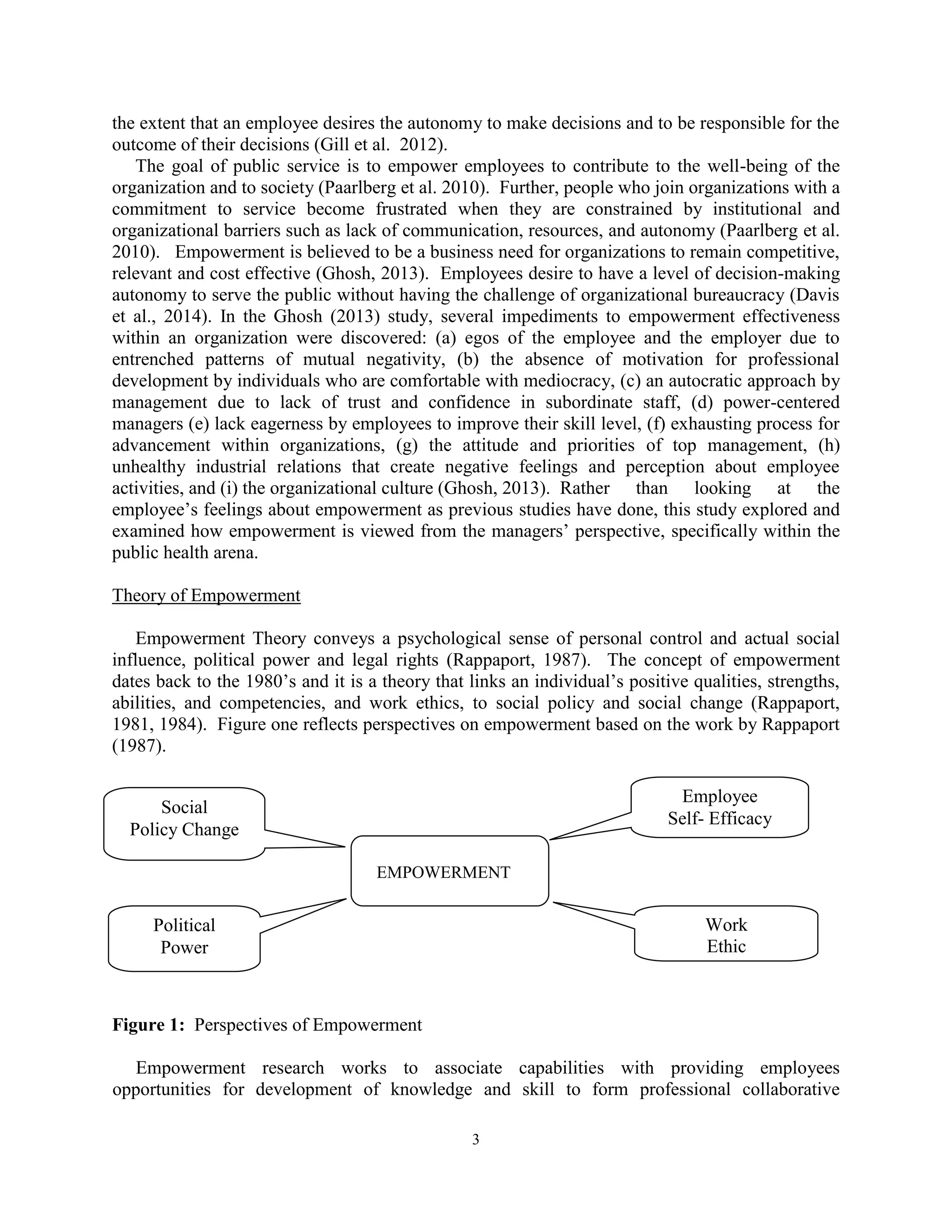
1981, 1984). Figure one reflects perspectives on empowerment based on the work by Rappaport
(1987).
Figure 1: Perspectives of Empowerment
Empowerment research works to associate capabilities with providing employees
opportunities for development of knowledge and skill to form professional collaborative
Employee
Self- Efficacy
Social
Policy Change
Work
Ethic
Political
Power
EMPOWERMENT
4
initiatives instead of authoritative experts (Perkins & Zimmerman, 1995). The concept of
empowerment not only requires individual power, but also includes the necessary training, credit
and information in order to be successful in making responsible job-related decisions (Hossein,
Saleh, Iman, & Jaafar, 2012). Early research proposed that in the last 10 or 15 years,
empowerment has evolved from a new organizational cultural challenge into a popular and
mainstream discipline within organizations (Kuhn, 1970). More recent, the studies examined the
leadership’s role in employee’s psychological empowerment, competence, impact, meaning,
self-determination, and how they believe it impacted their organizational identification process
(Zhu, Sosik, Riggio & Yang, 2012).
The research of this study connected the concept of empowerment to the perception of
managers, specifically in a healthcare setting; therefore the study expanded empowerment theory
to understand how healthcare managers in different leadership roles feel about empowerment.
Empowerment and Organizational Culture
Empowerment within organizations is related to employee burnout and other employee
behaviors (Gilbert et al., 2010). It is believed that empowerment plays a vital role in the work
performance of employees (Gilbert et al., 2010). Some organizations have begun the quest to
implement employee empowerment programs despite variable impediments such as egos, lack of
motivation, management types, politics, organizational priorities, industrial relations and
organizational culture (Ghosh, 2013). Empowerment within a workplace is considered to be
important (Proenca, 2014). According to the Proenca (2014) study, many organizations have
not totally realized the benefits of empowerment; therefore, the study examined the role that
perception played in organizational support and how it served as a moderator for empowerment
within organizations. Three practices surfaced within the study: sharing information, providing
access to resources and the clarity of roles. It was found that these three elements played a role
in the level of employee empowerment. The influence of managers on employee empowerment
was implicated to the degree of how management showed support and a commitment to
empowerment practices (Proenca, 2014). In a healthcare setting, leadership tends to be
associated as a skill related to people who are in positions of management (Fulop, 2012).
Effective leadership in hospitals is recognized as the key to organizational performance although
it has been challenging for public health agencies to create a quality improvement work culture
due to such barriers as perceptions about lack of relevance, time, resources and lack of leadership
commitment to quality improvement (Davis et al., 2014). The perception of job satisfaction,
leads to job involvement to the degree that employees feel empowered to handle job-related
issues. Employee performance is affected by their perception of how leadership empowers
employees to make decisions (Gill et al., 2012). Employee's perception of leadership affects
employee performance, as the study investigated the mediator of psychological empowerment
and the moderator of person-supervisor fit in order to understand the effect of moral leadership
on employee outcomes (Kim and Kim, 2013).
Organizational culture has a significant impact on employee empowerment; however, when
organizations fail to empower employees, there is a perception that employees resist
empowerment and a perception that management is reluctant to empower employees (Gill et al.,
2012). There is a significant level of importance of organizations establishing a culture of
openness, trust; willingness to experiment and competitiveness in order to empower employees
5
(Ghosh, 2013). It has also been noted by Gilbert et al. (2010) that financial strain, staffing
deficiencies and healthcare restructuring play a vital role in the lack of empowerment among
staff. According to Daft (2014), empowerment includes both managers and workers. In
addition, one of the requirements of managers within an organization is to mentor their staff and
to help people develop their full potential (Daft, 2014).
Daft (2014) identifies empowerment as an integral element in an organization’s ethical
responsibility and its sustainability. The government and the public pressure today's managers to
ensure that their organization implement empowerment tools among their staff to foster
accountability and to improve the morality. Senge (2010) confirmed that organizations innovate
their infrastructure by implementing empowerment.
Conclusion
Empowerment plays a significant role in work performance. (Gilbert et al., 2010).
Empowerment Theory conveys a psychological sense of personal control and actual social
influence, political power and legal rights (Rappaport, 1987). More recently, it has been
discovered that leadership plays a significant role in employee’s psychological empowerment,
competence, impact, meaning, and self-determination and how they believe it impacted their
organizational identification process (Zhu et al., 2012). The goal of public service is to empower
employees to contribute to the well-being of the organization and to society (Paarlberg et al.
2010). Within the healthcare work environment, the manager is only mentioned in the
responsibility and accountability to implement, promote and to assist employees; however, the
managers’ perception of empowerment needs to be understood (Gilbert et al., 2010).
Management’s attitude about employee empowerment has a vital impact in how empowerment is
implemented within organizations (Ghosh, Shuck, & Petrosko, 2012).
Recommendations for Future Research
Future research should explore the perceptions and experiences of management empowerment,
specifically in the public sector. There is no known research in a public sector health department
that explores this concept.
Research Question
How do managers perceive empowerment and how is it experienced working among their
employees?
6
REFERENCES
Daft, R.L. (2014). Understanding the theory and design of organizations. Mason, OH: Cengage
Learning.
Davis, M., Mah, E., Joly, B., Zelek, M., Riley, W., Verma, P., & Fisher, S. (2014). Creating
quality improvement culture in public health agencies. American Journal of Public Health,
104(1), 98-104.
Erkutlu, H. & Chafra, J. (2012). The impact of team empowerment on proactivity. The
moderating roles of leader’s emotional intelligence and proactive personality. Journal of
Health Organization and Management, 26(5), 560-577.
Fulop, L. (2012). Leadership, clinician managers and a thing called “hybridity.” Journal of
Health Organization and Management, 26(5), 578-604.
Gilbert, S., Laschinger, H., & Leiter, M. (2010). The mediating effect of burnout on the
relationship between structural empowerment and organizational citizenship behaviors.
Journal of Nursing Management, 18(19), 229-348.
Gill, A., Sharma, S., Mathur, N. & Bhutani, S. (2012). The effects of job satisfaction and work
experience on employee-desire for empowerment: A comparative study in Canada and India.
International Journal of Management, 29(1), 190-200.
Ghosh, A.K. (2013). Employee empowerment: a strategic tool to obtain sustainable competitive
advantage. International Journal of Management, 30(3), 95-107.
Ghosh, R., Shuck, B. & Petrosko, J. (2012). Emotional intelligence and organizational learning
in work teams. Journal of Management Development, 31(6), 603-619.
Hossein, R., Saleh, P. Iman, A., & Jaafar, A. (2012). An analysis of the empowerment level of
employees and it’s relation to organizational factors. International Journal of Business and
Social Science, 3(15), 255-263.
Kash, B., Spaulding, A., Johnson, C. & Gamm, L. (2014). Success factors for strategic change
initiatives: A qualitative study of healthcare administrators’ perspectives. Journal of
Healthcare Management, 59(1), 65-82.
Kim, T. & Kim, M. (2013). Leaders' moral competence and employee outcomes: The effects of
psychological empowerment and person-supervisor fit. Journal of Business Ethics, 112(1),
155-166.
Kuhn, T.S. (1970). The structure of scientific revolutions. (2nd ed.). Chicago: University of
Chicago Press.
7
Paarlberg, L. & Lavigna, B. (2010). Transformational leadership and public service motivation:
driving individual and organizational performance. Public Administration Review, 70(5),
710-718).
Perkins, D. & Zimmerman, M. (1995). Empowerment theory, research, and application.
American Journal of Community Psychology, 23(5), 569-579.
Proenca, J. (2014). Perceived organizational support as a moderator for empowerment practices.
Academy of Business Research Journal, (1), 139-153.
Rappaport, J. (1981). In praise of paradox: A social policy of empowerment over prevention.
American Journal of Community Psychology, 9, 1-25.
Rappaport, J. (1984). Studies in empowerment: Introduction to the issue. Prevention in Human
Services, 3, 1-7.
Rappaport, J. (1987). Terms of empowerment/exemplars of prevention: Toward a theory for
community psychology. American Journal of Community Psychology, 15(2), 121-148.
Ravazadeh, N. & Ravazadeh, A. (2013). The effect of transformational leadership on staff
empowerment. International Journal of Business and Social Science, 4(10), 165-158.
Senge, P M. (2006). The fifth discipline: The art and practice of the learning organization. New
York, NY: Doubleday.
Senge, P.M. (2014). The fifth discipline fieldbook: Strategies and tools for building a learning
organization. New York, NY: Crown Business
Zhu, W., Sosik, J.J., Riggio, R.E., & Yang, B. (2012). Relationships between transformational
and active transactional leadership and followers’ organizational identification: The role of
psychological empowerment. Journal of Behavioral and Applied Management, 13(3), 186-
212.

Discovering the HC Mgr Perception of Empowerment

  • 1.
    1 Discovering The HealthcareManager’s Perception of Empowerment Debra R. Wilson, PhD Perfecting~Purpose.com Certified Professional and Organizational Coach Abstract. As expectations within public healthcare are changing, it is important to understand how managers in various leadership capacities feel about their role in the empowerment process and how this perception plays a part in their ability to empower their staff. While empowerment has been studied and discussed from an employee’s perspective, it has not been addressed from the manager’s perspective. There is a gap in literature regarding how the healthcare manager’s perception of empowerment influences how they construct their working worlds. The literature review provides an opportunity for future research to discover how managers perceive empowerment and how it is experienced working among their employees, specifically in a public health department. Keywords: empowerment; empowerment theory; management; perception of empowerment. Background Empowerment is a concept used to describe an employee’s level of authority to make autonomous decisions within an organization. Empowerment is a concept that dates back to the 1980’s and it is a construct that links individual’s strengths and competencies, natural helping systems and proactive behaviors to social policy and social change (Rappaport, 1981, 1984). The perception of empowerment influences job satisfaction and leads to job involvement to the degree those employees feel empowered to handle job-related issues (Gill, Sharma, Mathur & Bhutani, 2012). The goal of public service is to empower employees to contribute to the well- being of the organization and to society (Paarlberg & Lavigna, 2010). Within the healthcare work environment, the manager is only mentioned in the responsibility and accountability to implement, promote and to assist employees in their quest for empowerment; however, the managers’ perception of empowerment is missing in research and needs to be understood (Gilbert, Laschinger & Leiter, 2010). An empowered workplace is considered important although the benefits of empowerment are seldom realized by many organizations (Proenca, 2014). Proenca found that the degree of how management shows support and their commitment to empowerment practices is influenced by the managers’ perception of empowerment. People who join organizations with a commitment to service become frustrated when they are constrained by institutional and organizational barriers (Paarlberg et al. 2010). Quality improvements happen in public health delivery when leadership is committed to empowering employees that are close to the issues to make changes (Davis, Mah, Joly, Zelek, Riley, Verma & Fisher, 2014).
  • 2.
    2 Statement of theProblem Leadership within healthcare is shifting its focus to emphasize on skill and organizational performance (Fulop, 2012). It is challenging for public health agencies to create a quality improvement work culture due to perceptions about the lack of relevance, time, resources and the leadership’s commitment to quality improvement (Davis et al., 2014). Employee’s perception of leadership impacts their feelings about being empowered in doing their jobs (Gill et al., 2012). A qualitative study explored the success factors related to the implementation of change initiatives within healthcare organizations. The top success factors that surfaced were related to (a) organizational culture and values, (b) business processes and (c) the engagement of people (Kash, Spaulding, Johnson & Gamm, 2014). Employee’s perception of an organization is related to job satisfaction, organizational performance, and helps to protect the public perception of the organization to external stakeholders (White, Vanc & Stafford, 2010). The importance of organizations establishing a culture of openness and trust in order to empower employees was stressed by a study conducted by Ghosh (2013). The study conducted by Gilbert et al. (2010), concluded that financial strain, staffing deficiencies and healthcare restructuring play a vital role in the lack of empowerment among staff. The healthcare manager is only mentioned in the responsibility and accountability to implement, promote and to assist employees; however, the managers’ perception and experience of empowerment is not clearly identified. Early research focused on empowerment as a managerial practice of delegating authority. More resent research seeks to understand the effect that leadership has on employee’s empowerment (Ravazadeh et al., 2013). Literature Review Literature confirms that leadership in a healthcare setting primarily emphasizes effectiveness as it relates to skill and organizational performance (Fulop, 2012). The generic qualitative research in this study investigated the healthcare manger’s perception of empowerment. It is important to understand how the manager feels about their role in the empowerment process and how this perception plays a part in their ability to empower staff. Management’s attitude about employee empowerment has a vital impact in how empowerment is implemented within organizations (Ghosh, Shuck, & Petrosko, 2012). Accordingly, this study sought to discover how managers in various roles within a public sector health department perceive empowerment, how their perception compares to that of their organization, and finally, how managers believe empowerment influences performance and satisfaction. Empowerment Employee empowerment has been defined as leadership promoting task motivation among employees in dimensions of meaningfulness, self-efficacy, autonomy and impact (Erkutlu & Chafra, 2012). Empowerment is the planned and systematic process of shifting or transferring power, and authority with responsibility and accountability from the manager to an employee at a lower classification within an organization (Ghosh, 2013). Ravazadeh and Ravazadeh (2013) confirmed that early research focused on empowerment as a managerial practice of delegating authority. More resent research seeks to understand the effect that leadership has on employee’s empowerment (Ravazadeh et al., 2013). Employee’s desire for empowerment is referred to as
  • 3.
    3 the extent thatan employee desires the autonomy to make decisions and to be responsible for the outcome of their decisions (Gill et al. 2012). The goal of public service is to empower employees to contribute to the well-being of the organization and to society (Paarlberg et al. 2010). Further, people who join organizations with a commitment to service become frustrated when they are constrained by institutional and organizational barriers such as lack of communication, resources, and autonomy (Paarlberg et al. 2010). Empowerment is believed to be a business need for organizations to remain competitive, relevant and cost effective (Ghosh, 2013). Employees desire to have a level of decision-making autonomy to serve the public without having the challenge of organizational bureaucracy (Davis et al., 2014). In the Ghosh (2013) study, several impediments to empowerment effectiveness within an organization were discovered: (a) egos of the employee and the employer due to entrenched patterns of mutual negativity, (b) the absence of motivation for professional development by individuals who are comfortable with mediocracy, (c) an autocratic approach by management due to lack of trust and confidence in subordinate staff, (d) power-centered managers (e) lack eagerness by employees to improve their skill level, (f) exhausting process for advancement within organizations, (g) the attitude and priorities of top management, (h) unhealthy industrial relations that create negative feelings and perception about employee activities, and (i) the organizational culture (Ghosh, 2013). Rather than looking at the employee’s feelings about empowerment as previous studies have done, this study explored and examined how empowerment is viewed from the managers’ perspective, specifically within the public health arena. Theory of Empowerment Empowerment Theory conveys a psychological sense of personal control and actual social influence, political power and legal rights (Rappaport, 1987). The concept of empowerment dates back to the 1980’s and it is a theory that links an individual’s positive qualities, strengths, abilities, and competencies, and work ethics, to social policy and social change (Rappaport, 1981, 1984). Figure one reflects perspectives on empowerment based on the work by Rappaport (1987). Figure 1: Perspectives of Empowerment Empowerment research works to associate capabilities with providing employees opportunities for development of knowledge and skill to form professional collaborative Employee Self- Efficacy Social Policy Change Work Ethic Political Power EMPOWERMENT
  • 4.
    4 initiatives instead ofauthoritative experts (Perkins & Zimmerman, 1995). The concept of empowerment not only requires individual power, but also includes the necessary training, credit and information in order to be successful in making responsible job-related decisions (Hossein, Saleh, Iman, & Jaafar, 2012). Early research proposed that in the last 10 or 15 years, empowerment has evolved from a new organizational cultural challenge into a popular and mainstream discipline within organizations (Kuhn, 1970). More recent, the studies examined the leadership’s role in employee’s psychological empowerment, competence, impact, meaning, self-determination, and how they believe it impacted their organizational identification process (Zhu, Sosik, Riggio & Yang, 2012). The research of this study connected the concept of empowerment to the perception of managers, specifically in a healthcare setting; therefore the study expanded empowerment theory to understand how healthcare managers in different leadership roles feel about empowerment. Empowerment and Organizational Culture Empowerment within organizations is related to employee burnout and other employee behaviors (Gilbert et al., 2010). It is believed that empowerment plays a vital role in the work performance of employees (Gilbert et al., 2010). Some organizations have begun the quest to implement employee empowerment programs despite variable impediments such as egos, lack of motivation, management types, politics, organizational priorities, industrial relations and organizational culture (Ghosh, 2013). Empowerment within a workplace is considered to be important (Proenca, 2014). According to the Proenca (2014) study, many organizations have not totally realized the benefits of empowerment; therefore, the study examined the role that perception played in organizational support and how it served as a moderator for empowerment within organizations. Three practices surfaced within the study: sharing information, providing access to resources and the clarity of roles. It was found that these three elements played a role in the level of employee empowerment. The influence of managers on employee empowerment was implicated to the degree of how management showed support and a commitment to empowerment practices (Proenca, 2014). In a healthcare setting, leadership tends to be associated as a skill related to people who are in positions of management (Fulop, 2012). Effective leadership in hospitals is recognized as the key to organizational performance although it has been challenging for public health agencies to create a quality improvement work culture due to such barriers as perceptions about lack of relevance, time, resources and lack of leadership commitment to quality improvement (Davis et al., 2014). The perception of job satisfaction, leads to job involvement to the degree that employees feel empowered to handle job-related issues. Employee performance is affected by their perception of how leadership empowers employees to make decisions (Gill et al., 2012). Employee's perception of leadership affects employee performance, as the study investigated the mediator of psychological empowerment and the moderator of person-supervisor fit in order to understand the effect of moral leadership on employee outcomes (Kim and Kim, 2013). Organizational culture has a significant impact on employee empowerment; however, when organizations fail to empower employees, there is a perception that employees resist empowerment and a perception that management is reluctant to empower employees (Gill et al., 2012). There is a significant level of importance of organizations establishing a culture of openness, trust; willingness to experiment and competitiveness in order to empower employees
  • 5.
    5 (Ghosh, 2013). Ithas also been noted by Gilbert et al. (2010) that financial strain, staffing deficiencies and healthcare restructuring play a vital role in the lack of empowerment among staff. According to Daft (2014), empowerment includes both managers and workers. In addition, one of the requirements of managers within an organization is to mentor their staff and to help people develop their full potential (Daft, 2014). Daft (2014) identifies empowerment as an integral element in an organization’s ethical responsibility and its sustainability. The government and the public pressure today's managers to ensure that their organization implement empowerment tools among their staff to foster accountability and to improve the morality. Senge (2010) confirmed that organizations innovate their infrastructure by implementing empowerment. Conclusion Empowerment plays a significant role in work performance. (Gilbert et al., 2010). Empowerment Theory conveys a psychological sense of personal control and actual social influence, political power and legal rights (Rappaport, 1987). More recently, it has been discovered that leadership plays a significant role in employee’s psychological empowerment, competence, impact, meaning, and self-determination and how they believe it impacted their organizational identification process (Zhu et al., 2012). The goal of public service is to empower employees to contribute to the well-being of the organization and to society (Paarlberg et al. 2010). Within the healthcare work environment, the manager is only mentioned in the responsibility and accountability to implement, promote and to assist employees; however, the managers’ perception of empowerment needs to be understood (Gilbert et al., 2010). Management’s attitude about employee empowerment has a vital impact in how empowerment is implemented within organizations (Ghosh, Shuck, & Petrosko, 2012). Recommendations for Future Research Future research should explore the perceptions and experiences of management empowerment, specifically in the public sector. There is no known research in a public sector health department that explores this concept. Research Question How do managers perceive empowerment and how is it experienced working among their employees?
  • 6.
    6 REFERENCES Daft, R.L. (2014).Understanding the theory and design of organizations. Mason, OH: Cengage Learning. Davis, M., Mah, E., Joly, B., Zelek, M., Riley, W., Verma, P., & Fisher, S. (2014). Creating quality improvement culture in public health agencies. American Journal of Public Health, 104(1), 98-104. Erkutlu, H. & Chafra, J. (2012). The impact of team empowerment on proactivity. The moderating roles of leader’s emotional intelligence and proactive personality. Journal of Health Organization and Management, 26(5), 560-577. Fulop, L. (2012). Leadership, clinician managers and a thing called “hybridity.” Journal of Health Organization and Management, 26(5), 578-604. Gilbert, S., Laschinger, H., & Leiter, M. (2010). The mediating effect of burnout on the relationship between structural empowerment and organizational citizenship behaviors. Journal of Nursing Management, 18(19), 229-348. Gill, A., Sharma, S., Mathur, N. & Bhutani, S. (2012). The effects of job satisfaction and work experience on employee-desire for empowerment: A comparative study in Canada and India. International Journal of Management, 29(1), 190-200. Ghosh, A.K. (2013). Employee empowerment: a strategic tool to obtain sustainable competitive advantage. International Journal of Management, 30(3), 95-107. Ghosh, R., Shuck, B. & Petrosko, J. (2012). Emotional intelligence and organizational learning in work teams. Journal of Management Development, 31(6), 603-619. Hossein, R., Saleh, P. Iman, A., & Jaafar, A. (2012). An analysis of the empowerment level of employees and it’s relation to organizational factors. International Journal of Business and Social Science, 3(15), 255-263. Kash, B., Spaulding, A., Johnson, C. & Gamm, L. (2014). Success factors for strategic change initiatives: A qualitative study of healthcare administrators’ perspectives. Journal of Healthcare Management, 59(1), 65-82. Kim, T. & Kim, M. (2013). Leaders' moral competence and employee outcomes: The effects of psychological empowerment and person-supervisor fit. Journal of Business Ethics, 112(1), 155-166. Kuhn, T.S. (1970). The structure of scientific revolutions. (2nd ed.). Chicago: University of Chicago Press.
  • 7.
    7 Paarlberg, L. &Lavigna, B. (2010). Transformational leadership and public service motivation: driving individual and organizational performance. Public Administration Review, 70(5), 710-718). Perkins, D. & Zimmerman, M. (1995). Empowerment theory, research, and application. American Journal of Community Psychology, 23(5), 569-579. Proenca, J. (2014). Perceived organizational support as a moderator for empowerment practices. Academy of Business Research Journal, (1), 139-153. Rappaport, J. (1981). In praise of paradox: A social policy of empowerment over prevention. American Journal of Community Psychology, 9, 1-25. Rappaport, J. (1984). Studies in empowerment: Introduction to the issue. Prevention in Human Services, 3, 1-7. Rappaport, J. (1987). Terms of empowerment/exemplars of prevention: Toward a theory for community psychology. American Journal of Community Psychology, 15(2), 121-148. Ravazadeh, N. & Ravazadeh, A. (2013). The effect of transformational leadership on staff empowerment. International Journal of Business and Social Science, 4(10), 165-158. Senge, P M. (2006). The fifth discipline: The art and practice of the learning organization. New York, NY: Doubleday. Senge, P.M. (2014). The fifth discipline fieldbook: Strategies and tools for building a learning organization. New York, NY: Crown Business Zhu, W., Sosik, J.J., Riggio, R.E., & Yang, B. (2012). Relationships between transformational and active transactional leadership and followers’ organizational identification: The role of psychological empowerment. Journal of Behavioral and Applied Management, 13(3), 186- 212.