Review Group Communication &  Discuss Abnormal Psychology
Review What is the focus of a process group? What is the focus of a content group? With respect to the roles of members, please provide examples of a) group task roles; b) group building roles; c) individual roles. In your opinion, which type of roles are needed in order to facilitate communication in a content-focused group? Why? Describe two therapeutic factors of group discussion.  Describe the symptoms of Groupthink. See handouts “Groupthink”
Childhood Disorders
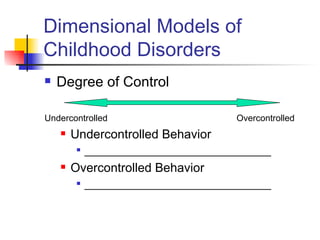
Dimensional Models of Childhood Disorders Degree of Control Undercontrolled Overcontrolled Undercontrolled Behavior ________________________________ Overcontrolled Behavior ________________________________
Undercontrolled Behavior Attention-deficit / Hyperactivity Disorder Conduct Disorder
Attention-deficit / Hyperactivity Disorder or ADHD  3 subcategories of symptoms Poor attention Hyperactive-impulsive behavior Have both problems
Studies on ADHD Symptoms Whalen & Henker (1985) Hyperactive children tend to miss subtle social cues _________________________ Misattribution and misinterpretation _____________________________ Therefore, hyperactive children have trouble getting along with others
Studies on ADHD Symptoms Hoza et al, 2000 Procedures: boys with ADHD and boys with no diagnosis engaged in a get-acquainted task. Results:  Objective raters evaluated that boys with ADHD performed poorer than control participants; boys with ADHD evaluated themselves in more positive terms Conclusion: Boys with ADHD tend to have illusory bias concerning their social behaviors.
Studies on ADHD Symptoms Casey et al, 1996 15% to 30% of children with ADHD have a learning disability in math, reading, or spelling Barkle et al, 1990 About 50% of children with ADHD are placed in special education programs.
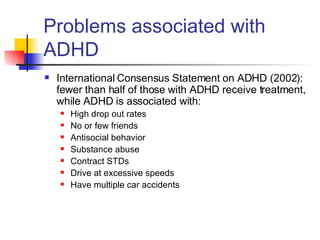
Problems associated with ADHD International Consensus Statement on ADHD (2002): fewer than half of those with ADHD receive treatment, while ADHD is associated with:  High drop out rates No or few friends Antisocial behavior Substance abuse Contract STDs Drive at excessive speeds Have multiple car accidents
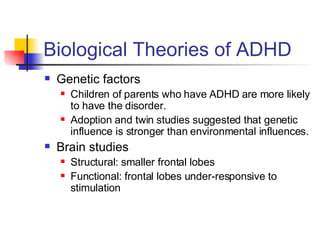
Biological Theories of ADHD Genetic factors Children of parents who have ADHD are more likely to have the disorder. Adoption and twin studies suggested that genetic influence is stronger than environmental influences. Brain studies Structural: smaller frontal lobes  Functional: frontal lobes under-responsive to stimulation
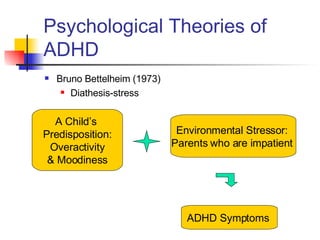
Psychological Theories of ADHD Bruno Bettelheim (1973) Diathesis-stress A Child’s  Predisposition: Overactivity  & Moodiness Environmental Stressor:  Parents who are impatient  ADHD Symptoms
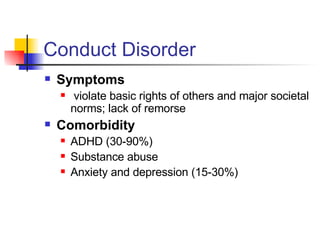
Conduct Disorder Symptoms violate basic rights of others and major societal norms; lack of remorse Comorbidity ADHD (30-90%) Substance abuse  Anxiety and depression (15-30%)
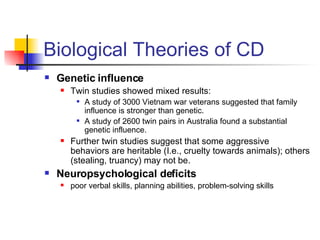
Biological Theories of CD Genetic influence Twin studies showed mixed results: A study of 3000 Vietnam war veterans suggested that family influence is stronger than genetic. A study of 2600 twin pairs in Australia found a substantial genetic influence. Further twin studies suggest that some aggressive behaviors are heritable (I.e., cruelty towards animals); others (stealing, truancy) may not be.  Neuropsychological deficits poor verbal skills, planning abilities, problem-solving skills
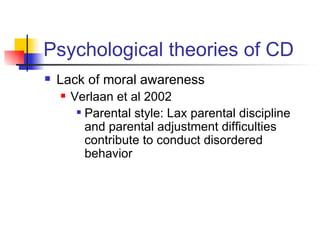
Psychological theories of CD  Lack of moral awareness Verlaan et al 2002 Parental style: Lax parental discipline and parental adjustment difficulties contribute to conduct disordered behavior
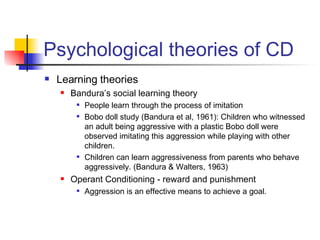
Psychological theories of CD Learning theories Bandura’s social learning theory  People learn through the process of imitation Bobo doll study (Bandura et al, 1961): Children who witnessed an adult being aggressive with a plastic Bobo doll were observed imitating this aggression while playing with other children. Children can learn aggressiveness from parents who behave aggressively. (Bandura & Walters, 1963) Operant Conditioning - reward and punishment Aggression is an effective means to achieve a goal.
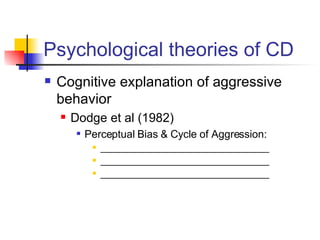
Psychological theories of CD Cognitive explanation of aggressive behavior Dodge et al (1982) Perceptual Bias & Cycle of Aggression: __________________________________ __________________________________ __________________________________
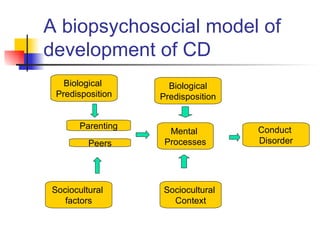
A biopsychosocial model of development of CD Biological  Predisposition Sociocultural  factors Parenting Biological Predisposition Sociocultural  Context Mental  Processes Conduct  Disorder Peers
Overcontrolled behavior Separation Anxiety Disorder School Phobia Social Phobia
Separation anxiety disorder Symptoms Excessive worries about harm to major attachment figures along with fears of abandonment, refusal to attend school; avoidance of being alone. The symptoms must be experienced for at least 8 weeks.
Attachment style theories of Separation Anxiety Disorder Ainsworth & Bowlby (1953) Procedure An infant was left in a room for a brief period of time with a stranger, the mother having left the room. Researchers observed and classified infants behavior into 3 types:  Secured attachment style Anxious attachment style  Avoidant attachment style Which style is associated with separation anxiety disorder?

March 4 Childhood Disorders

  • 1.
    Review Group Communication& Discuss Abnormal Psychology
  • 2.
    Review What isthe focus of a process group? What is the focus of a content group? With respect to the roles of members, please provide examples of a) group task roles; b) group building roles; c) individual roles. In your opinion, which type of roles are needed in order to facilitate communication in a content-focused group? Why? Describe two therapeutic factors of group discussion. Describe the symptoms of Groupthink. See handouts “Groupthink”
  • 3.
  • 4.
    Dimensional Models ofChildhood Disorders Degree of Control Undercontrolled Overcontrolled Undercontrolled Behavior ________________________________ Overcontrolled Behavior ________________________________
  • 5.
    Undercontrolled Behavior Attention-deficit/ Hyperactivity Disorder Conduct Disorder
  • 6.
    Attention-deficit / HyperactivityDisorder or ADHD 3 subcategories of symptoms Poor attention Hyperactive-impulsive behavior Have both problems
  • 7.
    Studies on ADHDSymptoms Whalen & Henker (1985) Hyperactive children tend to miss subtle social cues _________________________ Misattribution and misinterpretation _____________________________ Therefore, hyperactive children have trouble getting along with others
  • 8.
    Studies on ADHDSymptoms Hoza et al, 2000 Procedures: boys with ADHD and boys with no diagnosis engaged in a get-acquainted task. Results: Objective raters evaluated that boys with ADHD performed poorer than control participants; boys with ADHD evaluated themselves in more positive terms Conclusion: Boys with ADHD tend to have illusory bias concerning their social behaviors.
  • 9.
    Studies on ADHDSymptoms Casey et al, 1996 15% to 30% of children with ADHD have a learning disability in math, reading, or spelling Barkle et al, 1990 About 50% of children with ADHD are placed in special education programs.
  • 10.
    Problems associated withADHD International Consensus Statement on ADHD (2002): fewer than half of those with ADHD receive treatment, while ADHD is associated with: High drop out rates No or few friends Antisocial behavior Substance abuse Contract STDs Drive at excessive speeds Have multiple car accidents
  • 11.
    Biological Theories ofADHD Genetic factors Children of parents who have ADHD are more likely to have the disorder. Adoption and twin studies suggested that genetic influence is stronger than environmental influences. Brain studies Structural: smaller frontal lobes Functional: frontal lobes under-responsive to stimulation
  • 12.
    Psychological Theories ofADHD Bruno Bettelheim (1973) Diathesis-stress A Child’s Predisposition: Overactivity & Moodiness Environmental Stressor: Parents who are impatient ADHD Symptoms
  • 13.
    Conduct Disorder Symptomsviolate basic rights of others and major societal norms; lack of remorse Comorbidity ADHD (30-90%) Substance abuse Anxiety and depression (15-30%)
  • 14.
    Biological Theories ofCD Genetic influence Twin studies showed mixed results: A study of 3000 Vietnam war veterans suggested that family influence is stronger than genetic. A study of 2600 twin pairs in Australia found a substantial genetic influence. Further twin studies suggest that some aggressive behaviors are heritable (I.e., cruelty towards animals); others (stealing, truancy) may not be. Neuropsychological deficits poor verbal skills, planning abilities, problem-solving skills
  • 15.
    Psychological theories ofCD Lack of moral awareness Verlaan et al 2002 Parental style: Lax parental discipline and parental adjustment difficulties contribute to conduct disordered behavior
  • 16.
    Psychological theories ofCD Learning theories Bandura’s social learning theory People learn through the process of imitation Bobo doll study (Bandura et al, 1961): Children who witnessed an adult being aggressive with a plastic Bobo doll were observed imitating this aggression while playing with other children. Children can learn aggressiveness from parents who behave aggressively. (Bandura & Walters, 1963) Operant Conditioning - reward and punishment Aggression is an effective means to achieve a goal.
  • 17.
    Psychological theories ofCD Cognitive explanation of aggressive behavior Dodge et al (1982) Perceptual Bias & Cycle of Aggression: __________________________________ __________________________________ __________________________________
  • 18.
    A biopsychosocial modelof development of CD Biological Predisposition Sociocultural factors Parenting Biological Predisposition Sociocultural Context Mental Processes Conduct Disorder Peers
  • 19.
    Overcontrolled behavior SeparationAnxiety Disorder School Phobia Social Phobia
  • 20.
    Separation anxiety disorderSymptoms Excessive worries about harm to major attachment figures along with fears of abandonment, refusal to attend school; avoidance of being alone. The symptoms must be experienced for at least 8 weeks.
  • 21.
    Attachment style theoriesof Separation Anxiety Disorder Ainsworth & Bowlby (1953) Procedure An infant was left in a room for a brief period of time with a stranger, the mother having left the room. Researchers observed and classified infants behavior into 3 types: Secured attachment style Anxious attachment style Avoidant attachment style Which style is associated with separation anxiety disorder?