James Thomson  1700-1748 Ronnie Mickle Final Presentation IN PRESENTATION YOU SHOULD FIND THE FOLLOWING: 1. A LIST OF POEMS BY JAMES THOMSON  ( ONLY ONES I READ- THERE ARE MORE) 2. RELEVANT BIOGRAPHICAL INFORMTION AND HISTORICAL MATERIAL ABOUT THE AUTHOR & PIECE I CHOSE 3. MY ANNOTATED BIBLIOGRAPHY 4. MY THREE TO 4 MINUTE VIDEO DISCUSSING MY PROJECT
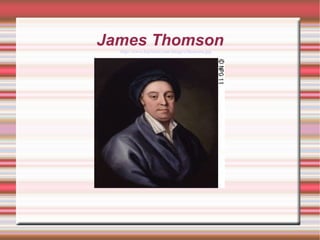
James Thomson http://www.hayinart.com/images/thomson.jpg
First Things, First! Here is your  List of Selected Titles  by James Thomson   (some of which will reappear in this presentation) 1  A Poem Sacred to the Memory of Sir Isaac Newton  2  Fareweel, ye bughts  3  Farewell to Ravelrig  4  Gifts  5  Hymn on Solitude  6  In the Train  7  Rule Britannia  8  Sunday up the River   ( ENJOYED AND RECOMMEND) 9  The Seasons: Winter  10  The Vine
The Next Few Slides have been selected to tell you all about relevant biographical and historical information about James Thomson.
Who is James Thomson? First of all, one of the things that I want to point out to anyone who is looking up James Thomson is that  t here are two James Thomsons  in literary history.  The James Thomson we will be focusing on will be the Dramatist & Poet from our Text,  The Norton Anthoology of English Literature , eighth edition.  The other James Thomson is easily identified by the purposely placed initials at the end of his name. James To Thomson B.V. That James Thomson utilized the initials to set himself apart. < http://aolsearch.aol.com/aol/search?encquery=daf4b3be2434f591fe43596285ac0778&invocationType=keyword_rollover&ie=UTF-8 > This is very important information because James Thomson B.V. Wanted to be known for different reasons. I checked out some of his work and they are nothing alike. The James Thomson we are studying in this project has a certain style and subject he attacks.
Facts About James Thomson James Thomson lived from 1700-1748 James Thomson was one of the first and most popular nature poets of his time.  Like Thomson, B.V., this Thomson was too from Scotland, however, resided in England after the age of 25 and from many resources is referred to as a British Writer.  All of Thomson's early education was received in Scotland, however, all of his college was received in England at Edinburgh University.
More interesting facts about James Thomson His true birth date is unknown and he is guesstimated to have been bornaround 1700 and around Ednam, Roxburghshire. He was the son of a minister who raised him in a remote fold in the wild country.  < http://www.slainte.org.uk/scotauth/thomsdsw.htm > Thomas performed a series of in house living and apprenticeships to various booksellers and royalty until Frederick, the Prince of Whales in 1737 granted him a living pension of 100 pounds a year.
Conflicting Information I found about Thomson in my Sources Contradictory to the Internet Sources that say Thomson's father was a minister, &quot;J ames Thomson: Poet of 'The Seasons,&quot; by Douglas Grant;  leads us to believe that he was actually a gardener who arranged to have Thomson taken away to study and that he did not raise his son himself and that he had an arrangement in order for his son to attend college. I felt it would be important to point this out because Thomson is known for talking about the immortality of man and having a father who is a minister may have been a big factor.
A Quote From “ THE VARIED GOD” for background information about Thomson's time period  “ THOMSON'S PERIOD, the twenty years between 1726 and 1746, was one of enormous complexity. During most of it, England was nominally at peace, and enjoying the greatest prosperity. Her revolutions were over, a new line of kings was firmly on the throne (despite the constant threat of Jacobite intrigue), commercial and industrial development were becoming more and more spectacular. Yet throughout all this time, the European situation was highly precarious: the description of the period as one of peace and prosperity is somewhat misleading. There were constant rumors of war; one of the main objections to Walpole as prime minister was his reluctance to engage England in wars that seemed inevitable, and even desirable. Thomson himself, in 1729, wrote Britannia &quot;in opposition to the peace-at-any-price policy of Walpole.&quot;
End of important Biographical and Historical Information Now Lets See a List of Thomson's works and  focus on one!
Works by Thomson that I Enjoyed U se Cntrl and Click the title to read these popular works by Thomson And if that doesn't work just visit: http://www.poemhunter.com/james-thomson/ A Poem Sacred to the Memory of Sir Isaac Newton  Farewell to Ravelrig  Gifts  Hymn on Solitude  Rule Britannia    The Seasons: Winter    The Vine
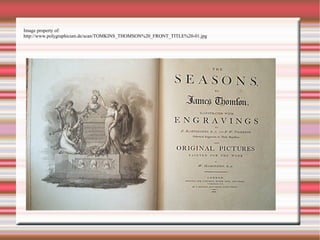
Image property of: http://www.polygraphicum.de/scan/TOMKINS_THOMSON%20_FRONT_TITLE%20-01.jpg
A Focus on Thomson's  “The Seasons” The Seasons was written in Blank Verse.  Thomson utilized the poems for the seasons to show the relations between human mortality and nature.
Background Info about  The Seasons The first poem of The Seasons was &quot;Winter in 1726.  It contained 405 lines.  The entire book of The Seasons was not truly completed until 1746.  It under went 20 years of revisions and expansions in its entirety and wound up with 5,541 lines total between the four poems.  It was completed 2 years before Thomson's death.  Patricia Meyer Spacks,  The Varied God: A Critical Study of Thomson's the Seasons  (Berkeley, CA: University of California Press, 1959) 3,  Questia , 26 Nov. 2006 <http://www.questia.com/PM.qst?a=o&d=9324837>.
Back Ground Information about The Seasons Thomas Published &quot;The Seasons&quot; in four parts as he needed funding for each part.  Winter, April 1726  Summer, February 1727  Spring, June 1728  Autumn, later half of 1728  <James Sambrook, &quot;&quot;A Just Balance between Patronage and the Press&quot;: The Case of James Thomson,&quot; Studies in the Literary Imagination 34.1 (2001): 137, Questia, 26 Nov. 2006 . >
Weaknesses in Thomson's  Twenty Years of Work &quot;There are serious weaknesses in the final version of The Seasons: stretches of emotional aridity, logical contradictions, flaws of structure, failures of style. For many of these flaws, the poet's increasing emphasis on narrow moral concerns, as opposed to the strengthening concept of man as a part of the natural order, is directly accountable . &quot; (Spacks 29)
Could it have been? Maybe Thomson over worked his own poetry? He did spend twenty years working on it... and in todays world we hear “leave it alone” a lot!
On the other hand; and relating our study of The Seasons to  something we have studied... &quot;Milton's God makes the world by dividing chaos and by pouring himself into it. It is Milton's second process of creation that Thomson seizes on and develops in The Seasons, both for the subject of his reverie of Nature and for his stylistic effects suggesting an elan vital running through things, a divine process at once sportive and sublime that unites seer and scene, writer and world written about. The divinity of Nature is also the ground of Thomson's ethical ideas and idea of British liberty, ideas that at once develop and contradict Milton's.&quot; (Reid)
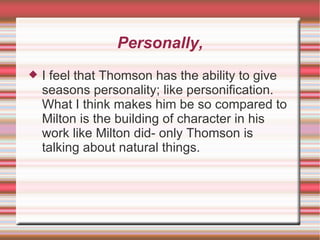
Personally, I feel that Thomson has the ability to give seasons personality; like personification. What I think makes him be so compared to Milton is the building of character in his work like Milton did- only Thomson is talking about natural things.
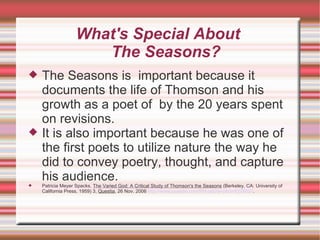
What's Special About  The Seasons? The Seasons is  important because it documents the life of Thomson and his growth as a poet of  by the 20 years spent on revisions.  It is also important because he was one of the first poets to utilize nature the way he did to convey poetry, thought, and capture his audience. Patricia Meyer Spacks,  The Varied God: A Critical Study of Thomson's the Seasons  (Berkeley, CA: University of California Press, 1959) 3,  Questia , 26 Nov. 2006  http://www.questia.com/PM.qst?a=o&d=9324837 .
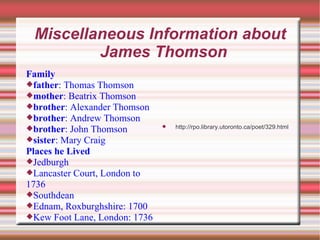
Miscellaneous Information about James Thomson Family father : Thomas Thomson mother : Beatrix Thomson brother : Alexander Thomson brother : Andrew Thomson brother : John Thomson sister : Mary Craig Places he Lived Jedburgh Lancaster Court, London to 1736 Southdean Ednam, Roxburghshire: 1700 Kew Foot Lane, London: 1736 http://rpo.library.utoronto.ca/poet/329.html
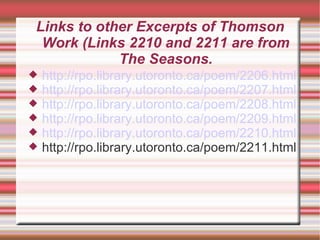
Links to other Excerpts of Thomson Work (Links 2210 and 2211 are from The Seasons. http://rpo.library.utoronto.ca/poem/2206.html http://rpo.library.utoronto.ca/poem/2207.html http://rpo.library.utoronto.ca/poem/2208.html http://rpo.library.utoronto.ca/poem/2209.html http://rpo.library.utoronto.ca/poem/2210.html http://rpo.library.utoronto.ca/poem/2211.html
Anootated Bibliography Editors, Rpo. &quot;Representative Poetry Online.&quot;  Selected Poetry of James Thomson . 01 Oct.-Nov. 2006 <http://rpo.library.utoronto.ca/poet/329.html>.  This particular source was one of my least used, however, it did provide me with my miscellaneous facts about Thomas. I was able to find out some other leads on his work and some of his relatives names which I thought was very interesting to know. I thought I might have found some of their names for important reasons later on my research but I did not catch anything. Grant, Douglas. James Thomson: Poet of 'The Seasons'. London: Cresset Press, 1951. Questia. 26 Nov. 2006 <http://www.questia.com/PM.qst?a=o&d=9874186>. This Source allowed me to gather the time periods and information about when the poems were written. Before reading this source I did not really understand how much effort went into The Seasons. It explains how The Seasons was a twenty year effort and why. &quot;IPL Literary Criticism Online.&quot;  Literary Criticsim Online . ILP. 01 Oct.-Nov. 2006 < http://www.ipl.org/div/litcrit/bin/litcrit.out.pl?au=tho756 >. This was my second favorite source for learning more about James Thomas. It was packed with information that I needed to understand his purpose in our literary history, and to be able to convey it back to you. It was a list of sources about his work contrasting different ideas from all over the place.  &quot;James Thomson 1700-1748.&quot;  Richmond Libraries_ocal Studies Collection  (2006):  1-3. 01 Nov. 2006 <http://aolsearch.aol.com/aol/search?encquery=49f61074b79253859ea5e63e22db818dd2a86521ff50727c&invocationType=keyword_rollover&ie=UTF-8>.  This sources was wonderful for confirming background information about Thomas. Although most of the background information, I felt did not coinside with what this projects needs were- this is a great source for finding out more about Thomson's alternative endevors (apprenticeships, residencies, schooling- etc) Macaulay, G. C. James Thomson. London: Macmillan and Co., 1908. Questia. 26 Nov. 2006 <http://www.questia.com/PM.qst?a=o&d=13557540>. This Source allowed me mostly to gain worldly knowledge about James Thomson. Really it didn't turn out surving a greater purpose as other sources, however, it did help with background information and understanding. Through this source I was allowed to understand how Thomson's poetry was influenced by those before him and how his work influenced those after him. I was allowed to see his work for its literary value. This source mostly served to persuade my own opinions for this particular project in which I hope to convey in my video.
Annotated Bibliography Continued Sambrook, James. &quot;&quot;A Just Balance between Patronage and the Press&quot;: The Case of James Thomson.&quot; Studies in the Literary Imagination 34.1 (2001): 137. Questia. 26 Nov. 2006 <http://www.questia.com/PM.qst?a=o&d=5001032038>. With this source I was able to compare some of the thoughts from “The Varied God,” about Thomson's work. It surved mostly as a comparison piece as it was not as full of information as other sources. Still it help to add to the validity of my research. &quot;SLAINTE.&quot;  Scottish Authors . 01 Jan. 1998. SLAINTE. 01 Oct.-Nov. 2006< http://www.slainte.org.uk/scotauth/thomsdsw.htm >.  Since Thomas is considered a British writer, I was able to see how he was respected from the Scottish Stand point. Apparently his people still claim him in their heritage as well . This source contributes his early exposures to nature to scottland. Spacks, Patricia Meyer. The Varied God: A Critical Study of Thomson's the Seasons. Berkeley, CA: University of California Press, 1959. Questia. 26 Nov. 2006 <http://www.questia.com/PM.qst?a=o&d=9324863>. In no way would I have been able to complete this project with out this source. Especially when I wanted to find information about “The Seasons. This particular source was a one stop shop for everything I talked about and was consistent with other sources as well. I would have to suggest it to anyone who is studying James T Reid, David. &quot;Thomson's Poetry of Reverie and Milton.&quot; Studies in English Literature, 1500-1900 43.3 (2003): 667+. Questia. 26 Nov. 2006 <http://www.questia.com/PM.qst?a=o&d=5001995062>. homson. &quot;The James Thomson Poetry Works.&quot;  The James Thomson Poetry Works . 01 Oct.-Nov. 2006 <http://vasthead.com/Thomson/>.  This source was important for me to be able to find out more about Thomson's other works. I was able to actually read other works online and confirm my personal thoughts about him as writer which I'll mostly display in my 3-4 minute video. Other than supplying alternative works by Thomson for me to read- this wasn't very useful.
LAST BUT NOT LEAST BELOW TO VIEW MY 3-4 MINUTE CLASS PRESENTATION ABOUT JAMES THOMSON
NOW... THE END

James Thomson

  • 1.
    James Thomson 1700-1748 Ronnie Mickle Final Presentation IN PRESENTATION YOU SHOULD FIND THE FOLLOWING: 1. A LIST OF POEMS BY JAMES THOMSON ( ONLY ONES I READ- THERE ARE MORE) 2. RELEVANT BIOGRAPHICAL INFORMTION AND HISTORICAL MATERIAL ABOUT THE AUTHOR & PIECE I CHOSE 3. MY ANNOTATED BIBLIOGRAPHY 4. MY THREE TO 4 MINUTE VIDEO DISCUSSING MY PROJECT
  • 2.
  • 3.
    First Things, First!Here is your List of Selected Titles by James Thomson (some of which will reappear in this presentation) 1 A Poem Sacred to the Memory of Sir Isaac Newton 2 Fareweel, ye bughts 3 Farewell to Ravelrig 4 Gifts 5 Hymn on Solitude 6 In the Train 7 Rule Britannia 8 Sunday up the River ( ENJOYED AND RECOMMEND) 9 The Seasons: Winter 10 The Vine
  • 4.
    The Next FewSlides have been selected to tell you all about relevant biographical and historical information about James Thomson.
  • 5.
    Who is JamesThomson? First of all, one of the things that I want to point out to anyone who is looking up James Thomson is that t here are two James Thomsons in literary history. The James Thomson we will be focusing on will be the Dramatist & Poet from our Text, The Norton Anthoology of English Literature , eighth edition. The other James Thomson is easily identified by the purposely placed initials at the end of his name. James To Thomson B.V. That James Thomson utilized the initials to set himself apart. < http://aolsearch.aol.com/aol/search?encquery=daf4b3be2434f591fe43596285ac0778&invocationType=keyword_rollover&ie=UTF-8 > This is very important information because James Thomson B.V. Wanted to be known for different reasons. I checked out some of his work and they are nothing alike. The James Thomson we are studying in this project has a certain style and subject he attacks.
  • 6.
    Facts About JamesThomson James Thomson lived from 1700-1748 James Thomson was one of the first and most popular nature poets of his time. Like Thomson, B.V., this Thomson was too from Scotland, however, resided in England after the age of 25 and from many resources is referred to as a British Writer. All of Thomson's early education was received in Scotland, however, all of his college was received in England at Edinburgh University.
  • 7.
    More interesting factsabout James Thomson His true birth date is unknown and he is guesstimated to have been bornaround 1700 and around Ednam, Roxburghshire. He was the son of a minister who raised him in a remote fold in the wild country. < http://www.slainte.org.uk/scotauth/thomsdsw.htm > Thomas performed a series of in house living and apprenticeships to various booksellers and royalty until Frederick, the Prince of Whales in 1737 granted him a living pension of 100 pounds a year.
  • 8.
    Conflicting Information Ifound about Thomson in my Sources Contradictory to the Internet Sources that say Thomson's father was a minister, &quot;J ames Thomson: Poet of 'The Seasons,&quot; by Douglas Grant; leads us to believe that he was actually a gardener who arranged to have Thomson taken away to study and that he did not raise his son himself and that he had an arrangement in order for his son to attend college. I felt it would be important to point this out because Thomson is known for talking about the immortality of man and having a father who is a minister may have been a big factor.
  • 9.
    A Quote From“ THE VARIED GOD” for background information about Thomson's time period “ THOMSON'S PERIOD, the twenty years between 1726 and 1746, was one of enormous complexity. During most of it, England was nominally at peace, and enjoying the greatest prosperity. Her revolutions were over, a new line of kings was firmly on the throne (despite the constant threat of Jacobite intrigue), commercial and industrial development were becoming more and more spectacular. Yet throughout all this time, the European situation was highly precarious: the description of the period as one of peace and prosperity is somewhat misleading. There were constant rumors of war; one of the main objections to Walpole as prime minister was his reluctance to engage England in wars that seemed inevitable, and even desirable. Thomson himself, in 1729, wrote Britannia &quot;in opposition to the peace-at-any-price policy of Walpole.&quot;
  • 10.
    End of importantBiographical and Historical Information Now Lets See a List of Thomson's works and focus on one!
  • 11.
    Works by Thomsonthat I Enjoyed U se Cntrl and Click the title to read these popular works by Thomson And if that doesn't work just visit: http://www.poemhunter.com/james-thomson/ A Poem Sacred to the Memory of Sir Isaac Newton Farewell to Ravelrig Gifts Hymn on Solitude Rule Britannia The Seasons: Winter The Vine
  • 12.
    Image property of:http://www.polygraphicum.de/scan/TOMKINS_THOMSON%20_FRONT_TITLE%20-01.jpg
  • 13.
    A Focus onThomson's “The Seasons” The Seasons was written in Blank Verse. Thomson utilized the poems for the seasons to show the relations between human mortality and nature.
  • 14.
    Background Info about The Seasons The first poem of The Seasons was &quot;Winter in 1726. It contained 405 lines. The entire book of The Seasons was not truly completed until 1746. It under went 20 years of revisions and expansions in its entirety and wound up with 5,541 lines total between the four poems. It was completed 2 years before Thomson's death. Patricia Meyer Spacks, The Varied God: A Critical Study of Thomson's the Seasons (Berkeley, CA: University of California Press, 1959) 3, Questia , 26 Nov. 2006 <http://www.questia.com/PM.qst?a=o&d=9324837>.
  • 15.
    Background Info about The Seasons The first poem of The Seasons was &quot;Winter in 1726. It contained 405 lines. The entire book of The Seasons was not truly completed until 1746. It under went 20 years of revisions and expansions in its entirety and wound up with 5,541 lines total between the four poems. It was completed 2 years before Thomson's death. Patricia Meyer Spacks, The Varied God: A Critical Study of Thomson's the Seasons (Berkeley, CA: University of California Press, 1959) 3, Questia , 26 Nov. 2006 <http://www.questia.com/PM.qst?a=o&d=9324837>.
  • 16.
    Back Ground Informationabout The Seasons Thomas Published &quot;The Seasons&quot; in four parts as he needed funding for each part. Winter, April 1726 Summer, February 1727 Spring, June 1728 Autumn, later half of 1728 <James Sambrook, &quot;&quot;A Just Balance between Patronage and the Press&quot;: The Case of James Thomson,&quot; Studies in the Literary Imagination 34.1 (2001): 137, Questia, 26 Nov. 2006 . >
  • 17.
    Weaknesses in Thomson's Twenty Years of Work &quot;There are serious weaknesses in the final version of The Seasons: stretches of emotional aridity, logical contradictions, flaws of structure, failures of style. For many of these flaws, the poet's increasing emphasis on narrow moral concerns, as opposed to the strengthening concept of man as a part of the natural order, is directly accountable . &quot; (Spacks 29)
  • 18.
    Could it havebeen? Maybe Thomson over worked his own poetry? He did spend twenty years working on it... and in todays world we hear “leave it alone” a lot!
  • 19.
    On the otherhand; and relating our study of The Seasons to something we have studied... &quot;Milton's God makes the world by dividing chaos and by pouring himself into it. It is Milton's second process of creation that Thomson seizes on and develops in The Seasons, both for the subject of his reverie of Nature and for his stylistic effects suggesting an elan vital running through things, a divine process at once sportive and sublime that unites seer and scene, writer and world written about. The divinity of Nature is also the ground of Thomson's ethical ideas and idea of British liberty, ideas that at once develop and contradict Milton's.&quot; (Reid)
  • 20.
    Personally, I feelthat Thomson has the ability to give seasons personality; like personification. What I think makes him be so compared to Milton is the building of character in his work like Milton did- only Thomson is talking about natural things.
  • 21.
    What's Special About The Seasons? The Seasons is important because it documents the life of Thomson and his growth as a poet of by the 20 years spent on revisions. It is also important because he was one of the first poets to utilize nature the way he did to convey poetry, thought, and capture his audience. Patricia Meyer Spacks, The Varied God: A Critical Study of Thomson's the Seasons (Berkeley, CA: University of California Press, 1959) 3, Questia , 26 Nov. 2006 http://www.questia.com/PM.qst?a=o&d=9324837 .
  • 22.
    Miscellaneous Information aboutJames Thomson Family father : Thomas Thomson mother : Beatrix Thomson brother : Alexander Thomson brother : Andrew Thomson brother : John Thomson sister : Mary Craig Places he Lived Jedburgh Lancaster Court, London to 1736 Southdean Ednam, Roxburghshire: 1700 Kew Foot Lane, London: 1736 http://rpo.library.utoronto.ca/poet/329.html
  • 23.
    Links to otherExcerpts of Thomson Work (Links 2210 and 2211 are from The Seasons. http://rpo.library.utoronto.ca/poem/2206.html http://rpo.library.utoronto.ca/poem/2207.html http://rpo.library.utoronto.ca/poem/2208.html http://rpo.library.utoronto.ca/poem/2209.html http://rpo.library.utoronto.ca/poem/2210.html http://rpo.library.utoronto.ca/poem/2211.html
  • 24.
    Anootated Bibliography Editors,Rpo. &quot;Representative Poetry Online.&quot; Selected Poetry of James Thomson . 01 Oct.-Nov. 2006 <http://rpo.library.utoronto.ca/poet/329.html>. This particular source was one of my least used, however, it did provide me with my miscellaneous facts about Thomas. I was able to find out some other leads on his work and some of his relatives names which I thought was very interesting to know. I thought I might have found some of their names for important reasons later on my research but I did not catch anything. Grant, Douglas. James Thomson: Poet of 'The Seasons'. London: Cresset Press, 1951. Questia. 26 Nov. 2006 <http://www.questia.com/PM.qst?a=o&d=9874186>. This Source allowed me to gather the time periods and information about when the poems were written. Before reading this source I did not really understand how much effort went into The Seasons. It explains how The Seasons was a twenty year effort and why. &quot;IPL Literary Criticism Online.&quot; Literary Criticsim Online . ILP. 01 Oct.-Nov. 2006 < http://www.ipl.org/div/litcrit/bin/litcrit.out.pl?au=tho756 >. This was my second favorite source for learning more about James Thomas. It was packed with information that I needed to understand his purpose in our literary history, and to be able to convey it back to you. It was a list of sources about his work contrasting different ideas from all over the place. &quot;James Thomson 1700-1748.&quot; Richmond Libraries_ocal Studies Collection (2006): 1-3. 01 Nov. 2006 <http://aolsearch.aol.com/aol/search?encquery=49f61074b79253859ea5e63e22db818dd2a86521ff50727c&invocationType=keyword_rollover&ie=UTF-8>. This sources was wonderful for confirming background information about Thomas. Although most of the background information, I felt did not coinside with what this projects needs were- this is a great source for finding out more about Thomson's alternative endevors (apprenticeships, residencies, schooling- etc) Macaulay, G. C. James Thomson. London: Macmillan and Co., 1908. Questia. 26 Nov. 2006 <http://www.questia.com/PM.qst?a=o&d=13557540>. This Source allowed me mostly to gain worldly knowledge about James Thomson. Really it didn't turn out surving a greater purpose as other sources, however, it did help with background information and understanding. Through this source I was allowed to understand how Thomson's poetry was influenced by those before him and how his work influenced those after him. I was allowed to see his work for its literary value. This source mostly served to persuade my own opinions for this particular project in which I hope to convey in my video.
  • 25.
    Annotated Bibliography ContinuedSambrook, James. &quot;&quot;A Just Balance between Patronage and the Press&quot;: The Case of James Thomson.&quot; Studies in the Literary Imagination 34.1 (2001): 137. Questia. 26 Nov. 2006 <http://www.questia.com/PM.qst?a=o&d=5001032038>. With this source I was able to compare some of the thoughts from “The Varied God,” about Thomson's work. It surved mostly as a comparison piece as it was not as full of information as other sources. Still it help to add to the validity of my research. &quot;SLAINTE.&quot; Scottish Authors . 01 Jan. 1998. SLAINTE. 01 Oct.-Nov. 2006< http://www.slainte.org.uk/scotauth/thomsdsw.htm >. Since Thomas is considered a British writer, I was able to see how he was respected from the Scottish Stand point. Apparently his people still claim him in their heritage as well . This source contributes his early exposures to nature to scottland. Spacks, Patricia Meyer. The Varied God: A Critical Study of Thomson's the Seasons. Berkeley, CA: University of California Press, 1959. Questia. 26 Nov. 2006 <http://www.questia.com/PM.qst?a=o&d=9324863>. In no way would I have been able to complete this project with out this source. Especially when I wanted to find information about “The Seasons. This particular source was a one stop shop for everything I talked about and was consistent with other sources as well. I would have to suggest it to anyone who is studying James T Reid, David. &quot;Thomson's Poetry of Reverie and Milton.&quot; Studies in English Literature, 1500-1900 43.3 (2003): 667+. Questia. 26 Nov. 2006 <http://www.questia.com/PM.qst?a=o&d=5001995062>. homson. &quot;The James Thomson Poetry Works.&quot; The James Thomson Poetry Works . 01 Oct.-Nov. 2006 <http://vasthead.com/Thomson/>. This source was important for me to be able to find out more about Thomson's other works. I was able to actually read other works online and confirm my personal thoughts about him as writer which I'll mostly display in my 3-4 minute video. Other than supplying alternative works by Thomson for me to read- this wasn't very useful.
  • 26.
    LAST BUT NOTLEAST BELOW TO VIEW MY 3-4 MINUTE CLASS PRESENTATION ABOUT JAMES THOMSON
  • 27.