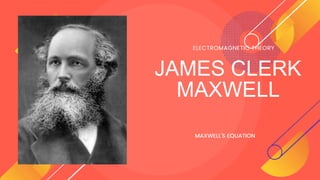
JAMES CLERK
MAXWELL
ELECTROMAGNETIC THEORY
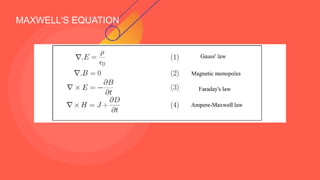
MAXWELL'S EQUATION
He was a Scottish physicist with broad interests who was responsible for the
classical theory of electromagnetic radiation, which was the first theory to
describe electricity, magnetism and light as different manifestations of the
same phenomenon. Maxwell's equations for electromagnetism have been
called the "second great unification in physics" where the first one had been
realised by Isaac Newton.
James clerk Maxwell (13 June 1831 – 5 November 1879)
With the publication of "A Dynamical Theory of the Electromagnetic Field" in
1865, Maxwell demonstrated that electric and magnetic fields travel through
space as waves moving at the speed of light. He proposed that light is an
undulation in the same medium that is the cause of electric and magnetic
phenomena.The unification of light and electrical phenomena led to his
prediction of the existence of radio waves. Maxwell is also regarded as a
founder of the modern field of electrical engineering.
James Clerk Maxwell formulated the Electromagnetic Wave Theory which says that an
oscillating electric current should be capable of radiating energy in the form of
electromagnetic waves .
•The force of attraction or repulsion between electric charges is inversely proportional to
the square of the distance between them.
•Magnetic poles come in pairs that attract and repel each other, much as electric charges
do.
•An electric current in a wire produces a magnetic field whose direction depends on the
direction of the current.
•A changing electric field induces a magnetic field, and vice versa.
MAXWELL'S
ELECTROMAGNETIC
THEORY
Maxwell began his work in electromagnetism by extending Michael Faraday's
theories of electricity and magnetic lines of force. He then began to see the
connections between the approaches of Faraday, Reimann and Gauss. As a result,
he was able to derive one of the most elegant theories yet formulated. Using four
equations, he described and quantified the relationships between electricity,
magnetism and the propagation of electromagnetic waves. The equations are now
known as Maxwell's Equations.
MAXWELL'S EQUATION
One of the first things that Maxwell did with the
equations was to calculate the speed of an
electromagnetic wave and found that the speed of
an electromagnetic wave was almost identical to
the speed of light. Based on this discovery, he was
the first to propose that light was an
electromagnetic wave.

JAMES CLERK MAXWELL (ELECTROMAGNETIC THEORY)

  • 1.
  • 2.
    He was aScottish physicist with broad interests who was responsible for the classical theory of electromagnetic radiation, which was the first theory to describe electricity, magnetism and light as different manifestations of the same phenomenon. Maxwell's equations for electromagnetism have been called the "second great unification in physics" where the first one had been realised by Isaac Newton. James clerk Maxwell (13 June 1831 – 5 November 1879)
  • 3.
    With the publicationof "A Dynamical Theory of the Electromagnetic Field" in 1865, Maxwell demonstrated that electric and magnetic fields travel through space as waves moving at the speed of light. He proposed that light is an undulation in the same medium that is the cause of electric and magnetic phenomena.The unification of light and electrical phenomena led to his prediction of the existence of radio waves. Maxwell is also regarded as a founder of the modern field of electrical engineering.
  • 4.
    James Clerk Maxwellformulated the Electromagnetic Wave Theory which says that an oscillating electric current should be capable of radiating energy in the form of electromagnetic waves . •The force of attraction or repulsion between electric charges is inversely proportional to the square of the distance between them. •Magnetic poles come in pairs that attract and repel each other, much as electric charges do. •An electric current in a wire produces a magnetic field whose direction depends on the direction of the current. •A changing electric field induces a magnetic field, and vice versa. MAXWELL'S ELECTROMAGNETIC THEORY
  • 5.
    Maxwell began hiswork in electromagnetism by extending Michael Faraday's theories of electricity and magnetic lines of force. He then began to see the connections between the approaches of Faraday, Reimann and Gauss. As a result, he was able to derive one of the most elegant theories yet formulated. Using four equations, he described and quantified the relationships between electricity, magnetism and the propagation of electromagnetic waves. The equations are now known as Maxwell's Equations.
  • 6.
  • 7.
    One of thefirst things that Maxwell did with the equations was to calculate the speed of an electromagnetic wave and found that the speed of an electromagnetic wave was almost identical to the speed of light. Based on this discovery, he was the first to propose that light was an electromagnetic wave.

Editor's Notes

  • #4 Ang discovery nila oersted at faraday sa relationship ng electricity and magnetism ang naging basehan ni Maxwell upang pag aralan kung puwedeng pagsamahin ang dalawa into one unified theory. Noong 1864 ay trinanslate ni Maxwell ang findings ni Faraday into mathematical equation and he developed the electromagnetic theory. Ayon kay Faraday, a changing electric field induces magnetic field. Idinagdag naman ni maxwell na, a changing magnetic field induces electric field. So Maxwell proposed that the alteration of electric field and magnetic field can be thought of as a form of energy carried by what he called as electromagnetic waves. Base sa lesson natin yesterday is it does not require a medium to travel so it can travel in free space or vacuum but Maxwell did not believe that electromagnetic wave propagates in space under any condition. He supposed that it must move at a certain speed. He calculated the speed using mathematical computation based on his theoretical assumption and numerical result of Faraday’s experiment he concluded that the speed of em wave must be 3×10⁸ m/s He noticed that the speed of EM wave is the same as the speed of light so he theorized that light is a form of em wave
  • #6 Ang discovery nila oersted at faraday sa relationship ng electricity and magnetism ang naging basehan ni Maxwell upang pag aralan kung puwedeng pagsamahin ang dalawa into one unified theory. Noong 1864 ay trinanslate ni Maxwell ang findings ni Faraday into mathematical equation and he developed the electromagnetic theory. Ayon kay Faraday, a changing electric field induces magnetic field. Idinagdag naman ni maxwell na, a changing magnetic field induces electric field. So Maxwell proposed that the alteration of electric field and magnetic field can be thought of as a form of energy carried by what he called as electromagnetic waves. Base sa lesson natin yesterday is it does not require a medium to travel so it can travel in free space or vacuum but Maxwell did not believe that electromagnetic wave propagates in space under any condition. He supposed that it must move at a certain speed. He calculated the speed using mathematical computation based on his theoretical assumption and numerical result of Faraday’s experiment he concluded that the speed of em wave must be 3×10⁸ m/s He noticed that the speed of EM wave is the same as the speed of light so he theorized that light is a form of em wave
  • #7 Gauss law states that the total electric flux out of a closed surface is equal to the charge enclosed divided by the permittivity. The electric flux in an area is defined as the electric field multiplied by the area of the surface projected in a plane and perpendicular to the field. Magnetic monopoles Similar to the above one, this states that there is no source for magnetic fields, i.e. no magnetic monopoles exist. This could, of course, be reformulated with magnetic charge density if it turns out that magnetic monopoles do exist, but by now there was absolutely no evidence. Faraday’s law states that the absolute value or magnitude of the circulation of the electric field E around a closed loop is equal to the rate of change of the magnetic flux through the area enclosed by the loop. . Ampere-Maxwell’s Law. An electric current or a changing electric flux through a surface produces a circulating magnetic field around any path that bounds that surface.