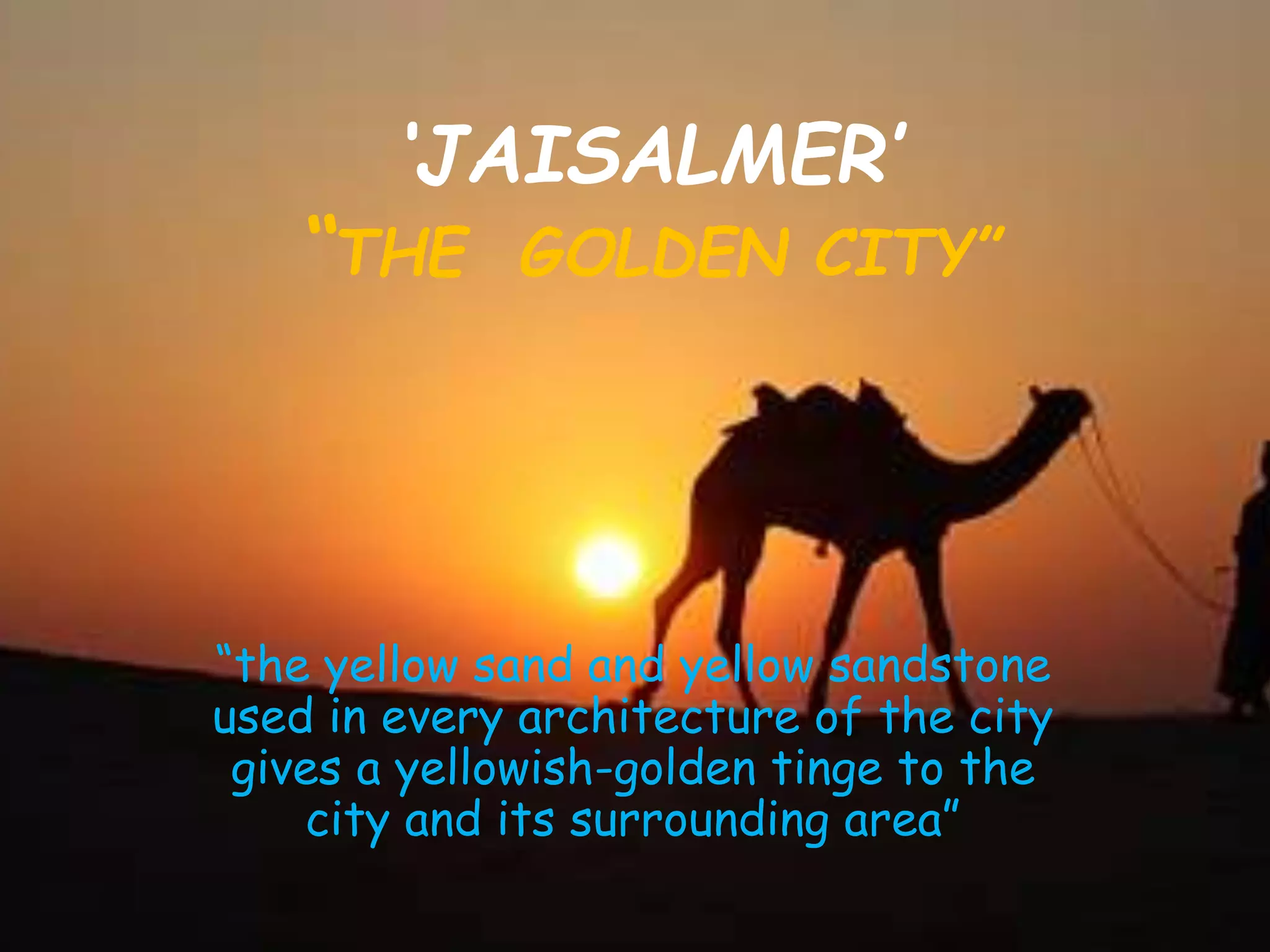
‘JAISALMER’
“THE GOLDEN CITY”
“the yellow sand and yellow sandstone
used in every architecture of the city
gives a yellowish-golden tinge to the
city and its surrounding area”
LOCATION
LOCATION - JAISALMER,
RAJASTHAN, INDIA
LATTITUDE -75” 55’ E
LONGITUDE -26” 55’ N
CLIMATE -DRYAND VERY HOT
HISTORY
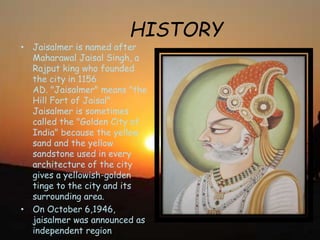
• Jaisalmer is named after
Maharawal Jaisal Singh, a
Rajput king who founded
the city in 1156
AD. "Jaisalmer" means "the
Hill Fort of Jaisal".
Jaisalmer is sometimes
called the "Golden City of
India" because the yellow
sand and the yellow
sandstone used in every
architecture of the city
gives a yellowish-golden
tinge to the city and its
surrounding area.
• On October 6,1946,
jaisalmer was announced as
independent region
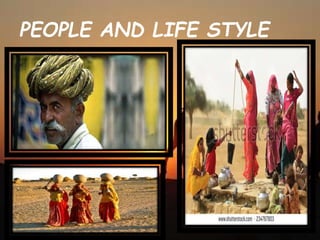
PEOPLE AND LIFE STYLE
FESTIVALS
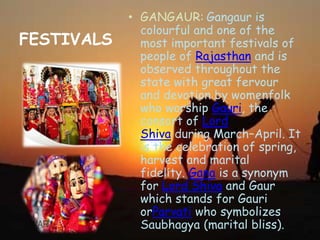
• GANGAUR: Gangaur is
colourful and one of the
most important festivals of
people of Rajasthan and is
observed throughout the
state with great fervour
and devotion by womenfolk
who worship Gauri, the
consort of Lord
Shiva during March–April. It
is the celebration of spring,
harvest and marital
fidelity. Gana is a synonym
for Lord Shiva and Gaur
which stands for Gauri
orParvati who symbolizes
Saubhagya (marital bliss).
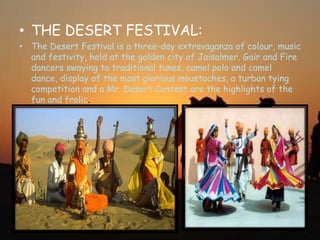
• THE DESERT FESTIVAL:
• The Desert Festival is a three-day extravaganza of colour, music
and festivity, held at the golden city of Jaisalmer. Gair and Fire
dancers swaying to traditional tunes, camel polo and camel
dance, display of the most glorious moustaches, a turban tying
competition and a Mr. Desert Contest are the highlights of the
fun and frolic.
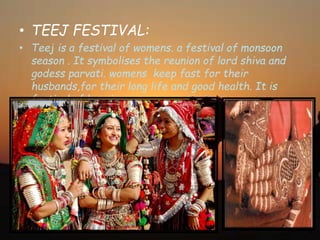
• TEEJ FESTIVAL:
• Teej is a festival of womens. a festival of monsoon
season . It symbolises the reunion of lord shiva and
godess parvati. womens keep fast for their
husbands,for their long life and good health. It is
festival of happiness.
PLACES TO VISIT IN
JAISALMER
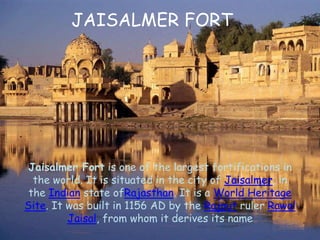
Jaisalmer Fort is one of the largest fortifications in
the world. It is situated in the city of Jaisalmer, in
the Indian state ofRajasthan. It is a World Heritage
Site. It was built in 1156 AD by the Rajput ruler Rawal
Jaisal, from whom it derives its name
JAISALMER FORT
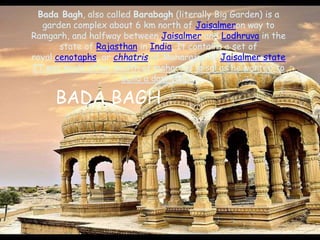
Bada Bagh, also called Barabagh (literally Big Garden) is a
garden complex about 6 km north of Jaisalmeron way to
Ramgarh, and halfway between Jaisalmer and Lodhruva in the
state of Rajasthan in India. It contains a set of
royal cenotaphs, or chhatris of Maharajas of Jaisalmer state
IT was made after dealth of maharaja jaisal as he wanted to
build a dam there.
BADA BAGH
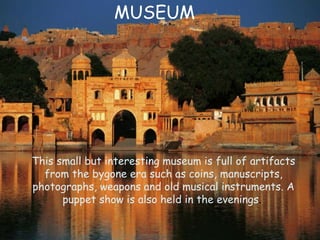
This small but interesting museum is full of artifacts
from the bygone era such as coins, manuscripts,
photographs, weapons and old musical instruments. A
puppet show is also held in the evenings.
MUSEUM
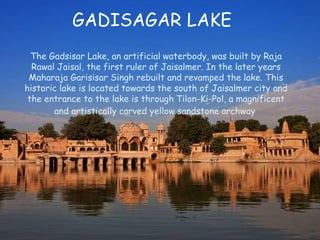
The Gadsisar Lake, an artificial waterbody, was built by Raja
Rawal Jaisal, the first ruler of Jaisalmer. In the later years
Maharaja Garisisar Singh rebuilt and revamped the lake. This
historic lake is located towards the south of Jaisalmer city and
the entrance to the lake is through Tilon-Ki-Pol, a magnificent
and artistically carved yellow sandstone archway
GADISAGAR LAKE
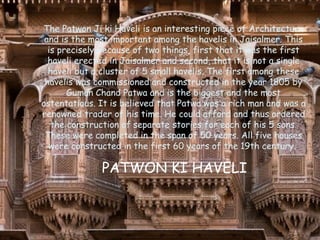
The Patwon Ji ki Haveli is an interesting piece of Architecture
and is the most important among the havelis in Jaisalmer. This
is precisely because of two things, first that it was the first
haveli erected in Jaisalmer and second, that it is not a single
haveli but a cluster of 5 small havelis. The first among these
havelis was commissioned and constructed in the year 1805 by
Guman Chand Patwa and is the biggest and the most
ostentatious. It is believed that Patwa was a rich man and was a
renowned trader of his time. He could afford and thus ordered
the construction of separate stories for each of his 5 sons.
These were completed in the span of 50 years. All five houses
were constructed in the first 60 years of the 19th century.
PATWON KI HAVELI
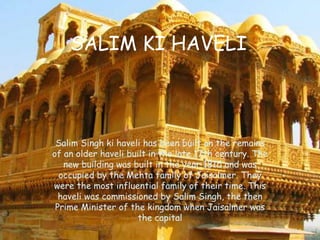
SALIM KI HAVELI
Salim Singh ki haveli has been built on the remains
of an older haveli built in the late 17th century. The
new building was built in the year 1815 and was
occupied by the Mehta family of Jaisalmer. They
were the most influential family of their time. This
haveli was commissioned by Salim Singh, the then
Prime Minister of the kingdom when Jaisalmer was
the capital
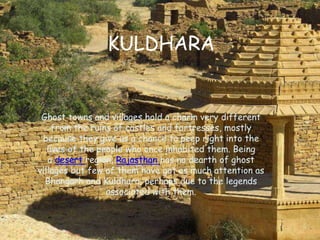
KULDHARA
Ghost towns and villages hold a charm very different
from the ruins of castles and fortresses, mostly
because they give us a chance to peep right into the
lives of the people who once inhabited them. Being
a desert region, Rajasthan has no dearth of ghost
villages but few of them have got as much attention as
Bhangarh and Kuldhara, perhaps due to the legends
associated with them.
TOURISM IMPACTS
Socio cultural
Positive
With the emergence of
tourism in jaisalmer,
people are getting
Chance to interact
with other people.
• People are able to
show case their
culture and festivals
to the world
•
• Negative
• People are moving
away from their
culture
• Adapting a new and
modern lifestyle
,leaving behind their
endless heritage and
traditions.
Enviornmental
• Positive
• It helps in
conservation of
fauna and flora as
people are more
interested in eco
tourism.
• Ratio of animals are
increasing
• Negative
• Water shortage is
the main problem in
rajasthan , due to
dessert area the
water resources are
less and with the
increase in tourism
water resources are
depleting.
Economical
Positive
People of jaisalmer are
earning money by
selling the cultural
and traditional
products.
Helps in overall
infrastructural
development of
jaisalmer
• Negative
• Generally the people
charge more money
to foreign tourist .
• Cost of products are
very high.
By; surbhi sharma
To: jaswinder kumar
Thankyou.. 

Jaiselmer

  • 1.
    ‘JAISALMER’ “THE GOLDEN CITY” “theyellow sand and yellow sandstone used in every architecture of the city gives a yellowish-golden tinge to the city and its surrounding area”
  • 2.
    LOCATION LOCATION - JAISALMER, RAJASTHAN,INDIA LATTITUDE -75” 55’ E LONGITUDE -26” 55’ N CLIMATE -DRYAND VERY HOT
  • 3.
    HISTORY • Jaisalmer isnamed after Maharawal Jaisal Singh, a Rajput king who founded the city in 1156 AD. "Jaisalmer" means "the Hill Fort of Jaisal". Jaisalmer is sometimes called the "Golden City of India" because the yellow sand and the yellow sandstone used in every architecture of the city gives a yellowish-golden tinge to the city and its surrounding area. • On October 6,1946, jaisalmer was announced as independent region
  • 4.
  • 5.
    FESTIVALS • GANGAUR: Gangauris colourful and one of the most important festivals of people of Rajasthan and is observed throughout the state with great fervour and devotion by womenfolk who worship Gauri, the consort of Lord Shiva during March–April. It is the celebration of spring, harvest and marital fidelity. Gana is a synonym for Lord Shiva and Gaur which stands for Gauri orParvati who symbolizes Saubhagya (marital bliss).
  • 6.
    • THE DESERTFESTIVAL: • The Desert Festival is a three-day extravaganza of colour, music and festivity, held at the golden city of Jaisalmer. Gair and Fire dancers swaying to traditional tunes, camel polo and camel dance, display of the most glorious moustaches, a turban tying competition and a Mr. Desert Contest are the highlights of the fun and frolic.
  • 7.
    • TEEJ FESTIVAL: •Teej is a festival of womens. a festival of monsoon season . It symbolises the reunion of lord shiva and godess parvati. womens keep fast for their husbands,for their long life and good health. It is festival of happiness.
  • 8.
    PLACES TO VISITIN JAISALMER
  • 9.
    Jaisalmer Fort isone of the largest fortifications in the world. It is situated in the city of Jaisalmer, in the Indian state ofRajasthan. It is a World Heritage Site. It was built in 1156 AD by the Rajput ruler Rawal Jaisal, from whom it derives its name JAISALMER FORT
  • 10.
    Bada Bagh, alsocalled Barabagh (literally Big Garden) is a garden complex about 6 km north of Jaisalmeron way to Ramgarh, and halfway between Jaisalmer and Lodhruva in the state of Rajasthan in India. It contains a set of royal cenotaphs, or chhatris of Maharajas of Jaisalmer state IT was made after dealth of maharaja jaisal as he wanted to build a dam there. BADA BAGH
  • 11.
    This small butinteresting museum is full of artifacts from the bygone era such as coins, manuscripts, photographs, weapons and old musical instruments. A puppet show is also held in the evenings. MUSEUM
  • 12.
    The Gadsisar Lake,an artificial waterbody, was built by Raja Rawal Jaisal, the first ruler of Jaisalmer. In the later years Maharaja Garisisar Singh rebuilt and revamped the lake. This historic lake is located towards the south of Jaisalmer city and the entrance to the lake is through Tilon-Ki-Pol, a magnificent and artistically carved yellow sandstone archway GADISAGAR LAKE
  • 13.
    The Patwon Jiki Haveli is an interesting piece of Architecture and is the most important among the havelis in Jaisalmer. This is precisely because of two things, first that it was the first haveli erected in Jaisalmer and second, that it is not a single haveli but a cluster of 5 small havelis. The first among these havelis was commissioned and constructed in the year 1805 by Guman Chand Patwa and is the biggest and the most ostentatious. It is believed that Patwa was a rich man and was a renowned trader of his time. He could afford and thus ordered the construction of separate stories for each of his 5 sons. These were completed in the span of 50 years. All five houses were constructed in the first 60 years of the 19th century. PATWON KI HAVELI
  • 14.
    SALIM KI HAVELI SalimSingh ki haveli has been built on the remains of an older haveli built in the late 17th century. The new building was built in the year 1815 and was occupied by the Mehta family of Jaisalmer. They were the most influential family of their time. This haveli was commissioned by Salim Singh, the then Prime Minister of the kingdom when Jaisalmer was the capital
  • 15.
    KULDHARA Ghost towns andvillages hold a charm very different from the ruins of castles and fortresses, mostly because they give us a chance to peep right into the lives of the people who once inhabited them. Being a desert region, Rajasthan has no dearth of ghost villages but few of them have got as much attention as Bhangarh and Kuldhara, perhaps due to the legends associated with them.
  • 16.
  • 17.
    Socio cultural Positive With theemergence of tourism in jaisalmer, people are getting Chance to interact with other people. • People are able to show case their culture and festivals to the world • • Negative • People are moving away from their culture • Adapting a new and modern lifestyle ,leaving behind their endless heritage and traditions.
  • 18.
    Enviornmental • Positive • Ithelps in conservation of fauna and flora as people are more interested in eco tourism. • Ratio of animals are increasing • Negative • Water shortage is the main problem in rajasthan , due to dessert area the water resources are less and with the increase in tourism water resources are depleting.
  • 19.
    Economical Positive People of jaisalmerare earning money by selling the cultural and traditional products. Helps in overall infrastructural development of jaisalmer • Negative • Generally the people charge more money to foreign tourist . • Cost of products are very high.
  • 20.
    By; surbhi sharma To:jaswinder kumar
  • 21.