
‘Corporate
Entrepreneurship’


                    1
INTRODUCTION


               2
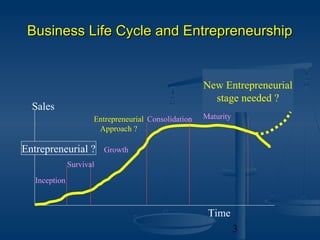
Business Life Cycle and Entrepreneurship


                                                      New Entrepreneurial
                                                        stage needed ?
  Sales
                      Entrepreneurial Consolidation   Maturity
                       Approach ?

Entrepreneurial ?         Growth
               Survival

   Inception


                                                       Time
                                                                 3
Businesses are faced with...
   Changing dynamic markets
   Globalisation
   Shorter product life cycles
   High rates of technological change
   Pressures to reduce costs
   Changes in business organisation (int. &
    ext.)

                                   4
A Possible Response
   Some large firms responded to the changing
    environment by addressing their necessary
    response to working with a dynamic environment
    involving attitudes to:
     risk
     innovation

     flexible, rapid response

     changes in management and

      organisation
                                      5
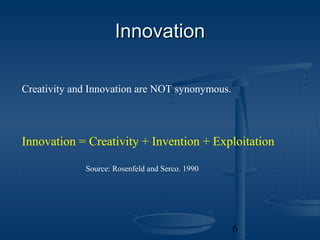
Innovation

Creativity and Innovation are NOT synonymous.


Innovation = Creativity + Invention + Exploitation

             Source: Rosenfeld and Serco. 1990


                                                 6
Role of Innovation

“An enterprise that does not daily innovate inevitably ages and
declines … even in a successful business the disease of
bureaucracy and complacency is ever present. (Drucker).

“Firms create competitive advantage by perceiving or
discovering new and better ways to compete in an industry and
bringing them to market, which is ultimately an act of
innovation” Michael Porter. The Competitive Advantage of
Nations.


                                                 7
Schumpeterian Innovation
   Schumpeter (1934). … By recombining the
    factors of production to create something new
    the entrepreneur creates a demand…
   Innovation could take different forms:
       Creation of a new or alternative product
       A new method of production
       Opening a new market
       Capture of a new source of supply
       A new organisation


                                                   8
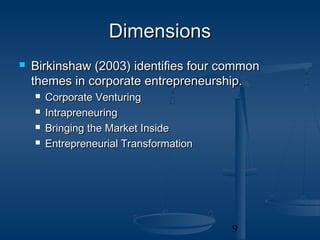
Dimensions
   Birkinshaw (2003) identifies four common
    themes in corporate entrepreneurship.
       Corporate Venturing
       Intrapreneuring
       Bringing the Market Inside
       Entrepreneurial Transformation


                                         9
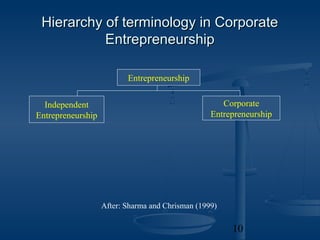
Hierarchy of terminology in Corporate
           Entrepreneurship

                          Entrepreneurship


  Independent                                        Corporate
Entrepreneurship                                  Entrepreneurship


                   After: Sharma and Chrisman (1999)

                                                       10
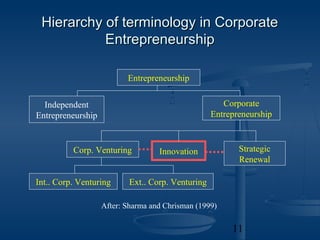
Hierarchy of terminology in Corporate
           Entrepreneurship

                          Entrepreneurship


  Independent                                        Corporate
Entrepreneurship                                  Entrepreneurship


          Corp. Venturing          Innovation            Strategic
                                                         Renewal

Int.. Corp. Venturing     Ext.. Corp. Venturing

                   After: Sharma and Chrisman (1999)

                                                       11
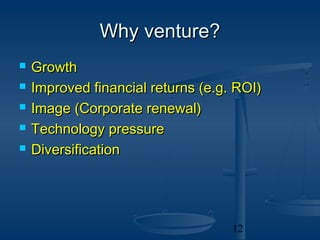
Why venture?
   Growth
   Improved financial returns (e.g. ROI)
   Image (Corporate renewal)
   Technology pressure
   Diversification


                                    12
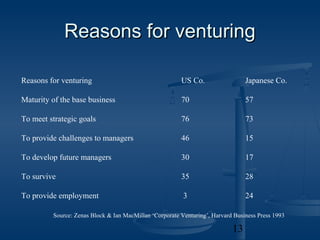
Reasons for venturing

Reasons for venturing                                   US Co.                  Japanese Co.

Maturity of the base business                           70                      57

To meet strategic goals                                 76                      73

To provide challenges to managers                       46                      15

To develop future managers                              30                      17

To survive                                              35                      28

To provide employment                                    3                      24

         Source: Zenas Block & Ian MacMillan ‘Corporate Venturing’, Harvard Business Press 1993

                                                                           13
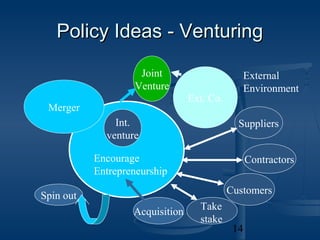
Policy Ideas - Venturing
                    Joint                         External
                   Venture                        Environment
                                 Ext. Co.
 Merger
               Int.                           Suppliers
             venture

           Encourage                              Contractors
           Entrepreneurship
                                            Buy stake
                                            Customers
Spin out
                   Acquisition     Take
                                   stake
                                             14
Intrapreneurs


                15
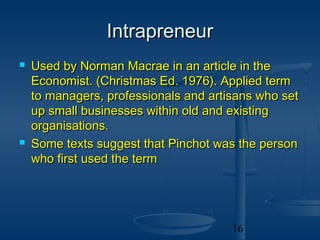
Intrapreneur
   Used by Norman Macrae in an article in the
    Economist. (Christmas Ed. 1976). Applied term
    to managers, professionals and artisans who set
    up small businesses within old and existing
    organisations.
   Some texts suggest that Pinchot was the person
    who first used the term


                                       16
Intrapreneur

   Developed by Pinchot (1986)
     “ An intrapreneur is an entrepreneur within an

      already established organisation”. Used to
      describe entrepreneurism within a large
      organisation, rather than establishment of
      small businesses within a large organisation.


                                        17
Intrapreneur
   Gibb (1988) An Intrapreneur is an employee of a
    large organisation who has the entrepreneurial
    qualities of drive, creativity, vision and ambition.
   Gibb goes on to state that these people differ
    from entrepreneurs as they wish to retain the
    security of the large organisation.

   A number of authors define Intrapreneur and
    related terms. See Sharma and Chrisman
    (1999).
                                           18
Intrapreneurs

May have these
characteristics in common
with independent
entrepreneurs
                    Ability to work amidst confusion
                    Ability to anticipate change
                    Ability to make intuitive leaps
                    High energy levels
                    Creativity in problem solving
                    Action orientation


                                              19
….. But want ...

BUT may differ ….


   Want less restrictive but supportive environment
   Want recognition
   Want their ideas to be a vehicle for advancement
   Want the security (pay cheque, pension etc)


                                        20
Intrapreneurs and entrepreneurs share: .


   Entrepreneurial
    characteristics
   Vision & Flexibility
   Action Orientated
   Dedicated
   Persistent / overcome failure
   Self determined goal setters
   Source: Pinchot 1986.
   Intrapreneuring. Harper & Row.   21
Intrapreneurs need in addition


                 An ability in a Multi-disciplinary role
                 To understand the environment
                 To encourage open discussion
                 Be able to create management
                  options
                 To build a coalition of supporters.
   Source: Pinchot 1986.
   Intrapreneuring. Harper &
    Row.

                                               22
Corporate Entrepreneurs as ‘Change Masters’

   ‘Change Master’ A term used by Rosabeth Moss
    Kanter
   Three Stages of the journey:
       Formulate and Sell,
       Power to advance,
       Maintain Momentum.


                                     23
Intrapreneurs as Change Masters

   A term used by Rosabeth Moss Kanter
   Three Stages of the journey: Formulate and Sell,
    Power to advance, maintain Momentum.
   Skills: Personal and Interpersonal
   Step outside of conventional thinking
   Often ‘generalists’ with ‘kaleidoscopic thinking,
    vision communicators, persistent individuals,
    coalition & team builders, willing to share credit


                                         24
Rosebeth Moss Kanter’s View
   Corporate entrepreneurs are people who
    envision something new and make it work.
    Being a corporate entrepreneur, what I call
    a ‘change master’ is much more
    challenging and fun than being a non-
    entrepreneur. It requires more of a person,
    but it gives back more self-satisfaction.
       Rosabeth Moss Kanter (1988). Handbook for Creative and Innovative
        Managers. McGraw Hill.


                                                         25
Intrapreneurial Behaviour

   May be seen as good news
     High achievement motivation

     High task commitment


                                    26
Intrapreneurial Behaviour


   May be seen as mild irritants
     High levels of informal networking

     Informal recruitment (This could be a major

      problem)


                                       27
Intrapreneurial Behaviour


   May be seen as serious problems
     Independence

     Non-acceptance of rules and boundaries

     Non-compliance with planning and control

      systems
     Conflict with authority


                                      28
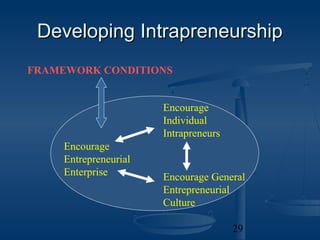
Developing Intrapreneurship
FRAMEWORK CONDITIONS


                       Encourage
                       Individual
                       Intrapreneurs
     Encourage
     Entrepreneurial
     Enterprise        Encourage General
                       Entrepreneurial
                       Culture

                                       29
Barriers to an Intrapreneurial Culture

   Barriers Include:
       Senior management feel alienated
       hierarchical nature of the organisation
       Corporate culture
       Short term performance requirements
       Planning procedures
            Source Gibb 1990


                                          30
Barriers to an Intrapreneurial Culture

   Barriers (continued) Include:

       Lack of ownership of the problem
       Mobility of managers
       lack of flexibility in the organisation
       methods of compensation
            Source Gibb 1990


                                             31
An ‘Intrapreneurial’ culture needs:
   Sponsors
   Continuous involvement
   Autonomy of the intrepreneurial team
   Ability to cross boundaries

          See Pinchot (1986)


                                       32
An ‘Intrapreneurial’ culture needs:
   (needs continued)

   A tolerance of risk and failures
   Long term objectives
   Making resources available
   Introducing suitable compensation schemes.
          See Pinchot (1986)


                                      33
Drucker’s Entrepreneurial Practices
   Druker suggests some key management
    practices are vital in the development of
    ‘entrepreneurship’ in an existing business.
       Management focuses on opportunity
       Generation and maintenance of entrepreneurial spirit
       Top-down and cross functional interaction
            Source Drucker, P. Innovation & Entrepreneurship. Pan 1986


                                                                 34
The final word …..


“Intrapreneurs cannot exist if their passionate
commitment is ignored and their visions given to
people who don’t understand them. Without
intrapreneurs, innovation flounders
                  Source Pinchot (1986)


                                          35

Jain group day 4 and 5

  • 1.
  • 2.
  • 3.
    Business Life Cycleand Entrepreneurship New Entrepreneurial stage needed ? Sales Entrepreneurial Consolidation Maturity Approach ? Entrepreneurial ? Growth Survival Inception Time 3
  • 4.
    Businesses are facedwith...  Changing dynamic markets  Globalisation  Shorter product life cycles  High rates of technological change  Pressures to reduce costs  Changes in business organisation (int. & ext.) 4
  • 5.
    A Possible Response  Some large firms responded to the changing environment by addressing their necessary response to working with a dynamic environment involving attitudes to:  risk  innovation  flexible, rapid response  changes in management and organisation 5
  • 6.
    Innovation Creativity and Innovationare NOT synonymous. Innovation = Creativity + Invention + Exploitation Source: Rosenfeld and Serco. 1990 6
  • 7.
    Role of Innovation “Anenterprise that does not daily innovate inevitably ages and declines … even in a successful business the disease of bureaucracy and complacency is ever present. (Drucker). “Firms create competitive advantage by perceiving or discovering new and better ways to compete in an industry and bringing them to market, which is ultimately an act of innovation” Michael Porter. The Competitive Advantage of Nations. 7
  • 8.
    Schumpeterian Innovation  Schumpeter (1934). … By recombining the factors of production to create something new the entrepreneur creates a demand…  Innovation could take different forms:  Creation of a new or alternative product  A new method of production  Opening a new market  Capture of a new source of supply  A new organisation 8
  • 9.
    Dimensions  Birkinshaw (2003) identifies four common themes in corporate entrepreneurship.  Corporate Venturing  Intrapreneuring  Bringing the Market Inside  Entrepreneurial Transformation 9
  • 10.
    Hierarchy of terminologyin Corporate Entrepreneurship Entrepreneurship Independent Corporate Entrepreneurship Entrepreneurship After: Sharma and Chrisman (1999) 10
  • 11.
    Hierarchy of terminologyin Corporate Entrepreneurship Entrepreneurship Independent Corporate Entrepreneurship Entrepreneurship Corp. Venturing Innovation Strategic Renewal Int.. Corp. Venturing Ext.. Corp. Venturing After: Sharma and Chrisman (1999) 11
  • 12.
    Why venture?  Growth  Improved financial returns (e.g. ROI)  Image (Corporate renewal)  Technology pressure  Diversification 12
  • 13.
    Reasons for venturing Reasonsfor venturing US Co. Japanese Co. Maturity of the base business 70 57 To meet strategic goals 76 73 To provide challenges to managers 46 15 To develop future managers 30 17 To survive 35 28 To provide employment 3 24 Source: Zenas Block & Ian MacMillan ‘Corporate Venturing’, Harvard Business Press 1993 13
  • 14.
    Policy Ideas -Venturing Joint External Venture Environment Ext. Co. Merger Int. Suppliers venture Encourage Contractors Entrepreneurship Buy stake Customers Spin out Acquisition Take stake 14
  • 15.
  • 16.
    Intrapreneur  Used by Norman Macrae in an article in the Economist. (Christmas Ed. 1976). Applied term to managers, professionals and artisans who set up small businesses within old and existing organisations.  Some texts suggest that Pinchot was the person who first used the term 16
  • 17.
    Intrapreneur  Developed by Pinchot (1986)  “ An intrapreneur is an entrepreneur within an already established organisation”. Used to describe entrepreneurism within a large organisation, rather than establishment of small businesses within a large organisation. 17
  • 18.
    Intrapreneur  Gibb (1988) An Intrapreneur is an employee of a large organisation who has the entrepreneurial qualities of drive, creativity, vision and ambition.  Gibb goes on to state that these people differ from entrepreneurs as they wish to retain the security of the large organisation.  A number of authors define Intrapreneur and related terms. See Sharma and Chrisman (1999). 18
  • 19.
    Intrapreneurs May have these characteristicsin common with independent entrepreneurs Ability to work amidst confusion Ability to anticipate change Ability to make intuitive leaps High energy levels Creativity in problem solving Action orientation 19
  • 20.
    ….. But want... BUT may differ …. Want less restrictive but supportive environment Want recognition Want their ideas to be a vehicle for advancement Want the security (pay cheque, pension etc) 20
  • 21.
    Intrapreneurs and entrepreneursshare: .  Entrepreneurial characteristics  Vision & Flexibility  Action Orientated  Dedicated  Persistent / overcome failure  Self determined goal setters  Source: Pinchot 1986.  Intrapreneuring. Harper & Row. 21
  • 22.
    Intrapreneurs need inaddition  An ability in a Multi-disciplinary role  To understand the environment  To encourage open discussion  Be able to create management options  To build a coalition of supporters.  Source: Pinchot 1986.  Intrapreneuring. Harper & Row. 22
  • 23.
    Corporate Entrepreneurs as‘Change Masters’  ‘Change Master’ A term used by Rosabeth Moss Kanter  Three Stages of the journey:  Formulate and Sell,  Power to advance,  Maintain Momentum. 23
  • 24.
    Intrapreneurs as ChangeMasters  A term used by Rosabeth Moss Kanter  Three Stages of the journey: Formulate and Sell, Power to advance, maintain Momentum.  Skills: Personal and Interpersonal  Step outside of conventional thinking  Often ‘generalists’ with ‘kaleidoscopic thinking, vision communicators, persistent individuals, coalition & team builders, willing to share credit 24
  • 25.
    Rosebeth Moss Kanter’sView  Corporate entrepreneurs are people who envision something new and make it work. Being a corporate entrepreneur, what I call a ‘change master’ is much more challenging and fun than being a non- entrepreneur. It requires more of a person, but it gives back more self-satisfaction.  Rosabeth Moss Kanter (1988). Handbook for Creative and Innovative Managers. McGraw Hill. 25
  • 26.
    Intrapreneurial Behaviour  May be seen as good news  High achievement motivation  High task commitment 26
  • 27.
    Intrapreneurial Behaviour  May be seen as mild irritants  High levels of informal networking  Informal recruitment (This could be a major problem) 27
  • 28.
    Intrapreneurial Behaviour  May be seen as serious problems  Independence  Non-acceptance of rules and boundaries  Non-compliance with planning and control systems  Conflict with authority 28
  • 29.
    Developing Intrapreneurship FRAMEWORK CONDITIONS Encourage Individual Intrapreneurs Encourage Entrepreneurial Enterprise Encourage General Entrepreneurial Culture 29
  • 30.
    Barriers to anIntrapreneurial Culture  Barriers Include:  Senior management feel alienated  hierarchical nature of the organisation  Corporate culture  Short term performance requirements  Planning procedures  Source Gibb 1990 30
  • 31.
    Barriers to anIntrapreneurial Culture  Barriers (continued) Include:  Lack of ownership of the problem  Mobility of managers  lack of flexibility in the organisation  methods of compensation  Source Gibb 1990 31
  • 32.
    An ‘Intrapreneurial’ cultureneeds:  Sponsors  Continuous involvement  Autonomy of the intrepreneurial team  Ability to cross boundaries  See Pinchot (1986) 32
  • 33.
    An ‘Intrapreneurial’ cultureneeds:  (needs continued)  A tolerance of risk and failures  Long term objectives  Making resources available  Introducing suitable compensation schemes.  See Pinchot (1986) 33
  • 34.
    Drucker’s Entrepreneurial Practices  Druker suggests some key management practices are vital in the development of ‘entrepreneurship’ in an existing business.  Management focuses on opportunity  Generation and maintenance of entrepreneurial spirit  Top-down and cross functional interaction  Source Drucker, P. Innovation & Entrepreneurship. Pan 1986 34
  • 35.
    The final word….. “Intrapreneurs cannot exist if their passionate commitment is ignored and their visions given to people who don’t understand them. Without intrapreneurs, innovation flounders Source Pinchot (1986) 35

Editor's Notes

  • #15 Introduction to Policy Ideas.- Link with Luke’s initial statements re. innovative ideas. Pont out that there are only a limited number of possibilities. Note move of AOL and Warners etc. Link with many of the innovative moves in management & processes Note that some methods are difficult to get to work. E.g. mergers & acquisitions - culture often key. Cultural Web. Internal venturing. Bootleg/skunk-work projects. (Note 3M) - more later Change of organisation structures in recent years. Moves to ‘e’ commerce and working. More home working. (e.g. FI, Utilities) and change of attitudes. Introduce risk.
  • #30 Either / And Develop Intrapreneurs. Use Gibb’s definition. Draw out some of the traits that may give problems. Introduce Rosebeth Moss Kanters ‘Change Master’ concept. Difficult to manage. Impact on the rest of the system. Resource availability (official / unofficial) Entrepreneurial culture necessary. From the TOP. Cross-discipline Job rotation. Shallow organisational structure Matrix structures Empowerment Risk