BUILT TO LAST
Successful Habits of Visionary Companies
     James C. Collins and Jerry I. Porras

  (BUSINESS CLASSIC PRESENTATION)
                 BY
TEAM-SOUTHWEST AIRLINES
HARSH DALVI
ABHISHEK VARMA
RAHUL WADHWA


                           05/02/2012
PREFACE

What these companies have to teach?
The average founding date being 1897.
Research Results and Comparison Companies.
Looked as start-ups, midsize and large companies.
Lessons can be learned and applied by the majority of
managers.
Lessons to be learn and apply to build visionary companies.
CONTENTS

Chapter 1 – Best of the Best
Chapter 2 – Clock Building, Not Time Telling
Chapter 3- More than Profits
Chapter 4 – Preserve the Core/Stimulate Progress
Chapter 5- Big Hairy Audacious Goals
Chapter 6 – Cult-like Cultures
                          Learning'sWhat Works
Chapter 7 – Try a Lot of Stuff and Keep
Chapter 8 – Home Grown Management
Chapter 9 – Good Enough Never Is
Chapter 10 –The End of the Beginning
Chapter 11 – Building the Vision
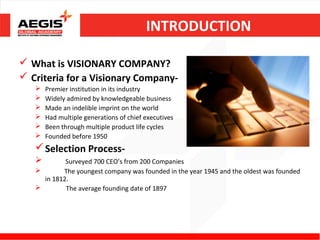
INTRODUCTION

 What is VISIONARY COMPANY?
 Criteria for a Visionary Company-
      Premier institution in its industry
      Widely admired by knowledgeable business
      Made an indelible imprint on the world
      Had multiple generations of chief executives
      Been through multiple product life cycles
      Founded before 1950
    Selection Process-
           Surveyed 700 CEO’s from 200 Companies
          The youngest company was founded in the year 1945 and the oldest was founded
     in 1812.
           The average founding date of 1897
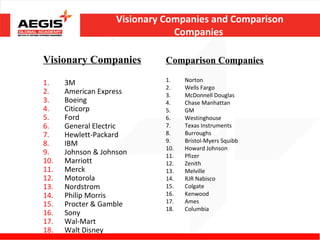
Visionary Companies and Comparison
                                Companies

Visionary Companies           Comparison Companies
                              1.    Norton
1.    3M
                              2.    Wells Fargo
2.    American Express        3.    McDonnell Douglas
3.    Boeing                  4.    Chase Manhattan
4.    Citicorp                5.    GM
5.    Ford                    6.    Westinghouse
6.    General Electric        7.    Texas Instruments
7.    Hewlett-Packard         8.    Burroughs
8.    IBM                     9.    Bristol-Myers Squibb
                              10.   Howard Johnson
9.    Johnson & Johnson       11.   Pfizer
10.   Marriott                12.   Zenith
11.   Merck                   13.   Melville
12.   Motorola                14.   RJR Nabisco
13.   Nordstrom               15.   Colgate
14.   Philip Morris           16.   Kenwood
15.   Procter & Gamble        17.   Ames
                              18.   Columbia
16.   Sony
17.   Wal-Mart
18.   Walt Disney
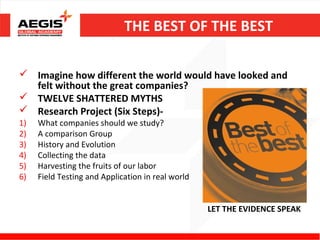
THE BEST OF THE BEST

 Imagine how different the world would have looked and
  felt without the great companies?
 TWELVE SHATTERED MYTHS
 Research Project (Six Steps)-
1)   What companies should we study?
2)   A comparison Group
3)   History and Evolution
4)   Collecting the data
5)   Harvesting the fruits of our labor
6)   Field Testing and Application in real world


                                                   LET THE EVIDENCE SPEAK
CLOCK BUILDING , NOT TIME TELLING


  “The builders of Visionary Companies
    tend to be clock builders, not time
                  tellers.”
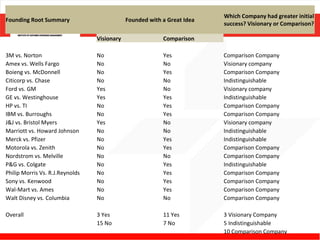
 THE MYHT OF THE “GREAT IDEA”-
 TI started with ‘great idea’ HP did not
 Sony had no specific product idea, while Kenwood appeared to have a
  specific category of products in mind.
 Negative correlation between early entrepreneurial
  success and becoming a highly visionary companies.
 The Company itself is a great creation.
 The Myth of the Great and the Charismatic Leader.
 Clock Builders at Work.
NO “TYRANNY OF THE OR”
(EMBRACE THE “GENIUS OF THE
           AND”)
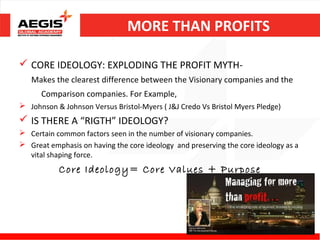
MORE THAN PROFITS

 CORE IDEOLOGY: EXPLODING THE PROFIT MYTH-
   Makes the clearest difference between the Visionary companies and the
      Comparison companies. For Example,
 Johnson & Johnson Versus Bristol-Myers ( J&J Credo Vs Bristol Myers Pledge)
 IS THERE A “RIGTH” IDEOLOGY?
 Certain common factors seen in the number of visionary companies.
 Great emphasis on having the core ideology and preserving the core ideology as a
  vital shaping force.
           Core Ideology= Core Values + Purpose
PRESERVE THE CORE/STIMULATE THE PROGRESS


 The essence of the visionary companies is to Preserve the
  core ideology of the business while simultaneously
  stimulating progress. For example , at 3M, “Respect for
  individual initiative” is a part of their core value group.
 This proves the “Genius of the AND” as visionary companies
  seeks to be both highly ideological and highly progressive at
  the same time.
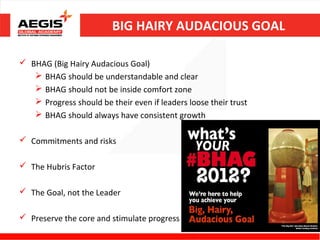
BIG HAIRY AUDACIOUS GOAL

 BHAG (Big Hairy Audacious Goal)
    BHAG should be understandable and clear
    BHAG should not be inside comfort zone
    Progress should be their even if leaders loose their trust
    BHAG should always have consistent growth

 Commitments and risks

 The Hubris Factor

 The Goal, not the Leader

 Preserve the core and stimulate progress
                                                                  12
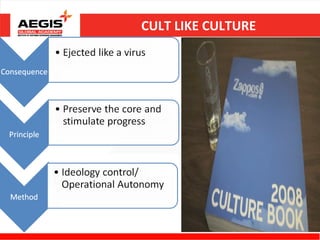
CULT LIKE CULTURE


                    13
TRY A LOT OF STUFF AND KEEP WHAT WORKS


 Corporations as evolving species

 Darwin’s theory of Evolution Applied to Visionary companies

 Lesson for CEO, Managers and Entrepreneurs

 Stick to the knitting ??? Stick to the core


                                                                 14
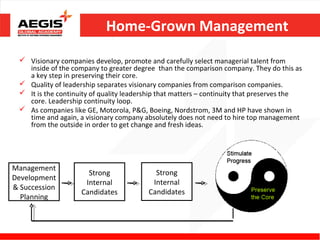
Home-Grown Management
  Visionary companies develop, promote and carefully select managerial talent from
   inside of the company to greater degree than the comparison company. They do this as
   a key step in preserving their core.
  Quality of leadership separates visionary companies from comparison companies.
  It is the continuity of quality leadership that matters – continuity that preserves the
   core. Leadership continuity loop.
  As companies like GE, Motorola, P&G, Boeing, Nordstrom, 3M and HP have shown in
   time and again, a visionary company absolutely does not need to hire top management
   from the outside in order to get change and fresh ideas.


Management
                      Strong               Strong
Development
                     Internal             Internal
& Succession
                    Candidates           Candidates
  Planning
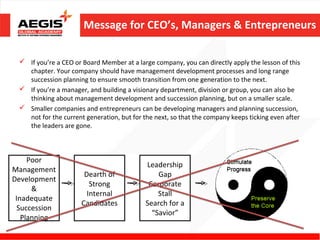
Message for CEO’s, Managers & Entrepreneurs

  If you’re a CEO or Board Member at a large company, you can directly apply the lesson of this
   chapter. Your company should have management development processes and long range
   succession planning to ensure smooth transition from one generation to the next.
  If you’re a manager, and building a visionary department, division or group, you can also be
   thinking about management development and succession planning, but on a smaller scale.
  Smaller companies and entrepreneurs can be developing managers and planning succession,
   not for the current generation, but for the next, so that the company keeps ticking even after
   the leaders are gone.


     Poor
                                            Leadership
Management
                       Dearth of                Gap
Development
                         Strong              Corporate
      &
                        Internal                Stall
 Inadequate
                      Candidates            Search for a
  Succession
                                              “Savior”
   Planning
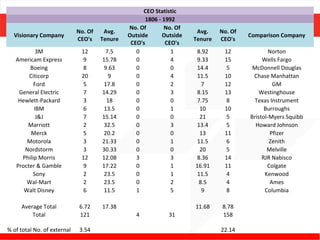
CEO Statistic
                                                     1806 - 1992
                                               No. Of       No. Of
                             No. Of    Avg.                            Avg.    No. Of
  Visionary Company                            Outside      Outside                     Comparison Company
                             CEO's    Tenure                          Tenure   CEO's
                                                CEO's        CEO's
           3M                 12       7.5        0            1       8.92     12              Norton
   Americam Express            9      15.78       0            4       9.33     15           Wells Fargo
        Boeing                 8       9.63       0            0       14.4      5       McDonnell Douglas
        Citicorp              20        9         0            4       11.5     10       Chase Manhattan
          Ford                 5       17.8       0            2         7      12               GM
    General Electric           7      14.29       0            3       8.15     13          Westinghouse
    Hewlett-Packard            3        18        0            0       7.75      8        Texas Instrument
          IBM                  6       13.5       0            1        10      10            Burroughs
           J&J                 7      15.14       0            0        21       5      Bristol-Myers Squibb
       Marriott                2       32.5       0            3       13.4      5        Howard Johnson
         Merck                 5       20.2       0            0        13      11              Pfizer
       Motorola                3      21.33       0            1       11.5      6              Zenith
      Nordstorm                3      30.33       0            0        20       5             Melville
     Philip Morris            12      12.08       3            3       8.36     14           RJR Nabisco
   Procter & Gamble            9      17.22       0            1      16.91     11             Colgate
          Sony                 2       23.5       0            1       11.5      4            Kenwood
       Wal-Mart                2       23.5       0            2       8.5       4              Ames
      Walt Disney              6       11.5       1            5         9       8            Columbia

     Average Total            6.72    17.38                           11.68     8.78
         Total                121                 4           31                158

% of total No. of external    3.54                                             22.14
Some Key Example in the Chapter
Good Enough Never Is
 “How can we do better tomorrow than we
  did today?”
 The essence of this chapter lies in the
  above question.
 Comfort is not the objective in a visionary
  company.
 Create discomfort – to obliterate
  complacency
 Stretching ahead to beat themselves.
 Invest more of the profit back into the
  company
 Invest more in their people’s training,
  spending a significant amount in training
  centres.
Message for CEO’s, Managers & Entrepreneurs

 If you are involved in building and managing a company, the book urges
  you to consider the following questions:
 What mechanisms of discontent can you create that would obliterate
  complacency and bring about change and improvement from within, yet
  are consistent with your core ideology? How can you give these
  mechanism sharp teeth?
 What are you doing to invest for the future while doing well today? Does
  your company adopts new technologies and innovative ideas before the
  rest of the industry?
 How you respond to downturns? Does your company continue to build for
  a the long term even during difficult times?
 Do people in your company understand that comfort is not the objective –
  that life at visionary company is not supposed to be easy?
 Does your company reject doing well as an end goal, replacing it with the
  never-ending discipline of working to do better tomorrow that it did
  today?
The End of the Beginning

 It’s become fashionable in recent
  decades for companies to spend
  countless hours and money drafting
  elegant vision, mission, value, purpose
  statements.
 But they are not the essence of visionary
  companies
 Just because a company has a vision
  statement or something like that in no
  ways guarantees that it will become a
  visionary company
 The essence of a visionary company
  comes in the translation of its core
  ideology & its unique drive for progress
 Visionary company aligns its core
  ideology for future progress
The Power of Alignment

 Ford
 Wrote statement of mission, values and guiding principles – MVGP
 It listed people and product ahead of profit
 Emphasized the central importance of quality improvement, employee
  involvement and customer satisfaction
 MVGP however, did not bring the turnaround
 It had translated MVGP into reality by aligning its operations, strategies
  and tactics consistently with the MVGP
 The real force behind Fords remarkable turnaround was the translation
  of MVGP into daily practice and into reality
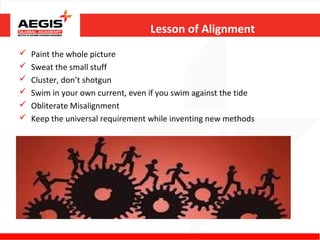
Lesson of Alignment
   Paint the whole picture
   Sweat the small stuff
   Cluster, don’t shotgun
   Swim in your own current, even if you swim against the tide
   Obliterate Misalignment
   Keep the universal requirement while inventing new methods
Building The Vision

 Key finding from “Built to
  Last”
 Preserve core ideology and
  stimulate progress
 Understand the difference
 Two major components of
  well conceived vision
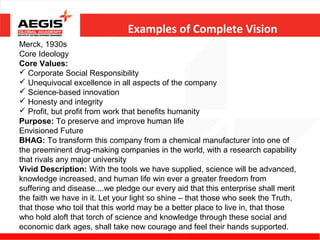
Examples of Complete Vision
Merck, 1930s
Core Ideology
Core Values:
 Corporate Social Responsibility
 Unequivocal excellence in all aspects of the company
 Science-based innovation
 Honesty and integrity
 Profit, but profit from work that benefits humanity
Purpose: To preserve and improve human life
Envisioned Future
BHAG: To transform this company from a chemical manufacturer into one of
the preeminent drug-making companies in the world, with a research capability
that rivals any major university
Vivid Description: With the tools we have supplied, science will be advanced,
knowledge increased, and human life win ever a greater freedom from
suffering and disease....we pledge our every aid that this enterprise shall merit
the faith we have in it. Let your light so shine – that those who seek the Truth,
that those who toil that this world may be a better place to live in, that those
who hold aloft that torch of science and knowledge through these social and
economic dark ages, shall take new courage and feel their hands supported.
Which Company had greater initial
Founding Root Summary                        Founded with a Great Idea
                                                                         success? Visionary or Comparison?

                                 Visionary                Comparison

3M vs. Norton                    No                       Yes            Comparison Company
Amex vs. Wells Fargo             No                       No             Visionary company
Boieng vs. McDonnell             No                       Yes            Comparison Company
Citicorp vs. Chase               No                       No             Indistinguishable
Ford vs. GM                      Yes                      No             Visionary company
GE vs. Westinghouse              Yes                      Yes            Indistinguishable
HP vs. TI                        No                       Yes            Comparison Company
IBM vs. Burroughs                No                       Yes            Comparison Company
J&J vs. Bristol Myers            Yes                      No             Visionary company
Marriott vs. Howard Johnson      No                       No             Indistinguishable
Merck vs. Pfizer                 No                       Yes            Indistinguishable
Motorola vs. Zenith              No                       Yes            Comparison Company
Nordstrom vs. Melville           No                       No             Comparison Company
P&G vs. Colgate                  No                       Yes            Indistinguishable
Philip Morris Vs. R.J.Reynolds   No                       Yes            Comparison Company
Sony vs. Kenwood                 No                       Yes            Comparison Company
Wal-Mart vs. Ames                No                       Yes            Comparison Company
Walt Disney vs. Columbia         No                       No             Comparison Company

Overall                          3 Yes                    11 Yes         3 Visionary Company
                                 15 No                    7 No           5 Indistinguishable
                                                                         10 Comparison Company
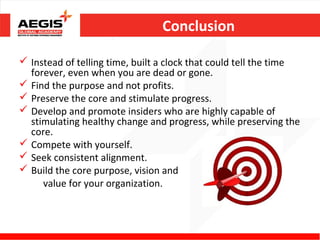
Conclusion

 Instead of telling time, built a clock that could tell the time
  forever, even when you are dead or gone.
 Find the purpose and not profits.
 Preserve the core and stimulate progress.
 Develop and promote insiders who are highly capable of
  stimulating healthy change and progress, while preserving the
  core.
 Compete with yourself.
 Seek consistent alignment.
 Build the core purpose, vision and
     value for your organization.
"Built to last" Business Classics Presentation by Mr.James C.Collins & Mr.Jerry I.Porras

"Built to last" Business Classics Presentation by Mr.James C.Collins & Mr.Jerry I.Porras

  • 1.
    BUILT TO LAST SuccessfulHabits of Visionary Companies James C. Collins and Jerry I. Porras (BUSINESS CLASSIC PRESENTATION) BY
  • 2.
    TEAM-SOUTHWEST AIRLINES HARSH DALVI ABHISHEKVARMA RAHUL WADHWA 05/02/2012
  • 3.
    PREFACE What these companieshave to teach? The average founding date being 1897. Research Results and Comparison Companies. Looked as start-ups, midsize and large companies. Lessons can be learned and applied by the majority of managers. Lessons to be learn and apply to build visionary companies.
  • 4.
    CONTENTS Chapter 1 –Best of the Best Chapter 2 – Clock Building, Not Time Telling Chapter 3- More than Profits Chapter 4 – Preserve the Core/Stimulate Progress Chapter 5- Big Hairy Audacious Goals Chapter 6 – Cult-like Cultures Learning'sWhat Works Chapter 7 – Try a Lot of Stuff and Keep Chapter 8 – Home Grown Management Chapter 9 – Good Enough Never Is Chapter 10 –The End of the Beginning Chapter 11 – Building the Vision
  • 5.
    INTRODUCTION  What isVISIONARY COMPANY?  Criteria for a Visionary Company-  Premier institution in its industry  Widely admired by knowledgeable business  Made an indelible imprint on the world  Had multiple generations of chief executives  Been through multiple product life cycles  Founded before 1950  Selection Process-  Surveyed 700 CEO’s from 200 Companies  The youngest company was founded in the year 1945 and the oldest was founded in 1812.  The average founding date of 1897
  • 6.
    Visionary Companies andComparison Companies Visionary Companies Comparison Companies 1. Norton 1. 3M 2. Wells Fargo 2. American Express 3. McDonnell Douglas 3. Boeing 4. Chase Manhattan 4. Citicorp 5. GM 5. Ford 6. Westinghouse 6. General Electric 7. Texas Instruments 7. Hewlett-Packard 8. Burroughs 8. IBM 9. Bristol-Myers Squibb 10. Howard Johnson 9. Johnson & Johnson 11. Pfizer 10. Marriott 12. Zenith 11. Merck 13. Melville 12. Motorola 14. RJR Nabisco 13. Nordstrom 15. Colgate 14. Philip Morris 16. Kenwood 15. Procter & Gamble 17. Ames 18. Columbia 16. Sony 17. Wal-Mart 18. Walt Disney
  • 7.
    THE BEST OFTHE BEST  Imagine how different the world would have looked and felt without the great companies?  TWELVE SHATTERED MYTHS  Research Project (Six Steps)- 1) What companies should we study? 2) A comparison Group 3) History and Evolution 4) Collecting the data 5) Harvesting the fruits of our labor 6) Field Testing and Application in real world LET THE EVIDENCE SPEAK
  • 8.
    CLOCK BUILDING ,NOT TIME TELLING “The builders of Visionary Companies tend to be clock builders, not time tellers.”  THE MYHT OF THE “GREAT IDEA”-  TI started with ‘great idea’ HP did not  Sony had no specific product idea, while Kenwood appeared to have a specific category of products in mind.  Negative correlation between early entrepreneurial success and becoming a highly visionary companies.  The Company itself is a great creation.  The Myth of the Great and the Charismatic Leader.  Clock Builders at Work.
  • 9.
    NO “TYRANNY OFTHE OR” (EMBRACE THE “GENIUS OF THE AND”)
  • 10.
    MORE THAN PROFITS CORE IDEOLOGY: EXPLODING THE PROFIT MYTH- Makes the clearest difference between the Visionary companies and the Comparison companies. For Example,  Johnson & Johnson Versus Bristol-Myers ( J&J Credo Vs Bristol Myers Pledge)  IS THERE A “RIGTH” IDEOLOGY?  Certain common factors seen in the number of visionary companies.  Great emphasis on having the core ideology and preserving the core ideology as a vital shaping force. Core Ideology= Core Values + Purpose
  • 11.
    PRESERVE THE CORE/STIMULATETHE PROGRESS  The essence of the visionary companies is to Preserve the core ideology of the business while simultaneously stimulating progress. For example , at 3M, “Respect for individual initiative” is a part of their core value group.  This proves the “Genius of the AND” as visionary companies seeks to be both highly ideological and highly progressive at the same time.
  • 12.
    BIG HAIRY AUDACIOUSGOAL  BHAG (Big Hairy Audacious Goal)  BHAG should be understandable and clear  BHAG should not be inside comfort zone  Progress should be their even if leaders loose their trust  BHAG should always have consistent growth  Commitments and risks  The Hubris Factor  The Goal, not the Leader  Preserve the core and stimulate progress 12
  • 13.
  • 14.
    TRY A LOTOF STUFF AND KEEP WHAT WORKS  Corporations as evolving species  Darwin’s theory of Evolution Applied to Visionary companies  Lesson for CEO, Managers and Entrepreneurs  Stick to the knitting ??? Stick to the core 14
  • 15.
    Home-Grown Management Visionary companies develop, promote and carefully select managerial talent from inside of the company to greater degree than the comparison company. They do this as a key step in preserving their core.  Quality of leadership separates visionary companies from comparison companies.  It is the continuity of quality leadership that matters – continuity that preserves the core. Leadership continuity loop.  As companies like GE, Motorola, P&G, Boeing, Nordstrom, 3M and HP have shown in time and again, a visionary company absolutely does not need to hire top management from the outside in order to get change and fresh ideas. Management Strong Strong Development Internal Internal & Succession Candidates Candidates Planning
  • 16.
    Message for CEO’s,Managers & Entrepreneurs  If you’re a CEO or Board Member at a large company, you can directly apply the lesson of this chapter. Your company should have management development processes and long range succession planning to ensure smooth transition from one generation to the next.  If you’re a manager, and building a visionary department, division or group, you can also be thinking about management development and succession planning, but on a smaller scale.  Smaller companies and entrepreneurs can be developing managers and planning succession, not for the current generation, but for the next, so that the company keeps ticking even after the leaders are gone. Poor Leadership Management Dearth of Gap Development Strong Corporate & Internal Stall Inadequate Candidates Search for a Succession “Savior” Planning
  • 17.
    CEO Statistic 1806 - 1992 No. Of No. Of No. Of Avg. Avg. No. Of Visionary Company Outside Outside Comparison Company CEO's Tenure Tenure CEO's CEO's CEO's 3M 12 7.5 0 1 8.92 12 Norton Americam Express 9 15.78 0 4 9.33 15 Wells Fargo Boeing 8 9.63 0 0 14.4 5 McDonnell Douglas Citicorp 20 9 0 4 11.5 10 Chase Manhattan Ford 5 17.8 0 2 7 12 GM General Electric 7 14.29 0 3 8.15 13 Westinghouse Hewlett-Packard 3 18 0 0 7.75 8 Texas Instrument IBM 6 13.5 0 1 10 10 Burroughs J&J 7 15.14 0 0 21 5 Bristol-Myers Squibb Marriott 2 32.5 0 3 13.4 5 Howard Johnson Merck 5 20.2 0 0 13 11 Pfizer Motorola 3 21.33 0 1 11.5 6 Zenith Nordstorm 3 30.33 0 0 20 5 Melville Philip Morris 12 12.08 3 3 8.36 14 RJR Nabisco Procter & Gamble 9 17.22 0 1 16.91 11 Colgate Sony 2 23.5 0 1 11.5 4 Kenwood Wal-Mart 2 23.5 0 2 8.5 4 Ames Walt Disney 6 11.5 1 5 9 8 Columbia Average Total 6.72 17.38 11.68 8.78 Total 121 4 31 158 % of total No. of external 3.54 22.14
  • 18.
    Some Key Examplein the Chapter
  • 19.
    Good Enough NeverIs  “How can we do better tomorrow than we did today?”  The essence of this chapter lies in the above question.  Comfort is not the objective in a visionary company.  Create discomfort – to obliterate complacency  Stretching ahead to beat themselves.  Invest more of the profit back into the company  Invest more in their people’s training, spending a significant amount in training centres.
  • 20.
    Message for CEO’s,Managers & Entrepreneurs  If you are involved in building and managing a company, the book urges you to consider the following questions:  What mechanisms of discontent can you create that would obliterate complacency and bring about change and improvement from within, yet are consistent with your core ideology? How can you give these mechanism sharp teeth?  What are you doing to invest for the future while doing well today? Does your company adopts new technologies and innovative ideas before the rest of the industry?  How you respond to downturns? Does your company continue to build for a the long term even during difficult times?  Do people in your company understand that comfort is not the objective – that life at visionary company is not supposed to be easy?  Does your company reject doing well as an end goal, replacing it with the never-ending discipline of working to do better tomorrow that it did today?
  • 21.
    The End ofthe Beginning  It’s become fashionable in recent decades for companies to spend countless hours and money drafting elegant vision, mission, value, purpose statements.  But they are not the essence of visionary companies  Just because a company has a vision statement or something like that in no ways guarantees that it will become a visionary company  The essence of a visionary company comes in the translation of its core ideology & its unique drive for progress  Visionary company aligns its core ideology for future progress
  • 22.
    The Power ofAlignment  Ford  Wrote statement of mission, values and guiding principles – MVGP  It listed people and product ahead of profit  Emphasized the central importance of quality improvement, employee involvement and customer satisfaction  MVGP however, did not bring the turnaround  It had translated MVGP into reality by aligning its operations, strategies and tactics consistently with the MVGP  The real force behind Fords remarkable turnaround was the translation of MVGP into daily practice and into reality
  • 23.
    Lesson of Alignment  Paint the whole picture  Sweat the small stuff  Cluster, don’t shotgun  Swim in your own current, even if you swim against the tide  Obliterate Misalignment  Keep the universal requirement while inventing new methods
  • 24.
    Building The Vision Key finding from “Built to Last”  Preserve core ideology and stimulate progress  Understand the difference  Two major components of well conceived vision
  • 25.
    Examples of CompleteVision Merck, 1930s Core Ideology Core Values:  Corporate Social Responsibility  Unequivocal excellence in all aspects of the company  Science-based innovation  Honesty and integrity  Profit, but profit from work that benefits humanity Purpose: To preserve and improve human life Envisioned Future BHAG: To transform this company from a chemical manufacturer into one of the preeminent drug-making companies in the world, with a research capability that rivals any major university Vivid Description: With the tools we have supplied, science will be advanced, knowledge increased, and human life win ever a greater freedom from suffering and disease....we pledge our every aid that this enterprise shall merit the faith we have in it. Let your light so shine – that those who seek the Truth, that those who toil that this world may be a better place to live in, that those who hold aloft that torch of science and knowledge through these social and economic dark ages, shall take new courage and feel their hands supported.
  • 26.
    Which Company hadgreater initial Founding Root Summary Founded with a Great Idea success? Visionary or Comparison? Visionary Comparison 3M vs. Norton No Yes Comparison Company Amex vs. Wells Fargo No No Visionary company Boieng vs. McDonnell No Yes Comparison Company Citicorp vs. Chase No No Indistinguishable Ford vs. GM Yes No Visionary company GE vs. Westinghouse Yes Yes Indistinguishable HP vs. TI No Yes Comparison Company IBM vs. Burroughs No Yes Comparison Company J&J vs. Bristol Myers Yes No Visionary company Marriott vs. Howard Johnson No No Indistinguishable Merck vs. Pfizer No Yes Indistinguishable Motorola vs. Zenith No Yes Comparison Company Nordstrom vs. Melville No No Comparison Company P&G vs. Colgate No Yes Indistinguishable Philip Morris Vs. R.J.Reynolds No Yes Comparison Company Sony vs. Kenwood No Yes Comparison Company Wal-Mart vs. Ames No Yes Comparison Company Walt Disney vs. Columbia No No Comparison Company Overall 3 Yes 11 Yes 3 Visionary Company 15 No 7 No 5 Indistinguishable 10 Comparison Company
  • 27.
    Conclusion  Instead oftelling time, built a clock that could tell the time forever, even when you are dead or gone.  Find the purpose and not profits.  Preserve the core and stimulate progress.  Develop and promote insiders who are highly capable of stimulating healthy change and progress, while preserving the core.  Compete with yourself.  Seek consistent alignment.  Build the core purpose, vision and value for your organization.