JAD
JRP
&
CASE TOOL
Made by : Saroj Niraula
JOINT APPLICATION DEVELOPMENT(JAD)
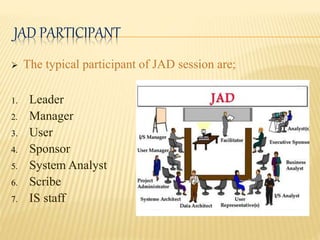
JAD PARTICIPANT
 The typical participant of JAD session are;
1. Leader
2. Manager
3. User
4. Sponsor
5. System Analyst
6. Scribe
7. IS staff
JOINT REQUIREMENT PLANNING(JRP)
 JRP is a process whereby highly structured group meetings
are conducted for the purpose of analyzing problems and
defining requirements.
 JRP is a subset of a more comprehensive joint application
development or JAD technique that encompasses the entire
systems development process.
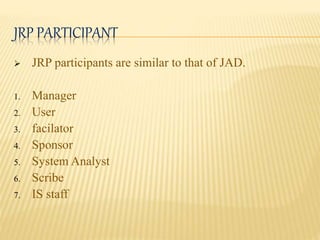
JRP PARTICIPANT
 JRP participants are similar to that of JAD.
1. Manager
2. User
3. facilator
4. Sponsor
5. System Analyst
6. Scribe
7. IS staff
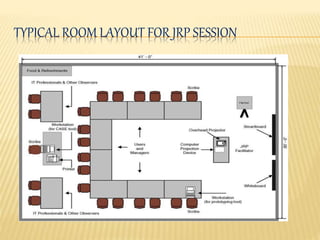
TYPICAL ROOM LAYOUT FOR JRP SESSION
ADVANTAGE OF JRP
 Easy to find the requirement of complex system.
 More focus on requirement to develop best system or
complete system for an organization.
DISADVANTAGE OF JRP
 Extensive training is required for JRP as it is a group form
COMPUTER-AIDED SYSTEM ENGINEERING(CASE) TOOL
 Case Tool are the software programs that helps the
development team to do their jobs more efficiently and more
effectively.
 These tools support the drawing and analysis of system
models.
 Some case tools also provide prototyping and code
generation capabilities.
 Examples : Oracle's designer 2000, Rational's Rose,
Platinum's Erwin, etc.
TYPES OF CASE TOOL
 There are various types of case tools used for various
purposes.They are;
1. Diagramming tools
2. Computer display and report generator
3. Analysis tools
4. A control respiratory
5. Documentation generator
6. Code generator
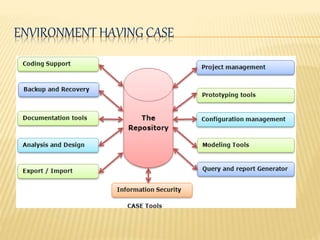
ENVIRONMENT HAVING CASE
TYPES OF CASE TOOLS
 Sometimes CASE tools are classified in to following
categories due to their activities:
1. UPPER CASE Tools
2. LOWER CASE Tools
3. INTEGRATED CASE Tools
UPPER CASE TOOLS
 They support the analysis and the design phase. They include
tools for analysis modeling, reports and forms generation.
LOWER CASE TOOLS
 They support the coding phase, configuration management,
etc.
INTEGRATED CASE TOOLS
 It is known as I-CASE and also supports analysis, design and
coding phases
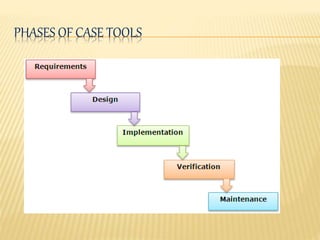
PHASES OF CASE TOOLS
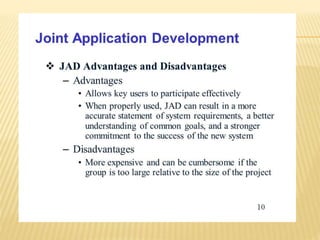
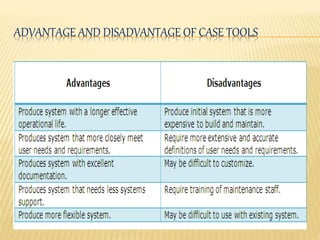
ADVANTAGE AND DISADVANTAGE OF CASE TOOLS
JAD , JAP and CASE tools

JAD , JAP and CASE tools

  • 1.
  • 2.
  • 3.
    JAD PARTICIPANT  Thetypical participant of JAD session are; 1. Leader 2. Manager 3. User 4. Sponsor 5. System Analyst 6. Scribe 7. IS staff
  • 5.
    JOINT REQUIREMENT PLANNING(JRP) JRP is a process whereby highly structured group meetings are conducted for the purpose of analyzing problems and defining requirements.  JRP is a subset of a more comprehensive joint application development or JAD technique that encompasses the entire systems development process.
  • 6.
    JRP PARTICIPANT  JRPparticipants are similar to that of JAD. 1. Manager 2. User 3. facilator 4. Sponsor 5. System Analyst 6. Scribe 7. IS staff
  • 7.
    TYPICAL ROOM LAYOUTFOR JRP SESSION
  • 8.
    ADVANTAGE OF JRP Easy to find the requirement of complex system.  More focus on requirement to develop best system or complete system for an organization.
  • 9.
    DISADVANTAGE OF JRP Extensive training is required for JRP as it is a group form
  • 10.
    COMPUTER-AIDED SYSTEM ENGINEERING(CASE)TOOL  Case Tool are the software programs that helps the development team to do their jobs more efficiently and more effectively.  These tools support the drawing and analysis of system models.  Some case tools also provide prototyping and code generation capabilities.  Examples : Oracle's designer 2000, Rational's Rose, Platinum's Erwin, etc.
  • 11.
    TYPES OF CASETOOL  There are various types of case tools used for various purposes.They are; 1. Diagramming tools 2. Computer display and report generator 3. Analysis tools 4. A control respiratory 5. Documentation generator 6. Code generator
  • 12.
  • 13.
    TYPES OF CASETOOLS  Sometimes CASE tools are classified in to following categories due to their activities: 1. UPPER CASE Tools 2. LOWER CASE Tools 3. INTEGRATED CASE Tools
  • 14.
    UPPER CASE TOOLS They support the analysis and the design phase. They include tools for analysis modeling, reports and forms generation.
  • 15.
    LOWER CASE TOOLS They support the coding phase, configuration management, etc.
  • 16.
    INTEGRATED CASE TOOLS It is known as I-CASE and also supports analysis, design and coding phases
  • 17.
  • 18.