Why monetary policy
doesn’t work very well
Larry Hatheway
Jackson Hole Economics
larry@jheconomics.com
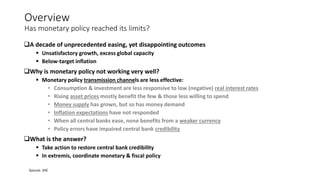
Overview
Has monetary policy reached its limits?
A decade of unprecedented easing, yet disappointing outcomes
 Unsatisfactory growth, excess global capacity
 Below-target inflation
Why is monetary policy not working very well?
 Monetary policy transmission channels are less effective:
• Consumption & investment are less responsive to low (negative) real interest rates
• Rising asset prices mostly benefit the few & those less willing to spend
• Money supply has grown, but so has money demand
• Inflation expectations have not responded
• When all central banks ease, none benefits from a weaker currency
• Policy errors have impaired central bank credibility
What is the answer?
 Take action to restore central bank credibility
 In extremis, coordinate monetary & fiscal policy
Source: JHE
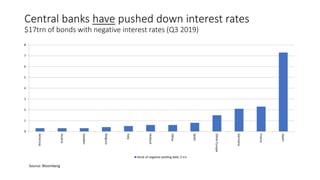
Central banks have pushed down interest rates
$17trn of bonds with negative interest rates (Q3 2019)
0
1
2
3
4
5
6
7
8
Americas
Austria
Sweden
Belgium
Italy
Holland
Other
Spain
OtherEurope
Germany
France
Japan
Stock of negative yielding debt, $ trn
Source: Bloomberg
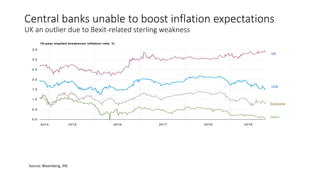
Central banks unable to boost inflation expectations
UK an outlier due to Bexit-related sterling weakness
Source: Bloomberg, JHE
UK
USA
Eurozone
Japan
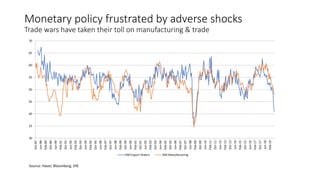
Monetary policy frustrated by adverse shocks
Trade wars have taken their toll on manufacturing & trade
Source: Haver, Bloomberg, JHE
30
35
40
45
50
55
60
65
70
Oct-87
Jun-88
Feb-89
Oct-89
Jun-90
Feb-91
Oct-91
Jun-92
Feb-93
Oct-93
Jun-94
Feb-95
Oct-95
Jun-96
Feb-97
Oct-97
Jun-98
Feb-99
Oct-99
Jun-00
Feb-01
Oct-01
Jun-02
Feb-03
Oct-03
Jun-04
Feb-05
Oct-05
Jun-06
Feb-07
Oct-07
Jun-08
Feb-09
Oct-09
Jun-10
Feb-11
Oct-11
Jun-12
Feb-13
Oct-13
Jun-14
Feb-15
Oct-15
Jun-16
Feb-17
Oct-17
Jun-18
Feb-19
ISM Export Orders ISM Manufacturing
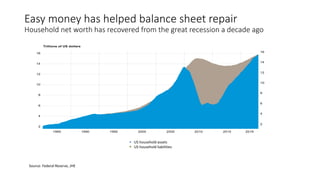
Easy money has helped balance sheet repair
Household net worth has recovered from the great recession a decade ago
Source: Federal Reserve, JHE
 US household assets
 US household liabilities
WHATCAN
CENTRALBANKS
STILLACHIEVE?
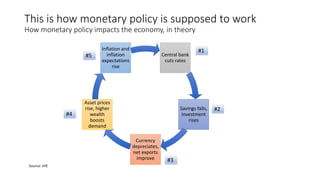
This is how monetary policy is supposed to work
How monetary policy impacts the economy, in theory
Source: JHE
Central bank
cuts rates
Savings falls,
investment
rises
Currency
depreciates,
net exports
improve
Asset prices
rise, higher
wealth
boosts
demand
Inflation and
inflation
expectations
rise
#1
#2
#3
#4
#5
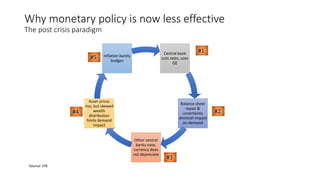
Why monetary policy is now less effective
The post crisis paradigm
Source: JHE
Central bank
cuts rates, uses
QE
Balance sheet
repair &
uncertainty
diminish impact
on demand
Other central
banks ease,
currency does
not depreciate
Asset prices
rise, but skewed
wealth
distribution
limits demand
impact
Inflation barely
budges
#1
#2
#3
#4
#5
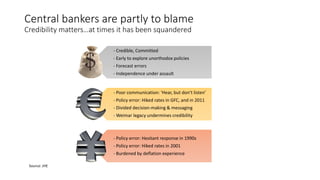
Central bankers are partly to blame
Credibility matters…at times it has been squandered
Source: JHE
- Credible, Committed
- Early to explore unorthodox policies
- Forecast errors
- Independence under assault
- Poor communication: ‘Hear, but don’t listen’
- Policy error: Hiked rates in GFC, and in 2011
- Divided decision-making & messaging
- Weimar legacy undermines credibility
- Policy error: Hesitant response in 1990s
- Policy error: Hiked rates in 2001
- Burdened by deflation experience
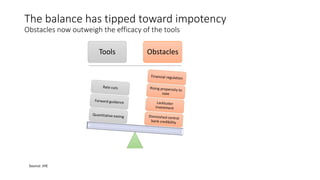
The balance has tipped toward impotency
Obstacles now outweigh the efficacy of the tools
Source: JHE
Tools Obstacles

Jackson Hole Economics Monetary policy

  • 1.
    Why monetary policy doesn’twork very well Larry Hatheway Jackson Hole Economics larry@jheconomics.com
  • 2.
    Overview Has monetary policyreached its limits? A decade of unprecedented easing, yet disappointing outcomes  Unsatisfactory growth, excess global capacity  Below-target inflation Why is monetary policy not working very well?  Monetary policy transmission channels are less effective: • Consumption & investment are less responsive to low (negative) real interest rates • Rising asset prices mostly benefit the few & those less willing to spend • Money supply has grown, but so has money demand • Inflation expectations have not responded • When all central banks ease, none benefits from a weaker currency • Policy errors have impaired central bank credibility What is the answer?  Take action to restore central bank credibility  In extremis, coordinate monetary & fiscal policy Source: JHE
  • 3.
    Central banks havepushed down interest rates $17trn of bonds with negative interest rates (Q3 2019) 0 1 2 3 4 5 6 7 8 Americas Austria Sweden Belgium Italy Holland Other Spain OtherEurope Germany France Japan Stock of negative yielding debt, $ trn Source: Bloomberg
  • 4.
    Central banks unableto boost inflation expectations UK an outlier due to Bexit-related sterling weakness Source: Bloomberg, JHE UK USA Eurozone Japan
  • 5.
    Monetary policy frustratedby adverse shocks Trade wars have taken their toll on manufacturing & trade Source: Haver, Bloomberg, JHE 30 35 40 45 50 55 60 65 70 Oct-87 Jun-88 Feb-89 Oct-89 Jun-90 Feb-91 Oct-91 Jun-92 Feb-93 Oct-93 Jun-94 Feb-95 Oct-95 Jun-96 Feb-97 Oct-97 Jun-98 Feb-99 Oct-99 Jun-00 Feb-01 Oct-01 Jun-02 Feb-03 Oct-03 Jun-04 Feb-05 Oct-05 Jun-06 Feb-07 Oct-07 Jun-08 Feb-09 Oct-09 Jun-10 Feb-11 Oct-11 Jun-12 Feb-13 Oct-13 Jun-14 Feb-15 Oct-15 Jun-16 Feb-17 Oct-17 Jun-18 Feb-19 ISM Export Orders ISM Manufacturing
  • 6.
    Easy money hashelped balance sheet repair Household net worth has recovered from the great recession a decade ago Source: Federal Reserve, JHE  US household assets  US household liabilities
  • 7.
  • 8.
    This is howmonetary policy is supposed to work How monetary policy impacts the economy, in theory Source: JHE Central bank cuts rates Savings falls, investment rises Currency depreciates, net exports improve Asset prices rise, higher wealth boosts demand Inflation and inflation expectations rise #1 #2 #3 #4 #5
  • 9.
    Why monetary policyis now less effective The post crisis paradigm Source: JHE Central bank cuts rates, uses QE Balance sheet repair & uncertainty diminish impact on demand Other central banks ease, currency does not depreciate Asset prices rise, but skewed wealth distribution limits demand impact Inflation barely budges #1 #2 #3 #4 #5
  • 10.
    Central bankers arepartly to blame Credibility matters…at times it has been squandered Source: JHE - Credible, Committed - Early to explore unorthodox policies - Forecast errors - Independence under assault - Poor communication: ‘Hear, but don’t listen’ - Policy error: Hiked rates in GFC, and in 2011 - Divided decision-making & messaging - Weimar legacy undermines credibility - Policy error: Hesitant response in 1990s - Policy error: Hiked rates in 2001 - Burdened by deflation experience
  • 11.
    The balance hastipped toward impotency Obstacles now outweigh the efficacy of the tools Source: JHE Tools Obstacles