Alpha Amylase Production
Company in Light: Novozymes
Products : Liquozyme and Termamyl
Submitted By-
Name: Rishav Roy
Roll No. 1860140
IMTH-5
Submitted to-
Dr. Gargi Dey
KIIT School of Biotechnology
Founders- Harald and Thorvald Pedersen (1925)
The current Novozymes was founded in 2000
Products- Enzymes, Microorganisms, Biopharma
Ingredients
-
Rethink Tomorrow
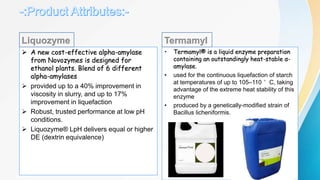
Liquozyme
 A new cost-effective alpha-amylase
from Novozymes is designed for
ethanol plants. Blend of 6 different
alpha-amylases
 provided up to a 40% improvement in
viscosity in slurry, and up to 17%
improvement in liquefaction
 Robust, trusted performance at low pH
conditions.
 Liquozyme® LpH delivers equal or higher
DE (dextrin equivalence)
Termamyl
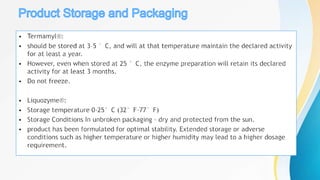
• Termamyl® is a liquid enzyme preparation
containing an outstandingly heat-stable α-
amylase.
• used for the continuous liquefaction of starch
at temperatures of up to 105–110 °C, taking
advantage of the extreme heat stability of this
enzyme
• produced by a genetically-modified strain of
Bacillus licheniformis.
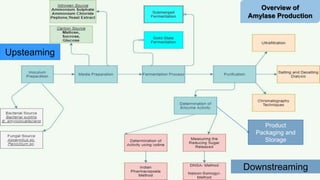
Overview of
Amylase Production
Upsteaming
Product
Packaging and
Storage
Downstreaming
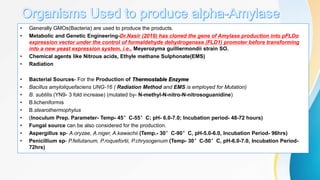
• Generally GMOs(Bacteria) are used to produce the products.
• Metabolic and Genetic Engineering-Dr.Nasir (2019) has cloned the gene of Amylase production into pFLDα
expression vector under the control of formaldehyde dehydrogenase (FLD1) promoter before transforming
into a new yeast expression system, i.e., Meyerozyma guilliermondii strain SO.
• Chemical agents like Nitrous acids, Ethyle methane Sulphonate(EMS)
• Radiation
• Bacterial Sources- For the Production of Thermostable Enzyme
• Bacillus amyloliquefaciens UNG-16 ( Radiation Method and EMS is employed for Mutation)
• B. subtilis (YN9- 3 fold increase) (mutated by- N-methyl-N-nitro-N-nitrosoguanidine)
• B.licheniformis
• B.stearothermophylus
• (Inoculum Prep. Parameter- Temp- 45°C-55°C; pH- 6.0-7.0; Incubation period- 48-72 hours)
• Fungal source can be also considered for the production.
• Aspergillus sp- A.oryzae, A.niger, A.kawachii (Temp.- 30°C-90°C, pH-5.0-6.0, Incubation Period- 96hrs)
• Penicillium sp- P.fellutanum, P.roquefortii, P.chrysogenum (Temp- 30°C-50°C, pH-6.0-7.0, Incubation Period-
72hrs)
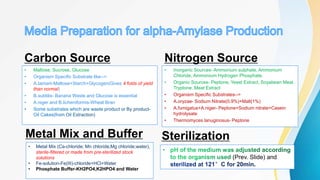
Carbon Source
• Maltose, Sucrose, Glucose
• Organism Specific Substrate like-->
• A.tamarii-Maltose+Starch+Glycogen(Gives 4 folds of yield
than normal)
• B.subtilis- Banana Waste and Glucose is essential
• A.niger and B.licheniformis-Wheat Bran
Nitrogen Source
• Inorganic Sources- Ammonium sulphate, Ammonium
Chloride, Ammonium Hydrogen Phosphate.
• Organic Sources- Peptone, Yeast Extract, Soyabean Meal,
Tryptone, Meat Extract
• Organism Specific Substrates-->
• A.oryzae- Sodium Nitrate(0.9%)+Malt(1%)
• A.fumigatus+A.niger- Peptone+Sodium nitrate+Casein
hydrolysate
• Thermomyces lanuginosus- Peptone
Metal Mix and Buffer
• Metal Mix (Ca-chloride; Mn chloride;Mg chloride;water),
sterile-filtered or made from pre-sterilized stock
solutions
• Fe-solution-Fe(III)-chloride+HCl+Water
• Phosphate Buffer-KH2PO4,K2HPO4 and Water
Sterilization
(Prev. Slide) and
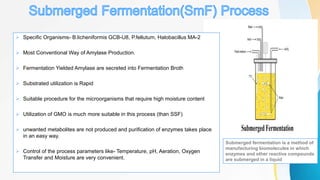
 Specific Organisms- B.licheniformis GCB-U8, P.fellutum, Halobacillus MA-2
 Most Conventional Way of Amylase Production.
 Fermentation Yielded Amylase are secreted into Fermentation Broth
 Substrated utilization is Rapid
 Suitable procedure for the microorganisms that require high moisture content
 Utilization of GMO is much more suitable in this process (than SSF)
 unwanted metabolites are not produced and purification of enzymes takes place
in an easy way.
 Control of the process parameters like- Temperature, pH, Aeration, Oxygen
Transfer and Moisture are very convenient.
Submerged fermentation is a method of
manufacturing biomolecules in which
enzymes and other reactive compounds
are submerged in a liquid
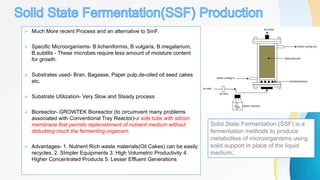
 Much More recent Process and an alternative to SmF.
 Specific Microorganisms- B.licheniformis, B.vulgaris, B.megaterium,
B.subtilis - These microbes require less amount of moisture content
for growth.
 Substrates used- Bran, Bagasse, Paper pulp,de-oiled oil seed cakes
etc.
 Substrate Utilization- Very Slow and Steady process
 Bioreactor- GROWTEK Bioreactor (to circumvent many problems
associated with Conventional Tray Reactor)-a side tube with silicon
membrane that permits replenishment of nutrient medium without
disturbing much the fermenting organism.
 Advantages- 1. Nutrient Rich waste materials(Oil Cakes) can be easily
recycles. 2. SImpler Equipments 3. High Volumetric Productivity 4.
Higher Concentrated Products 5. Lesser Effluent Generations
Solid State Fermentation (SSF) is a
fermentation methods to produce
metabolites of microorganisms using
solid support in place of the liquid
medium.
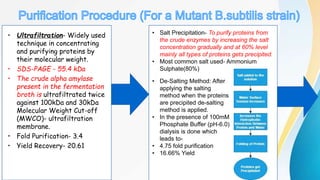
• Ultrafiltration- Widely used
technique in concentrating
and purifying proteins by
their molecular weight.
• SDS-PAGE - 55.4 kDa
• The crude alpha amylase
present in the fermentation
broth is ultrafiltrated twice
against 100kDa and 30kDa
Molecular Weight Cut-off
(MWCO)- ultrafiltration
membrane.
• Fold Purification- 3.4
• Yield Recovery- 20.61
• De-Salting Method: After
applying the salting
method when the proteins
are precipited de-salting
method is applied.
• In the presence of 100mM
Phosphate Buffer (pH-6.0)
dialysis is done which
leads to-
• 4.75 fold purification
• 16.66% Yield
• Salt Precipitation- To purify proteins from
the crude enzymes by increasing the salt
concentration gradually and at 60% level
mainly all types of proteins gets precipited.
• Most common salt used- Ammonium
Sulphate(80%)
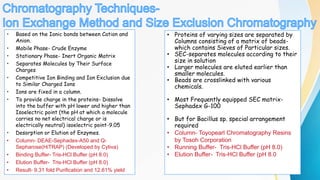
• Based on the Ionic bonds between Cation and
Anion.
• Mobile Phase- Crude Enzyme
• Stationary Phase- Inert Organic Matrix
• Separates Molecules by Their Surface
Charges
• Competitive Ion Binding and Ion Exclusion due
to Similar Charged Ions
• Ions are fixed in a column.
• To provide charge in the proteins- Dissolve
into the buffer with pH lower and higher than
Isoelectric point (the pH at which a molecule
carries no net electrical charge or is
electrically neutral) isoelectric point-9.05
• Desorption or Elution of Enzymes.
• Column- DEAE-Sephadex-A50 and Q-
Sepharose(HiTRAP) (Developed by Cytiva)
• Binding Buffer- Tris-HCl Buffer (pH 8.0)
• Elution Buffer- Tris-HCl Buffer (pH 8.0)
• Result- 9.31 fold Purification and 12.61% yield
`
• Proteins of varying sizes are separated by
Columns consisting of a matrix of beads-
which contains Sieves of Particular sizes.
• SEC-separates molecules according to their
size in solution
• Larger molecules are eluted earlier than
smaller molecules.
• Beads are crosslinked with various
chemicals.
• Most Frequently equipped SEC matrix-
Sephadex G-100
• But for Bacillus sp. special arrangement
required
• Column- Toyopearl Chromatography Resins
by Tosoh Corporation
• Running Buffer- Tris-HCl Buffer (pH 8.0)
• Elution Buffer- Tris-HCl Buffer (pH 8.0
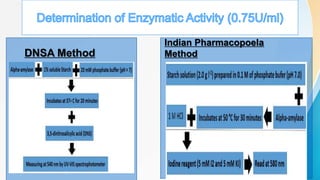
DNSA Method
Indian Pharmacopoela
Method
References:-
• http://www.ebiosis.co.kr/Novozymes%20Product%20Sheet/Liquozyme%20Supra.pdf
• https://bioresources.cnr.ncsu.edu/resources/purification-and-characterisation-of-thermostable-
%CE%B1-amylases-from-microbial-sources/
• http://pubs.sciepub.com/jaem/2/4/10/
• https://www.hindawi.com/journals/bmri/2017/1272193/
• https://www.sigmaaldrich.com/analytical-chromatography/analytical-
products.html?TablePage=101277530
• https://www.ncbi.nlm.nih.gov/pmc/articles/PMC3768732/
• https://www.ncbi.nlm.nih.gov/pmc/articles/PMC7335993/
• https://www.researchgate.net/publication/6262674_Comparative_profiles_of_alpha-
amylase_production_in_conventional_tray_reactor_and_GROWTEK_bioreactor
• nlm.nih.gov/21234823/
Alpha Amylase Production Process

Alpha Amylase Production Process

  • 1.
    Alpha Amylase Production Companyin Light: Novozymes Products : Liquozyme and Termamyl Submitted By- Name: Rishav Roy Roll No. 1860140 IMTH-5 Submitted to- Dr. Gargi Dey KIIT School of Biotechnology
  • 2.
    Founders- Harald andThorvald Pedersen (1925) The current Novozymes was founded in 2000 Products- Enzymes, Microorganisms, Biopharma Ingredients - Rethink Tomorrow
  • 3.
    Liquozyme  A newcost-effective alpha-amylase from Novozymes is designed for ethanol plants. Blend of 6 different alpha-amylases  provided up to a 40% improvement in viscosity in slurry, and up to 17% improvement in liquefaction  Robust, trusted performance at low pH conditions.  Liquozyme® LpH delivers equal or higher DE (dextrin equivalence) Termamyl • Termamyl® is a liquid enzyme preparation containing an outstandingly heat-stable α- amylase. • used for the continuous liquefaction of starch at temperatures of up to 105–110 °C, taking advantage of the extreme heat stability of this enzyme • produced by a genetically-modified strain of Bacillus licheniformis.
  • 4.
  • 5.
    • Generally GMOs(Bacteria)are used to produce the products. • Metabolic and Genetic Engineering-Dr.Nasir (2019) has cloned the gene of Amylase production into pFLDα expression vector under the control of formaldehyde dehydrogenase (FLD1) promoter before transforming into a new yeast expression system, i.e., Meyerozyma guilliermondii strain SO. • Chemical agents like Nitrous acids, Ethyle methane Sulphonate(EMS) • Radiation • Bacterial Sources- For the Production of Thermostable Enzyme • Bacillus amyloliquefaciens UNG-16 ( Radiation Method and EMS is employed for Mutation) • B. subtilis (YN9- 3 fold increase) (mutated by- N-methyl-N-nitro-N-nitrosoguanidine) • B.licheniformis • B.stearothermophylus • (Inoculum Prep. Parameter- Temp- 45°C-55°C; pH- 6.0-7.0; Incubation period- 48-72 hours) • Fungal source can be also considered for the production. • Aspergillus sp- A.oryzae, A.niger, A.kawachii (Temp.- 30°C-90°C, pH-5.0-6.0, Incubation Period- 96hrs) • Penicillium sp- P.fellutanum, P.roquefortii, P.chrysogenum (Temp- 30°C-50°C, pH-6.0-7.0, Incubation Period- 72hrs)
  • 6.
    Carbon Source • Maltose,Sucrose, Glucose • Organism Specific Substrate like--> • A.tamarii-Maltose+Starch+Glycogen(Gives 4 folds of yield than normal) • B.subtilis- Banana Waste and Glucose is essential • A.niger and B.licheniformis-Wheat Bran Nitrogen Source • Inorganic Sources- Ammonium sulphate, Ammonium Chloride, Ammonium Hydrogen Phosphate. • Organic Sources- Peptone, Yeast Extract, Soyabean Meal, Tryptone, Meat Extract • Organism Specific Substrates--> • A.oryzae- Sodium Nitrate(0.9%)+Malt(1%) • A.fumigatus+A.niger- Peptone+Sodium nitrate+Casein hydrolysate • Thermomyces lanuginosus- Peptone Metal Mix and Buffer • Metal Mix (Ca-chloride; Mn chloride;Mg chloride;water), sterile-filtered or made from pre-sterilized stock solutions • Fe-solution-Fe(III)-chloride+HCl+Water • Phosphate Buffer-KH2PO4,K2HPO4 and Water Sterilization (Prev. Slide) and
  • 7.
     Specific Organisms-B.licheniformis GCB-U8, P.fellutum, Halobacillus MA-2  Most Conventional Way of Amylase Production.  Fermentation Yielded Amylase are secreted into Fermentation Broth  Substrated utilization is Rapid  Suitable procedure for the microorganisms that require high moisture content  Utilization of GMO is much more suitable in this process (than SSF)  unwanted metabolites are not produced and purification of enzymes takes place in an easy way.  Control of the process parameters like- Temperature, pH, Aeration, Oxygen Transfer and Moisture are very convenient. Submerged fermentation is a method of manufacturing biomolecules in which enzymes and other reactive compounds are submerged in a liquid
  • 8.
     Much Morerecent Process and an alternative to SmF.  Specific Microorganisms- B.licheniformis, B.vulgaris, B.megaterium, B.subtilis - These microbes require less amount of moisture content for growth.  Substrates used- Bran, Bagasse, Paper pulp,de-oiled oil seed cakes etc.  Substrate Utilization- Very Slow and Steady process  Bioreactor- GROWTEK Bioreactor (to circumvent many problems associated with Conventional Tray Reactor)-a side tube with silicon membrane that permits replenishment of nutrient medium without disturbing much the fermenting organism.  Advantages- 1. Nutrient Rich waste materials(Oil Cakes) can be easily recycles. 2. SImpler Equipments 3. High Volumetric Productivity 4. Higher Concentrated Products 5. Lesser Effluent Generations Solid State Fermentation (SSF) is a fermentation methods to produce metabolites of microorganisms using solid support in place of the liquid medium.
  • 9.
    • Ultrafiltration- Widelyused technique in concentrating and purifying proteins by their molecular weight. • SDS-PAGE - 55.4 kDa • The crude alpha amylase present in the fermentation broth is ultrafiltrated twice against 100kDa and 30kDa Molecular Weight Cut-off (MWCO)- ultrafiltration membrane. • Fold Purification- 3.4 • Yield Recovery- 20.61 • De-Salting Method: After applying the salting method when the proteins are precipited de-salting method is applied. • In the presence of 100mM Phosphate Buffer (pH-6.0) dialysis is done which leads to- • 4.75 fold purification • 16.66% Yield • Salt Precipitation- To purify proteins from the crude enzymes by increasing the salt concentration gradually and at 60% level mainly all types of proteins gets precipited. • Most common salt used- Ammonium Sulphate(80%)
  • 10.
    • Based onthe Ionic bonds between Cation and Anion. • Mobile Phase- Crude Enzyme • Stationary Phase- Inert Organic Matrix • Separates Molecules by Their Surface Charges • Competitive Ion Binding and Ion Exclusion due to Similar Charged Ions • Ions are fixed in a column. • To provide charge in the proteins- Dissolve into the buffer with pH lower and higher than Isoelectric point (the pH at which a molecule carries no net electrical charge or is electrically neutral) isoelectric point-9.05 • Desorption or Elution of Enzymes. • Column- DEAE-Sephadex-A50 and Q- Sepharose(HiTRAP) (Developed by Cytiva) • Binding Buffer- Tris-HCl Buffer (pH 8.0) • Elution Buffer- Tris-HCl Buffer (pH 8.0) • Result- 9.31 fold Purification and 12.61% yield ` • Proteins of varying sizes are separated by Columns consisting of a matrix of beads- which contains Sieves of Particular sizes. • SEC-separates molecules according to their size in solution • Larger molecules are eluted earlier than smaller molecules. • Beads are crosslinked with various chemicals. • Most Frequently equipped SEC matrix- Sephadex G-100 • But for Bacillus sp. special arrangement required • Column- Toyopearl Chromatography Resins by Tosoh Corporation • Running Buffer- Tris-HCl Buffer (pH 8.0) • Elution Buffer- Tris-HCl Buffer (pH 8.0
  • 11.
  • 13.
    References:- • http://www.ebiosis.co.kr/Novozymes%20Product%20Sheet/Liquozyme%20Supra.pdf • https://bioresources.cnr.ncsu.edu/resources/purification-and-characterisation-of-thermostable- %CE%B1-amylases-from-microbial-sources/ •http://pubs.sciepub.com/jaem/2/4/10/ • https://www.hindawi.com/journals/bmri/2017/1272193/ • https://www.sigmaaldrich.com/analytical-chromatography/analytical- products.html?TablePage=101277530 • https://www.ncbi.nlm.nih.gov/pmc/articles/PMC3768732/ • https://www.ncbi.nlm.nih.gov/pmc/articles/PMC7335993/ • https://www.researchgate.net/publication/6262674_Comparative_profiles_of_alpha- amylase_production_in_conventional_tray_reactor_and_GROWTEK_bioreactor • nlm.nih.gov/21234823/

Editor's Notes

  • #4 Dextrose equivalent (DE) is a measure of the amount of reducing sugars present in a sugar product, expressed as a percentage on a dry basis relative to dextrose.
  • #10 SDS-Page-> SDS is a detergent, an anionic (negatively charged) surfactant (compound that lowers surface tension). SDS disrupts the non-covalent bonds in protein molecules. PAGE- Poly-Acrylamide Gel Electrophoresis