IX
Computer Application
CBSE
Ch 2
Types of Hardware
2.2 Computer System
● CPU
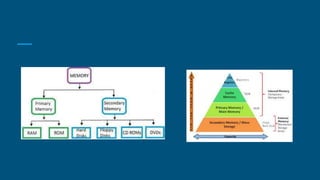
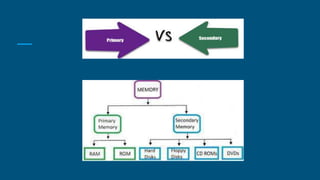
● Memory- Primary (RAM, ROM) & Secondary(external
storage)
● Input Devices
● Output Devices
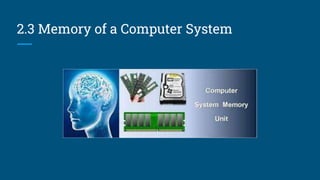
2.3 Memory of a Computer System
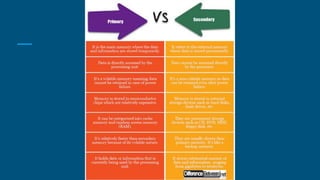
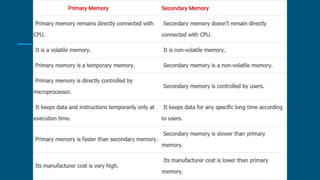
● Main memory/Primary memory/Internal
memory
● Auxiliary memory/ Secondary memory/
External memory
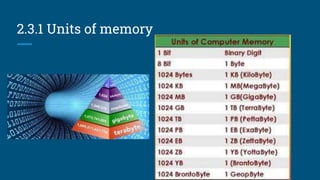
2.3.1 Units of memory
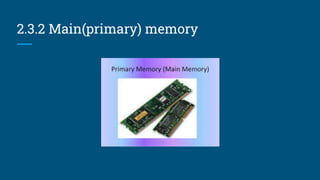
2.3.2 Main(primary) memory
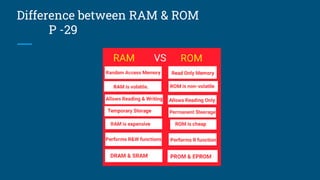
Difference between RAM & ROM
P -29
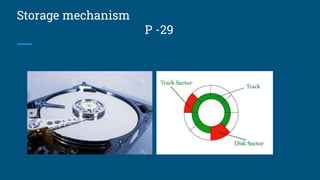
Storage mechanism
P -29
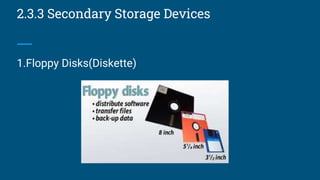
2.3.3 Secondary Storage Devices
1.Floppy Disks(Diskette)
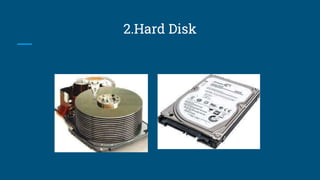
2.Hard Disk
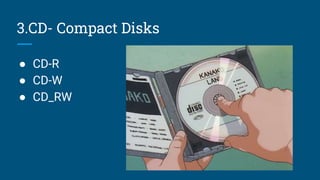
3.CD- Compact Disks
● CD-R
● CD-W
● CD_RW
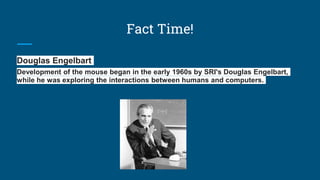
Fact Time!
Douglas Engelbart
Development of the mouse began in the early 1960s by SRI's Douglas Engelbart,
while he was exploring the interactions between humans and computers.
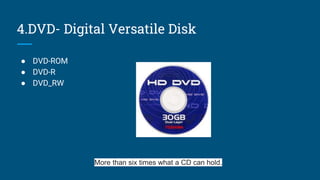
4.DVD- Digital Versatile Disk
● DVD-ROM
● DVD-R
● DVD_RW
More than six times what a CD can hold.
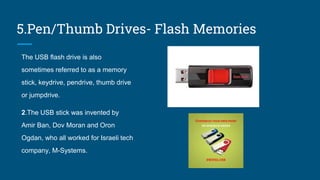
5.Pen/Thumb Drives- Flash Memories
The USB flash drive is also
sometimes referred to as a memory
stick, keydrive, pendrive, thumb drive
or jumpdrive.
2.The USB stick was invented by
Amir Ban, Dov Moran and Oron
Ogdan, who all worked for Israeli tech
company, M-Systems.
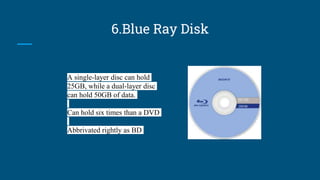
6.Blue Ray Disk
A single-layer disc can hold
25GB, while a dual-layer disc
can hold 50GB of data.
Can hold six times than a DVD
Abbrivated rightly as BD
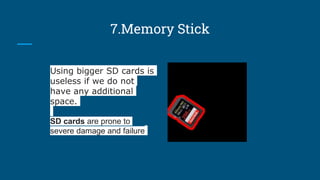
7.Memory Stick
Using bigger SD cards is
useless if we do not
have any additional
space.
SD cards are prone to
severe damage and failure
Cloud Storage(Not a Device)
80% of the companies
that move to cloud
witness improvements in
their IT departments in
less than six months
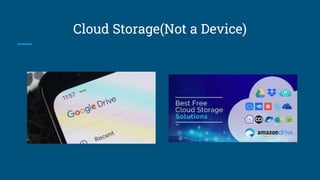
Cloud Storage(Not a Device)
FACT TIME !
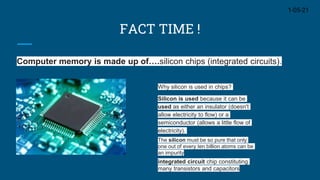
Computer memory is made up of….silicon chips (integrated circuits).
1-05-21
Why silicon is used in chips?
Silicon is used because it can be
used as either an insulator (doesn't
allow electricity to flow) or a
semiconductor (allows a little flow of
electricity).
The silicon must be so pure that only
one out of every ten billion atoms can be
an impurity
integrated circuit chip constituting
many transistors and capacitors
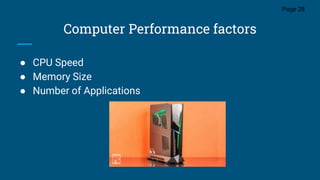
Computer Performance factors
● CPU Speed
● Memory Size
● Number of Applications
Page 28
Computer Performance factors -SPEED
Page 28
The speed of the CPU is also known as the clock speed of the CPU. …
Processor speed is measured in gigahertz (GHz). The higher this measurement,
the faster the processor.
One megahertz equals one million instructions per second, and one gigahertz
equals one billion instructions per second.
Modern laptops varies from 1 to 2.6Ghz.
Computer Performance factors- MEMORY SIZE
Page 28
Cache memory
This saves fetching the instructions and data repeatedly from RAM – might otherwise
keep the CPU waiting.
Transfers to and from cache take less time than transfers to and from RAM.
The more cache there is, the more data can be stored closer to the CPU.
Computer Performance factors- Number of
applications running
Page 28
Speed of the CPU, the space on the hard disk, the size of the RAM, the
type of the graphics card, the speed of the hard disk
the computer is multitasking, the defragmenting files.
The distribution of clock towards different application.
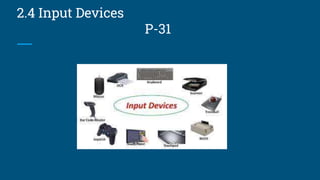
2.4 Input Devices
P-31
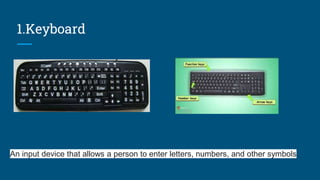
1.Keyboard
An input device that allows a person to enter letters, numbers, and other symbols
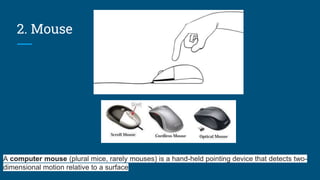
2. Mouse
A computer mouse (plural mice, rarely mouses) is a hand-held pointing device that detects two-
dimensional motion relative to a surface
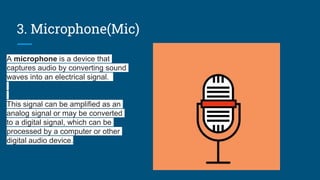
3. Microphone(Mic)
A microphone is a device that
captures audio by converting sound
waves into an electrical signal.
This signal can be amplified as an
analog signal or may be converted
to a digital signal, which can be
processed by a computer or other
digital audio device.
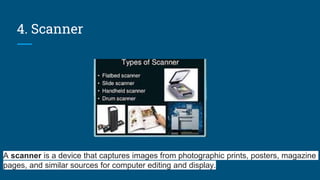
4. Scanner
A scanner is a device that captures images from photographic prints, posters, magazine
pages, and similar sources for computer editing and display.
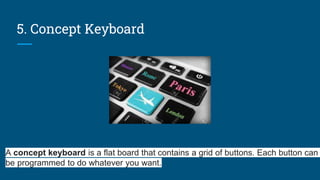
5. Concept Keyboard
A concept keyboard is a flat board that contains a grid of buttons. Each button can
be programmed to do whatever you want.
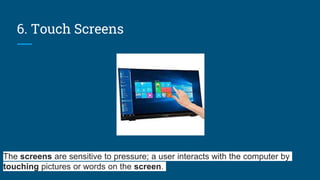
6. Touch Screens
The screens are sensitive to pressure; a user interacts with the computer by
touching pictures or words on the screen.
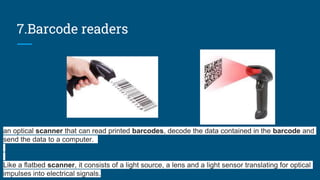
7.Barcode readers
an optical scanner that can read printed barcodes, decode the data contained in the barcode and
send the data to a computer.
Like a flatbed scanner, it consists of a light source, a lens and a light sensor translating for optical
impulses into electrical signals.
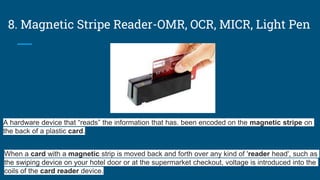
8. Magnetic Stripe Reader-OMR, OCR, MICR, Light Pen
When a card with a magnetic strip is moved back and forth over any kind of 'reader head', such as
the swiping device on your hotel door or at the supermarket checkout, voltage is introduced into the
coils of the card reader device.
A hardware device that “reads” the information that has. been encoded on the magnetic stripe on
the back of a plastic card.
Fact Time!
Refresh Rate-
● Monitors quality depends upon fps-frames per second
● As the rate of fps is higher, image quality will be better.
● Considered as the number of times image updating on screen
● Corresponding that, information reaching to eyes
OUTPUT DEVICES
Output Devices
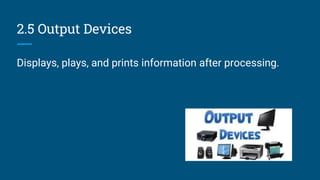
2.5 Output Devices
Displays, plays, and prints information after processing.
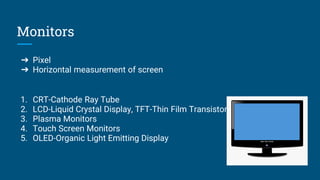
Monitors
➔ Pixel
➔ Horizontal measurement of screen
1. CRT-Cathode Ray Tube
2. LCD-Liquid Crystal Display, TFT-Thin Film Transistor
3. Plasma Monitors
4. Touch Screen Monitors
5. OLED-Organic Light Emitting Display
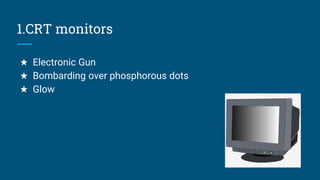
1.CRT monitors
★ Electronic Gun
★ Bombarding over phosphorous dots
★ Glow
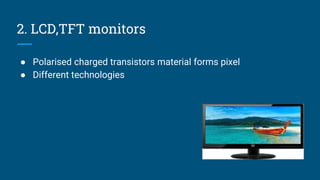
2. LCD,TFT monitors
● Polarised charged transistors material forms pixel
● Different technologies
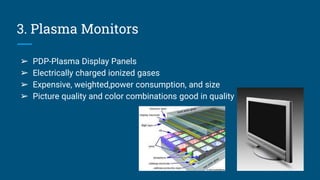
3. Plasma Monitors
➢ PDP-Plasma Display Panels
➢ Electrically charged ionized gases
➢ Expensive, weighted,power consumption, and size
➢ Picture quality and color combinations good in quality
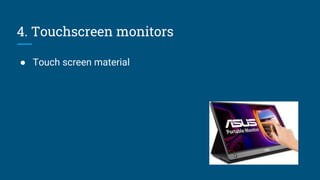
4. Touchscreen monitors
● Touch screen material
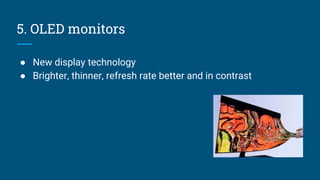
5. OLED monitors
● New display technology
● Brighter, thinner, refresh rate better and in contrast
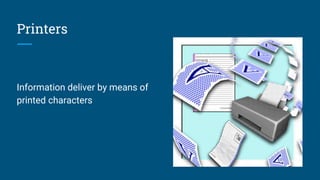
Printers
Information deliver by means of
printed characters
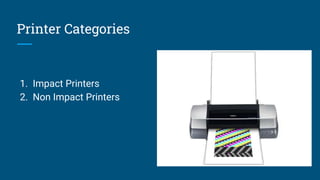
Printer Categories
1. Impact Printers
2. Non Impact Printers
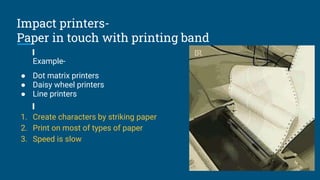
Impact printers-
Paper in touch with printing band
Example-
● Dot matrix printers
● Daisy wheel printers
● Line printers
1. Create characters by striking paper
2. Print on most of types of paper
3. Speed is slow
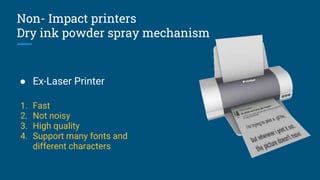
Non- Impact printers
Dry ink powder spray mechanism
● Ex-Laser Printer
1. Fast
2. Not noisy
3. High quality
4. Support many fonts and
different characters
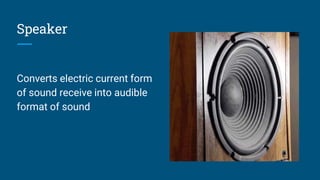
Speaker
Converts electric current form
of sound receive into audible
format of sound
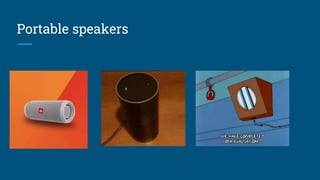
Portable speakers
Plotters- Design graphics and drawing on paper
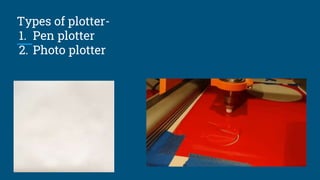
Types of plotter-
1. Pen plotter
2. Photo plotter
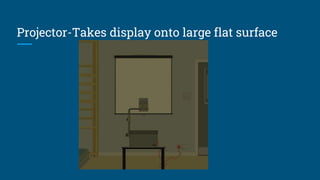
Projector-Takes display onto large flat surface
Fact Time!
Android 12 Beta version out for selected devices
● Google mobile OS
● 2008, first version 1.0 to 1.1
● Till 9th versions all names upon eatables
● 2019, android 10
● 2020, android 11
Nature is the greatest place to recharge and heal
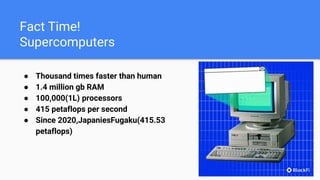
● Thousand times faster than human
● 1.4 million gb RAM
● 100,000(1L) processors
● 415 petaflops per second
● Since 2020,JapaniesFugaku(415.53
petaflops)
Fact Time!
Supercomputers
Fact Time!
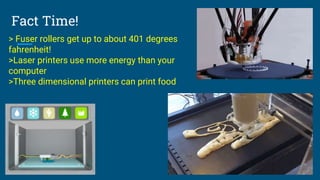
> Fuser rollers get up to about 401 degrees
fahrenheit!
>Laser printers use more energy than your
computer
>Three dimensional printers can print food
Thank you!

Ix CBSE Computer Application Ch 2 Types of Hardware

  • 1.
  • 2.
    2.2 Computer System ●CPU ● Memory- Primary (RAM, ROM) & Secondary(external storage) ● Input Devices ● Output Devices
  • 3.
    2.3 Memory ofa Computer System
  • 4.
    2.3 Memory ofa Computer System ● Main memory/Primary memory/Internal memory ● Auxiliary memory/ Secondary memory/ External memory
  • 5.
  • 6.
  • 9.
  • 10.
  • 11.
    2.3.3 Secondary StorageDevices 1.Floppy Disks(Diskette)
  • 12.
  • 13.
    3.CD- Compact Disks ●CD-R ● CD-W ● CD_RW
  • 14.
    Fact Time! Douglas Engelbart Developmentof the mouse began in the early 1960s by SRI's Douglas Engelbart, while he was exploring the interactions between humans and computers.
  • 15.
    4.DVD- Digital VersatileDisk ● DVD-ROM ● DVD-R ● DVD_RW More than six times what a CD can hold.
  • 16.
    5.Pen/Thumb Drives- FlashMemories The USB flash drive is also sometimes referred to as a memory stick, keydrive, pendrive, thumb drive or jumpdrive. 2.The USB stick was invented by Amir Ban, Dov Moran and Oron Ogdan, who all worked for Israeli tech company, M-Systems.
  • 17.
    6.Blue Ray Disk Asingle-layer disc can hold 25GB, while a dual-layer disc can hold 50GB of data. Can hold six times than a DVD Abbrivated rightly as BD
  • 18.
    7.Memory Stick Using biggerSD cards is useless if we do not have any additional space. SD cards are prone to severe damage and failure
  • 19.
    Cloud Storage(Not aDevice) 80% of the companies that move to cloud witness improvements in their IT departments in less than six months
  • 20.
  • 22.
    FACT TIME ! Computermemory is made up of….silicon chips (integrated circuits). 1-05-21 Why silicon is used in chips? Silicon is used because it can be used as either an insulator (doesn't allow electricity to flow) or a semiconductor (allows a little flow of electricity). The silicon must be so pure that only one out of every ten billion atoms can be an impurity integrated circuit chip constituting many transistors and capacitors
  • 25.
    Computer Performance factors ●CPU Speed ● Memory Size ● Number of Applications Page 28
  • 26.
    Computer Performance factors-SPEED Page 28 The speed of the CPU is also known as the clock speed of the CPU. … Processor speed is measured in gigahertz (GHz). The higher this measurement, the faster the processor. One megahertz equals one million instructions per second, and one gigahertz equals one billion instructions per second. Modern laptops varies from 1 to 2.6Ghz.
  • 27.
    Computer Performance factors-MEMORY SIZE Page 28 Cache memory This saves fetching the instructions and data repeatedly from RAM – might otherwise keep the CPU waiting. Transfers to and from cache take less time than transfers to and from RAM. The more cache there is, the more data can be stored closer to the CPU.
  • 28.
    Computer Performance factors-Number of applications running Page 28 Speed of the CPU, the space on the hard disk, the size of the RAM, the type of the graphics card, the speed of the hard disk the computer is multitasking, the defragmenting files. The distribution of clock towards different application.
  • 30.
  • 31.
    1.Keyboard An input devicethat allows a person to enter letters, numbers, and other symbols
  • 32.
    2. Mouse A computermouse (plural mice, rarely mouses) is a hand-held pointing device that detects two- dimensional motion relative to a surface
  • 33.
    3. Microphone(Mic) A microphoneis a device that captures audio by converting sound waves into an electrical signal. This signal can be amplified as an analog signal or may be converted to a digital signal, which can be processed by a computer or other digital audio device.
  • 34.
    4. Scanner A scanneris a device that captures images from photographic prints, posters, magazine pages, and similar sources for computer editing and display.
  • 35.
    5. Concept Keyboard Aconcept keyboard is a flat board that contains a grid of buttons. Each button can be programmed to do whatever you want.
  • 36.
    6. Touch Screens Thescreens are sensitive to pressure; a user interacts with the computer by touching pictures or words on the screen.
  • 37.
    7.Barcode readers an opticalscanner that can read printed barcodes, decode the data contained in the barcode and send the data to a computer. Like a flatbed scanner, it consists of a light source, a lens and a light sensor translating for optical impulses into electrical signals.
  • 38.
    8. Magnetic StripeReader-OMR, OCR, MICR, Light Pen When a card with a magnetic strip is moved back and forth over any kind of 'reader head', such as the swiping device on your hotel door or at the supermarket checkout, voltage is introduced into the coils of the card reader device. A hardware device that “reads” the information that has. been encoded on the magnetic stripe on the back of a plastic card.
  • 39.
    Fact Time! Refresh Rate- ●Monitors quality depends upon fps-frames per second ● As the rate of fps is higher, image quality will be better. ● Considered as the number of times image updating on screen ● Corresponding that, information reaching to eyes
  • 41.
  • 42.
    2.5 Output Devices Displays,plays, and prints information after processing.
  • 43.
    Monitors ➔ Pixel ➔ Horizontalmeasurement of screen 1. CRT-Cathode Ray Tube 2. LCD-Liquid Crystal Display, TFT-Thin Film Transistor 3. Plasma Monitors 4. Touch Screen Monitors 5. OLED-Organic Light Emitting Display
  • 44.
    1.CRT monitors ★ ElectronicGun ★ Bombarding over phosphorous dots ★ Glow
  • 45.
    2. LCD,TFT monitors ●Polarised charged transistors material forms pixel ● Different technologies
  • 46.
    3. Plasma Monitors ➢PDP-Plasma Display Panels ➢ Electrically charged ionized gases ➢ Expensive, weighted,power consumption, and size ➢ Picture quality and color combinations good in quality
  • 47.
    4. Touchscreen monitors ●Touch screen material
  • 48.
    5. OLED monitors ●New display technology ● Brighter, thinner, refresh rate better and in contrast
  • 49.
    Printers Information deliver bymeans of printed characters
  • 50.
    Printer Categories 1. ImpactPrinters 2. Non Impact Printers
  • 51.
    Impact printers- Paper intouch with printing band Example- ● Dot matrix printers ● Daisy wheel printers ● Line printers 1. Create characters by striking paper 2. Print on most of types of paper 3. Speed is slow
  • 52.
    Non- Impact printers Dryink powder spray mechanism ● Ex-Laser Printer 1. Fast 2. Not noisy 3. High quality 4. Support many fonts and different characters
  • 53.
    Speaker Converts electric currentform of sound receive into audible format of sound
  • 54.
  • 55.
    Plotters- Design graphicsand drawing on paper
  • 56.
    Types of plotter- 1.Pen plotter 2. Photo plotter
  • 57.
    Projector-Takes display ontolarge flat surface
  • 58.
    Fact Time! Android 12Beta version out for selected devices ● Google mobile OS ● 2008, first version 1.0 to 1.1 ● Till 9th versions all names upon eatables ● 2019, android 10 ● 2020, android 11
  • 59.
    Nature is thegreatest place to recharge and heal
  • 60.
    ● Thousand timesfaster than human ● 1.4 million gb RAM ● 100,000(1L) processors ● 415 petaflops per second ● Since 2020,JapaniesFugaku(415.53 petaflops) Fact Time! Supercomputers
  • 61.
    Fact Time! > Fuserrollers get up to about 401 degrees fahrenheit! >Laser printers use more energy than your computer >Three dimensional printers can print food
  • 62.