Simulating flood-peak probability in the Rhine basin and the effect of climate change Institute for Environmental Studies (IVM) Aline te Linde (IVM - VU / Deltares) Jeroen Aerts (IVM -  VU) Oxford – October 2, 2008
Outline Introduction Method - GRADE Results - Climate change scenarios - Extreme value analysis Conclusions
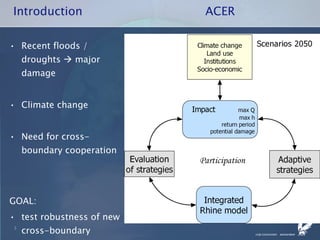
Introduction ACER Recent floods / droughts    major damage Climate change Need for cross-boundary cooperation GOAL:  test robustness of new cross-boundary adaptation strategies
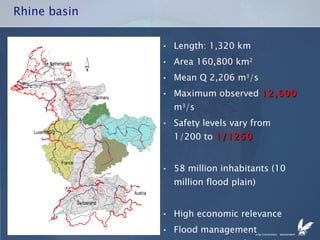
Rhine basin Length: 1,320 km Area 160,800 km 2 Mean Q 2,206 m 3 /s Maximum observed  12,600   m 3 /s  Safety levels vary from 1/200 to  1/1250 58 million inhabitants (10 million flood plain) High economic relevance Flood management strategies since beginning 19 th  century
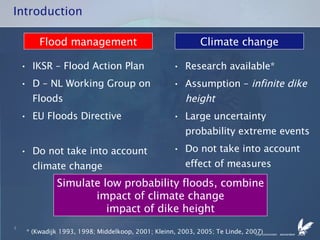
Introduction IKSR – Flood Action Plan D – NL Working Group on Floods EU Floods Directive Do not take into account climate change Research available* Assumption –  infinite dike height Large uncertainty probability extreme events Do not take into account effect of measures Flood management Climate change * (Kwadijk 1993, 1998; Middelkoop, 2001; Kleinn, 2003, 2005; Te Linde, 2007) Simulate low probability floods, combine impact of climate change impact of dike height
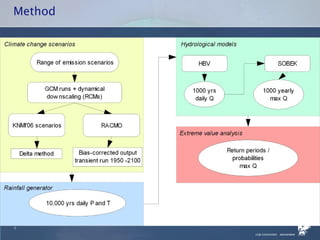
Method
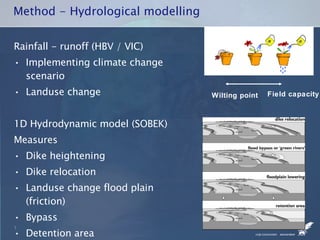
Method - Hydrological modelling Rainfall - runoff (HBV / VIC) Implementing climate change scenario Landuse change 1D Hydrodynamic model (SOBEK) Measures Dike heightening Dike relocation Landuse change flood plain (friction) Bypass Detention area Flooding (calibrated on 2D model) Field capacity Wilting point
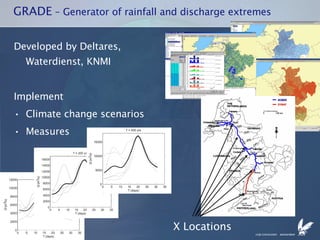
GRADE  – Generator of rainfall and discharge extremes Developed by Deltares, Waterdienst, KNMI Implement Climate change scenarios Measures X Locations
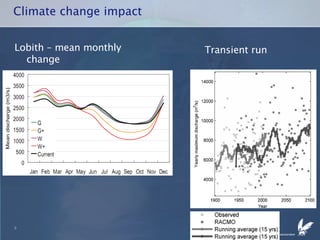
Climate change impact Lobith – mean monthly change Transient run
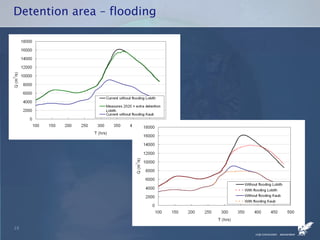
Detention area – flooding
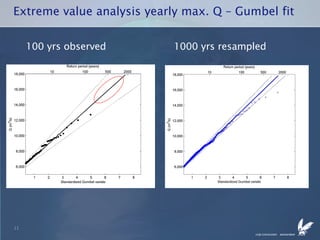
Extreme value analysis yearly max. Q – Gumbel fit 100 yrs observed 1000 yrs resampled
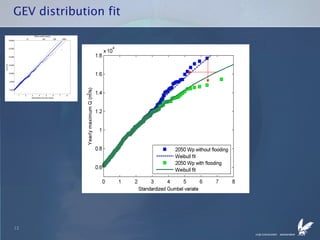
GEV distribution fit
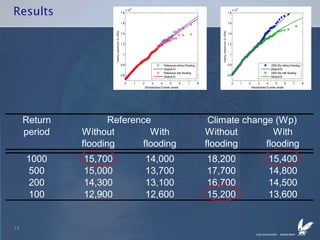
Results
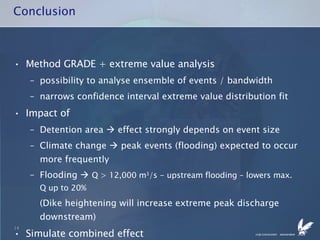
Conclusion Method GRADE + extreme value analysis possibility to analyse ensemble of events / bandwidth narrows confidence interval extreme value distribution fit Impact of Detention area    effect strongly depends on event size Climate change    peak events (flooding) expected to occur more frequently Flooding     Q > 12,000 m 3 /s - upstream flooding – lowers max. Q up to 20% (Dike heightening will increase extreme peak discharge downstream) Simulate combined effect
This reseach is part of a ‘Climate Changes Spatial Planning’ project Thank you Adaptive Capacity to Extreme events in the Rhine basin (ACER) More information on: www.klimaatvoorruimte.nl (english version) and www.adaptation.nl\acer [email_address]

Simulating flood-peak probability in the Rhine basin and the effect of climate change

  • 1.
    Simulating flood-peak probabilityin the Rhine basin and the effect of climate change Institute for Environmental Studies (IVM) Aline te Linde (IVM - VU / Deltares) Jeroen Aerts (IVM - VU) Oxford – October 2, 2008
  • 2.
    Outline Introduction Method- GRADE Results - Climate change scenarios - Extreme value analysis Conclusions
  • 3.
    Introduction ACER Recentfloods / droughts  major damage Climate change Need for cross-boundary cooperation GOAL: test robustness of new cross-boundary adaptation strategies
  • 4.
    Rhine basin Length:1,320 km Area 160,800 km 2 Mean Q 2,206 m 3 /s Maximum observed 12,600 m 3 /s Safety levels vary from 1/200 to 1/1250 58 million inhabitants (10 million flood plain) High economic relevance Flood management strategies since beginning 19 th century
  • 5.
    Introduction IKSR –Flood Action Plan D – NL Working Group on Floods EU Floods Directive Do not take into account climate change Research available* Assumption – infinite dike height Large uncertainty probability extreme events Do not take into account effect of measures Flood management Climate change * (Kwadijk 1993, 1998; Middelkoop, 2001; Kleinn, 2003, 2005; Te Linde, 2007) Simulate low probability floods, combine impact of climate change impact of dike height
  • 6.
  • 7.
    Method - Hydrologicalmodelling Rainfall - runoff (HBV / VIC) Implementing climate change scenario Landuse change 1D Hydrodynamic model (SOBEK) Measures Dike heightening Dike relocation Landuse change flood plain (friction) Bypass Detention area Flooding (calibrated on 2D model) Field capacity Wilting point
  • 8.
    GRADE –Generator of rainfall and discharge extremes Developed by Deltares, Waterdienst, KNMI Implement Climate change scenarios Measures X Locations
  • 9.
    Climate change impactLobith – mean monthly change Transient run
  • 10.
  • 11.
    Extreme value analysisyearly max. Q – Gumbel fit 100 yrs observed 1000 yrs resampled
  • 12.
  • 13.
  • 14.
    Conclusion Method GRADE+ extreme value analysis possibility to analyse ensemble of events / bandwidth narrows confidence interval extreme value distribution fit Impact of Detention area  effect strongly depends on event size Climate change  peak events (flooding) expected to occur more frequently Flooding  Q > 12,000 m 3 /s - upstream flooding – lowers max. Q up to 20% (Dike heightening will increase extreme peak discharge downstream) Simulate combined effect
  • 15.
    This reseach ispart of a ‘Climate Changes Spatial Planning’ project Thank you Adaptive Capacity to Extreme events in the Rhine basin (ACER) More information on: www.klimaatvoorruimte.nl (english version) and www.adaptation.nl\acer [email_address]