PrePared by:
Kind KiSHOR
Tribhuvan university
ITV
 ITV (interactive television) allows subscribers to access video
programs when they want and to interact with them.
 Requires a very high transmission rate and stringent QoS
guarantees.
 Demands point-to-point switched connections, good customer
services and excellent management for information sharing, billing
and security.
KIND@KISHOR
2
Introduction
1. A home terminal commonly known as the Set-Top Box (STB) or
Customer Premises Equipment (CPE).
2. An access network.
3. A network-based server.
4. A powerful user-friendly interface.
KIND@KISHOR
3
Components of ITV
 STB (or CPE) typically takes the form of a box sitting on the top
of the TV set.
 STB connects to both the television and an external
communication network using a subscriber drop or loop.
 When interactive services are offered, the complexity and cost of
the STB increases.
 A service may require that more than one server be implemented,
or a server may implement more than one service.
KIND@KISHOR
4
Contd….
 ITV servers are a collection of computing, storage and
communications equipment interactive video services.
 Two key components of the server technology are;
 Logical organization of the multimedia samples in a file system or
database
 Techniques by which media components can be continuously
recorded or played back from the server.
 The multimedia database server must ensure that the recording and
presentation follow a real-time data rate.
KIND@KISHOR
5
Contd….
 VoD is an important ITV service.
 It provides electronic video-rental services across the broad band
network.
 Customers are allowed to select programs from remote massive
video archives, view them at the time they want without leaving the
comfort of their homes and interact with the programs.
 A VoD system that satisfies requirements is called a true VoD
system and is said to provide true VoD services.
 Otherwise it is called a near VoD system.
KIND@KISHOR
6
VoD (Video on Demand)
 One way to allow true VoD services is to have a dedicated video-
stream for each customer.
 This is expensive and wasteful of the system resources because the
system has to deliver multiple identical copies to the multiple users
at the same time.
 To reduce this cost, batching may be used.
 A protocol called Split-and-Merge (SAM) has been proposed to
provide true VoD.
KIND@KISHOR
7
True VoD
KIND@KISHOR
8
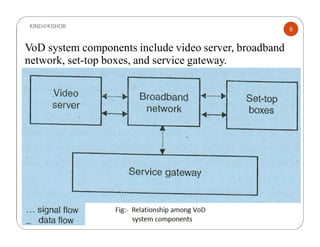
VoD system components include video server, broadband
network, set-top boxes, and service gateway.
 It consists of massive storage and media controllers.
 It stores a large number of digitized videos and serves a
considerable number of simultaneous video requests to the same
or to different videos on demand.
 It may be located at the local or regional switch of the network
provider or at remote information archives.
 Its basic functions include request handling, random access, and
user interactions.
KIND@KISHOR
9
Video Server
 It delivers video programs from the video server to the customers.
 It must have a very high data rate and must satisfy the real-time
delivery constraints of video traffic.
 It consists of two major components:
 the backbone network with high-speed switches, and
 the local access network.
 The backbone network links the remote video server at
geographically dispersed locations and the regional, national or
international information archives.
KIND@KISHOR
Broadband Network
10
 It serves as the bridge between the subscribers and the system.
 The major functions are receiving the incoming videostreams,
demodulating, demultiplexing and decoding the signals,
performing the necessary signal conversion, and sending outgoing
control messages.
 It must accommodate the heterogeneity of technologies and
formats from various controls to services.
 Its usefulness is in its adaptation to the diversity of access
networks, service providers, applications and user interfaces.
KIND@KISHOR
11
Set-top-boxes (STB)
 It may be integrated with an access node or may be a separate element in
the network.
 Its main functions are:
 Directory services to provide menu browsing and program scheduling.
 Mapping from service identity to corresponding location and program
provider.
 Controlling, coordinating, and signaling for multimedia session
establishment, maintenance, and disconnection.
 System management.
 Subscriber profile maintenance and billing.
 Secure communication to prevent unauthorized access.
KIND@KISHOR
12
Service Gateway
 Video server placement.
 Servers need to be changed periodically.
 Requires more communication and storage costs.
 Complexity in managing servers.
KIND@KISHOR
13
Issues of VoD
The End
KIND@KISHOR
14
THANK YOU
The house is open for queries.

ITV ( Interactive Television )

  • 1.
  • 2.
     ITV (interactivetelevision) allows subscribers to access video programs when they want and to interact with them.  Requires a very high transmission rate and stringent QoS guarantees.  Demands point-to-point switched connections, good customer services and excellent management for information sharing, billing and security. KIND@KISHOR 2 Introduction
  • 3.
    1. A hometerminal commonly known as the Set-Top Box (STB) or Customer Premises Equipment (CPE). 2. An access network. 3. A network-based server. 4. A powerful user-friendly interface. KIND@KISHOR 3 Components of ITV
  • 4.
     STB (orCPE) typically takes the form of a box sitting on the top of the TV set.  STB connects to both the television and an external communication network using a subscriber drop or loop.  When interactive services are offered, the complexity and cost of the STB increases.  A service may require that more than one server be implemented, or a server may implement more than one service. KIND@KISHOR 4 Contd….
  • 5.
     ITV serversare a collection of computing, storage and communications equipment interactive video services.  Two key components of the server technology are;  Logical organization of the multimedia samples in a file system or database  Techniques by which media components can be continuously recorded or played back from the server.  The multimedia database server must ensure that the recording and presentation follow a real-time data rate. KIND@KISHOR 5 Contd….
  • 6.
     VoD isan important ITV service.  It provides electronic video-rental services across the broad band network.  Customers are allowed to select programs from remote massive video archives, view them at the time they want without leaving the comfort of their homes and interact with the programs.  A VoD system that satisfies requirements is called a true VoD system and is said to provide true VoD services.  Otherwise it is called a near VoD system. KIND@KISHOR 6 VoD (Video on Demand)
  • 7.
     One wayto allow true VoD services is to have a dedicated video- stream for each customer.  This is expensive and wasteful of the system resources because the system has to deliver multiple identical copies to the multiple users at the same time.  To reduce this cost, batching may be used.  A protocol called Split-and-Merge (SAM) has been proposed to provide true VoD. KIND@KISHOR 7 True VoD
  • 8.
    KIND@KISHOR 8 VoD system componentsinclude video server, broadband network, set-top boxes, and service gateway.
  • 9.
     It consistsof massive storage and media controllers.  It stores a large number of digitized videos and serves a considerable number of simultaneous video requests to the same or to different videos on demand.  It may be located at the local or regional switch of the network provider or at remote information archives.  Its basic functions include request handling, random access, and user interactions. KIND@KISHOR 9 Video Server
  • 10.
     It deliversvideo programs from the video server to the customers.  It must have a very high data rate and must satisfy the real-time delivery constraints of video traffic.  It consists of two major components:  the backbone network with high-speed switches, and  the local access network.  The backbone network links the remote video server at geographically dispersed locations and the regional, national or international information archives. KIND@KISHOR Broadband Network 10
  • 11.
     It servesas the bridge between the subscribers and the system.  The major functions are receiving the incoming videostreams, demodulating, demultiplexing and decoding the signals, performing the necessary signal conversion, and sending outgoing control messages.  It must accommodate the heterogeneity of technologies and formats from various controls to services.  Its usefulness is in its adaptation to the diversity of access networks, service providers, applications and user interfaces. KIND@KISHOR 11 Set-top-boxes (STB)
  • 12.
     It maybe integrated with an access node or may be a separate element in the network.  Its main functions are:  Directory services to provide menu browsing and program scheduling.  Mapping from service identity to corresponding location and program provider.  Controlling, coordinating, and signaling for multimedia session establishment, maintenance, and disconnection.  System management.  Subscriber profile maintenance and billing.  Secure communication to prevent unauthorized access. KIND@KISHOR 12 Service Gateway
  • 13.
     Video serverplacement.  Servers need to be changed periodically.  Requires more communication and storage costs.  Complexity in managing servers. KIND@KISHOR 13 Issues of VoD
  • 14.
    The End KIND@KISHOR 14 THANK YOU Thehouse is open for queries.