IPTV
Concept Stage Presentation
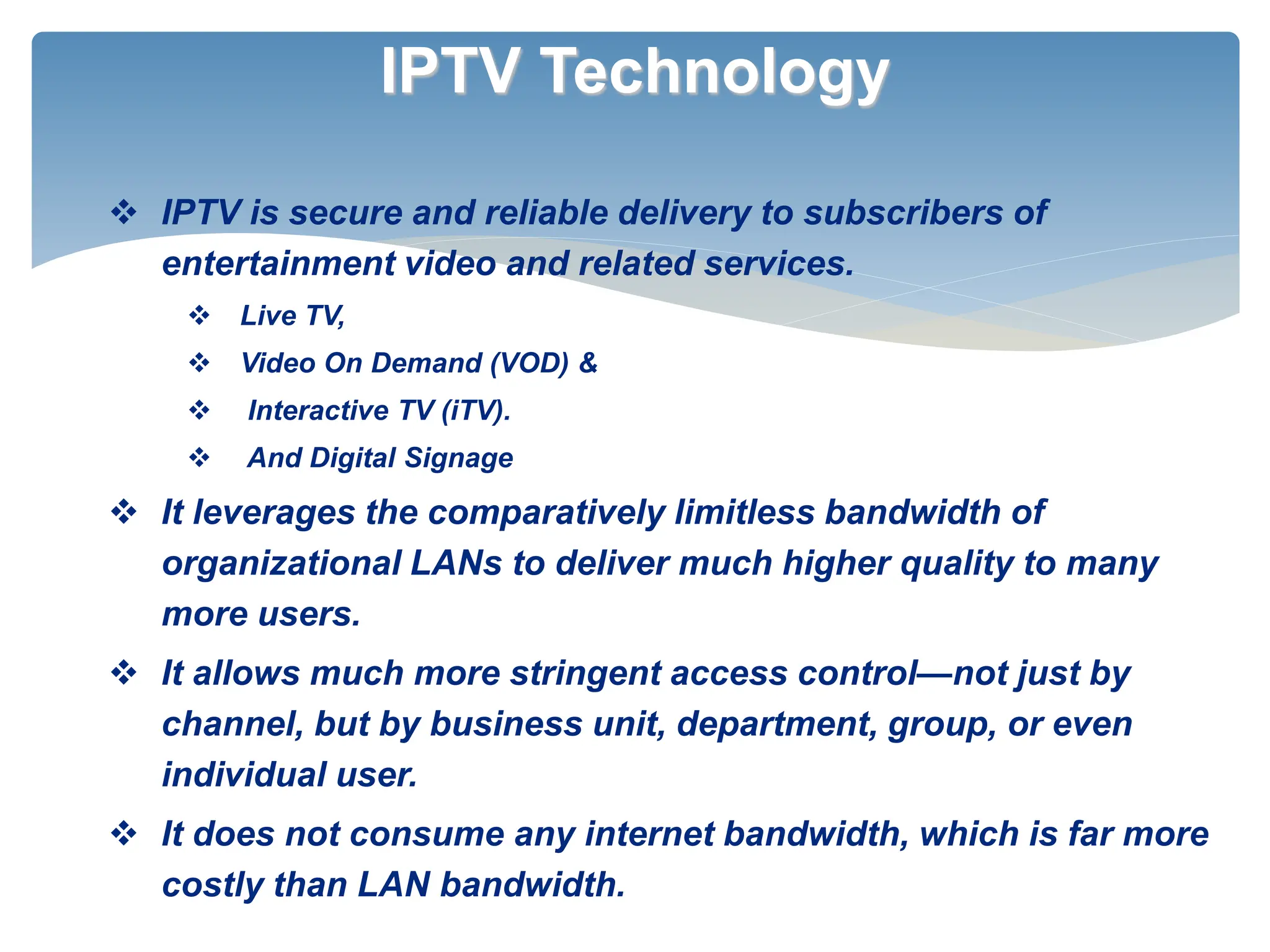
 IPTV is secure and reliable delivery to subscribers of
entertainment video and related services.
 Live TV,
 Video On Demand (VOD) &
 Interactive TV (iTV).
 And Digital Signage
 It leverages the comparatively limitless bandwidth of
organizational LANs to deliver much higher quality to many
more users.
 It allows much more stringent access control—not just by
channel, but by business unit, department, group, or even
individual user.
 It does not consume any internet bandwidth, which is far more
costly than LAN bandwidth.
IPTV Technology
IPTV Guidelines
 Day one 200 Endpoints (Scalable able up to a
maximum of 400 nodes)
 Standard Definition 10 Channels
 High Definition 10 Channels
 Total number of channels 20 (Scalable up to a maximum of 50
Channels)
 Health Club will use the existing RF based endpoints
 Satellite Dish farm on the Roof to be used for DVB-S feed.
 IPTV headend shall be located in the Data Center.
 IT infrastructure shall be utilized for distribution of IPTV.
 Corporate Info Channel shall be used to drive the Digital Signage.
IPTV Technology
Encoding & Network Utilization
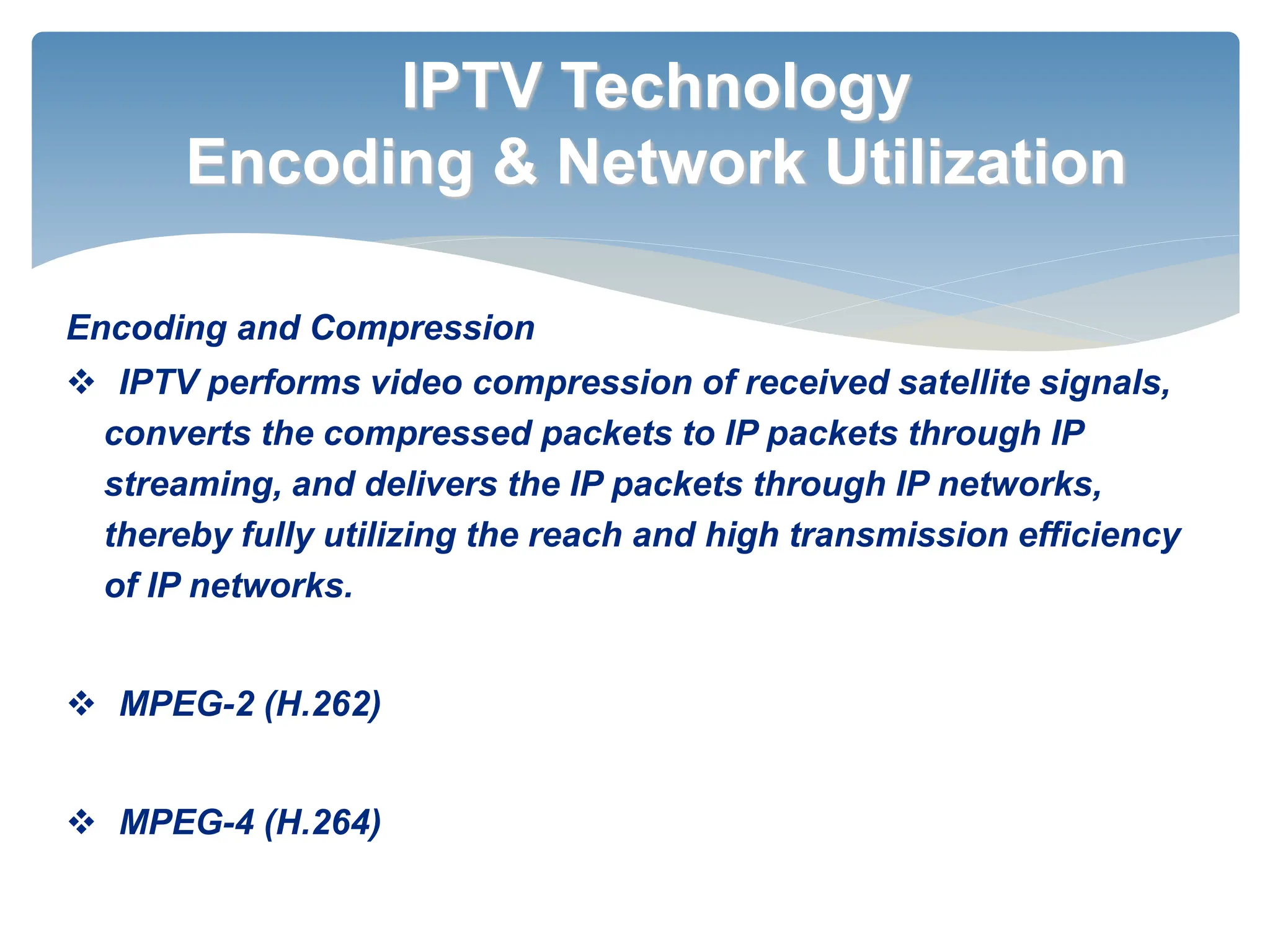
Encoding and Compression
 IPTV performs video compression of received satellite signals,
converts the compressed packets to IP packets through IP
streaming, and delivers the IP packets through IP networks,
thereby fully utilizing the reach and high transmission efficiency
of IP networks.
 MPEG-2 (H.262)
 MPEG-4 (H.264)
Services and Bandwidths
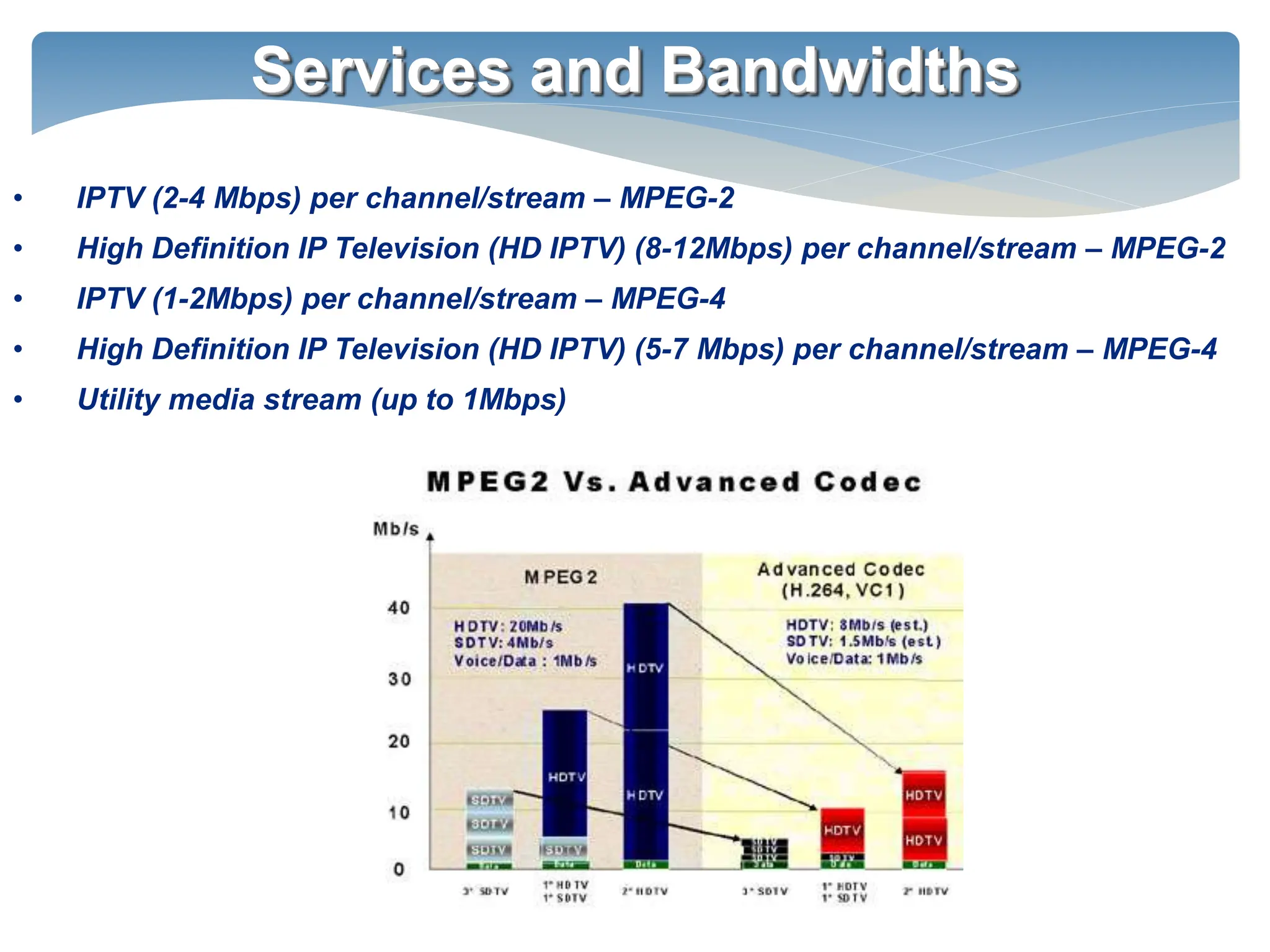
• IPTV (2-4 Mbps) per channel/stream – MPEG-2
• High Definition IP Television (HD IPTV) (8-12Mbps) per channel/stream – MPEG-2
• IPTV (1-2Mbps) per channel/stream – MPEG-4
• High Definition IP Television (HD IPTV) (5-7 Mbps) per channel/stream – MPEG-4
• Utility media stream (up to 1Mbps)
Bandwidth Computation MPEG-2
MPEG-2 Video for Backbone
No of Channels
Band width /
Channel Network Utilization
MPEG -2 Standard
Definition 5 4 Mbps 20 Mbps
MPEG -2 High Definition 15 12 Mbps 180 Mbps
Overall network utilization for backbone 200 Mbps
MPEG-2 Video for End point device (Assuming 2 SD & 2 HD channels simultaneously
viewed / node)
No of Channels
Band width /
Channel Network Utilization
MPEG -2 Standard
Definition 2 4 Mbps 8 Mbps
MPEG -2 High Definition 2 12 Mbps 24 Mbps
Overall network utilization for end point device 32 Mbps
Bandwidth when all 200 nodes are fully active (Note that it is unlikely
that all nodes will require simultaneous viewing of 4 channels)
6400 Mbps
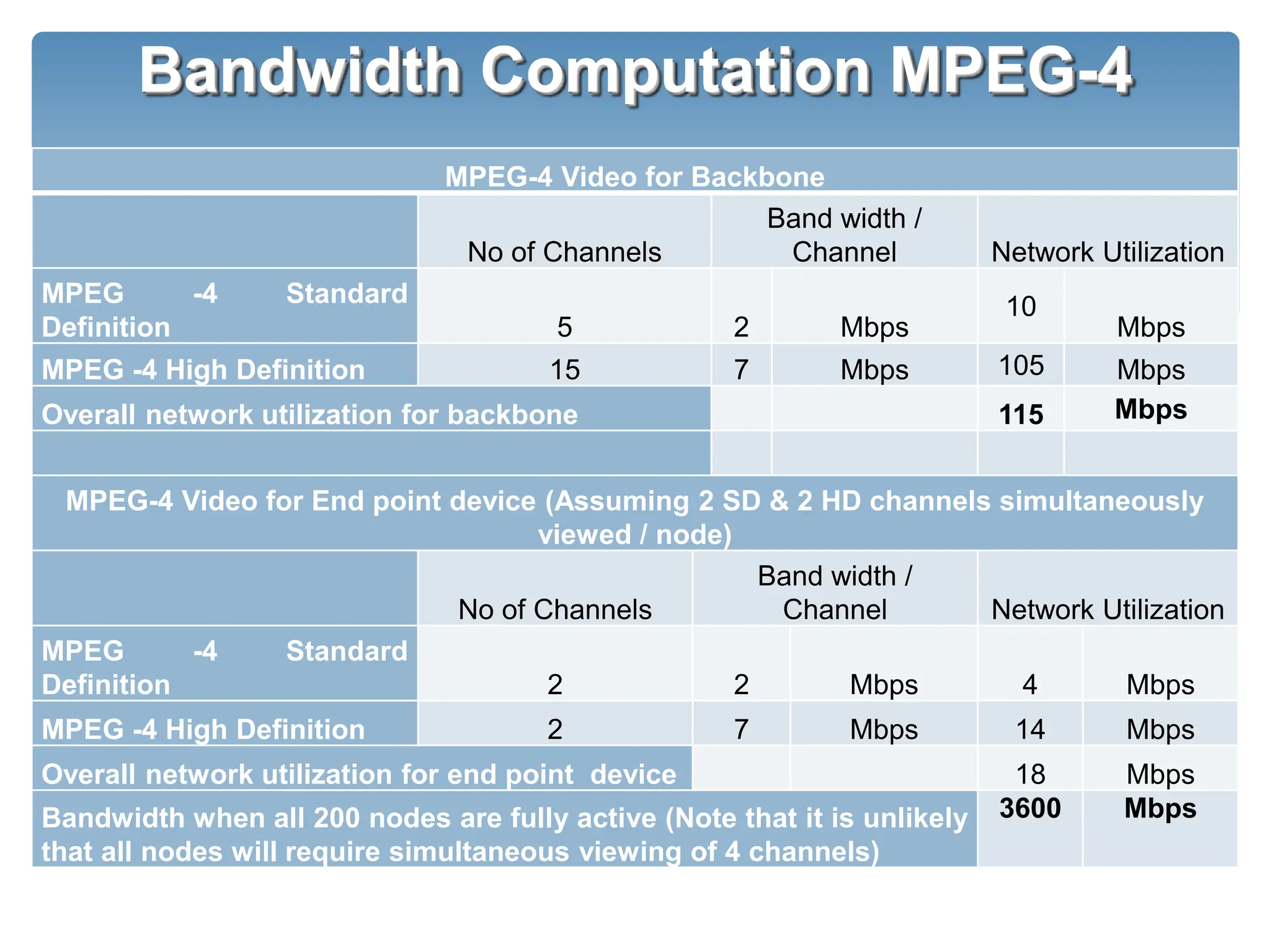
Bandwidth Computation MPEG-4
MPEG-4 Video for Backbone
No of Channels
Band width /
Channel Network Utilization
MPEG -4 Standard
Definition 5 2 Mbps
10
Mbps
MPEG -4 High Definition 15 7 Mbps 105 Mbps
Overall network utilization for backbone 115 Mbps
MPEG-4 Video for End point device (Assuming 2 SD & 2 HD channels simultaneously
viewed / node)
No of Channels
Band width /
Channel Network Utilization
MPEG -4 Standard
Definition 2 2 Mbps 4 Mbps
MPEG -4 High Definition 2 7 Mbps 14 Mbps
Overall network utilization for end point device 18 Mbps
Bandwidth when all 200 nodes are fully active (Note that it is unlikely
that all nodes will require simultaneous viewing of 4 channels)
3600 Mbps
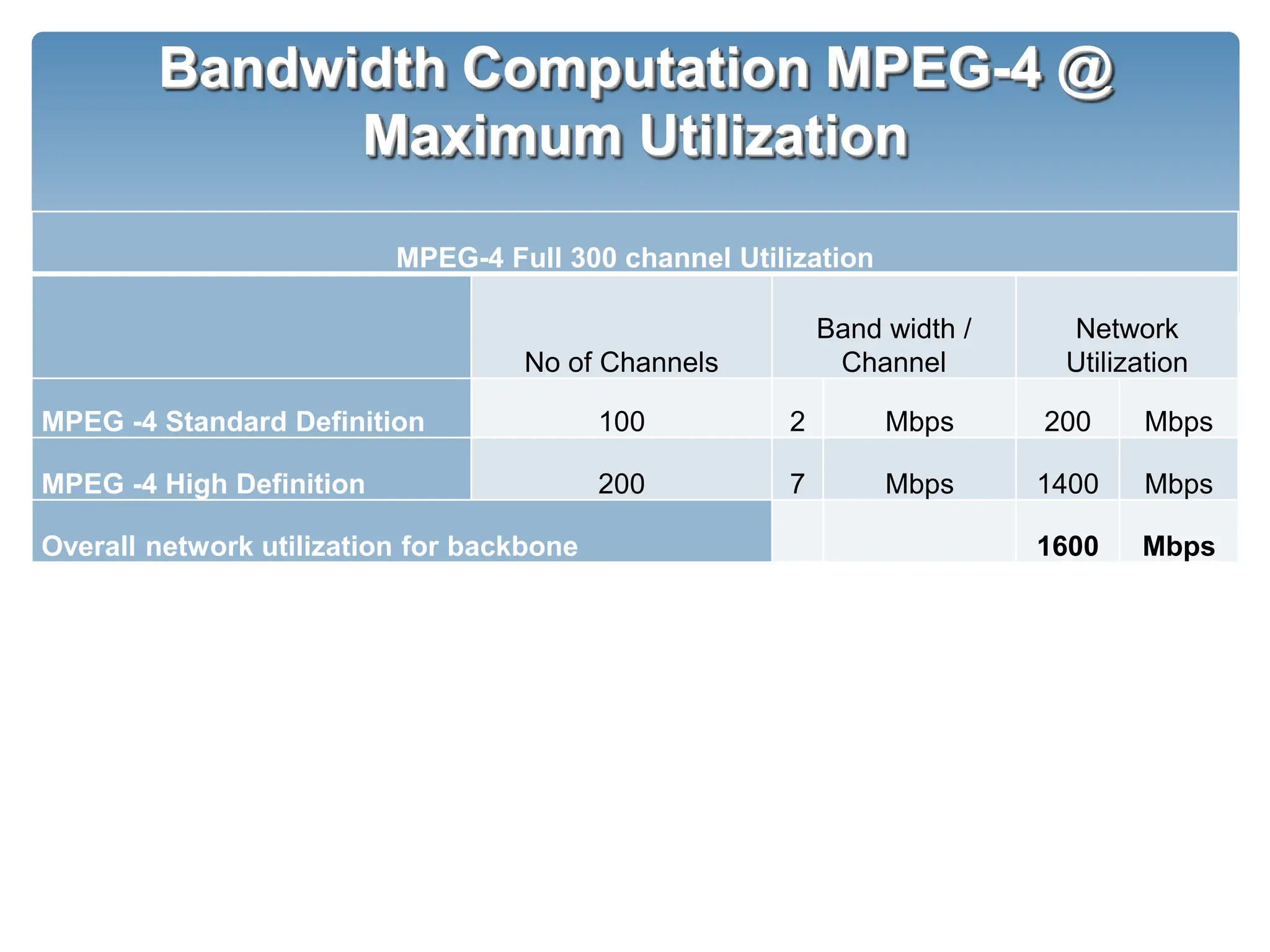
Bandwidth Computation MPEG-4 @
Maximum Utilization
MPEG-4 Full 300 channel Utilization
No of Channels
Band width /
Channel
Network
Utilization
MPEG -4 Standard Definition 100 2 Mbps 200 Mbps
MPEG -4 High Definition 200 7 Mbps 1400 Mbps
Overall network utilization for backbone 1600 Mbps
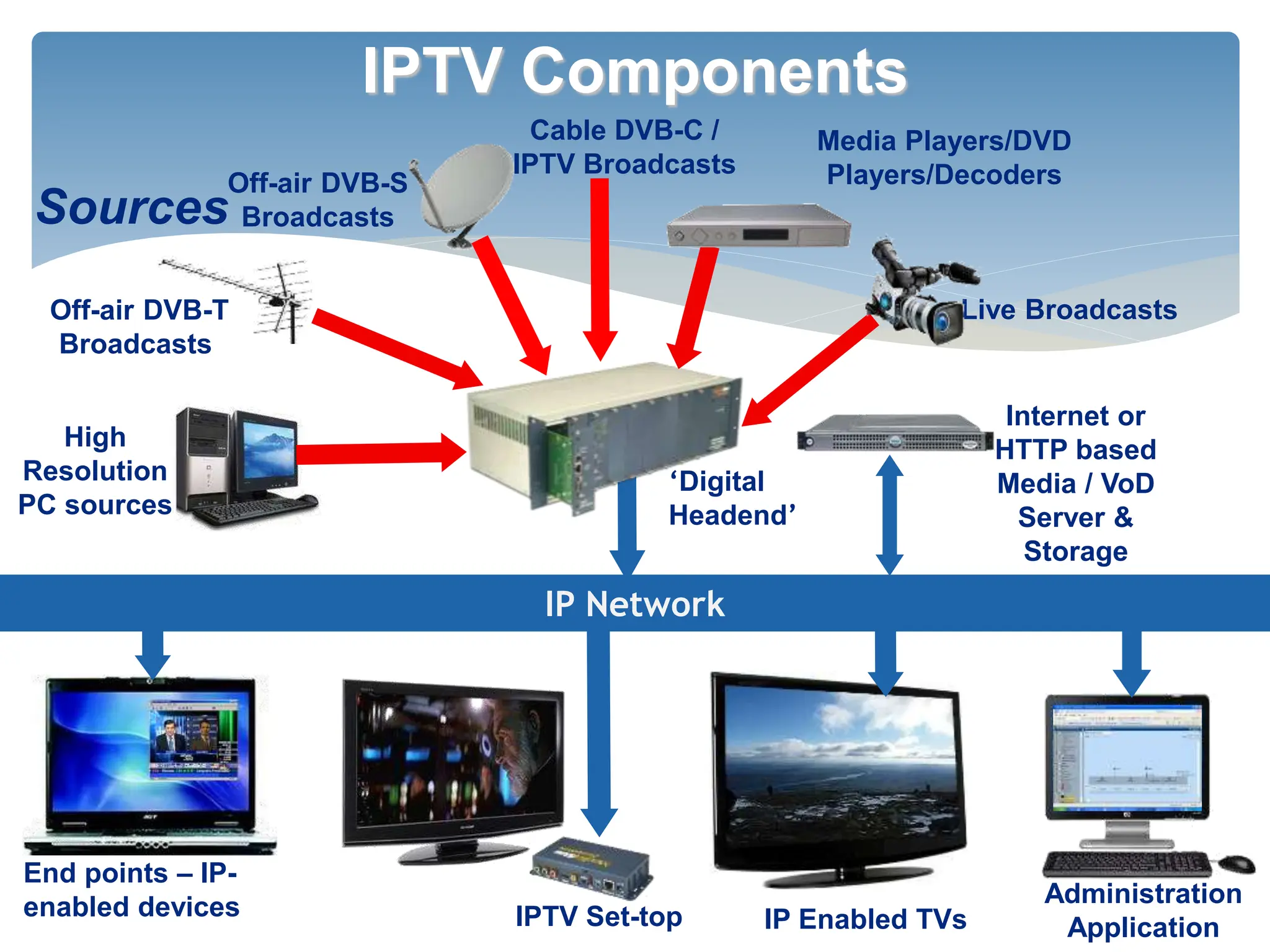
IPTV Components
Administration
Application
Media Players/DVD
Players/Decoders
Off-air DVB-S
Broadcasts
Live Broadcasts
Internet or
HTTP based
Media / VoD
Server &
Storage
‘Digital
Headend’
High
Resolution
PC sources
Cable DVB-C /
IPTV Broadcasts
IPTV Set-top
Sources
End points – IP-
enabled devices
Off-air DVB-T
Broadcasts
IP Enabled TVs
IP Network
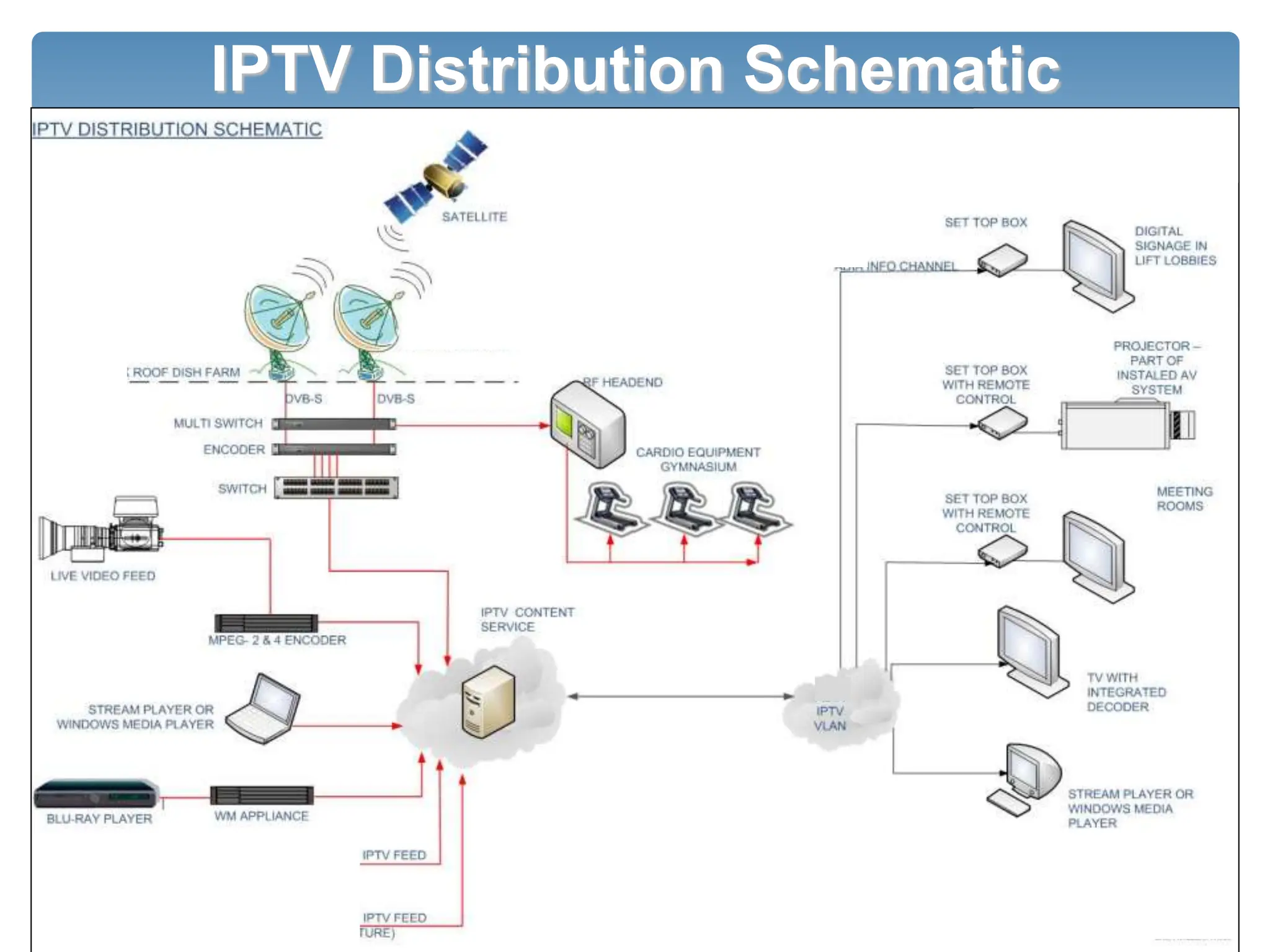
IPTV Distribution Schematic
Migration Strategy-
Scope of Services
• Review of Existing Systems - Completed
• Technology planning
- Definition of requirements
- Deployment options
- Systems demonstrations
• Migration plan
• Specification and Tender management
• Implementation
Migration Strategy-
Roles & Responsibilities
• Client
- Stakeholders – project strategy, sign-off and content
- Network team – project coordination
- Facilities management – deployment and support
• Consultant
- System budgeting and design
- Design coordination and migration planning with ADIA
- Implementation coordination and project management
• Vendor
- Shop drawings and implementation
- Commissioning
- Support & Maintenance
Migration Strategy- Deployment
 IPTV Integrator will develop Working Drawings
 Assemble the IPTV Rack offsite
 Offsite testing and verification
 Commissioning the system onsite
 Monitor Network utilization
 Phase I – Cafeterias, Public Spaces and Senior Management
Offices.
 Phase 2 – Conference and Meeting Spaces
 Phase 3 – Digital Signage
 IPTV Integrator will develop As Built Drawings
 Support & Maintenance

IPTV Concept Presentation Bandwidth .pptx

  • 1.
  • 2.
     IPTV issecure and reliable delivery to subscribers of entertainment video and related services.  Live TV,  Video On Demand (VOD) &  Interactive TV (iTV).  And Digital Signage  It leverages the comparatively limitless bandwidth of organizational LANs to deliver much higher quality to many more users.  It allows much more stringent access control—not just by channel, but by business unit, department, group, or even individual user.  It does not consume any internet bandwidth, which is far more costly than LAN bandwidth. IPTV Technology
  • 3.
    IPTV Guidelines  Dayone 200 Endpoints (Scalable able up to a maximum of 400 nodes)  Standard Definition 10 Channels  High Definition 10 Channels  Total number of channels 20 (Scalable up to a maximum of 50 Channels)  Health Club will use the existing RF based endpoints  Satellite Dish farm on the Roof to be used for DVB-S feed.  IPTV headend shall be located in the Data Center.  IT infrastructure shall be utilized for distribution of IPTV.  Corporate Info Channel shall be used to drive the Digital Signage.
  • 4.
    IPTV Technology Encoding &Network Utilization Encoding and Compression  IPTV performs video compression of received satellite signals, converts the compressed packets to IP packets through IP streaming, and delivers the IP packets through IP networks, thereby fully utilizing the reach and high transmission efficiency of IP networks.  MPEG-2 (H.262)  MPEG-4 (H.264)
  • 5.
    Services and Bandwidths •IPTV (2-4 Mbps) per channel/stream – MPEG-2 • High Definition IP Television (HD IPTV) (8-12Mbps) per channel/stream – MPEG-2 • IPTV (1-2Mbps) per channel/stream – MPEG-4 • High Definition IP Television (HD IPTV) (5-7 Mbps) per channel/stream – MPEG-4 • Utility media stream (up to 1Mbps)
  • 6.
    Bandwidth Computation MPEG-2 MPEG-2Video for Backbone No of Channels Band width / Channel Network Utilization MPEG -2 Standard Definition 5 4 Mbps 20 Mbps MPEG -2 High Definition 15 12 Mbps 180 Mbps Overall network utilization for backbone 200 Mbps MPEG-2 Video for End point device (Assuming 2 SD & 2 HD channels simultaneously viewed / node) No of Channels Band width / Channel Network Utilization MPEG -2 Standard Definition 2 4 Mbps 8 Mbps MPEG -2 High Definition 2 12 Mbps 24 Mbps Overall network utilization for end point device 32 Mbps Bandwidth when all 200 nodes are fully active (Note that it is unlikely that all nodes will require simultaneous viewing of 4 channels) 6400 Mbps
  • 7.
    Bandwidth Computation MPEG-4 MPEG-4Video for Backbone No of Channels Band width / Channel Network Utilization MPEG -4 Standard Definition 5 2 Mbps 10 Mbps MPEG -4 High Definition 15 7 Mbps 105 Mbps Overall network utilization for backbone 115 Mbps MPEG-4 Video for End point device (Assuming 2 SD & 2 HD channels simultaneously viewed / node) No of Channels Band width / Channel Network Utilization MPEG -4 Standard Definition 2 2 Mbps 4 Mbps MPEG -4 High Definition 2 7 Mbps 14 Mbps Overall network utilization for end point device 18 Mbps Bandwidth when all 200 nodes are fully active (Note that it is unlikely that all nodes will require simultaneous viewing of 4 channels) 3600 Mbps
  • 8.
    Bandwidth Computation MPEG-4@ Maximum Utilization MPEG-4 Full 300 channel Utilization No of Channels Band width / Channel Network Utilization MPEG -4 Standard Definition 100 2 Mbps 200 Mbps MPEG -4 High Definition 200 7 Mbps 1400 Mbps Overall network utilization for backbone 1600 Mbps
  • 9.
    IPTV Components Administration Application Media Players/DVD Players/Decoders Off-airDVB-S Broadcasts Live Broadcasts Internet or HTTP based Media / VoD Server & Storage ‘Digital Headend’ High Resolution PC sources Cable DVB-C / IPTV Broadcasts IPTV Set-top Sources End points – IP- enabled devices Off-air DVB-T Broadcasts IP Enabled TVs IP Network
  • 10.
  • 11.
    Migration Strategy- Scope ofServices • Review of Existing Systems - Completed • Technology planning - Definition of requirements - Deployment options - Systems demonstrations • Migration plan • Specification and Tender management • Implementation
  • 12.
    Migration Strategy- Roles &Responsibilities • Client - Stakeholders – project strategy, sign-off and content - Network team – project coordination - Facilities management – deployment and support • Consultant - System budgeting and design - Design coordination and migration planning with ADIA - Implementation coordination and project management • Vendor - Shop drawings and implementation - Commissioning - Support & Maintenance
  • 13.
    Migration Strategy- Deployment IPTV Integrator will develop Working Drawings  Assemble the IPTV Rack offsite  Offsite testing and verification  Commissioning the system onsite  Monitor Network utilization  Phase I – Cafeterias, Public Spaces and Senior Management Offices.  Phase 2 – Conference and Meeting Spaces  Phase 3 – Digital Signage  IPTV Integrator will develop As Built Drawings  Support & Maintenance