Iterative adaptive compensation of modeling
uncertainties in emission control of freeway
                    traffic


                   József K. Tar, Imre J. Rudas,
                  László Nádai, Teréz A. Várkonyi
                              Óbuda University,
                    H-1034 Budapest, Bécsi út 96/B, Hungary


  19th ITS World Congress, 22-26 October 2012, Vienna, Austria
Motivations
• Lyapunov’s 2nd Method is a very sophisticated and complicated
  model-based technique for designing globally (sometimes
  asymptotically) stable controllers.
• Its use is dubious if the analytical form of the available system
  model is ambiguous besides the parameter uncertainties.
• It needs designers well skilled in Math. Finding an appropriate
  Lyapunov function is an art.
• It works with a great number of non-optimally set control
  parameters. Parameter optimization may happen via ample
  computations (e.g. by GAs or Evolutionary Computation)
                           Aims
It is expedient to find less complicated design methodology that
does not need „artistic skills” by the designer;
• contains little number of arbitrary parameters and more easy to
    be „automated” by standardized procedures;
• Doesn’t need exact analytical system model (Freeway Traffic).
Macroscopic Dynamic Model of Freeway Traffic
• Deals with average traffic data as vehicle density, mean
  velocity; No information is contained for individual vehicles.
• The analytical model is based on the flow of compressible fluid
  and discretization of the spatial variable.
• Conservation of the vehicles is guaranteed by the continuity
  equation.
• The model’s form is dubious (backward, forward or central
  differences may be used for discretization).
• The model’s parameters may depend on various
  circumstances, they are only of approximate nature.
• The resulting model necessarily provides highly nonlinear
  coupled differential equations for the variables of the individual
  segments;
• The segments are embedded in an environment that
  determines the ingress flow rates and they must „swallow” their
  inputs.
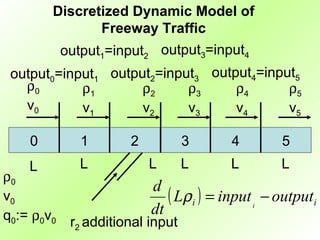
Discretized Dynamic Model of
               Freeway Traffic
         output1=input2 output3=input4
 output0=input1 output2=input3 output4=input5
   ρ0       ρ1       ρ2     ρ3     ρ4      ρ5
   v0       v1       v2     v3     v4      v5

    0        1        2       3        4        5
    L        L            L   L        L       L
ρ0
                        d
v0                         ( Lρi ) = input i − outputi
                        dt
q0:= ρ0v0 r additional input
           2
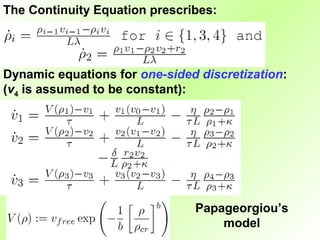
The Continuity Equation prescribes:


Dynamic equations for one-sided discretization:
(v4 is assumed to be constant):


                               Papageorgiou’s
                                   model
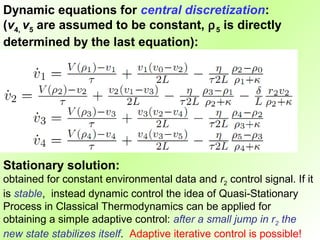
Dynamic equations for central discretization:
(v4, v5 are assumed to be constant, ρ 5 is directly
determined by the last equation):


Stationary solution:
obtained for constant environmental data and r2 control signal. If it
is stable, instead dynamic control the idea of Quasi-Stationary
Process in Classical Thermodynamics can be applied for
obtaining a simple adaptive control: after a small jump in r2 the
new state stabilizes itself. Adaptive iterative control is possible!
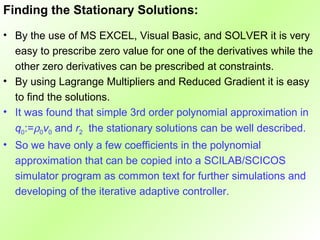
Finding the Stationary Solutions:
• By the use of MS EXCEL, Visual Basic, and SOLVER it is very
  easy to prescribe zero value for one of the derivatives while the
  other zero derivatives can be prescribed at constraints.
• By using Lagrange Multipliers and Reduced Gradient it is easy
  to find the solutions.
• It was found that simple 3rd order polynomial approximation in
  q0:=ρ0v0 and r2 the stationary solutions can be well described.
• So we have only a few coefficients in the polynomial
  approximation that can be copied into a SCILAB/SCICOS
  simulator program as common text for further simulations and
  developing of the iterative adaptive controller.
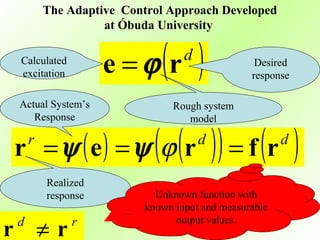
The Adaptive Control Approach Developed
                      at Óbuda University

    Calculated
    excitation         e =ϕ r  ( )  d              Desired
                                                  response

    Actual System’s              Rough system
       Response                     model


    r = ψ ( e) = ψ ϕ r
        r
                              ( ( ) ) = f (r )
                                        d                d

            Realized
            response          Unknown function with
                            known input and measurable

            ≠r
    d            r                output values.
r
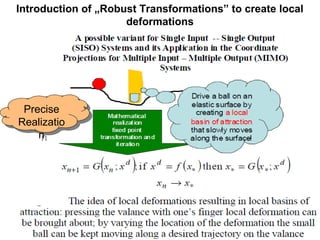
Introduction of „Robust Transformations” to create local
                     deformations


 Precise
 Precise
Realizatio
Realizatio
    nn
A possibility is the utilization of the strongly saturated nature
     of sigmoid functions with σ(0)=0 for SISO systems

G ( r; r   d
               ) = ( r + K )[1 + B tanh ( A[ f ( r ) − r ]) ] − K       d


                      BAf ′( r )
G' = ( r + K )                               + [1 + B tanh ( A[ f ( r ) − r d ] ) ]
               cosh 2 ( A[ f ( r ) − r d ] )
False fixed point: G(-K;rd)=-K   Good fixed point: if f(r*)=rd then G(r*;rd)=r*

The derivative easily can be made small enough in the fixed point
to obtain convergent iteration:
                  G ' ( r∗ ) = ( r∗ + K ) BAf ′( r∗ ) + 1
For this purpose the manipulation of three adaptive control
parameters (A,B,K) is needed. The design of the control
parameters can be done in a few simple steps via simulation:
Convergence Issues: Contractive Mappings in
              Banach Spaces
Seeking the Fixed Point of the function g(x)
via iteration in the case of a contractive mapping:


                                      b                                b
g ′( x ) ≤ K < 1, g ( b ) − g ( a ) = ∫ g ′( t ) dt , g ( b ) − g ( a ) ≤ ∫ g ′( t ) dt ≤ K b − a
                                      a                                a


                      Cauchy Sequence in a Complete
                    Metric Space! It is convergent to some
                                   value u!
The fixed point u is the limit of the iteration:
g ( u ) − u ≤ g ( u ) − xn + xn − u ≤ g ( u ) − xn + xn − u = g ( u ) − g ( xn−1 ) + xn − u ≤
                                   ≤ K u − xn−1 + xn − u n→ 0
                                                          →∞
Design of the control parameters
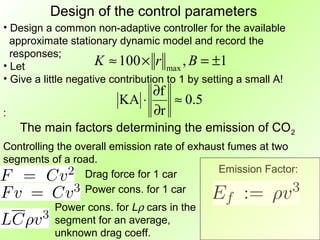
• Design a common non-adaptive controller for the available
  approximate stationary dynamic model and record the
  responses;
• Let                 K ≈ 100 × r max , B = ±1
• Give a little negative contribution to 1 by setting a small A!
                               ∂f
                          KA ⋅    ≈ 0.5
:                              ∂r
    The main factors determining the emission of CO 2
Controlling the overall emission rate of exhaust fumes at two
segments of a road.
                  Drag force for 1 car        Emission Factor:
                  Power cons. for 1 car
           Power cons. for Lρ cars in the
           segment for an average,
           unknown drag coeff.
The control task with contradiction
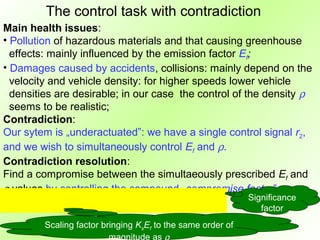
Main health issues:
• Pollution of hazardous materials and that causing greenhouse
  effects: mainly influenced by the emission factor Ef;
• Damages caused by accidents, collisions: mainly depend on the
  velocity and vehicle density: for higher speeds lower vehicle
  densities are desirable; in our case the control of the density ρ
  seems to be realistic;
Contradiction:
Our sytem is „underactuated”: we have a single control signal r2,
and we wish to simultaneously control Ef and ρ.
Contradiction resolution:
Find a compromise between the simultaeously prescribed Ef and
ρ values by controlling the compound „compromise factor”
                                                             Significance
                                                                factor
         Scaling factor bringing KsEf to the same order of
                          magnitude as ρ
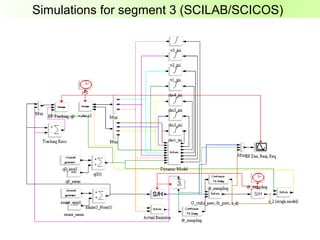
Simulations for segment 3 (SCILAB/SCICOS)
Non-adaptive tracking of ρ3 [vehicle/km] vs. time [h] (ξ=0)
                                                                                  v1, v2, v3 versus time [h]

     Nominal        Simulated                                 120
                                                              118


                                               [km/h]
                                                              116
                                                              114
                                                              112
                                                              110
                                                              108
                                                              106
                                                              104
                                                                                               1234
                                                                 0.0        0.5           1.0          1.5          2.0
                                                                              rho1, rho2, rho3, rho4 versus time [h]
                                                                    18


                                                     [vehicle/km]
                                                                    16
                                                                    14
                                                                    12
                                                                    10
                                                                     8
                                                                     6
                                                                     4
                                                                     2
                                                                     0
                                                                      0.0   0.5          1.0          1.5          2.0
                                                                                     r2 versus time [h]
                                                     1600


                                       [vehicle/h]
                                                     1400
                                                     1200
                                                     1000
                                                      800
                                                      600
                                                      400
                                                      200
                                                        0
                                                         0.0                0.5          1.0          1.5          2.0
               Sampling time: 20 s, K= −104, B=1, A=0.25×10⁻⁴, Ks=10−6


       This chart reveals the effects of
             the modeling errors
Adaptive tracking of ρ3 [vehicle/km] vs. time [h] (ξ=0)

    Nominal        Simulated


                                                                1234


              Sampling time: 20 s, K= −104, B=1, A=0.25×10⁻⁴, Ks=10−6


      This chart reveals the effects of
                  adaptivity
Tracking of Ef [vehicle×km2/h3] vs. time [h] (ξ=1)
          Nominal          Tracking of E.F. vs. time
1.6e+007
1.5e+007
1.4e+007                             Simulated                     Nominal
1.3e+007
1.2e+007
1.1e+007                                                                         Simulated
1.0e+007
9.0e+006
       0.0     0.2   0.4   0.6    0.8    1.0    1.2    1.4   1.6
                           Tracking error vs. time
 4e+006
 3e+006
 2e+006
 1e+006      Non-adaptive
 0e+000
-1e+006
                                                                      Adaptive
-2e+006
-3e+006
       0.0     0.2   0.4   0.6      0.8    1.0   1.2   1.4   1.6
                                 q0 vs. time

    450
    350
    250
    150

       0.0     0.2   0.4   0.6     0.8    1.0    1.2   1.4   1.6

                       Sampling time: 20 s, K= −104, B=1, A=0.25×10⁻⁴, Ks=10−6
Adaptive tracking of fcompr [vehicle/km] vs. time [h] (ξ=0)


  Simulated


                                       Required: adaptively deformed


                  Desired


       Sampling time: 20 s, K= −104, B=1, A=0.25×10⁻⁴, Ks=10−6
Adaptive tracking of fcompr [vehicle/km] vs. time [h] (ξ=0.4)
                             f o p d s r d s m l t d r q i e v r u t m [ ]
                              c m r e i e , i u a e , e u r d e s s i e h


               18


                               Desired
               16                                          Simulated
 v h c e k ]
[ e i l / m


               14


               12


               10


               8
                                         Required: adaptively deformed
                0 0
                 .                0 5
                                   .                1 0
                                                     .                 1 5
                                                                        .            2 0
                                                                                      .


                           Sampling time: 20 s, K= −104, B=1, A=0.25×10⁻⁴, Ks=10−6
Conclusions
• Commonly available and cheap software/hardware sets seem
  to be satisfactory for the design of a Robust Fixed Point
  Transformation based iterative adaptive controller for freeway
  traffic using the stability of the stationary states.
• Simple 3rd order polynomial approximation in the main ingress
  and control rate seems to be satisfactory to well describe the
  stationary solutions.
• The real difficulties in finding appropriate compromises in multi
  objective optimization stem from the strongly nonlinear nature
  of the phenomenon under consideration.
• Considerations for bigger lumps (more segments)
   may be of interest.
                               Thank you for
                              your attention!!!

ITS World Congress :: Vienna, Oct 2012

  • 1.
    Iterative adaptive compensationof modeling uncertainties in emission control of freeway traffic József K. Tar, Imre J. Rudas, László Nádai, Teréz A. Várkonyi Óbuda University, H-1034 Budapest, Bécsi út 96/B, Hungary 19th ITS World Congress, 22-26 October 2012, Vienna, Austria
  • 2.
    Motivations • Lyapunov’s 2ndMethod is a very sophisticated and complicated model-based technique for designing globally (sometimes asymptotically) stable controllers. • Its use is dubious if the analytical form of the available system model is ambiguous besides the parameter uncertainties. • It needs designers well skilled in Math. Finding an appropriate Lyapunov function is an art. • It works with a great number of non-optimally set control parameters. Parameter optimization may happen via ample computations (e.g. by GAs or Evolutionary Computation) Aims It is expedient to find less complicated design methodology that does not need „artistic skills” by the designer; • contains little number of arbitrary parameters and more easy to be „automated” by standardized procedures; • Doesn’t need exact analytical system model (Freeway Traffic).
  • 3.
    Macroscopic Dynamic Modelof Freeway Traffic • Deals with average traffic data as vehicle density, mean velocity; No information is contained for individual vehicles. • The analytical model is based on the flow of compressible fluid and discretization of the spatial variable. • Conservation of the vehicles is guaranteed by the continuity equation. • The model’s form is dubious (backward, forward or central differences may be used for discretization). • The model’s parameters may depend on various circumstances, they are only of approximate nature. • The resulting model necessarily provides highly nonlinear coupled differential equations for the variables of the individual segments; • The segments are embedded in an environment that determines the ingress flow rates and they must „swallow” their inputs.
  • 4.
    Discretized Dynamic Modelof Freeway Traffic output1=input2 output3=input4 output0=input1 output2=input3 output4=input5 ρ0 ρ1 ρ2 ρ3 ρ4 ρ5 v0 v1 v2 v3 v4 v5 0 1 2 3 4 5 L L L L L L ρ0 d v0 ( Lρi ) = input i − outputi dt q0:= ρ0v0 r additional input 2
  • 5.
    The Continuity Equationprescribes: Dynamic equations for one-sided discretization: (v4 is assumed to be constant): Papageorgiou’s model
  • 6.
    Dynamic equations forcentral discretization: (v4, v5 are assumed to be constant, ρ 5 is directly determined by the last equation): Stationary solution: obtained for constant environmental data and r2 control signal. If it is stable, instead dynamic control the idea of Quasi-Stationary Process in Classical Thermodynamics can be applied for obtaining a simple adaptive control: after a small jump in r2 the new state stabilizes itself. Adaptive iterative control is possible!
  • 7.
    Finding the StationarySolutions: • By the use of MS EXCEL, Visual Basic, and SOLVER it is very easy to prescribe zero value for one of the derivatives while the other zero derivatives can be prescribed at constraints. • By using Lagrange Multipliers and Reduced Gradient it is easy to find the solutions. • It was found that simple 3rd order polynomial approximation in q0:=ρ0v0 and r2 the stationary solutions can be well described. • So we have only a few coefficients in the polynomial approximation that can be copied into a SCILAB/SCICOS simulator program as common text for further simulations and developing of the iterative adaptive controller.
  • 8.
    The Adaptive ControlApproach Developed at Óbuda University Calculated excitation e =ϕ r ( ) d Desired response Actual System’s Rough system Response model r = ψ ( e) = ψ ϕ r r ( ( ) ) = f (r ) d d Realized response Unknown function with known input and measurable ≠r d r output values. r
  • 9.
    Introduction of „RobustTransformations” to create local deformations Precise Precise Realizatio Realizatio nn
  • 10.
    A possibility isthe utilization of the strongly saturated nature of sigmoid functions with σ(0)=0 for SISO systems G ( r; r d ) = ( r + K )[1 + B tanh ( A[ f ( r ) − r ]) ] − K d BAf ′( r ) G' = ( r + K ) + [1 + B tanh ( A[ f ( r ) − r d ] ) ] cosh 2 ( A[ f ( r ) − r d ] ) False fixed point: G(-K;rd)=-K Good fixed point: if f(r*)=rd then G(r*;rd)=r* The derivative easily can be made small enough in the fixed point to obtain convergent iteration: G ' ( r∗ ) = ( r∗ + K ) BAf ′( r∗ ) + 1 For this purpose the manipulation of three adaptive control parameters (A,B,K) is needed. The design of the control parameters can be done in a few simple steps via simulation:
  • 11.
    Convergence Issues: ContractiveMappings in Banach Spaces Seeking the Fixed Point of the function g(x) via iteration in the case of a contractive mapping: b b g ′( x ) ≤ K < 1, g ( b ) − g ( a ) = ∫ g ′( t ) dt , g ( b ) − g ( a ) ≤ ∫ g ′( t ) dt ≤ K b − a a a Cauchy Sequence in a Complete Metric Space! It is convergent to some value u! The fixed point u is the limit of the iteration: g ( u ) − u ≤ g ( u ) − xn + xn − u ≤ g ( u ) − xn + xn − u = g ( u ) − g ( xn−1 ) + xn − u ≤ ≤ K u − xn−1 + xn − u n→ 0 →∞
  • 12.
    Design of thecontrol parameters • Design a common non-adaptive controller for the available approximate stationary dynamic model and record the responses; • Let K ≈ 100 × r max , B = ±1 • Give a little negative contribution to 1 by setting a small A! ∂f KA ⋅ ≈ 0.5 : ∂r The main factors determining the emission of CO 2 Controlling the overall emission rate of exhaust fumes at two segments of a road. Drag force for 1 car Emission Factor: Power cons. for 1 car Power cons. for Lρ cars in the segment for an average, unknown drag coeff.
  • 13.
    The control taskwith contradiction Main health issues: • Pollution of hazardous materials and that causing greenhouse effects: mainly influenced by the emission factor Ef; • Damages caused by accidents, collisions: mainly depend on the velocity and vehicle density: for higher speeds lower vehicle densities are desirable; in our case the control of the density ρ seems to be realistic; Contradiction: Our sytem is „underactuated”: we have a single control signal r2, and we wish to simultaneously control Ef and ρ. Contradiction resolution: Find a compromise between the simultaeously prescribed Ef and ρ values by controlling the compound „compromise factor” Significance factor Scaling factor bringing KsEf to the same order of magnitude as ρ
  • 14.
    Simulations for segment3 (SCILAB/SCICOS)
  • 15.
    Non-adaptive tracking ofρ3 [vehicle/km] vs. time [h] (ξ=0) v1, v2, v3 versus time [h] Nominal Simulated 120 118 [km/h] 116 114 112 110 108 106 104 1234 0.0 0.5 1.0 1.5 2.0 rho1, rho2, rho3, rho4 versus time [h] 18 [vehicle/km] 16 14 12 10 8 6 4 2 0 0.0 0.5 1.0 1.5 2.0 r2 versus time [h] 1600 [vehicle/h] 1400 1200 1000 800 600 400 200 0 0.0 0.5 1.0 1.5 2.0 Sampling time: 20 s, K= −104, B=1, A=0.25×10⁻⁴, Ks=10−6 This chart reveals the effects of the modeling errors
  • 16.
    Adaptive tracking ofρ3 [vehicle/km] vs. time [h] (ξ=0) Nominal Simulated 1234 Sampling time: 20 s, K= −104, B=1, A=0.25×10⁻⁴, Ks=10−6 This chart reveals the effects of adaptivity
  • 17.
    Tracking of Ef[vehicle×km2/h3] vs. time [h] (ξ=1) Nominal Tracking of E.F. vs. time 1.6e+007 1.5e+007 1.4e+007 Simulated Nominal 1.3e+007 1.2e+007 1.1e+007 Simulated 1.0e+007 9.0e+006 0.0 0.2 0.4 0.6 0.8 1.0 1.2 1.4 1.6 Tracking error vs. time 4e+006 3e+006 2e+006 1e+006 Non-adaptive 0e+000 -1e+006 Adaptive -2e+006 -3e+006 0.0 0.2 0.4 0.6 0.8 1.0 1.2 1.4 1.6 q0 vs. time 450 350 250 150 0.0 0.2 0.4 0.6 0.8 1.0 1.2 1.4 1.6 Sampling time: 20 s, K= −104, B=1, A=0.25×10⁻⁴, Ks=10−6
  • 18.
    Adaptive tracking offcompr [vehicle/km] vs. time [h] (ξ=0) Simulated Required: adaptively deformed Desired Sampling time: 20 s, K= −104, B=1, A=0.25×10⁻⁴, Ks=10−6
  • 19.
    Adaptive tracking offcompr [vehicle/km] vs. time [h] (ξ=0.4) f o p d s r d s m l t d r q i e v r u t m [ ] c m r e i e , i u a e , e u r d e s s i e h 18 Desired 16 Simulated v h c e k ] [ e i l / m 14 12 10 8 Required: adaptively deformed 0 0 . 0 5 . 1 0 . 1 5 . 2 0 . Sampling time: 20 s, K= −104, B=1, A=0.25×10⁻⁴, Ks=10−6
  • 20.
    Conclusions • Commonly availableand cheap software/hardware sets seem to be satisfactory for the design of a Robust Fixed Point Transformation based iterative adaptive controller for freeway traffic using the stability of the stationary states. • Simple 3rd order polynomial approximation in the main ingress and control rate seems to be satisfactory to well describe the stationary solutions. • The real difficulties in finding appropriate compromises in multi objective optimization stem from the strongly nonlinear nature of the phenomenon under consideration. • Considerations for bigger lumps (more segments) may be of interest. Thank you for your attention!!!