Geno Church
| Brains On Fire
John Moore 

| Brand Autopsy
The
Latest &
Greatest
All this shit...
makes sense
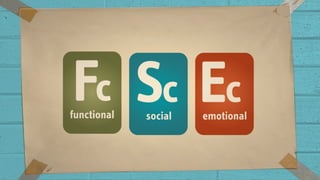
Functional.
Social.
Emotional.
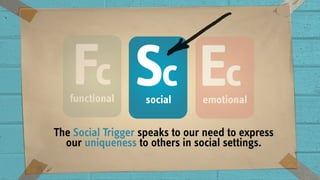
The Social Trigger speaks to our need to express
our uniqueness to others in social settings.
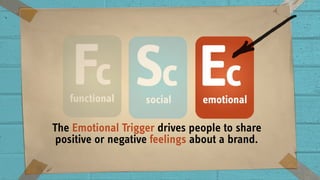
The Emotional Trigger drives people to share
positive or negative feelings about a brand.
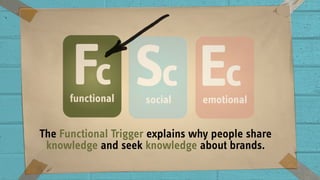
The Functional Trigger explains why people share
knowledge and seek knowledge about brands.
People rely more 

on "word of mouth"
for brands that are
new and or highly
complex.
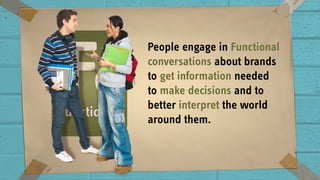
People engage in Functional
conversations about brands
to get information needed
to make decisions and to
better interpret the world
around them.
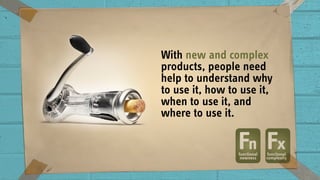
With new and complex
products, people need
help to understand why
to use it, how to use it,
when to use it, and
where to use it.
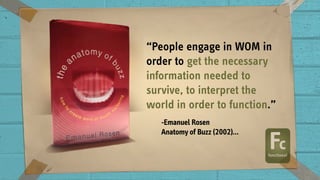
“People engage in WOM in
order to get the necessary
information needed to
survive, to interpret the
world in order to function.”
-Emanuel Rosen 

Anatomy of Buzz (2002)…
We naturally talk to function.
astory
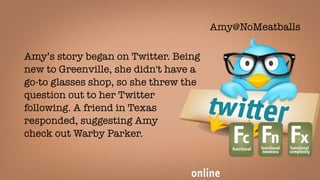
Amy’s story began on Twitter. Being
new to Greenville, she didn't have a
go-to glasses shop, so she threw the
question out to her Twitter
following. A friend in Texas
responded, suggesting Amy
check out Warby Parker.
Fcfunctional
Fnfunctional
newness
Fxfunctional
complexity
online
Amy@NoMeatballs
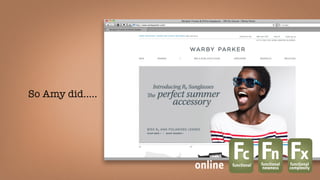
So Amy did.....
Fcfunctional
Fnfunctional
newness
Fxfunctional
complexityonline
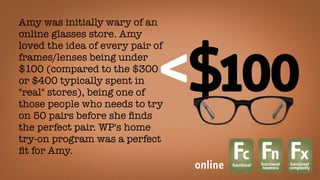
Amy was initially wary of an
online glasses store. Amy
loved the idea of every pair of
frames/lenses being under
$100 (compared to the $300
or $400 typically spent in
"real" stores), being one of
those people who needs to try
on 50 pairs before she finds
the perfect pair. WP's home
try-on program was a perfect
fit for Amy.
Fcfunctional
Fnfunctional
newness
Fxfunctional
complexityonline
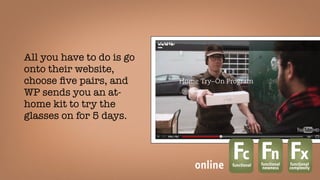
All you have to do is go
onto their website,
choose five pairs, and
WP sends you an at-
home kit to try the
glasses on for 5 days.
Fcfunctional
Fnfunctional
newness
Fxfunctional
complexityonline
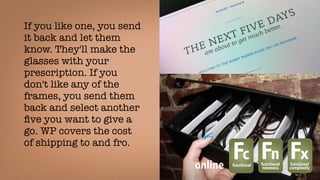
If you like one, you send
it back and let them
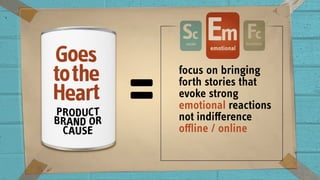
know. They'll make the
glasses with your
prescription. If you
don't like any of the
frames, you send them
back and select another
five you want to give a
go. WP covers the cost
of shipping to and fro. 
Fcfunctional
Fnfunctional
newness
Fxfunctional
complexityonline
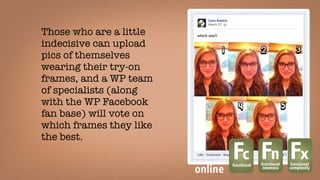
Those who are a little
indecisive can upload
pics of themselves
wearing their try-on
frames, and a WP team
of specialists (along
with the WP Facebook
fan base) will vote on
which frames they like
the best. 
Fcfunctional
Fnfunctional
newness
Fxfunctional
complexity
online
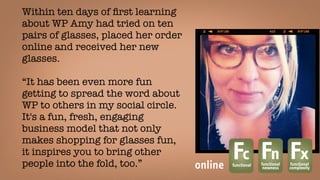
Within ten days of first learning
about WP Amy had tried on ten
pairs of glasses, placed her order
online and received her new
glasses.
“It has been even more fun
getting to spread the word about
WP to others in my social circle.
It's a fun, fresh, engaging
business model that not only
makes shopping for glasses fun,
it inspires you to bring other
people into the fold, too.” 
Fcfunctional
Fnfunctional
newness
Fxfunctional
complexityonline
online
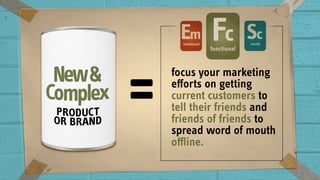
New&
Complex
offline
Complex
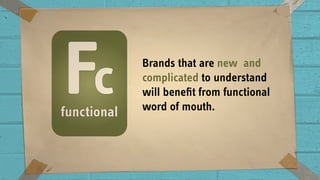
Brands that are new and
complicated to understand
will benefit from functional
word of mouth.
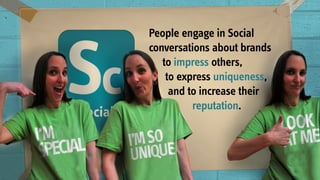
People engage in Social
conversations about brands
to impress others,
to express uniqueness,
and to increase their
reputation.
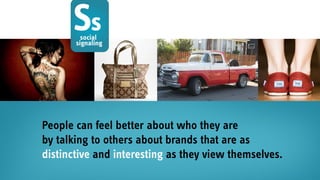
People can feel better about who they are
by talking to others about brands that are as
distinctive and interesting as they view themselves.
“The higher the degree of
differentiation of a brand, the
easier it is for an individual
to project uniqueness.”
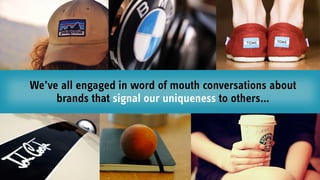
We’ve all engaged in word of mouth conversations about
brands that signal our uniqueness to others…
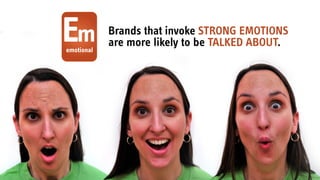
Brands that invoke STRONG EMOTIONS
are more likely to be TALKED ABOUT.Ememotional
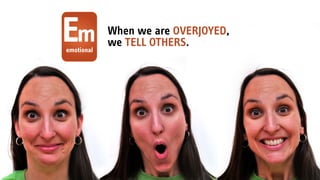
When we are OVERJOYED,
we TELL OTHERS.Ememotional
Ememotional
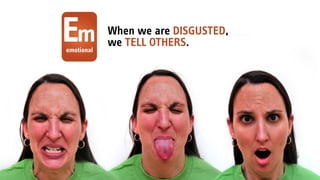
When we are DISGUSTED,
we TELL OTHERS.
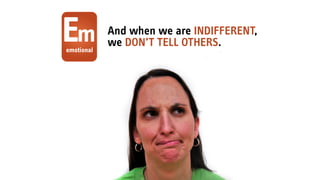
And when we are INDIFFERENT,
we DON’T TELL OTHERS.Ememotional
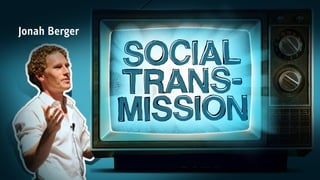
Jonah Berger
translated...
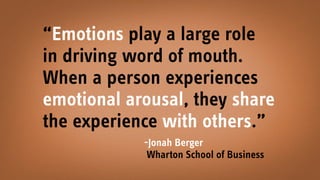
“Emotions play a large role
in driving word of mouth.
When a person experiences
emotional arousal, they share
the experience with others.” 
-Jonah Berger
Wharton School of Business
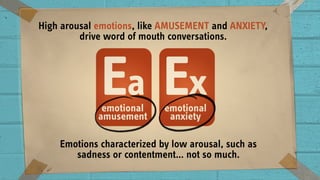
High arousal emotions, like AMUSEMENT and ANXIETY,
drive word of mouth conversations.
Emotions characterized by low arousal, such as 

sadness or contentment… not so much.
Geeky
TidBit
Ememotional
Eaemotional
amusement
Exemotional
anxiety
Jogging… boosts general arousal over sitting.
Ememotional
Eaemotional
amusement
Exemotional
anxiety
Student studies showed that students who jogged over those who sat
were more likely to spread a neutral or low arousal online article.
Ememotional
Eaemotional
amusement
Exemotional
anxiety
Huh?
So what does 

this mean?
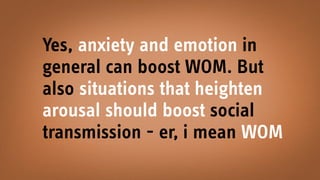
Yes, anxiety and emotion in
general can boost WOM. But
also situations that heighten
arousal should boost social
transmission - er, i mean WOM
Ok,Cool.
Double
Rainbow
Dude.
tap into stories about products

that communicate amazing,
amusing, and awe-inspiring
aspects about a brand.
Ememotional
Eaemotional
amusement
Ememotional
Eaemotional
amusement
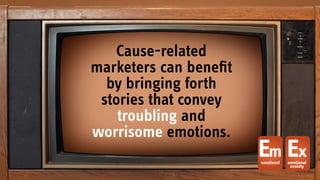
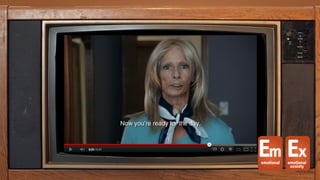
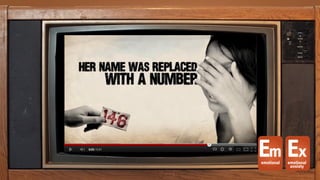
Cause-related
marketers can benefit
by bringing forth
stories that convey
troubling and
worrisome emotions.
Ememotional
Exemotional
anxiety
Ememotional
Exemotional
anxiety
Ememotional
Exemotional
anxiety
Emotional word of mouth
conversations are sparked
when people are highly
aroused. If your brand can
spark amusement, amazement,
and or anxiety, then your brand
stands a far better chance of
being talkable by being more
emotional.
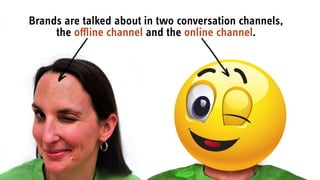
Brands are talked about in two conversation channels,
the offline channel and the online channel.
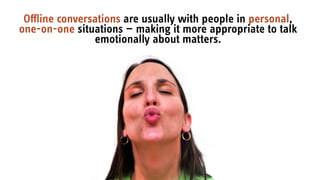
Offline conversations are usually with people in personal,
one-on-one situations — making it more appropriate to talk
emotionally about matters.
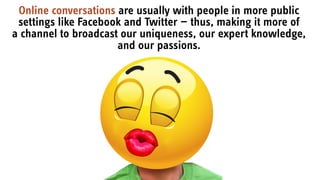
Online conversations are usually with people in more public
settings like Facebook and Twitter — thus, making it more of
a channel to broadcast our uniqueness, our expert knowledge,
and our passions.
ok class...
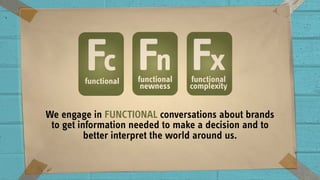
We engage in FUNCTIONAL conversations about brands
to get information needed to make a decision and to
better interpret the world around us.
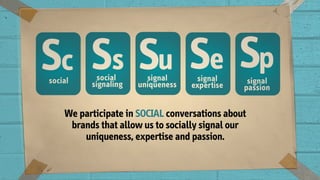
We participate in SOCIAL conversations about
brands that allow us to socially signal our
uniqueness, expertise and passion.
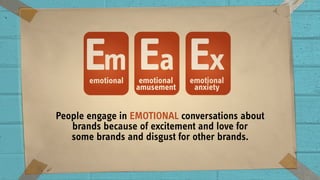
People engage in EMOTIONAL conversations about
brands because of excitement and love for 

some brands and disgust for other brands.
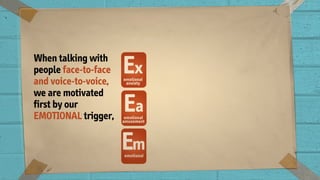
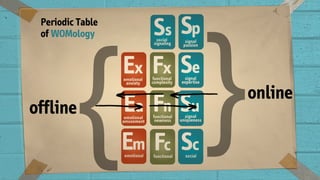
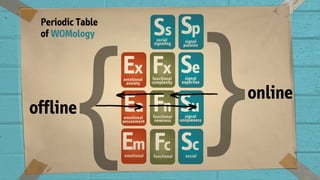
When talking with
people face-to-face
and voice-to-voice,
we are motivated
first by our
EMOTIONAL trigger,
then by our
FUNCTIONAL
trigger,
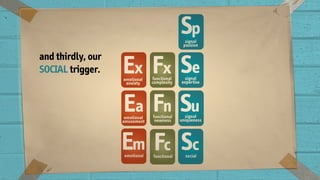
and thirdly, our
SOCIAL trigger.
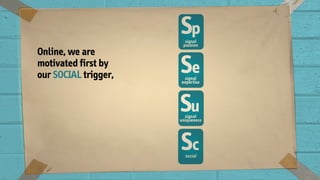
Online, we are
motivated first by
our SOCIAL trigger,
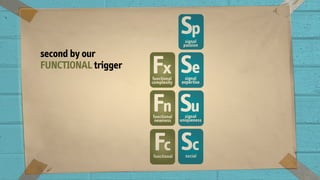
second by our
FUNCTIONAL trigger
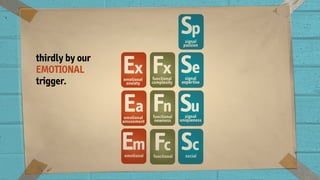
thirdly by our
EMOTIONAL
trigger.
}{offline
online
Periodic Table
of WOMology
focus your marketing
efforts on getting
current customers to
tell their friends and
friends of friends to
spread word of mouth
offline.
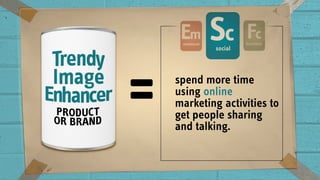
spend more time
using online
marketing activities to
get people sharing
and talking.
focus on bringing
forth stories that
evoke strong
emotional reactions
not indifference
offline / online
 If you better understand WHY people are
talking about your brand and WHERE
people are talking, you’ll be in a better
place to design marketing activities in the
RIGHT channel, offline or online, in order
to make your brand more conversational
to become more talkable.
WOMconnects us as Humans
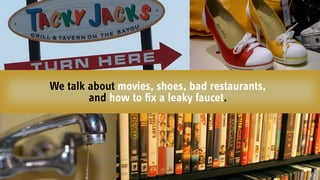
We talk about movies, shoes, bad restaurants,
and how to fix a leaky faucet.
What leads people 

to talk about a certain
product or brand rather
than others.
Much less is know about…
Can the conversation

channel itself shape 

what PEOPLE talk about?
Prior research showed: rather than
being driven by motivation, WOM,
particularly ongoing WOM, is driven by
accessibility.
we have face to face conversations
we post on blogs
we write online reviews
we send texts
we send emails
chat on our phones
WOM can be shared in many different ways…
The conversation channel
continuity shape what

gets discussed…
In discontinuous channels
(online, text), pauses
between conversational
turns are expected…
So, people have time

to select and craft

what they say.
More interesting products
should be talked about
more than boring ones.
In channels where
conversations occur more
continuously (f2f, phone).
There is less time to be
selective about what you
talk about.
People communicate information when
they talk… they also communicate things
about themselves.
People not only communicate
through what they talk about,
they also communicate
through how they talk.
Most face-to-face conversations as
well as phone conversations involve
continuous discussion. There is an
expectation that ongoing conversation
will occur, and it is awkward to sit
in silence.
Contrast that, with the types of conversations
that occur online; discussion forums, blogs
or Facebook, they’re mostly discontinuous
in nature. People have time to deliberate
and think through what they say.
Many Practitioners often
argue that products need to
be interesting to be talked
about…
When conversations are expected to be
discontinuous, people have time to select
and craft what they say. They have more
opportunity to think of a clever or interesting
response and can wait to respond until they
have something worthwhile to talk about.
In discontinuous channels
people should be more likely
to post or share something if
they think it will be interesting.
When conversations are
continuous, as in most
face-to-face interactions,
there is less time to selectively
pick what one talks about.
People will talk about whatever
is top-of-mind to keep the
conversation flowing.
before you cry… bullshit!
lets put the research under
the microscope…
1) aggregate word-of-mouth data from people who have
conversations both online and offline (pilot study).
2) individual-level dataset covering word-of-mouth over various
channels. It contained over 35,000 brand and product mentions of
approximately 6,000 people who recorded all of the word-of-mouth
they engaged in, as well as the channel they used (face-to-face,
online posts, or text) over a one-day period.
3) tested the causal impact of conversation continuity through an
experiment. We keep the conversation channel itself the same but
manipulate whether people expect to pause (or not) before and
between conversational turns.
There was a positive and significant
relationship between interest and online
posts in online conversations, more
interesting products were mentioned
more frequently than their less interesting
counterparts.
In contrast, there was no relationship
between interest and face-to-face word-
of-mouth in face-to-face conversations,
more interesting products were not
mentioned more frequently than their
less interesting counterparts.
Interest has a much larger impact on online
conversations than offline conversations.
Similarly, interest has a larger
impact on text or email rather
than phone conversations.
Not only was the relationship between
interest and word-of-mouth different in
online and offline channels, but results
were the same for other types of continuous
(phone) and discontinuous (text and email)
conversation channels.
When pauses between and before conversational
turns are expected (discontinuous), more interesting
topics and brands are more likely to be discussed
than less interesting ones. In contrast, when pauses
between and before conversational turns is not
expected (continuous), this difference disappears.
If the goal is to get more discussion online,
framing the product in an interesting or
surprising way should help. Ads or online
content that surprises people, violates
expectations, or evokes interest in some other
manner should be more likely to be shared.
If the goal is to get more offline word-of-
mouth, however, then other factors may be
more important than evoking interest. In a
face-to-face context, making the product
accessible in consumer minds, or publicly
visible, may be more important.
 If you better understand WHY people are
talking about your brand and WHERE
people are talking, you’ll be in a better
place to design marketing activities in the
RIGHT channel, offline or online, in order
to make your brand more conversational
to become more talkable.
}{offline
online
Periodic Table
of WOMology
Class Dismissed
Geno Church | @GenoChurch John Moore | @BrandAutopsy 

On Brands and Word-Of-Mouth
Renana Peres, Ron Shachar, Mitch Lovett

How Interest Shapes Word-of-Mouth Over Different Channels
Jonah Berger, Raghuram Iyengar

Arousal Increases Social Transmission of Information
Jonah Berger


WOMOLOGY 101

  • 1.
    Geno Church | BrainsOn Fire John Moore 
 | Brand Autopsy
  • 6.
  • 8.
  • 9.
  • 12.
  • 15.
    The Social Triggerspeaks to our need to express our uniqueness to others in social settings.
  • 16.
    The Emotional Triggerdrives people to share positive or negative feelings about a brand.
  • 17.
    The Functional Triggerexplains why people share knowledge and seek knowledge about brands.
  • 19.
    People rely more 
 on"word of mouth" for brands that are new and or highly complex.
  • 20.
    People engage inFunctional conversations about brands to get information needed to make decisions and to better interpret the world around them.
  • 22.
    With new andcomplex products, people need help to understand why to use it, how to use it, when to use it, and where to use it.
  • 23.
    “People engage inWOM in order to get the necessary information needed to survive, to interpret the world in order to function.” -Emanuel Rosen 
 Anatomy of Buzz (2002)…
  • 24.
    We naturally talkto function.
  • 25.
  • 26.
    Amy’s story beganon Twitter. Being new to Greenville, she didn't have a go-to glasses shop, so she threw the question out to her Twitter following. A friend in Texas responded, suggesting Amy check out Warby Parker. Fcfunctional Fnfunctional newness Fxfunctional complexity online Amy@NoMeatballs
  • 27.
  • 28.
    Amy was initiallywary of an online glasses store. Amy loved the idea of every pair of frames/lenses being under $100 (compared to the $300 or $400 typically spent in "real" stores), being one of those people who needs to try on 50 pairs before she finds the perfect pair. WP's home try-on program was a perfect fit for Amy. Fcfunctional Fnfunctional newness Fxfunctional complexityonline
  • 29.
    All you haveto do is go onto their website, choose five pairs, and WP sends you an at- home kit to try the glasses on for 5 days. Fcfunctional Fnfunctional newness Fxfunctional complexityonline
  • 30.
    If you likeone, you send it back and let them know. They'll make the glasses with your prescription. If you don't like any of the frames, you send them back and select another five you want to give a go. WP covers the cost of shipping to and fro.  Fcfunctional Fnfunctional newness Fxfunctional complexityonline
  • 31.
    Those who area little indecisive can upload pics of themselves wearing their try-on frames, and a WP team of specialists (along with the WP Facebook fan base) will vote on which frames they like the best.  Fcfunctional Fnfunctional newness Fxfunctional complexity online
  • 32.
    Within ten daysof first learning about WP Amy had tried on ten pairs of glasses, placed her order online and received her new glasses. “It has been even more fun getting to spread the word about WP to others in my social circle. It's a fun, fresh, engaging business model that not only makes shopping for glasses fun, it inspires you to bring other people into the fold, too.”  Fcfunctional Fnfunctional newness Fxfunctional complexityonline
  • 34.
  • 35.
  • 36.
  • 39.
  • 40.
    Brands that arenew and complicated to understand will benefit from functional word of mouth.
  • 42.
    People engage inSocial conversations about brands to impress others, to express uniqueness, and to increase their reputation.
  • 45.
    People can feelbetter about who they are by talking to others about brands that are as distinctive and interesting as they view themselves.
  • 46.
    “The higher thedegree of differentiation of a brand, the easier it is for an individual to project uniqueness.”
  • 47.
    We’ve all engagedin word of mouth conversations about brands that signal our uniqueness to others…
  • 49.
    Brands that invokeSTRONG EMOTIONS are more likely to be TALKED ABOUT.Ememotional
  • 50.
    When we areOVERJOYED, we TELL OTHERS.Ememotional
  • 51.
    Ememotional When we areDISGUSTED, we TELL OTHERS.
  • 52.
    And when weare INDIFFERENT, we DON’T TELL OTHERS.Ememotional
  • 53.
  • 54.
  • 55.
    “Emotions play alarge role in driving word of mouth. When a person experiences emotional arousal, they share the experience with others.”  -Jonah Berger Wharton School of Business
  • 56.
    High arousal emotions,like AMUSEMENT and ANXIETY, drive word of mouth conversations. Emotions characterized by low arousal, such as 
 sadness or contentment… not so much.
  • 57.
  • 58.
    Jogging… boosts generalarousal over sitting. Ememotional Eaemotional amusement Exemotional anxiety
  • 59.
    Student studies showedthat students who jogged over those who sat were more likely to spread a neutral or low arousal online article. Ememotional Eaemotional amusement Exemotional anxiety
  • 60.
  • 61.
    So what does
 this mean?
  • 62.
    Yes, anxiety andemotion in general can boost WOM. But also situations that heighten arousal should boost social transmission - er, i mean WOM
  • 63.
  • 64.
  • 65.
    tap into storiesabout products
 that communicate amazing, amusing, and awe-inspiring aspects about a brand.
  • 66.
  • 67.
  • 68.
    Cause-related marketers can benefit bybringing forth stories that convey troubling and worrisome emotions. Ememotional Exemotional anxiety
  • 69.
  • 70.
  • 71.
    Emotional word ofmouth conversations are sparked when people are highly aroused. If your brand can spark amusement, amazement, and or anxiety, then your brand stands a far better chance of being talkable by being more emotional.
  • 74.
    Brands are talkedabout in two conversation channels, the offline channel and the online channel.
  • 75.
    Offline conversations areusually with people in personal, one-on-one situations — making it more appropriate to talk emotionally about matters.
  • 76.
    Online conversations areusually with people in more public settings like Facebook and Twitter — thus, making it more of a channel to broadcast our uniqueness, our expert knowledge, and our passions.
  • 77.
  • 78.
    We engage inFUNCTIONAL conversations about brands to get information needed to make a decision and to better interpret the world around us.
  • 79.
    We participate inSOCIAL conversations about brands that allow us to socially signal our uniqueness, expertise and passion.
  • 80.
    People engage inEMOTIONAL conversations about brands because of excitement and love for 
 some brands and disgust for other brands.
  • 81.
    When talking with peopleface-to-face and voice-to-voice, we are motivated first by our EMOTIONAL trigger,
  • 82.
  • 83.
  • 84.
    Online, we are motivatedfirst by our SOCIAL trigger,
  • 85.
  • 86.
  • 87.
  • 92.
    focus your marketing effortson getting current customers to tell their friends and friends of friends to spread word of mouth offline.
  • 93.
    spend more time usingonline marketing activities to get people sharing and talking.
  • 94.
    focus on bringing forthstories that evoke strong emotional reactions not indifference offline / online
  • 95.
     If you betterunderstand WHY people are talking about your brand and WHERE people are talking, you’ll be in a better place to design marketing activities in the RIGHT channel, offline or online, in order to make your brand more conversational to become more talkable.
  • 97.
  • 98.
    We talk aboutmovies, shoes, bad restaurants, and how to fix a leaky faucet.
  • 99.
    What leads people
 to talk about a certain product or brand rather than others. Much less is know about…
  • 100.
    Can the conversation
 channelitself shape 
 what PEOPLE talk about?
  • 101.
    Prior research showed:rather than being driven by motivation, WOM, particularly ongoing WOM, is driven by accessibility.
  • 102.
    we have faceto face conversations we post on blogs we write online reviews we send texts we send emails chat on our phones WOM can be shared in many different ways…
  • 103.
    The conversation channel continuityshape what
 gets discussed…
  • 104.
    In discontinuous channels (online,text), pauses between conversational turns are expected… So, people have time
 to select and craft
 what they say.
  • 105.
    More interesting products shouldbe talked about more than boring ones.
  • 106.
    In channels where conversationsoccur more continuously (f2f, phone). There is less time to be selective about what you talk about.
  • 107.
    People communicate informationwhen they talk… they also communicate things about themselves.
  • 108.
    People not onlycommunicate through what they talk about, they also communicate through how they talk.
  • 109.
    Most face-to-face conversationsas well as phone conversations involve continuous discussion. There is an expectation that ongoing conversation will occur, and it is awkward to sit in silence.
  • 110.
    Contrast that, withthe types of conversations that occur online; discussion forums, blogs or Facebook, they’re mostly discontinuous in nature. People have time to deliberate and think through what they say.
  • 111.
    Many Practitioners often arguethat products need to be interesting to be talked about…
  • 112.
    When conversations areexpected to be discontinuous, people have time to select and craft what they say. They have more opportunity to think of a clever or interesting response and can wait to respond until they have something worthwhile to talk about.
  • 113.
    In discontinuous channels peopleshould be more likely to post or share something if they think it will be interesting.
  • 114.
    When conversations are continuous,as in most face-to-face interactions, there is less time to selectively pick what one talks about.
  • 115.
    People will talkabout whatever is top-of-mind to keep the conversation flowing.
  • 116.
    before you cry…bullshit! lets put the research under the microscope…
  • 117.
    1) aggregate word-of-mouthdata from people who have conversations both online and offline (pilot study). 2) individual-level dataset covering word-of-mouth over various channels. It contained over 35,000 brand and product mentions of approximately 6,000 people who recorded all of the word-of-mouth they engaged in, as well as the channel they used (face-to-face, online posts, or text) over a one-day period. 3) tested the causal impact of conversation continuity through an experiment. We keep the conversation channel itself the same but manipulate whether people expect to pause (or not) before and between conversational turns.
  • 119.
    There was apositive and significant relationship between interest and online posts in online conversations, more interesting products were mentioned more frequently than their less interesting counterparts.
  • 120.
    In contrast, therewas no relationship between interest and face-to-face word- of-mouth in face-to-face conversations, more interesting products were not mentioned more frequently than their less interesting counterparts.
  • 121.
    Interest has amuch larger impact on online conversations than offline conversations. Similarly, interest has a larger impact on text or email rather than phone conversations.
  • 122.
    Not only wasthe relationship between interest and word-of-mouth different in online and offline channels, but results were the same for other types of continuous (phone) and discontinuous (text and email) conversation channels.
  • 123.
    When pauses betweenand before conversational turns are expected (discontinuous), more interesting topics and brands are more likely to be discussed than less interesting ones. In contrast, when pauses between and before conversational turns is not expected (continuous), this difference disappears.
  • 124.
    If the goalis to get more discussion online, framing the product in an interesting or surprising way should help. Ads or online content that surprises people, violates expectations, or evokes interest in some other manner should be more likely to be shared.
  • 125.
    If the goalis to get more offline word-of- mouth, however, then other factors may be more important than evoking interest. In a face-to-face context, making the product accessible in consumer minds, or publicly visible, may be more important.
  • 126.
     If you betterunderstand WHY people are talking about your brand and WHERE people are talking, you’ll be in a better place to design marketing activities in the RIGHT channel, offline or online, in order to make your brand more conversational to become more talkable.
  • 127.
  • 128.
    Class Dismissed Geno Church| @GenoChurch John Moore | @BrandAutopsy 
 On Brands and Word-Of-Mouth Renana Peres, Ron Shachar, Mitch Lovett
 How Interest Shapes Word-of-Mouth Over Different Channels Jonah Berger, Raghuram Iyengar
 Arousal Increases Social Transmission of Information Jonah Berger