Wri$ng	
  for	
  the	
  Web	
  
...	
  isn’t	
  much	
  different	
  from	
  wri$ng	
  in	
  
         general.	
  What’s	
  always	
  been	
  
interes$ng,	
  what’s	
  always	
  been	
  can’t-­‐
 put-­‐it-­‐down,	
  is	
  s"ll	
  interes$ng,	
  can’t-­‐
                    put-­‐it-­‐down.	
  
Wri$ng	
  for	
  the	
  Web	
  
          The	
  difference	
  is	
  ...	
  

...	
  now	
  we	
  know	
  what	
  works	
  and	
  
               what	
  doesn’t.	
  
And	
  it	
  turns	
  out	
  ...	
  	
  
 Wri$ng	
  for	
  the	
  Web	
  has	
  a	
  lot	
  in	
  
    common	
  with	
  wri$ng	
  for	
  
broadcas$ng	
  –	
  wri$ng	
  for	
  the	
  ear.	
  
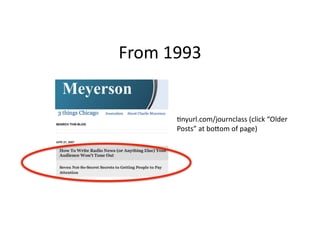
From	
  1993	


          $nyurl.com/journclass	
  (click	
  “Older	
  
          Posts”	
  at	
  boLom	
  of	
  page)	
  
Secrets	
  to	
  geOng	
  people	
  not	
  to	
  tune	
  out	
  	
  -­‐-­‐	
  
for	
  radio	
  and,	
  it	
  turns	
  out,	
  just	
  about	
  anything	
  
                             on	
  the	
  Web	
  ...	
  

      • 	
  Select	
  the	
  most	
  interes$ng	
  word	
  or	
  phrase.	
  
      • 	
  Make	
  that	
  the	
  first	
  element	
  of	
  your	
  story	
  (and,	
  
      on	
  the	
  Web,	
  your	
  headline),	
  and	
  let	
  your	
  wri$ng	
  
      flow	
  from	
  there.	
  
But	
  what	
  are	
  the	
  most	
  interes$ng	
  words?	
  

  • 	
  Develop	
  a	
  sense	
  of	
  your	
  audience’s	
  priori$es	
  by	
  
  monitoring	
  clicks.	
  
  • 	
  And	
  develop	
  a	
  sense	
  of	
  the	
  wider	
  world’s	
  
  priori$es	
  by	
  checking	
  sites	
  like	
  Google	
  Trends	
  
  <google.com/trends/>	
  
Secrets	
  to	
  geOng	
  people	
  not	
  to	
  tune	
  out	
  	
  -­‐-­‐	
  
for	
  radio	
  and,	
  it	
  turns	
  out,	
  just	
  about	
  anything	
  
                             on	
  the	
  Web	
  ...	
  
                Omit	
  needless	
  words.	
  
            -­‐-­‐	
  Will	
  Strunk,	
  The	
  Elements	
  of	
  Style,	
  1918	


                     TwiLer.	
  Tex$ng.	
  
           Tiny	
  smartphone	
  screens,	
  2012.	
  

                         Need	
  we	
  say	
  more?	
  
Read	
  your	
  wri$ng	
  out	
  loud.	
  
          Especially	
  important	
  for	
  
broadcas$ng,	
  but	
  a	
  great	
  test	
  of	
  any	
  
 piece	
  of	
  wri$ng	
  or	
  repor$ng.	
  If	
  your	
  
ear	
  doesn’t	
  get	
  it,	
  neither	
  will	
  others’	
  
                  ears.	
  Or	
  eyes.	
  

Bonus	
  proofreading	
  /p:	
  Change	
  font,	
  font-­‐size,	
  window	
  width,	
  etc.	
  
Secrets	
  to	
  geOng	
  people	
  not	
  to	
  tune	
  out	
  	
  -­‐-­‐	
  
for	
  radio	
  and,	
  it	
  turns	
  out,	
  just	
  about	
  anything	
  
                             on	
  the	
  Web	
  ...	
  
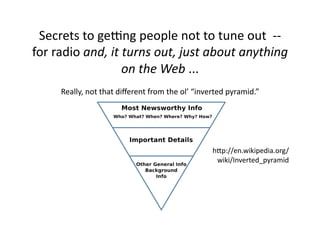
        Really,	
  not	
  that	
  different	
  from	
  the	
  ol’	
  “inverted	
  pyramid.”	


                                                                         hLp://en.wikipedia.org/
                                                                          wiki/Inverted_pyramid	
  
All	
  your	
  work’s	
  for	
  nothing	
  if	
  people	
  
             don’t	
  read	
  your	
  work.	
  
...	
  So	
  you	
  need	
  great	
  headlines,	
  great	
  subject	
  
     lines,	
  great	
  Tweets	
  and	
  Facebook	
  posts.	
  

If	
  the	
  headline	
  doesn’t	
  hook	
  ’em,	
  the	
  rest	
  of	
  
      your	
  work	
  goes	
  unseen.	
  
Headlines	
  that	
  work	
  
Two	
  kinds	
  of	
  headlines:	
  

•  Search-­‐engine-­‐op6mized	
  headlines.	
  
  	
  Good	
  for	
  story-­‐level	
  placement.	
  

•  “Curiosity	
  gap”-­‐op$mized	
  headlines.	


  Good	
  for	
  front-­‐page	
  and	
  email	
  placement,	
  for	
  
      print	
  publica6ons	
  ...	
  and	
  for	
  social	
  media	
  
      (TwiCer,	
  Facebook).	
  
SEO-­‐friendly	
  headline	
  techniques	
  
•  Place	
  the	
  story's	
  most	
  interes6ng	
  word	
  or	
  
   phrase	
  as	
  close	
  as	
  possible	
  to	
  the	
  start	
  of	
  the	
  
   headline.	
  
•  Simple,	
  direct	
  headlines	
  (with	
  familiar	
  
   names).	
  
•  “How-­‐to”	
  or	
  “Why”	
  headlines.	
  
•  Accentuate	
  the	
  posi6ve.	
  Say	
  what	
  did	
  happen,	
  
   not	
  what’s	
  unchanged	
  or	
  stable.	
  
‘Curiosity	
  gap’	
  
The	
  difference	
  between	
  what	
  you	
  know	
  and	
  
             what	
  you	
  want	
  to	
  know	
  

          Like	
  The	
  Onion,	
  the	
  editorial	
  team	
  at	
  Upworthy	
  begins	
  with	
  dozens	
  
              of	
  headlines	
  and	
  works	
  on	
  them	
  un"l	
  they	
  create	
  what	
  Mr.	
  [Eli]	
  
                    Pariser	
  called	
  “a	
  curiosity	
  gap”	
  —	
  a	
  need	
  to	
  know	
  more	
  that	
  
                                               prompts	
  the	
  impulse	
  to	
  click	
  on	
  something.	
  
                                                             -­‐-­‐	
  David	
  Carr,	
  The	
  New	
  York	
  Times	
  

               hLp://mediadecoder.blogs.ny$mes.com/2012/07/09/two-­‐guys-­‐made-­‐a-­‐web-­‐site-­‐and-­‐this-­‐is-­‐what-­‐they-­‐got/	
  
‘Curiosity	
  gap’	
  headlines	
  
•  Assume	
  most	
  people	
  aren’t	
  interested.	
  
    Write	
  headlines	
  to	
  engage	
  people	
  who	
  think	
  they’re	
  
     not	
  interested,	
  and	
  your	
  core	
  audience	
  will	
  s$ll	
  be	
  
     there	
  for	
  you.	
  (Dare	
  them	
  not	
  to	
  be	
  interested.)	
  
•  Play	
  down	
  loca6on.	
  (Except	
  for	
  famous	
  loca$ons.)	
  
•  Play	
  down	
  names.	
  (Except	
  for	
  famous	
  names.)	
  
‘Curiosity	
  gap’	
  headlines	
  
•  Simple,	
  direct	
  headlines	
  (with	
  generic	
  nouns	
  
   for	
  unfamiliar	
  names).	
  

      The	
  most-­‐clicked	
  Internet	
  headline	
  (or	
  most-­‐
       read	
  newspaper	
  headline)	
  ever	
  might	
  be	
  ...	
  
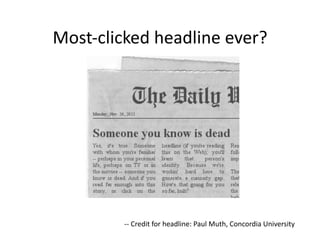
Most-­‐clicked	
  headline	
  ever?	


            -­‐-­‐	
  Credit	
  for	
  headline:	
  Paul	
  Muth,	
  Concordia	
  University	
  
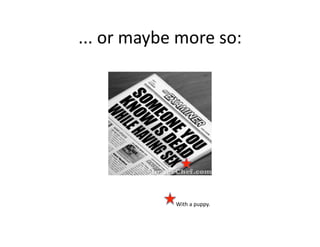
...	
  or	
  maybe	
  more	
  so:	


                     With	
  a	
  puppy.	
  
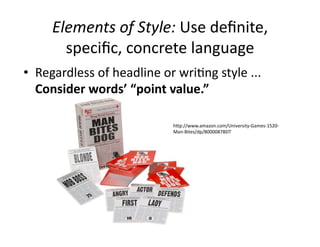
Elements	
  of	
  Style:	
  Use	
  definite,	
  
         specific,	
  concrete	
  language	
  
•  Regardless	
  of	
  headline	
  or	
  wri$ng	
  style	
  ...	
  
   Consider	
  words’	
  “point	
  value.”	
  

                                         hLp://www.amazon.com/University-­‐Games-­‐1520-­‐
                                         Man-­‐Bites/dp/B000087BDT	
  
‘Curiosity	
  gap’	
  headlines	
  
•  Ques6ons:	
  ‘Who	
  was	
  Deep	
  Throat?’	
  
•  Ellipses,	
  teases:	
  ‘Na$on’s	
  faLest	
  city	
  is	
  ...’	
  
•  Pull-­‐quotes:	
  ‘Suck	
  it	
  up,	
  wussies.’	
  
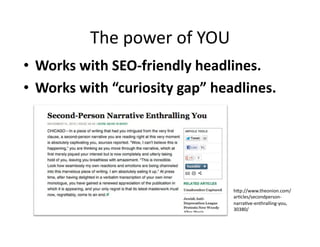
The	
  power	
  of	
  YOU	
  
•  Works	
  with	
  SEO-­‐friendly	
  headlines.	
  
•  Works	
  with	
  “curiosity	
  gap”	
  headlines.	


                                             hLp://www.theonion.com/
                                             ar$cles/secondperson-­‐
                                             narra$ve-­‐enthralling-­‐you,
                                             30380/	
  
Bad	
  headlines	
  
•  Unfamiliar	
  words	
  and	
  names	
  –	
  including	
  all	
  
   but	
  top-­‐line	
  acronyms	
  and	
  abbrevia$ons.	
  	
  
•  “No-­‐change”	
  words:	
  
    –  “Stable”	
  
    –  “unchanged”	
  
    –  “s$ll”	
  
    –  “con$nues”	
  
Bad	
  headlines	
  
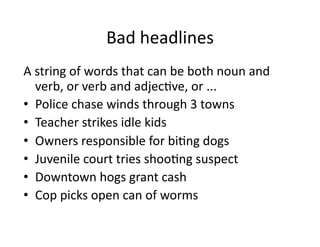
A	
  string	
  of	
  words	
  that	
  can	
  be	
  both	
  noun	
  and	
  
     verb,	
  or	
  verb	
  and	
  adjec$ve,	
  or	
  ...	
  	
  
•  Police	
  chase	
  winds	
  through	
  3	
  towns	
  
•  Teacher	
  strikes	
  idle	
  kids	
  
•  Owners	
  responsible	
  for	
  bi$ng	
  dogs	
  
•  Juvenile	
  court	
  tries	
  shoo$ng	
  suspect	
  
•  Downtown	
  hogs	
  grant	
  cash	
  
•  Cop	
  picks	
  open	
  can	
  of	
  worms	
  
Bad	
  headlines	
  
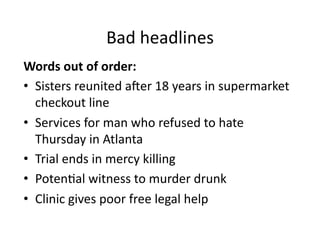
Words	
  out	
  of	
  order:	
  
•  Sisters	
  reunited	
  aner	
  18	
  years	
  in	
  supermarket	
  
   checkout	
  line	
  
•  Services	
  for	
  man	
  who	
  refused	
  to	
  hate	
  
   Thursday	
  in	
  Atlanta	
  
•  Trial	
  ends	
  in	
  mercy	
  killing	
  
•  Poten$al	
  witness	
  to	
  murder	
  drunk	
  
•  Clinic	
  gives	
  poor	
  free	
  legal	
  help	
  
Charlie Meyerson
      Bit.ly/Meyerson
linkedin.com/in/cmeyerson
      708-TEQ-NEWS

Headlines that work

  • 1.
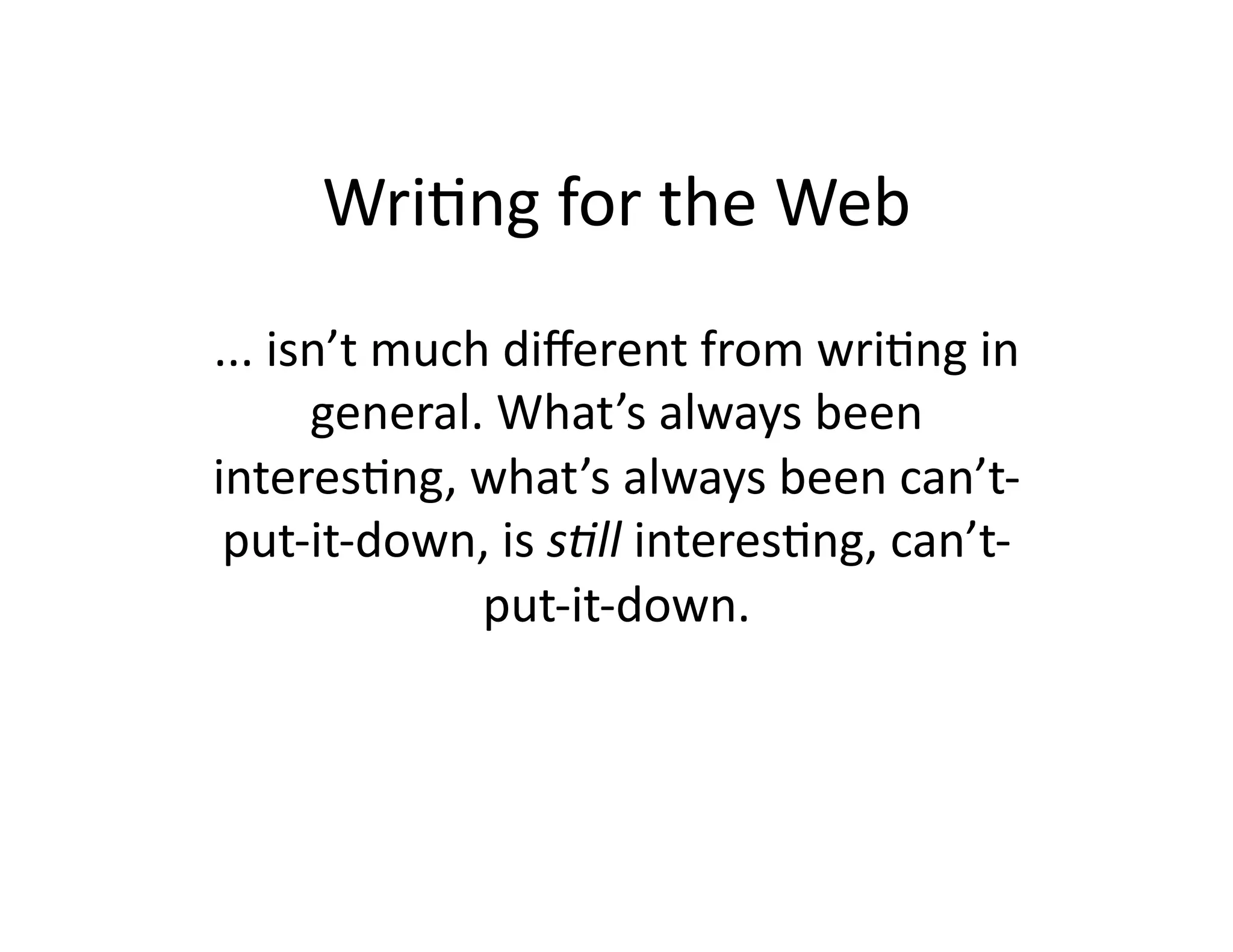
    Wri$ng  for  the  Web   ...  isn’t  much  different  from  wri$ng  in   general.  What’s  always  been   interes$ng,  what’s  always  been  can’t-­‐ put-­‐it-­‐down,  is  s"ll  interes$ng,  can’t-­‐ put-­‐it-­‐down.  
  • 2.
    Wri$ng  for  the  Web   The  difference  is  ...   ...  now  we  know  what  works  and   what  doesn’t.  
  • 3.
    And  it  turns  out  ...     Wri$ng  for  the  Web  has  a  lot  in   common  with  wri$ng  for   broadcas$ng  –  wri$ng  for  the  ear.  
  • 4.
    From  1993   $nyurl.com/journclass  (click  “Older   Posts”  at  boLom  of  page)  
  • 5.
    Secrets  to  geOng  people  not  to  tune  out    -­‐-­‐   for  radio  and,  it  turns  out,  just  about  anything   on  the  Web  ...   •   Select  the  most  interes$ng  word  or  phrase.   •   Make  that  the  first  element  of  your  story  (and,   on  the  Web,  your  headline),  and  let  your  wri$ng   flow  from  there.  
  • 6.
    But  what  are  the  most  interes$ng  words?   •   Develop  a  sense  of  your  audience’s  priori$es  by   monitoring  clicks.   •   And  develop  a  sense  of  the  wider  world’s   priori$es  by  checking  sites  like  Google  Trends   <google.com/trends/>  
  • 7.
    Secrets  to  geOng  people  not  to  tune  out    -­‐-­‐   for  radio  and,  it  turns  out,  just  about  anything   on  the  Web  ...   Omit  needless  words.   -­‐-­‐  Will  Strunk,  The  Elements  of  Style,  1918   TwiLer.  Tex$ng.   Tiny  smartphone  screens,  2012.   Need  we  say  more?  
  • 8.
    Read  your  wri$ng  out  loud.   Especially  important  for   broadcas$ng,  but  a  great  test  of  any   piece  of  wri$ng  or  repor$ng.  If  your   ear  doesn’t  get  it,  neither  will  others’   ears.  Or  eyes.   Bonus  proofreading  /p:  Change  font,  font-­‐size,  window  width,  etc.  
  • 9.
    Secrets  to  geOng  people  not  to  tune  out    -­‐-­‐   for  radio  and,  it  turns  out,  just  about  anything   on  the  Web  ...   Really,  not  that  different  from  the  ol’  “inverted  pyramid.”   hLp://en.wikipedia.org/ wiki/Inverted_pyramid  
  • 10.
    All  your  work’s  for  nothing  if  people   don’t  read  your  work.   ...  So  you  need  great  headlines,  great  subject   lines,  great  Tweets  and  Facebook  posts.   If  the  headline  doesn’t  hook  ’em,  the  rest  of   your  work  goes  unseen.  
  • 11.
    Headlines  that  work   Two  kinds  of  headlines:   •  Search-­‐engine-­‐op6mized  headlines.    Good  for  story-­‐level  placement.   •  “Curiosity  gap”-­‐op$mized  headlines.      Good  for  front-­‐page  and  email  placement,  for   print  publica6ons  ...  and  for  social  media   (TwiCer,  Facebook).  
  • 12.
    SEO-­‐friendly  headline  techniques   •  Place  the  story's  most  interes6ng  word  or   phrase  as  close  as  possible  to  the  start  of  the   headline.   •  Simple,  direct  headlines  (with  familiar   names).   •  “How-­‐to”  or  “Why”  headlines.   •  Accentuate  the  posi6ve.  Say  what  did  happen,   not  what’s  unchanged  or  stable.  
  • 13.
    ‘Curiosity  gap’   The  difference  between  what  you  know  and   what  you  want  to  know   Like  The  Onion,  the  editorial  team  at  Upworthy  begins  with  dozens   of  headlines  and  works  on  them  un"l  they  create  what  Mr.  [Eli]   Pariser  called  “a  curiosity  gap”  —  a  need  to  know  more  that   prompts  the  impulse  to  click  on  something.   -­‐-­‐  David  Carr,  The  New  York  Times   hLp://mediadecoder.blogs.ny$mes.com/2012/07/09/two-­‐guys-­‐made-­‐a-­‐web-­‐site-­‐and-­‐this-­‐is-­‐what-­‐they-­‐got/  
  • 14.
    ‘Curiosity  gap’  headlines   •  Assume  most  people  aren’t  interested.   Write  headlines  to  engage  people  who  think  they’re   not  interested,  and  your  core  audience  will  s$ll  be   there  for  you.  (Dare  them  not  to  be  interested.)   •  Play  down  loca6on.  (Except  for  famous  loca$ons.)   •  Play  down  names.  (Except  for  famous  names.)  
  • 15.
    ‘Curiosity  gap’  headlines   •  Simple,  direct  headlines  (with  generic  nouns   for  unfamiliar  names).   The  most-­‐clicked  Internet  headline  (or  most-­‐ read  newspaper  headline)  ever  might  be  ...  
  • 16.
    Most-­‐clicked  headline  ever?   -­‐-­‐  Credit  for  headline:  Paul  Muth,  Concordia  University  
  • 17.
    ...  or  maybe  more  so:   With  a  puppy.  
  • 18.
    Elements  of  Style:  Use  definite,   specific,  concrete  language   •  Regardless  of  headline  or  wri$ng  style  ...   Consider  words’  “point  value.”   hLp://www.amazon.com/University-­‐Games-­‐1520-­‐ Man-­‐Bites/dp/B000087BDT  
  • 19.
    ‘Curiosity  gap’  headlines   •  Ques6ons:  ‘Who  was  Deep  Throat?’   •  Ellipses,  teases:  ‘Na$on’s  faLest  city  is  ...’   •  Pull-­‐quotes:  ‘Suck  it  up,  wussies.’  
  • 20.
    The  power  of  YOU   •  Works  with  SEO-­‐friendly  headlines.   •  Works  with  “curiosity  gap”  headlines.   hLp://www.theonion.com/ ar$cles/secondperson-­‐ narra$ve-­‐enthralling-­‐you, 30380/  
  • 21.
    Bad  headlines   • Unfamiliar  words  and  names  –  including  all   but  top-­‐line  acronyms  and  abbrevia$ons.     •  “No-­‐change”  words:   –  “Stable”   –  “unchanged”   –  “s$ll”   –  “con$nues”  
  • 22.
    Bad  headlines   A  string  of  words  that  can  be  both  noun  and   verb,  or  verb  and  adjec$ve,  or  ...     •  Police  chase  winds  through  3  towns   •  Teacher  strikes  idle  kids   •  Owners  responsible  for  bi$ng  dogs   •  Juvenile  court  tries  shoo$ng  suspect   •  Downtown  hogs  grant  cash   •  Cop  picks  open  can  of  worms  
  • 23.
    Bad  headlines   Words  out  of  order:   •  Sisters  reunited  aner  18  years  in  supermarket   checkout  line   •  Services  for  man  who  refused  to  hate   Thursday  in  Atlanta   •  Trial  ends  in  mercy  killing   •  Poten$al  witness  to  murder  drunk   •  Clinic  gives  poor  free  legal  help  
  • 24.
    Charlie Meyerson Bit.ly/Meyerson linkedin.com/in/cmeyerson 708-TEQ-NEWS