Will Patch
Manchester University
IACAC Congress 2017 @will_patch
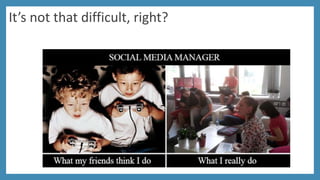
It’s not that difficult, right?
If you think…
Managing is the same as having a personal account
Posts can be written on the fly
It’s easy to go viral
Brand standards don’t apply
I won’t need math
Who is this guy anyway?
Manager of 10 institutional accounts
6 years managing social media
Coordinate with 75+ other accounts
Work with Content Specialist
Team of 13 students
The team
Invest in people first, not tools
Students – Hire them, train them, empower them
Marketing – Show them that you want to learn
Photographer/videographer – Buy them coffee, learn how to work together
Faculty – Build relationships
Manchester’s social success
1,272 undergraduate, 32 graduate, and 294 PharmD students
Over 265,000 followers across 10 accounts
In 2016:
~12,000,000 impressions
~595,000 engagements
Average of 216 interactions/post
Social media hub with aggregator (www.manchester.edu/hub)
Survey of first year students – Fall 2016
2016 survey results
Followed us during their college search
Found it helpful during their search
Followed us prior to deciding to apply
2016 survey results
Most popular networks (asked for top 3):
83% 67% 57%
2016 survey results
Felt like they would
fit in on campus
Were influenced to
attend Manchester
Were influenced to get
involved on campus
Most
Effective
Least
Effective
2016 survey results
OurViewofMU
Student run Instagram
Different host each week
Entirely up to them
2016 survey results
Followed account
Less impactful in driving involvement
on campus or deciding to enroll than
our primary account.
2016 survey results
What do students want to see more of?
Campus events
Study abroad
NCAA athletics
What do students want to see less of?
College tips/hacks
First year experiences
Think your content works?
Prove it!
First: Know your goal
Followers
How many people follow you?
Impressions
How many people view your content?
Engagement
How many people click, like, favorite, share, or screenshot your content?
Measuring Followers
Measuring Impressions and Engagement
on Instagram
Measuring Impressions and Engagement
on Twitter
Measuring Impressions and Engagement
on Facebook
Measuring Impressions and Engagement
on Facebook
Measuring Impressions and Engagement
on YouTube
Measuring Impressions and Engagement
on Snapchat
You should be asking
“So what?”
Making sense of numbers
Engagement Rate, Conversions, ROI, and Natural Audience Ratio
Know what it is you want to know
Engagement Rate – Measures how engaging your content is
Engagements per impression
Conversions – Those who saw a post and took your call to action
Clicks per impression
ROI – Return on Investment, actions per post or call per action per $ spent
Varies by need
Natural Audience Ratio – Comparison between accounts, competitor analysis
Followers per enrollment
An example
You have an engagement campaign to drive people to a landing page. You
spend $5 to boost the post and drive more impressions. The post makes
2,500 impressions and engages 250 people including 70 link clicks.
Engagement Rate: 10%
Conversions: 2.8%
ROI: 14 web hits/$1
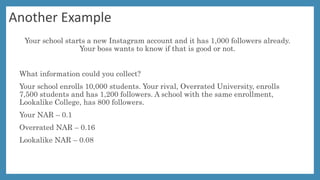
Another Example
Your school starts a new Instagram account and it has 1,000 followers
already. Your boss wants to know if that is good or not.
What information could you collect?
Your school enrolls 10,000 students. Your rival, Overrated University,
enrolls 7,500 students and has 1,200 followers. A school with the same
enrollment, Lookalike College, has 800 followers.
Your NAR – 0.1
Overrated NAR – 0.16
Lookalike NAR – 0.08
Content with your content?
Keep track of content type and timing
Quality over quantity
We decreased posting by 42%
Increased engagements by 177%
Good content takes time
The answer to all of these goals is…
Get creative and original
Share and interact
Reuse content
Crowdsource content
Go multichannel
182,000 impressions and
7,000 engagements
Most importantly: Tell a story
How do you know what is killer content?
Know your audience
Insights and analytics on each account
It doesn’t matter what you want to say and how, it matters what they
want/need to hear and how
Differentiate your messages, imagery, and even content
Test, test, test
Audiences
Twitter – Students, media, schools
Instagram – Students
Snapchat – College students
Facebook – Parents, alumni, community
YouTube – Students, mostly male
Pinterest – Women, skews parents
LinkedIn – Alumni and parents, professional
Where to invest your time
1. Videos (80% of students watch college videos)
2. Authentic student content
3. Student blogs (40% of students look for student blogs)
Focus group your content – only 28% of students find content relevant
Testing content
Determine parameters, text or visuals
A:B testing – run two different samples with randomized groups
Testing matrix – run a set of text samples with visual variations
Testing content
Engagement Rate
SoftLanguage
DirectCTA
IndirectCTA
Offsite photo 2.9% 1.4% 0.7% 2.0%
Equipment 2.0% 1.6% 2.7% 2.2%
On site photo 1.4% 3.2% 1.0% 2.5%
2.3% 2.5% 1.6%
New developments
Facebook Live
Start the video from the page – but advertise in advance
Have a good connection and a power cord
Well viewed and interactions can be time coded
Facebook 360 photos
Take a panorama or use a special 360 photo app
Uses scrolling or phone accelerometer
Post as a normal photo and it will be recognized
Tip – Make sure that you complete the circle
360 video
YouTube, Twitter, or Facebook
Easiest is using a 360 video camera
Snapchat and Instagram stories
Find creative ways to share content in a coherent story
Use students
Events, FAQs, or even original stories
Keep learning
LinkedIn groups
HigherEdLive
CASE
Chegg/TargetX/NRCCUA – Social Admissions Report
Follow other schools
Ask questions!
Session F6

It’s Just Social Media

  • 1.
    Will Patch Manchester University IACACCongress 2017 @will_patch
  • 2.
    It’s not thatdifficult, right?
  • 3.
    If you think… Managingis the same as having a personal account Posts can be written on the fly It’s easy to go viral Brand standards don’t apply I won’t need math
  • 4.
    Who is thisguy anyway? Manager of 10 institutional accounts 6 years managing social media Coordinate with 75+ other accounts Work with Content Specialist Team of 13 students
  • 5.
    The team Invest inpeople first, not tools Students – Hire them, train them, empower them Marketing – Show them that you want to learn Photographer/videographer – Buy them coffee, learn how to work together Faculty – Build relationships
  • 6.
    Manchester’s social success 1,272undergraduate, 32 graduate, and 294 PharmD students Over 265,000 followers across 10 accounts In 2016: ~12,000,000 impressions ~595,000 engagements Average of 216 interactions/post Social media hub with aggregator (www.manchester.edu/hub) Survey of first year students – Fall 2016
  • 7.
    2016 survey results Followedus during their college search Found it helpful during their search Followed us prior to deciding to apply
  • 8.
    2016 survey results Mostpopular networks (asked for top 3): 83% 67% 57%
  • 9.
    2016 survey results Feltlike they would fit in on campus Were influenced to attend Manchester Were influenced to get involved on campus Most Effective Least Effective
  • 10.
    2016 survey results OurViewofMU Studentrun Instagram Different host each week Entirely up to them
  • 11.
    2016 survey results Followedaccount Less impactful in driving involvement on campus or deciding to enroll than our primary account.
  • 12.
    2016 survey results Whatdo students want to see more of? Campus events Study abroad NCAA athletics What do students want to see less of? College tips/hacks First year experiences
  • 13.
    Think your contentworks? Prove it!
  • 14.
    First: Know yourgoal Followers How many people follow you? Impressions How many people view your content? Engagement How many people click, like, favorite, share, or screenshot your content?
  • 15.
  • 16.
    Measuring Impressions andEngagement on Instagram
  • 17.
    Measuring Impressions andEngagement on Twitter
  • 18.
    Measuring Impressions andEngagement on Facebook
  • 19.
    Measuring Impressions andEngagement on Facebook
  • 20.
    Measuring Impressions andEngagement on YouTube
  • 21.
    Measuring Impressions andEngagement on Snapchat
  • 22.
    You should beasking “So what?”
  • 23.
    Making sense ofnumbers Engagement Rate, Conversions, ROI, and Natural Audience Ratio Know what it is you want to know Engagement Rate – Measures how engaging your content is Engagements per impression Conversions – Those who saw a post and took your call to action Clicks per impression ROI – Return on Investment, actions per post or call per action per $ spent Varies by need Natural Audience Ratio – Comparison between accounts, competitor analysis Followers per enrollment
  • 24.
    An example You havean engagement campaign to drive people to a landing page. You spend $5 to boost the post and drive more impressions. The post makes 2,500 impressions and engages 250 people including 70 link clicks. Engagement Rate: 10% Conversions: 2.8% ROI: 14 web hits/$1
  • 25.
    Another Example Your schoolstarts a new Instagram account and it has 1,000 followers already. Your boss wants to know if that is good or not. What information could you collect? Your school enrolls 10,000 students. Your rival, Overrated University, enrolls 7,500 students and has 1,200 followers. A school with the same enrollment, Lookalike College, has 800 followers. Your NAR – 0.1 Overrated NAR – 0.16 Lookalike NAR – 0.08
  • 26.
    Content with yourcontent? Keep track of content type and timing Quality over quantity We decreased posting by 42% Increased engagements by 177% Good content takes time
  • 27.
    The answer toall of these goals is…
  • 28.
  • 29.
  • 30.
  • 31.
  • 32.
  • 33.
  • 34.
    How do youknow what is killer content? Know your audience Insights and analytics on each account It doesn’t matter what you want to say and how, it matters what they want/need to hear and how Differentiate your messages, imagery, and even content Test, test, test
  • 35.
    Audiences Twitter – Students,media, schools Instagram – Students Snapchat – College students Facebook – Parents, alumni, community YouTube – Students, mostly male Pinterest – Women, skews parents LinkedIn – Alumni and parents, professional
  • 36.
    Where to investyour time 1. Videos (80% of students watch college videos) 2. Authentic student content 3. Student blogs (40% of students look for student blogs) Focus group your content – only 28% of students find content relevant
  • 37.
    Testing content Determine parameters,text or visuals A:B testing – run two different samples with randomized groups Testing matrix – run a set of text samples with visual variations
  • 38.
    Testing content Engagement Rate SoftLanguage DirectCTA IndirectCTA Offsitephoto 2.9% 1.4% 0.7% 2.0% Equipment 2.0% 1.6% 2.7% 2.2% On site photo 1.4% 3.2% 1.0% 2.5% 2.3% 2.5% 1.6%
  • 39.
  • 40.
    Facebook Live Start thevideo from the page – but advertise in advance Have a good connection and a power cord Well viewed and interactions can be time coded
  • 41.
    Facebook 360 photos Takea panorama or use a special 360 photo app Uses scrolling or phone accelerometer Post as a normal photo and it will be recognized Tip – Make sure that you complete the circle
  • 42.
    360 video YouTube, Twitter,or Facebook Easiest is using a 360 video camera
  • 43.
    Snapchat and Instagramstories Find creative ways to share content in a coherent story Use students Events, FAQs, or even original stories
  • 44.
    Keep learning LinkedIn groups HigherEdLive CASE Chegg/TargetX/NRCCUA– Social Admissions Report Follow other schools Ask questions! Session F6