Metricon 4.0: The importance of context Security measures as a dependent variable Data reveals foundational practices that optimize security and operations  Kurt Milne Managing Director, IT Process Institute [email_address] Gene Kim CTO, Co-Founder, Tripwire, Inc. [email_address] , @RealGeneKim
Where Did The High Performers Come From?
Agenda Present research background IT Process Institute  Share study methodology findings VEESC 2006 IT Controls performance study 2007 (funded by Institute of Internal Auditors Research Foundation) Change configuration and release 2008 Virtualization maturity 2009 Study limitations and feedback
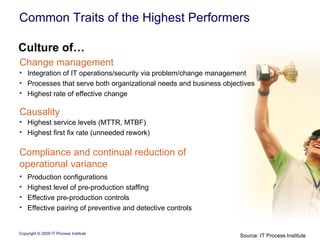
Common Traits of the Highest Performers Source: IT Process Institute  Change management Causality Compliance and continual reduction of operational variance Culture of… Integration of IT operations/security via problem/change management Processes that serve both organizational needs and business objectives Highest rate of effective change  Highest service levels (MTTR, MTBF) Highest first fix rate (unneeded rework) Production configurations Highest level of pre-production staffing Effective pre-production controls Effective pairing of preventive and detective controls
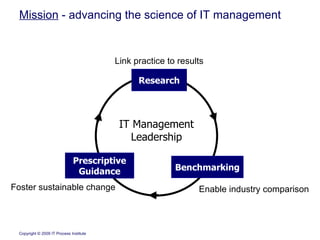
Mission  - advancing the science of IT management Research Prescriptive Guidance Benchmarking  IT Management Leadership Foster sustainable change  Enable industry comparison Link practice to results
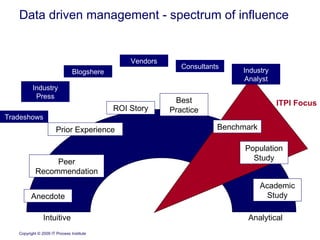
Data driven management - spectrum of influence Intuitive  Analytical  Academic Study Population Sample Population Sample Academic Study Population Sample Population Sample Academic Study Population Study Benchmark ROI Story Best Practice Peer Recommendation Anecdote Prior Experience ITPI Focus Vendors Consultants Industry Analyst Tradeshows Industry Press Blogshere
Vision: Quality Systems Approach Simple Mathematical function - Y = 2x+1  Complex system – 300 step semiconductor fab Settings at each step may potentially impact attributes of final product –i.e. CPU speed How do you identify where to set equipment knobs at which process steps to optimize CPU speed? Run controlled experiments – and identify correlation. Complex system – enterprise production environment Hundreds of services Many nodes, switches, configurations etc. etc. etc. If you implement a new security control, how do you know it is working?  If it is not working  Do you consider it a sunk cost and pull it back out?  Or leave it on the ever growing pile of IT systems.
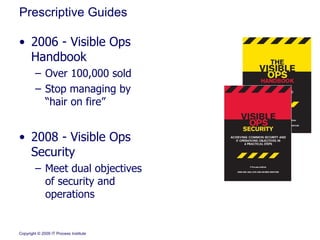
Prescriptive Guides 2006 - Visible Ops Handbook Over 100,000 sold Stop managing by “hair on fire”  2008 - Visible Ops Security  Meet dual objectives of security and operations
Surprise #1: Higher Performing IT Organizations High performers maintain a posture of compliance Fewest  number of repeat audit findings One-third  amount of audit preparation effort High performers find and fix security breaches faster 5 times  more likely to detect breaches by automated control 5 times  less likely to have breaches result in a loss event When high performers implement changes… 14 times more   changes One-half  the change failure rate  One-quarter  the change failure rate  10x faster   MTTR for Sev 1 outages When high performers manage IT resources… One-third  the amount of unplanned work 8 times more   projects and IT services 6 times more   applications Source: IT Process Institute, May 2007
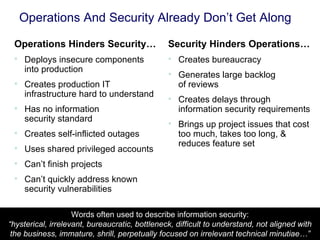
Operations And Security Already Don’t Get Along Operations Hinders Security… Deploys insecure components into production Creates production IT infrastructure hard to understand Has no information  security standard Creates self-inflicted outages Uses shared privileged accounts Can’t finish projects Can’t quickly address known security vulnerabilities Security Hinders Operations… Creates bureaucracy Generates large backlog  of reviews Creates delays through information security requirements  Brings up project issues that cost too much, takes too long, & reduces feature set Words often used to describe information security: “hysterical, irrelevant, bureaucratic, bottleneck, difficult to understand, not aligned with the business, immature, shrill, perpetually focused on irrelevant technical minutiae…”
Surprise #2: Three Controls Predicts 60% Of Performance To what extent does an organization define, monitor and enforce the following? Standardized configuration strategy Process discipline Controlled access to production systems Source: IT Process Institute, May 2006
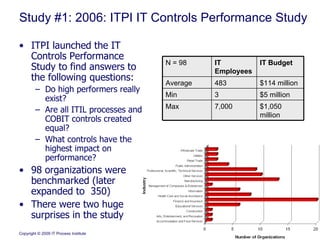
Study #1: 2006: ITPI IT Controls Performance Study ITPI launched the IT Controls Performance Study to find answers to the following questions: Do high performers really exist? Are all ITIL processes and COBIT controls created equal? What controls have the highest impact on performance? 98 organizations were benchmarked (later expanded to  350) There were two huge surprises in the study N = 98 IT Employees IT Budget Average 483 $114 million Min 3 $5 million Max 7,000 $1,050 million
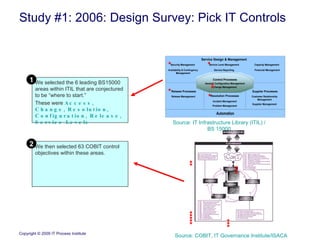
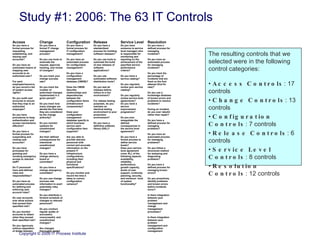
Study #1: 2006: Design Survey: Pick IT Controls Source: COBIT, IT Governance Institute/ISACA We selected the 6 leading BS15000 areas within ITIL that are conjectured to be “where to start.” These were  Access, Change, Resolution, Configuration, Release, Service Levels 1 We then selected 63 COBIT control objectives within these areas. 2 Source: IT Infrastructure Library (ITIL) / BS 15000
Study #1: 2006: The 63 IT Controls The resulting controls that we selected were in the following control categories: •  Access Controls : 17 controls •  Change Controls : 13 controls •  Configuration Controls : 7 controls •  Release Controls : 6 controls •  Service Level Controls : 8 controls •  Resolution Controls : 12 controls
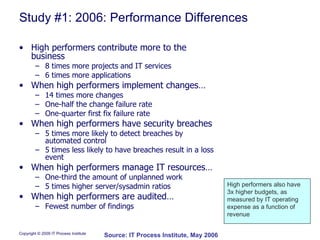
Study #1: 2006: Performance Differences High performers contribute more to the business 8 times more projects and IT services 6 times more applications When high performers implement changes… 14 times more changes One-half the change failure rate  One-quarter first fix failure rate When high performers have security breaches 5 times more likely to detect breaches by automated control 5 times less likely to have breaches result in a loss event When high performers manage IT resources… One-third the amount of unplanned work 5 times higher server/sysadmin ratios When high performers are audited… Fewest number of findings Source: IT Process Institute, May 2006 High performers also have 3x higher budgets, as measured by IT operating expense as a function of revenue
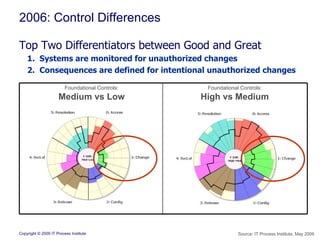
2006: Control Differences Top Two Differentiators between Good and Great 1.  Systems are monitored for unauthorized changes 2.  Consequences are defined for intentional unauthorized changes Source: IT Process Institute, May 2006 Foundational Controls: High vs Medium Foundational Controls: Medium vs Low
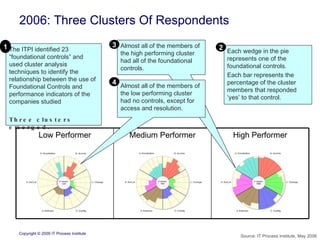
2006: Three Clusters Of Respondents Each wedge in the pie represents one of the foundational controls. Each bar represents the percentage of the cluster members that responded ‘yes’ to that control.  2 Almost all of the members of the high performing cluster had all of the foundational controls. 3 Almost all of the members of the low performing cluster had no controls, except for access and resolution. 4 Source: IT Process Institute, May 2006 Low Performer Medium Performer High Performer The ITPI identified 23 “foundational controls” and used cluster analysis techniques to identify the relationship between the use of Foundational Controls and performance indicators of the companies studied Three clusters emerged. 1
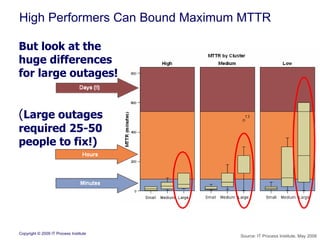
High Performers Can Bound Maximum MTTR But look at the huge differences for large outages! ( Large outages required 25-50  people to fix!) Source: IT Process Institute, May 2006
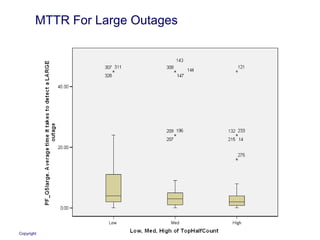
MTTR For Large Outages
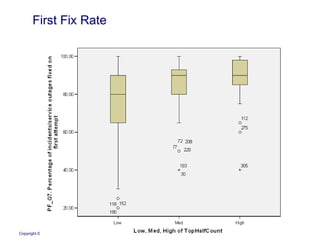
First Fix Rate
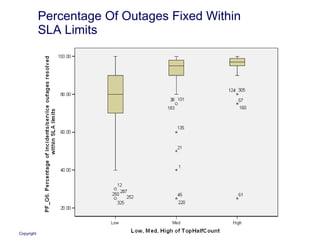
Percentage Of Outages Fixed Within SLA Limits
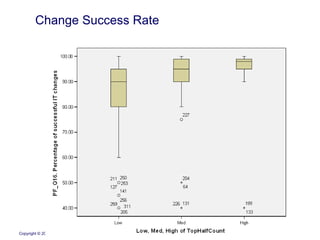
Change Success Rate
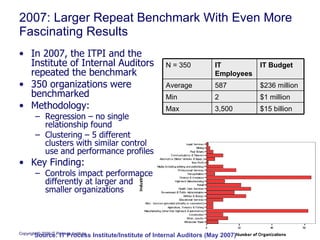
2007: Larger Repeat Benchmark With Even More Fascinating Results In 2007, the ITPI and the Institute of Internal Auditors repeated the benchmark 350 organizations were benchmarked Methodology: Regression – no single relationship found Clustering – 5 different clusters with similar control use and performance profiles Key Finding:  Controls impact performance differently at larger and smaller organizations Source: IT Process Institute/Institute of Internal Auditors (May 2007) N = 350 IT Employees IT Budget Average 587 $236 million Min 2 $1 million Max 3,500 $15 billion
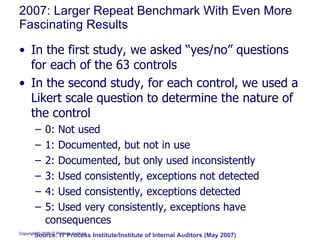
2007: Larger Repeat Benchmark With Even More Fascinating Results In the first study, we asked “yes/no” questions for each of the 63 controls In the second study, for each control, we used a Likert scale question to determine the nature of the control 0: Not used 1: Documented, but not in use 2: Documented, but only used inconsistently 3: Used consistently, exceptions not detected 4: Used consistently, exceptions detected 5: Used very consistently, exceptions have consequences Source: IT Process Institute/Institute of Internal Auditors (May 2007)
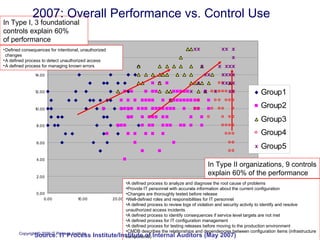
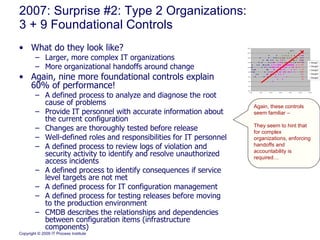
2007: Overall Performance vs. Control Use In Type I, 3 foundational controls explain 60% of performance In Type II organizations, 9 controls explain 60% of the performance Defined consequences for intentional, unauthorized changes A defined process to detect unauthorized access A defined process for managing known errors A defined process to analyze and diagnose the root cause of problems Provide IT personnel with accurate information about the current configuration Changes are thoroughly tested before release Well-defined roles and responsibilities for IT personnel A defined process to review logs of violation and security activity to identify and resolve unauthorized access incidents A defined process to identify consequences if service level targets are not met A defined process for IT configuration management A defined process for testing releases before moving to the production environment CMDB describes the relationships and dependencies between configuration items (infrastructure components) Source: IT Process Institute/Institute of Internal Auditors (May 2007)
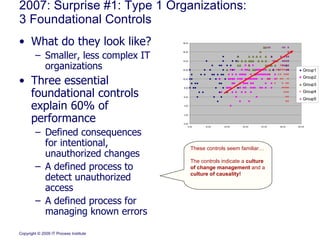
2007: Surprise #1: Type 1 Organizations:  3 Foundational Controls What do they look like?  Smaller, less complex IT organizations Three essential foundational controls explain 60% of performance Defined consequences for intentional, unauthorized changes A defined process to detect unauthorized access A defined process for managing known errors These controls seem familiar… The controls indicate a  culture of change management  and a  culture of causality!
2007: Surprise #2: Type 2 Organizations: 3 + 9 Foundational Controls What do they look like?  Larger, more complex IT organizations More organizational handoffs around change Again, nine more foundational controls explain 60% of performance! A defined process to analyze and diagnose the root cause of problems Provide IT personnel with accurate information about the current configuration Changes are thoroughly tested before release Well-defined roles and responsibilities for IT personnel A defined process to review logs of violation and security activity to identify and resolve unauthorized access incidents A defined process to identify consequences if service level targets are not met A defined process for IT configuration management A defined process for testing releases before moving to the production environment CMDB describes the relationships and dependencies between configuration items (infrastructure components) Again, these controls seem familiar – They seem to hint that for complex organizations, enforcing handoffs and accountability is required…
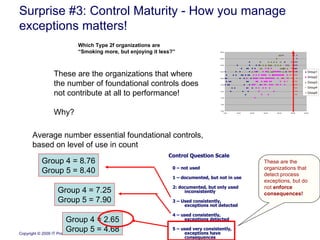
Control Question Scale 0 – not used 1 – documented, but not in use 2: documented, but only used inconsistently 3 – Used consistently, exceptions not detected 4 – used consistently, exceptions detected 5 – used very consistently, exceptions have consequences These are the organizations that detect process exceptions, but do not  enforce consequences! Group 4 = 2.65 Group 5 = 4.68 Group 4 = 7.25 Group 5 = 7.90 Group 4 = 8.76 Group 5 = 8.40 Average number essential foundational controls, based on level of use in count  Which Type 2f organizations are  “Smoking more, but enjoying it less?” These are the organizations that where the number of foundational controls does not contribute at all to performance! Why? Surprise #3: Control Maturity - How you manage exceptions matters!
2007: Summary of Key Findings Controls impact smaller and larger organizations differently 3 foundational control predict 45% of performance variation in smaller organizations. 9 foundational controls predict 60% of performance variation in larger organizations. Organizations should monitor and manage process exceptions for foundational controls in order to achieve performance improvement. Performance improvement potential is significant.
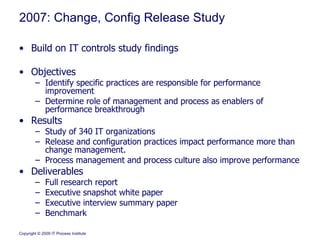
2007: Change, Config Release Study Build on IT controls study findings Objectives Identify specific practices are responsible for performance improvement Determine role of management and process as enablers of performance breakthrough Results Study of 340 IT organizations Release and configuration practices impact performance more than change management. Process management and process culture also improve performance Deliverables  Full research report Executive snapshot white paper Executive interview summary paper Benchmark
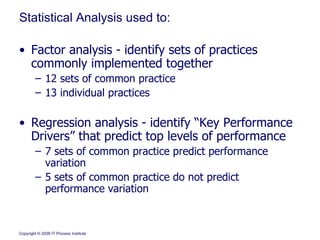
Statistical Analysis used to: Factor analysis - identify sets of practices commonly implemented together 12 sets of common practice 13 individual practices  Regression analysis - identify “Key Performance Drivers” that predict top levels of performance 7 sets of common practice predict performance variation 5 sets of common practice do not predict performance variation
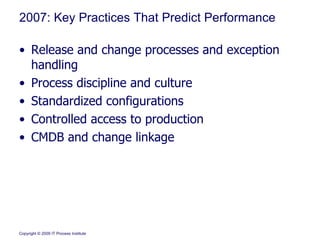
2007: Key Practices That Predict Performance Release and change processes and exception handling Process discipline and culture Standardized configurations Controlled access to production CMDB and change linkage
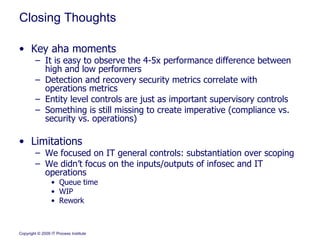
Closing Thoughts Key aha moments It is easy to observe the 4-5x performance difference between high and low performers Detection and recovery security metrics correlate with operations metrics Entity level controls are just as important supervisory controls Something is still missing to create imperative (compliance vs. security vs. operations) Limitations We focused on IT general controls: substantiation over scoping We didn’t focus on the inputs/outputs of infosec and IT operations Queue time WIP Rework

Itpi metricon 0906a final

  • 1.
    Metricon 4.0: Theimportance of context Security measures as a dependent variable Data reveals foundational practices that optimize security and operations Kurt Milne Managing Director, IT Process Institute [email_address] Gene Kim CTO, Co-Founder, Tripwire, Inc. [email_address] , @RealGeneKim
  • 2.
    Where Did TheHigh Performers Come From?
  • 3.
    Agenda Present researchbackground IT Process Institute Share study methodology findings VEESC 2006 IT Controls performance study 2007 (funded by Institute of Internal Auditors Research Foundation) Change configuration and release 2008 Virtualization maturity 2009 Study limitations and feedback
  • 4.
    Common Traits ofthe Highest Performers Source: IT Process Institute Change management Causality Compliance and continual reduction of operational variance Culture of… Integration of IT operations/security via problem/change management Processes that serve both organizational needs and business objectives Highest rate of effective change Highest service levels (MTTR, MTBF) Highest first fix rate (unneeded rework) Production configurations Highest level of pre-production staffing Effective pre-production controls Effective pairing of preventive and detective controls
  • 5.
    Mission -advancing the science of IT management Research Prescriptive Guidance Benchmarking IT Management Leadership Foster sustainable change Enable industry comparison Link practice to results
  • 6.
    Data driven management- spectrum of influence Intuitive Analytical Academic Study Population Sample Population Sample Academic Study Population Sample Population Sample Academic Study Population Study Benchmark ROI Story Best Practice Peer Recommendation Anecdote Prior Experience ITPI Focus Vendors Consultants Industry Analyst Tradeshows Industry Press Blogshere
  • 7.
    Vision: Quality SystemsApproach Simple Mathematical function - Y = 2x+1 Complex system – 300 step semiconductor fab Settings at each step may potentially impact attributes of final product –i.e. CPU speed How do you identify where to set equipment knobs at which process steps to optimize CPU speed? Run controlled experiments – and identify correlation. Complex system – enterprise production environment Hundreds of services Many nodes, switches, configurations etc. etc. etc. If you implement a new security control, how do you know it is working? If it is not working Do you consider it a sunk cost and pull it back out? Or leave it on the ever growing pile of IT systems.
  • 8.
    Prescriptive Guides 2006- Visible Ops Handbook Over 100,000 sold Stop managing by “hair on fire” 2008 - Visible Ops Security Meet dual objectives of security and operations
  • 9.
    Surprise #1: HigherPerforming IT Organizations High performers maintain a posture of compliance Fewest number of repeat audit findings One-third amount of audit preparation effort High performers find and fix security breaches faster 5 times more likely to detect breaches by automated control 5 times less likely to have breaches result in a loss event When high performers implement changes… 14 times more changes One-half the change failure rate One-quarter the change failure rate 10x faster MTTR for Sev 1 outages When high performers manage IT resources… One-third the amount of unplanned work 8 times more projects and IT services 6 times more applications Source: IT Process Institute, May 2007
  • 10.
    Operations And SecurityAlready Don’t Get Along Operations Hinders Security… Deploys insecure components into production Creates production IT infrastructure hard to understand Has no information security standard Creates self-inflicted outages Uses shared privileged accounts Can’t finish projects Can’t quickly address known security vulnerabilities Security Hinders Operations… Creates bureaucracy Generates large backlog of reviews Creates delays through information security requirements Brings up project issues that cost too much, takes too long, & reduces feature set Words often used to describe information security: “hysterical, irrelevant, bureaucratic, bottleneck, difficult to understand, not aligned with the business, immature, shrill, perpetually focused on irrelevant technical minutiae…”
  • 11.
    Surprise #2: ThreeControls Predicts 60% Of Performance To what extent does an organization define, monitor and enforce the following? Standardized configuration strategy Process discipline Controlled access to production systems Source: IT Process Institute, May 2006
  • 12.
    Study #1: 2006:ITPI IT Controls Performance Study ITPI launched the IT Controls Performance Study to find answers to the following questions: Do high performers really exist? Are all ITIL processes and COBIT controls created equal? What controls have the highest impact on performance? 98 organizations were benchmarked (later expanded to 350) There were two huge surprises in the study N = 98 IT Employees IT Budget Average 483 $114 million Min 3 $5 million Max 7,000 $1,050 million
  • 13.
    Study #1: 2006:Design Survey: Pick IT Controls Source: COBIT, IT Governance Institute/ISACA We selected the 6 leading BS15000 areas within ITIL that are conjectured to be “where to start.” These were Access, Change, Resolution, Configuration, Release, Service Levels 1 We then selected 63 COBIT control objectives within these areas. 2 Source: IT Infrastructure Library (ITIL) / BS 15000
  • 14.
    Study #1: 2006:The 63 IT Controls The resulting controls that we selected were in the following control categories: • Access Controls : 17 controls • Change Controls : 13 controls • Configuration Controls : 7 controls • Release Controls : 6 controls • Service Level Controls : 8 controls • Resolution Controls : 12 controls
  • 15.
    Study #1: 2006:Performance Differences High performers contribute more to the business 8 times more projects and IT services 6 times more applications When high performers implement changes… 14 times more changes One-half the change failure rate One-quarter first fix failure rate When high performers have security breaches 5 times more likely to detect breaches by automated control 5 times less likely to have breaches result in a loss event When high performers manage IT resources… One-third the amount of unplanned work 5 times higher server/sysadmin ratios When high performers are audited… Fewest number of findings Source: IT Process Institute, May 2006 High performers also have 3x higher budgets, as measured by IT operating expense as a function of revenue
  • 16.
    2006: Control DifferencesTop Two Differentiators between Good and Great 1. Systems are monitored for unauthorized changes 2. Consequences are defined for intentional unauthorized changes Source: IT Process Institute, May 2006 Foundational Controls: High vs Medium Foundational Controls: Medium vs Low
  • 17.
    2006: Three ClustersOf Respondents Each wedge in the pie represents one of the foundational controls. Each bar represents the percentage of the cluster members that responded ‘yes’ to that control. 2 Almost all of the members of the high performing cluster had all of the foundational controls. 3 Almost all of the members of the low performing cluster had no controls, except for access and resolution. 4 Source: IT Process Institute, May 2006 Low Performer Medium Performer High Performer The ITPI identified 23 “foundational controls” and used cluster analysis techniques to identify the relationship between the use of Foundational Controls and performance indicators of the companies studied Three clusters emerged. 1
  • 18.
    High Performers CanBound Maximum MTTR But look at the huge differences for large outages! ( Large outages required 25-50 people to fix!) Source: IT Process Institute, May 2006
  • 19.
  • 20.
  • 21.
    Percentage Of OutagesFixed Within SLA Limits
  • 22.
  • 23.
    2007: Larger RepeatBenchmark With Even More Fascinating Results In 2007, the ITPI and the Institute of Internal Auditors repeated the benchmark 350 organizations were benchmarked Methodology: Regression – no single relationship found Clustering – 5 different clusters with similar control use and performance profiles Key Finding: Controls impact performance differently at larger and smaller organizations Source: IT Process Institute/Institute of Internal Auditors (May 2007) N = 350 IT Employees IT Budget Average 587 $236 million Min 2 $1 million Max 3,500 $15 billion
  • 24.
    2007: Larger RepeatBenchmark With Even More Fascinating Results In the first study, we asked “yes/no” questions for each of the 63 controls In the second study, for each control, we used a Likert scale question to determine the nature of the control 0: Not used 1: Documented, but not in use 2: Documented, but only used inconsistently 3: Used consistently, exceptions not detected 4: Used consistently, exceptions detected 5: Used very consistently, exceptions have consequences Source: IT Process Institute/Institute of Internal Auditors (May 2007)
  • 25.
    2007: Overall Performancevs. Control Use In Type I, 3 foundational controls explain 60% of performance In Type II organizations, 9 controls explain 60% of the performance Defined consequences for intentional, unauthorized changes A defined process to detect unauthorized access A defined process for managing known errors A defined process to analyze and diagnose the root cause of problems Provide IT personnel with accurate information about the current configuration Changes are thoroughly tested before release Well-defined roles and responsibilities for IT personnel A defined process to review logs of violation and security activity to identify and resolve unauthorized access incidents A defined process to identify consequences if service level targets are not met A defined process for IT configuration management A defined process for testing releases before moving to the production environment CMDB describes the relationships and dependencies between configuration items (infrastructure components) Source: IT Process Institute/Institute of Internal Auditors (May 2007)
  • 26.
    2007: Surprise #1:Type 1 Organizations: 3 Foundational Controls What do they look like? Smaller, less complex IT organizations Three essential foundational controls explain 60% of performance Defined consequences for intentional, unauthorized changes A defined process to detect unauthorized access A defined process for managing known errors These controls seem familiar… The controls indicate a culture of change management and a culture of causality!
  • 27.
    2007: Surprise #2:Type 2 Organizations: 3 + 9 Foundational Controls What do they look like? Larger, more complex IT organizations More organizational handoffs around change Again, nine more foundational controls explain 60% of performance! A defined process to analyze and diagnose the root cause of problems Provide IT personnel with accurate information about the current configuration Changes are thoroughly tested before release Well-defined roles and responsibilities for IT personnel A defined process to review logs of violation and security activity to identify and resolve unauthorized access incidents A defined process to identify consequences if service level targets are not met A defined process for IT configuration management A defined process for testing releases before moving to the production environment CMDB describes the relationships and dependencies between configuration items (infrastructure components) Again, these controls seem familiar – They seem to hint that for complex organizations, enforcing handoffs and accountability is required…
  • 28.
    Control Question Scale0 – not used 1 – documented, but not in use 2: documented, but only used inconsistently 3 – Used consistently, exceptions not detected 4 – used consistently, exceptions detected 5 – used very consistently, exceptions have consequences These are the organizations that detect process exceptions, but do not enforce consequences! Group 4 = 2.65 Group 5 = 4.68 Group 4 = 7.25 Group 5 = 7.90 Group 4 = 8.76 Group 5 = 8.40 Average number essential foundational controls, based on level of use in count Which Type 2f organizations are “Smoking more, but enjoying it less?” These are the organizations that where the number of foundational controls does not contribute at all to performance! Why? Surprise #3: Control Maturity - How you manage exceptions matters!
  • 29.
    2007: Summary ofKey Findings Controls impact smaller and larger organizations differently 3 foundational control predict 45% of performance variation in smaller organizations. 9 foundational controls predict 60% of performance variation in larger organizations. Organizations should monitor and manage process exceptions for foundational controls in order to achieve performance improvement. Performance improvement potential is significant.
  • 30.
    2007: Change, ConfigRelease Study Build on IT controls study findings Objectives Identify specific practices are responsible for performance improvement Determine role of management and process as enablers of performance breakthrough Results Study of 340 IT organizations Release and configuration practices impact performance more than change management. Process management and process culture also improve performance Deliverables Full research report Executive snapshot white paper Executive interview summary paper Benchmark
  • 31.
    Statistical Analysis usedto: Factor analysis - identify sets of practices commonly implemented together 12 sets of common practice 13 individual practices Regression analysis - identify “Key Performance Drivers” that predict top levels of performance 7 sets of common practice predict performance variation 5 sets of common practice do not predict performance variation
  • 32.
    2007: Key PracticesThat Predict Performance Release and change processes and exception handling Process discipline and culture Standardized configurations Controlled access to production CMDB and change linkage
  • 33.
    Closing Thoughts Keyaha moments It is easy to observe the 4-5x performance difference between high and low performers Detection and recovery security metrics correlate with operations metrics Entity level controls are just as important supervisory controls Something is still missing to create imperative (compliance vs. security vs. operations) Limitations We focused on IT general controls: substantiation over scoping We didn’t focus on the inputs/outputs of infosec and IT operations Queue time WIP Rework

Editor's Notes

  • #5 When we look beyond the metrics into what they actually do day-to-day, the high performers set themselves apart and three major areas. First, they placed a significant emphasis on their change management process. In fact, high performers see their change management as a key capability that allows them to become a high performers. The next area of difference, is that high performers operate within a culture of causality. In other words, they placed a high amount of value on understanding why it change happened -- not just that it was resolved. These attributes led to a third aspect that was evident within the high performers: they were very rigorous about enforcing the policies and insisted on compliance from their team members. They also use the data they collected to reduce the variance of configurations and an increase consistency of practice within their operating environments. This was achieved through an emphasis on sending the right cultural message within the company, implementing the correct controls to hold people accountable for adhering to policies, and following through with consequences for not doing things the right way.
  • #6 Need to redraw with three arrows in circle IT Management Demming rolling up a hill
  • #11 How each side Actively impedes the achievement of each other’s goals.
  • #17 Key findings indicate that a set of 21 control activities, what the ITPI calls Foundational Controls, have the broadest impact on key performance measures. Top performers had higher performance measures in key operational metrics such as 12 to 37 percent less unplanned work than medium and low performers, 12 to 26 percent higher change success rate, and 2.5 to 5.4 times higher server to system administrator ratio. In addition, the presence of specific Change and Configuration controls, among others, appear to be the primary differentiators of top performing organizations.
  • #18 (1) Of the universe of potential controls, the researchers identified 23 "Foundational Controls" spanning 6 areas of ITIL (Access, Change, Config, Release, Service Level Mgt, and Resolution). Foundational controls were those controls which had the highest correlation with positive performance indicators (there were ~50 performance indicators spanning Operations, Compliance, and Security). By segmenting the respondents based on the performance indicators, 3 clusters of performers were apparent - high, medium, and low. (2) (See block 2 above) (3) (See block 3 above) (4) (See block 4 above) You'll also notice that the high performers utilize a very balanced approach to implementing controls, while the other groups have unbalanced approaches. We believe that the appropriate balance of controls is essential for success. However, some controls have a much greater impact than others. Let's discuss which ones those are…
  • #30 Based on analysis of the top performers in this study, our overall conclusion is that focusing ongoing audit, compliance, and best practice related resources on Foundational Control activities will generate a significant return on investment realized through increased performance on a wide range of key performance measures.