
IT Sector 
Presented by : 
(Group 4) 
Shiva Ganesh 
Anshul Kothari 
Soumya Sharma 
Chandra Nath Paul 
Sameeksha Verma 
Amit Binwani 
Yogesh Agarwal
INTRODUCTION OF IT 
 Information technology is playing an important role in 
India today & has transformed India's image from a 
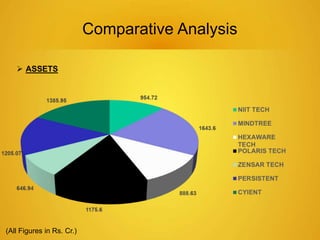
slow moving bureaucratic economy to a land of 
innovative entrepreneurs. 
 The IT sector in India is generating 2.5 million direct 
employment. 
 India is now one of the biggest IT capitals of the 
modern world.
According to DeitY 
 The major developed markets are sourcing IT/ITES from India to 
gain bottom-line benefits, improving their competitive edge. 
 Indian IT companies have set up over 600 delivery centres 
 The sector revenues have grown from 1.2 per cent in FY1997- 
98 to nearly 8.1 per cent in FY2013-14 
 Department of Electronics and Information Technology is 
coordinating strategic activities, promoting skill development 
programmes, enhancing infrastructure capabilities and 
supporting R&D for India’s leadership position in IT and IT-Enabled 
services.
KEY PLAYERS 
A key player or stakeholders is someone who has a 'stake' or 
vested interest in an industry. Key players in the IT sector are 
those that have influence and interest in the direction and use of 
Information and Communications Technology. These include 
bodies such as: 
 Vendors of IT products and services 
 IT consultancy organisations 
 Government departments 
 Professional bodies 
 Research organisations and publisher
KEY PLAYERS (Companies) 
 TCS 
 WIPRO 
 HCL 
 INFOSYS 
 TECHMAHINDRA
Regulator of the Sector 
INFORMATION TECHNOLOGY ACT,2000 (ITA-2000) 
An Act to provide legal recognition for transactions carried out by means of electronic 
data interchange and other means of electronic communication, commonly referred to 
as "electronic commerce", which involve the use of alternatives to paper-based 
methods of communication and storage of information, to facilitate electronic filing of 
documents with the Government agencies and further to amend the Indian Penal 
Code, the Indian Evidence Act, 1872, the Bankers' Books Evidence Act, 1891 and the 
Reserve Bank of India Act, 1934 and for matters connected therewith or incidental 
thereto. 
TRAI (TELECOM REGULATORY AUTHORITY OF INDIA) 
After the economic reforms of 1991-92, liberalization of external trade, elimination of 
duties on imports of information technology products, relaxation of controls on both 
inward and outward investments and foreign exchange and the fiscal measures taken 
by the Government of India and the individual State Governments specifically for IT 
and ITES have been major contributory factors for the sector to flourish in India and 
for the country to be able to acquire a dominant position in offshore services in the 
world.
Market Size 
 30 per cent and the overall sales are projected 
to touch US$ 17 billion in FY-15 . 
 Comprising server, storage and networking 
equipment - is expected to grow by four per 
cent in 2014 to touch US$ 1.9 billion 
 The IT services market in India is expected to 
grow at the rate of 8.4 per cent in 2014 to Rs 
476,356 million (US$ 7.88 billion), according to 
International Data Corporation (IDC).
INVESTMENT 
Indian IT's core competencies and strengths have 
placed it on the international canvas, attracting 
investments from major countries 
 TCS - US$ 200 million 
 WIPRO - US$ 1.2 billion 
 L&T Technology Services has bought 74 per cent 
equity stake in Thales Software India Pvt Ltd
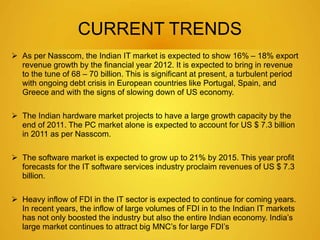
CURRENT TRENDS 
 As per Nasscom, the Indian IT market is expected to show 16% – 18% export 
revenue growth by the financial year 2012. It is expected to bring in revenue 
to the tune of 68 – 70 billion. This is significant at present, a turbulent period 
with ongoing debt crisis in European countries like Portugal, Spain, and 
Greece and with the signs of slowing down of US economy. 
 The Indian hardware market projects to have a large growth capacity by the 
end of 2011. The PC market alone is expected to account for US $ 7.3 billion 
in 2011 as per Nasscom. 
 The software market is expected to grow up to 21% by 2015. This year profit 
forecasts for the IT software services industry proclaim revenues of US $ 7.3 
billion. 
 Heavy inflow of FDI in the IT sector is expected to continue for coming years. 
In recent years, the inflow of large volumes of FDI in to the Indian IT markets 
has not only boosted the industry but also the entire Indian economy. India’s 
large market continues to attract big MNC’s for large FDI’s
What are trends in information 
technology development? 
 Integrating smartphones into the daily lives of consumers. 
 Continuity across several platforms and devices. 
 Television transformation. 
 Outsourcing 
 Private investment 
 FDI 
 Merger and acquisition 
 Budgetary provision
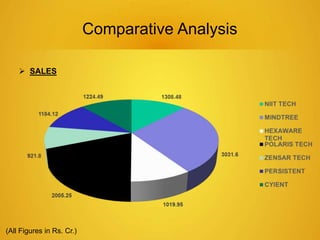
Comparative Analysis 
 SALES 
(All Figures in Rs. Cr.)
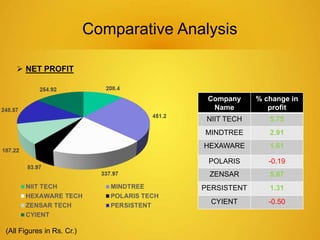
Comparative Analysis 
 NET PROFIT 
(All Figures in Rs. Cr.) 
Company 
Name 
% change in 
profit 
NIIT TECH 5.75 
MINDTREE 2.91 
HEXAWARE 1.61 
POLARIS -0.19 
ZENSAR 5.87 
PERSISTENT 1.31 
CYIENT -0.50
Comparative Analysis 
 ASSETS 
(All Figures in Rs. Cr.)
Comparative Analysis 
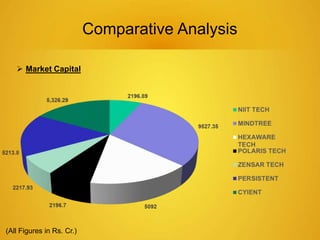
 Market Capital 
(All Figures in Rs. Cr.)
Comparative Analysis 
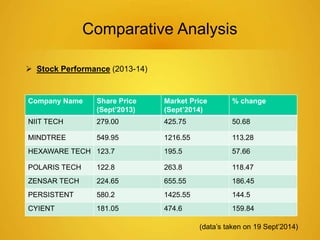
 Stock Performance (2013-14) 
Company Name Share Price 
(Sept’2013) 
Market Price 
(Sept’2014) 
% change 
NIIT TECH 279.00 425.75 50.68 
MINDTREE 549.95 1216.55 113.28 
HEXAWARE TECH 123.7 195.5 57.66 
POLARIS TECH 122.8 263.8 118.47 
ZENSAR TECH 224.65 655.55 186.45 
PERSISTENT 580.2 1425.55 144.5 
CYIENT 181.05 474.6 159.84 
(data’s taken on 19 Sept’2014)
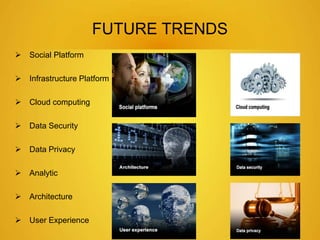
FUTURE TRENDS 
 Social Platform 
 Infrastructure Platform 
 Cloud computing 
 Data Security 
 Data Privacy 
 Analytic 
 Architecture 
 User Experience
Future Prospectus 
 Globalization has had a profound impact in shaping the Indian Information 
Technology industry. Over the years, verticals like manufacturing, telecom, 
insurance, banking, finance and lately the retail, have been the growth drivers 
for this sector. 
 But it is very fast getting clear that the future growth of IT and IT enabled 
services will be fuelled by the verticals of climate change, mobile applications, 
healthcare, energy efficiency and sustainable energy. 
 The near future of Indian IT industry sees a significant rise in share of 
technology spend as more and more service providers both Indian and global 
target new segments and provide low cost, flexible solutions to customers. 
 By 2015, IT sector is expected to generate revenues of USD 130 billion 
(NASSCOM) which will create a transformational impact on the overall 
economy.
Conclusion 
 IT has potential of not only accelerating the growth of the Indian economy 
but also promoting the broad-based economic development. 
 To realize the same , besides standard policy initiatives such as improving 
infrastructure, strengthening training and education system, and introducing 
flexible labour laws that affect every sector of the economy including the IT 
sector. 
 The government needs to take specific measures to promote IT use and to 
make it accessible to every section of the society. The IT should be promoted 
to be used as a tool for raising the living standards of the common people 
and enriching their lives.
 IT literacy needs to be enhanced manifold among the population at large 
through conventional and non-conventional means, so that ordinary people 
can begin to use it to derive benefits, both economically and socially. 
 India will not reap the full benefits of its success in IT unless its broader 
institutional and incentive regime creates opportunities for local 
communities and villages to realize the benefits from the same.
Thank You

Analysis of IT Sector

  • 1.
    IT Sector Presentedby : (Group 4) Shiva Ganesh Anshul Kothari Soumya Sharma Chandra Nath Paul Sameeksha Verma Amit Binwani Yogesh Agarwal
  • 2.
    INTRODUCTION OF IT  Information technology is playing an important role in India today & has transformed India's image from a slow moving bureaucratic economy to a land of innovative entrepreneurs.  The IT sector in India is generating 2.5 million direct employment.  India is now one of the biggest IT capitals of the modern world.
  • 3.
    According to DeitY  The major developed markets are sourcing IT/ITES from India to gain bottom-line benefits, improving their competitive edge.  Indian IT companies have set up over 600 delivery centres  The sector revenues have grown from 1.2 per cent in FY1997- 98 to nearly 8.1 per cent in FY2013-14  Department of Electronics and Information Technology is coordinating strategic activities, promoting skill development programmes, enhancing infrastructure capabilities and supporting R&D for India’s leadership position in IT and IT-Enabled services.
  • 4.
    KEY PLAYERS Akey player or stakeholders is someone who has a 'stake' or vested interest in an industry. Key players in the IT sector are those that have influence and interest in the direction and use of Information and Communications Technology. These include bodies such as:  Vendors of IT products and services  IT consultancy organisations  Government departments  Professional bodies  Research organisations and publisher
  • 5.
    KEY PLAYERS (Companies)  TCS  WIPRO  HCL  INFOSYS  TECHMAHINDRA
  • 6.
    Regulator of theSector INFORMATION TECHNOLOGY ACT,2000 (ITA-2000) An Act to provide legal recognition for transactions carried out by means of electronic data interchange and other means of electronic communication, commonly referred to as "electronic commerce", which involve the use of alternatives to paper-based methods of communication and storage of information, to facilitate electronic filing of documents with the Government agencies and further to amend the Indian Penal Code, the Indian Evidence Act, 1872, the Bankers' Books Evidence Act, 1891 and the Reserve Bank of India Act, 1934 and for matters connected therewith or incidental thereto. TRAI (TELECOM REGULATORY AUTHORITY OF INDIA) After the economic reforms of 1991-92, liberalization of external trade, elimination of duties on imports of information technology products, relaxation of controls on both inward and outward investments and foreign exchange and the fiscal measures taken by the Government of India and the individual State Governments specifically for IT and ITES have been major contributory factors for the sector to flourish in India and for the country to be able to acquire a dominant position in offshore services in the world.
  • 7.
    Market Size 30 per cent and the overall sales are projected to touch US$ 17 billion in FY-15 .  Comprising server, storage and networking equipment - is expected to grow by four per cent in 2014 to touch US$ 1.9 billion  The IT services market in India is expected to grow at the rate of 8.4 per cent in 2014 to Rs 476,356 million (US$ 7.88 billion), according to International Data Corporation (IDC).
  • 8.
    INVESTMENT Indian IT'score competencies and strengths have placed it on the international canvas, attracting investments from major countries  TCS - US$ 200 million  WIPRO - US$ 1.2 billion  L&T Technology Services has bought 74 per cent equity stake in Thales Software India Pvt Ltd
  • 9.
    CURRENT TRENDS As per Nasscom, the Indian IT market is expected to show 16% – 18% export revenue growth by the financial year 2012. It is expected to bring in revenue to the tune of 68 – 70 billion. This is significant at present, a turbulent period with ongoing debt crisis in European countries like Portugal, Spain, and Greece and with the signs of slowing down of US economy.  The Indian hardware market projects to have a large growth capacity by the end of 2011. The PC market alone is expected to account for US $ 7.3 billion in 2011 as per Nasscom.  The software market is expected to grow up to 21% by 2015. This year profit forecasts for the IT software services industry proclaim revenues of US $ 7.3 billion.  Heavy inflow of FDI in the IT sector is expected to continue for coming years. In recent years, the inflow of large volumes of FDI in to the Indian IT markets has not only boosted the industry but also the entire Indian economy. India’s large market continues to attract big MNC’s for large FDI’s
  • 10.
    What are trendsin information technology development?  Integrating smartphones into the daily lives of consumers.  Continuity across several platforms and devices.  Television transformation.  Outsourcing  Private investment  FDI  Merger and acquisition  Budgetary provision
  • 11.
    Comparative Analysis SALES (All Figures in Rs. Cr.)
  • 12.
    Comparative Analysis NET PROFIT (All Figures in Rs. Cr.) Company Name % change in profit NIIT TECH 5.75 MINDTREE 2.91 HEXAWARE 1.61 POLARIS -0.19 ZENSAR 5.87 PERSISTENT 1.31 CYIENT -0.50
  • 13.
    Comparative Analysis ASSETS (All Figures in Rs. Cr.)
  • 14.
    Comparative Analysis Market Capital (All Figures in Rs. Cr.)
  • 15.
    Comparative Analysis Stock Performance (2013-14) Company Name Share Price (Sept’2013) Market Price (Sept’2014) % change NIIT TECH 279.00 425.75 50.68 MINDTREE 549.95 1216.55 113.28 HEXAWARE TECH 123.7 195.5 57.66 POLARIS TECH 122.8 263.8 118.47 ZENSAR TECH 224.65 655.55 186.45 PERSISTENT 580.2 1425.55 144.5 CYIENT 181.05 474.6 159.84 (data’s taken on 19 Sept’2014)
  • 16.
    FUTURE TRENDS Social Platform  Infrastructure Platform  Cloud computing  Data Security  Data Privacy  Analytic  Architecture  User Experience
  • 17.
    Future Prospectus Globalization has had a profound impact in shaping the Indian Information Technology industry. Over the years, verticals like manufacturing, telecom, insurance, banking, finance and lately the retail, have been the growth drivers for this sector.  But it is very fast getting clear that the future growth of IT and IT enabled services will be fuelled by the verticals of climate change, mobile applications, healthcare, energy efficiency and sustainable energy.  The near future of Indian IT industry sees a significant rise in share of technology spend as more and more service providers both Indian and global target new segments and provide low cost, flexible solutions to customers.  By 2015, IT sector is expected to generate revenues of USD 130 billion (NASSCOM) which will create a transformational impact on the overall economy.
  • 18.
    Conclusion  IThas potential of not only accelerating the growth of the Indian economy but also promoting the broad-based economic development.  To realize the same , besides standard policy initiatives such as improving infrastructure, strengthening training and education system, and introducing flexible labour laws that affect every sector of the economy including the IT sector.  The government needs to take specific measures to promote IT use and to make it accessible to every section of the society. The IT should be promoted to be used as a tool for raising the living standards of the common people and enriching their lives.
  • 19.
     IT literacyneeds to be enhanced manifold among the population at large through conventional and non-conventional means, so that ordinary people can begin to use it to derive benefits, both economically and socially.  India will not reap the full benefits of its success in IT unless its broader institutional and incentive regime creates opportunities for local communities and villages to realize the benefits from the same.
  • 20.