Welcomes You All!!!!!!!!!!!!!!!!
Information Technology Engineering What it means to be an IT - Engineer! “ Information Technology is the use of hardware, software, services, and supporting infrastructure to manage and deliver information.”
“ Informatics is the scientific field that deals with biomedical information, data and knowledge - their storage, retrieval and optimal use for problem-solving and decision-making.”  “ Knowledge Management is the collection of processes that govern the creation, dissemination, and utilization of knowledge”
How it works…… IT World Professional Users: CAD engineers, E - traders  Industry Professionals & Workers: Programmers, System Analysts,  Network Managers, Technicians, etc. Users — for work: Accountants, Architects, Writers Users — for learning: Stud ents and Workers Users — for living: On - line Shoppers,  Check - writers,  Websurfers Gr. 1 - 6 IT World  Awareness Gr. 7 - 8 IT World Exploration Gr. 9 - 12 Work - based  Learning (Internships Mentoring & other) Programming Science Math 4 - year  coll ege 2 - year  college Certificate  programs Education System
Making Sense of IT for Learning,  Living & Working Hardware Hardware Software Multimedia/Web Systems Integration IT INDUSTRY SPECIFIC  TECHNICAL SKILLS/COMPETENCIES IT INTEGRATION APPLICATION-INTENSIVE SKILLS/COMPETENCIES Agriculture/ Natural  Resources Construction Manufacturing Transportation, Distribution & Logistics Wholesale/ Retail Sales & Service Hospitality & Tourism Business & Administration Health Science Human Services Arts & Audio-Visual Communications Legal & Protective Services Scientific,  Research,  Engineering &  Technical Education & Training Public  Administration/ Government Financial  Services IT SCANS TECHNOLOGY  INFORMATION SYSTEMS IT  for  LEARNING & LIVING: K-LIFELONG HARDWARE/ SOFTWARE Support Management HARDWARE/ SOFTWARE Support Management HARDWARE/ SOFTWARE Design Development IT USERS IT PRODUCERS IT Career Cluster Initiative is focused in this area NSF IT Applications Across Careers is focused in this area HARDWARE/ SOFTWARE Design Development
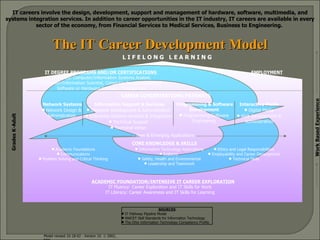
The IT Career Development Model Grades K-Adult Work Based Experience EMPLOYMENT IT DEGREE PROGRAMS AND/OR CERTIFICATIONS  Examples: Computer/Information Systems Analyst, Computer/Information Scientist, Computer Security Specialist Software or Hardware Engineer, Programmer SOURCES IT Pathway Pipeline Model NWCET Skill Standards for Information Technology  The Ohio Information Technology Competency Profile Model revised 10-18-02 - Version 10    2002, EDC CAREER CONCENTRATIONS/PATHWAYS CORE KNOWLEDGE & SKILLS L I F E L O N G  L E A R N I N G IT careers involve the design,   development, support and management of hardware, software, multimedia, and systems integration services. In addition to career opportunities in the IT industry, IT careers are available in every sector of the economy, from Financial Services to Medical Services, Business to Engineering.   Programming & Software Development Programming/Software Engineering Information Support & Services Database Development & Administration Enterprise Systems Analysis & Integration Technical Support Technical Writer Interactive Media Digital Media Web Development & Administration Network Systems Network Design & Administration IT Fluency: Career Exploration and IT Skills for Work IT Literacy: Career Awareness and IT Skills for Learning ACADEMIC FOUNDATION/INTENSIVE IT CAREER EXPLORATION Information Technology Applications Systems  Safety, Health and Environmental Leadership and Teamwork Academic Foundations Communications Problem Solving and Critical Thinking Ethics and Legal Responsibilities Employability and Career Development Technical Skills New & Emerging Applications
Most colleges have courses in IT, which someone going into this field will need. Good knowledge of mathematics, especially OOPS concept is necessary. Depending on the school, you may be considered an Engineering student instead of a physics student, but there will be a fair amount of overlap. This is one of the more practical fields of physics, so you will likely focus more on applications than theory.
IT Literacy Definition IT (Information Technologies) literacy is using digital technology, communications tools, and/or networks to access, manage, integrate, evaluate, and create information in order to function in a knowledge society.   The five critical components of IT literacy are: Access - knowing about and knowing to collect and/or retrieve  information  Access  – knowing about and knowing how to collect and/or retrieve  information  Manage  – applying an existing organizational or classification scheme Integrate  – interpreting and representing information. It involves summarizing, comparing and contrasting Evaluate  – making judgments about the quality, relevance, usefulness, or efficiency of information. Create   –  generating information by adapting, applying, designing,  inventing, or authoring information.
Integrate Information MECHANISMS:  IT tools used to summarize, compare and contrast information Such as:  spreadsheet visualization system statistical analysis tools INPUT: Raw data, information OUTPUT: Interpreted information; conclusions, reports, presentations CONTROLS:  e.g.  Cost,  Schedule, protocol, laws, regulations Summarize, compare, and contrast information
Core IT Skills Found Across Clusters Personal Information Management (PIM) Productivity Electronic Mail Internet Writing/Publishing Presentation Software Database Collaborative Groupware Computer-based Equipment Geographic Information/Global Positioning
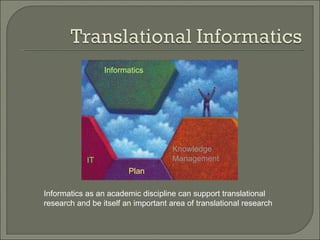
IT Knowledge Management Plan Informatics Informatics as an academic discipline can support translational research and be itself an important area of translational research
•  Data Structure •  Programming Languages C, C++, .NET, Java •  Digital Circuit System •  ADA • Artificial Intelligence •  Software Engineering  •  Data Communication •  Multimedia Concept •  Theory of  Computation OOT
Information technology expertise alone cannot guarantee effective use of IT in biomedicine Informatics complements IT expertise in creating solutions to complex “real-world” problems in Biomedicine The IRT strategic plan will create new opportunities for Applied Informatics research and education We need to grow our Applied Informatics community
As an IT Engineer, entry for junior posts in the Government departments is by direct recruitment through advertisements in newspapers.  Selection to IT – Manager posts in banking industry is through the competitive examinations conducted by Individual banks as BOI, SBI, UBI, CBI etc… As an IT Engineer, entry for various posts in private sector are always on demand as in HCL, Wipro, TCS, InfoSys, CapGemini, Oracle, Microsoft…...
In the Defence Services, young engineers start as Second Lieutenants. For selection into the Defence Services- Indian Army, Indian Air Force, Indian Navy, applications are invited through National dailies and  Employment  News.  Similarly vacancies in the private and public sector are advertised through leading daily newspapers of the country and the Employment News. Mostly the candidates are interviewed after thorough scrutiny of their basic inputs and the selections are made on merit. Indian Railways, Atomic Energy Commission, Hindustan Aeronautics Limited, Ministry of Civil Aviation, Directorate General Posts and Telegraphs Departments etc are some of the prospective employers in the field. 
IT Engineers can start their own business  by developing individual softwares using different platforms. IT peripherals, Widgets, Gadgets and components are always in demand. One can get huge advantage and reap huge benefit out of it. They can also start a repair or assembly shop for peripherals like monitors, printers, scanners equipment etc., it gives high returns for a given initial investment. Loan facilities are offered by banks and Small Scale Industries Development Corporations for starting a business.  
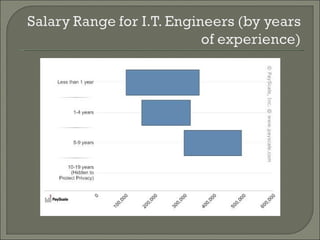
This section provides salary profile of IT engineers in India based on years of experience, city of employment, type of employer. ( Time 2 Cheer!!!!!!!!!!!!!!!!!!!!!!!!!!!)


For More Information Contact Er. Anurag S. Bhadoriya Lect. – I. T. Department a.bhadoriya@ btirt.com 09827290138

It presentation final1

  • 1.
  • 2.
    Information Technology EngineeringWhat it means to be an IT - Engineer! “ Information Technology is the use of hardware, software, services, and supporting infrastructure to manage and deliver information.”
  • 3.
    “ Informatics isthe scientific field that deals with biomedical information, data and knowledge - their storage, retrieval and optimal use for problem-solving and decision-making.” “ Knowledge Management is the collection of processes that govern the creation, dissemination, and utilization of knowledge”
  • 4.
    How it works……IT World Professional Users: CAD engineers, E - traders Industry Professionals & Workers: Programmers, System Analysts, Network Managers, Technicians, etc. Users — for work: Accountants, Architects, Writers Users — for learning: Stud ents and Workers Users — for living: On - line Shoppers, Check - writers, Websurfers Gr. 1 - 6 IT World Awareness Gr. 7 - 8 IT World Exploration Gr. 9 - 12 Work - based Learning (Internships Mentoring & other) Programming Science Math 4 - year coll ege 2 - year college Certificate programs Education System
  • 5.
    Making Sense ofIT for Learning, Living & Working Hardware Hardware Software Multimedia/Web Systems Integration IT INDUSTRY SPECIFIC TECHNICAL SKILLS/COMPETENCIES IT INTEGRATION APPLICATION-INTENSIVE SKILLS/COMPETENCIES Agriculture/ Natural Resources Construction Manufacturing Transportation, Distribution & Logistics Wholesale/ Retail Sales & Service Hospitality & Tourism Business & Administration Health Science Human Services Arts & Audio-Visual Communications Legal & Protective Services Scientific, Research, Engineering & Technical Education & Training Public Administration/ Government Financial Services IT SCANS TECHNOLOGY INFORMATION SYSTEMS IT for LEARNING & LIVING: K-LIFELONG HARDWARE/ SOFTWARE Support Management HARDWARE/ SOFTWARE Support Management HARDWARE/ SOFTWARE Design Development IT USERS IT PRODUCERS IT Career Cluster Initiative is focused in this area NSF IT Applications Across Careers is focused in this area HARDWARE/ SOFTWARE Design Development
  • 6.
    The IT CareerDevelopment Model Grades K-Adult Work Based Experience EMPLOYMENT IT DEGREE PROGRAMS AND/OR CERTIFICATIONS Examples: Computer/Information Systems Analyst, Computer/Information Scientist, Computer Security Specialist Software or Hardware Engineer, Programmer SOURCES IT Pathway Pipeline Model NWCET Skill Standards for Information Technology The Ohio Information Technology Competency Profile Model revised 10-18-02 - Version 10  2002, EDC CAREER CONCENTRATIONS/PATHWAYS CORE KNOWLEDGE & SKILLS L I F E L O N G L E A R N I N G IT careers involve the design, development, support and management of hardware, software, multimedia, and systems integration services. In addition to career opportunities in the IT industry, IT careers are available in every sector of the economy, from Financial Services to Medical Services, Business to Engineering. Programming & Software Development Programming/Software Engineering Information Support & Services Database Development & Administration Enterprise Systems Analysis & Integration Technical Support Technical Writer Interactive Media Digital Media Web Development & Administration Network Systems Network Design & Administration IT Fluency: Career Exploration and IT Skills for Work IT Literacy: Career Awareness and IT Skills for Learning ACADEMIC FOUNDATION/INTENSIVE IT CAREER EXPLORATION Information Technology Applications Systems Safety, Health and Environmental Leadership and Teamwork Academic Foundations Communications Problem Solving and Critical Thinking Ethics and Legal Responsibilities Employability and Career Development Technical Skills New & Emerging Applications
  • 7.
    Most colleges havecourses in IT, which someone going into this field will need. Good knowledge of mathematics, especially OOPS concept is necessary. Depending on the school, you may be considered an Engineering student instead of a physics student, but there will be a fair amount of overlap. This is one of the more practical fields of physics, so you will likely focus more on applications than theory.
  • 8.
    IT Literacy DefinitionIT (Information Technologies) literacy is using digital technology, communications tools, and/or networks to access, manage, integrate, evaluate, and create information in order to function in a knowledge society. The five critical components of IT literacy are: Access - knowing about and knowing to collect and/or retrieve information Access – knowing about and knowing how to collect and/or retrieve information Manage – applying an existing organizational or classification scheme Integrate – interpreting and representing information. It involves summarizing, comparing and contrasting Evaluate – making judgments about the quality, relevance, usefulness, or efficiency of information. Create – generating information by adapting, applying, designing, inventing, or authoring information.
  • 9.
    Integrate Information MECHANISMS: IT tools used to summarize, compare and contrast information Such as: spreadsheet visualization system statistical analysis tools INPUT: Raw data, information OUTPUT: Interpreted information; conclusions, reports, presentations CONTROLS: e.g. Cost, Schedule, protocol, laws, regulations Summarize, compare, and contrast information
  • 10.
    Core IT SkillsFound Across Clusters Personal Information Management (PIM) Productivity Electronic Mail Internet Writing/Publishing Presentation Software Database Collaborative Groupware Computer-based Equipment Geographic Information/Global Positioning
  • 11.
    IT Knowledge ManagementPlan Informatics Informatics as an academic discipline can support translational research and be itself an important area of translational research
  • 12.
    • DataStructure • Programming Languages C, C++, .NET, Java • Digital Circuit System • ADA • Artificial Intelligence • Software Engineering • Data Communication • Multimedia Concept • Theory of Computation OOT
  • 13.
    Information technology expertisealone cannot guarantee effective use of IT in biomedicine Informatics complements IT expertise in creating solutions to complex “real-world” problems in Biomedicine The IRT strategic plan will create new opportunities for Applied Informatics research and education We need to grow our Applied Informatics community
  • 14.
    As an ITEngineer, entry for junior posts in the Government departments is by direct recruitment through advertisements in newspapers.  Selection to IT – Manager posts in banking industry is through the competitive examinations conducted by Individual banks as BOI, SBI, UBI, CBI etc… As an IT Engineer, entry for various posts in private sector are always on demand as in HCL, Wipro, TCS, InfoSys, CapGemini, Oracle, Microsoft…...
  • 15.
    In the DefenceServices, young engineers start as Second Lieutenants. For selection into the Defence Services- Indian Army, Indian Air Force, Indian Navy, applications are invited through National dailies and  Employment  News.  Similarly vacancies in the private and public sector are advertised through leading daily newspapers of the country and the Employment News. Mostly the candidates are interviewed after thorough scrutiny of their basic inputs and the selections are made on merit. Indian Railways, Atomic Energy Commission, Hindustan Aeronautics Limited, Ministry of Civil Aviation, Directorate General Posts and Telegraphs Departments etc are some of the prospective employers in the field. 
  • 16.
    IT Engineers canstart their own business  by developing individual softwares using different platforms. IT peripherals, Widgets, Gadgets and components are always in demand. One can get huge advantage and reap huge benefit out of it. They can also start a repair or assembly shop for peripherals like monitors, printers, scanners equipment etc., it gives high returns for a given initial investment. Loan facilities are offered by banks and Small Scale Industries Development Corporations for starting a business.  
  • 17.
    This section providessalary profile of IT engineers in India based on years of experience, city of employment, type of employer. ( Time 2 Cheer!!!!!!!!!!!!!!!!!!!!!!!!!!!)
  • 18.
  • 19.
  • 20.
  • 21.
    For More InformationContact Er. Anurag S. Bhadoriya Lect. – I. T. Department a.bhadoriya@ btirt.com 09827290138