Isabela State University Echague
Research Consultation Portal
(ISU-E RCP)
DARIOS B. ALADO
August, 2017
CHAPTER I
THE PROBLEM AND ITS BACKGROUND
Introduction
Isabela State University Echague Campus offers undergraduate and
graduate programs that require research projects as course requirements.
Students and faculty researchers need constant consultations to their
advisers who are experts in doing research. This enables them to answer
their queries about the research being undertaken and educate them on
how to perform different research processes. Providing a rendezvous for the
researchers allows them to share their expert thoughts to others who are
willing to venture in field of research construction.
Although ISU-E are full of competent and knowledgeable researchers the
instant contact and access to these researchers becomes impossible due to
lack of time and instant communication. The advent of the new technology
today allows the students and faculty researchers get in touch with the
experts using forum, chat room and emails and instant messages for
consultation.
The development and implementation of ISU-E Research Information System
provides an ultimate solution to the problems of ISU-E in providing unlimited
access to all its clientele and researchers. It also provides a venue for the
students of the undergraduate and graduate programs to consult and
communicate to their advisers for some insights and professional inputs in
doing the research via online anytime as long as internet connection is
available.
The ISU-E Research Consultation Portal will highlight different faculty and
students researches. The system also provides chat room, forum, publication,
and announcement page for the users. The users who are bonafide students
and faculty members of ISU-E can also upload and download faculty and
student researches as reference and guide in doing research.
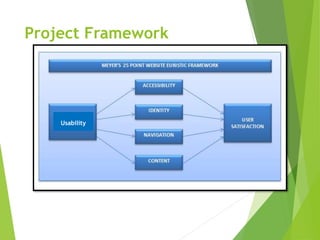
The modified version of Meyer, et al, (2009) as 25-point Website
Usability Checklist which is divided only into four (4) sections such as
Accessibility, Identity, Navigation, and content which is originally derived
from Nielsen 113- point checklist in his book, Homepage Usability. 25-point
Website Usability checklist as developed by Dr. Meyer will be the
instrument to use and it will be guided through the Nielsen's heuristic
process.
The following are the sections relating to usability of the proposed
system which is defined and organized by Dr. Meyer
Project Framework
Accessibility: “the application features that support universal access
by any class of users and technology”. It is one of the main goals of
the agency to attract as many as possible from various users,
especially researchers. By the word “accessible” it means that users
would not only to get connection to a site but also able to browse all
contents available. The higher the degree of accessibility, the higher
the level of usability. The agency, student researchers, research
expert, and other visitors might keep from being able to access the
information on a website and there are three elements need to
consider, first is the loading time, and second is browser
compatibility and lastly the search facility because web users are
impatient: they want to get their answer immediately and do not
want to be slowed down by cool features, missions statements, or
self-promoting grandstanding (Nielsen, 1997)
Identity: ” the distinctive characterization belongs to an individuality
or site”. It gives clear path to the company information and makes
the company purpose clear.
Navigation: ” the act of navigating”. The good navigation in a site
comparable to good road map. With good navigation users especially
farmers know where they are, where they’ve been, and where they can go
from their current position. In short navigation is the key to making the
experience enjoyable and efficient.
Content: ” it refers to information contains” One factor of content is
providing clear information if what the agency being offered, the
information must be accurate, reliable, and up-to-date. Also, the
importance of short pages titles, meaningful headings and singed pages
must be considered.
25- Point Website Usability Checklist is measured on Five Point
Ranging Scale. This indicated that the value of one is equivalent to strongly
disagree and Five as to strongly agree. The Lickert scale Method will be
used in analyzing the result of the survey.
Project Framework
Usability
After a thorough analysis and investigation the researcher aims to
attain the following specific research objectives:
• To be able to investigate the status of the current system of ISU-E
campus on research consultation;
• To be able to design, develop and implement ISU-E Research
Consultation Portal for Isabela State University –Echague Campus; and
• To evaluate the users’ perception on the system using the following
criteria:
• Accessibility
• Identity
• Navigation
• Content
Statement of the Objectives
Scope and Delimitation of the Study
This study will be conducted to Isabela State University Echague
Campus located at San Fabian, Echague, Isabela. The research started
on April, 2012 and ends on October, 2012. There are 50 respondents in
this study which is consist of: (17) I.T. Experts, (10) ISU Faculty
Members who are handling capstone projects, thesis researches and
other related agricultural researches in the graduate and
undergraduate programs, (18) Students Researchers both in the
graduate and undergraduate programs (2) Research Heads and (3)
Research Employees.
This research covers the different researches of graduate and
undergraduate programs of Isabela State University - Echague Campus.
All bonafide members’ faculty and students of ISU-Echague campus
can access the system and its services and non-members have limited
access to the system.
The access to the system is limited only on consultation about
research processes, list of researches in the graduate and
undergraduate program, publication, journal, services, and portal.
Other matters which are not part of the research process will not be
included in this research. Downloading of information related to
research output is limited only to all bonafide members of the
University and of course with consent to the real owner of the
research. Students and researchers from other colleges and
universities are not allowed to access the system without securing a
written consent form the administrator.
Importance of the Study
The implementation of the ISU-E Research Information
System provides new technology for the ISU-E. This study provides an
avenue for the researchers to publish, promote, and maintain a
repository of records of all researches conducted by the researchers.
The unlimited access to the different researches of ISU-E
allows the users to enhance their basic knowledge in conducting
researchers through the help of the online communication provided by
the system.
Research output of the different researchers at ISU-E is now
in a wider range of coverage in terms of publication and not only
found in the library, desktop computer and office shelves but can also
be viewed not only within the premises of Echague but it can be
accessed anywhere as long as internet connection is available. The
limited access of research information is now replaced with unlimited
access time.
The students form the graduate and undergraduate programs can
now communicate to expert researchers using the system to do queries
regarding research matters. Consultation is now easy for the students of
both graduate and undergraduate program since the system is equipped
with interactive features to address the problem.
Researchers can easily publish their researches and journals
online for further criticisms of different experts in the field for some
professional insights and inclusion of relevant information for the success
of the research being undertaken.
Researchers and advisers can now communicate online anytime of
the day for consultation purposes about the research being undertaken by
the researcher. Delays in critiquing the papers in now eliminated since the
adviser can easily access the manuscripts online and talk to its advisee
online using the online chat room. Advisers and researchers can also
upload and download information and resources to be used as reference in
the research study being carried out by the researcher.
CHAPTERII
REVIEW OF RELATED LITERATURE AND SYSTEMS
Pls. refer to the manuscript
CHAPTERIII
RESULTS AND DISCUSSION
Existing System Procedures
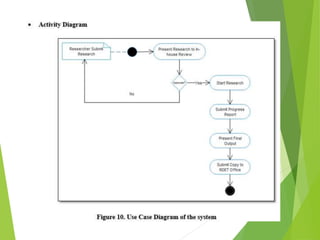
Research process in the University in the current
system undergo different stages of below. The process same
goes to both graduate and undergraduate programs. The
problem arises when researchers seek advises to the pool of
expert researchers in terms of communication. Consultation is
very difficult that results sometimes to disagreement of the
concepts of the research during presentations. There is no
proper venue for the researcher and the adviser to discuss the
research due to the preoccupied schedule of the adviser.
Another problem occurs when the researches were already
presented and finished.
There is no organized system that being followed in
keeping the research. The bulk of printed documents are put
into shelves in the Research Development and Extension
Training Office. Monitoring of these researches are difficult to
handle. Every time the students proposes a title the RDET
office finds it difficult to determine if the proposed title
contains duplication with the existing researches. Access to
these researches is also another problems to the new
researchers. It is hard for them to access the contents of the
research because it is only available during class hours as
provided by the Library and the RDET office.
Requirements Documentation
The researcher gave emphasis on the functional and non-
functional requirements in identifying the user requirements. The
functional requirements specifically focus on the process, data,
interface and network. The researcher used the User Stories
approach as a tool in identifying the functional requirement of the
system.
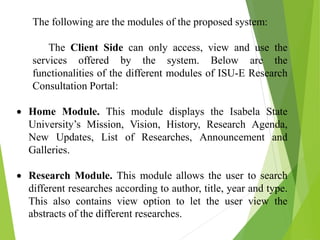
The following are the modules of the proposed system:
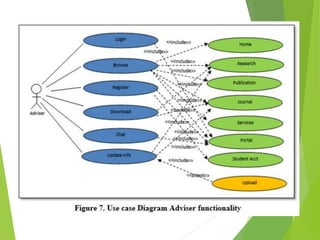
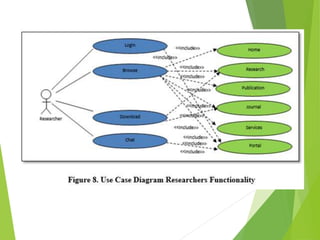
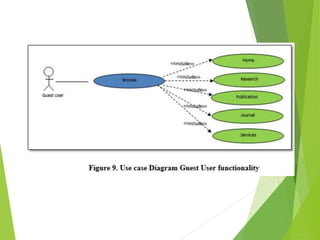
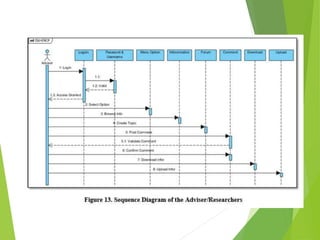
The Client Side can only access, view and use the
services offered by the system. Below are the
functionalities of the different modules of ISU-E Research
Consultation Portal:
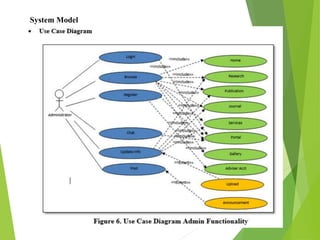
 Home Module. This module displays the Isabela State
University’s Mission, Vision, History, Research Agenda,
New Updates, List of Researches, Announcement and
Galleries.
 Research Module. This module allows the user to search
different researches according to author, title, year and type.
This also contains view option to let the user view the
abstracts of the different researches.
 Publication Module. This module allows the researcher to
publish research and journal.
 Journal Module. The journal module allows the user to view
lists of published and unpublished journal of the University.
 Services Module. This module provides different services
for both researchers and advisers. It is consists of:
Downloadable files such as: Research Format, Research
Templates, Research Guidelines, and other pertinent
documents related to research processes. The advisers and the
researchers can also upload items such as research
manuscripts for the purpose of editing, progress reports,
proposals, and other pertinent research documents.
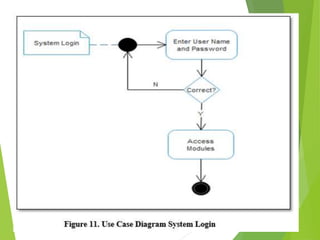
 Portal Module. This module serves as the entry point of the
user to the main modules of the system. The user can create
its account, change its account, edit its profile, edit primary
photo, user login, join chat room, join forum, and send e-mail
and attached files.
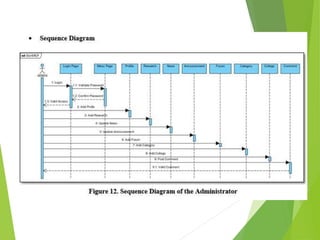
The following functionalities are intended to the
following modules under the administrator side:
 Home Module. This module allows the administrator of the
system to modify such as editing, adding and updating content
of the Mission, Vision, History, Research Agenda, New
Updates, List of Researches, Announcement and Galleries.
 Research Module. This module allows the administrator to
add, edit, and delete the list of researches in the database file
of the system.
 Publication Module. This module allows administrator to
filter the content of the publication for security purposes of the
website.
 Journal Module. The journal module allows the administrator
to add, edit and delete list of journals contained in the database
of the system.
 Services Module. This module allows the administrator to
add, edit, and delete the list of downloadable items in this
module. The administrator in this module also filters the
content of the uploaded files from the user side prior to the
display of the information on the web.
 Portal Module. This module allows the administrator to
create accounts for the users.
 Status Module. This module allows the administrator to
Add, Edit, Delete, Search status of the research. Status is
about the nature of the research whether it is Proposal,
Ongoing or Finished.
 Category Module. The category module allows the
administrator to classify the research whether it is action
research, technology related, agricultural, social and
technical researches.
 College Module. This module classify the origin of the
research in terms of college who serves as the proponent of
the research.
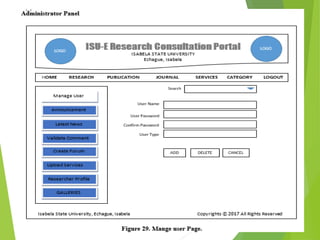
 Profile Module. This module allows the administrator to
add, edit, search, and delete profile of the researcher.
 Gallery Module. This module allows the administrator to
add pictures of the research activities.
Software Development Tool ISO Standard
PHP (Hypertext Preprocessor) - The researchers used PHP
(Hypertext Preprocessor) for developing and creating a dynamic
web page. The researchers choose PHP because it is open source
and it is compatible with MySQL.
MySQL–The researcher used MySQL to create a database. The
researchers choose MySQL because it is open source software and
it has the features that use a very fast thread-based memory
allocation, and it isrelational (RDBMS) that runs as a server
providing multi-user access to a number of databases.
Navicat for MySql – The researcher used Navicat Premium as
graphical interface of Mysql Server database. It has an Explorer
like interface and supports multiple database connections for
local and remote databases since this software could easily
manage the database.
Appache Server – It is software that interprets scripts written in
the PHP programming language.
Adobe Photoshop – It is used for editing icons and photos
needed to put to the system to beautify.
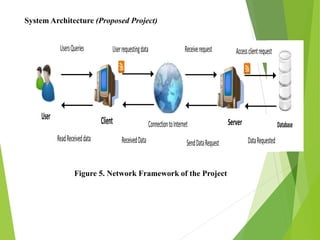
System Architecture (Proposed Project)
Client Server
User
Database
UsersQueries Userrequestingdata
ConnectiontoInternet
Receiverequest Accessclientrequest
ReceivedData DataRequestedSendDataRequestReadReceiveddata
Figure 5. Network Framework of the Project
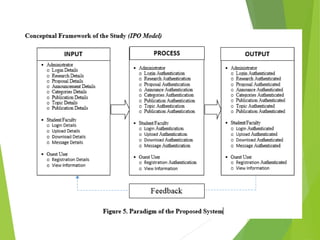
System Model
Development and Testing
Data Analysis Plan
The researcher adopted the Meyer’s, et al, usability
theory (2009) as 25-point Website Usability Checklist is
split into 4 roughly equal sections, Accessibility, Identity,
Navigation, and Content which is originally derived from
Nielsen 113- point checklist in his book, Homepage
Usability. 25-point Website Usability checklist as
developed by Dr. Meyer was used and guided through the
Nielsen's heuristic process.
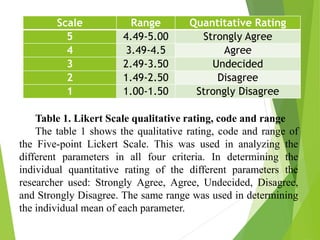
Scale Range Quantitative Rating
5 4.49-5.00 Strongly Agree
4 3.49-4.5 Agree
3 2.49-3.50 Undecided
2 1.49-2.50 Disagree
1 1.00-1.50 Strongly Disagree
Table 1. Likert Scale qualitative rating, code and range
The table 1 shows the qualitative rating, code and range of
the Five-point Lickert Scale. This was used in analyzing the
different parameters in all four criteria. In determining the
individual quantitative rating of the different parameters the
researcher used: Strongly Agree, Agree, Undecided, Disagree,
and Strongly Disagree. The same range was used in determining
the individual mean of each parameter.
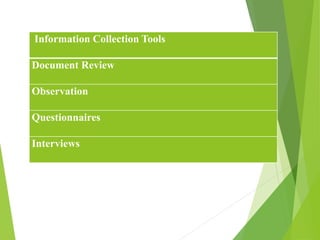
Information Collection Tools
Document Review
Observation
Questionnaires
Interviews
Test Plan
Unit Testing. This unit is concerned with knowledge
about testing a program unit, typically developed by a
single individual, to determine that it is free of data, logic,
or standards errors. This unit includes knowledge of
dynamic analysis (equivalent partitioning, boundary value
analysis, cause-effect graphing, logic-based testing, random
testing, and syntax testing) and static analysis (complete
path testing, decision testing, condition testing, and data-
flow testing).
Integration Testing. This unit is concerned with
knowledge about validating that software components, which
have been unit tested separately, interact correctly when they
are put together to perform a higher order function. This unit
also includes knowledge about dependency checking for
calls, data, and processes, and about interface checking in
terms of range, type compatibility, representation, number and
order of parameters, and method of transfer.
System Testing. This unit is concerned with knowledge
about validating the specified functional requirements of a
system. This unit includes knowledge about techniques to
design and enact an independent testing process of all of the
system’s functions described in the software requirements
specifications.
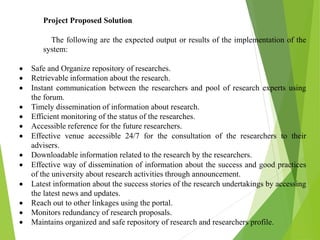
Project Proposed Solution
The following are the expected output or results of the implementation of the
system:
 Safe and Organize repository of researches.
 Retrievable information about the research.
 Instant communication between the researchers and pool of research experts using
the forum.
 Timely dissemination of information about research.
 Efficient monitoring of the status of the researches.
 Accessible reference for the future researchers.
 Effective venue accessible 24/7 for the consultation of the researchers to their
advisers.
 Downloadable information related to the research by the researchers.
 Effective way of dissemination of information about the success and good practices
of the university about research activities through announcement.
 Latest information about the success stories of the research undertakings by accessing
the latest news and updates.
 Reach out to other linkages using the portal.
 Monitors redundancy of research proposals.
 Maintains organized and safe repository of research and researchers profile.
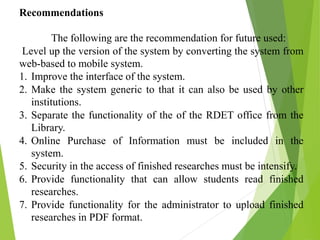
Recommendations
The following are the recommendation for future used:
Level up the version of the system by converting the system from
web-based to mobile system.
1. Improve the interface of the system.
2. Make the system generic to that it can also be used by other
institutions.
3. Separate the functionality of the of the RDET office from the
Library.
4. Online Purchase of Information must be included in the
system.
5. Security in the access of finished researches must be intensify.
6. Provide functionality that can allow students read finished
researches.
7. Provide functionality for the administrator to upload finished
researches in PDF format.
Thank you…

ISU-E Research Consultation Portal

  • 1.
    Isabela State UniversityEchague Research Consultation Portal (ISU-E RCP) DARIOS B. ALADO August, 2017
  • 2.
    CHAPTER I THE PROBLEMAND ITS BACKGROUND
  • 3.
    Introduction Isabela State UniversityEchague Campus offers undergraduate and graduate programs that require research projects as course requirements. Students and faculty researchers need constant consultations to their advisers who are experts in doing research. This enables them to answer their queries about the research being undertaken and educate them on how to perform different research processes. Providing a rendezvous for the researchers allows them to share their expert thoughts to others who are willing to venture in field of research construction. Although ISU-E are full of competent and knowledgeable researchers the instant contact and access to these researchers becomes impossible due to lack of time and instant communication. The advent of the new technology today allows the students and faculty researchers get in touch with the experts using forum, chat room and emails and instant messages for consultation.
  • 4.
    The development andimplementation of ISU-E Research Information System provides an ultimate solution to the problems of ISU-E in providing unlimited access to all its clientele and researchers. It also provides a venue for the students of the undergraduate and graduate programs to consult and communicate to their advisers for some insights and professional inputs in doing the research via online anytime as long as internet connection is available. The ISU-E Research Consultation Portal will highlight different faculty and students researches. The system also provides chat room, forum, publication, and announcement page for the users. The users who are bonafide students and faculty members of ISU-E can also upload and download faculty and student researches as reference and guide in doing research.
  • 5.
    The modified versionof Meyer, et al, (2009) as 25-point Website Usability Checklist which is divided only into four (4) sections such as Accessibility, Identity, Navigation, and content which is originally derived from Nielsen 113- point checklist in his book, Homepage Usability. 25-point Website Usability checklist as developed by Dr. Meyer will be the instrument to use and it will be guided through the Nielsen's heuristic process. The following are the sections relating to usability of the proposed system which is defined and organized by Dr. Meyer Project Framework
  • 6.
    Accessibility: “the applicationfeatures that support universal access by any class of users and technology”. It is one of the main goals of the agency to attract as many as possible from various users, especially researchers. By the word “accessible” it means that users would not only to get connection to a site but also able to browse all contents available. The higher the degree of accessibility, the higher the level of usability. The agency, student researchers, research expert, and other visitors might keep from being able to access the information on a website and there are three elements need to consider, first is the loading time, and second is browser compatibility and lastly the search facility because web users are impatient: they want to get their answer immediately and do not want to be slowed down by cool features, missions statements, or self-promoting grandstanding (Nielsen, 1997) Identity: ” the distinctive characterization belongs to an individuality or site”. It gives clear path to the company information and makes the company purpose clear.
  • 7.
    Navigation: ” theact of navigating”. The good navigation in a site comparable to good road map. With good navigation users especially farmers know where they are, where they’ve been, and where they can go from their current position. In short navigation is the key to making the experience enjoyable and efficient. Content: ” it refers to information contains” One factor of content is providing clear information if what the agency being offered, the information must be accurate, reliable, and up-to-date. Also, the importance of short pages titles, meaningful headings and singed pages must be considered. 25- Point Website Usability Checklist is measured on Five Point Ranging Scale. This indicated that the value of one is equivalent to strongly disagree and Five as to strongly agree. The Lickert scale Method will be used in analyzing the result of the survey.
  • 8.
  • 9.
    After a thoroughanalysis and investigation the researcher aims to attain the following specific research objectives: • To be able to investigate the status of the current system of ISU-E campus on research consultation; • To be able to design, develop and implement ISU-E Research Consultation Portal for Isabela State University –Echague Campus; and • To evaluate the users’ perception on the system using the following criteria: • Accessibility • Identity • Navigation • Content Statement of the Objectives
  • 10.
    Scope and Delimitationof the Study This study will be conducted to Isabela State University Echague Campus located at San Fabian, Echague, Isabela. The research started on April, 2012 and ends on October, 2012. There are 50 respondents in this study which is consist of: (17) I.T. Experts, (10) ISU Faculty Members who are handling capstone projects, thesis researches and other related agricultural researches in the graduate and undergraduate programs, (18) Students Researchers both in the graduate and undergraduate programs (2) Research Heads and (3) Research Employees. This research covers the different researches of graduate and undergraduate programs of Isabela State University - Echague Campus. All bonafide members’ faculty and students of ISU-Echague campus can access the system and its services and non-members have limited access to the system.
  • 11.
    The access tothe system is limited only on consultation about research processes, list of researches in the graduate and undergraduate program, publication, journal, services, and portal. Other matters which are not part of the research process will not be included in this research. Downloading of information related to research output is limited only to all bonafide members of the University and of course with consent to the real owner of the research. Students and researchers from other colleges and universities are not allowed to access the system without securing a written consent form the administrator.
  • 12.
    Importance of theStudy The implementation of the ISU-E Research Information System provides new technology for the ISU-E. This study provides an avenue for the researchers to publish, promote, and maintain a repository of records of all researches conducted by the researchers. The unlimited access to the different researches of ISU-E allows the users to enhance their basic knowledge in conducting researchers through the help of the online communication provided by the system. Research output of the different researchers at ISU-E is now in a wider range of coverage in terms of publication and not only found in the library, desktop computer and office shelves but can also be viewed not only within the premises of Echague but it can be accessed anywhere as long as internet connection is available. The limited access of research information is now replaced with unlimited access time.
  • 13.
    The students formthe graduate and undergraduate programs can now communicate to expert researchers using the system to do queries regarding research matters. Consultation is now easy for the students of both graduate and undergraduate program since the system is equipped with interactive features to address the problem. Researchers can easily publish their researches and journals online for further criticisms of different experts in the field for some professional insights and inclusion of relevant information for the success of the research being undertaken. Researchers and advisers can now communicate online anytime of the day for consultation purposes about the research being undertaken by the researcher. Delays in critiquing the papers in now eliminated since the adviser can easily access the manuscripts online and talk to its advisee online using the online chat room. Advisers and researchers can also upload and download information and resources to be used as reference in the research study being carried out by the researcher.
  • 14.
    CHAPTERII REVIEW OF RELATEDLITERATURE AND SYSTEMS Pls. refer to the manuscript
  • 15.
  • 16.
    Existing System Procedures Researchprocess in the University in the current system undergo different stages of below. The process same goes to both graduate and undergraduate programs. The problem arises when researchers seek advises to the pool of expert researchers in terms of communication. Consultation is very difficult that results sometimes to disagreement of the concepts of the research during presentations. There is no proper venue for the researcher and the adviser to discuss the research due to the preoccupied schedule of the adviser. Another problem occurs when the researches were already presented and finished.
  • 17.
    There is noorganized system that being followed in keeping the research. The bulk of printed documents are put into shelves in the Research Development and Extension Training Office. Monitoring of these researches are difficult to handle. Every time the students proposes a title the RDET office finds it difficult to determine if the proposed title contains duplication with the existing researches. Access to these researches is also another problems to the new researchers. It is hard for them to access the contents of the research because it is only available during class hours as provided by the Library and the RDET office.
  • 18.
    Requirements Documentation The researchergave emphasis on the functional and non- functional requirements in identifying the user requirements. The functional requirements specifically focus on the process, data, interface and network. The researcher used the User Stories approach as a tool in identifying the functional requirement of the system.
  • 19.
    The following arethe modules of the proposed system: The Client Side can only access, view and use the services offered by the system. Below are the functionalities of the different modules of ISU-E Research Consultation Portal:  Home Module. This module displays the Isabela State University’s Mission, Vision, History, Research Agenda, New Updates, List of Researches, Announcement and Galleries.  Research Module. This module allows the user to search different researches according to author, title, year and type. This also contains view option to let the user view the abstracts of the different researches.
  • 20.
     Publication Module.This module allows the researcher to publish research and journal.  Journal Module. The journal module allows the user to view lists of published and unpublished journal of the University.  Services Module. This module provides different services for both researchers and advisers. It is consists of: Downloadable files such as: Research Format, Research Templates, Research Guidelines, and other pertinent documents related to research processes. The advisers and the researchers can also upload items such as research manuscripts for the purpose of editing, progress reports, proposals, and other pertinent research documents.  Portal Module. This module serves as the entry point of the user to the main modules of the system. The user can create its account, change its account, edit its profile, edit primary photo, user login, join chat room, join forum, and send e-mail and attached files.
  • 21.
    The following functionalitiesare intended to the following modules under the administrator side:  Home Module. This module allows the administrator of the system to modify such as editing, adding and updating content of the Mission, Vision, History, Research Agenda, New Updates, List of Researches, Announcement and Galleries.  Research Module. This module allows the administrator to add, edit, and delete the list of researches in the database file of the system.  Publication Module. This module allows administrator to filter the content of the publication for security purposes of the website.  Journal Module. The journal module allows the administrator to add, edit and delete list of journals contained in the database of the system.
  • 22.
     Services Module.This module allows the administrator to add, edit, and delete the list of downloadable items in this module. The administrator in this module also filters the content of the uploaded files from the user side prior to the display of the information on the web.  Portal Module. This module allows the administrator to create accounts for the users.  Status Module. This module allows the administrator to Add, Edit, Delete, Search status of the research. Status is about the nature of the research whether it is Proposal, Ongoing or Finished.  Category Module. The category module allows the administrator to classify the research whether it is action research, technology related, agricultural, social and technical researches.
  • 23.
     College Module.This module classify the origin of the research in terms of college who serves as the proponent of the research.  Profile Module. This module allows the administrator to add, edit, search, and delete profile of the researcher.  Gallery Module. This module allows the administrator to add pictures of the research activities.
  • 24.
    Software Development ToolISO Standard PHP (Hypertext Preprocessor) - The researchers used PHP (Hypertext Preprocessor) for developing and creating a dynamic web page. The researchers choose PHP because it is open source and it is compatible with MySQL. MySQL–The researcher used MySQL to create a database. The researchers choose MySQL because it is open source software and it has the features that use a very fast thread-based memory allocation, and it isrelational (RDBMS) that runs as a server providing multi-user access to a number of databases.
  • 25.
    Navicat for MySql– The researcher used Navicat Premium as graphical interface of Mysql Server database. It has an Explorer like interface and supports multiple database connections for local and remote databases since this software could easily manage the database. Appache Server – It is software that interprets scripts written in the PHP programming language. Adobe Photoshop – It is used for editing icons and photos needed to put to the system to beautify.
  • 27.
    System Architecture (ProposedProject) Client Server User Database UsersQueries Userrequestingdata ConnectiontoInternet Receiverequest Accessclientrequest ReceivedData DataRequestedSendDataRequestReadReceiveddata Figure 5. Network Framework of the Project
  • 28.
  • 37.
    Development and Testing DataAnalysis Plan The researcher adopted the Meyer’s, et al, usability theory (2009) as 25-point Website Usability Checklist is split into 4 roughly equal sections, Accessibility, Identity, Navigation, and Content which is originally derived from Nielsen 113- point checklist in his book, Homepage Usability. 25-point Website Usability checklist as developed by Dr. Meyer was used and guided through the Nielsen's heuristic process.
  • 38.
    Scale Range QuantitativeRating 5 4.49-5.00 Strongly Agree 4 3.49-4.5 Agree 3 2.49-3.50 Undecided 2 1.49-2.50 Disagree 1 1.00-1.50 Strongly Disagree Table 1. Likert Scale qualitative rating, code and range The table 1 shows the qualitative rating, code and range of the Five-point Lickert Scale. This was used in analyzing the different parameters in all four criteria. In determining the individual quantitative rating of the different parameters the researcher used: Strongly Agree, Agree, Undecided, Disagree, and Strongly Disagree. The same range was used in determining the individual mean of each parameter.
  • 39.
    Information Collection Tools DocumentReview Observation Questionnaires Interviews
  • 40.
    Test Plan Unit Testing.This unit is concerned with knowledge about testing a program unit, typically developed by a single individual, to determine that it is free of data, logic, or standards errors. This unit includes knowledge of dynamic analysis (equivalent partitioning, boundary value analysis, cause-effect graphing, logic-based testing, random testing, and syntax testing) and static analysis (complete path testing, decision testing, condition testing, and data- flow testing).
  • 41.
    Integration Testing. Thisunit is concerned with knowledge about validating that software components, which have been unit tested separately, interact correctly when they are put together to perform a higher order function. This unit also includes knowledge about dependency checking for calls, data, and processes, and about interface checking in terms of range, type compatibility, representation, number and order of parameters, and method of transfer. System Testing. This unit is concerned with knowledge about validating the specified functional requirements of a system. This unit includes knowledge about techniques to design and enact an independent testing process of all of the system’s functions described in the software requirements specifications.
  • 44.
    Project Proposed Solution Thefollowing are the expected output or results of the implementation of the system:  Safe and Organize repository of researches.  Retrievable information about the research.  Instant communication between the researchers and pool of research experts using the forum.  Timely dissemination of information about research.  Efficient monitoring of the status of the researches.  Accessible reference for the future researchers.  Effective venue accessible 24/7 for the consultation of the researchers to their advisers.  Downloadable information related to the research by the researchers.  Effective way of dissemination of information about the success and good practices of the university about research activities through announcement.  Latest information about the success stories of the research undertakings by accessing the latest news and updates.  Reach out to other linkages using the portal.  Monitors redundancy of research proposals.  Maintains organized and safe repository of research and researchers profile.
  • 45.
    Recommendations The following arethe recommendation for future used: Level up the version of the system by converting the system from web-based to mobile system. 1. Improve the interface of the system. 2. Make the system generic to that it can also be used by other institutions. 3. Separate the functionality of the of the RDET office from the Library. 4. Online Purchase of Information must be included in the system. 5. Security in the access of finished researches must be intensify. 6. Provide functionality that can allow students read finished researches. 7. Provide functionality for the administrator to upload finished researches in PDF format.
  • 46.