THE MATHEMATICAL UNIVERSE IN A NUTSHELL
K. K. NAMBIAR
ABSTRACT. The mathematical universe discussed here gives models of possible
structures our physical universe can have.
Keywords—Cosmology, White Hole, Black Whole.
Date: July 12, 2002.
1. Introduction 3
2. Mathematical Logic 5
3. Generalized Anthropic Principle and The Book 10
4. Expanding Universe 13
5. Intuitive Set Theory 15
6. Universal Number System 21
7. Conclusion 23
25
1. INTRODUCTION
When we talk about the universe, we usually mean the physical universe around
us, but then we must recognize that we are capable of visualizing universes which
are quite different from the one we live in. The possible universes that we can
reasonably imagine is what we collectively call the mathematical universe. There
is yet another universe which we may call the spiritual universe, a universe hard
to avoid and to define. We will accept a weak definiton of the spiritual universe as
the collection of unverifiable persistent emotional beliefs within us that are difficult
to analyze. Our description makes it clear that spiritual universe is beyond and the
physical universe is within the mathematical universe. As a matter of record, here
are the three universes we are interested in:
• Physical universe
• Mathematical universe
• Spiritual universe
The purpose of this paper is to discuss the mathematical universe in some detail,
so that we may have a deeper understanding of the physical universe and a greater
appreciation for the spiritual universe.
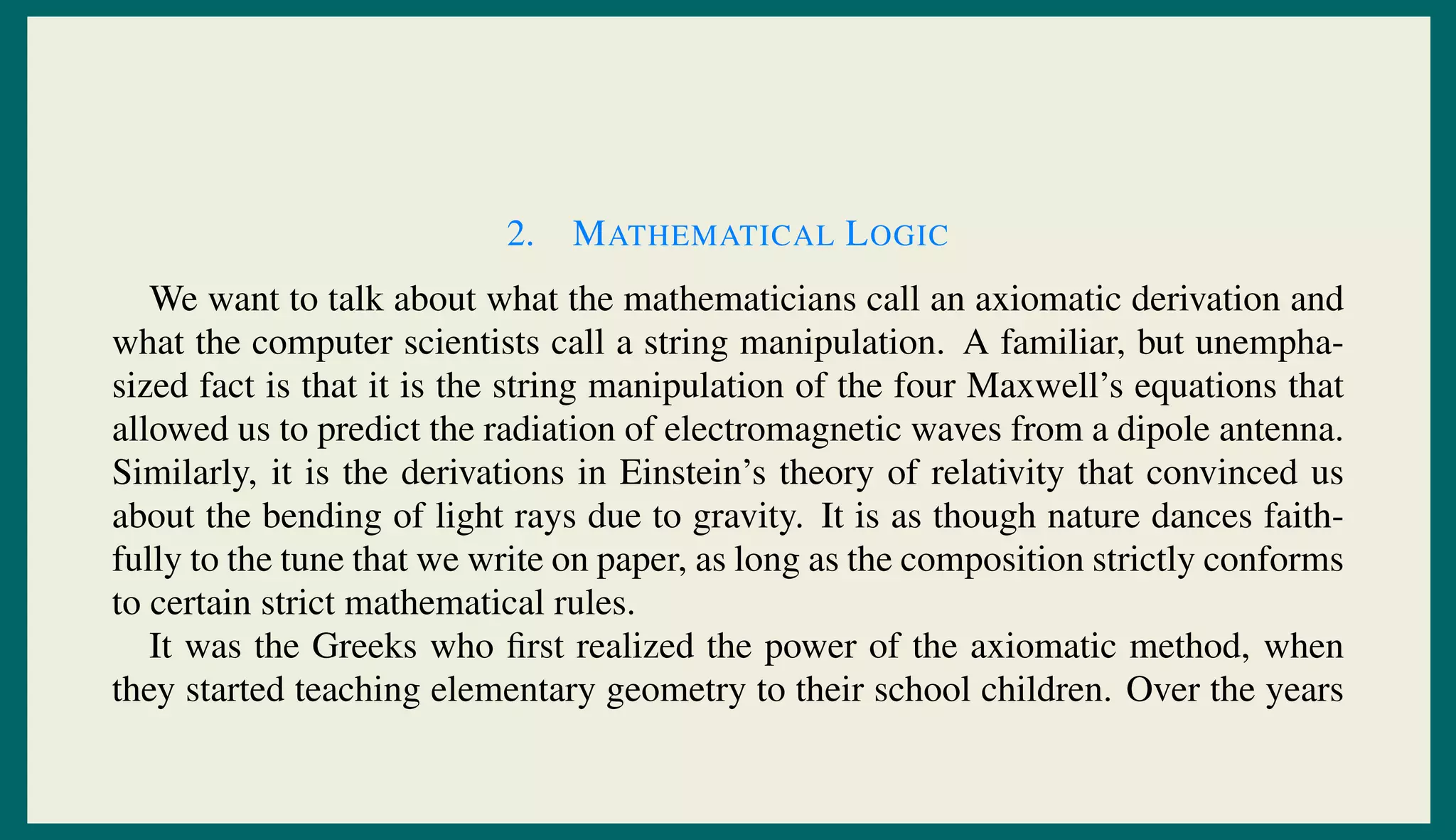
2. MATHEMATICAL LOGIC
We want to talk about what the mathematicians call an axiomatic derivation and
what the computer scientists call a string manipulation. A familiar, but unempha-
sized fact is that it is the string manipulation of the four Maxwell’s equations that
allowed us to predict the radiation of electromagnetic waves from a dipole antenna.
Similarly, it is the derivations in Einstein’s theory of relativity that convinced us
about the bending of light rays due to gravity. It is as though nature dances faith-
fully to the tune that we write on paper, as long as the composition strictly conforms
to certain strict mathematical rules.
It was the Greeks who first realized the power of the axiomatic method, when
they started teaching elementary geometry to their school children. Over the years
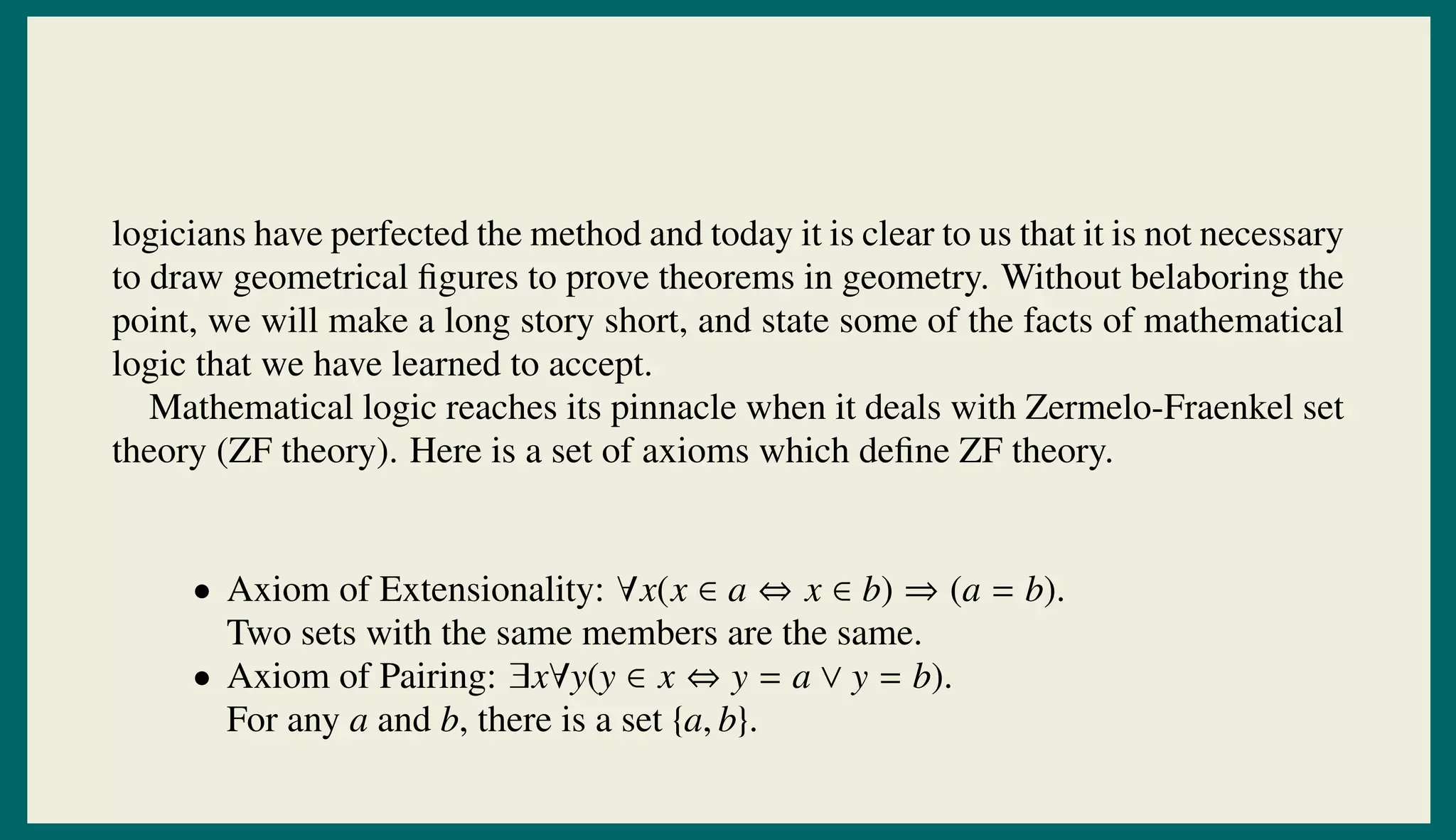
logicians have perfected the method and today it is clear to us that it is not necessary
to draw geometrical figures to prove theorems in geometry. Without belaboring the
point, we will make a long story short, and state some of the facts of mathematical
logic that we have learned to accept.
Mathematical logic reaches its pinnacle when it deals with Zermelo-Fraenkel set
theory (ZF theory). Here is a set of axioms which define ZF theory.
• Axiom of Extensionality: ∀x(x ∈ a ⇔ x ∈ b) ⇒ (a = b).
Two sets with the same members are the same.
• Axiom of Pairing: ∃x∀y(y ∈ x ⇔ y = a ∨ y = b).
For any a and b, there is a set {a, b}.
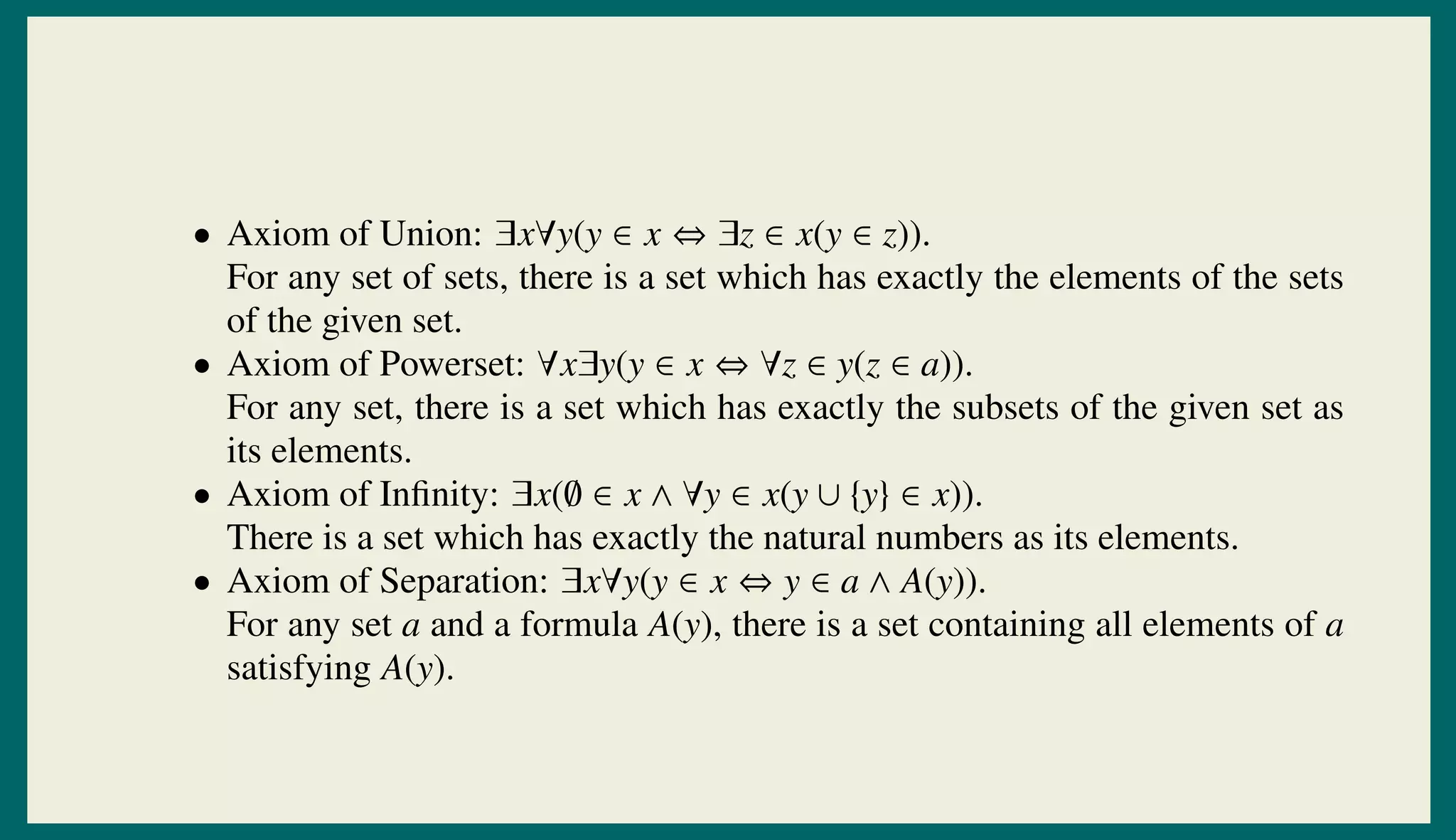
• Axiom of Union: ∃x∀y(y ∈ x ⇔ ∃z ∈ x(y ∈ z)).
For any set of sets, there is a set which has exactly the elements of the sets
of the given set.
• Axiom of Powerset: ∀x∃y(y ∈ x ⇔ ∀z ∈ y(z ∈ a)).
For any set, there is a set which has exactly the subsets of the given set as
its elements.
• Axiom of Infinity: ∃x(∅ ∈ x ∧ ∀y ∈ x(y ∪ {y} ∈ x)).
There is a set which has exactly the natural numbers as its elements.
• Axiom of Separation: ∃x∀y(y ∈ x ⇔ y ∈ a ∧ A(y)).
For any set a and a formula A(y), there is a set containing all elements of a
satisfying A(y).
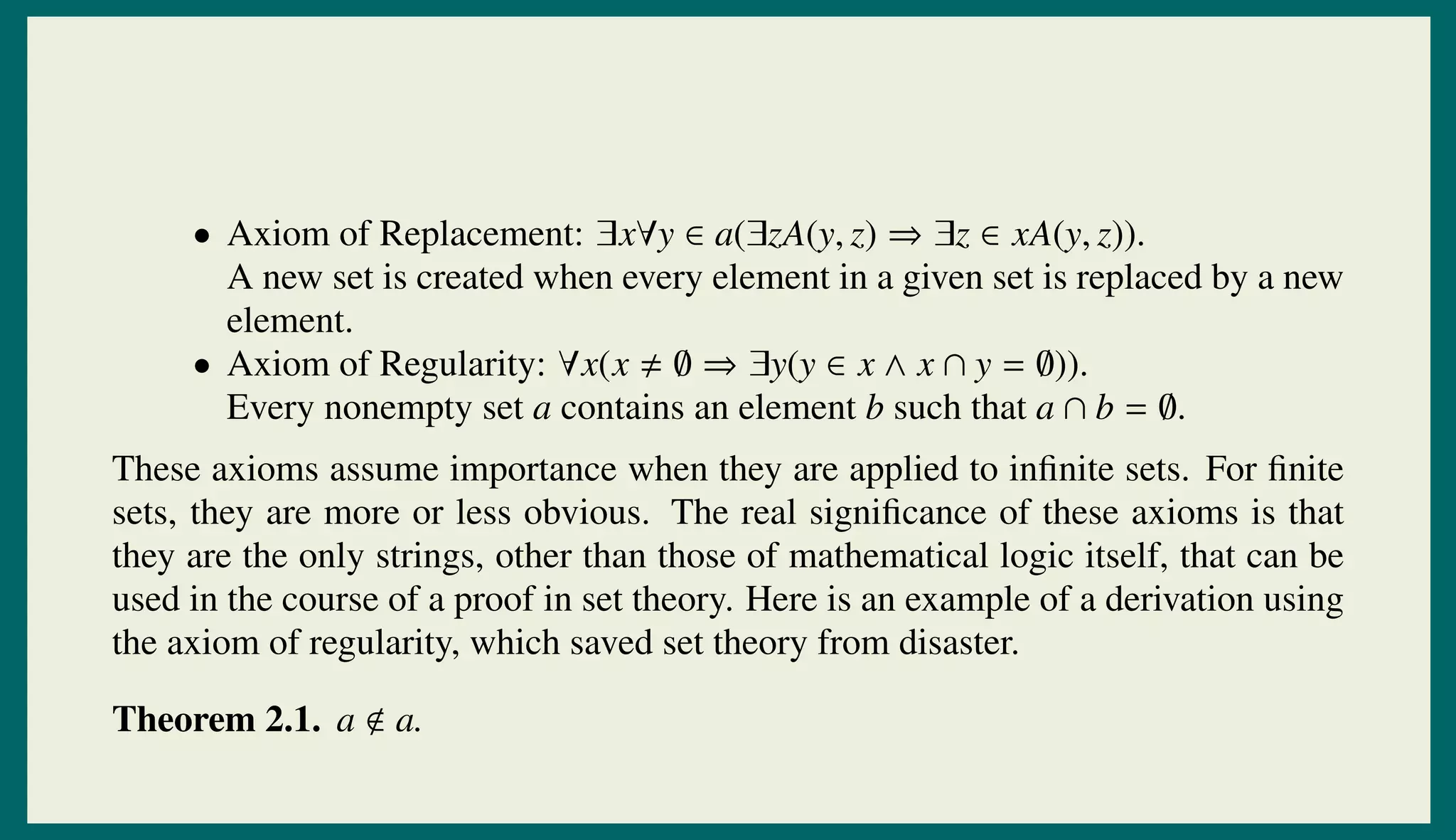
• Axiom of Replacement: ∃x∀y ∈ a(∃zA(y, z) ⇒ ∃z ∈ xA(y, z)).
A new set is created when every element in a given set is replaced by a new
element.
• Axiom of Regularity: ∀x(x ∅ ⇒ ∃y(y ∈ x ∧ x ∩ y = ∅)).
Every nonempty set a contains an element b such that a ∩ b = ∅.
These axioms assume importance when they are applied to infinite sets. For finite
sets, they are more or less obvious. The real significance of these axioms is that
they are the only strings, other than those of mathematical logic itself, that can be
used in the course of a proof in set theory. Here is an example of a derivation using
the axiom of regularity, which saved set theory from disaster.
Theorem 2.1. a a.
Proof: a ∈ a leads to a contradiction as shown below.
a ∈ a ⇒ a ∈ [{a} ∩ a] ... (1).
b ∈ {a} ⇒ b = a ... (2).
Using axiom of regularity and (2),
{a} ∩ a = ∅, which contradicts, a ∈ [{a} ∩ a] in (1).
Even though we are in no position to prove it, over a period of time we have built
up enough confidence in set theory to believe that there are no contradictions in it.
3. GENERALIZED ANTHROPIC PRINCIPLE AND THE BOOK
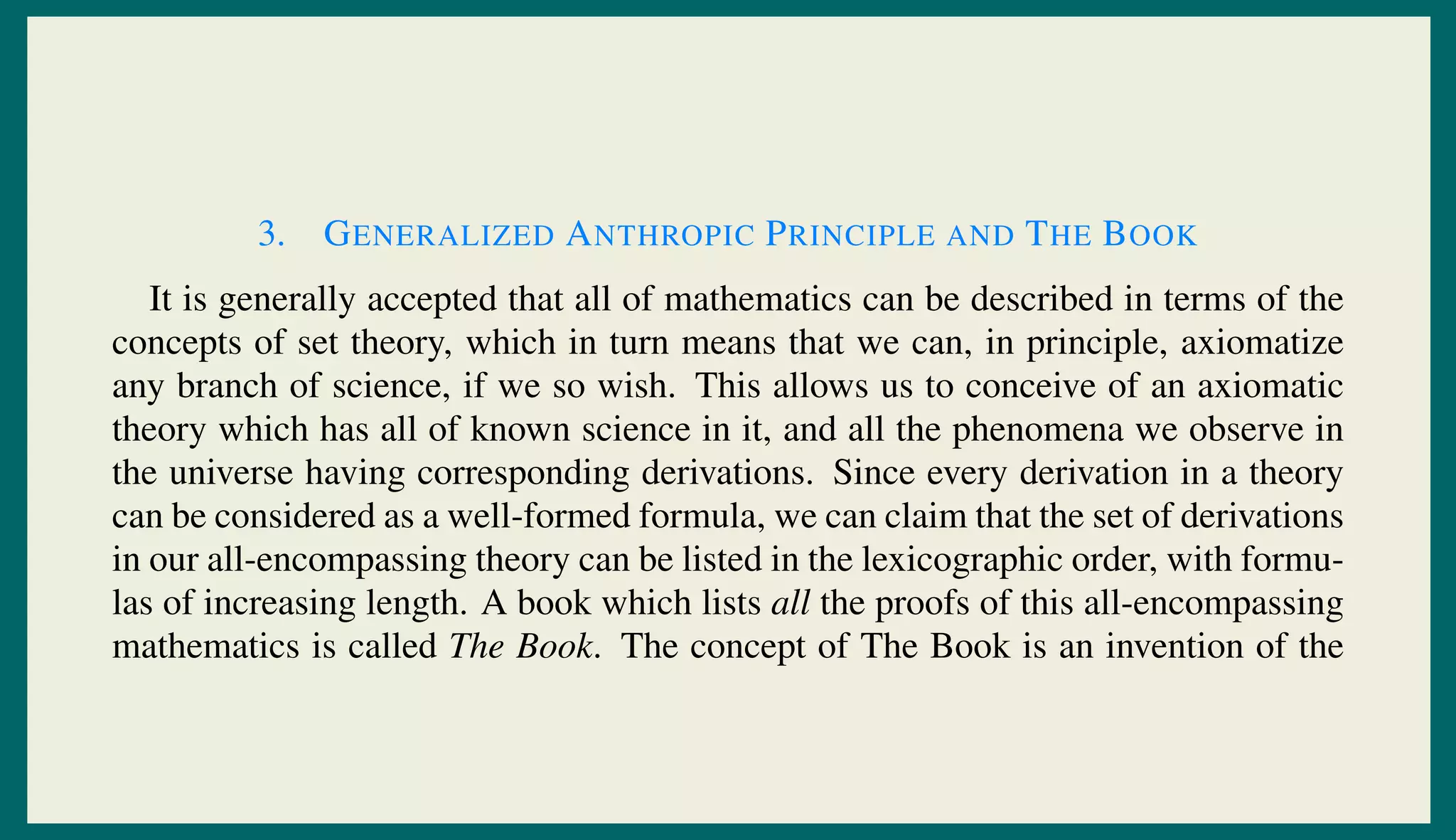
It is generally accepted that all of mathematics can be described in terms of the
concepts of set theory, which in turn means that we can, in principle, axiomatize
any branch of science, if we so wish. This allows us to conceive of an axiomatic
theory which has all of known science in it, and all the phenomena we observe in
the universe having corresponding derivations. Since every derivation in a theory
can be considered as a well-formed formula, we can claim that the set of derivations
in our all-encompassing theory can be listed in the lexicographic order, with formu-
las of increasing length. A book which lists all the proofs of this all-encompassing
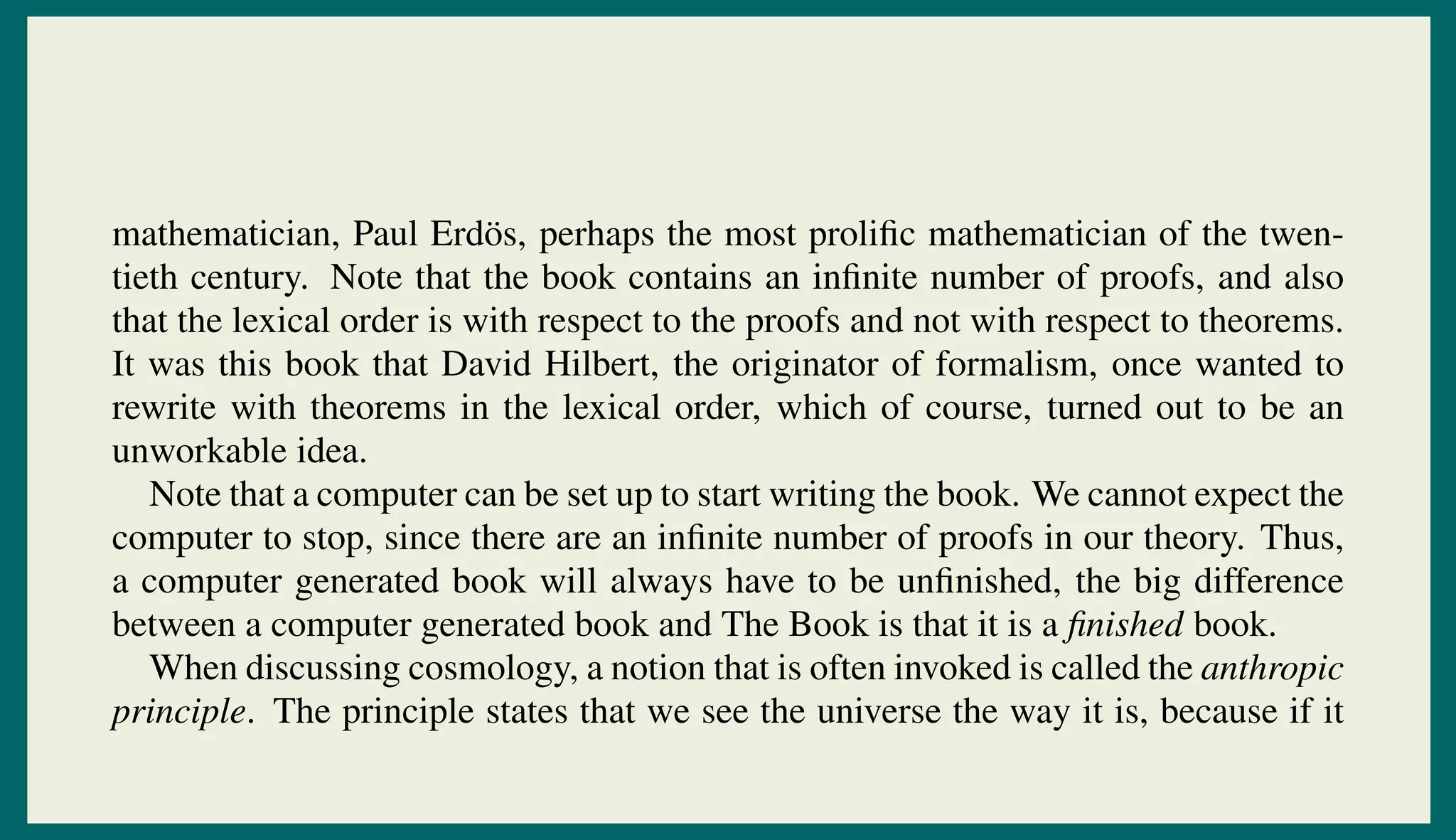
mathematics is called The Book. The concept of The Book is an invention of the
mathematician, Paul Erd¨os, perhaps the most prolific mathematician of the twen-
tieth century. Note that the book contains an infinite number of proofs, and also
that the lexical order is with respect to the proofs and not with respect to theorems.
It was this book that David Hilbert, the originator of formalism, once wanted to
rewrite with theorems in the lexical order, which of course, turned out to be an
unworkable idea.
Note that a computer can be set up to start writing the book. We cannot expect the
computer to stop, since there are an infinite number of proofs in our theory. Thus,
a computer generated book will always have to be unfinished, the big difference
between a computer generated book and The Book is that it is a finished book.
When discussing cosmology, a notion that is often invoked is called the anthropic
principle. The principle states that we see the universe the way it is, because if it
were any different, we would not be here to see it [1]. We generalize this concept
as follows.
Generalized Anthropic Principle: Every phenomenon in the uni-
verse has a corresponding derivation in The Book.
Note that the generalized anthropic principle does not claim that there is a phenom-
enon corresponding to every derivation. Such derivations are part of mathematics,
but not of physics, in other words, we consider the physical universe as part of the
mathematical universe.
4. EXPANDING UNIVERSE
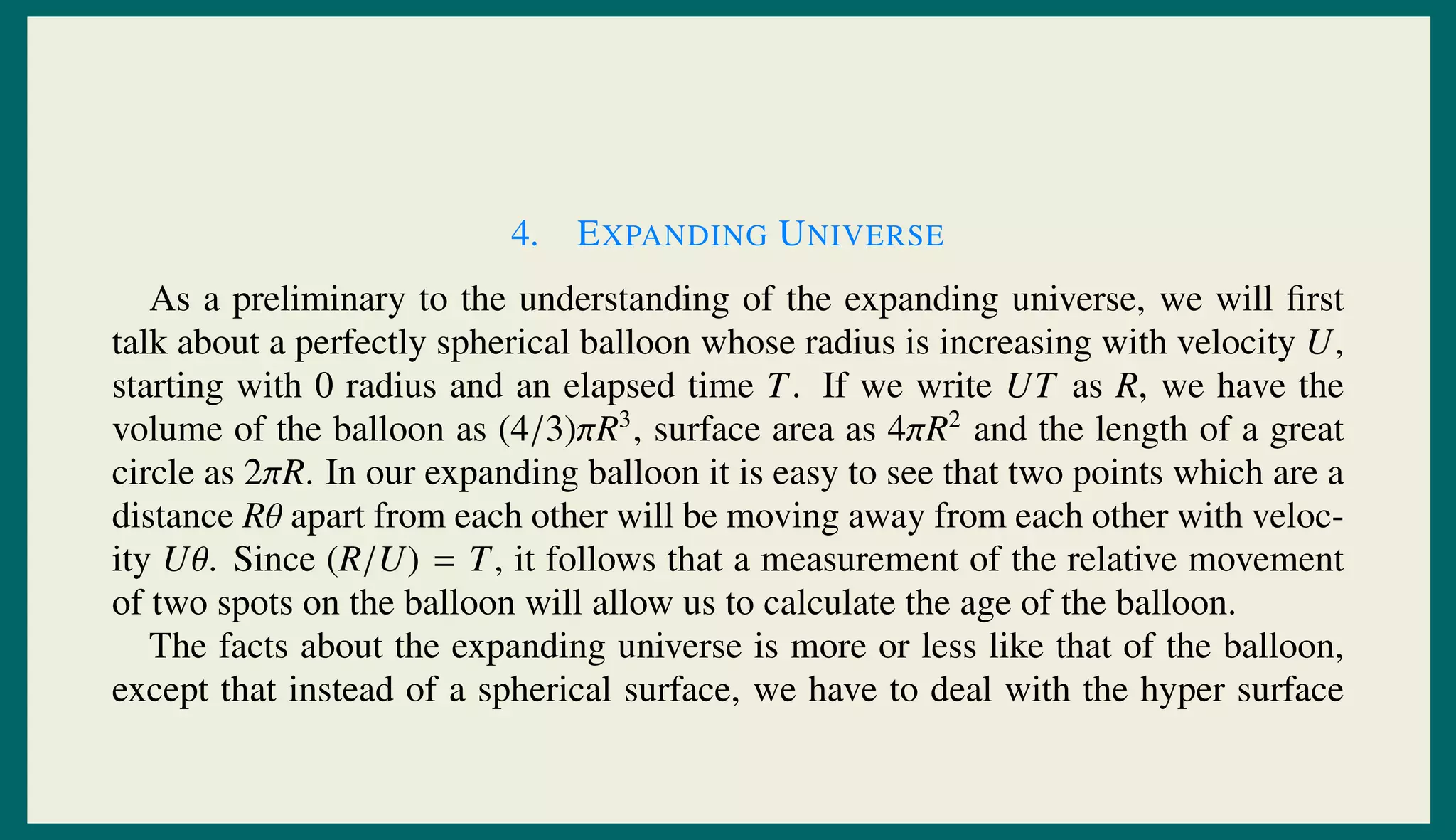
As a preliminary to the understanding of the expanding universe, we will first
talk about a perfectly spherical balloon whose radius is increasing with velocity U,
starting with 0 radius and an elapsed time T. If we write UT as R, we have the
volume of the balloon as (4/3)πR3
, surface area as 4πR2
and the length of a great
circle as 2πR. In our expanding balloon it is easy to see that two points which are a
distance Rθ apart from each other will be moving away from each other with veloc-
ity Uθ. Since (R/U) = T, it follows that a measurement of the relative movement
of two spots on the balloon will allow us to calculate the age of the balloon.
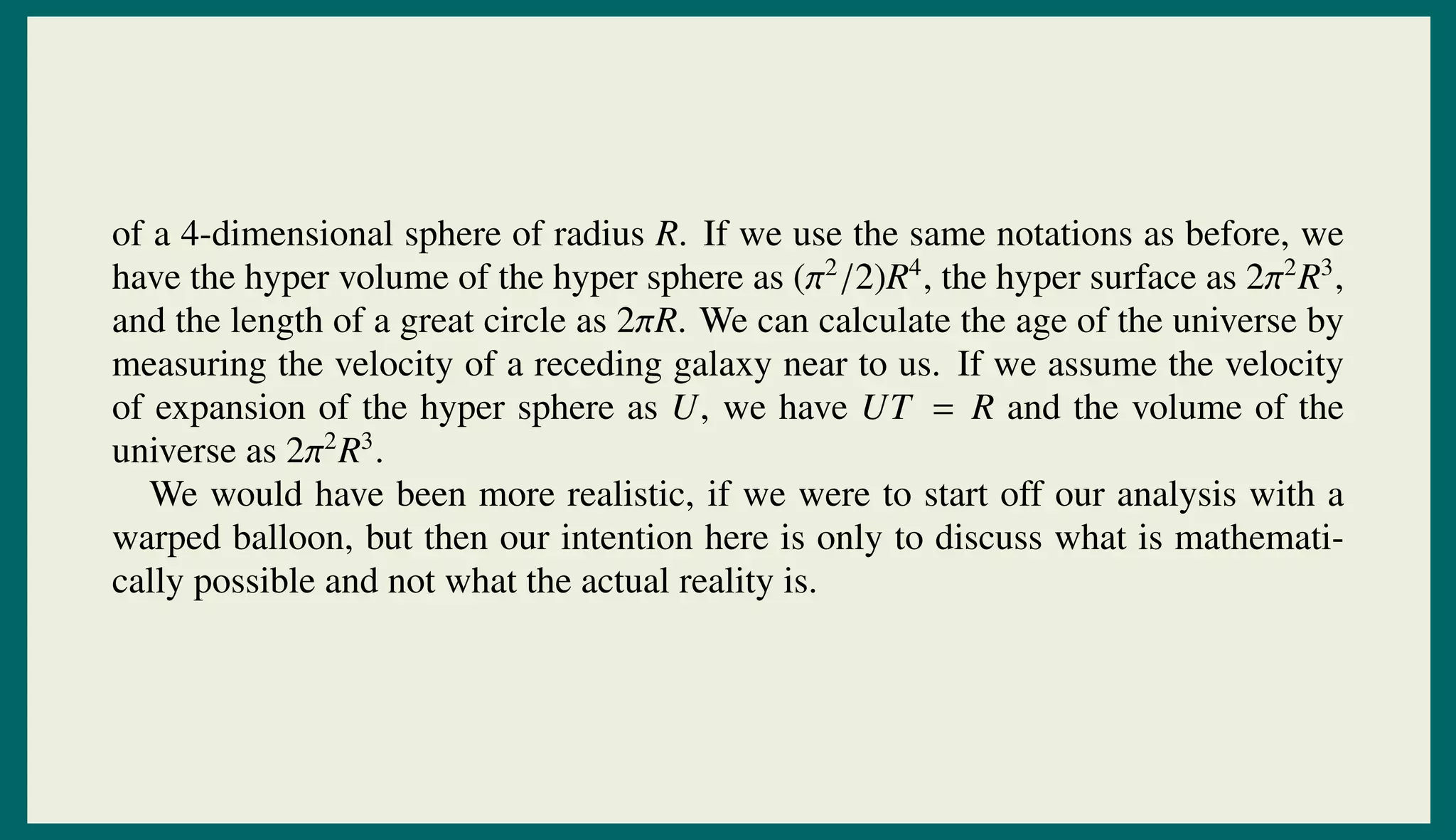
The facts about the expanding universe is more or less like that of the balloon,
except that instead of a spherical surface, we have to deal with the hyper surface
of a 4-dimensional sphere of radius R. If we use the same notations as before, we
have the hyper volume of the hyper sphere as (π2
/2)R4
, the hyper surface as 2π2
R3
,
and the length of a great circle as 2πR. We can calculate the age of the universe by
measuring the velocity of a receding galaxy near to us. If we assume the velocity
of expansion of the hyper sphere as U, we have UT = R and the volume of the
universe as 2π2
R3
.
We would have been more realistic, if we were to start off our analysis with a
warped balloon, but then our intention here is only to discuss what is mathemati-
cally possible and not what the actual reality is.
5. INTUITIVE SET THEORY
ZF theory which forms the foundations of mathematics gets simplified further to
Intuitive Set Theory (IST), if we add two more axioms to it as given below [2]. If
k is an ordinal, we will write ℵα
k
for the cardinality of the set of all subsets of ℵα
with the same cardinality as k.
Axiom of Combinatorial Sets:
ℵα+1 =
ℵα
ℵα
.
We will accept the fact that every number in the interval (0, 1] can be represented
uniquely by an infinite nonterminating binary sequence. For example, the infinite
binary sequence
.10111111 · · ·
can be recognized as the representation for the number 3/4 and similarly for other
numbers. This in turn implies that an infinite recursive subset of positive integers
can be used to represent numbers in the interval (0, 1]. It is known that the cardi-
nality of the set R of such recursive subsets is ℵ0. Thus, every r ∈ R represents a
real number in the interval (0, 1].
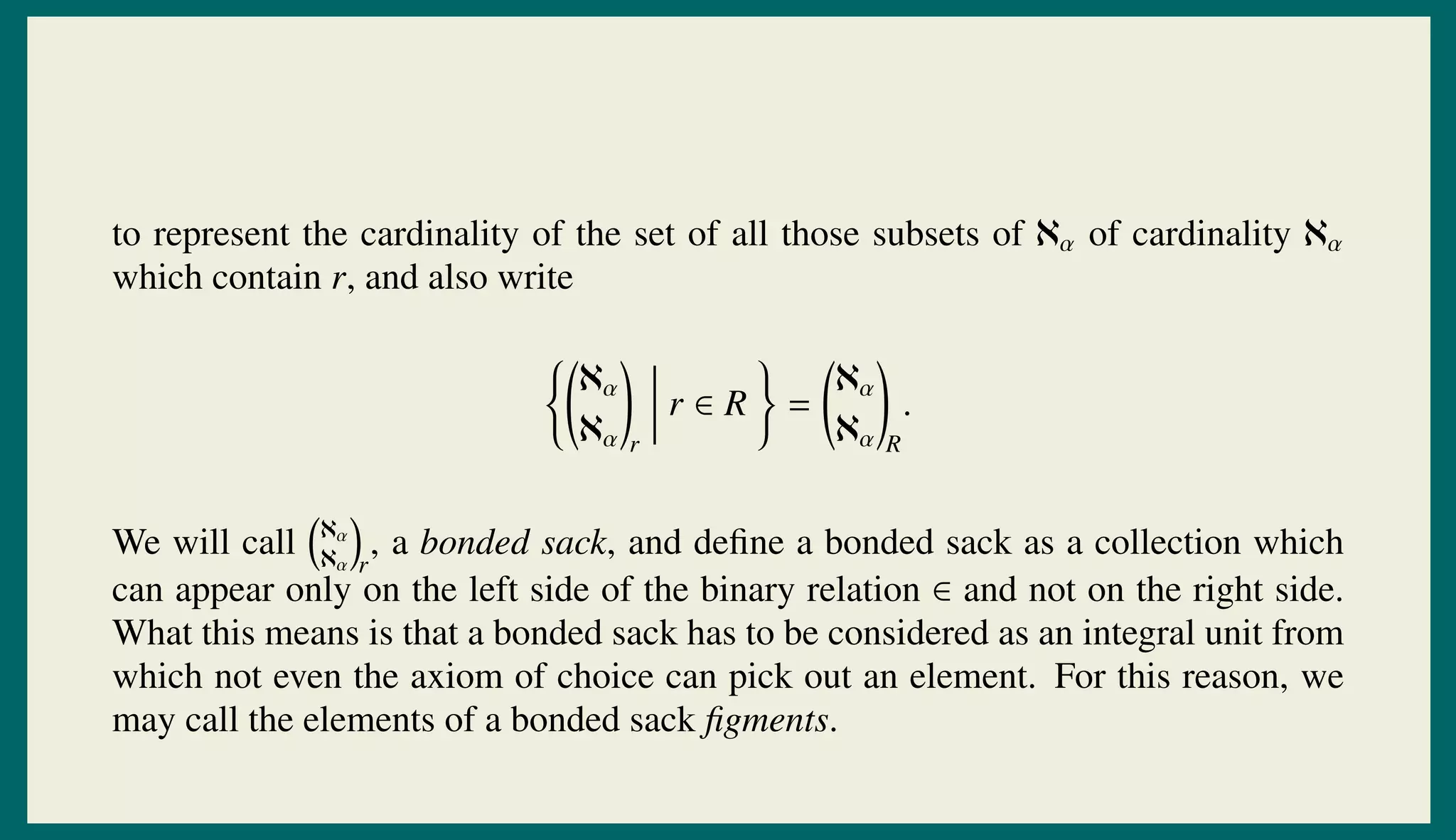
We will write
ℵα
ℵα r
,
to represent the cardinality of the set of all those subsets of ℵα of cardinality ℵα
which contain r, and also write
ℵα
ℵα r
r ∈ R =
ℵα
ℵα R
.
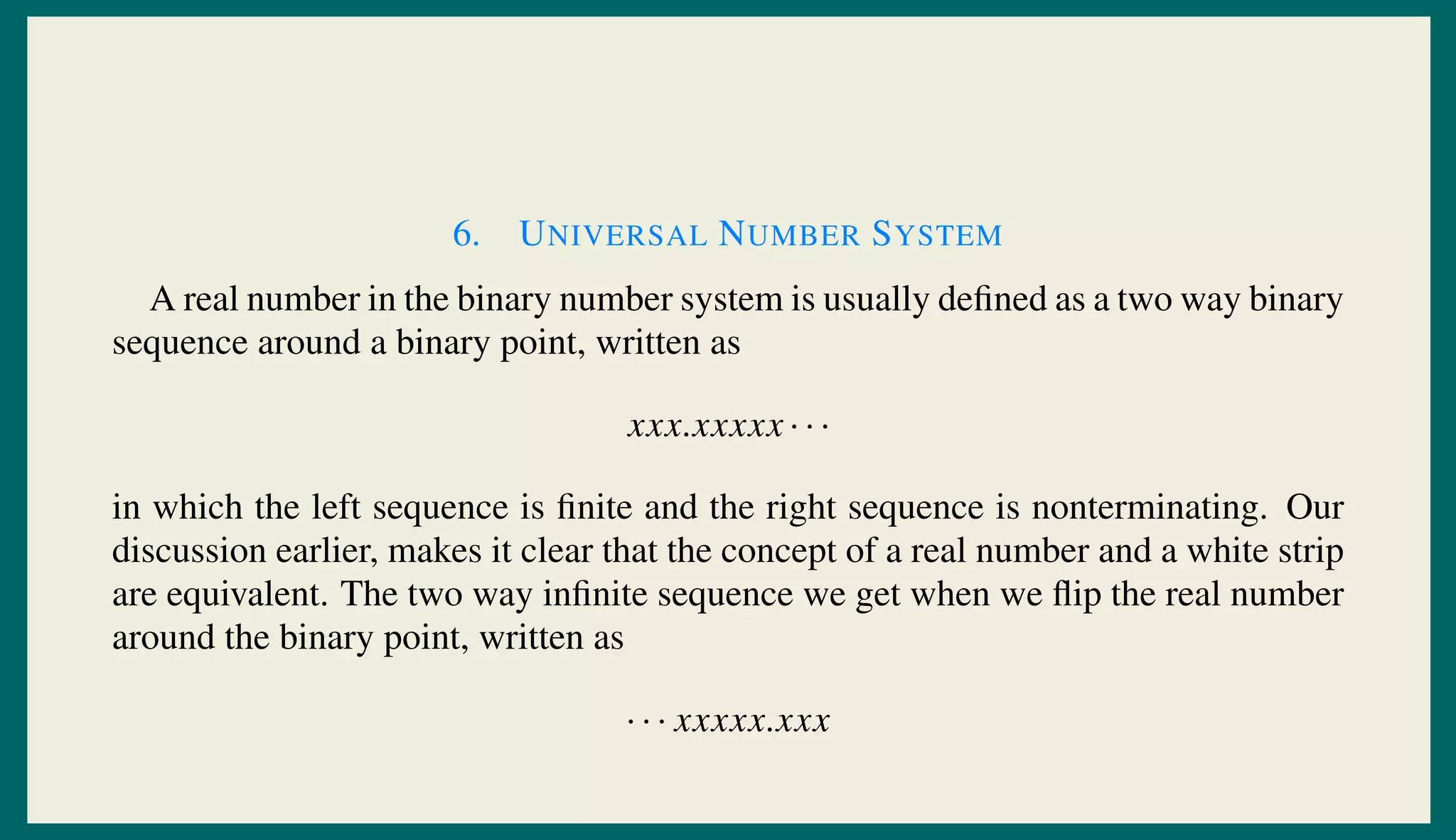
We will call ℵα
ℵα r
, a bonded sack, and define a bonded sack as a collection which
can appear only on the left side of the binary relation ∈ and not on the right side.
What this means is that a bonded sack has to be considered as an integral unit from
which not even the axiom of choice can pick out an element. For this reason, we
may call the elements of a bonded sack figments.
Axiom of Infinitesimals:
(0, 1] =
ℵα
ℵα R
.
The axiom of infinitesimals makes it easy to visualize the unit interval (0, 1].
We derive the generalized continuum hypothesis from the axiom of combinatorial
sets as below:
2ℵα
=
ℵα
0
+
ℵα
1
+
ℵα
2
+ · · ·
ℵα
ℵ0
+ · · ·
ℵα
ℵα
.
Note that ℵα
1
= ℵα. Since, there are ℵα terms in this addition and ℵα
k
is a mono-
tonically nondecreasing function of k, we can conclude that
2ℵα
=
ℵα
ℵα
.
Using axiom of combinatorial sets, we get
2ℵα
= ℵα+1.
The concept of a bonded sack is significant in that it puts a limit beyond which
the interval (0, 1] cannot be pried any further. The axiom of infinitesimals allows
us to visualize the unit interval (0, 1] as a set of bonded sacks, with cardinality ℵ0.
Thus, ℵα
ℵα r
represents an infinitesimal or white hole or white strip corresponding to
the number r in the interval (0, 1].
6. UNIVERSAL NUMBER SYSTEM
A real number in the binary number system is usually defined as a two way binary
sequence around a binary point, written as
xxx.xxxxx · · ·
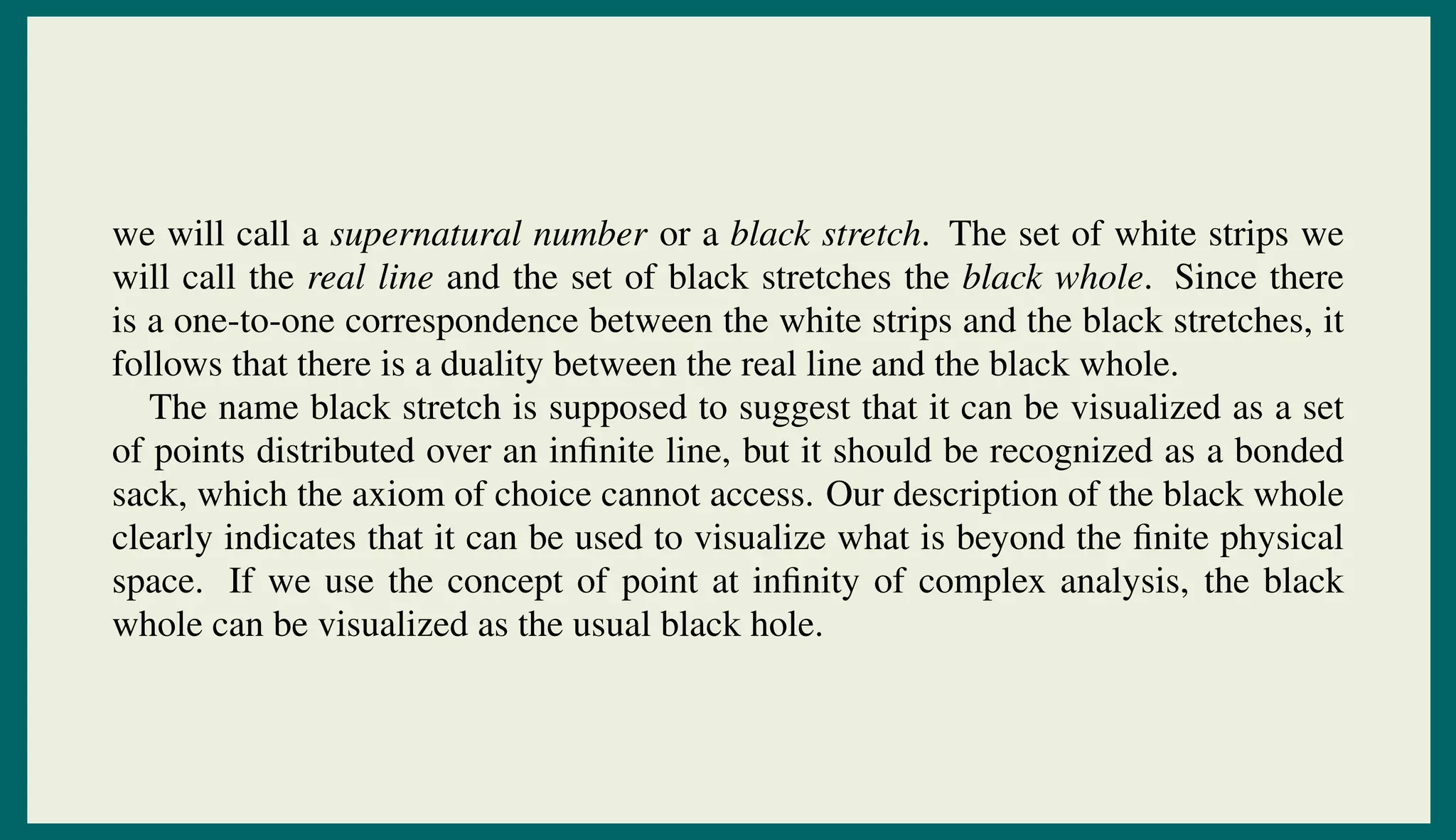
in which the left sequence is finite and the right sequence is nonterminating. Our
discussion earlier, makes it clear that the concept of a real number and a white strip
are equivalent. The two way infinite sequence we get when we flip the real number
around the binary point, written as
· · · xxxxx.xxx
we will call a supernatural number or a black stretch. The set of white strips we
will call the real line and the set of black stretches the black whole. Since there
is a one-to-one correspondence between the white strips and the black stretches, it
follows that there is a duality between the real line and the black whole.
The name black stretch is supposed to suggest that it can be visualized as a set
of points distributed over an infinite line, but it should be recognized as a bonded
sack, which the axiom of choice cannot access. Our description of the black whole
clearly indicates that it can be used to visualize what is beyond the finite physical
space. If we use the concept of point at infinity of complex analysis, the black
whole can be visualized as the usual black hole.
7. CONCLUSION
We will conclude with a few remarks about mathematical logic, which give us
some indication why we cannot afford to ignore the spiritual universe. G¨odel tells
us that there is no logical way to establish that there are no contradictions in ZF
theory, which forms the foundations of mathematics. We are confident about our
mathematics only because it has worked well for us for the last two thousand years.
Since, any set of axioms is a set of beliefs, it follows that any theory is only a set of
beliefs. Since, any individual is the sum total of h(is)er beliefs (axioms) and rational
thoughts (derivations), no individual, including scientists, can claim to be infallible
on any subject matter. If an honest scientist is called to appear in the ultimate court
of nature, (s)he can use The Book for taking the oath, and the most (s)he can say
is: I solemnly swear that if I am sane, I will tell the truth, nothing but the truth, but
never the whole truth.
1. S. W. Hawking, The Universe in a Nutshell, Bantam Books, New York, NY, 2001.
2. K. K. Nambiar, Visualization of Intuitive Set Theory, Computers and Mathematics with Applica-
tions 41 (2001), no. 5-6, 619–626.
FORMERLY, JAWAHARLAL NEHRU UNIVERSITY, NEW DELHI, 110067, INDIA

The Mathematical Universe in a Nutshell

  • 1.
    THE MATHEMATICAL UNIVERSEIN A NUTSHELL K. K. NAMBIAR ABSTRACT. The mathematical universe discussed here gives models of possible structures our physical universe can have. Keywords—Cosmology, White Hole, Black Whole. Date: July 12, 2002.
  • 2.
    1. Introduction 3 2.Mathematical Logic 5 3. Generalized Anthropic Principle and The Book 10 4. Expanding Universe 13 5. Intuitive Set Theory 15 6. Universal Number System 21 7. Conclusion 23 25
  • 3.
    1. INTRODUCTION When wetalk about the universe, we usually mean the physical universe around us, but then we must recognize that we are capable of visualizing universes which are quite different from the one we live in. The possible universes that we can reasonably imagine is what we collectively call the mathematical universe. There is yet another universe which we may call the spiritual universe, a universe hard to avoid and to define. We will accept a weak definiton of the spiritual universe as the collection of unverifiable persistent emotional beliefs within us that are difficult to analyze. Our description makes it clear that spiritual universe is beyond and the physical universe is within the mathematical universe. As a matter of record, here are the three universes we are interested in:
  • 4.
    • Physical universe •Mathematical universe • Spiritual universe The purpose of this paper is to discuss the mathematical universe in some detail, so that we may have a deeper understanding of the physical universe and a greater appreciation for the spiritual universe.
  • 5.
    2. MATHEMATICAL LOGIC Wewant to talk about what the mathematicians call an axiomatic derivation and what the computer scientists call a string manipulation. A familiar, but unempha- sized fact is that it is the string manipulation of the four Maxwell’s equations that allowed us to predict the radiation of electromagnetic waves from a dipole antenna. Similarly, it is the derivations in Einstein’s theory of relativity that convinced us about the bending of light rays due to gravity. It is as though nature dances faith- fully to the tune that we write on paper, as long as the composition strictly conforms to certain strict mathematical rules. It was the Greeks who first realized the power of the axiomatic method, when they started teaching elementary geometry to their school children. Over the years
  • 6.
    logicians have perfectedthe method and today it is clear to us that it is not necessary to draw geometrical figures to prove theorems in geometry. Without belaboring the point, we will make a long story short, and state some of the facts of mathematical logic that we have learned to accept. Mathematical logic reaches its pinnacle when it deals with Zermelo-Fraenkel set theory (ZF theory). Here is a set of axioms which define ZF theory. • Axiom of Extensionality: ∀x(x ∈ a ⇔ x ∈ b) ⇒ (a = b). Two sets with the same members are the same. • Axiom of Pairing: ∃x∀y(y ∈ x ⇔ y = a ∨ y = b). For any a and b, there is a set {a, b}.
  • 7.
    • Axiom ofUnion: ∃x∀y(y ∈ x ⇔ ∃z ∈ x(y ∈ z)). For any set of sets, there is a set which has exactly the elements of the sets of the given set. • Axiom of Powerset: ∀x∃y(y ∈ x ⇔ ∀z ∈ y(z ∈ a)). For any set, there is a set which has exactly the subsets of the given set as its elements. • Axiom of Infinity: ∃x(∅ ∈ x ∧ ∀y ∈ x(y ∪ {y} ∈ x)). There is a set which has exactly the natural numbers as its elements. • Axiom of Separation: ∃x∀y(y ∈ x ⇔ y ∈ a ∧ A(y)). For any set a and a formula A(y), there is a set containing all elements of a satisfying A(y).
  • 8.
    • Axiom ofReplacement: ∃x∀y ∈ a(∃zA(y, z) ⇒ ∃z ∈ xA(y, z)). A new set is created when every element in a given set is replaced by a new element. • Axiom of Regularity: ∀x(x ∅ ⇒ ∃y(y ∈ x ∧ x ∩ y = ∅)). Every nonempty set a contains an element b such that a ∩ b = ∅. These axioms assume importance when they are applied to infinite sets. For finite sets, they are more or less obvious. The real significance of these axioms is that they are the only strings, other than those of mathematical logic itself, that can be used in the course of a proof in set theory. Here is an example of a derivation using the axiom of regularity, which saved set theory from disaster. Theorem 2.1. a a.
  • 9.
    Proof: a ∈a leads to a contradiction as shown below. a ∈ a ⇒ a ∈ [{a} ∩ a] ... (1). b ∈ {a} ⇒ b = a ... (2). Using axiom of regularity and (2), {a} ∩ a = ∅, which contradicts, a ∈ [{a} ∩ a] in (1). Even though we are in no position to prove it, over a period of time we have built up enough confidence in set theory to believe that there are no contradictions in it.
  • 10.
    3. GENERALIZED ANTHROPICPRINCIPLE AND THE BOOK It is generally accepted that all of mathematics can be described in terms of the concepts of set theory, which in turn means that we can, in principle, axiomatize any branch of science, if we so wish. This allows us to conceive of an axiomatic theory which has all of known science in it, and all the phenomena we observe in the universe having corresponding derivations. Since every derivation in a theory can be considered as a well-formed formula, we can claim that the set of derivations in our all-encompassing theory can be listed in the lexicographic order, with formu- las of increasing length. A book which lists all the proofs of this all-encompassing mathematics is called The Book. The concept of The Book is an invention of the
  • 11.
    mathematician, Paul Erd¨os,perhaps the most prolific mathematician of the twen- tieth century. Note that the book contains an infinite number of proofs, and also that the lexical order is with respect to the proofs and not with respect to theorems. It was this book that David Hilbert, the originator of formalism, once wanted to rewrite with theorems in the lexical order, which of course, turned out to be an unworkable idea. Note that a computer can be set up to start writing the book. We cannot expect the computer to stop, since there are an infinite number of proofs in our theory. Thus, a computer generated book will always have to be unfinished, the big difference between a computer generated book and The Book is that it is a finished book. When discussing cosmology, a notion that is often invoked is called the anthropic principle. The principle states that we see the universe the way it is, because if it
  • 12.
    were any different,we would not be here to see it [1]. We generalize this concept as follows. Generalized Anthropic Principle: Every phenomenon in the uni- verse has a corresponding derivation in The Book. Note that the generalized anthropic principle does not claim that there is a phenom- enon corresponding to every derivation. Such derivations are part of mathematics, but not of physics, in other words, we consider the physical universe as part of the mathematical universe.
  • 13.
    4. EXPANDING UNIVERSE Asa preliminary to the understanding of the expanding universe, we will first talk about a perfectly spherical balloon whose radius is increasing with velocity U, starting with 0 radius and an elapsed time T. If we write UT as R, we have the volume of the balloon as (4/3)πR3 , surface area as 4πR2 and the length of a great circle as 2πR. In our expanding balloon it is easy to see that two points which are a distance Rθ apart from each other will be moving away from each other with veloc- ity Uθ. Since (R/U) = T, it follows that a measurement of the relative movement of two spots on the balloon will allow us to calculate the age of the balloon. The facts about the expanding universe is more or less like that of the balloon, except that instead of a spherical surface, we have to deal with the hyper surface
  • 14.
    of a 4-dimensionalsphere of radius R. If we use the same notations as before, we have the hyper volume of the hyper sphere as (π2 /2)R4 , the hyper surface as 2π2 R3 , and the length of a great circle as 2πR. We can calculate the age of the universe by measuring the velocity of a receding galaxy near to us. If we assume the velocity of expansion of the hyper sphere as U, we have UT = R and the volume of the universe as 2π2 R3 . We would have been more realistic, if we were to start off our analysis with a warped balloon, but then our intention here is only to discuss what is mathemati- cally possible and not what the actual reality is.
  • 15.
    5. INTUITIVE SETTHEORY ZF theory which forms the foundations of mathematics gets simplified further to Intuitive Set Theory (IST), if we add two more axioms to it as given below [2]. If k is an ordinal, we will write ℵα k for the cardinality of the set of all subsets of ℵα with the same cardinality as k. Axiom of Combinatorial Sets: ℵα+1 = ℵα ℵα . We will accept the fact that every number in the interval (0, 1] can be represented uniquely by an infinite nonterminating binary sequence. For example, the infinite
  • 16.
    binary sequence .10111111 ·· · can be recognized as the representation for the number 3/4 and similarly for other numbers. This in turn implies that an infinite recursive subset of positive integers can be used to represent numbers in the interval (0, 1]. It is known that the cardi- nality of the set R of such recursive subsets is ℵ0. Thus, every r ∈ R represents a real number in the interval (0, 1]. We will write ℵα ℵα r ,
  • 17.
    to represent thecardinality of the set of all those subsets of ℵα of cardinality ℵα which contain r, and also write ℵα ℵα r r ∈ R = ℵα ℵα R . We will call ℵα ℵα r , a bonded sack, and define a bonded sack as a collection which can appear only on the left side of the binary relation ∈ and not on the right side. What this means is that a bonded sack has to be considered as an integral unit from which not even the axiom of choice can pick out an element. For this reason, we may call the elements of a bonded sack figments.
  • 18.
    Axiom of Infinitesimals: (0,1] = ℵα ℵα R . The axiom of infinitesimals makes it easy to visualize the unit interval (0, 1]. We derive the generalized continuum hypothesis from the axiom of combinatorial sets as below: 2ℵα = ℵα 0 + ℵα 1 + ℵα 2 + · · · ℵα ℵ0 + · · · ℵα ℵα .
  • 19.
    Note that ℵα 1 =ℵα. Since, there are ℵα terms in this addition and ℵα k is a mono- tonically nondecreasing function of k, we can conclude that 2ℵα = ℵα ℵα . Using axiom of combinatorial sets, we get 2ℵα = ℵα+1. The concept of a bonded sack is significant in that it puts a limit beyond which the interval (0, 1] cannot be pried any further. The axiom of infinitesimals allows us to visualize the unit interval (0, 1] as a set of bonded sacks, with cardinality ℵ0.
  • 20.
    Thus, ℵα ℵα r representsan infinitesimal or white hole or white strip corresponding to the number r in the interval (0, 1].
  • 21.
    6. UNIVERSAL NUMBERSYSTEM A real number in the binary number system is usually defined as a two way binary sequence around a binary point, written as xxx.xxxxx · · · in which the left sequence is finite and the right sequence is nonterminating. Our discussion earlier, makes it clear that the concept of a real number and a white strip are equivalent. The two way infinite sequence we get when we flip the real number around the binary point, written as · · · xxxxx.xxx
  • 22.
    we will calla supernatural number or a black stretch. The set of white strips we will call the real line and the set of black stretches the black whole. Since there is a one-to-one correspondence between the white strips and the black stretches, it follows that there is a duality between the real line and the black whole. The name black stretch is supposed to suggest that it can be visualized as a set of points distributed over an infinite line, but it should be recognized as a bonded sack, which the axiom of choice cannot access. Our description of the black whole clearly indicates that it can be used to visualize what is beyond the finite physical space. If we use the concept of point at infinity of complex analysis, the black whole can be visualized as the usual black hole.
  • 23.
    7. CONCLUSION We willconclude with a few remarks about mathematical logic, which give us some indication why we cannot afford to ignore the spiritual universe. G¨odel tells us that there is no logical way to establish that there are no contradictions in ZF theory, which forms the foundations of mathematics. We are confident about our mathematics only because it has worked well for us for the last two thousand years. Since, any set of axioms is a set of beliefs, it follows that any theory is only a set of beliefs. Since, any individual is the sum total of h(is)er beliefs (axioms) and rational thoughts (derivations), no individual, including scientists, can claim to be infallible on any subject matter. If an honest scientist is called to appear in the ultimate court of nature, (s)he can use The Book for taking the oath, and the most (s)he can say
  • 24.
    is: I solemnlyswear that if I am sane, I will tell the truth, nothing but the truth, but never the whole truth.
  • 25.
    1. S. W.Hawking, The Universe in a Nutshell, Bantam Books, New York, NY, 2001. 2. K. K. Nambiar, Visualization of Intuitive Set Theory, Computers and Mathematics with Applica- tions 41 (2001), no. 5-6, 619–626. FORMERLY, JAWAHARLAL NEHRU UNIVERSITY, NEW DELHI, 110067, INDIA