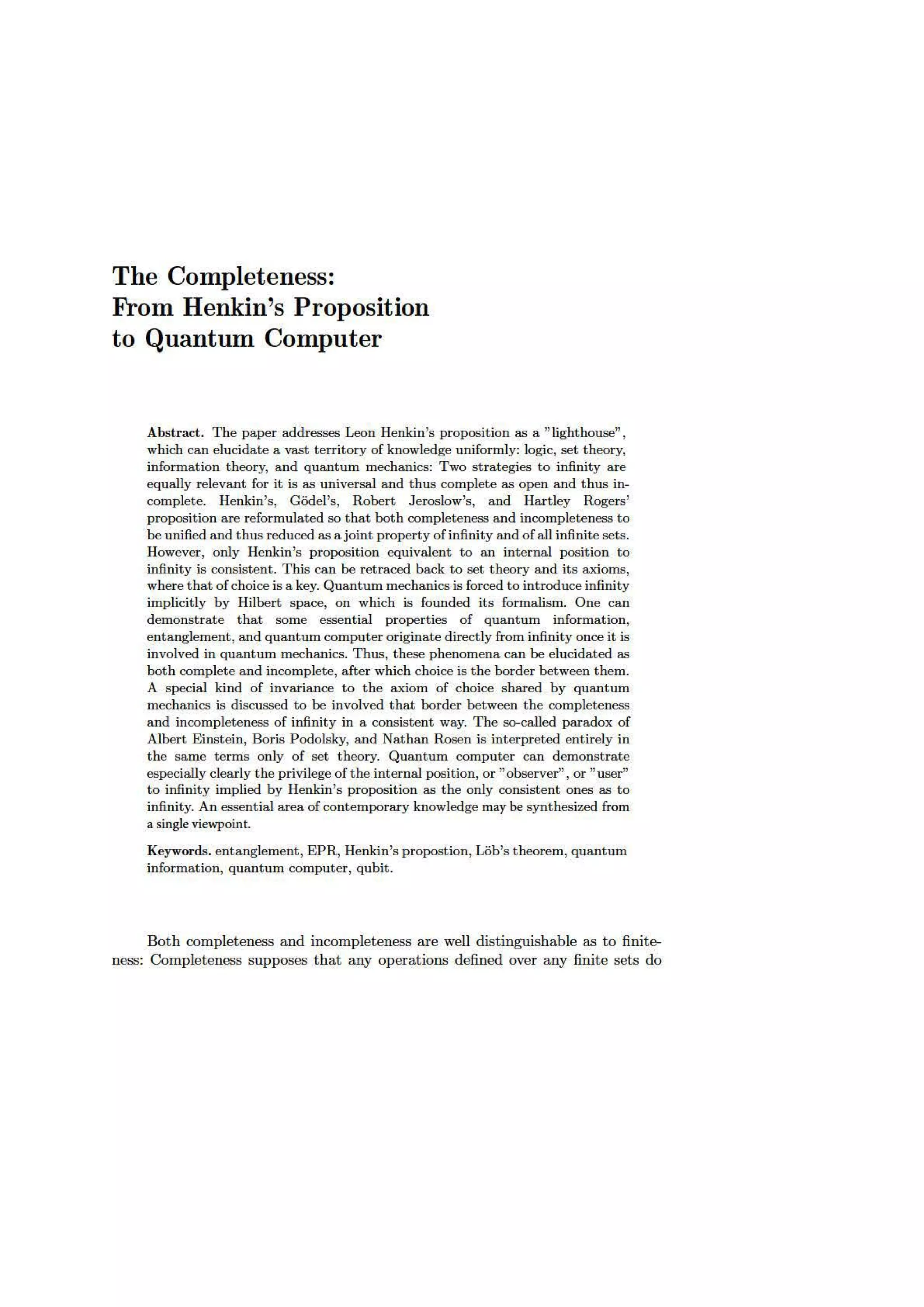
The Completeness:
From Henkin's Proposition
to Quantum Computer
Abstract. The paper addresses Leon Hen.kin's proposition as a "lighthouse",
which can elucidate a vast territory of knowledge uniformly: logic, set theory,
information theory, and quantum mechanics: Two strategies to infinity are
equally relevant for it is as universal and t hus complete as open and thus in-
complete. Henkin's, Godel's, Robert Jeroslow's, and Hartley Rogers'
proposition are reformulated so that both completeness and incompleteness to
be unified and thus reduced as a joint property ofinfinity and ofall infinite sets.
However, only Henkin's proposition equivalent to an internal position to
infinity is consistent . This can be retraced back to set theory and its axioms,
where that ofchoice is a key. Quantum mechanics is forced to introduce infinity
implicitly by Hilbert space, on which is founded its formalism. One can
demonstrate that some essential properties of quantum information,
entanglement, and quantum computer originate directly from infinity once it is
involved in quantum mechanics. Thus, these phenomena can be elucidated as
both complete and incomplete, after which choice is the border between them.
A special kind of invariance to the axiom of choice shared by quantum
mechanics is discussed to be involved that border between the completeness
and incompleteness of infinity in a consistent way. The so-called paradox of
Albert Einstein, Boris Podolsky, and Nathan Rosen is interpreted entirely in
the same terms only of set theory. Quantum computer can demonstrate
especially clearly the privilege of the internal position, or "observer'' , or "user"
to infinity implied by Henkin's proposition as the only consistent ones as to
infinity. An essential area ofcontemporary knowledge may be synthesized from
a single viewpoint.
Keywords. entanglement, EPR, Henkin's propostion, Lob's theorem, quantum
information, quantum computer, qubit.
Both completeness and incompleteness are well distinguishable as to finite-
ness: Completeness supposes that any operations defined over any finite sets do
2
not transcend them while incompleteness displays that they can do it sometimes.
This legible boundary turns out to be unclear and even inconsistent jumping into
infinity.
One may say that there are two strategies or ”philosophies” after that leap
has been just made and any orientation in the unknown infinity is necessary for the
thought to survive: one should keep either to completeness or to incompleteness for
the infinity seems both complete and incomplete being as universal as open. Henkin
and G¨odel tempt to be recognized correspondingly as the symbolic personages
embodying those two opposite types.
The paper retraces the strategy of completeness originating from Henkin’s
proposition [1] via L¨ob’s proof [2] to the alleged incompleteness of quantum me-
chanics [3], the ”no hidden variables” theorem [12],[13], entanglement and quantum
information and to the endpoint of a quantum computer [4], [5], which can solve
any problem only if its user is situated inside it [6], [7].
An introductory reformulating roof sketch in the most concise relevant lan-
guage is necessary for the above tentative itinerary to be able to be seen as a
progressing whole rather than a heterogenic and eclectic mix. The man and scien-
tist Leon Henkin can be a reliable guide implicitly:
Many efforts address the constructiveness of the proof in the so-called G¨odel
first incompleteness theorem [8]. However it is not only redundant but putting
obstacles for the above objectivity. One should use the axiom of choice instead of
this and abstract from that the theorem is formulated about statements, which will
be replaced by the arbitrary elements of any infinite countable set. Furthermore all
four theorems [2], [8], [9], [10] about the so-called metamathematical fixed points
induced by the G¨odel incompleteness theorems will be considered jointly and in a
generalized way.
The strategy is the following:
An arbitrary infinite countable set ”A” and another set ”B” so that their
intersection is empty are given. One constitutes their union ”C=A∪B”, which will
be an infinite set whatever ”B” is. Utilizing the axiom of choice, a one-to-one
mapping ”f = A ↔ C” exists. One designates the image of ”B” into ”A” through
”f ” by ”Bf ” so that ”Bf ⊂ A”. If the axiom of choice holds, there always an
internal and equivalent image like ”Bf ” for any external set like ”B”. Thus, if one
accepts that ”Bf ≡B”, whether an element ”b” of ”B” belongs or not to ”A” is an
undecidable problem as ”bf ≡b”.
However if the axiom of choice is not valid, one cannot guarantee that ”f ”
exists and should display how a constructive analog of ”f ” can be built. If one
shows how ”f ” to be constructed at least in one case, this will be a constructive
proof of undecidability as what G¨odel’s is.
Another option is to prove that no constructive analog exists for any ”f ”
guaranteed by the axiom of choice. In a sense, this would be an analog of the
theorems about the absence of hidden variables in quantum mechanics [12], [13].
Coring the reformulation, the problem of (in)completeness can be generalized
as a property of all infinite sets. An infinite set unlike any finite one can be both
3
complete (universal) and incomplete (open) in a sense reminiscent to the ”clopen”
(both closed and open) sets in topology such as all discrete sets are. There is a
hidden, but intimately link between discreteness and infinity. Quantum mechanics,
forced to introduce quanta and thus discreteness, has therefore introduced infin-
ity in an experimental and exact science such as physics. What is that bridge is
what leads from Henkin’s proposition to quantum computer, both being from the
”internal side” of completeness.
1. Henkin’s proposition
This is the ”formula” defined in ”a problem concerning provability”:
”If Σ is any standard formal system adequate for recursive number theory, a
formula (having a certain integer q as its G¨odel number) can be constructed which
expresses the proposition that the formula with G¨odel number q is provable in Σ.
Is this formula provable or independent in Σ?” [1]
It is commonly interpreted as the opposite to the G¨odel proposition stating
the proper unprovability under the same conditions.
The statements can be also reformulated in two ways, which are not self-
referential:
”Jeroslow’s proposition”: a formula stating the provability of another under
the same conditions [9].
”Rogers’ proposition”: a formula stating the unprovability of another under
the same conditions [10].
The reformulation of all four cases in the present context is the following:
An element ”a” of an infinite countable set ”A” and an element ”b” of another
set ”B” are given, and ”bf ” designates the image of ”b” after ”A∪B” is counted
by ”A” [”f=(A∪B) ↔ A”]:
H: The reformulation of Henkin’s case: ”(a ≡ bf ) ∧ (B ⊂ A)”
G: The reformulation of G¨odel’s case: ”(a ≡ bf ) ∧ (B ∩ A = ∅)”
J: The reformulation of Jeroslow’s case: ”(a ≡ bf ) ∧ (B ⊂ A)”
R: The reformulation of Roger’s case: ”(a ≡ bf ) (B ∩ A = ∅)”
The reformulations are more general for they abandon:
→ The specification of the elements both of ”A” and ”B” as any propositions;
→ The specification of ”f ” as any constructive encoding of the elements of
”A∪B” including the G¨odel numbering.
However it needs the axiom of choice to guarantee the existence of ”f ” in
any case.
Consequently, the proof of the reformulation of Henkin’s case would be a
proof of the ZFC consistency (”ZFC” means the set theory founded on the axioms
of Zermelo, Fraenkel plus the axiom of choice). Indeed the strategy of ZFC involves
as ”sets” those entities (”classes”), which are true subsets or parts of another entity
(”class”). Then one can say about any proposition in ZFC that it has an image as
4
an element of some set definable in ZFC and thus the ZFC set theory represents
its proper consistency just as Henkin’s proposition states its provability.
Even more, any other axiomatics of set theory should be necessarily equiva-
lent to it as G¨odel’s, Jeroslow’s, and Rogers’ propositions are undecidable and one
can conjecture the same in a sense about their reformulations as above.
2. Martin L¨ob’s theorem
Martin L¨ob proved that Henkin’s proposition is provable [2]:
”If S is any formula such that ˜B(S) → S is a theorem, then S is a theorem”
The corollary is: ”The particular formula S of Henkin’s problem, which is
the same as ˜B(S), is a theorem.”
One can reformulate in a trivial way his proof so that it holds in the reformu-
lation of Henkin’s case as above. Indeed almost all proof of Martin L¨ob concerns
the G¨odel encoding to be validated under the conditions of the theorem. If one
accepts the above generalizing reformulation, its statement seems to be obvious:
”bf → b” (as ”bf ≡ b”) implies ”b A” (as ”b B ⊂ A”). This is not true in the
rest three cases (the reformulations G¨odel’s, Jeroslow’s, and Rogers’ proposition).
The only positive result (about Henkin’s propostion) as well as the rest three,
which can be considered as negative, can be interpreted also thus: The only con-
sistent position to infinity is the internal one. As set theory involves infinity, its
axiomatics such as ZFC should guarantee just the internal position for itself to be
consistent.
3. The Einstein Podolsky Rosen ”paradox” in quantum
mechanics [3]
However the set theory is not the single one, which involves infinity in science. The
same does quantum mechanics utilizing the infinite-dimensional Hilbert space to
describe both quantum leaps and continuous trajectories uniformly.
On the other hand, Einstein’s theories of relativity includes the notion of an
internal or external position by means of the concepts of ”observer” or ”reference
frame” yet in relation to finite sets as what special and general relativity discuss
in general.
So the collision of relativity and quantum mechanics was unavoidable and
it was articulated in an especially clear and instructive way in [3]: Indeed, if one
introduces an external observer to a quantum system, the incompleteness of quan-
tum mechanics can be easily demonstrated. After reformulating above, this should
be obvious as a quantum system implies infinity to be adequately described, and
thus excludes an external position to it to be consistent and therefore complete.
The close friendship between the Princeton refugees Einstein and G¨odel [11] could
address the fact that the Einstein, Podolsky and Rosen’s argument is another in-
terpretation of the famous G¨odel incompleteness argument [8] in terms of quantum
5
mechanics. This is obvious as soon as ones look at them by the above reformulation
of G¨odel’s case as their common structure:
Indeed there is an initial quantum system ”Q”, which is divided to two other
systems ”P” and ”S” moving with some relative speed to each other in space-
time. For ”Q”, ”P”, and ”S” are quantum systems and they are represented by
three infinite-dimensional Hilbert spaces, the EPR argument can be bared to the
following set-theory core: There is an initial infinity ”Q”, which is divided into
two infinities ”P” and ”S”, each of which suggests an external viewpoint to the
other. So each of the two pairs ”(P, Q)” and ”(Q, P)” models the ”reformulation of
G¨odels case” above and can serve to demonstrate the ”incompleteness of quantum
mechanics”, which produces that description of reality. However the cause is the
paradoxical properties of infinity rather than the description of quantum mechanics
once forced to introduce infinity in itself.
4. The theorems about the absence of ”hidden variables” in
quantum mechanics
As Einstein, Podolsky, and Rosen could paraphrase the G¨odel incompleteness ar-
gument in terms of quantum mechanics, as John von Neumann initially [12] and
Simon Kochen and Ernst Specker afterwards [13] also managed to paraphrase
the internal consistency of infinity corresponding to the reformulation of Henkin’s
proposition in the same terms. Neumann deduced it from the availability of non-
commutative operators in the mathematical formalism of quantum mechanics
founded on Hilbert space while Kochen and Specker did the same on the ground
of wave-particle dualism even if the corresponding operators are commutative.
Furthermore the corollaries of these theorems can demonstrate the intimate
and extraordinary link between quantum mechanics and the axiom of choice: one
link inherited in fact yet from the infinity admitted in quantum mechanics:
According to them, any well-ordering in any quantum system is excluded
before measurement being a coherent and inseparable whole. Nevertheless it rep-
resents a well-ordered statistical ensemble of results after measurement. The basic
epistemological postulate requires the states before and after measurement to be
equated and thus the well-ordering theorem equivalent to the axiom of choice to
be utilized necessarily to equate an unorderable set (before measurement) with a
well-ordered set (after measurement).
However the coherent state before measurement excludes the axiom of choice
just as these theorems are valid. Thus the mathematical structure used by quantum
mechanics should be invariant to the axiom of choice in a sense, and this is just so
after one involves the so-called probabilistic interpretation of wave function [14],
[15], [16], [17], [18]. Indeed Hilbert space together with its identical dual space can
describe equally successfully a well-ordered infinitely-dimensional vector and the
unorderable characteristic function of the probabilistic distribution of the values
of its components.
6
Thus quantum mechanics interpreted as a theory about infinity can transfer
rather instructive conclusions into set theory concerning a possible and undevel-
oped yet probabilistic interpretation of infinity and therefore, that of the set theory
itself. All this allows the further discussed entanglement, quantum information,
and quantum computer to be interpreted in terms of set theory and seen from the
viewpoint of the generalization of Henkin’s proposition.
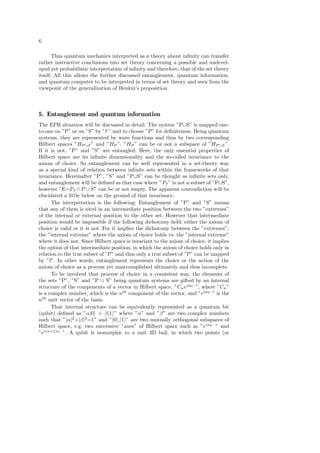
5. Entanglement and quantum information
The EPR situation will be discussed in detail. The system ”P∪S” is mapped one-
to-one on ”P” or on ”S” by ”f ” and to choose ”P” for definiteness. Being quantum
systems, they are represented by wave functions and thus by two corresponding
Hilbert spaces ”HP ∪S” and ”HP ”. ”HP ” can be or not a subspace of ”HP ∪S”.
If it is not, ”P” and ”S” are entangled. Here, the only essential properties of
Hilbert space are its infinite dimensionality and the so-called invariance to the
axiom of choice. So entanglement can be well represented in a set-theory way
as a special kind of relation between infinite sets within the frameworks of that
invariance. Hereinafter ”P”, ”S” and ”P∪S” can be thought as infinite sets only,
and entanglement will be defined as that case where ”Pf ” is not a subset of ”P∪S”,
however ”E=Pf ∩ P ∪ S” can be or not empty. The apparent contradiction will be
elucidated a little below on the ground of that invariance.
The interpretation is the following: Entanglement of ”P” and ”S” means
that any of them is sited in an intermediate position between the two ”extremes”
of the internal or external position to the other set. However that intermediate
position would be impossible if the following dichotomy held: either the axiom of
choice is valid or it is not. For it implies the dichotomy between the ”extremes”:
the ”internal extreme” where the axiom of choice holds vs. the ”internal extreme”
where it does not. Since Hilbert space is invariant to the axiom of choice, it implies
the option of that intermediate position, in which the axiom of choice holds only in
relation to the true subset of ”P” and thus only a true subset of ”P” can be mapped
by ”f”. In other words, entanglement represents the choice or the action of the
axiom of choice as a process yet unaccomplished ultimately and thus incomplete.
To be involved that process of choice in a consistent way, the elements of
the sets ”P”, ”S” and ”P ∪ S” being quantum systems are gifted by an internal
structure of the components of a vector in Hilbert space, ”Cneinω
”, where ”Cn”
is a complex number, which is the nth
component of the vector, and ”einω
” is the
nth
unit vector of the basis.
That internal structure can be equivalently represented as a quantum bit
(qubit) defined as ”α|0 + β|1 ” where ”α” and ”β” are two complex numbers
such that ”|α|2
+|β|2
=1” and ”|0 ,|1 ” are two mutually orthogonal subspaces of
Hilbert space, e.g. two successive ”axes” of Hilbert space such as ”einω
” and
”ei(n+1)ω
”. A qubit is isomorphic to a unit 3D ball, in which two points (or
7
vectors) are chosen under certain conditions: they should be on two orthogonal
great circles of the ball so that their sum is a point of the surface of the ball.
It can be considered as a generalization of the notion of ”bit”, the unit of
information, where the choice is between a continuum of alternatives rather than
two ones as in a bit. That generalization allows the choice to be seen as a process
as it is necessary above. Furthermore all physical processes, which are represented
by certain transformations of wave functions according to quantum mechanics, can
be thought as the computations on a quantum computer processing qubits rather
than bits. Thus a bridge is built to connect physics with mathematics by means
of two its branches: the one is applied (the theory of information) and the other
is fundamental (set theory), therefore erasing those borders.
One can object that entanglement does not involve necessarily infinity for it
can exist between finitely-dimensional subspaces of Hilbert space. However, the
so called Banach-Tarski paradox [19] implies that any qubit (being isomorphic to
a 3D sphere as above) is equivalent to two ones and thus to the entire Hilbert
space under the condition of the axiom of choice. Consequently, once the elements
of a set are gifted by the structure of qubits, the infinity is already involved, and
entanglement is definable even if the set is finite.
6. Quantum computer
The quantum Turing machine [4] and quantum circuits [5] describe how a quantum
computer can be defined. Those two ways are equivalent to each other [20]. One
can utilize another model of a quantum Turing machine where all bits are replaced
by qubits, and a quantum Turing tape can content infinitely many qubits so that
it is equivalent to a wave function. The operations, which can be accomplished
on a single qubit, are the same as those on a cell of a Turing machine: ”Write!”;
”Read!”; ”Next!”, and ”Stop!” That model is quite enough for it includes the
essential features as to the present context: the infinity and ”invariance to the
axiom of choice”.
One can object that the computation of a quantum computer is reversible
unlike a Turing machine or unlike a quantum Turing machine if it is defined in thus.
However the computation within each separate qubit is reversible and equivalent
to the computation of the entire quantum Turing tape containing infinitely many
qubits if or to the extent in which the axiom of choice holds. Consequently a
quantum computer is reversible to or from a boundary defined by that the axiom
of choice is valid to or from it.
What is the criterion for an infinite computation to have a certain result?
That is the following: if the limit of all successive partial computations exists. If
the axiom of choice is valid as to all those members, which is equivalent to an
internal position to infinity as above, that series can be always reordered in two
(increasing and decreasing) monotonic ways so that it converges necessarily though
to two different limits in general, which are complementary to each other: Indeed
8
if one chooses to reorder in an increasing way, this excludes it to be simultaneously
reordered in a decreasing one, and vice versa.
The internal position to infinity as to a quantum computer means the fol-
lowing: Any potential ”user” should be sited inside the quantum computer before
the beginning of the computation so that user’s observation on the quantum com-
puter is included in advance in the result which will be obtained ultimately. Under
that condition, the quantum computer can resolve any problem, and it cannot
”hang up” ever. As any quantum computation is equivalent to a wave function of
the universe in general and thus to one state of it, mankind observes constantly
this property of a quantum computer: Indeed the universe, to which mankind is
sited always inside, never ”hangs up” and any physical process finishes in a finite
time. A quantum computer to an internal observer knows its state and resolves the
”halting problem” as its computation ends always with a result. The same David
Albert [6], [7] proved in another way coining the term ”quantum automaton” for
a quantum computer.
What about a quantum computer locked in a ”Chinese room” therefore forc-
ing an external position to it? First of all, a quantum ”Chinese room” should
admit an arbitrary degree of entanglement between the quantum computer inside
and the interviewers outside, a kind of ”quantum telepathy”. Then the axiom of
choice will be partially valid to the extent exactly defined by that degree of en-
tanglement. Consequently the quantum computer in any degree of entanglement
cannot accomplish the reordering right, to the utterance and it will hang up in
general. However in fact the quantum computer locked in the ”Chinese room” will
be replaced by another quantum computer including both the interviewers outside
the ”Chinese room” and the former inside it. The latter quantum computer will
give the answer for the former always as it includes the ”users” of it while the in-
terviewers will think that the answer is given by the locked one, which will ”hang
up” and thus mute.
What turns out to be the case? As if a quantum computer cannot be locked
in a ”Chinese room” as a law of nature. However it will fail in the ”Chinese room
test” in a paradoxical way: It will give the right answer always even ostensibly
”locked” while a human being can be really deprived of the context outside the
”Chinese room” and thus give a different answer in general.
The ”Chinese room” allows of a curious visualization of the invariance to the
axiom of choice as to a quantum computer: The invariance means that the hung-up
quantum computer inside and the entire quantum computer including that inside
together with the interviewers can be discussed as equivalent as quantum systems
described in Hilbert space(s). The same can be formulated also so: The quantum
computer is only a single one, and all including mankind is within it necessarily.
9
7. Conclusion:
The link between quantum mechanics, logic, and mathematics is much closer than it
is commonly accepted. There is a special area of continuous transition between
them, a "bridge" rather than a "gap". The solutions in each of those sciences may
influence the formulations ofproblems as well as their solutions in the rest ones.
Particularly, the problem of completeness or incompleteness as well as the
approaches for its solution in logic, mathematics, and quantum mechanics may be
unified.
References
(1] L. Henkin, A problem concerning provability, problem 3. J. Symb. Logic
17 (1952), 160.
(2] M. Lob, Solution of a problem of Leon Henkin. J. Symb. Logic 20 (1955),
115-118.
(3) A. Einstein, B. Podolsky, N. Rosen, Can Quantum-Mechanical Description
of Physical Reality Be Considered Complete? Phys. Rev. 47 (1935), 777-
780.
(4] D. Deutsch, Quantum theory, the Church-Turing principle and the univer-
sal quantum computer. P roc. R. Soc. London A 400 (1985), 97-117.
(5) D. Deutsch, Quantum computational networks. Proc. R. Soc. London A
425 (1989), 73-90.
(6) D. Albert, On quantum-mechanical automata. Phys. Lett. A 98 (1983),
249-252.
(7] D. Albert, A Quantum-Mechanical Automation. Philos. Sci. 54 (1987),
577-585.
(8) K. Godel, Uber formal unentscheidbare Satze der Principia mathematica
und verwandter Systeme I. Monatsh. Math. Phys. 38 (1931), 173-198.
(9) R. Jeroslow, Consistency statements in formal mathematics. Fund. Math.
72 {1971), 1740.
(10] H. Rogers, Theory of Recursive Functions and Effective Computability.
McGraw Hill, 1967.
(11] P. Yourgrau, A World Without Time: The Forgotten Legacy of Godel and
Einstein. Perseus Books Group, 2006.
(12] J. von Neumann, Mathematische Grundlagen der Quantenmechanik.
Springer, 1932.
(13] S. Kochen, E. Specker, The problem of hidden variables in quantum me-
chanics. J. Math. Mech. 17 (1968), 59-87.
10
[14] M. Born, Zur Quantenmechanik der Stoβvorg¨ange. Z. Physik 37 (1926),
863-867.
[15] M. Born, Quantenmechanik der Stoβvorg¨ange. Z. Physik 38 (1926), 803-
827.
[16] M. Born, Das Adiabatenprinzip in der Quantenmechanik. Z. Physik 40
(1927), 167-192.
[17] M. Born, Physical aspects of quantum mechanics. Nature 119 (1927), 354-
357.
[18] M. Born, V. Fock, Beweis der Adiabatensatzes. Z. Physik 51 (1928), 165-
180.
[19] S. Banach, A. Tarski, Sur la d´ecomposition des ensembles de points en
parties respectivement congruentes. Fund. Math. 6 (1924), 244-277.
[20] A. Yao, Quantum circuit complexity. In: Proceedings of the 34th Annual
Symposium on Foundations of Computer Science. IEEE Computer Society
Press, 1993, 352361.

Completeness: From henkin's Proposition to Quantum Computer

  • 1.
    The Completeness: From Henkin'sProposition to Quantum Computer Abstract. The paper addresses Leon Hen.kin's proposition as a "lighthouse", which can elucidate a vast territory of knowledge uniformly: logic, set theory, information theory, and quantum mechanics: Two strategies to infinity are equally relevant for it is as universal and t hus complete as open and thus in- complete. Henkin's, Godel's, Robert Jeroslow's, and Hartley Rogers' proposition are reformulated so that both completeness and incompleteness to be unified and thus reduced as a joint property ofinfinity and ofall infinite sets. However, only Henkin's proposition equivalent to an internal position to infinity is consistent . This can be retraced back to set theory and its axioms, where that ofchoice is a key. Quantum mechanics is forced to introduce infinity implicitly by Hilbert space, on which is founded its formalism. One can demonstrate that some essential properties of quantum information, entanglement, and quantum computer originate directly from infinity once it is involved in quantum mechanics. Thus, these phenomena can be elucidated as both complete and incomplete, after which choice is the border between them. A special kind of invariance to the axiom of choice shared by quantum mechanics is discussed to be involved that border between the completeness and incompleteness of infinity in a consistent way. The so-called paradox of Albert Einstein, Boris Podolsky, and Nathan Rosen is interpreted entirely in the same terms only of set theory. Quantum computer can demonstrate especially clearly the privilege of the internal position, or "observer'' , or "user" to infinity implied by Henkin's proposition as the only consistent ones as to infinity. An essential area ofcontemporary knowledge may be synthesized from a single viewpoint. Keywords. entanglement, EPR, Henkin's propostion, Lob's theorem, quantum information, quantum computer, qubit. Both completeness and incompleteness are well distinguishable as to finite- ness: Completeness supposes that any operations defined over any finite sets do
  • 2.
    2 not transcend themwhile incompleteness displays that they can do it sometimes. This legible boundary turns out to be unclear and even inconsistent jumping into infinity. One may say that there are two strategies or ”philosophies” after that leap has been just made and any orientation in the unknown infinity is necessary for the thought to survive: one should keep either to completeness or to incompleteness for the infinity seems both complete and incomplete being as universal as open. Henkin and G¨odel tempt to be recognized correspondingly as the symbolic personages embodying those two opposite types. The paper retraces the strategy of completeness originating from Henkin’s proposition [1] via L¨ob’s proof [2] to the alleged incompleteness of quantum me- chanics [3], the ”no hidden variables” theorem [12],[13], entanglement and quantum information and to the endpoint of a quantum computer [4], [5], which can solve any problem only if its user is situated inside it [6], [7]. An introductory reformulating roof sketch in the most concise relevant lan- guage is necessary for the above tentative itinerary to be able to be seen as a progressing whole rather than a heterogenic and eclectic mix. The man and scien- tist Leon Henkin can be a reliable guide implicitly: Many efforts address the constructiveness of the proof in the so-called G¨odel first incompleteness theorem [8]. However it is not only redundant but putting obstacles for the above objectivity. One should use the axiom of choice instead of this and abstract from that the theorem is formulated about statements, which will be replaced by the arbitrary elements of any infinite countable set. Furthermore all four theorems [2], [8], [9], [10] about the so-called metamathematical fixed points induced by the G¨odel incompleteness theorems will be considered jointly and in a generalized way. The strategy is the following: An arbitrary infinite countable set ”A” and another set ”B” so that their intersection is empty are given. One constitutes their union ”C=A∪B”, which will be an infinite set whatever ”B” is. Utilizing the axiom of choice, a one-to-one mapping ”f = A ↔ C” exists. One designates the image of ”B” into ”A” through ”f ” by ”Bf ” so that ”Bf ⊂ A”. If the axiom of choice holds, there always an internal and equivalent image like ”Bf ” for any external set like ”B”. Thus, if one accepts that ”Bf ≡B”, whether an element ”b” of ”B” belongs or not to ”A” is an undecidable problem as ”bf ≡b”. However if the axiom of choice is not valid, one cannot guarantee that ”f ” exists and should display how a constructive analog of ”f ” can be built. If one shows how ”f ” to be constructed at least in one case, this will be a constructive proof of undecidability as what G¨odel’s is. Another option is to prove that no constructive analog exists for any ”f ” guaranteed by the axiom of choice. In a sense, this would be an analog of the theorems about the absence of hidden variables in quantum mechanics [12], [13]. Coring the reformulation, the problem of (in)completeness can be generalized as a property of all infinite sets. An infinite set unlike any finite one can be both
  • 3.
    3 complete (universal) andincomplete (open) in a sense reminiscent to the ”clopen” (both closed and open) sets in topology such as all discrete sets are. There is a hidden, but intimately link between discreteness and infinity. Quantum mechanics, forced to introduce quanta and thus discreteness, has therefore introduced infin- ity in an experimental and exact science such as physics. What is that bridge is what leads from Henkin’s proposition to quantum computer, both being from the ”internal side” of completeness. 1. Henkin’s proposition This is the ”formula” defined in ”a problem concerning provability”: ”If Σ is any standard formal system adequate for recursive number theory, a formula (having a certain integer q as its G¨odel number) can be constructed which expresses the proposition that the formula with G¨odel number q is provable in Σ. Is this formula provable or independent in Σ?” [1] It is commonly interpreted as the opposite to the G¨odel proposition stating the proper unprovability under the same conditions. The statements can be also reformulated in two ways, which are not self- referential: ”Jeroslow’s proposition”: a formula stating the provability of another under the same conditions [9]. ”Rogers’ proposition”: a formula stating the unprovability of another under the same conditions [10]. The reformulation of all four cases in the present context is the following: An element ”a” of an infinite countable set ”A” and an element ”b” of another set ”B” are given, and ”bf ” designates the image of ”b” after ”A∪B” is counted by ”A” [”f=(A∪B) ↔ A”]: H: The reformulation of Henkin’s case: ”(a ≡ bf ) ∧ (B ⊂ A)” G: The reformulation of G¨odel’s case: ”(a ≡ bf ) ∧ (B ∩ A = ∅)” J: The reformulation of Jeroslow’s case: ”(a ≡ bf ) ∧ (B ⊂ A)” R: The reformulation of Roger’s case: ”(a ≡ bf ) (B ∩ A = ∅)” The reformulations are more general for they abandon: → The specification of the elements both of ”A” and ”B” as any propositions; → The specification of ”f ” as any constructive encoding of the elements of ”A∪B” including the G¨odel numbering. However it needs the axiom of choice to guarantee the existence of ”f ” in any case. Consequently, the proof of the reformulation of Henkin’s case would be a proof of the ZFC consistency (”ZFC” means the set theory founded on the axioms of Zermelo, Fraenkel plus the axiom of choice). Indeed the strategy of ZFC involves as ”sets” those entities (”classes”), which are true subsets or parts of another entity (”class”). Then one can say about any proposition in ZFC that it has an image as
  • 4.
    4 an element ofsome set definable in ZFC and thus the ZFC set theory represents its proper consistency just as Henkin’s proposition states its provability. Even more, any other axiomatics of set theory should be necessarily equiva- lent to it as G¨odel’s, Jeroslow’s, and Rogers’ propositions are undecidable and one can conjecture the same in a sense about their reformulations as above. 2. Martin L¨ob’s theorem Martin L¨ob proved that Henkin’s proposition is provable [2]: ”If S is any formula such that ˜B(S) → S is a theorem, then S is a theorem” The corollary is: ”The particular formula S of Henkin’s problem, which is the same as ˜B(S), is a theorem.” One can reformulate in a trivial way his proof so that it holds in the reformu- lation of Henkin’s case as above. Indeed almost all proof of Martin L¨ob concerns the G¨odel encoding to be validated under the conditions of the theorem. If one accepts the above generalizing reformulation, its statement seems to be obvious: ”bf → b” (as ”bf ≡ b”) implies ”b A” (as ”b B ⊂ A”). This is not true in the rest three cases (the reformulations G¨odel’s, Jeroslow’s, and Rogers’ proposition). The only positive result (about Henkin’s propostion) as well as the rest three, which can be considered as negative, can be interpreted also thus: The only con- sistent position to infinity is the internal one. As set theory involves infinity, its axiomatics such as ZFC should guarantee just the internal position for itself to be consistent. 3. The Einstein Podolsky Rosen ”paradox” in quantum mechanics [3] However the set theory is not the single one, which involves infinity in science. The same does quantum mechanics utilizing the infinite-dimensional Hilbert space to describe both quantum leaps and continuous trajectories uniformly. On the other hand, Einstein’s theories of relativity includes the notion of an internal or external position by means of the concepts of ”observer” or ”reference frame” yet in relation to finite sets as what special and general relativity discuss in general. So the collision of relativity and quantum mechanics was unavoidable and it was articulated in an especially clear and instructive way in [3]: Indeed, if one introduces an external observer to a quantum system, the incompleteness of quan- tum mechanics can be easily demonstrated. After reformulating above, this should be obvious as a quantum system implies infinity to be adequately described, and thus excludes an external position to it to be consistent and therefore complete. The close friendship between the Princeton refugees Einstein and G¨odel [11] could address the fact that the Einstein, Podolsky and Rosen’s argument is another in- terpretation of the famous G¨odel incompleteness argument [8] in terms of quantum
  • 5.
    5 mechanics. This isobvious as soon as ones look at them by the above reformulation of G¨odel’s case as their common structure: Indeed there is an initial quantum system ”Q”, which is divided to two other systems ”P” and ”S” moving with some relative speed to each other in space- time. For ”Q”, ”P”, and ”S” are quantum systems and they are represented by three infinite-dimensional Hilbert spaces, the EPR argument can be bared to the following set-theory core: There is an initial infinity ”Q”, which is divided into two infinities ”P” and ”S”, each of which suggests an external viewpoint to the other. So each of the two pairs ”(P, Q)” and ”(Q, P)” models the ”reformulation of G¨odels case” above and can serve to demonstrate the ”incompleteness of quantum mechanics”, which produces that description of reality. However the cause is the paradoxical properties of infinity rather than the description of quantum mechanics once forced to introduce infinity in itself. 4. The theorems about the absence of ”hidden variables” in quantum mechanics As Einstein, Podolsky, and Rosen could paraphrase the G¨odel incompleteness ar- gument in terms of quantum mechanics, as John von Neumann initially [12] and Simon Kochen and Ernst Specker afterwards [13] also managed to paraphrase the internal consistency of infinity corresponding to the reformulation of Henkin’s proposition in the same terms. Neumann deduced it from the availability of non- commutative operators in the mathematical formalism of quantum mechanics founded on Hilbert space while Kochen and Specker did the same on the ground of wave-particle dualism even if the corresponding operators are commutative. Furthermore the corollaries of these theorems can demonstrate the intimate and extraordinary link between quantum mechanics and the axiom of choice: one link inherited in fact yet from the infinity admitted in quantum mechanics: According to them, any well-ordering in any quantum system is excluded before measurement being a coherent and inseparable whole. Nevertheless it rep- resents a well-ordered statistical ensemble of results after measurement. The basic epistemological postulate requires the states before and after measurement to be equated and thus the well-ordering theorem equivalent to the axiom of choice to be utilized necessarily to equate an unorderable set (before measurement) with a well-ordered set (after measurement). However the coherent state before measurement excludes the axiom of choice just as these theorems are valid. Thus the mathematical structure used by quantum mechanics should be invariant to the axiom of choice in a sense, and this is just so after one involves the so-called probabilistic interpretation of wave function [14], [15], [16], [17], [18]. Indeed Hilbert space together with its identical dual space can describe equally successfully a well-ordered infinitely-dimensional vector and the unorderable characteristic function of the probabilistic distribution of the values of its components.
  • 6.
    6 Thus quantum mechanicsinterpreted as a theory about infinity can transfer rather instructive conclusions into set theory concerning a possible and undevel- oped yet probabilistic interpretation of infinity and therefore, that of the set theory itself. All this allows the further discussed entanglement, quantum information, and quantum computer to be interpreted in terms of set theory and seen from the viewpoint of the generalization of Henkin’s proposition. 5. Entanglement and quantum information The EPR situation will be discussed in detail. The system ”P∪S” is mapped one- to-one on ”P” or on ”S” by ”f ” and to choose ”P” for definiteness. Being quantum systems, they are represented by wave functions and thus by two corresponding Hilbert spaces ”HP ∪S” and ”HP ”. ”HP ” can be or not a subspace of ”HP ∪S”. If it is not, ”P” and ”S” are entangled. Here, the only essential properties of Hilbert space are its infinite dimensionality and the so-called invariance to the axiom of choice. So entanglement can be well represented in a set-theory way as a special kind of relation between infinite sets within the frameworks of that invariance. Hereinafter ”P”, ”S” and ”P∪S” can be thought as infinite sets only, and entanglement will be defined as that case where ”Pf ” is not a subset of ”P∪S”, however ”E=Pf ∩ P ∪ S” can be or not empty. The apparent contradiction will be elucidated a little below on the ground of that invariance. The interpretation is the following: Entanglement of ”P” and ”S” means that any of them is sited in an intermediate position between the two ”extremes” of the internal or external position to the other set. However that intermediate position would be impossible if the following dichotomy held: either the axiom of choice is valid or it is not. For it implies the dichotomy between the ”extremes”: the ”internal extreme” where the axiom of choice holds vs. the ”internal extreme” where it does not. Since Hilbert space is invariant to the axiom of choice, it implies the option of that intermediate position, in which the axiom of choice holds only in relation to the true subset of ”P” and thus only a true subset of ”P” can be mapped by ”f”. In other words, entanglement represents the choice or the action of the axiom of choice as a process yet unaccomplished ultimately and thus incomplete. To be involved that process of choice in a consistent way, the elements of the sets ”P”, ”S” and ”P ∪ S” being quantum systems are gifted by an internal structure of the components of a vector in Hilbert space, ”Cneinω ”, where ”Cn” is a complex number, which is the nth component of the vector, and ”einω ” is the nth unit vector of the basis. That internal structure can be equivalently represented as a quantum bit (qubit) defined as ”α|0 + β|1 ” where ”α” and ”β” are two complex numbers such that ”|α|2 +|β|2 =1” and ”|0 ,|1 ” are two mutually orthogonal subspaces of Hilbert space, e.g. two successive ”axes” of Hilbert space such as ”einω ” and ”ei(n+1)ω ”. A qubit is isomorphic to a unit 3D ball, in which two points (or
  • 7.
    7 vectors) are chosenunder certain conditions: they should be on two orthogonal great circles of the ball so that their sum is a point of the surface of the ball. It can be considered as a generalization of the notion of ”bit”, the unit of information, where the choice is between a continuum of alternatives rather than two ones as in a bit. That generalization allows the choice to be seen as a process as it is necessary above. Furthermore all physical processes, which are represented by certain transformations of wave functions according to quantum mechanics, can be thought as the computations on a quantum computer processing qubits rather than bits. Thus a bridge is built to connect physics with mathematics by means of two its branches: the one is applied (the theory of information) and the other is fundamental (set theory), therefore erasing those borders. One can object that entanglement does not involve necessarily infinity for it can exist between finitely-dimensional subspaces of Hilbert space. However, the so called Banach-Tarski paradox [19] implies that any qubit (being isomorphic to a 3D sphere as above) is equivalent to two ones and thus to the entire Hilbert space under the condition of the axiom of choice. Consequently, once the elements of a set are gifted by the structure of qubits, the infinity is already involved, and entanglement is definable even if the set is finite. 6. Quantum computer The quantum Turing machine [4] and quantum circuits [5] describe how a quantum computer can be defined. Those two ways are equivalent to each other [20]. One can utilize another model of a quantum Turing machine where all bits are replaced by qubits, and a quantum Turing tape can content infinitely many qubits so that it is equivalent to a wave function. The operations, which can be accomplished on a single qubit, are the same as those on a cell of a Turing machine: ”Write!”; ”Read!”; ”Next!”, and ”Stop!” That model is quite enough for it includes the essential features as to the present context: the infinity and ”invariance to the axiom of choice”. One can object that the computation of a quantum computer is reversible unlike a Turing machine or unlike a quantum Turing machine if it is defined in thus. However the computation within each separate qubit is reversible and equivalent to the computation of the entire quantum Turing tape containing infinitely many qubits if or to the extent in which the axiom of choice holds. Consequently a quantum computer is reversible to or from a boundary defined by that the axiom of choice is valid to or from it. What is the criterion for an infinite computation to have a certain result? That is the following: if the limit of all successive partial computations exists. If the axiom of choice is valid as to all those members, which is equivalent to an internal position to infinity as above, that series can be always reordered in two (increasing and decreasing) monotonic ways so that it converges necessarily though to two different limits in general, which are complementary to each other: Indeed
  • 8.
    8 if one choosesto reorder in an increasing way, this excludes it to be simultaneously reordered in a decreasing one, and vice versa. The internal position to infinity as to a quantum computer means the fol- lowing: Any potential ”user” should be sited inside the quantum computer before the beginning of the computation so that user’s observation on the quantum com- puter is included in advance in the result which will be obtained ultimately. Under that condition, the quantum computer can resolve any problem, and it cannot ”hang up” ever. As any quantum computation is equivalent to a wave function of the universe in general and thus to one state of it, mankind observes constantly this property of a quantum computer: Indeed the universe, to which mankind is sited always inside, never ”hangs up” and any physical process finishes in a finite time. A quantum computer to an internal observer knows its state and resolves the ”halting problem” as its computation ends always with a result. The same David Albert [6], [7] proved in another way coining the term ”quantum automaton” for a quantum computer. What about a quantum computer locked in a ”Chinese room” therefore forc- ing an external position to it? First of all, a quantum ”Chinese room” should admit an arbitrary degree of entanglement between the quantum computer inside and the interviewers outside, a kind of ”quantum telepathy”. Then the axiom of choice will be partially valid to the extent exactly defined by that degree of en- tanglement. Consequently the quantum computer in any degree of entanglement cannot accomplish the reordering right, to the utterance and it will hang up in general. However in fact the quantum computer locked in the ”Chinese room” will be replaced by another quantum computer including both the interviewers outside the ”Chinese room” and the former inside it. The latter quantum computer will give the answer for the former always as it includes the ”users” of it while the in- terviewers will think that the answer is given by the locked one, which will ”hang up” and thus mute. What turns out to be the case? As if a quantum computer cannot be locked in a ”Chinese room” as a law of nature. However it will fail in the ”Chinese room test” in a paradoxical way: It will give the right answer always even ostensibly ”locked” while a human being can be really deprived of the context outside the ”Chinese room” and thus give a different answer in general. The ”Chinese room” allows of a curious visualization of the invariance to the axiom of choice as to a quantum computer: The invariance means that the hung-up quantum computer inside and the entire quantum computer including that inside together with the interviewers can be discussed as equivalent as quantum systems described in Hilbert space(s). The same can be formulated also so: The quantum computer is only a single one, and all including mankind is within it necessarily.
  • 9.
    9 7. Conclusion: The linkbetween quantum mechanics, logic, and mathematics is much closer than it is commonly accepted. There is a special area of continuous transition between them, a "bridge" rather than a "gap". The solutions in each of those sciences may influence the formulations ofproblems as well as their solutions in the rest ones. Particularly, the problem of completeness or incompleteness as well as the approaches for its solution in logic, mathematics, and quantum mechanics may be unified. References (1] L. Henkin, A problem concerning provability, problem 3. J. Symb. Logic 17 (1952), 160. (2] M. Lob, Solution of a problem of Leon Henkin. J. Symb. Logic 20 (1955), 115-118. (3) A. Einstein, B. Podolsky, N. Rosen, Can Quantum-Mechanical Description of Physical Reality Be Considered Complete? Phys. Rev. 47 (1935), 777- 780. (4] D. Deutsch, Quantum theory, the Church-Turing principle and the univer- sal quantum computer. P roc. R. Soc. London A 400 (1985), 97-117. (5) D. Deutsch, Quantum computational networks. Proc. R. Soc. London A 425 (1989), 73-90. (6) D. Albert, On quantum-mechanical automata. Phys. Lett. A 98 (1983), 249-252. (7] D. Albert, A Quantum-Mechanical Automation. Philos. Sci. 54 (1987), 577-585. (8) K. Godel, Uber formal unentscheidbare Satze der Principia mathematica und verwandter Systeme I. Monatsh. Math. Phys. 38 (1931), 173-198. (9) R. Jeroslow, Consistency statements in formal mathematics. Fund. Math. 72 {1971), 1740. (10] H. Rogers, Theory of Recursive Functions and Effective Computability. McGraw Hill, 1967. (11] P. Yourgrau, A World Without Time: The Forgotten Legacy of Godel and Einstein. Perseus Books Group, 2006. (12] J. von Neumann, Mathematische Grundlagen der Quantenmechanik. Springer, 1932. (13] S. Kochen, E. Specker, The problem of hidden variables in quantum me- chanics. J. Math. Mech. 17 (1968), 59-87.
  • 10.
    10 [14] M. Born,Zur Quantenmechanik der Stoβvorg¨ange. Z. Physik 37 (1926), 863-867. [15] M. Born, Quantenmechanik der Stoβvorg¨ange. Z. Physik 38 (1926), 803- 827. [16] M. Born, Das Adiabatenprinzip in der Quantenmechanik. Z. Physik 40 (1927), 167-192. [17] M. Born, Physical aspects of quantum mechanics. Nature 119 (1927), 354- 357. [18] M. Born, V. Fock, Beweis der Adiabatensatzes. Z. Physik 51 (1928), 165- 180. [19] S. Banach, A. Tarski, Sur la d´ecomposition des ensembles de points en parties respectivement congruentes. Fund. Math. 6 (1924), 244-277. [20] A. Yao, Quantum circuit complexity. In: Proceedings of the 34th Annual Symposium on Foundations of Computer Science. IEEE Computer Society Press, 1993, 352361.