ABSTRACT
Title of dissertation: GABOR FRAMES FOR QUASICRYSTALS
AND K-THEORY
Michael Kreisel, Doctor of Philosophy, 2015
Dissertation directed by: Professor Jonathan Rosenberg
Department of Mathematics
We study the connection between Gabor frames for quasicrystals, the topology
of the hull ΩΛ of a quasicrystal Λ and the K-theory of an associated twisted groupoid
algebra. In particular, we construct a finitely generated projective module over
this algebra, and any multiwindow Gabor frame for Λ can be used to construct a
projection representing this module in K-theory. For the case of lattices, modules
of this kind were first constructed over noncommutative tori in [31]. Luef developed
connections with Gabor analysis and showed that the operator algebraic framework
tied together many unique aspects of lattice Gabor frames [25], [26]. Our work
adapts their results to the setting of quasicrystals.
Along the way, we prove a variety of compatibility conditions between the
topology of ΩΛ and the associated Gabor frame operators. We give a version of
Janssen’s representation for the Gabor frame operator when Λ is a model set. We
also prove that certain quasicrystals can never be the support of a tight multiwindow
Gabor frame when the window functions are in the modulation space M1
(Rd
).
As an application to noncommutative topology, we are able to deduce results
on the twisted version of Bellissard’s gap labeling conjecture. We show that the
twisted gap labeling group of Λ always contains the image of the trace map of an
associated noncommutative torus and we identify modules in K-theory correspond-
ing to these gap labels. For lattice subsets in dimension two we prove that this
constitutes the entire gap labeling group. As a byproduct of our analysis, we also
show that when ΩΛ is viewed as a fiber bundle over a torus with projection p, the
pullback map p∗
is injective on K0
.
GABOR FRAMES FOR QUASICRYSTALS AND K-THEORY
by
Michael Kreisel
Dissertation submitted to the Faculty of the Graduate School of the
University of Maryland, College Park in partial fulfillment
of the requirements for the degree of
Doctor of Philosophy
2015
Advisory Committee:
Professor Jonathan Rosenberg, Chair/Advisor
Professor Radu Balan
Professor Wojciech Czaja
Professor Kasso Okoudjou
Professor Victor Yakovenko
c Copyright by
Michael Kreisel
Released under a Creative Commons License
(CC BY-NC-SA 2.0)
2015
Acknowledgments
I owe a great debt of gratitude to the many people who made this thesis
possible.
First and foremost I would like to thank my adviser, Jonathan Rosenberg, for
his support and encouragement throughout my time at Maryland. He was always
available when I had questions, even when they didn’t make any sense. I greatly
appreciate his patience and willingness to work with me on a project which is not
directly related to his research. I’d also like to thank the other members of my
thesis committee for taking the time to read this thesis. I am particularly indebted
to Professor Balan and Professor Okoudjou, who were often available to explain and
discuss the harmonic analytic aspects of my research.
Next I’d like to thank Scott Schmieding, Jake Ralston, Tim Mercure, Dan
Weinberg, and all the other friends I’ve made here at Maryland. Without all of
them I probably would have given up on math long ago. I am especially thankful
to Scott, who introduced me to quasicrystals and taught me just about everything
I know about them. I would never have been able to pursue this project without
his help.
Finally I’d like to thank my family for supporting me throughout graduate
school, even though they never could really understand what I was learning or what
my research was about, and Laura, for helping me to relax when I was stressed
about work, and for accepting in stride the many long pauses and stares off into the
distance which are the trademarks of doing math.
ii
Table of Contents
1 Introduction 1
2 Quasicrystals 9
2.1 Topological Dynamics . . . . . . . . . . . . . . . . . . . . . . . . . . 9
2.2 Examples . . . . . . . . . . . . . . . . . . . . . . . . . . . . . . . . . 14
2.3 Poisson Summation Formulas . . . . . . . . . . . . . . . . . . . . . . 19
2.4 The Groupoid C∗
-algebra Aσ . . . . . . . . . . . . . . . . . . . . . . 23
3 Gabor Analysis 27
3.1 Time-Frequency Analysis . . . . . . . . . . . . . . . . . . . . . . . . . 27
3.2 Gabor Frames for Quasicrystals . . . . . . . . . . . . . . . . . . . . . 32
3.2.1 Existence of Multiwindow Gabor Frames . . . . . . . . . . . . 32
3.2.2 Continuity and Covariance Properties of the Frame Operator . 34
3.3 Comparison of Convergence Properties . . . . . . . . . . . . . . . . . 38
4 Constructing Aσ-modules 41
4.1 Lattice Gabor Frames and Modules over Noncommutative Tori . . . . 41
4.2 Projections in Noncommutative Tori . . . . . . . . . . . . . . . . . . 46
4.3 Constructing HΛ . . . . . . . . . . . . . . . . . . . . . . . . . . . . . 49
4.4 Hilbert C∗
-module Structure . . . . . . . . . . . . . . . . . . . . . . . 54
5 Twisted Gap Labeling 69
5.1 Gap Labeling for 2-D Lattice Subsets . . . . . . . . . . . . . . . . . . 69
5.2 Connections with Deformation Theory . . . . . . . . . . . . . . . . . 74
Appendices 77
A K-theory for C∗
-algebras 78
B Hilbert C∗
-modules and Morita Equivalence 83
Bibliography 87
iii
Chapter 1
Introduction
The first examples of mathematical quasicrystals were studied by Meyer in [28].
Meyer thought of quasicrystals as generalizations of lattices which retained enough
lattice-like structure to be useful for studying sampling problems in harmonic analy-
sis. In another direction, the mathematical theory of quasicrystals began developing
rapidly after real, physical quasicrystals were discovered by Shechtman et. al. [35].
This led to the study of the topological dynamics of the hull ΩΛ of a quasicrystal
Λ, which are directly related to a variety of questions and constructions in symbolic
dynamics (see [1] and [32] for an introduction). Bellissard’s gap labeling conjec-
ture provides a clear connection between the mathematics and physics [6]. While
Bellissard’s work demonstrates the value of topology and dynamics in studying the
physics of quasicrystals, little has been done to integrate Meyer’s original vision into
this picture. The goal of the present paper is to show one avenue by which these
strands of research can be connected. Namely, we will show how Gabor frames for
a quasicrystal can be made compatible with its topological dynamics, and we use
this connection to prove a twisted version of Bellissard’s gap labeling conjecture for
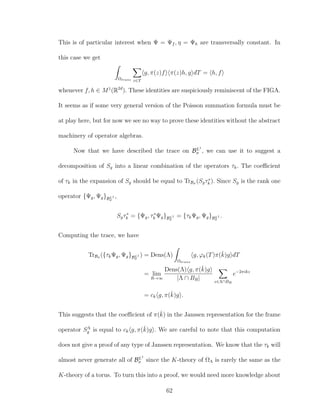
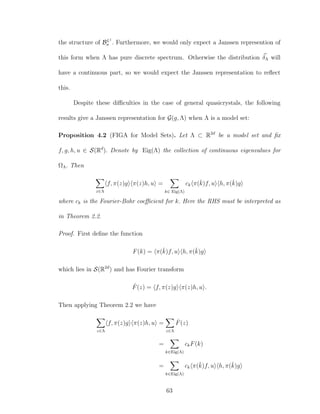
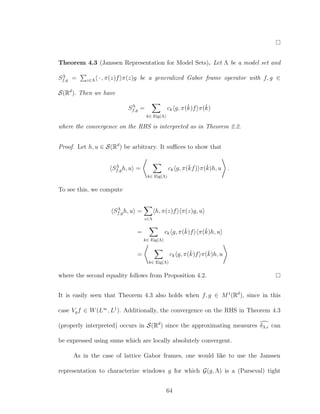
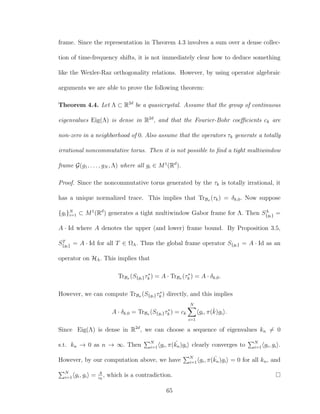
two-dimensional quasicrystals.
To elaborate, we will begin by describing Bellissard’s gap labeling conjecture
in detail. Given a quasicrystal Λ, we can imagine a material with an electron at each
1
point in Λ. In order to analyze electron interactions in Λ, one studies a Schrodinger
operator of the form
HΛ =
1
2m i
− eA
2
+
y∈Λ
v(· − y)
acting on L2
(Rd
), where v is a suitable potential( [4] Section 2.7). The vector po-
tential A models the effect of a constant, uniform magnetic field. With appropriate
boundary conditions, it is possible to restrict HΛ to an operator HΛ,R on L2
(CR(0))
where CR(0) is the closed cube of side length R. Then we can define the integrated
density of states (IDOS)
N(E) = lim
R→∞
1
|CR(0)|
|{E ∈ Sp(HΛ,R) | E ≤ E}|
which is used to express thermodynamical properties such as the heat capacity.
The IDOS can also be expressed using the language of operator algebras. There
are natural C∗
and Von Neumann (VN) algebras related to HΛ which are generated
by the resolvent of HΛ. Essentially, the C∗
-algebra the same as the twisted groupoid
algebra Aθ = C∗
(RΛ, θ) described in Section 2.4, where the cocycle θ is determined
by the magnetic field and is the restriction of a cocycle on R2d
(see [4] and [6] for
details). The algebra Aθ is simple and has a unique normalized trace. The associated
VN algebra (its weak closure) will be denoted by Aθ. The spectral projection of HΛ
onto (−∞, E] is denoted by χE(HΛ), and lies in Aθ. This allows us to describe the
IDOS using the trace on Aθ as
N(E) = Tr(χE(HΛ))
which is known as Shubin’s formula ( [4] Section 2.7). When E lies in a spectral gap,
2
χE(HΛ) lies in the C∗
-algebra Aθ. In this case, the value of the IDOS is constant
over the gap and can be described using the trace on Aθ.
Thus there is physical interest in computing the image of the trace map
Tr∗ : K0(Aθ) → R
which we will call the gap labeling group. Moreover, from physical considerations
we would expect that the gap labels can be computed from only the structure of
Λ and θ. A large part of the gap labeling group can be computed by looking at
the structure of Aθ as a groupoid algebra. Since the unit space of RΛ is a Cantor
set, any clopen set of the unit space gives a projection in Aθ. The trace of the
corresponding projection is simply the measure of the clopen set, which is given by
a patch frequency as described in Section 2.1. This leads to Bellissard’s gap labeling
conjecture:
Conjecture 1.1 ( [6] Problem 1.15). When the magnetic field θ = 0, the set of gap
labels is given by
Tr∗(K0(Aθ=0)) =
Ωtrans
C(Ωtrans, Z),
which is precisely the group generated by the normalized patch frequencies of Λ.
There are many proofs of Conjecture 1.1 in low dimensions and other special cases,
and there are at least three proofs of the conjecture in full generality [5], [7], [17].
However, all three of these papers depend upon the results of [11], which have been
shown to be incorrect [12]. Thus the conjecture appears to remain open in its full
generality, although all cases of physical interest have been settled.
3
Despite the success of Bellissard’s gap labeling program when θ = 0, nothing
seems to be known when a magnetic field is present. Part of the difficulty lies in
the simplicity of Conjecture 1.1. When θ = 0, we can ignore all classes in K0(Aθ=0)
which do not come from projections on the unit space, at least for the purpose of gap
labeling. However, once we twist by θ the other summands in K0(Aθ) may contribute
to the gap labeling group. Additionally, the methods of [5], [7], and [17] all apply
some version of transverse index theory. This allows them to prove Conjecture 1.1
without knowing how to construct all the classes in K0(Aθ). Thus one might ask:
Question 1.1. How can we construct the classes in K0(Aθ) which do not come from
projections on the unit space of RΛ?
If we could construct these elements directly then we would immediately be able to
compute the gap labeling group.
Motivated by Question 1.1, we look at the simpler case when Λ is a lattice.
In this case, the algebra Aθ is a noncommutative torus. In [31], Rieffel describes
a general procedure for constructing all modules over noncommutative tori. In
[25] and [26] Luef shows how Rieffel’s construction is related to Gabor analysis.
In particular, he shows how Gabor frames for lattices can be used to construct
projections in noncommutative tori which represent Rieffel’s modules. In order to
prove that his modules are finitely generated and projective, Rieffel uses arguments
that rely heavily on the group structure of a lattice. The construction of Luef’s
projections is more flexible since Gabor frames can be defined not only for lattices,
but for any point set. One roadblock to generalizing Luef’s results to the setting
4
of quasicrystals is that lattice Gabor frames are understood much better than non-
uniform frames. The recent results of Gr¨ochenig, Ortega-Cerda, and Romero in [15]
have greatly increased our understanding of non-uniform frames and they comprise
the main technical results that we need.
The main goal of this thesis is to adapt Rieffel’s construction to the setting of
quasicrystals. In Chapter 2 and we review the background on quasicrystals needed
to understand our main results. In Chapter 3 we review the work of Gr¨ochenig,
Ortega-Cerda, and Romero in [15], which allows us to prove the following result:
Theorem 1.1. Let Λ ⊂ R2d
be a quasicrystal. Then there exist functions g1, . . . , gN
in M1
(Rd
) so that for any T ∈ ΩΛ, G(g1, . . . , gN , T) is a frame for L2
(Rd
) and an
Mp
-frame for all 1 ≤ p ≤ ∞.
We also show various ways in which the topology of the hull ΩΛ is compatible with
the frame operators for point sets contained in ΩΛ.
In Chapter 4 we give a review of Rieffel’s and Luef’s work on noncommutative
tori to motivate our constructions, then we construct an Aθ module HΛ which
is a representation of Aθ by time-frequency shifts. We then use the results from
Chapter 3 to show that HΛ is finitely generated and projective. In order to compute
the dimension of HΛ, we apply a deep result from [3] on the frame measure for
non-uniform Gabor frames. This yields the following theorem:
Theorem 1.2. The module HΛ is finitely generated and projective as an Aθ-module,
and thus defines a class [HΛ] ∈ K0(Aθ). The dimension of HΛ is given by
Tr([HΛ]) =
1
Dens(Λ)
,
5
so that 1
Dens(Λ)
lies in the gap labeling group of Aθ.
We also construct a projection in MN (Aθ) representing [HΛ] in K0(Aθ) and
use this to give HΛ the structure of a Hilbert C∗
-module. We describe some fea-
tures of EndAθ
(HΛ) which indicate that a Janssen representation should exist for
Gabor frames when Λ has pure discrete spectrum. We then prove a Janssen rep-
resentation for model sets rigorously using a Poisson summation formula. This
representation suggests that when Λ is a quasicrystal and g1, . . . , gN ∈ M1
(Rd
)
then G(g1, . . . , gN , Λ) can never be a tight frame. We are able to prove this under
certain assumptions on the eigenvalues of ΩΛ, and we indicate how some of these
assumptions may be able to be relaxed.
Theorem 1.2 indicates that when the cocycle σ is nontrivial, the gap labeling
group may be generated by more than just the patch frequencies. Note that while
the density of Λ is intrinsic to the space ΩΛ, it is not an isomorphism invariant of the
groupoid RΛ. For example, we can apply a linear map A with det(A) = 1 to Λ. The
groupoids RΛ and RAΛ are isomorphic, however Dens(AΛ) = Dens(Λ)
|det(A)|
. If the cocycle
σ is preserved by the isomorphism then HΛ and HAΛ are both modules over Aσ,
but represent different elements in K0(Aσ). Thus by deforming Λ in a way which
does not alter the groupoid RΛ or the cocycle σ, we can construct many modules
over Aσ using our methods.
In Chapter 5, we illustrate this point by computing the gap labeling group for
any standard cocycle θ when Λ ⊂ R2
is contained in a lattice. This involves showing
exactly how the modules HAΛ fit into K0(Aθ), which can be computed easily using
6
the Pimsner-Voiculescu exact sequence. Thus we have:
Theorem 1.3. When Λ ⊂ Z2
is a quasicrystal and θ is a standard cocycle, the gap
labeling group of Aθ is
Tr∗(K0(Aθ)) = µ(C(Ωtrans, Z)) +
θ
Dens(Λ)
Z .
Here the cocycle θ is determined by a single real number, also denoted θ.
In higher dimensions K0(Aθ) is larger and the modules HAΛ are not enough
to generate the rest of K0(Aθ), although they do give us some information about
the gap labeling group. We are able to prove the following theorem which is a
partial generalization of our results to higher dimensions. Let Λ ⊂ Rd
be a marked
lattice with an aperiodic coloring satisfying the definition of a quasicrystal. Then
ΩΛ naturally has the structure of a fiber bundle
p : ΩΛ → Td
over the torus Td
with the Cantor set as its fibers. The fiber bundle structure comes
from viewing ΩΛ as the suspension of the Cantor set Ωtrans by an action of Zd
.
Theorem 1.4. The induced map p∗
: K0
(Td
) → K0
(ΩΛ) is injective. Furthermore,
we can compare the image of p∗
with the image of r∗,
r∗ : K0(C(Ωtrans)) → K0(C(Ωtrans) Zd
) ∼= K0(C(ΩΛ) Rd
) ∼= K0
(ΩΛ)
where r∗ is induced by the inclusion r : C(Ωtrans) → C(Ωtrans) Zd
. The intersection
of the images of p∗
and r∗ is generated by [1], the class of the trivial bundle.
7
By results of Sadun and Williams [33], given any quasicrystal Λ we can find a marked
lattice L so that ΩΛ is homeomorphic to ΩL, and thus Theorem 1.4 holds in much
greater generality than at first it may appear. The proof of Theorem 1.4 shows that
it can be useful to study the twisted algebras Aσ even if one’s primary goal is to
understand the topology of ΩΛ.
Appendices A and B collect various basic facts about C∗
-algebras, K-theory,
and Morita equivalence which will be used implicitly throughout the text.
8
Chapter 2
Quasicrystals
2.1 Topological Dynamics
The main objects of our investigation are quasicrystals, so we begin with a
review of the topological and dynamical properties of a quasicrystal, as well as
properties of the associated operator algebras. We will state the basic definitions
and theorems for even dimensional quasicrystals since it will simplify notation later,
however the same definitions and theorems apply in any dimension. We will always
think of R2d ∼= Rd
׈R
d
as time-frequency space, and elements z ∈ R2d
will be written
as z = (x, ω) when it is necessary to emphasize this point of view.
Definition 2.1. Let Λ ⊂ R2d
be a discrete set.
1. The hole of Λ is defined to be
ρ(Λ) := sup
z∈R2d
inf
λ∈Λ
|z − λ|
and Λ is called relatively dense if ρ(Λ) < ∞.
2. Λ is called relatively separated if
rel(Λ) := sup{#(Λ ∩ C1(z)) : z ∈ R2d
} < ∞
where C1(z) is the cube of side length 1 centered at z.
9
3. Λ is called uniformly discrete if there is an open ball Br(0) s.t. (Λ − Λ) ∩
Br(0) = {0}.
If Λ is both relatively dense and uniformly discrete then it is called a Delone set.
A Delone set Λ is called aperiodic if Λ − z = Λ for any z ∈ R2d
.
In Gabor analysis, the goal is to recover a function from samples of its Short Time
Fourier Transform on a discrete set (see Chapter 3). Often the sampling set is
assumed to be a lattice; however there are now a variety of results available which
treat sampling on non-uniform sets as well ([3], [15]). While these results are able
to deal with sampling on arbitrary Delone sets, we will restrict our attention to
quasicrystals, which are Delone sets with additional regularity properties.
Definition 2.2. Let Λ be a Delone set. The sets Br(z) ∩ Λ where z ∈ Λ are called
the r-patches of Λ.
1. If for any fixed r there are only finitely many r-patches up to translation, then
Λ is said to be of finite local complexity (FLC).
2. For an r-patch P and a set A ⊂ R2d
we define
LP (A) = #{z ∈ R2d
| P − z ⊂ A ∩ Λ}.
Thus LP (A) counts the number of times P appears in A. For a sequence of
balls Brk
(z) in R2d
such that rk goes to ∞, we define the patch frequency of
P to be
freq(P, Λ) = lim
k→∞
LP (Brk
− z)
vol(Brk
)
10
if this limit exists uniformly in z and independent of the choice of balls Brk
.
If the patch frequencies exist for all patches P ⊂ Λ then Λ is said to have
uniform cluster frequencies (UCF).
A Delone set is called a quasicrystal if it is FLC and has UCF.
The study of quasicrystals has to a large extent been driven by the study of
electron interactions in aperiodic solids. Given an electron in an aperiodic solid, we
might assume that it will only interact with nearby electrons since the forces drop
off rapidly as distances increase. Thus for the study of electron interactions, it is
natural to treat two quasicrystals Λ and Λ as the same if they contain precisely the
same local patterns. One could formalize this by saying that any r-patch appearing
in Λ also appears as an r-patch in Λ and vice versa, and in this case we say Λ
and Λ are locally isomorphic. For example, any translate Λ − z is clearly locally
isomorphic to Λ. The collection of all quasicrystals which are locally isomorphic to
Λ will be called the hull of Λ (denoted ΩΛ), and this object is useful in studying
the physics of aperiodic solids (see [6]).
Now we present another construction of the hull which demonstrates how ΩΛ
can be given the structure of a topological dynamical system. Given two Delone
sets Λ, Λ , define
R(Λ, Λ ) = sup{r | ∃z ∈ R2d
with ||z|| <
1
r
, Br ∩ (Λ − z) = Λ ∩ Br}.
We can define the distance between Λ and Λ as
d(Λ, Λ ) = min 1,
1
R(Λ, Λ )
.
11
Intuitively, two Delone sets are close if they agree in a large ball around the origin
after a small translation. This defines a metric d on the space of all Delone subsets
of R2d
, and the resulting topology on point sets is known as the local topology.
Definition 2.3. Given a Delone set Λ, the orbit of Λ is OΛ = {Λ − z | z ∈ R2d
}.
The hull ΩΛ is the closure of OΛ in the metric d.
The hull ΩΛ comes with a natural action of R2d
by translation. The following
proposition shows how regularity properties of Λ can be translated into properties
of the dynamical system (ΩΛ, R2d
) :
Proposition 2.1 ([6], [23]). Let Λ be an aperiodic Delone set.
1. Λ is FLC iff ΩΛ is compact.
2. Λ has UCF iff the dynamical system (ΩΛ, R2d
) is minimal and uniquely ergodic.
Thus we see that for any quasicrystal Λ we have an associated dynamical
system (ΩΛ, R2d
) which is compact, minimal, and uniquely ergodic. In fact, we have
an explicit description of the ergodic measure µ using patch frequencies. Given a
patch P in Λ, and V ⊂ R2d
a precompact open set, define the cylinder set
ΩP,V = {Λ ∈ ΩΛ | P − z ⊂ Λ for some z ∈ V }.
The cylinder sets form a basis for the topology on ΩΛ, so it suffices to describe the
ergodic measure for cylinder sets. Fix η(Λ) so that any ball of radius η(Λ) contains
at most one point of Λ. If diam(V ) < η(Λ), then the measure of ΩP,V is given by
µ(ΩP,V ) = V ol(V )freq(P, Γ)
12
where Γ is an element of ΩΛ. Since we can also describe the hull using local isomor-
phism classes, for any Λ ∈ ΩΛ the quantities rel(Λ ) and ρ(Λ ) are equal to rel(Λ)
and ρ(Λ) respectively. Thus we may think of these quantities as associated to the
hull itself, and not just to a particular point set contained in it. Furthermore, the
patch frequencies are also independent of the choice of point set Λ ∈ ΩΛ so that
the patch frequencies and density can be associated to the tiling space as a whole
as well.
While the hull ΩΛ appears naturally from physical considerations, we will con-
sider now a different space which appears more naturally in the context of harmonic
analysis. We would like to think of a quasicrystal Λ as a collection of shifts we can
apply to a function. The shifts might simply be translations (see [27]), but in the
case of Gabor analysis they will be time-frequency shifts. In this vein, we consider
OΛ
trans := {Λ − z | z ∈ Λ},
the collection of Delone sets which are translates of Λ by points in Λ.
Definition 2.4. We define the canonical transversal Ωtrans as the closure of
OΛ
trans in the metric d.
Note that the canonical transversal can also be defined as
Ωtrans = {Λ ∈ ΩΛ | 0 ∈ Λ },
and is a transversal to the action of R2d
on the hull.
Topologically Ωtrans is a Cantor set, and it comes with a measure which, by
13
abuse of notation, we shall also call µ. Given a patch P ⊂ Λ, we can define
ΩP := {Λ ∈ Ωtrans | P − z = Br(0) ∩ Λ for some r ∈ R, z ∈ R2d
}.
The set ΩP contains exactly the point sets in Ωtrans which have the pattern P
centered at the origin. The sets ΩP form a clopen basis for the topology on Ωtrans,
and µ(ΩP ) = freq(P, Λ). The hull ΩΛ is locally the product of Ωtrans and R2d
as
both a topological space and a measure space. By results of Sadun and Williams
we can always realize ΩΛ as a fiber bundle over a torus with Cantor set fibers [33],
however it is not always the case that Ωtrans carries an action of Z2d
so that ΩΛ is
the suspension of Ωtrans. This will be an important point to keep in mind during
Chapter 5.
2.2 Examples
Now we will present two classes of quasicrystals which comprise the most
commonly studied examples: model sets and substitutions. To construct model
sets in Rd
, we first embed Rd
into a higher dimensional Rn
= Rd
× Rn−d
, or more
generally as part of a product Rd
×G where G is a locally compact abelian group.
Denote by p1 and p2 the projections onto the factors Rd
and G respectively. Then
we choose a lattice D ⊂ Rd
×G so that p1 is injective on D and p2(D) is dense in G.
Instead of projecting all of D onto Rd
, we will project only a piece of D, ensuring
that the resulting collection of points in Rd
is a quasicrystal. This is summarized in
the definition below:
Definition 2.5 (Model sets). Consider the space Rd
×G, where G is a locally com-
14
pact abelian group. Fix D ⊂ Rd
×G a discrete cocompact subgroup and W ⊂ G a
relatively compact subset whose boundary has Haar measure 0. Also assume that π1
is injective on D and π2(D) is dense in W. The triple (Rd
, G, D) is known as the
cut and project scheme. We define the model set or cut and project set ΛW
by
ΛW = {π1(d) | d ∈ D, π2(d) ∈ W}.
When x ∈ ΛW , we define x := p2(p−1
1 (x)). The group G is known as the internal
space and Rd
is known as the physical space.
Any model set (except for a lattice) is aperiodic, FLC, and has UCF ( [6], [23]).
In fact, we can calculate the patch frequencies of patterns in ΛW using the cut and
project scheme:
Proposition 2.2 (Corollary 7.3 in [1]). Let Λ be a model set for the cut and project
scheme (Rd
, G, D) and suppose the window W is compact. If P ⊂ ΛW is a finite
subset, we can determine the relative frequency of P as
rel freq(P, ΛW ) =
vol x∈P (W − x )
vol(W)
and we have the equality
freq(P, ΛW ) = Dens(ΛW )rel freq(P, ΛW ).
We can also compute the density of ΛW as Dens(ΛW ) = vol(W)
vol(D)
.
Many interesting examples of model sets can be constructed using objects from
number theory. Consider the number ring Z[ζ8] ⊂ C where ζ8 is a primitive eighth
root of unity. We have an automorphism x → x of Z[ζ8] given by extending the
15
Figure 2.1: A patch of the Ammann-Beenker tiling.
map ζ8 → ζ3
8 . The map x → (x, x ) gives an embedding of Z[ζ8] as a lattice L8 in
C2 ∼= R4
. We can write L8 =
√
2R8 Z4
where R8 is the rotation matrix
R8 =
1
2












√
2 1 0 −1
0 1
√
2 1
√
2 −1 0 1
0 1 −
√
2 1












.
The projections p1 and p2 are given by projecting onto the first and second copies
of C ∼= R2
respectively. Collectively, we have described a cut and project scheme
(R2
, R2
, L8). The window W will be a regular octagon in R2
centered at the origin
with side length one, and oriented so that all edges are perpendicular to some eighth
root of unity. The resulting model set ΛW is known as the Ammann-Beenker
16
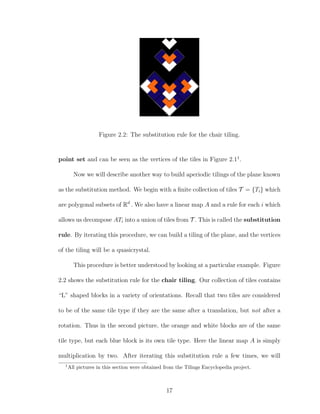
Figure 2.2: The substitution rule for the chair tiling.
point set and can be seen as the vertices of the tiles in Figure 2.11
.
Now we will describe another way to build aperiodic tilings of the plane known
as the substitution method. We begin with a finite collection of tiles T = {Ti} which
are polygonal subsets of Rd
. We also have a linear map A and a rule for each i which
allows us decompose ATi into a union of tiles from T . This is called the substitution
rule. By iterating this procedure, we can build a tiling of the plane, and the vertices
of the tiling will be a quasicrystal.
This procedure is better understood by looking at a particular example. Figure
2.2 shows the substitution rule for the chair tiling. Our collection of tiles contains
“L” shaped blocks in a variety of orientations. Recall that two tiles are considered
to be of the same tile type if they are the same after a translation, but not after a
rotation. Thus in the second picture, the orange and white blocks are of the same
tile type, but each blue block is its own tile type. Here the linear map A is simply
multiplication by two. After iterating this substitution rule a few times, we will
1
All pictures in this section were obtained from the Tilings Encyclopedia project.
17
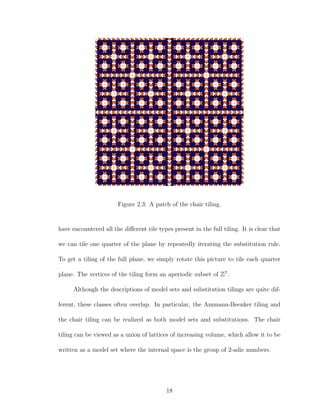
Figure 2.3: A patch of the chair tiling.
have encountered all the different tile types present in the full tiling. It is clear that
we can tile one quarter of the plane by repeatedly iterating the substitution rule.
To get a tiling of the full plane, we simply rotate this picture to tile each quarter
plane. The vertices of the tiling form an aperiodic subset of Z2
.
Although the descriptions of model sets and substitution tilings are quite dif-
ferent, these classes often overlap. In particular, the Ammann-Beenker tiling and
the chair tiling can be realized as both model sets and substitutions. The chair
tiling can be viewed as a union of lattices of increasing volume, which allow it to be
written as a model set where the internal space is the group of 2-adic numbers.
18
2.3 Poisson Summation Formulas
In studying Gabor analysis on model sets we shall sometimes need to make
use of a generalized Poisson summation formula. Recall that for f ∈ S(Rd
) and a
lattice L ⊂ Rd
the classical Poisson summation states
z∈L
f(z) =
l∈L∗
ˆf(l)
where L∗
denotes the dual lattice
L∗
:= {l ∈ Rd
| l · z ∈ Z for all z ∈ L}.
We can consider the translation bounded measure δL := z∈L δz where δz is the
Dirac delta function at z. Then we can rephrase the Poisson summation formula as
an equality of measures
δL = δL∗ .
Thus if we want an analogous formula for a quasicrystal Λ, we can begin by consid-
ering the measure
δΛ :=
z∈Λ
δz
and try to compute δΛ. Unfortunately, this computation is complicated by the fact
that although δΛ is a measure, δΛ will not be a measure in general. In fact there are
rather stringent restrictions on when this can occur.
Theorem 2.1 ([21] Theorem 3.7). Suppose that Λ and Λ are discrete sets in Rd
,
that {c(l) | l ∈ Λ } are positive numbers, and that the two distributions
f1 =
z∈Λ
δz, f2 =
l∈Λ
c(l)δl
19
are tempered distributions. If f2 = ˆf1, then Λ is a full rank lattice in Rd
, Λ is the
dual lattice, and all c(l) = 1
vol(Λ)
.
Thus we must be very careful while computing δΛ.
For the remainder of the section we will assume that Λ ⊂ Rd
is a model set
with cut and project scheme (Rd
, Rn
, D). We have assumed that the internal space
is Rn
largely for convenience, and all results carry over to the more general case
([34]). We define the dual cut and project scheme to be (Rd
, Rn
, D∗
) and for
convenience we denote p1 and p2 as the projections for both the original cut and
project scheme and its dual. We fix a relatively compact window W and consider
the model set ΛW . For a point k ∈ Rd
, we define the Fourier-Bohr coefficient at
k to be
ck := lim
R→∞
Dens(ΛW )
|ΛW ∩ BR| z∈ΛW ∩BR
e−2πikz
.
For model sets this limit exists independently of the center of the ball BR ([1] Prop
9.9). When k /∈ p1(D∗
) we have ck = 0. It is possible to have ck = 0 even though
k ∈ p1(D∗
), however for model sets such k form a discrete subset of p1(D∗
). One
can see this by computing the Fourier-Bohr coefficients using the Fourier transform
of the characteristic function of the window, as in [1].
A cursory computation of δΛW
shows that ([16] Section 5)
δΛW
=
k∈p1(D∗)
ckδk.
However, since the RHS of this expression is not locally absolutely summable, we
need a more precise way to interpret this sum. To do this, we consider a sequence
of smooth functions ϕ on W such that lim →0 ϕ = χW , the characteristic function
20
of W. We define a corresponding collection of measures
δΛW , :=
z∈ΛW
ϕ (z )δz.
It can be shown that
δΛW , =
k∈p1(D∗)
ckδk
where the RHS is locally absolutely summable. Additionally, we have lim →0 ck = ck.
We summarize this by the following theorem, whose proof can be found in [8] Section
2:
Theorem 2.2. We have
lim
→0
δΛW , = δΛW
in the sense of tempered distributions. Interpreted in this sense, for any f ∈ S(Rd
)
we have
z∈ΛW
ˆf(z) =
k∈p1(D∗)
ckf(k)
where
ck = lim
R→∞
Dens(ΛW )
|ΛW ∩ BR| z∈ΛW ∩BR
e−2πikz
.
To better motivate the definition of the Fourier-Bohr coefficients, we can give
them a dynamical interpretation. For any point k ∈ Rd
we say that k is an eigen-
value of the dynamical system (ΩΛ, Rd
) with eigenfunction ϕk if ϕk is a measurable
complex valued function on ΩΛ satisfying
ϕk(T − z) = e2πikz
ϕk(T)
21
for all T ∈ ΩΛ and z ∈ Rd
. If an eigenfunction exists for an eigenvalue k then
it is unique up to scaling by a unit complex number. If the eigenfunction is con-
tinuous, we call k a continuous eigenvalue. The continuous eigenvalues make
up the discrete part of the dynamical spectrum. By this, we mean that we can
decompose the joint spectrum of the translation operators on ΩΛ, and that the con-
tinuous eigenfunctions make up the discrete part in this decomposition. When the
continuous eigenfunctions make up the entire spectrum, we say that ΩΛ has pure
discrete spectrum. This is equivalent to saying that the linear span of the con-
tinuous eigenfunctions is dense in L2
(ΩΛ). For the classes of quasicrystals we have
described (namely model sets and substitutions) all eigenfunctions are continuous,
and thus we do not have to draw the distinction between measurable and continu-
ous eigenfunctions. However there are other classes where this distinction becomes
important [20].
Now we can describe the connection between Fourier-Bohr coefficients and
eigenvalues. For a model set Λ, ΩΛ always has pure discrete spectrum and the
collection of eigenvalues is exactly p1(D∗
). In this case, we see that the Fourier-Bohr
coefficient ck is simply the integral of the eigenfunction ϕk over Ωtrans after applying
Birkhoff’s ergodic theorem. We will see the eigenfunctions appear again, along with
the Fourier-Bohr coefficients, when we investigate Hilbert C∗
-module structures and
the Janssen representation in Section 4.4.
22
2.4 The Groupoid C∗
-algebra Aσ
We are now ready to describe our main object of study: the groupoid C∗
-
algebra Aσ associated to Ωtrans. We consider the equivalence relation
RΛ = {(T, T ) ∈ Ωtrans × Ωtrans | T is a translate of T }
and an element of RΛ will be written as (T, T − z) where z ∈ R2d
. We give RΛ a
topology by declaring that a sequence (Tk, Tk −zk) → (T, T −z) iff Tk → T in Ωtrans
and |zk − z| → 0. With this topology, RΛ has the structure of a locally compact,
principal, r-discrete groupoid (see [30]). The unit space of RΛ is given by elements
of the form (T, T). We can compose two elements (T, T − z), (T , T − w) only if
T = T − z, and in this case
(T, T − z) ∗ (T − z, T − z − w) = (T, T − z − w).
This groupoid captures the idea of shifting by exactly the points in Λ. To
see this, note that (Λ, Λ − z) ∈ RΛ iff z ∈ Λ. Thus the orbit of Λ in RΛ is in
correspondence with the points of Λ, and the element (Λ, Λ − z) can be thought
of as a shift by z. This will be made more explicit in Section 4.3, where we will
construct a projective representation of RΛ using time-frequency shifts. Anticipating
this, we will describe the cocycle on RΛ which will be involved in this projective
representation. First, let θ be a 2-cocycle on R2d
. We can use θ to construct a
2-cocycle on RΛ, denoted θΛ, using the formula
θΛ ((T, T − z), (T , T − w)) = θ(z, w).
23
Cocycles of this form will be called standard cocycles, and when it is clear we will
drop the subscript from θΛ and refer to both cocycles as θ. We will be particularly
concerned with the symplectic cocycle σ on R2d
given by
σ(z, w) = e−2πixω
where z = (x, ω) and w = (x , ω ).
Following [30] and [6], we construct a C∗
-algebra from RΛ and a 2-cocycle
θ. To construct the C∗
-algebra Aθ = C∗
(RΛ, θ), we begin with Cc(RΛ), with the
product
f ∗ g(T, T − z) :=
w∈T
f(T, T − w)g(T − w, T − z)θ ((T, T − w), (T − w, T − z))
and involution defined by
f∗
(T, T − z) := f(T − z, T)θ ((T, T − z), (T − z, T))
where z = (x, ω). For the symplectic cocycle σ, the multiplication and involution
can be written as
f ∗ g(T, T − z) :=
w=(x ,ω )∈T
f(T, T − w)g(T − w, T − z)e2πix (ω −ω)
and
f∗
(T, T − z) := f(T − z, T)e2πixω
respectively. We can define a norm on Cc(RΛ) by taking the sup over all the norms
coming from the bounded representations of Cc(RΛ) (see [30] Chapter 2 for details,
or [6] Section 4.1 for a description specific to quasicrystals). After completing Cc(RΛ)
in this norm, we obtain the C∗
-algebra Aθ.
24
For a standard cocycle θ, we can also construct a cocycle on the action groupoid
C(ΩΛ) R2d
, and in this case Aθ is Morita equivalent to the twisted crossed product
C∗
(C(ΩΛ) R2d
, θ) [29]. Since the action of R2d
on ΩΛ is minimal and uniquely
ergodic, both algebras are simple and have a unique normalized trace given by
integrating over the unit space of their respective groupoids. For a function f ∈
Cc(RΛ), the trace is given by
Tr(f) =
Ωtrans
f(T, T)dT,
and after applying Birkhoff’s ergodic theorem we can write
Tr(f) = lim
k→∞
1
|Λ ∩ Ck|
z∈(Λ∩Ck)
f(T − z, T − z)
so that the trace is expressed as an average over the values of f on the orbit of Λ.
For a standard cocycle θ we can compute the K-theory of Aθ by appealing to
the following theorem of Gillaspy [13]:
Theorem 2.3 ([13] Thm. 5.1). Let G be a second countable locally compact Haus-
dorff group acting on a second countable locally compact Hausdorff space X such that
G satisfies the Baum-Connes conjecture with coefficients, and let ωt be a homotopy
of continuous 2-cocycles on the transformation group X G. For any t ∈ [0, 1], the
∗-homomorphism
qt : C∗
r (G X × [0, 1], ω) → C∗
r (G X, ωt),
given on Cc(G X × [0, 1]) by evaluation at t ∈ [0, 1], induces an isomorphism
K∗(C∗
r (G X × [0, 1], ω)) ∼= K∗(C∗
r (G X, ωt)).
25
Theorem 2.3, combined with the Connes-Thom isomorphism and the Morita equiv-
alence between Aθ and C∗
(C(ΩΛ) R2d
, θ), gives
K∗(Aθ) ∼= K∗(C∗
(C(ΩΛ) R2d
, θ)) ∼= K∗(C(ΩΛ) R2d
) ∼= K∗(C(ΩΛ)) ∼= K∗
(ΩΛ).
Theorem 2.3 applies since any cocycle on R2d
is homotopic to the trivial cocycle,
essentially by the straight line homotopy. Unfortunately, the K-theory of ΩΛ can be
quite complicated. In many cases K0
(ΩΛ) will not be finitely generated, and there
are examples where it has torsion [12]. Because of these complexities, it is in general
difficult to see how our module HΛ fits into K0(Aσ). In Section 5, we will show that
when Λ ⊂ R2
is a subset of a lattice these difficulties can be overcome, and an
understanding of how HΛ fits into K0(Aσ) is enough to compute Tr∗(K0(Aσ)).
26
Chapter 3
Gabor Analysis
3.1 Time-Frequency Analysis
Now we will review some basic concepts from time-frequency analysis. For a
point z = (x, ω) ∈ R2d
we denote by π(z) the time-frequency shift by z, which
operates on L2
(Rd
) by
π(z)f(t) = MωTxf(t) = e2πiωt
f(t − x).
Here Mω denotes the modulation operator
Mωf(t) = e2πiωt
f(t)
and Tx denotes the translation operator
Txf(t) = f(t − x).
Fix g = 0 ∈ L2
(Rd
) which we will call the window function. Then the Short Time
Fourier Transform (STFT) of f ∈ L2
(Rd
) with respect to the window g is
Vgf(x, ω) =
Rd
f(t)g(t − x)e−2πitω
dt for (x, ω) ∈ R2d
.
The STFT of a function f with respect to the window g is an attempt to decompose
f into time-frequency shifts of g. If g is supported on a small set around the origin
then we can view Vgf as an attempt to measure the “local frequencies” present in
27
f. Similar to the Fourier transform, the STFT has the following continuous recon-
struction formula:
Proposition 3.1 ([14]). Fix g, γ ∈ L2
(Rd
) s.t. g, γ = 0. Then for all f ∈ L2
(Rd
),
f =
1
g, γ R2d
Vgf(x, ω)MωTxγ dωdx.
A central goal in Gabor analysis is to look for discrete versions of this reconstruction
formula. This idea is expressed through the language of frames.
Definition 3.1. A sequence (ej)j∈J in a separable Hilbert space W is called a frame
if there exist constants A, B > 0 s.t. for all f ∈ W
A||f||2
≤
j∈J
| f, ej |2
≤ B||f||2
.
If A = B then (ej) is called a tight frame, and if A = B = 1 then (ej) is called a
Parseval tight frame.
Any frame (ej) has an associated frame operator S given by
Sf =
j∈J
f, ej ej,
which is the composition of the analysis and synthesis operators
(Cf)j = f, ej
D({aj}j∈J ) =
j∈J
ajej.
We have a (non-unique, non-orthogonal) expansion of f given by
f =
j∈J
f, S−1
ej ej
28
where the elements S−1
ej are known as the dual frame. We also have an associated
Parseval tight frame given by (S−1/2
ej)j∈J .
If we wish to discretize the STFT, we can choose a subset Λ ⊂ R2d
and a
window g and ask whether the set
G(g, Λ) =: {π(z)g | z ∈ Λ}
forms a frame for L2
(Rd
). Such frames are called Gabor frames for Λ. More gen-
erally, we can choose finitely many functions g1, . . . , gN and look for multiwindow
Gabor frames of the form
G(g1, . . . , gN , Λ) := {π(z)gi | i = 1 . . . , N, z ∈ Λ}.
In this case elements of the dual frame will be denoted by ˜giz = S−1
(π(z)gi). When
Λ is a lattice, the dual frame will also have the structure of a Gabor frame given by
G( ˜g1, . . . , ˜gN , Λ) where ˜gi = S−1
gi.
With this background in place, it is natural to ask:
Question 3.1. Given a quasicrystal Λ, can we find functions g1, . . . , gN so that
G(g1, . . . , gN , Λ) is a Gabor frame for Λ?
Much of the work in Gabor analysis has focused on the case where Λ is a lattice.
However, recent results in [15] took a large step towards answering this question not
just for quasicrystals, but for any discrete set Λ. In order to explain their results, it
will be necessary to introduce the modulation spaces Mp
(Rd
).
Definition 3.2. Fix a non-zero g ∈ S(Rd
). For 1 ≤ p ≤ ∞ we define the modula-
29
tion spaces
Mp
(Rd
) := {f ∈ S (Rd
) | Vgf ∈ Lp
(R2d
)}
with the norm ||f||Mp = ||Vgf||p.
Different choices for g give rise to equivalent norms on Mp
(Rd
). The modula-
tion space M1
(Rd
) consists of good windows for Gabor analysis. When g ∈ M1
(Rd
)
the analysis and synthesis operators for a Gabor system G(g, Λ) are bounded be-
tween Mp
(Rd
) and lp
(Λ) :
||CΛ
g f||lp ≤ rel(Λ)||g||M1 ||f||Mp
||DΛ
g c||Mp ≤ rel(Λ)||g||M1 ||c||lp .
A Gabor system G(g, Λ) with g ∈ M1
(Rd
) will be called an Mp
-frame if CΛ
g is
bounded below on Mp
(Rd
). This is equivalent to having constants A, B so that for
all f ∈ Mp
(Rd
)
√
A||f||Mp ≤ ||SΛ
g f||Mp ≤
√
B||f||Mp .
In this case the frame operator SΛ
g is invertible on Mp
(Rd
).
Now we are ready to state the result from [15] which gives sufficient conditions
for answering Question 3.1. For g ∈ M1
(Rd
) and δ > 0, we can define the M1
modulus of continuity of g as
ωδ(g) = sup
|z−w|≤δ
||π(z)g − π(w)g||M1
It is clear that ωδ → 0 as δ → 0 since the representation π is strongly continuous in
B(M1
(Rd
)).
30
Theorem 3.1 ( [15]). For g ∈ M1
(Rd
) with ||g||2 = 1 choose δ > 0 so that ωδ(g) < 1.
If Λ ⊂ R2d
is relatively separated and ρ(Λ) < δ, then G(g, Λ) is a Gabor frame for
L2
(Rd
).
From this result, we can see that when ρ(Λ) is small enough there will be many
windows g for which G(g, Λ) is a Gabor frame. Furthermore, when g is one of these
admissible windows, G(g, Λ ) will also form a Gabor frame for any Λ ∈ ΩΛ since
ρ(Λ ) = ρ(Λ). However, when ρ(Λ) is large we cannot expect G(g, Λ) to form a
Gabor frame for any g. In fact, the Balian-Low theorem for non-uniform frames
proven in [15] shows that if G(g, Λ) is a frame then Dens(Λ) > 1. In this case, we
can only expect a multiwindow Gabor frame to exist.
Finally, we will need to introduce one more function space needed for the
proofs in Section 3.2. The Wiener amalgam space W(L∞
, L1
)(Rd
) consists of all
functions f ∈ L∞
(Rd
) such that
||f||W(L∞,L1) :=
k∈Zd
||f||L∞([0,1]d+k) < ∞.
It is a standard result (see [14] Proposition 12.1.11) that when g ∈ M1
(Rd
) then
for any f ∈ M1
(Rd
), Vgf ∈ W(L∞
, L1
)(R2d
) and ||Vgf||W(L∞,L1) ≤ C||f||M1 ||g||M1 .
Also note that if f ∈ W(L∞
, L1
)(Rd
) and T ⊂ Rd
is a Delone set then we have the
inequality
t∈T
|f(t)| ≤ rel(T)||f||W(L∞,L1). (3.1)
If T ∈ ΩΛ then the bound in this inequality is independent of T since rel(T) = rel(Λ).
31
3.2 Gabor Frames for Quasicrystals
3.2.1 Existence of Multiwindow Gabor Frames
Our first goal will be to prove Theorem 1.1. Given a quasicrystal Λ, Theorem
3.1 gives sufficient conditions for a single window Gabor frame to exist for Λ based on
the size of ρ(Λ). To show that multiwindow frames exist, we first need the following
lemma:
Lemma 3.1. Suppose Λ ⊂ R2d
is FLC. Fix > 0. We can find finitely many disjoint
translates {Λi}N
i=1 so that ¯Λ = N
i=1 Λi has ρ(¯Λ) < .
Proof. First we let R = ρ(λ) + δ for some small δ. Since Λ is FLC, there are only
finitely many patterns of the form BR(z) ∩ Λ up to translation. These patterns
contain all the possible types of holes in Λ, some of which have size larger than .
Note that if we have a finite sequence zn then N
n=1 Λ + zn is also FLC. Thus we
can systematically shrink these holes one by one by taking unions of translates of
Λ. It will suffice to take a single pattern P which contains a hole of size larger than
and show how we can shrink that hole by a factor of 2. Repeating the procedure
will shrink the hole below a size of .
Choose a point z ∈ P and let c denote the center of the largest hole in P. Then
the set Λ ∪ (Λ − z + c) will no longer contain the patch P. Instead, all occurrences
of the patch P in Λ will now have a point in the center of the largest hole of P, so
that the largest hole will have been reduced in size by a factor of 2.
This method does not ensure that the sets Λ and Λ − z + c will be disjoint,
32
since the vector z −c may lie in Λ−Λ. To fix this, note that we do not need to place
a point exactly in the center of the hole, but only very close to the center, in order
to reduce the hole by a significant amount. Thus if z −c ∈ Λ−Λ, we instead choose
a point c close enough to c so that z − c /∈ Λ − Λ and the hole in P is reduced by
a factor of 2 − η for some small η. We can find such a point c since Λ FLC implies
that Λ − Λ is discrete.
Proposition 3.2. Given a Delone set Λ ⊂ R2d
with FLC and g ∈ M1
(Rd
), we can
find a multiwindow Gabor frame for Λ where the windows consist of time frequency
translates of g. Furthermore, this multiwindow Gabor frame will be an Mp
-frame for
all p.
Proof. Choose δ > 0 so that ωδ(g) < 1. Applying Lemma 3.1, we can find Λ =
N
i=1(Λ + zi) so that ρ(Λ ) < δ. Then by Theorem 1.1,
G(g, Λ ) =
N
i=1
{π(z + zi)g | z ∈ Λ}
is a Gabor frame and by Theorem 5.1 of [15] it is an Mp
-frame for all p. This is
almost equal to the multiwindow Gabor system given by
N
i=1
G(π(zi)g, Λ) =
N
i=1
{π(z)π(zi)g | z ∈ Λ} =
N
i=1
{e−2πixωi
π(z + zi)g | z ∈ Λ}
where z = (x, ω) and zi = (xi, ωi). The functions in the two Gabor systems differ
only by phase factors, so N
i=1 G(π(zi)g, Λ) will satisfy the same frame inequalities
as G(g, Λ ) and thus N
i=1 G(π(zi)g, Λ) is a multiwindow Gabor frame with the same
frame bounds (and Mp
-frame bounds) as G(g, Λ ).
33
Corollary 3.1. If g ∈ M1
(Rd
) and N
i=1 G(π(zi)g, Λ) is a multiwindow Gabor frame
as constructed above, then so is N
i=1 G(π(zi)g, Λ ) for any Λ ∈ ΩΛ.
Proof. Since Λ ∈ ΩΛ, it contains exactly the same patches as Λ. Thus the procedure
in Lemma 3.1 also works to fill in the holes of Λ , so that the sets N
i=1 Λ + zi and
N
i=1 Λ + zi have the same sized hole. Then the argument from Proposition 3.2 ap-
plies in exactly the same way to Λ , showing that N
i=1 G(π(zi)g, Λ ) is a multiwindow
Gabor frame.
Taken together, Proposition 3.2 and Corollary 3.1 immediately imply Theorem 1.1.
3.2.2 Continuity and Covariance Properties of the Frame Operator
Now we will investigate various continuity and covariance properties of the
frame operator. When G(g1, . . . , gN , Λ) is a multiwindow Gabor frame, we will
denote the associated frame operator by SΛ
{gi}. We will often omit the subscripts
and superscripts when they are clear from context. We would like to understand
the relationship between the frame operators ST
and ST
when T, T ∈ ΩΛ. First we
shall show that when T = T − z then there is a covariance condition relating ST
and ST
.
Proposition 3.3. If G(g1, . . . , gN , T) and G(g1, . . . , gN , T − w) are multiwindow
Gabor systems for T and T − w respectively, then the frame operators ST
and ST−w
satisfy
ST
π(w) = π(w)ST−w
.
34
Proof. Fix f ∈ L2
(Rd
). On the one hand we have
ST
π(w)f =
N
i=1 z∈T
π(w)f, π(z)gi π(z)gi =
N
i=1 z∈T
e2πix ω
f, π(z − w)gi π(z)gi.
where z = (x, ω) and w = (x , ω ). On the other hand we have
π(w)ST−w
f =
N
i=1 z∈T
f, π(z − w)gi π(w)π(z − w)gi
=
N
i=1 z∈T
e2πix ω
f, π(z − w)gi π(z)gi
and so the two expressions are equal.
We would also like to know something about the continuity of the frame oper-
ators over ΩΛ. If Tk → T in ΩΛ, we cannot expect STk → ST
in the operator norm.
However, we do have that STk → ST
in the strong operator topology.
Proposition 3.4. Suppose Tk → T in ΩΛ and the window functions g1, . . . , gN lie
in M1
(Rd
). Then STk → ST
in the strong operator topology on B(M1
(Rd
)).
Proof. Fix f ∈ M1
(Rd
). Let A = max{||gi||M1 }. Fix > 0 and choose a large cube
C so that for all i
a∈Zn
C
||Vgi
f||L∞([0,1]n+a) <
4ANrel(Λ)
where N is the number of windows in the multiwindow frame. Since Tk → T, we
can choose K so that for all k ≥ K, Tk agrees with T on the cube C up to a small
translation, so that
N
i=1 z∈T∩C
f, π(z)gi π(z)gi −
N
i=1 z∈Tk∩C
f, π(z)gi π(z)gi
M1
<
2
.
35
Then for all k ≥ K we have
||ST
f − STk
f||M1 ≤
N
i=1 z∈TC
f, π(z)gi π(z)gi −
N
i=1 z∈TkC
f, π(z)gi π(z)gi
M1
+
2
≤ A


N
i=1 z∈TC
| f, π(z)gi | +
N
i=1 z∈TkC
| f, π(z)gi |

 +
2
= A


N
i=1 z∈TC
|Vgi
f(z)| +
N
i=1 z∈TkC
|Vgi
f(z)|

 +
2
≤ 2Arel(Λ)


N
i=1 a∈Zn
C
||Vgi
f||L∞([0,1]n+a)

 +
2
< 2ANrel(Λ)
4ANrel(Λ)
+
2
= .
In the fourth inequality it is important to note that the inequality (3.1) holds not
only for the norms, but also for the partial sums. The main reason this proof works
is that rel(T) is constant on ΩΛ. By applying inequality (3.1), this implies that we
can find a cube C so that the sum ST
f is arbitrarily small outside of C independent
of T ∈ ΩΛ.
Even though the mapping T → ST
will not be continuous when B(M1
(Rd
)) is
given the norm topology, we can still show that all the frames G(g1, . . . , gN , T) have
the same optimal frame bounds.
Proposition 3.5. Suppose G(g1, . . . , gN , T) is a frame for each T ∈ ΩΛ and each
gi ∈ M1
(Rd
). For any T ∈ ΩΛ the optimal upper and lower frame bounds for
G(g1, . . . , gN , T) are the same as those for G(g1, . . . , gN , Λ). As a result, ||ST
||M1 =
||SΛ
||M1 and ||(ST
)−1
||M1 = ||(SΛ
)−1
||M1 where || · ||M1 denotes the operator norm
on B(M1
(Rd
)).
36
Proof. Let A and B denote the optimal lower and upper frame bounds for
G(g1, . . . , gN , Λ) so that for all f ∈ M1
(Rd
)
√
A||f||M1 ≤ ||SΛ
f||M1 ≤
√
B||f||M1 .
Since the translates of Λ are dense in ΩΛ, we can find a sequence of translates
Λ − zk → T. Note that by Proposition 3.3 the frame bounds are constant on the
orbit of Λ. Since Λ − zk → T, SΛ−zk → ST
in the strong topology by Proposition
3.4.
Now fix f ∈ M1
(Rd
). We have ||SΛ−zk f||M1 → ||ST
f||M1 . Since
√
A||f||M1 ≤
||SΛ−zk f||M1 ≤
√
B||f||M1 for all k, we have
√
A||f||M1 ≤ ||ST
f||M1 ≤
√
B||f||M1 .
By reversing the roles of T and Λ in this argument, we see that the upper and lower
frame bounds for T and Λ must be equal. The last remark follows since the lower
and upper frame bounds are equal to ||(ST
)−1
||M1 and ||ST
||M1 respectively.
Corollary 3.2. Suppose g1, . . . , gN ∈ M1
(Rd
) and G(g1, . . . , gN , Λ) is an M1
-frame.
Then for any T ∈ ΩΛ, G(g1, . . . , gN , T) is also an M1
-frame.
Proof. By examining the basic frame inequalities in Definition 3.1, we can see that
if G(g1, . . . , gN , Λ) is a frame then so is G(g1, . . . , gN , Λ − z) for any z ∈ R2d
. Given
T ∈ ΩΛ, we can find a sequence of translates Λ−zk converging to T. By Proposition
3.4 we have SΛ−zk → ST
in the strong topology on B(M1
(Rd
)). The frame bounds
for the frames G(g1, . . . , gN , Λ − zk) are all equal by Proposition 3.3, so ST
also
satisfies those same frame bounds. In particular ST
is bounded below on M1
(Rd
),
and thus G(g1, . . . , gN , T) is an M1
-frame.
37
Note the difference between Corollary 3.1 and Corollary 3.2. Corollary 3.1 says that
there exist windows {gi}N
i=1 ⊂ M1
(Rd
) so that G(g1, . . . , gN , T) is a Gabor frame for
any T ∈ ΩΛ. Corollary 3.2 says that when G(g1, . . . , gN , Λ) is a multiwindow Gabor
frame and each gi ∈ M1
(Rd
), then G(g1, . . . , gN , T) is automatically also a Gabor
frame for any T ∈ ΩΛ. The similarity between the Delone sets in ΩΛ is the key to
Proposition 3.4 which drives all of our results.
3.3 Comparison of Convergence Properties
It is interesting to compare our Proposition 3.4 to the results in [15]. They
define a notion of convergence for point sets which is seemingly much stronger than
the local topology defined in Section 2.1. For Λ ⊂ R2d
a Delone set, they consider
a sequence of Delone sets {Λn | n ≥ 1} produced as follows. For each n ≥ 1 let
τn : Λ → R2d
be a map and define Λn := τn(Λ) = {τn(λ) | λ ∈ Λ}. We assume
τn(λ) → λ as n → ∞. The sequence of sets Λn together with the maps τn is called
a deformation of Λ. We will say that a sequence of sets Λn is a deformation of Λ
with the understanding that the maps τn are also given.
Definition 3.3. A deformation of Λ is called Lipschitz, denoted by Λn
Lip
→ Λ, if:
1. Given R > 0,
sup
λ,λ ∈Λ
|λ−λ |≤R
|(τn(λ) − τn(λ )) − (λ − λ )| → 0 as n → ∞.
2. Given R > 0 there exists R > 0 and n0 ∈ N such that if |τn(λ) − τn(λ) | ≤ R
for some n ≥ n0 and some λ, λ ∈ Λ then |λ − λ | ≤ R .
38
The goal of Lipschitz convergence is to ensure that the separation, relative
density, and hole of Λn are close to the corresponding quantities for Λ when n is
large. This level of control allows them to prove the following result:
Theorem 3.2. Let g ∈ M1
(Rd
), Λ ⊂ R2d
and assume that G(g, Λ) is a frame. If Λn
is Lipschitz convergent to Λ then G(g, Λn) is a frame for sufficiently large n.
The proof depends on a general characterization of Gabor frames which does not
involve inequalities. Their result does not imply that SΛn
→ SΛ
in any of the
standard operator topologies, and does not yield estimates for the frame bounds of
SΛn
when n is sufficiently large. This illustrates how much simpler the situation
becomes when we restrict our attention to quasicrystals.
We would like to compare Lipschitz convergence with the local topology. In
particular, if Λn
Lip
→ Λ and all Λn ∈ ΩΛ, does Λn → Λ in ΩΛ? After reflecting
upon this, it seems quite difficult for any deformation Λn to satisfy condition one
in Definition 3.3 if all Λn ∈ ΩΛ. The sets in ΩΛ were chosen based on their local
structure, but condition one implies a kind of global convergence. We are led to
conjecture:
Conjecture 3.1. Suppose Λn ∈ ΩΛ and Λn
Lip
→ Λ. Then for any > 0 we can find
N such that for all n ≥ N , Λn = Λ + vn where vn ∈ R2d
is a vector with ||vn|| ≤ .
Conjecture 3.1 would imply that Lipschitz convergence implies convergence in the
local topology, but is actually far stronger as any Lipschitz convergent sequence
would be somewhat trivial. We can illustrate this by stating a slightly weaker
conjecture:
39
Conjecture 3.2. Suppose Λn ∈ Ωtrans and Λn
Lip
→ Λ. Then the sequence Λn is
eventually constant and equal to Λ.
These conjectures seem reasonable in light of the fact that a local isomorphism
between two quasicrystals need not imply global similarity. However, there is one
class of point sets where local similarity does imply a kind of global similarity. In [2]
the authors show that model sets which are close in the local topology are statisti-
cally similar in the following sense. Let Λ be a model set and suppose Λ ∈ ΩΛ and
Λ agrees with Λ on a large ball around the origin so that d(Λ, Λ ) < . Then there is
a constant C independent of Λ, Λ so that dens(Λ ∆ Λ ) < C . Here dens(Λ) denotes
the upper density of a point set Λ and ∆ denotes the symmetric difference. Further-
more, they show that this property characterizes model sets among quasicrystals.
It is unclear whether this statistical similarity is enough to construct a counterex-
ample to either conjecture. It would be interesting to see whether these conjectures
have different answers depending on the class of quasicrystals (e.g. model set or
substitution) under consideration.
40
Chapter 4
Constructing Aσ-modules
4.1 Lattice Gabor Frames and Modules over Noncommutative Tori
To motivate our construction of modules over Aσ, we will review Rieffel’s
results in [31] on constructing modules over noncommutative tori and relate them
to Gabor analysis as in [25], [26].
Definition 4.1. Let L ⊂ R2d
be a lattice. The C∗
-algebra AL generated by the
time-frequency shifts {π(z) | z ∈ L} is called a noncommutative torus.
We can also define noncommutative tori as twisted convolution algebras. We take
l1
(L) with twisted convolution
a ∗ b(l) :=
µ∈L
a(µ)b(l − µ)σ(µ, l − µ)
where σ is the symplectic cocycle on R2d
. This is equivalent to taking the twisted
group algebra Aθ = C∗
r (Z2d
, θ) where θ = σ|L. The group algebra is generated
by unitaries Un which correspond to the Dirac δ-functions at the elements of Z2d
.
Any cocycle on Z2d
is given by a skew symmetric matrix Θ which describes the
commutation relations between the Un :
UnUm = e2πintΘm
UmUn.
When the off diagonal entries of this matrix are all irrational and rationally inde-
pendent, we call the cocycle totally irrational. The standard trace on Aθ is given
41
by
TrAθ


n∈Z2d
anUn

 = a0.
When θ is totally irrational the map TrAθ∗ : K0(Aθ) → R is injective, although in
general it will not be [9].
Each of these definitions of the noncommutative torus comes with its own
advantages. By viewing a noncommutative torus as a twisted group algebra Aθ we
can easily compute its K-theory. Any skew symmetric matrix Θ is homotopic to
the zero matrix by the straight line homotopy, so Theorem 2.3 applies1
and shows
K∗(Aθ) ∼= K∗
(T2d
). On the other hand, when we have a lattice L such that σ|L = θ,
the algebra AL
∼= Aθ and describes Aθ in a specific representation. Rieffel’s insight
was that different lattices can produce different representations of Aθ, and that these
representations exhaust the classes in K0(Aθ).
More precisely, we define the smooth noncommutative torus
A∞
L :=
z∈L
azπ(z) ∈ AL | az decays faster than any polynomial ,
and the analogous smooth subalgebra of Aθ is defined similarly. The algebra A∞
L is
a spectrally invariant subalgebra of AL. There is a canonical action of A∞
L on S(Rd
)
by time-frequency shifts, and we denote this A∞
L -module by VL. We have
TrAL∗([VL]) = vol(L) =
1
Dens(L)
,
and this last equality already suggests how the dimension of this module will gen-
eralize to quasicrystals. We identify a lattice L with a linear map A such that
1
There are many ways to compute the K-theory of noncommutative tori, but we use Theorem
2.3 since we will need this specific isomorphism later.
42
A Z2d
= L. If we fix a cocycle θ then σ|L = θ exactly when A∗
σ = θ.
Theorem 4.1 (Rieffel [31]). Fix a cocycle θ on Z2d
. Any invertible linear map A
such that A∗
σ = θ gives rise to an A∞
θ -module VA Z2d . These modules are finitely
generated and projective, and any class in K0(A∞
θ ) can be represented as [VA Z2d ] for
some A.
In order to promote VL from an A∞
L -module to an AL-module we first endow
it with the structure of a Hilbert C∗
-module. For f, g ∈ S(Rd
), we define an A∞
L
valued inner product by
L f, g :=
z∈L
f, π(z)g π(z).
To prove that this inner product makes VL into a Hilbert A∞
L -module, we must
show (among other, easier identities) that the inner product L f, f always yields a
positive element of A∞
L . It suffices to show that for any g ∈ S(Rd
) we have
L f, f g, g ≥ 0.
Simplifying the right hand side, we have
L f, f g, g =
z∈L
f, π(z)f π(z)g, g =
1
vol(L) l∈L◦
f, π(l)g π(l)g, f ≥ 0
where
L◦
:=




0 −I
I 0



 L∗
is the adjoint lattice. Here the second equality follows from an application of the
Poisson summation formula.
43
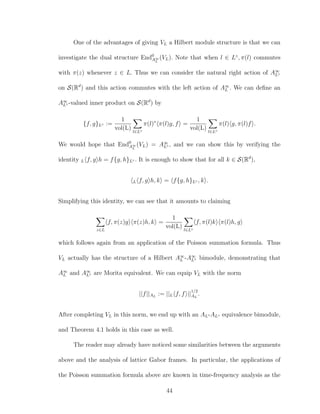
One of the advantages of giving VL a Hilbert module structure is that we can
investigate the dual structure End0
A∞
L
(VL). Note that when l ∈ L◦
, π(l) commutes
with π(z) whenever z ∈ L. Thus we can consider the natural right action of A∞
L◦
on S(Rd
) and this action commutes with the left action of A∞
L . We can define an
A∞
L◦ -valued inner product on S(Rd
) by
{f, g}L◦ :=
1
vol(L) l∈L◦
π(l)∗
π(l)g, f =
1
vol(L) l∈L◦
π(l) g, π(l)f .
We would hope that End0
A∞
L
(VL) = A∞
L◦ , and we can show this by verifying the
identity L f, g h = f{g, h}L◦ . It is enough to show that for all k ∈ S(Rd
),
L f, g h, k = f{g, h}L◦ , k .
Simplifying this identity, we can see that it amounts to claiming
z∈L
f, π(z)g π(z)h, k =
1
vol(L) l∈L◦
f, π(l)k π(l)h, g
which follows again from an application of the Poisson summation formula. Thus
VL actually has the structure of a Hilbert A∞
L -A∞
L◦ bimodule, demonstrating that
A∞
L and A∞
L◦ are Morita equivalent. We can equip VL with the norm
||f||AL
:= ||L f, f ||
1/2
AL
.
After completing VL in this norm, we end up with an AL-AL◦ equivalence bimodule,
and Theorem 4.1 holds in this case as well.
The reader may already have noticed some similarities between the arguments
above and the analysis of lattice Gabor frames. In particular, the applications of
the Poisson summation formula above are known in time-frequency analysis as the
44
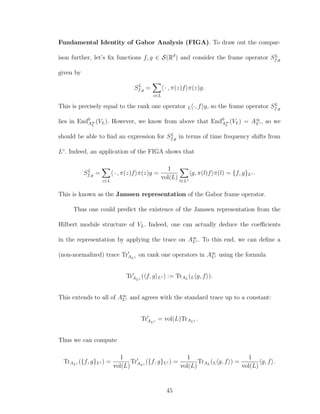
Fundamental Identity of Gabor Analysis (FIGA). To draw out the compar-
ison further, let’s fix functions f, g ∈ S(Rd
) and consider the frame operator SL
f,g
given by
SL
f,g =
z∈L
· , π(z)f π(z)g.
This is precisely equal to the rank one operator L ·, f g, so the frame operator SL
f,g
lies in End0
A∞
L
(VL). However, we know from above that End0
A∞
L
(VL) = A∞
L◦ , so we
should be able to find an expression for SL
f,g in terms of time frequency shifts from
L◦
. Indeed, an application of the FIGA shows that
SL
f,g =
z∈L
· , π(z)f π(z)g =
1
vol(L) l∈L◦
g, π(l)f π(l) = {f, g}L◦ .
This is known as the Janssen representation of the Gabor frame operator.
Thus one could predict the existence of the Janssen representation from the
Hilbert module structure of VL. Indeed, one can actually deduce the coefficients
in the representation by applying the trace on A∞
L◦ . To this end, we can define a
(non-normalized) trace TrAL◦
on rank one operators in A∞
L◦ using the formula
TrAL◦
( f, g L◦ ) := TrAL
(L g, f ).
This extends to all of A∞
L◦ and agrees with the standard trace up to a constant:
TrAL◦
= vol(L)TrAL◦ .
Thus we can compute
TrAL◦ ({f, g}L◦ ) =
1
vol(L)
TrAL◦
({f, g}L◦ ) =
1
vol(L)
TrAL
(L g, f ) =
1
vol(L)
g, f .
45
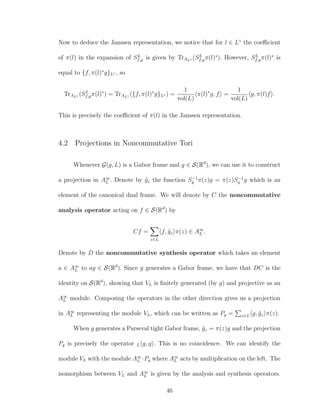
Now to deduce the Janssen representation, we notice that for l ∈ L◦
the coefficient
of π(l) in the expansion of SL
f,g is given by TrAL◦ (SL
f,gπ(l)∗
). However, SL
f,gπ(l)∗
is
equal to {f, π(l)∗
g}L◦ , so
TrAL◦ (SL
f,gπ(l)∗
) = TrAL◦ ({f, π(l)∗
g}L◦ ) =
1
vol(L)
π(l)∗
g, f =
1
vol(L)
g, π(l)f .
This is precisely the coefficient of π(l) in the Janssen representation.
4.2 Projections in Noncommutative Tori
Whenever G(g, L) is a Gabor frame and g ∈ S(Rd
), we can use it to construct
a projection in A∞
L . Denote by ˜gz the function S−1
g π(z)g = π(z)S−1
g g which is an
element of the canonical dual frame. We will denote by C the noncommutative
analysis operator acting on f ∈ S(Rd
) by
Cf =
z∈L
f, ˜gz π(z) ∈ A∞
L .
Denote by D the noncommutative synthesis operator which takes an element
a ∈ A∞
L to ag ∈ S(Rd
). Since g generates a Gabor frame, we have that DC is the
identity on S(Rd
), showing that VL is finitely generated (by g) and projective as an
A∞
L module. Composing the operators in the other direction gives us a projection
in A∞
L representing the module VL, which can be written as Pg = z∈L g, ˜gz π(z).
When g generates a Parseval tight Gabor frame, ˜gz = π(z)g and the projection
Pg is precisely the operator L g, g . This is no coincidence. We can identify the
module VL with the module A∞
L ·Pg where A∞
L acts by multiplication on the left. The
isomorphism between VL and A∞
L is given by the analysis and synthesis operators.
46
After doing this, we can consider the canonical Hilbert module structure on A∞
L · Pg
which is given by
a, b = aPgb∗
.
We can use the analysis and synthesis operators to translate this inner product into
an inner product on VL, and this defines a new C∗
-inner product given by
g
L f, h =
z∈L
f, S−1
g π(z)h π(z).
Using this inner product, we have again that Pg = g
L g, g . We can see that this
inner product is equivalent to our original one since
g
L f, h =
z∈L
f, S−1
g π(z)h π(z) =
z∈L
S
−1
2
g f, S
−1
2
g π(z)h π(z) =L S
−1
2
g f, S
−1
2
g h .
Thus we see that g
L g, g is a projection iff L S
−1
2
g g, S
−1
2
g g is a projection iff S
−1
2
g g
generates a Parseval tight frame. Here the last equivalence comes from Theorem 3.3
in [26].
We can see from the previous discussion that when f and g generate Gabor
frames for L, the inner products f
L · , · and g
L · , · are equal iff Sf = Sg, though
they are always isomorphic as Hilbert module structures. We can define an equiva-
lence relation on functions f, g ∈ S(Rd
) by saying f ∼ g iff SL
f = SL
g . We call such
functions L frame equivalent.
Question 4.1. Can we classify functions up to L frame equivalence?
This question is posed as an attempt to understand what types of frame oper-
ators are possible for a lattice L. Note that if f and g generate Parseval tight Gabor
47
frames for L then they are L frame equivalent. We have a characterization of such
functions called the Wexler-Raz orthogonality relations which say that G(g, L)
is a Parseval tight frame iff g, π(l)g = 1
vol(L)
δL◦,0. Thus we can already see the level
of complexity inherent in Question 4.1 by examining Parseval tight frames. Given
the connection between frame equivalence and equality of the Hilbert inner prod-
ucts f
L · , · and g
L · , · , it would be interesting to see whether operator algebraic
techniques could be used to tackle Question 4.1.
In the previous discussion we have used Gabor frames to construct projec-
tions, and then projections to construct Hilbert module structures. However, it
can be advantageous to work in the opposite direction as well. For example, when
vol(L) ≥ 1, we can never construct a single window Gabor frame for L. Regardless,
we will always have a Hilbert bimodule structure on VL. As in the proof of Propo-
sition 3.3 in [31], we can always find a finite collection {gi}N
i=1 ⊂ M1
(Rd
) so that
N
i=1{gi, gi}L◦ = 1A◦
L
. After unpacking the definitions, we see that this is precisely
the condition that G(g1, . . . , gN , L) is a Parseval tight multiwindow Gabor frame.
Thus we have proven the existence of Parseval tight multiwindow Gabor frames for
L using purely operator algebraic machinery! This result was first proven in [25]
using these methods, but now has purely analytic proofs. Nonetheless, it still shows
the benefits of using operator algebras to study Gabor systems.
48
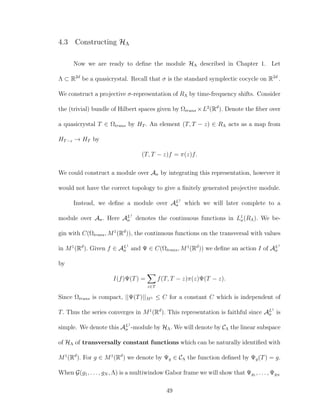
4.3 Constructing HΛ
Now we are ready to define the module HΛ described in Chapter 1. Let
Λ ⊂ R2d
be a quasicrystal. Recall that σ is the standard symplectic cocycle on R2d
.
We construct a projective σ-representation of RΛ by time-frequency shifts. Consider
the (trivial) bundle of Hilbert spaces given by Ωtrans ×L2
(Rd
). Denote the fiber over
a quasicrystal T ∈ Ωtrans by HT . An element (T, T − z) ∈ RΛ acts as a map from
HT−z → HT by
(T, T − z)f = π(z)f.
We could construct a module over Aσ by integrating this representation, however it
would not have the correct topology to give a finitely generated projective module.
Instead, we define a module over AL1
σ which we will later complete to a
module over Aσ. Here AL1
σ denotes the continuous functions in L1
σ(RΛ). We be-
gin with C(Ωtrans, M1
(Rd
)), the continuous functions on the transversal with values
in M1
(Rd
). Given f ∈ AL1
σ and Ψ ∈ C(Ωtrans, M1
(Rd
)) we define an action I of AL1
σ
by
I(f)Ψ(T) =
z∈T
f(T, T − z)π(z)Ψ(T − z).
Since Ωtrans is compact, ||Ψ(T)||M1 ≤ C for a constant C which is independent of
T. Thus the series converges in M1
(Rd
). This representation is faithful since AL1
σ is
simple. We denote this AL1
σ -module by HΛ. We will denote by CΛ the linear subspace
of HΛ of transversally constant functions which can be naturally identified with
M1
(Rd
). For g ∈ M1
(Rd
) we denote by Ψg ∈ CΛ the function defined by Ψg(T) = g.
When G(g1, . . . , gN , Λ) is a multiwindow Gabor frame we will show that Ψg1 , . . . , ΨgN
49
generate HΛ as an AL1
σ -module and construct an associated projection in AL1
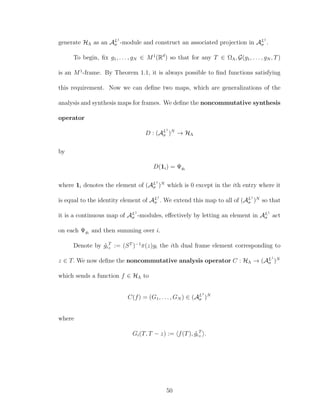
σ .
To begin, fix g1, . . . , gN ∈ M1
(Rd
) so that for any T ∈ ΩΛ, G(g1, . . . , gN , T)
is an M1
-frame. By Theorem 1.1, it is always possible to find functions satisfying
this requirement. Now we can define two maps, which are generalizations of the
analysis and synthesis maps for frames. We define the noncommutative synthesis
operator
D : (AL1
σ )N
→ HΛ
by
D(1i) = Ψgi
where 1i denotes the element of (AL1
σ )N
which is 0 except in the ith entry where it
is equal to the identity element of AL1
σ . We extend this map to all of (AL1
σ )N
so that
it is a continuous map of AL1
σ -modules, effectively by letting an element in AL1
σ act
on each Ψgi
and then summing over i.
Denote by ˜gi
T
z := (ST
)−1
π(z)gi the ith dual frame element corresponding to
z ∈ T. We now define the noncommutative analysis operator C : HΛ → (AL1
σ )N
which sends a function f ∈ HΛ to
C(f) = (G1, . . . , GN ) ∈ (AL1
σ )N
where
Gi(T, T − z) := f(T), ˜gi
T
z .
50
To see that Gi ∈ AL1
σ , we compute
RΛ
|Gi| =
Ωtrans z∈T
f(T), ˜gi
T
z dT
=
Ωtrans z∈T
(ST
)−1
f(T), π(z)gi dT
which holds since ST
is self-adjoint. For convenience we denote by FT the function
(ST
)−1
f(T). Since ST
is invertible in B(M1
(Rd
)) we have FT ∈ M1
(Rd
). Now we
have
Ωtrans z∈T
| FT , π(z)gi | dT =
Ωtrans z∈T
|Vgi
FT (z)|dT
≤ rel(Λ)
Ωtrans
||Vgi
FT ||W(L∞,L1)dT
≤ C rel(Λ)||gi||M1
Ωtrans
||FT ||M1 dT
≤ C rel(Λ) ||gi||M1
Ωtrans
||(ST
)−1
||M1 ||f(T)||M1 dT < ∞
The inequality in the third line comes from Proposition 12.1.11 in [14], and the
constant C is independent of T. We see the integral is finite because the continuity
of f implies ||f(T)||M1 is bounded on Ωtrans, and because Proposition 3.5 shows that
||(ST
)−1
|| = ||(SΛ
)−1
|| for all T.
Proposition 4.1. The map C is a map of AL1
σ -modules.
Proof. First note that the transversally constant functions CΛ are cyclic in HΛ under
the action of AL1
σ . For example, we can get all transversally locally constant functions
by applying characteristic functions of the unit space of RΛ, and locally constant
functions are dense in C(Ωtrans, M1
(Rd
)). Thus it will suffice to prove that C is an
AL1
σ -module map when AL1
σ acts on CΛ.
51
So assume that Ψf ∈ CΛ and that a ∈ AL1
σ . On the one hand we have
C(I(a)Ψf )i(T, T − z) =
w∈T
a(T, T − w)π(w)f, ˜gi
T
z
=
w∈T
a(T, T − w) π(w)f, ˜gi
T
z
=
w∈T
a(T, T − w) f, T−x M−ω ˜gi
T
z .
where w = (x , ω ). On the other hand we have
a ∗ C(Ψf )i(T, T − z) =
w∈T
a(T, T − w) f, e2πix (ω −ω)
˜gi
T−w
z−w .
where z = (x, ω). We will show that
T−x M−ω ˜gi
T
(x,ω) = e2πix (ω −ω)
˜gi
T−w
z−w .
Unpacking the definitions, we see that this is equivalent to showing
T−x M−ω (ST
)−1
π(z)gi = e2πix (ω −ω)
(ST−w
)−1
π(z − w)gi
which is equivalent to
T−x M−ω (ST
)−1
π(z)gi = (ST−w
)−1
T−x M−ω π(z)gi
after commuting T−x past M(ω−ω ) on the RHS. We can cancel the π(z) from both
sides and simply show the operator equality
T−x M−ω (ST
)−1
= (ST−w
)−1
T−x M−ω .
By inverting both sides we see this is equivalent to showing
ST
π(w) = π(w)ST−w
which follows from Proposition 3.3.
52
Now we can see that the maps D and C are well defined maps of AL1
σ -modules.
Composing these maps, we get that
DCf(T) =
N
i=1 z∈T
f(T), ˜gi
T
z gi = f(T)
where the last equality holds since this is exactly the reconstruction formula for
f(T) using the Gabor frame G(g1, . . . , gN , T). Thus C splits the map D, showing
that HΛ is finitely generated (by the functions Ψgi
) and projective. Thus we have:
Theorem 4.2. HΛ is finitely generated and projective as a AL1
σ -module.
If we compose these maps in the opposite order, we can construct a projection
matrix P ∈ MN (AL1
σ ) which represents HΛ in K0(Aσ). We can write the elements
of P explicitly as functions in AL1
σ as
Pij(T, T − z) = gi, ˜gj
T
z .
To compute the trace of this projection (and thus the dimension of the module HΛ)
we apply the normalized trace on MN (Aσ) to get
Tr(P) =
1
N
N
i=1 Ωtrans
gi, ˜gi
T
0 dT.
By applying Birkhoff’s Ergodic Theorem, the integrals can be replaced by averages
over the orbits of Λ. Thus we get
Tr(P) = lim
k→∞
1
N|Λ ∩ Ck|
N
i=1 z∈(Λ∩Ck)
gi, ˜gi
Λ−z
(0,0)
where Ck is the cube centered at the origin with side length k. We would like to
rewrite this sum so that it involves only the dual frame for G(g1, . . . , gN , Λ). We can
53
use Proposition 3.3 to rewrite ˜gi
Λ−z
(0,0) as
˜gi
Λ−z
(0,0) = (SΛ−z
)−1
gi = (SΛ−z
)−1
T−xM−ωMωTxgi = T−xM−ω(SΛ
)−1
π(z)gi.
Now we can rewrite the sum as
Tr(P) = lim
k→∞
1
N|Λ ∩ Ck|
N
i=1 z∈(Λ∩Ck)
gi, T−xM−ω(SΛ
)−1
π(z)gi
= lim
k→∞
1
N|Λ ∩ Ck|
N
i=1 z∈(Λ∩Ck)
π(z)gi, ˜gi
Λ
z
which involves only the Gabor frame G(g1, . . . , gN , Λ) and its dual. These averages
coincide precisely with the frame measure introduced in [3]. In Theorem 4.2 (b)
they show that for a single window frame, the averages above are equal to 1
Dens(Λ)
.
Their results are easily generalized to show that this also holds for multiwindow
frames, so we get the following result:
Corollary 4.1. The dimension of HΛ is equal to 1
Dens(Λ)
.
Thus we have completed the proof of Theorem 1.2. Note that the realization of the
frame measure as the dimension of a projective module gives a structural reason
why it should be independent of the choice of windows for the frame.
4.4 Hilbert C∗
-module Structure
In Section 4.1 we saw that it was advantageous to give VL the structure of a
Morita equivalence bimodule. Understanding the structure of End0
A∞
L
VL was partic-
ularly useful as it could be used to derive the Janssen representation of the frame
operator. Motivated by this example, we would like to give HΛ the structure of
54
a Hilbert C∗
-module and study the endomorphism algebra End0
AL1
σ
HΛ, which for
brevity we will denote by BL1
σ . We denote its completion to a C∗
-algebra by Bσ.
In the previous section we showed that HΛ is a finitely generated projective
module. When G(g1, . . . , gN , Λ) is a multiwindow Gabor frame, we constructed an
associated projection2
P ∈ MN (AL1
σ ) which represents [HΛ] in K0(Aσ). In principal,
the projection P can be used to give HΛ an AL1
σ -valued inner product. We can also
use P to describe BL1
σ , though this description does not immediately identify BL1
σ
as a familiar algebra (e.g. it is unclear whether BL1
σ is a twisted groupoid algebra
associated to a quasicrystal Λ ).
We now outline our strategy in greater detail. We can identify the module
HΛ with (AL1
σ )N
P where AL1
σ acts by multiplication on the left. The isomorphism
between HΛ and (AL1
σ )N
P is given by the noncommutative analysis and synthesis
maps. For elements a, b ∈ (AL1
σ )N
P the natural Hilbert C∗
-inner product is given
by
AL1
σ
a, b = aPb∗
.
Using the noncommutative analysis and synthesis operators we can translate this
inner product structure to HΛ. After doing this, we can identify the endomorphism
algebra BL1
σ with P(AL1
σ )N
P acting on (AL1
σ )N
P by multiplication on the right. By
utilizing the noncommutative analysis and synthesis maps we can take an element
of the form PaP where a ∈ (AL1
σ )N
and get an explicit formula for how it acts on
an element in HΛ.
2
Note that the projection P does depend on the choice of window functions g1, . . . , gN , but the
class of P in K0(Aσ) is independent of this choice.
55
To carry out this strategy, we first make a simplifying assumption. We assume
that there is a single window Gabor frame G(g, Λ) so that Pg ∈ AL1
σ is given by
Pg(T, T − z) = g, ˜gT
z = g, (ST
g )−1
π(z)g .
Although it will not always be possible to construct such a frame, it serves to simplify
the resulting formulas and does not change the nature of any of the results. Now
suppose Ψ, η ∈ HΛ. Then we apply the noncommutative analysis operator Cg and
compute
g
AL1
σ
Ψ, η (T, T − z) = (CgΨ) ∗ P ∗ (Cgη)∗
(T, T − z) = Ψ(T), (ST
g )−1
π(z)η(T − z) .
The final equality requires repeated use of the reconstruction formula for the Gabor
frame G(g, Λ). This is quite similar to the inner product defined on VL in the case
of noncommutative tori. However, we might have guessed that
AL1
σ
Ψ, η (T, T − z) = Ψ(T), π(z)η(T − z)
would also define an inner product for HΛ. This would immediately be true if we
could choose G(g, Λ) to be a tight frame, however it is not clear that this is possible.
Instead, we introduce the global frame operator Sg as an operator on HΛ
defined by
(Sgf)(T) = ST
g f(T).
By Proposition 3.4 we see Sg is well defined and invertible. Now we compute
g
AL1
σ
Ψ, η (T, T − z) = Ψ(T), (ST
g )−1
π(z)η(T − z)
= (ST
g )−1
2 Ψ(T), π(z)(ST−z
g )−1
2 η(T − z)
= AL1
σ
(Sg)−1
2 Ψ, (Sg)−1
2 η (T, T − z).
56
Thus the operator S
−1
2
g implements an isomorphism between g
AL1
σ
· , · and
AL1
σ
· , · , which shows that AL1
σ
· , · is a well defined inner product.
In the case of noncommutative tori, the existence of an inner product like
AL1
σ
· , · immediately implied the existence of tight multiwindow Gabor frames.
Unfortunately, we cannot conclude the same for the case of quasicrystals. To illus-
trate this, suppose for simplicity that we have an element Ψ ∈ HΛ so that AL1
σ
Ψ, Ψ
is the identity operator. For noncommutative tori, this would immediately imply
that Ψ generates a Parseval tight Gabor frame. This would also be true in our
case if Ψ were transversally constant. Of course, we cannot guarantee that Ψ will
be transversally constant. For example, let G(g, Λ) be a Gabor frame and con-
sider Ψg, which we know generates HΛ as an AL1
σ -module. Then (Sg)−1
2 Ψg satisfies
AL1
σ
(Sg)−1
2 Ψg, (Sg)−1
2 Ψg = Id, but is not transversally constant. This phenomenon
is explained by the fact that the collection {(ST
g )−1
2 π(z)g}z∈T = {π(z)(ST−z
g )−1
2 g}z∈T
is a Parseval tight frame, but not necessarily a Gabor frame.
It may seem disappointing that our method was unable to prove the existence
of Parseval tight multiwindow frames for quasicrystals. After all, this was the first
contribution of operator algebraic methods to understanding lattice Gabor frames.
However, we will soon have evidence that it is impossible to construct Parseval
multiwindow frames for certain quasicrystals. Thus we should not have expected
the methods here to prove their existence. We might instead view the complications
above in a positive light. If we were to determine a Janssen-type representation
using the structure of Bσ then we should expect a similar representation to hold for
57
frames like {(ST
g )−1
2 π(z)g}z∈T even though they are not Gabor frames.
Next we would like to investigate some operators lying in BL1
σ which are of
particular interest. In order to do this, it will help to have a succinct list of generators
for AL1
σ . To this end we introduce the sets Ez = {(T, T − z) ∈ RΛ | z ∈ T} and the
operators χz := χEz . The operator I(χz) acts on Ψ ∈ HΛ by
I(χz)Ψ(T) =



π(z)Ψ(T − z) if z ∈ T
0 otherwise
These operators generate AL1
σ as a C∗
-algebra and demonstrate how AL1
σ acts by
time frequency shifts. The operator I(χz) does a time frequency shift by z if z ∈ T,
and is the zero operator otherwise. In order to construct operators in BL1
σ , we must
first find operators which commute with all the I(χz). An operator O will commute
with all the I(χz) iff it satisfies the following two properties. First, if Ψ ∈ HΛ then
OΨ(T) must depend only on Ψ(T). This corresponds to commuting with projections
on the unit space of RΛ, which can be written as combinations of operators of the
form I(χzχ∗
z). Thus we can think of O as a continuous family of operators O(T) each
acting on M1
(R2d
). Finally, the family of operators O(T) must satisfy the covariance
condition
O(T)π(z) = π(z)O(T − z).
From the conditions above and Proposition 3.3, we immediately see that the
global frame operator Sg commutes with AL1
σ . This mirrors the results of Section 4.1,
where we found that the frame operator for a lattice Gabor frame was an element of
End0
A∞
L
. In looking for a Janssen representation, we would like to decompose Sg into
58
a linear combination of time-frequency shifts. The first step would be to show that
BL1
σ contains operators which look something like time-frequency shifts. We define
operators τk on HΛ by
(τkΨ)(T) = ϕk(T)π(ˇk)Ψ(T)
where ϕk is a continuous eigenfunction for ΩΛ with eigenvalue k, and
ˇk =




0 −I
I 0



 k
is a symplectic transformation of the eigenvalue k. A simple computation shows that
all τk commute with AL1
σ . The operators τk play the same role as time-frequency
shifts from the adjoint lattice did in the case of noncommutative tori.
Up until now we have only shown that Sg and the τk commute with AL1
σ , but
we have not actually shown that they are in BL1
σ . This is a somewhat subtle point,
but it becomes important if we consider operators τk when k is a measurable, but not
continuous, eigenvalue. In this case, the operator τk is well defined as an operator
in B(L2
(Ωtrans × Rd
)), but will not lie in BL1
σ . It will, however, lie in the commutant
of the von Neumann algebra generated by Aσ. It is as yet unclear whether such an
operator should contribute to something like a Janssen representation.
Nevertheless, we can show that Sg and all τk (for continuous eigenvalues k)
lie in BL1
σ . Showing Sg ∈ BL1
σ is simple, as Sg is exactly the rank one operator
AL1
σ
· , Ψg Ψg. Note that since all the C∗
-inner products above are isomorphic, the
corresponding endomorphism algebras are equal. Thus we can use any of the inner
products to show that an operator lies in BL1
σ , and we shall use this technique below.
To show that the τk lie in BL1
σ , we will identify BL1
σ with PgAL1
σ Pg. For a function
59
a(T, T − z) ∈ AL1
σ , the element PgaPg acts on Ψ ∈ HΛ by
Ψ(PgaPg)(T) =
z∈T
Ψ(T), ˜gT
z
w∈T
e2πix(ω−ω )
a(T − z, T − w)π(w)g
where z = (z, ω), w = (x , ω ). When a(T) is a function on the unit space of RΛ, this
formula simplifies to
z∈T
Ψ(T), ˜gT
z a(T − z)π(z)g.
We can interpret these operators as altering the reconstruction procedure of the
frame G(g, T). If we define
˜τk(T − z, T − w) = e−2πix(ω−ω )
ϕk(T) π(ˇk)π(z)g, ˜gT
w
then we see that the function ˜τk acts on HΛ in exactly the same way as the operator
τk. This demonstrates that τk lies in BL1
σ . To compare with our earlier remarks, note
that ˜τk is a continuous function iff ϕk is a continuous eigenfunction.
Remark 4.1. For a model set with internal space equal to Rn
, the operators τk
generate a noncommutative torus inside Bσ. Because HΛ is finitely generated and
projective, we can complete it to get a type II1 representation of the von Neumann
algebra generated by Aσ. This implies that the representation of the rotation algebra
generated by the τk (which lies in the VN completion of Bσ) completes to a von
Neumann algebra with a faithful, finite trace. This is curious, considering that the
τk act something like time-frequency shifts from a dense subgroup of R2d
. The stan-
dard representation of these time frequency shifts on L2
(Rd
) completes to B(L2
(Rd
))
which has no such trace. This complication was one large obstruction to generalizing
Linnell’s results in [24]. By considering the noncommutative torus generated by the
τk, it may be possible to sidestep this issue and generalize his results.
60
The next step in reproducing the results from Section 4.1 is to describe the
trace on BL1
σ . There are two possible ways we might approach this. First, we can
use the Hilbert module structure to describe the trace on rank one operators in BL1
σ .
For Ψ, η ∈ HΛ we define the BL1
σ -valued inner product { · , · }BL1
σ
by
{Ψ, η}BL1
σ
= AL1
σ
· , Ψ η
so that {Ψ, η}BL1
σ
is the rank one operator corresponding to Ψ and η. In this case
we can define a (non-normalized) trace TrBσ
by
TrBσ
({Ψ, η}BL1
σ
) := TrAσ AL1
σ
η, Ψ =
Ωtrans
η(T), Ψ(T) dT.
We know that TrBσ
(Id) is the dimension of HΛ, so the unique normalized trace on
Bσ is given by
TrBσ = Dens(Λ)TrBσ
.
We can also define traces Trg
Bσ
by identifying BL1
σ with PgAL1
σ Pg and using the trace
on Aσ. For a rank one operator we have
Trg
Bσ
({Ψ, η}BL1
σ
) =
Ωtrans z∈T
g, (ST
)−1
π(z)Ψ(T − z) π(z)η(T − z), (ST
)−1
g dT.
We know that all traces on BL1
σ are equal up to a constant multiple, and by evaluating
on the projection Pg we see that
Trg
Bσ
= TrBσ
.
After some suitable choices, we can deduce the following identity whenever Ψ, η ∈
HΛ and G(g, Λ) is a Gabor frame:
Ωtrans z∈T
g, π(z)Ψ(T − z) π(z)η(T − z), g dT =
Ωtrans
η(T), Ψ(T) dT.
61
This is of particular interest when Ψ = Ψf , η = Ψh are transversally constant. In
this case we get
Ωtrans z∈T
g, π(z)f π(z)h, g dT = h, f
whenever f, h ∈ M1
(R2d
). These identities are suspiciously reminiscent of the FIGA.
It seems as if some very general version of the Poisson summation formula must be
at play here, but for now we see no way to prove these identities without the abstract
machinery of operator algebras.
Now that we have described the trace on BL1
σ , we can use it to suggest a
decomposition of Sg into a linear combination of the operators τk. The coefficient
of τk in the expansion of Sg should be equal to TrBσ (Sgτ∗
k ). Since Sg is the rank one
operator {Ψg, Ψg}BL1
σ
,
Sgτ∗
k = {Ψg, τ∗
k Ψg}BL1
σ
= {τkΨg, Ψg}BL1
σ
.
Computing the trace, we have
TrBσ ({τkΨg, Ψg}BL1
σ
) = Dens(Λ)
Ωtrans
g, ϕk(T)π(ˇk)g dT
= lim
R→∞
Dens(Λ) g, π(ˇk)g
|Λ ∩ BR| z∈Λ∩BR
e−2πikz
= ck g, π(ˇk)g .
This suggests that the coefficient of π(ˇk) in the Janssen representation for the frame
operator SΛ
g is equal to ck g, π(ˇk)g . We are careful to note that this computation
does not give a proof of any type of Janssen representation. We know that the τk will
almost never generate all of BL1
σ since the K-theory of ΩΛ is rarely the same as the
K-theory of a torus. To turn this into a proof, we would need more knowledge about
62
the structure of BL1
σ . Furthermore, we would only expect a Janssen represention of
this form when Λ has pure discrete spectrum. Otherwise the distribution δΛ will
have a continuous part, so we would expect the Janssen representation to reflect
this.
Despite these difficulties in the case of general quasicrystals, the following
results give a Janssen representation for G(g, Λ) when Λ is a model set:
Proposition 4.2 (FIGA for Model Sets). Let Λ ⊂ R2d
be a model set and fix
f, g, h, u ∈ S(Rd
). Denote by Eig(Λ) the collection of continuous eigenvalues for
ΩΛ. Then
z∈Λ
f, π(z)g π(z)h, u =
k∈ Eig(Λ)
ck π(ˇk)f, u h, π(ˇk)g
where ck is the Fourier-Bohr coefficient for k. Here the RHS must be interpreted as
in Theorem 2.2.
Proof. First define the function
F(k) = π(ˇk)f, u h, π(ˇk)g
which lies in S(R2d
) and has Fourier transform
ˆF(z) = f, π(z)g π(z)h, u .
Then applying Theorem 2.2 we have
z∈Λ
f, π(z)g π(z)h, u =
z∈Λ
ˆF(z)
=
k∈Eig(Λ)
ckF(k)
=
k∈Eig(Λ)
ck π(ˇk)f, u h, π(ˇk)g
63
Theorem 4.3 (Janssen Representation for Model Sets). Let Λ be a model set and
SΛ
f,g = z∈Λ · , π(z)f π(z)g be a generalized Gabor frame operator with f, g ∈
S(Rd
). Then we have
SΛ
f,g =
k∈ Eig(Λ)
ck g, π(ˇk)f π(ˇk)
where the convergence on the RHS is interpreted as in Theorem 2.2.
Proof. Let h, u ∈ S(Rd
) be arbitrary. It suffices to show that
SΛ
f,gh, u =
k∈ Eig(Λ)
ck g, π(ˇkf) π(ˇk)h, u .
To see this, we compute
SΛ
f,gh, u =
z∈Λ
h, π(z)f π(z)g, u
=
k∈ Eig(Λ)
ck g, π(ˇk)f π(ˇk)h, u
=
k∈ Eig(Λ)
ck g, π(ˇk)f π(ˇk)h, u
where the second equality follows from Proposition 4.2.
It is easily seen that Theorem 4.3 also holds when f, g ∈ M1
(Rd
), since in this
case Vgf ∈ W(L∞
, L1
). Additionally, the convergence on the RHS in Theorem 4.3
(properly interpreted) occurs in S(Rd
) since the approximating measures δΛ, can
be expressed using sums which are locally absolutely convergent.
As in the case of lattice Gabor frames, one would like to use the Janssen
representation to characterize windows g for which G(g, Λ) is a (Parseval) tight
64
frame. Since the representation in Theorem 4.3 involves a sum over a dense collec-
tion of time-frequency shifts, it is not immediately clear how to deduce something
like the Wexler-Raz orthogonality relations. However, by using operator algebraic
arguments we are able to prove the following theorem:
Theorem 4.4. Let Λ ⊂ R2d
be a quasicrystal. Assume that the group of continuous
eigenvalues Eig(Λ) is dense in R2d
, and that the Fourier-Bohr coefficients ck are
non-zero in a neighborhood of 0. Also assume that the operators τk generate a totally
irrational noncommutative torus. Then it is not possible to find a tight multiwindow
frame G(g1, . . . , gN , Λ) where all gi ∈ M1
(Rd
).
Proof. Since the noncommutative torus generated by the τk is totally irrational, it
has a unique normalized trace. This implies that TrBσ (τk) = δk,0. Now suppose
{gi}N
i=1 ⊂ M1
(Rd
) generates a tight multiwindow Gabor frame for Λ. Then SΛ
{gi} =
A · Id where A denotes the upper (and lower) frame bound. By Proposition 3.5,
ST
{gi} = A · Id for all T ∈ ΩΛ. Thus the global frame operator S{gi} = A · Id as an
operator on HΛ. This implies that
TrBσ (S{gi}τ∗
k ) = A · TrBσ (τ∗
k ) = A · δk,0.
However, we can compute TrBσ (S{gi}τ∗
k ) directly, and this implies
A · δk,0 = TrBσ (S{gi}τ∗
k ) = ck
N
i=1
gi, π(ˇk)gi .
Since Eig(Λ) is dense in R2d
, we can choose a sequence of eigenvalues kn = 0
s.t. kn → 0 as n → ∞. Then N
i=1 gi, π( ˇkn)gi clearly converges to N
i=1 gi, gi .
However, by our computation above, we have N
i=1 gi, π( ˇkn)gi = 0 for all kn, and
N
i=1 gi, gi = A
c0
, which is a contradiction.
65
Note that the operator algebraic approach helped us in two ways. First, it allowed
us to avoid the messy convergence issues we ran into in Theorem 4.3 if we tried to
prove the result using analytic methods. It also allowed us to generalize the result
considerably, since we did not need to assume that Λ is a model set.
In Theorem 4.4, the assumption that the τk generate a totally irrational non-
commutative torus may seem suspect. The following lemma shows that there are
examples where this assumption holds:
Lemma 4.1. Let x1 . . . xn ∈ R2d
. Then we can construct a cut and project scheme
(R2d
, Rk
, D) and a window W so that x1, . . . , xn ∈ ΛW .
Proof. (Sketch) Assume n > 2d, as the result is trivial otherwise. We consider R2d
as the first factor in R2d
× Rk
where 2d + k = n. To each point xi, we have a k-
dimensional affine subspace Vi ⊂ Rn
so that the projection of Vi onto R2d
is exactly
xi. To ensure that each xi will lie in our model set, it suffices to find a lattice D
which contains at least one point from each Vi. The span of n vectors in Rn
will quite
generically form a lattice, so we can choose a lattice D which contains at least one
point from each Vi. Now all xi lie in p1(D), so we simply need to choose a window
W large enough so that they all lie in ΛW .
By using this lemma we can construct model sets with any specified (finitely gener-
ated) group of eigenvalues. This shows that the assumption in Theorem 4.4 actually
occurs in a rather generic case for model sets.
Finally, we would be able to drop the irrationality assumption on Eig(Λ) if
we knew more about the restriction of TrBσ to the algebra generated by the τk. We
66
would need to show that TrBσ (τk) = δk,0. This amounts to computing
TrBσ (τk) =
Ωtrans
ϕk(T) π(ˇk)(ST
g )−1
2 g, (ST
g )−1
2 g dT
= lim
R→∞
1
|Λ ∩ Br| z∈Λ∩BR
e2πikz
π(ˇk)(SΛ−z
g )−1
2 g, (SΛ−z
g )−1
2 g
= lim
R→∞
1
|Λ ∩ Br| z∈Λ∩BR
e2πikz
π(z)π(ˇk)(SΛ−z
g )−1
2 g, π(z)(SΛ−z
g )−1
2 g
= lim
R→∞
1
|Λ ∩ Br| z∈Λ∩BR
π(ˇk)(SΛ
g )−1
2 π(z)g, (SΛ
g )−1
2 π(z)g
?
=
1
Dens(Λ)
δk,0
whenever g ∈ M1
(Rd
) generates a Gabor frame for Λ. If Dens(Λ) < 1 then no such
frame will exist, but a similar computation for multiwindow frames would suffice.
To put this in context, when G(g, L) is a Gabor frame for a lattice L, (SL
g )−1
2 g
generates a Parseval tight multiwindow frame. Consequently, when z ∈ L, the
functions (SL
g )−1
2 π(z)g = π(z)(SL
g )−1
2 g all also generate Parseval tight frames. Thus
we have
π(l)(SL
g )−1
2 π(z)g, (SL
g )−1
2 π(z)g = vol(L)δl,0
whenever z ∈ L and l ∈ L◦
by the Wexler-Raz orthogonality relations. So for
lattices, the computation above clearly holds. We also know that the computation
holds for ˇk = 0; this was precisely the computation of the frame measure from [3].
It is possible that an extension of their methods could complete the computation in
full, allowing as to remove the irrationality assumption in Theorem 4.4.
Remark 4.2. To get the equality
TrBσ (τk) =
Ωtrans
ϕk(T) π(ˇk)(ST
)−1
2 g, (ST
)−1
2 g dT
67
we need to slightly tweak the discussion above. We identify BL1
σ with Pg(AL1
σ )N
Pg
acting on (AL1
σ )N
Pg by multiplication on the right. We have a formula for how
an element PgaPg acts on Ψ ∈ HΛ, but this formula depends on the choice of the
noncommutative analysis and synthesis operators. In the original formula given for
˜τk, we used
CgΨ(T, T − z) = Ψ(T), ˜gT
z
Dga = I(a)Ψg.
However to get the expression for the trace above, one instead should choose
CΨ(T, T − z) = Ψ(T), (ST
g )−1
2 π(z)g
Da = I(a)(Sg)−1
2 g
where Sg again denotes the global frame operator. This amounts to using the Parse-
val tight frame {(SΛ
g )−1
2 π(z)g | z ∈ Λ} rather than the Gabor frame G(g, Λ). In this
case, the formula for ˜τk is
˜τk(T − z, T − w) = e−2πix(ω−ω )
ϕk(T) π(ˇk)(ST
g )−1
2 π(z)g, (ST
g )−1
2 π(w)g
and the formula for the trace above is simply the integral of this function over the
unit space of RΛ.
68
Chapter 5
Twisted Gap Labeling
5.1 Gap Labeling for 2-D Lattice Subsets
Now we will look at the simpler case when Λ is a marked lattice and investigate
the way that HΛ fits into K0(Aσ). A marked lattice is a lattice L ⊂ Rd
where each
point l ∈ L is also assigned a color. For simplicity we shall always assume L = Zd
,
and the arguments given can be easily adapted to apply when L is a general lattice.
We can construct the hull ΩΛ in exactly the same way when Λ is a marked lattice.
As point sets, all elements of ΩΛ will be a translate of the integer lattice, however
the sets are only considered equal when their colorings are also the same. We will
always assume that a marked lattice has an aperiodic coloring with FLC and UCF.
Example 5.1. Consider the chair tiling of Section 2.2 where the vertices of the tiles
are contained in Z2
. We denote the set of vertices of the tiling by V. We can take
Z2
and color the points in V red and all other points blue. This is an example of a
marked lattice whose hull has the same properties as the hull of a quasicrystal.
When Λ is a marked lattice, the hull ΩΛ has the structure of a fiber bundle
Ωtrans → ΩΛ → Td
. It is the suspension of Ωtrans by an action of Zd
. We can
understand the second map using the associated C∗
-algebras. Denote by A :=
C∗
(RΛ) the untwisted groupoid C∗
-algebra of RΛ which in this case is isomorphic
69
to the crossed product C(Ωtrans) Zd
. Then we have a map
i : C(Td
) ∼= C∗
r(Zd
) → A
where i takes a function f ∈ C0(Zd
) and extends it to a function F on RΛ by making
it constant in the direction of Ωtrans, i.e. F(T, T − z) = f(z). In other words, the
image of i is generated by the functions on RΛ which do not depend on the colorings
of the points. The map i is the discrete analog of the map C(Td
) → C(ΩΛ) induced
by the fibration. Similarly when we twist by a standard cocycle θ we have an induced
map
j : Aθ → Aθ
from a noncommutative torus into Aθ. Both i and j preserve the trace on C∗
r (Zd
)
and Aθ respectively.
Our goal is to prove that the induced maps i∗ and j∗ are injective on K0. When
θ is totally irrational, the trace on Aθ is injective. Since j preserves the trace this
immediately implies that j∗ will be injective. We will show that the maps i∗ and j∗
are compatible, so that the injectivity of j∗ for a totally irrational cocycle implies
the injectivity of i∗.
Proposition 5.1. Let Λ = Zd
be a marked lattice. Fix a cocycle θ1 on Zd
, and let
the maps i and j be defined as above. Also fix a homotopy θ between θ1 = θ(1) and
the trivial cocycle θ(0). Then we have a commutative diagram
70
K0(C∗
r (Zd
))
i∗
−−−→ K0(A)
∼=



∼=
K0(C∗
r (Zd
×[0, 1], θ))
k∗
−−−→ K0(C∗
r (Zd
Ωtrans × [0, 1], θ))
∼=



∼=
K0(Aθ1 ) −−−→
j∗
K0(Aθ1 )
where the vertical arrows come from the isomorphisms in Theorem 2.3 and the second
horizontal map is induced by the map k : C∗
r (Zd
×[0, 1], θ) → C∗
r (Zd
Ωtrans ×
[0, 1], θ) given by i on the fiber at 0 and the map jt : Aθ(t) → Aθ(t) on the fiber at
0 < t ≤ 1.
Proof. We will prove only the commutativity of the upper square; commutativ-
ity of the lower square follows by a similar argument. Choose a projection P ∈
MN (C∗
r (Zd
)). We can lift this to a path of projections Pt, yielding an element of
K0(C∗
r (Zd
×[0, 1], θ)). When we map this via k∗, we simply extend the projection
on each fiber by making it constant in the Ωtrans direction. Following the maps
the other way around, we can take P and extend it to be constant in the Ωtrans
direction, then lift it to a path of projections. It is clear that k∗(Pt) is one such
possible lift, so we are done.
Theorem 5.1. Let Λ = Zd
be a marked lattice and fix any cocycle θ on Zd
. Then
the maps i∗ and j∗ are injective. We can compare their images with the image of
the canonical map r∗ : K0(C(Ωtrans)) → K0(Aθ) and we find that the intersection is
generated by [1], the class of the rank 1 trivial module.
Remark 5.1. Note that this immediately implies Theorem 1.4, since the map i∗ is
just the noncommutative version of the map p∗
. By a result of Sadun and Williams
71
[33], given any quasicrystal Λ we can find a marked lattice Λ so that ΩΛ and ΩΛ
are homeomorphic. Thus for an arbitrary quasicrystal we can view ΩΛ as a fiber
bundle over a torus, and Theorem 1.4 holds in this case as well.
Proof. First note that when θ is totally irrational, the map Tr∗ ◦j∗ is injective, so j∗
is injective as well. Thus by Proposition 5.1, we see that i∗ must also be injective.
Now let θ be any cocycle. Since i∗ is injective, by Proposition 5.1 we see that j∗
must be as well.
Now we compare the images of i∗ and j∗ with the image of r∗. First suppose θ
is a totally irrational cocycle, and that the intersection of the groups TrAθ∗(K0(Aθ))
and Tr∗(K0(A)) is equal to Z ⊂ R . This is possible since Tr∗(K0(A)) is countable,
so we can simply choose the entries in the matrix for θ to be rationally independent
from Tr∗(K0(A)). Now it is clear that the image of j∗ is disjoint from the projections
in C(Ωtrans) (except for multiples of the identity) since this is true after applying
the trace. Now note that projections in C(Ωtrans) are preserved by the vertical
isomorphisms on the RHS of the diagram in Proposition 5.1, so the same must be
true for i∗. Finally, using the diagram from Proposition 5.1, the theorem holds when
θ is an arbitrary cocycle.
We can interpret the results above in terms of the modules HΛ. When Λ is
a marked lattice, a Gabor frame for Λ is simply a lattice Gabor frame and does
not depend at all on the colorings of the points in Λ. Furthermore, when Λ = Z2d
as a point set then the standard symplectic cocycle σ|Λ is the trivial cocycle. In
this case, we can use the construction of VΛ in Section 4.1 to get a module over
72
C∗
r (Z2d
), and i∗([VΛ]) = [HΛ]. To construct modules over Aθ for general θ, we follow
Rieffel’s construction and apply a linear map A to Λ with A∗
σ = θ. Then we get
a module VΛ over the noncommutative torus AAΛ and j∗([VAΛ]) = [HAΛ]. Thus
our modules precisely describe the images of i∗ and j∗ for even dimensional Λ, and
we can conclude that the twisted gap labeling group for a marked lattice always
contains the image of the trace map on an associated noncommutative torus. With
a little more work, it seems likely that Rieffel’s more general method can be adapted
to construct modules when Λ is odd dimensional as well.
Now we will describe these results in dimension two, where they allow us to
determine the entire gap labeling group. Note that any cocycle θ on Z2
is determined
by a single real number (also denoted θ), which is the only non-zero entry in the
associated skew symmetric matrix. When Λ = Z2
is a marked lattice, we can
compute its K-theory by applying the Pimsner-Voiculescu exact sequence twice, or
by applying the associated Kasparov spectral sequence [18], [36]. In this case we
have
K0(C(Ωtrans) Z2
) = C(Ωtrans, Z)Z2 ⊕ Z
where C(Ωtrans, Z)Z2 denotes the group of coinvariants of the action of Z2
on Ωtrans.
Here the extra copy of Z comes from the inclusion
K0
(T2
) ∼= K0(C∗
r (Z2
)) → K0(C(Ωtrans) Z2
)
of the group algebra of Z2
into C(Ωtrans) Z2
, and the summand C(Ωtrans, Z)Z2
comes from the inclusion
K0(C(Ωtrans)) → K0(C(Ωtrans) Z2
).
73
The extra generator is precisely the image of the Bott vector bundle in K0
(T2
).
Thus from our results above, we immediately have
Proposition 5.2. When Λ = Z2
is a marked lattice, the gap labeling group of Aθ is
Tr∗(K0(Aθ)) = µ(C(Ωtrans, Z)) + θ Z .
We can also determine the gap labeling group when we have a quasicrystal
Λ ⊂ Z2
. In this case, we can construct a marked lattice Γ = Z2
by coloring the
points of Λ red and the remaining points blue. Then ΩΛ
trans sits as a clopen set in
ΩΓ
trans with measure equal to Dens(Λ). This shows that the gap labeling group of AΛ
θ
is equal to 1
Dens(Λ)
Tr∗(K0(AΓ
θ )), which is in turn equal to µ(C(ΩΛ
trans), Z)+ θ
Dens(Λ)
Z .
Thus we have:
Theorem 5.2. When Λ ⊂ Z2
is a quasicrystal, the gap labeling group of Aθ is
Tr∗(K0(Aθ)) = µ(C(Ωtrans, Z)) +
θ
Dens(Λ)
Z .
Note that in dimension two a matrix A satisfies A∗
σ = θ exactly when det(A) = θ.
Thus the module HAΛ has trace 1
Dens(AΛ)
= θ
Dens(Λ)
and represents the extra generator
in K0(Aθ).
5.2 Connections with Deformation Theory
In the previous section we were able to determine the twisted gap labeling
group for lattice subsets in dimension two. There are two ways we might want to
generalize this result. First, we might want to compute the twisted gap labeling
group for any 2-D quasicrystal twisted by any cocycle, not merely lattice subsets
74
twisted by standard cocycles. Bellissard’s original (untwisted) gap labeling conjec-
ture could be reduced to the case of marked lattices, essentially by the results of
Sadun and Williams [33]. They show that a quasicrystal Λ can be deformed so that
it is a marked lattice Λ , and that this deformation gives rise to a homeomorphism
between ΩΛ and ΩΛ . Thus we might be tempted to say that we can reduce the
twisted gap labeling conjecture so that it falls within the scope of our results. Un-
fortunately, our results hold only for standard cocycles (i.e. restrictions of cocycles
on R2d
) and in the process of deforming from Λ to Λ we are likely to take a standard
cocycle on Λ to a nonstandard cocycle on Λ . Thus a general computation of the
gap labeling group in dimension two still seems out of reach.
In another direction, our results do not give a full computation of the gap
labeling group in higher dimensions, even for marked lattices with standard cocycles.
We were able to apply linear maps to a marked lattice, and this allowed us to realize
any standard cocycle as the restriction of the symplectic cocycle on R2d
in a number
of different ways. For each linear map with A∗
σ = θ, we got a class in K0(Aθ).
However, linear maps alone are not enough to fill out all the classes in K-theory. A
linear deformation of a marked lattice ignores the colorings of points in the lattice,
essentially avoiding the complexities that make it a quasicrystal.
To summarize, there are two difficulties preventing a more complete compu-
tation of twisted gap labels. First, there is the problem of passing from a general
quasicrystal to a marked lattice, which really has to with extending our results from
standard cocycles to all cocycles. The second problem has to do with finding more
sophisticated deformations of a quasicrystal so that we can represent all classes in
75
K0(Aθ) when the dimension of Λ is greater than two. Actually, it seems reasonable
to hope that a solution to the second problem will also resolve the first. Namely,
we might expect that even given a nonstandard cocycle c we can find a deformation
ϕ so that σ|ϕ(Λ) = c. In fact this was already evident when we were describing the
difficulties in dimension two.
Thus we present the following strategy for improving our results on the twisted
gap labeling. First, we must get a sense of the types of cocycles by which we can
twist. This involves computing the second cohomology group H2
(RΛ, S1
). Ideally
H2
(RΛ, S1
) should be computable in terms of the cohomology of ΩΛ. Next, we fix a
cocycle c and give sufficient conditions for a deformation ϕ to yield the cocycle c on
ϕ(Λ). To expand upon this, we first assume that ϕ(Λ) is a quasicrystal with RΛ
∼=
Rϕ(Λ). Kellendonk has given sufficient conditions on a map ϕ : R2d
→ R2d
which will
ensure this isomorphism of groupoids [19]. Furthermore, we need σ|ϕ(Λ) = c. Once
we have this, Hϕ(Λ) gives a class in K0(Ac) with trace equal to 1
Dens(ϕ(Λ))
. Ideally,
constructing enough maps of this form should exhaust the classes in K0(Ac) and
give us a full computation of the gap labeling group.
76
Appendices
77
Appendix A
K-theory for C∗
-algebras
The discussion in these appendices is modeled largely on the explanations of
K-theory in [10], [22]. We begin with some basic facts about C∗
-algebras.
Definition A.1. A C∗
-algebra A is a C-algebra equipped with a norm || · || and
an involution a → a∗
such that A is complete with respect to the norm, ||ab|| ≤
||a|| · ||b||, and ||a∗
a|| = ||a||2
for all a, b ∈ A. Although a C∗
-algebra need not
have a multiplicative identity, all of our examples will. A homomorphism between
C∗
-algebras is a simply a homomorphism of C-algebras which is continuous and
preserves the involution.
C∗
-algebras and Banach algebras differ only by the final condition in the above
definition. Small though it may seem, this additional axiom makes C∗
-algebras
especially amenable to topological techniques.
Example A.1. C itself is a C∗
-algebra, as is any matrix algebra MN (C). Here the
norm is given by the operator norm, and the involution is by conjugate transpose.
Similarly, for any C∗
-algebra A, MN (A) is also a C∗
-algebra. Finally, B(H), the
bounded linear operators on a Hilbert space, is a C∗
-algebra. In fact it can be shown
that any C∗
-algebra embeds as a subalgebra of B(H).
Example A.2. Let L ⊂ R2
be a lattice and consider the family of time-frequency
78
shifts
{π(z) | z ∈ L}.
The closure of this family of operators in the operator norm on B(L2
(R)) is a C∗
-
algebra known as a noncommutative torus.
Example A.3. Let X be any compact, Hausdorff topological space. The algebra
C(X) of complex valued functions on X forms a C∗
-algebra, where we use the sup
norm and the involution is given by complex conjugation.
This last example is perhaps the most important to keep in mind, given the
following theorem:
Theorem A.1 (Gelfand-Naimark). Suppose A is a commutative, unital C∗
-algebra.
Then there exists a compact Hausdorff space X such that A ∼= C(X).
The Gelfand-Naimark theorem demonstrates the intrinsic link between C∗
-algebras
and topology. In light of this theorem, one is tempted to translate as much of topol-
ogy as possible into C∗
-algebraic language. The goal is to use topological techniques
to study C∗
-algebras which are not necessarily commutative (like the noncommuta-
tive torus above), and thus have no realization as an algebra of functions on some
topological space. This is the goal of noncommutative topology. While it is pos-
sible to translate the ideas of homology and cohomology into C∗
-algebraic language,
it ends up being difficult. K-theory, however, admits a relatively simple transla-
tion into the world of C∗
-algebras, and has been strikingly effective in a variety of
programs which seek to classify C∗
-algebras.
In preparation, we review some facts about K-theory for topological spaces.
79
Definition A.2. Let X be a compact, Hausdorff topological space. A vector bun-
dle over X is a topological space E equipped with a projection π : E → X such that
for each x ∈ X, the fiber π−1
(x) is a complex vector space of a fixed dimension n.
Additionally, for each x ∈ X there exists a neighborhood Ux such that π−1
(Ux) is
homeomorphic to Ux × Cn
, where the homeomorphism preserves the fibers and is a
linear isomorphism on each fiber.
We can think of a vector bundle as a family of vector spaces parametrized by X.
Two vector bundles E and F over X are isomorphic if there is a map from E → F
which commutes with the corresponding projections to X and is a linear isomor-
phism on each fiber. We can take the direct sum of two vector bundles E ⊕ F by
taking the direct sum of the fibers over each point in X. We denote by Vect(X) the
abelian semigroup of isomorphism classes of vector bundles over X where the addi-
tion operation is direct sum. We can complete this semigroup to a group by formally
adding inverses for each element, which gives us an abelian group known as K0
(X).
The association X → K0
(X) is a contravariant functor, which means that whenever
f : X → Y is a continuous map, there is an induced map f∗
: K0
(Y ) → K0
(X).
The group K0
(X) is a homotopy invariant of a topological space, and carries with
it much interesting topological information.
We shall now indicate how one can translate the concept of a vector bundle
into the language of C∗
-algebras. First we must make note of the following lemma:
Lemma A.1. Given any vector bundle E over X, we can find a trivial bundle of
the form X × Cn
such that E embeds as a subbundle of X × Cn
.
80
In other words, we can find a (potentially large) n so that each of the fibers of
E exists as a subspace of Cn
in a way which is continuous over X. We can think
of this in a slightly different way. The bundle E, considered as a subbundle of
X × Cn
, specifies a projection matrix at each point of X. Namely, the projection at
x ∈ X is the projection from Cn
to the fiber of E over x. Furthermore, this choice
of projection matrix is continuous over X, so gives a continuous map from X into
MN (C). However, C(X, MN (C)) ∼= MN (C(X)), so we naturally get a projection in
the C∗
-algebra MN (C(X)).
We can also consider the continuous sections Γ(E) of the bundle E, which are
maps s : X → E such that π(s(x)) = x. Given any section, we can always multiply
it pointwise by a function in C(X). Thus Γ(E) becomes a C(X)-module, and we
can check that it will always be finitely generated and projective. So now we have
two ways to express the concept of a vector bundle in the language of C∗
-algebras.
First it gives us a projection in a matrix algebra over C(X), and second it give us a
finitely generated, projective C(X)-module. We shall see that these points of view
are actually equivalent, and will allow us to extend K-theory to noncommutative
C∗
-algebras.
Motivated by K-theory for topological spaces, for a C∗
-algebra A we denote
by PN (A) the collection of projections in MN (A) and let P∞(A) = ∞
N=1 PN (A).
We can take the direct sum of two projections p, q ∈ P∞(A) by
p ⊕ q =




p 0
0 q



 .
Two projections p, q ∈ PN (A), are called Murray-Von Neumann equivalent,
81
denoted p ∼ q, if there exists v ∈ MN (A) with vv∗
= p and v∗
v = q. We can extend
this equivalence relation to P∞(A) by defining p ∼0 q if there exist matrices of all
zeros 0n, 0m of sizes n and m respectively so that p ⊕ 0n and q ⊕ 0m are the same
size and p ⊕ 0n ∼ q ⊕ 0m. This is a well defined equivalence relation on P∞(A) and
respects the direct sum operation. We denote by D(A) the set of equivalence classes
P∞(A)/ ∼0 . This gives us an abelian semigroup D(A), and after completing D(A)
to a group we arrive at K0(A), the C∗
-algebraic K-theory group. The assignment
A → K0(A) is a covariant functor, so that whenever ϕ : A → B is a homomorphism
there is a corresponding map ϕ∗ : K0(A) → K0(B). To complete the analogy with
the K-theory of topological spaces, we have:
Theorem A.2. When X is a compact Hausdorff space, K0(C(X)) ∼= K0
(X).
Alternatively, we could have constructed the K0 group by examining finitely
generated, projective left (or right) A-modules. The isomorphism classes of such
modules form an abelian semigroup under direct sum. After completing this to a
group by adding formal inverses for the elements, we end up with a group isomor-
phic to K0(A). To see the connection between this construction and the one above,
choose p ∈ Pn(A). Then An
p is a finitely generated, projective left A-module. This
association p → An
p gives a map between the two different versions of C∗
-algebraic
K-theory we have described. When A has a unique normalized trace, we can as-
sign each finitely generated, projective A-module a dimension. We simply find a
projection p ∈ MN (A) which represents the module in K0 and apply the trace to p.
The terminology comes from looking at projections in MN (C), where applying the
82
usual matrix trace gives the dimension of the range of the projection. Thus to any
trace we can define a homomorphism from K0(A) to R simply by applying the trace
to classes of projections in P∞(A). For C∗
-algebras coming from quasicrystals, the
image of the trace map has a physical interpretation. Determining this image is the
subject of Bellissard’s gap labeling conjecture, described in Chapter 1.
Appendix B
Hilbert C∗
-modules and Morita Equivalence
In Appendix A, we have seen how isomorphism classes of finitely generated,
projective A-modules can be used to construct K0(A). In this section we will explore
the concept of A-modules further. It is possible to endow all finitely generated,
projective A-modules with the structure of a Hilbert C∗
-module, which is meant
to emulate the inner product structure on a Hilbert space.
Definition B.1. A (left) pre-C∗
-module over a C∗
-algebra A is a complex vector
space E which is also an A-module with a pairing A · , · : E × E → A satisfying the
following conditions for all r, s, t ∈ E and a ∈ A :
1. A r + s, t = A r, t + A s, t
2. A ar, s = aA r, s
3. A r, s = A s, r ∗
4. A s, s > 0 when s = 0
The last condition means that A s, s gives a positive element of the C∗
-algebra A.
83
We can use the inner product to define a norm on E by
||s||E := || s, s A||.
We call the completion of E in this norm a Hilbert C∗
-module. Denote by A E, E
the linear span of all elements of the form A r, s . We call E a full Hilbert C∗
-module
if A E, E is dense in A. When A is unital, this implies A E, E = A.
Example B.1. A itself is a Hilbert A-module, where the inner product is given by
A a, b = ab∗
.
Moreover, An
is a Hilbert A-module with inner product
A (a1, . . . , an), (b1, . . . , bn) :=
n
i=1
aib∗
i .
Example B.2. Whenever P ∈ Pn(A) is a projection, An
P becomes a Hilbert A-
module with inner product
A a, b := aPb∗
.
This last example shows how K0(A) can be described using the (seemingly more
complicated) concept of Hilbert A-modules. Any finitely generated, projective A-
module is represented by a projection P ∈ Pn(A) for some n. Thus it is isomorphic to
An
P for some projection P, which comes with a natural Hilbert A-module structure.
The beauty of Hilbert A-modules is that they let us to construct new C∗
-
algebras which are related to A but not equal to A, allowing us to understand the
structure of A using a variety of techniques.
84
Definition B.2. Let E and F be Hilbert A-modules. A map T : E → F is ad-
jointable if there exists a map T∗
: F → E, called the adjoint of T, such that
F
A r, Ts = E
A T∗
r, s
whenever r ∈ F, s ∈ E.
We shall be primarily concerned with EndA(E), the space of adjointable operators
from E to itself. An important class of adjointable operators is given by the A-finite
rank operators, which are operators of the form A · , r s where r, s ∈ E. The A-
finite rank operators form a vector space denoted by End00
A (E), and the closure of
End00
A (E) will be known as the collection of A-compact operators, denoted by
End0
A.
Example B.3. If P ∈ Pn then An
P is a Hilbert A-module and End0
A(An
P) =
PMn(A)P. See [10] Lemma 2.18 for details.
We can think of A acting on E on the left while B = End0
A acts on E on the
right. Additionally, we can give E the structure of a right Hilbert B-module by
defining the inner product
{r, s}B := A · , r s.
This leads to the definition of a Hilbert A-B bimodule.
Definition B.3. A pre-C∗
A-B-bimodule is a complex vector space E which is
both a left Hilbert A-module and a right Hilbert B-module where the inner products
satisfy the following compatibility condition:
A r, s t = r{s, t}B for all r, s, t ∈ E.
85
A pre-C∗
A-B-bimodule is called full if A E, E and {E, E}B are dense in A and B
respectively.
For bimodules, we could define a norm on E using either of the inner products. As
it turns out, these norms are equivalent, and the completion of E with respect to
either norm is known as a Hilbert A-B-bimodule. Two C∗
-algebras A and B
are called Morita equivalent if there exists a full Hilbert A-B-bimodule E. In this
case, B = End0
A(E).
Morita equivalence is a sort of “homotopy equivalence” for noncommutative
spaces. When A and B are Morita equivalent, we have K0(A) ∼= K0(B). Given a
trace TrA on A, we can define a trace TrB on the finite rank operators in B by
TrB({r, s}B) := TrA( s, r A)
when r, s ∈ E. This extends to a trace on B and defines a bijection between the
traces on A and B. There is much more to be said about Morita equivalence, however
these facts will be enough to understand the analysis in the text above.
86
Bibliography
[1] M. Baake and U. Grimm. Aperiodic Order Volume 1: A Mathematical Invita-
tion. Encyclopedia of Mathematics and its Applications. Cambridge, 2013.
[2] M. Baake, D. Lenz, and R. Moody. Characterization of model sets by dynamical
systems. Ergodic Theory and Dynamical Systems, 27:341–382, 2007.
[3] R. Balan, P. Casazza, C. Heil, and Z. Landau. Density, Overcompleteness, and
Localization of Frames. II. Gabor Systems. Journal of Fourier Analysis and
Applications, 12:307–344, 2006.
[4] J. Bellissard. The Noncommutative Geometry of Aperiodic Solids. In Geometric
and Topological Methods for Quantum Field Theory, pages 86–156. World Sci.
Publishing, 2003.
[5] J. Bellissard, R. Benedetti, and J.-M. Gambaudo. Spaces of tilings, finite
telescopic approximation and gap labelings. Communications in Mathemati-
cal Physics, 261:1–41, 2006.
[6] J. Bellissard, D.J.L. Herrmann, and M. Zarrouati. Hulls of Aperiodic Solids and
Gap Labelling Theorems. In M. Baake and R. Moody, editors, Directions in
Mathematical Quasicrystals, volume 13 of CRM Monogr. Ser., pages 177–206.
Amer. Math. Soc., 2000.
[7] M. Benameur and H. Oyono-Oyono. Index theory for quasi-crystals I. Compu-
tation of the gap-label group. Journal of Functional Analysis, pages 137–170,
2007.
[8] G. Bernuau and M. Duneau. Fourier Analysis of Deformed Model Sets. In
M. Baake and R. Moody, editors, Directions in Mathematical Quasicrystals,
volume 13 of CRM Monogr. Ser., pages 43–60. Amer. Math. Soc., 2000.
[9] G. Elliott. On the K-theory of the C∗
-algebra generated by a projective rep-
resentation of a torsion-free discrete Abelian group. In Gr. Arsene, S. Str˘atil˘a,
A. Verona, and D. Voiculescu, editors, Operator Algebras and Group Represen-
tations Volume 1. Pitman Advanced Publishing Program, 1980.
[10] H. Figueroa, J. M. Gracia-Bondia, and J. Varilly. Elements of Noncommutative
Geometry. Birkh¨auser, 2001.
[11] A. Forrest and J. Hunton. The cohomology and K-theory of commuting home-
morphisms of the Cantor set. Ergodic Theory and Dynamical Systems, 19:611–
625, 1999.
[12] F. Gahler, J. Hunton, and J. Kellendonk. Integral cohomology of rational
projection method patterns. Algebraic and Geometric Topology, 13:1661–1708,
2013.
87
[13] E. Gillaspy. K-theory and homotopies of 2-cocycles on transformation groups.
2014. Pre-print, arXiv:1402.3280 [math.OA].
[14] K. Gr¨ochenig. Foundations of Time-Frequency Analysis. Birkh¨auser, 2001.
[15] K. Gr¨ochenig, J. Ortega-Cerda, and J. L. Romero. Deformations of Gabor
Systems. 2013. Pre-print, arXiv:1311.3861 [math.FA].
[16] A. Hof. On Diffraction by Aperiodic Structures. Communications in Mathe-
matical Physics, 169:25–43, 1995.
[17] J. Kaminker and I. Putnam. A proof of the gap labeling conjecture. Michigan
Math Journal, 51:537–546, 2003.
[18] G. G. Kasparov. Equivariant KK-theory and the Novikov conjecture. Invent.
math., 91:147–201, 1988.
[19] J. Kellendonk. Pattern equivariant functions, deformations and equivalence of
tiling spaces. Ergodic Theory and Dynamical Systems, 28:1153–1176, 2008.
[20] J. Kellendonk and L. Sadun. Meyer sets, topological eigenvalues, and Cantor
fiber bundles. Preprint arXiv:1211.2250 [math.DS].
[21] J. Lagarias. Mathematical Quasicrystals and the Problem of Diffraction. In
M. Baake and R. Moody, editors, Directions in Mathematical Quasicrystals,
volume 13 of CRM Monogr. Ser., pages 61–93. Amer. Math. Soc., 2000.
[22] F. Larsen, N. Laustsen, and M. Rordam. An Introduction to K-theory for
C∗
-algebras.
[23] J.Y. Lee, R. Moody, and B. Solomyak. Pure Point Dynamical and Diffraction
Spectra. Annales Henri Poincare, 3:1003–1018, 2002.
[24] P. A. Linnell. Von Neumann Algebras and Linear Independence of Translates.
Proceedings of the American Mathematical Society, 127(11):3269–3277, 1999.
[25] F. Luef. Projective modules over noncommutative tori are multi-window Gabor
frames for modulation spaces. Journal of Functional Analysis, 257:1921–1946,
2009.
[26] F. Luef. Projections in noncommutative tori and Gabor frames. Proceedings of
the AMS, 139:571–582, 2011.
[27] B. Matei and Y. Meyer. Simple quasicrystals are sets of stable sampling. Com-
plex Variables and Elliptic Equations, 55:947–964, 2010.
[28] Y. Meyer. Algebraic Numbers and Harmonic Analysis. North-Holland, 1972.
[29] P. Muhly, J. Renault, and D. Williams. Equivalence and Isomorphism for
Groupoid C∗
-Algebras. Journal of Operator Theory, 17, 1987.
88
[30] J. Renault. A Groupoid Approach to C∗
-Algebras, volume 793 of Lecture Notes
in Mathematics. Springer, 1980.
[31] M. Rieffel. Projective modules over higher-dimensional noncommutative tori.
Canadian Journal of Mathematics, 40:257–338, 1988.
[32] L. Sadun. Topology of Tiling Spaces, volume 46 of University Lecture Series.
American Mathematical Society, 2008.
[33] L. Sadun and R. F. Williams. Tiling spaces are Cantor set fiber bundles. Ergodic
Theory and Dynamical Systems, 23:307–316, 2003.
[34] M. Schlottmann. Generalized Model Sets and Dynamical Systems. In M. Baake
and R. Moody, editors, Directions in Mathematical Quasicrystals, volume 13 of
CRM Monogr. Ser., pages 143–159. Amer. Math. Soc., 2000.
[35] D. Shechtman, I. Blech, D. Gratias, and J. Cahn. Metallic Phase with Long-
Range Orientational Order and No Translational Symmetry. Physical Review
Letters, 53:1951–1953, 1984.
[36] A. van Elst. Gap labelling for Schr¨odinger operators on the square and cubic
lattices. Rev. Math. Phys, 6, 1994.
89

Gabor Frames for Quasicrystals and K-theory

  • 1.
    ABSTRACT Title of dissertation:GABOR FRAMES FOR QUASICRYSTALS AND K-THEORY Michael Kreisel, Doctor of Philosophy, 2015 Dissertation directed by: Professor Jonathan Rosenberg Department of Mathematics We study the connection between Gabor frames for quasicrystals, the topology of the hull ΩΛ of a quasicrystal Λ and the K-theory of an associated twisted groupoid algebra. In particular, we construct a finitely generated projective module over this algebra, and any multiwindow Gabor frame for Λ can be used to construct a projection representing this module in K-theory. For the case of lattices, modules of this kind were first constructed over noncommutative tori in [31]. Luef developed connections with Gabor analysis and showed that the operator algebraic framework tied together many unique aspects of lattice Gabor frames [25], [26]. Our work adapts their results to the setting of quasicrystals. Along the way, we prove a variety of compatibility conditions between the topology of ΩΛ and the associated Gabor frame operators. We give a version of Janssen’s representation for the Gabor frame operator when Λ is a model set. We also prove that certain quasicrystals can never be the support of a tight multiwindow Gabor frame when the window functions are in the modulation space M1 (Rd ). As an application to noncommutative topology, we are able to deduce results
  • 2.
    on the twistedversion of Bellissard’s gap labeling conjecture. We show that the twisted gap labeling group of Λ always contains the image of the trace map of an associated noncommutative torus and we identify modules in K-theory correspond- ing to these gap labels. For lattice subsets in dimension two we prove that this constitutes the entire gap labeling group. As a byproduct of our analysis, we also show that when ΩΛ is viewed as a fiber bundle over a torus with projection p, the pullback map p∗ is injective on K0 .
  • 3.
    GABOR FRAMES FORQUASICRYSTALS AND K-THEORY by Michael Kreisel Dissertation submitted to the Faculty of the Graduate School of the University of Maryland, College Park in partial fulfillment of the requirements for the degree of Doctor of Philosophy 2015 Advisory Committee: Professor Jonathan Rosenberg, Chair/Advisor Professor Radu Balan Professor Wojciech Czaja Professor Kasso Okoudjou Professor Victor Yakovenko
  • 4.
    c Copyright by MichaelKreisel Released under a Creative Commons License (CC BY-NC-SA 2.0) 2015
  • 5.
    Acknowledgments I owe agreat debt of gratitude to the many people who made this thesis possible. First and foremost I would like to thank my adviser, Jonathan Rosenberg, for his support and encouragement throughout my time at Maryland. He was always available when I had questions, even when they didn’t make any sense. I greatly appreciate his patience and willingness to work with me on a project which is not directly related to his research. I’d also like to thank the other members of my thesis committee for taking the time to read this thesis. I am particularly indebted to Professor Balan and Professor Okoudjou, who were often available to explain and discuss the harmonic analytic aspects of my research. Next I’d like to thank Scott Schmieding, Jake Ralston, Tim Mercure, Dan Weinberg, and all the other friends I’ve made here at Maryland. Without all of them I probably would have given up on math long ago. I am especially thankful to Scott, who introduced me to quasicrystals and taught me just about everything I know about them. I would never have been able to pursue this project without his help. Finally I’d like to thank my family for supporting me throughout graduate school, even though they never could really understand what I was learning or what my research was about, and Laura, for helping me to relax when I was stressed about work, and for accepting in stride the many long pauses and stares off into the distance which are the trademarks of doing math. ii
  • 6.
    Table of Contents 1Introduction 1 2 Quasicrystals 9 2.1 Topological Dynamics . . . . . . . . . . . . . . . . . . . . . . . . . . 9 2.2 Examples . . . . . . . . . . . . . . . . . . . . . . . . . . . . . . . . . 14 2.3 Poisson Summation Formulas . . . . . . . . . . . . . . . . . . . . . . 19 2.4 The Groupoid C∗ -algebra Aσ . . . . . . . . . . . . . . . . . . . . . . 23 3 Gabor Analysis 27 3.1 Time-Frequency Analysis . . . . . . . . . . . . . . . . . . . . . . . . . 27 3.2 Gabor Frames for Quasicrystals . . . . . . . . . . . . . . . . . . . . . 32 3.2.1 Existence of Multiwindow Gabor Frames . . . . . . . . . . . . 32 3.2.2 Continuity and Covariance Properties of the Frame Operator . 34 3.3 Comparison of Convergence Properties . . . . . . . . . . . . . . . . . 38 4 Constructing Aσ-modules 41 4.1 Lattice Gabor Frames and Modules over Noncommutative Tori . . . . 41 4.2 Projections in Noncommutative Tori . . . . . . . . . . . . . . . . . . 46 4.3 Constructing HΛ . . . . . . . . . . . . . . . . . . . . . . . . . . . . . 49 4.4 Hilbert C∗ -module Structure . . . . . . . . . . . . . . . . . . . . . . . 54 5 Twisted Gap Labeling 69 5.1 Gap Labeling for 2-D Lattice Subsets . . . . . . . . . . . . . . . . . . 69 5.2 Connections with Deformation Theory . . . . . . . . . . . . . . . . . 74 Appendices 77 A K-theory for C∗ -algebras 78 B Hilbert C∗ -modules and Morita Equivalence 83 Bibliography 87 iii
  • 7.
    Chapter 1 Introduction The firstexamples of mathematical quasicrystals were studied by Meyer in [28]. Meyer thought of quasicrystals as generalizations of lattices which retained enough lattice-like structure to be useful for studying sampling problems in harmonic analy- sis. In another direction, the mathematical theory of quasicrystals began developing rapidly after real, physical quasicrystals were discovered by Shechtman et. al. [35]. This led to the study of the topological dynamics of the hull ΩΛ of a quasicrystal Λ, which are directly related to a variety of questions and constructions in symbolic dynamics (see [1] and [32] for an introduction). Bellissard’s gap labeling conjec- ture provides a clear connection between the mathematics and physics [6]. While Bellissard’s work demonstrates the value of topology and dynamics in studying the physics of quasicrystals, little has been done to integrate Meyer’s original vision into this picture. The goal of the present paper is to show one avenue by which these strands of research can be connected. Namely, we will show how Gabor frames for a quasicrystal can be made compatible with its topological dynamics, and we use this connection to prove a twisted version of Bellissard’s gap labeling conjecture for two-dimensional quasicrystals. To elaborate, we will begin by describing Bellissard’s gap labeling conjecture in detail. Given a quasicrystal Λ, we can imagine a material with an electron at each 1
  • 8.
    point in Λ.In order to analyze electron interactions in Λ, one studies a Schrodinger operator of the form HΛ = 1 2m i − eA 2 + y∈Λ v(· − y) acting on L2 (Rd ), where v is a suitable potential( [4] Section 2.7). The vector po- tential A models the effect of a constant, uniform magnetic field. With appropriate boundary conditions, it is possible to restrict HΛ to an operator HΛ,R on L2 (CR(0)) where CR(0) is the closed cube of side length R. Then we can define the integrated density of states (IDOS) N(E) = lim R→∞ 1 |CR(0)| |{E ∈ Sp(HΛ,R) | E ≤ E}| which is used to express thermodynamical properties such as the heat capacity. The IDOS can also be expressed using the language of operator algebras. There are natural C∗ and Von Neumann (VN) algebras related to HΛ which are generated by the resolvent of HΛ. Essentially, the C∗ -algebra the same as the twisted groupoid algebra Aθ = C∗ (RΛ, θ) described in Section 2.4, where the cocycle θ is determined by the magnetic field and is the restriction of a cocycle on R2d (see [4] and [6] for details). The algebra Aθ is simple and has a unique normalized trace. The associated VN algebra (its weak closure) will be denoted by Aθ. The spectral projection of HΛ onto (−∞, E] is denoted by χE(HΛ), and lies in Aθ. This allows us to describe the IDOS using the trace on Aθ as N(E) = Tr(χE(HΛ)) which is known as Shubin’s formula ( [4] Section 2.7). When E lies in a spectral gap, 2
  • 9.
    χE(HΛ) lies inthe C∗ -algebra Aθ. In this case, the value of the IDOS is constant over the gap and can be described using the trace on Aθ. Thus there is physical interest in computing the image of the trace map Tr∗ : K0(Aθ) → R which we will call the gap labeling group. Moreover, from physical considerations we would expect that the gap labels can be computed from only the structure of Λ and θ. A large part of the gap labeling group can be computed by looking at the structure of Aθ as a groupoid algebra. Since the unit space of RΛ is a Cantor set, any clopen set of the unit space gives a projection in Aθ. The trace of the corresponding projection is simply the measure of the clopen set, which is given by a patch frequency as described in Section 2.1. This leads to Bellissard’s gap labeling conjecture: Conjecture 1.1 ( [6] Problem 1.15). When the magnetic field θ = 0, the set of gap labels is given by Tr∗(K0(Aθ=0)) = Ωtrans C(Ωtrans, Z), which is precisely the group generated by the normalized patch frequencies of Λ. There are many proofs of Conjecture 1.1 in low dimensions and other special cases, and there are at least three proofs of the conjecture in full generality [5], [7], [17]. However, all three of these papers depend upon the results of [11], which have been shown to be incorrect [12]. Thus the conjecture appears to remain open in its full generality, although all cases of physical interest have been settled. 3
  • 10.
    Despite the successof Bellissard’s gap labeling program when θ = 0, nothing seems to be known when a magnetic field is present. Part of the difficulty lies in the simplicity of Conjecture 1.1. When θ = 0, we can ignore all classes in K0(Aθ=0) which do not come from projections on the unit space, at least for the purpose of gap labeling. However, once we twist by θ the other summands in K0(Aθ) may contribute to the gap labeling group. Additionally, the methods of [5], [7], and [17] all apply some version of transverse index theory. This allows them to prove Conjecture 1.1 without knowing how to construct all the classes in K0(Aθ). Thus one might ask: Question 1.1. How can we construct the classes in K0(Aθ) which do not come from projections on the unit space of RΛ? If we could construct these elements directly then we would immediately be able to compute the gap labeling group. Motivated by Question 1.1, we look at the simpler case when Λ is a lattice. In this case, the algebra Aθ is a noncommutative torus. In [31], Rieffel describes a general procedure for constructing all modules over noncommutative tori. In [25] and [26] Luef shows how Rieffel’s construction is related to Gabor analysis. In particular, he shows how Gabor frames for lattices can be used to construct projections in noncommutative tori which represent Rieffel’s modules. In order to prove that his modules are finitely generated and projective, Rieffel uses arguments that rely heavily on the group structure of a lattice. The construction of Luef’s projections is more flexible since Gabor frames can be defined not only for lattices, but for any point set. One roadblock to generalizing Luef’s results to the setting 4
  • 11.
    of quasicrystals isthat lattice Gabor frames are understood much better than non- uniform frames. The recent results of Gr¨ochenig, Ortega-Cerda, and Romero in [15] have greatly increased our understanding of non-uniform frames and they comprise the main technical results that we need. The main goal of this thesis is to adapt Rieffel’s construction to the setting of quasicrystals. In Chapter 2 and we review the background on quasicrystals needed to understand our main results. In Chapter 3 we review the work of Gr¨ochenig, Ortega-Cerda, and Romero in [15], which allows us to prove the following result: Theorem 1.1. Let Λ ⊂ R2d be a quasicrystal. Then there exist functions g1, . . . , gN in M1 (Rd ) so that for any T ∈ ΩΛ, G(g1, . . . , gN , T) is a frame for L2 (Rd ) and an Mp -frame for all 1 ≤ p ≤ ∞. We also show various ways in which the topology of the hull ΩΛ is compatible with the frame operators for point sets contained in ΩΛ. In Chapter 4 we give a review of Rieffel’s and Luef’s work on noncommutative tori to motivate our constructions, then we construct an Aθ module HΛ which is a representation of Aθ by time-frequency shifts. We then use the results from Chapter 3 to show that HΛ is finitely generated and projective. In order to compute the dimension of HΛ, we apply a deep result from [3] on the frame measure for non-uniform Gabor frames. This yields the following theorem: Theorem 1.2. The module HΛ is finitely generated and projective as an Aθ-module, and thus defines a class [HΛ] ∈ K0(Aθ). The dimension of HΛ is given by Tr([HΛ]) = 1 Dens(Λ) , 5
  • 12.
    so that 1 Dens(Λ) liesin the gap labeling group of Aθ. We also construct a projection in MN (Aθ) representing [HΛ] in K0(Aθ) and use this to give HΛ the structure of a Hilbert C∗ -module. We describe some fea- tures of EndAθ (HΛ) which indicate that a Janssen representation should exist for Gabor frames when Λ has pure discrete spectrum. We then prove a Janssen rep- resentation for model sets rigorously using a Poisson summation formula. This representation suggests that when Λ is a quasicrystal and g1, . . . , gN ∈ M1 (Rd ) then G(g1, . . . , gN , Λ) can never be a tight frame. We are able to prove this under certain assumptions on the eigenvalues of ΩΛ, and we indicate how some of these assumptions may be able to be relaxed. Theorem 1.2 indicates that when the cocycle σ is nontrivial, the gap labeling group may be generated by more than just the patch frequencies. Note that while the density of Λ is intrinsic to the space ΩΛ, it is not an isomorphism invariant of the groupoid RΛ. For example, we can apply a linear map A with det(A) = 1 to Λ. The groupoids RΛ and RAΛ are isomorphic, however Dens(AΛ) = Dens(Λ) |det(A)| . If the cocycle σ is preserved by the isomorphism then HΛ and HAΛ are both modules over Aσ, but represent different elements in K0(Aσ). Thus by deforming Λ in a way which does not alter the groupoid RΛ or the cocycle σ, we can construct many modules over Aσ using our methods. In Chapter 5, we illustrate this point by computing the gap labeling group for any standard cocycle θ when Λ ⊂ R2 is contained in a lattice. This involves showing exactly how the modules HAΛ fit into K0(Aθ), which can be computed easily using 6
  • 13.
    the Pimsner-Voiculescu exactsequence. Thus we have: Theorem 1.3. When Λ ⊂ Z2 is a quasicrystal and θ is a standard cocycle, the gap labeling group of Aθ is Tr∗(K0(Aθ)) = µ(C(Ωtrans, Z)) + θ Dens(Λ) Z . Here the cocycle θ is determined by a single real number, also denoted θ. In higher dimensions K0(Aθ) is larger and the modules HAΛ are not enough to generate the rest of K0(Aθ), although they do give us some information about the gap labeling group. We are able to prove the following theorem which is a partial generalization of our results to higher dimensions. Let Λ ⊂ Rd be a marked lattice with an aperiodic coloring satisfying the definition of a quasicrystal. Then ΩΛ naturally has the structure of a fiber bundle p : ΩΛ → Td over the torus Td with the Cantor set as its fibers. The fiber bundle structure comes from viewing ΩΛ as the suspension of the Cantor set Ωtrans by an action of Zd . Theorem 1.4. The induced map p∗ : K0 (Td ) → K0 (ΩΛ) is injective. Furthermore, we can compare the image of p∗ with the image of r∗, r∗ : K0(C(Ωtrans)) → K0(C(Ωtrans) Zd ) ∼= K0(C(ΩΛ) Rd ) ∼= K0 (ΩΛ) where r∗ is induced by the inclusion r : C(Ωtrans) → C(Ωtrans) Zd . The intersection of the images of p∗ and r∗ is generated by [1], the class of the trivial bundle. 7
  • 14.
    By results ofSadun and Williams [33], given any quasicrystal Λ we can find a marked lattice L so that ΩΛ is homeomorphic to ΩL, and thus Theorem 1.4 holds in much greater generality than at first it may appear. The proof of Theorem 1.4 shows that it can be useful to study the twisted algebras Aσ even if one’s primary goal is to understand the topology of ΩΛ. Appendices A and B collect various basic facts about C∗ -algebras, K-theory, and Morita equivalence which will be used implicitly throughout the text. 8
  • 15.
    Chapter 2 Quasicrystals 2.1 TopologicalDynamics The main objects of our investigation are quasicrystals, so we begin with a review of the topological and dynamical properties of a quasicrystal, as well as properties of the associated operator algebras. We will state the basic definitions and theorems for even dimensional quasicrystals since it will simplify notation later, however the same definitions and theorems apply in any dimension. We will always think of R2d ∼= Rd ׈R d as time-frequency space, and elements z ∈ R2d will be written as z = (x, ω) when it is necessary to emphasize this point of view. Definition 2.1. Let Λ ⊂ R2d be a discrete set. 1. The hole of Λ is defined to be ρ(Λ) := sup z∈R2d inf λ∈Λ |z − λ| and Λ is called relatively dense if ρ(Λ) < ∞. 2. Λ is called relatively separated if rel(Λ) := sup{#(Λ ∩ C1(z)) : z ∈ R2d } < ∞ where C1(z) is the cube of side length 1 centered at z. 9
  • 16.
    3. Λ iscalled uniformly discrete if there is an open ball Br(0) s.t. (Λ − Λ) ∩ Br(0) = {0}. If Λ is both relatively dense and uniformly discrete then it is called a Delone set. A Delone set Λ is called aperiodic if Λ − z = Λ for any z ∈ R2d . In Gabor analysis, the goal is to recover a function from samples of its Short Time Fourier Transform on a discrete set (see Chapter 3). Often the sampling set is assumed to be a lattice; however there are now a variety of results available which treat sampling on non-uniform sets as well ([3], [15]). While these results are able to deal with sampling on arbitrary Delone sets, we will restrict our attention to quasicrystals, which are Delone sets with additional regularity properties. Definition 2.2. Let Λ be a Delone set. The sets Br(z) ∩ Λ where z ∈ Λ are called the r-patches of Λ. 1. If for any fixed r there are only finitely many r-patches up to translation, then Λ is said to be of finite local complexity (FLC). 2. For an r-patch P and a set A ⊂ R2d we define LP (A) = #{z ∈ R2d | P − z ⊂ A ∩ Λ}. Thus LP (A) counts the number of times P appears in A. For a sequence of balls Brk (z) in R2d such that rk goes to ∞, we define the patch frequency of P to be freq(P, Λ) = lim k→∞ LP (Brk − z) vol(Brk ) 10
  • 17.
    if this limitexists uniformly in z and independent of the choice of balls Brk . If the patch frequencies exist for all patches P ⊂ Λ then Λ is said to have uniform cluster frequencies (UCF). A Delone set is called a quasicrystal if it is FLC and has UCF. The study of quasicrystals has to a large extent been driven by the study of electron interactions in aperiodic solids. Given an electron in an aperiodic solid, we might assume that it will only interact with nearby electrons since the forces drop off rapidly as distances increase. Thus for the study of electron interactions, it is natural to treat two quasicrystals Λ and Λ as the same if they contain precisely the same local patterns. One could formalize this by saying that any r-patch appearing in Λ also appears as an r-patch in Λ and vice versa, and in this case we say Λ and Λ are locally isomorphic. For example, any translate Λ − z is clearly locally isomorphic to Λ. The collection of all quasicrystals which are locally isomorphic to Λ will be called the hull of Λ (denoted ΩΛ), and this object is useful in studying the physics of aperiodic solids (see [6]). Now we present another construction of the hull which demonstrates how ΩΛ can be given the structure of a topological dynamical system. Given two Delone sets Λ, Λ , define R(Λ, Λ ) = sup{r | ∃z ∈ R2d with ||z|| < 1 r , Br ∩ (Λ − z) = Λ ∩ Br}. We can define the distance between Λ and Λ as d(Λ, Λ ) = min 1, 1 R(Λ, Λ ) . 11
  • 18.
    Intuitively, two Delonesets are close if they agree in a large ball around the origin after a small translation. This defines a metric d on the space of all Delone subsets of R2d , and the resulting topology on point sets is known as the local topology. Definition 2.3. Given a Delone set Λ, the orbit of Λ is OΛ = {Λ − z | z ∈ R2d }. The hull ΩΛ is the closure of OΛ in the metric d. The hull ΩΛ comes with a natural action of R2d by translation. The following proposition shows how regularity properties of Λ can be translated into properties of the dynamical system (ΩΛ, R2d ) : Proposition 2.1 ([6], [23]). Let Λ be an aperiodic Delone set. 1. Λ is FLC iff ΩΛ is compact. 2. Λ has UCF iff the dynamical system (ΩΛ, R2d ) is minimal and uniquely ergodic. Thus we see that for any quasicrystal Λ we have an associated dynamical system (ΩΛ, R2d ) which is compact, minimal, and uniquely ergodic. In fact, we have an explicit description of the ergodic measure µ using patch frequencies. Given a patch P in Λ, and V ⊂ R2d a precompact open set, define the cylinder set ΩP,V = {Λ ∈ ΩΛ | P − z ⊂ Λ for some z ∈ V }. The cylinder sets form a basis for the topology on ΩΛ, so it suffices to describe the ergodic measure for cylinder sets. Fix η(Λ) so that any ball of radius η(Λ) contains at most one point of Λ. If diam(V ) < η(Λ), then the measure of ΩP,V is given by µ(ΩP,V ) = V ol(V )freq(P, Γ) 12
  • 19.
    where Γ isan element of ΩΛ. Since we can also describe the hull using local isomor- phism classes, for any Λ ∈ ΩΛ the quantities rel(Λ ) and ρ(Λ ) are equal to rel(Λ) and ρ(Λ) respectively. Thus we may think of these quantities as associated to the hull itself, and not just to a particular point set contained in it. Furthermore, the patch frequencies are also independent of the choice of point set Λ ∈ ΩΛ so that the patch frequencies and density can be associated to the tiling space as a whole as well. While the hull ΩΛ appears naturally from physical considerations, we will con- sider now a different space which appears more naturally in the context of harmonic analysis. We would like to think of a quasicrystal Λ as a collection of shifts we can apply to a function. The shifts might simply be translations (see [27]), but in the case of Gabor analysis they will be time-frequency shifts. In this vein, we consider OΛ trans := {Λ − z | z ∈ Λ}, the collection of Delone sets which are translates of Λ by points in Λ. Definition 2.4. We define the canonical transversal Ωtrans as the closure of OΛ trans in the metric d. Note that the canonical transversal can also be defined as Ωtrans = {Λ ∈ ΩΛ | 0 ∈ Λ }, and is a transversal to the action of R2d on the hull. Topologically Ωtrans is a Cantor set, and it comes with a measure which, by 13
  • 20.
    abuse of notation,we shall also call µ. Given a patch P ⊂ Λ, we can define ΩP := {Λ ∈ Ωtrans | P − z = Br(0) ∩ Λ for some r ∈ R, z ∈ R2d }. The set ΩP contains exactly the point sets in Ωtrans which have the pattern P centered at the origin. The sets ΩP form a clopen basis for the topology on Ωtrans, and µ(ΩP ) = freq(P, Λ). The hull ΩΛ is locally the product of Ωtrans and R2d as both a topological space and a measure space. By results of Sadun and Williams we can always realize ΩΛ as a fiber bundle over a torus with Cantor set fibers [33], however it is not always the case that Ωtrans carries an action of Z2d so that ΩΛ is the suspension of Ωtrans. This will be an important point to keep in mind during Chapter 5. 2.2 Examples Now we will present two classes of quasicrystals which comprise the most commonly studied examples: model sets and substitutions. To construct model sets in Rd , we first embed Rd into a higher dimensional Rn = Rd × Rn−d , or more generally as part of a product Rd ×G where G is a locally compact abelian group. Denote by p1 and p2 the projections onto the factors Rd and G respectively. Then we choose a lattice D ⊂ Rd ×G so that p1 is injective on D and p2(D) is dense in G. Instead of projecting all of D onto Rd , we will project only a piece of D, ensuring that the resulting collection of points in Rd is a quasicrystal. This is summarized in the definition below: Definition 2.5 (Model sets). Consider the space Rd ×G, where G is a locally com- 14
  • 21.
    pact abelian group.Fix D ⊂ Rd ×G a discrete cocompact subgroup and W ⊂ G a relatively compact subset whose boundary has Haar measure 0. Also assume that π1 is injective on D and π2(D) is dense in W. The triple (Rd , G, D) is known as the cut and project scheme. We define the model set or cut and project set ΛW by ΛW = {π1(d) | d ∈ D, π2(d) ∈ W}. When x ∈ ΛW , we define x := p2(p−1 1 (x)). The group G is known as the internal space and Rd is known as the physical space. Any model set (except for a lattice) is aperiodic, FLC, and has UCF ( [6], [23]). In fact, we can calculate the patch frequencies of patterns in ΛW using the cut and project scheme: Proposition 2.2 (Corollary 7.3 in [1]). Let Λ be a model set for the cut and project scheme (Rd , G, D) and suppose the window W is compact. If P ⊂ ΛW is a finite subset, we can determine the relative frequency of P as rel freq(P, ΛW ) = vol x∈P (W − x ) vol(W) and we have the equality freq(P, ΛW ) = Dens(ΛW )rel freq(P, ΛW ). We can also compute the density of ΛW as Dens(ΛW ) = vol(W) vol(D) . Many interesting examples of model sets can be constructed using objects from number theory. Consider the number ring Z[ζ8] ⊂ C where ζ8 is a primitive eighth root of unity. We have an automorphism x → x of Z[ζ8] given by extending the 15
  • 22.
    Figure 2.1: Apatch of the Ammann-Beenker tiling. map ζ8 → ζ3 8 . The map x → (x, x ) gives an embedding of Z[ζ8] as a lattice L8 in C2 ∼= R4 . We can write L8 = √ 2R8 Z4 where R8 is the rotation matrix R8 = 1 2             √ 2 1 0 −1 0 1 √ 2 1 √ 2 −1 0 1 0 1 − √ 2 1             . The projections p1 and p2 are given by projecting onto the first and second copies of C ∼= R2 respectively. Collectively, we have described a cut and project scheme (R2 , R2 , L8). The window W will be a regular octagon in R2 centered at the origin with side length one, and oriented so that all edges are perpendicular to some eighth root of unity. The resulting model set ΛW is known as the Ammann-Beenker 16
  • 23.
    Figure 2.2: Thesubstitution rule for the chair tiling. point set and can be seen as the vertices of the tiles in Figure 2.11 . Now we will describe another way to build aperiodic tilings of the plane known as the substitution method. We begin with a finite collection of tiles T = {Ti} which are polygonal subsets of Rd . We also have a linear map A and a rule for each i which allows us decompose ATi into a union of tiles from T . This is called the substitution rule. By iterating this procedure, we can build a tiling of the plane, and the vertices of the tiling will be a quasicrystal. This procedure is better understood by looking at a particular example. Figure 2.2 shows the substitution rule for the chair tiling. Our collection of tiles contains “L” shaped blocks in a variety of orientations. Recall that two tiles are considered to be of the same tile type if they are the same after a translation, but not after a rotation. Thus in the second picture, the orange and white blocks are of the same tile type, but each blue block is its own tile type. Here the linear map A is simply multiplication by two. After iterating this substitution rule a few times, we will 1 All pictures in this section were obtained from the Tilings Encyclopedia project. 17
  • 24.
    Figure 2.3: Apatch of the chair tiling. have encountered all the different tile types present in the full tiling. It is clear that we can tile one quarter of the plane by repeatedly iterating the substitution rule. To get a tiling of the full plane, we simply rotate this picture to tile each quarter plane. The vertices of the tiling form an aperiodic subset of Z2 . Although the descriptions of model sets and substitution tilings are quite dif- ferent, these classes often overlap. In particular, the Ammann-Beenker tiling and the chair tiling can be realized as both model sets and substitutions. The chair tiling can be viewed as a union of lattices of increasing volume, which allow it to be written as a model set where the internal space is the group of 2-adic numbers. 18
  • 25.
    2.3 Poisson SummationFormulas In studying Gabor analysis on model sets we shall sometimes need to make use of a generalized Poisson summation formula. Recall that for f ∈ S(Rd ) and a lattice L ⊂ Rd the classical Poisson summation states z∈L f(z) = l∈L∗ ˆf(l) where L∗ denotes the dual lattice L∗ := {l ∈ Rd | l · z ∈ Z for all z ∈ L}. We can consider the translation bounded measure δL := z∈L δz where δz is the Dirac delta function at z. Then we can rephrase the Poisson summation formula as an equality of measures δL = δL∗ . Thus if we want an analogous formula for a quasicrystal Λ, we can begin by consid- ering the measure δΛ := z∈Λ δz and try to compute δΛ. Unfortunately, this computation is complicated by the fact that although δΛ is a measure, δΛ will not be a measure in general. In fact there are rather stringent restrictions on when this can occur. Theorem 2.1 ([21] Theorem 3.7). Suppose that Λ and Λ are discrete sets in Rd , that {c(l) | l ∈ Λ } are positive numbers, and that the two distributions f1 = z∈Λ δz, f2 = l∈Λ c(l)δl 19
  • 26.
    are tempered distributions.If f2 = ˆf1, then Λ is a full rank lattice in Rd , Λ is the dual lattice, and all c(l) = 1 vol(Λ) . Thus we must be very careful while computing δΛ. For the remainder of the section we will assume that Λ ⊂ Rd is a model set with cut and project scheme (Rd , Rn , D). We have assumed that the internal space is Rn largely for convenience, and all results carry over to the more general case ([34]). We define the dual cut and project scheme to be (Rd , Rn , D∗ ) and for convenience we denote p1 and p2 as the projections for both the original cut and project scheme and its dual. We fix a relatively compact window W and consider the model set ΛW . For a point k ∈ Rd , we define the Fourier-Bohr coefficient at k to be ck := lim R→∞ Dens(ΛW ) |ΛW ∩ BR| z∈ΛW ∩BR e−2πikz . For model sets this limit exists independently of the center of the ball BR ([1] Prop 9.9). When k /∈ p1(D∗ ) we have ck = 0. It is possible to have ck = 0 even though k ∈ p1(D∗ ), however for model sets such k form a discrete subset of p1(D∗ ). One can see this by computing the Fourier-Bohr coefficients using the Fourier transform of the characteristic function of the window, as in [1]. A cursory computation of δΛW shows that ([16] Section 5) δΛW = k∈p1(D∗) ckδk. However, since the RHS of this expression is not locally absolutely summable, we need a more precise way to interpret this sum. To do this, we consider a sequence of smooth functions ϕ on W such that lim →0 ϕ = χW , the characteristic function 20
  • 27.
    of W. Wedefine a corresponding collection of measures δΛW , := z∈ΛW ϕ (z )δz. It can be shown that δΛW , = k∈p1(D∗) ckδk where the RHS is locally absolutely summable. Additionally, we have lim →0 ck = ck. We summarize this by the following theorem, whose proof can be found in [8] Section 2: Theorem 2.2. We have lim →0 δΛW , = δΛW in the sense of tempered distributions. Interpreted in this sense, for any f ∈ S(Rd ) we have z∈ΛW ˆf(z) = k∈p1(D∗) ckf(k) where ck = lim R→∞ Dens(ΛW ) |ΛW ∩ BR| z∈ΛW ∩BR e−2πikz . To better motivate the definition of the Fourier-Bohr coefficients, we can give them a dynamical interpretation. For any point k ∈ Rd we say that k is an eigen- value of the dynamical system (ΩΛ, Rd ) with eigenfunction ϕk if ϕk is a measurable complex valued function on ΩΛ satisfying ϕk(T − z) = e2πikz ϕk(T) 21
  • 28.
    for all T∈ ΩΛ and z ∈ Rd . If an eigenfunction exists for an eigenvalue k then it is unique up to scaling by a unit complex number. If the eigenfunction is con- tinuous, we call k a continuous eigenvalue. The continuous eigenvalues make up the discrete part of the dynamical spectrum. By this, we mean that we can decompose the joint spectrum of the translation operators on ΩΛ, and that the con- tinuous eigenfunctions make up the discrete part in this decomposition. When the continuous eigenfunctions make up the entire spectrum, we say that ΩΛ has pure discrete spectrum. This is equivalent to saying that the linear span of the con- tinuous eigenfunctions is dense in L2 (ΩΛ). For the classes of quasicrystals we have described (namely model sets and substitutions) all eigenfunctions are continuous, and thus we do not have to draw the distinction between measurable and continu- ous eigenfunctions. However there are other classes where this distinction becomes important [20]. Now we can describe the connection between Fourier-Bohr coefficients and eigenvalues. For a model set Λ, ΩΛ always has pure discrete spectrum and the collection of eigenvalues is exactly p1(D∗ ). In this case, we see that the Fourier-Bohr coefficient ck is simply the integral of the eigenfunction ϕk over Ωtrans after applying Birkhoff’s ergodic theorem. We will see the eigenfunctions appear again, along with the Fourier-Bohr coefficients, when we investigate Hilbert C∗ -module structures and the Janssen representation in Section 4.4. 22
  • 29.
    2.4 The GroupoidC∗ -algebra Aσ We are now ready to describe our main object of study: the groupoid C∗ - algebra Aσ associated to Ωtrans. We consider the equivalence relation RΛ = {(T, T ) ∈ Ωtrans × Ωtrans | T is a translate of T } and an element of RΛ will be written as (T, T − z) where z ∈ R2d . We give RΛ a topology by declaring that a sequence (Tk, Tk −zk) → (T, T −z) iff Tk → T in Ωtrans and |zk − z| → 0. With this topology, RΛ has the structure of a locally compact, principal, r-discrete groupoid (see [30]). The unit space of RΛ is given by elements of the form (T, T). We can compose two elements (T, T − z), (T , T − w) only if T = T − z, and in this case (T, T − z) ∗ (T − z, T − z − w) = (T, T − z − w). This groupoid captures the idea of shifting by exactly the points in Λ. To see this, note that (Λ, Λ − z) ∈ RΛ iff z ∈ Λ. Thus the orbit of Λ in RΛ is in correspondence with the points of Λ, and the element (Λ, Λ − z) can be thought of as a shift by z. This will be made more explicit in Section 4.3, where we will construct a projective representation of RΛ using time-frequency shifts. Anticipating this, we will describe the cocycle on RΛ which will be involved in this projective representation. First, let θ be a 2-cocycle on R2d . We can use θ to construct a 2-cocycle on RΛ, denoted θΛ, using the formula θΛ ((T, T − z), (T , T − w)) = θ(z, w). 23
  • 30.
    Cocycles of thisform will be called standard cocycles, and when it is clear we will drop the subscript from θΛ and refer to both cocycles as θ. We will be particularly concerned with the symplectic cocycle σ on R2d given by σ(z, w) = e−2πixω where z = (x, ω) and w = (x , ω ). Following [30] and [6], we construct a C∗ -algebra from RΛ and a 2-cocycle θ. To construct the C∗ -algebra Aθ = C∗ (RΛ, θ), we begin with Cc(RΛ), with the product f ∗ g(T, T − z) := w∈T f(T, T − w)g(T − w, T − z)θ ((T, T − w), (T − w, T − z)) and involution defined by f∗ (T, T − z) := f(T − z, T)θ ((T, T − z), (T − z, T)) where z = (x, ω). For the symplectic cocycle σ, the multiplication and involution can be written as f ∗ g(T, T − z) := w=(x ,ω )∈T f(T, T − w)g(T − w, T − z)e2πix (ω −ω) and f∗ (T, T − z) := f(T − z, T)e2πixω respectively. We can define a norm on Cc(RΛ) by taking the sup over all the norms coming from the bounded representations of Cc(RΛ) (see [30] Chapter 2 for details, or [6] Section 4.1 for a description specific to quasicrystals). After completing Cc(RΛ) in this norm, we obtain the C∗ -algebra Aθ. 24
  • 31.
    For a standardcocycle θ, we can also construct a cocycle on the action groupoid C(ΩΛ) R2d , and in this case Aθ is Morita equivalent to the twisted crossed product C∗ (C(ΩΛ) R2d , θ) [29]. Since the action of R2d on ΩΛ is minimal and uniquely ergodic, both algebras are simple and have a unique normalized trace given by integrating over the unit space of their respective groupoids. For a function f ∈ Cc(RΛ), the trace is given by Tr(f) = Ωtrans f(T, T)dT, and after applying Birkhoff’s ergodic theorem we can write Tr(f) = lim k→∞ 1 |Λ ∩ Ck| z∈(Λ∩Ck) f(T − z, T − z) so that the trace is expressed as an average over the values of f on the orbit of Λ. For a standard cocycle θ we can compute the K-theory of Aθ by appealing to the following theorem of Gillaspy [13]: Theorem 2.3 ([13] Thm. 5.1). Let G be a second countable locally compact Haus- dorff group acting on a second countable locally compact Hausdorff space X such that G satisfies the Baum-Connes conjecture with coefficients, and let ωt be a homotopy of continuous 2-cocycles on the transformation group X G. For any t ∈ [0, 1], the ∗-homomorphism qt : C∗ r (G X × [0, 1], ω) → C∗ r (G X, ωt), given on Cc(G X × [0, 1]) by evaluation at t ∈ [0, 1], induces an isomorphism K∗(C∗ r (G X × [0, 1], ω)) ∼= K∗(C∗ r (G X, ωt)). 25
  • 32.
    Theorem 2.3, combinedwith the Connes-Thom isomorphism and the Morita equiv- alence between Aθ and C∗ (C(ΩΛ) R2d , θ), gives K∗(Aθ) ∼= K∗(C∗ (C(ΩΛ) R2d , θ)) ∼= K∗(C(ΩΛ) R2d ) ∼= K∗(C(ΩΛ)) ∼= K∗ (ΩΛ). Theorem 2.3 applies since any cocycle on R2d is homotopic to the trivial cocycle, essentially by the straight line homotopy. Unfortunately, the K-theory of ΩΛ can be quite complicated. In many cases K0 (ΩΛ) will not be finitely generated, and there are examples where it has torsion [12]. Because of these complexities, it is in general difficult to see how our module HΛ fits into K0(Aσ). In Section 5, we will show that when Λ ⊂ R2 is a subset of a lattice these difficulties can be overcome, and an understanding of how HΛ fits into K0(Aσ) is enough to compute Tr∗(K0(Aσ)). 26
  • 33.
    Chapter 3 Gabor Analysis 3.1Time-Frequency Analysis Now we will review some basic concepts from time-frequency analysis. For a point z = (x, ω) ∈ R2d we denote by π(z) the time-frequency shift by z, which operates on L2 (Rd ) by π(z)f(t) = MωTxf(t) = e2πiωt f(t − x). Here Mω denotes the modulation operator Mωf(t) = e2πiωt f(t) and Tx denotes the translation operator Txf(t) = f(t − x). Fix g = 0 ∈ L2 (Rd ) which we will call the window function. Then the Short Time Fourier Transform (STFT) of f ∈ L2 (Rd ) with respect to the window g is Vgf(x, ω) = Rd f(t)g(t − x)e−2πitω dt for (x, ω) ∈ R2d . The STFT of a function f with respect to the window g is an attempt to decompose f into time-frequency shifts of g. If g is supported on a small set around the origin then we can view Vgf as an attempt to measure the “local frequencies” present in 27
  • 34.
    f. Similar tothe Fourier transform, the STFT has the following continuous recon- struction formula: Proposition 3.1 ([14]). Fix g, γ ∈ L2 (Rd ) s.t. g, γ = 0. Then for all f ∈ L2 (Rd ), f = 1 g, γ R2d Vgf(x, ω)MωTxγ dωdx. A central goal in Gabor analysis is to look for discrete versions of this reconstruction formula. This idea is expressed through the language of frames. Definition 3.1. A sequence (ej)j∈J in a separable Hilbert space W is called a frame if there exist constants A, B > 0 s.t. for all f ∈ W A||f||2 ≤ j∈J | f, ej |2 ≤ B||f||2 . If A = B then (ej) is called a tight frame, and if A = B = 1 then (ej) is called a Parseval tight frame. Any frame (ej) has an associated frame operator S given by Sf = j∈J f, ej ej, which is the composition of the analysis and synthesis operators (Cf)j = f, ej D({aj}j∈J ) = j∈J ajej. We have a (non-unique, non-orthogonal) expansion of f given by f = j∈J f, S−1 ej ej 28
  • 35.
    where the elementsS−1 ej are known as the dual frame. We also have an associated Parseval tight frame given by (S−1/2 ej)j∈J . If we wish to discretize the STFT, we can choose a subset Λ ⊂ R2d and a window g and ask whether the set G(g, Λ) =: {π(z)g | z ∈ Λ} forms a frame for L2 (Rd ). Such frames are called Gabor frames for Λ. More gen- erally, we can choose finitely many functions g1, . . . , gN and look for multiwindow Gabor frames of the form G(g1, . . . , gN , Λ) := {π(z)gi | i = 1 . . . , N, z ∈ Λ}. In this case elements of the dual frame will be denoted by ˜giz = S−1 (π(z)gi). When Λ is a lattice, the dual frame will also have the structure of a Gabor frame given by G( ˜g1, . . . , ˜gN , Λ) where ˜gi = S−1 gi. With this background in place, it is natural to ask: Question 3.1. Given a quasicrystal Λ, can we find functions g1, . . . , gN so that G(g1, . . . , gN , Λ) is a Gabor frame for Λ? Much of the work in Gabor analysis has focused on the case where Λ is a lattice. However, recent results in [15] took a large step towards answering this question not just for quasicrystals, but for any discrete set Λ. In order to explain their results, it will be necessary to introduce the modulation spaces Mp (Rd ). Definition 3.2. Fix a non-zero g ∈ S(Rd ). For 1 ≤ p ≤ ∞ we define the modula- 29
  • 36.
    tion spaces Mp (Rd ) :={f ∈ S (Rd ) | Vgf ∈ Lp (R2d )} with the norm ||f||Mp = ||Vgf||p. Different choices for g give rise to equivalent norms on Mp (Rd ). The modula- tion space M1 (Rd ) consists of good windows for Gabor analysis. When g ∈ M1 (Rd ) the analysis and synthesis operators for a Gabor system G(g, Λ) are bounded be- tween Mp (Rd ) and lp (Λ) : ||CΛ g f||lp ≤ rel(Λ)||g||M1 ||f||Mp ||DΛ g c||Mp ≤ rel(Λ)||g||M1 ||c||lp . A Gabor system G(g, Λ) with g ∈ M1 (Rd ) will be called an Mp -frame if CΛ g is bounded below on Mp (Rd ). This is equivalent to having constants A, B so that for all f ∈ Mp (Rd ) √ A||f||Mp ≤ ||SΛ g f||Mp ≤ √ B||f||Mp . In this case the frame operator SΛ g is invertible on Mp (Rd ). Now we are ready to state the result from [15] which gives sufficient conditions for answering Question 3.1. For g ∈ M1 (Rd ) and δ > 0, we can define the M1 modulus of continuity of g as ωδ(g) = sup |z−w|≤δ ||π(z)g − π(w)g||M1 It is clear that ωδ → 0 as δ → 0 since the representation π is strongly continuous in B(M1 (Rd )). 30
  • 37.
    Theorem 3.1 ([15]). For g ∈ M1 (Rd ) with ||g||2 = 1 choose δ > 0 so that ωδ(g) < 1. If Λ ⊂ R2d is relatively separated and ρ(Λ) < δ, then G(g, Λ) is a Gabor frame for L2 (Rd ). From this result, we can see that when ρ(Λ) is small enough there will be many windows g for which G(g, Λ) is a Gabor frame. Furthermore, when g is one of these admissible windows, G(g, Λ ) will also form a Gabor frame for any Λ ∈ ΩΛ since ρ(Λ ) = ρ(Λ). However, when ρ(Λ) is large we cannot expect G(g, Λ) to form a Gabor frame for any g. In fact, the Balian-Low theorem for non-uniform frames proven in [15] shows that if G(g, Λ) is a frame then Dens(Λ) > 1. In this case, we can only expect a multiwindow Gabor frame to exist. Finally, we will need to introduce one more function space needed for the proofs in Section 3.2. The Wiener amalgam space W(L∞ , L1 )(Rd ) consists of all functions f ∈ L∞ (Rd ) such that ||f||W(L∞,L1) := k∈Zd ||f||L∞([0,1]d+k) < ∞. It is a standard result (see [14] Proposition 12.1.11) that when g ∈ M1 (Rd ) then for any f ∈ M1 (Rd ), Vgf ∈ W(L∞ , L1 )(R2d ) and ||Vgf||W(L∞,L1) ≤ C||f||M1 ||g||M1 . Also note that if f ∈ W(L∞ , L1 )(Rd ) and T ⊂ Rd is a Delone set then we have the inequality t∈T |f(t)| ≤ rel(T)||f||W(L∞,L1). (3.1) If T ∈ ΩΛ then the bound in this inequality is independent of T since rel(T) = rel(Λ). 31
  • 38.
    3.2 Gabor Framesfor Quasicrystals 3.2.1 Existence of Multiwindow Gabor Frames Our first goal will be to prove Theorem 1.1. Given a quasicrystal Λ, Theorem 3.1 gives sufficient conditions for a single window Gabor frame to exist for Λ based on the size of ρ(Λ). To show that multiwindow frames exist, we first need the following lemma: Lemma 3.1. Suppose Λ ⊂ R2d is FLC. Fix > 0. We can find finitely many disjoint translates {Λi}N i=1 so that ¯Λ = N i=1 Λi has ρ(¯Λ) < . Proof. First we let R = ρ(λ) + δ for some small δ. Since Λ is FLC, there are only finitely many patterns of the form BR(z) ∩ Λ up to translation. These patterns contain all the possible types of holes in Λ, some of which have size larger than . Note that if we have a finite sequence zn then N n=1 Λ + zn is also FLC. Thus we can systematically shrink these holes one by one by taking unions of translates of Λ. It will suffice to take a single pattern P which contains a hole of size larger than and show how we can shrink that hole by a factor of 2. Repeating the procedure will shrink the hole below a size of . Choose a point z ∈ P and let c denote the center of the largest hole in P. Then the set Λ ∪ (Λ − z + c) will no longer contain the patch P. Instead, all occurrences of the patch P in Λ will now have a point in the center of the largest hole of P, so that the largest hole will have been reduced in size by a factor of 2. This method does not ensure that the sets Λ and Λ − z + c will be disjoint, 32
  • 39.
    since the vectorz −c may lie in Λ−Λ. To fix this, note that we do not need to place a point exactly in the center of the hole, but only very close to the center, in order to reduce the hole by a significant amount. Thus if z −c ∈ Λ−Λ, we instead choose a point c close enough to c so that z − c /∈ Λ − Λ and the hole in P is reduced by a factor of 2 − η for some small η. We can find such a point c since Λ FLC implies that Λ − Λ is discrete. Proposition 3.2. Given a Delone set Λ ⊂ R2d with FLC and g ∈ M1 (Rd ), we can find a multiwindow Gabor frame for Λ where the windows consist of time frequency translates of g. Furthermore, this multiwindow Gabor frame will be an Mp -frame for all p. Proof. Choose δ > 0 so that ωδ(g) < 1. Applying Lemma 3.1, we can find Λ = N i=1(Λ + zi) so that ρ(Λ ) < δ. Then by Theorem 1.1, G(g, Λ ) = N i=1 {π(z + zi)g | z ∈ Λ} is a Gabor frame and by Theorem 5.1 of [15] it is an Mp -frame for all p. This is almost equal to the multiwindow Gabor system given by N i=1 G(π(zi)g, Λ) = N i=1 {π(z)π(zi)g | z ∈ Λ} = N i=1 {e−2πixωi π(z + zi)g | z ∈ Λ} where z = (x, ω) and zi = (xi, ωi). The functions in the two Gabor systems differ only by phase factors, so N i=1 G(π(zi)g, Λ) will satisfy the same frame inequalities as G(g, Λ ) and thus N i=1 G(π(zi)g, Λ) is a multiwindow Gabor frame with the same frame bounds (and Mp -frame bounds) as G(g, Λ ). 33
  • 40.
    Corollary 3.1. Ifg ∈ M1 (Rd ) and N i=1 G(π(zi)g, Λ) is a multiwindow Gabor frame as constructed above, then so is N i=1 G(π(zi)g, Λ ) for any Λ ∈ ΩΛ. Proof. Since Λ ∈ ΩΛ, it contains exactly the same patches as Λ. Thus the procedure in Lemma 3.1 also works to fill in the holes of Λ , so that the sets N i=1 Λ + zi and N i=1 Λ + zi have the same sized hole. Then the argument from Proposition 3.2 ap- plies in exactly the same way to Λ , showing that N i=1 G(π(zi)g, Λ ) is a multiwindow Gabor frame. Taken together, Proposition 3.2 and Corollary 3.1 immediately imply Theorem 1.1. 3.2.2 Continuity and Covariance Properties of the Frame Operator Now we will investigate various continuity and covariance properties of the frame operator. When G(g1, . . . , gN , Λ) is a multiwindow Gabor frame, we will denote the associated frame operator by SΛ {gi}. We will often omit the subscripts and superscripts when they are clear from context. We would like to understand the relationship between the frame operators ST and ST when T, T ∈ ΩΛ. First we shall show that when T = T − z then there is a covariance condition relating ST and ST . Proposition 3.3. If G(g1, . . . , gN , T) and G(g1, . . . , gN , T − w) are multiwindow Gabor systems for T and T − w respectively, then the frame operators ST and ST−w satisfy ST π(w) = π(w)ST−w . 34
  • 41.
    Proof. Fix f∈ L2 (Rd ). On the one hand we have ST π(w)f = N i=1 z∈T π(w)f, π(z)gi π(z)gi = N i=1 z∈T e2πix ω f, π(z − w)gi π(z)gi. where z = (x, ω) and w = (x , ω ). On the other hand we have π(w)ST−w f = N i=1 z∈T f, π(z − w)gi π(w)π(z − w)gi = N i=1 z∈T e2πix ω f, π(z − w)gi π(z)gi and so the two expressions are equal. We would also like to know something about the continuity of the frame oper- ators over ΩΛ. If Tk → T in ΩΛ, we cannot expect STk → ST in the operator norm. However, we do have that STk → ST in the strong operator topology. Proposition 3.4. Suppose Tk → T in ΩΛ and the window functions g1, . . . , gN lie in M1 (Rd ). Then STk → ST in the strong operator topology on B(M1 (Rd )). Proof. Fix f ∈ M1 (Rd ). Let A = max{||gi||M1 }. Fix > 0 and choose a large cube C so that for all i a∈Zn C ||Vgi f||L∞([0,1]n+a) < 4ANrel(Λ) where N is the number of windows in the multiwindow frame. Since Tk → T, we can choose K so that for all k ≥ K, Tk agrees with T on the cube C up to a small translation, so that N i=1 z∈T∩C f, π(z)gi π(z)gi − N i=1 z∈Tk∩C f, π(z)gi π(z)gi M1 < 2 . 35
  • 42.
    Then for allk ≥ K we have ||ST f − STk f||M1 ≤ N i=1 z∈TC f, π(z)gi π(z)gi − N i=1 z∈TkC f, π(z)gi π(z)gi M1 + 2 ≤ A   N i=1 z∈TC | f, π(z)gi | + N i=1 z∈TkC | f, π(z)gi |   + 2 = A   N i=1 z∈TC |Vgi f(z)| + N i=1 z∈TkC |Vgi f(z)|   + 2 ≤ 2Arel(Λ)   N i=1 a∈Zn C ||Vgi f||L∞([0,1]n+a)   + 2 < 2ANrel(Λ) 4ANrel(Λ) + 2 = . In the fourth inequality it is important to note that the inequality (3.1) holds not only for the norms, but also for the partial sums. The main reason this proof works is that rel(T) is constant on ΩΛ. By applying inequality (3.1), this implies that we can find a cube C so that the sum ST f is arbitrarily small outside of C independent of T ∈ ΩΛ. Even though the mapping T → ST will not be continuous when B(M1 (Rd )) is given the norm topology, we can still show that all the frames G(g1, . . . , gN , T) have the same optimal frame bounds. Proposition 3.5. Suppose G(g1, . . . , gN , T) is a frame for each T ∈ ΩΛ and each gi ∈ M1 (Rd ). For any T ∈ ΩΛ the optimal upper and lower frame bounds for G(g1, . . . , gN , T) are the same as those for G(g1, . . . , gN , Λ). As a result, ||ST ||M1 = ||SΛ ||M1 and ||(ST )−1 ||M1 = ||(SΛ )−1 ||M1 where || · ||M1 denotes the operator norm on B(M1 (Rd )). 36
  • 43.
    Proof. Let Aand B denote the optimal lower and upper frame bounds for G(g1, . . . , gN , Λ) so that for all f ∈ M1 (Rd ) √ A||f||M1 ≤ ||SΛ f||M1 ≤ √ B||f||M1 . Since the translates of Λ are dense in ΩΛ, we can find a sequence of translates Λ − zk → T. Note that by Proposition 3.3 the frame bounds are constant on the orbit of Λ. Since Λ − zk → T, SΛ−zk → ST in the strong topology by Proposition 3.4. Now fix f ∈ M1 (Rd ). We have ||SΛ−zk f||M1 → ||ST f||M1 . Since √ A||f||M1 ≤ ||SΛ−zk f||M1 ≤ √ B||f||M1 for all k, we have √ A||f||M1 ≤ ||ST f||M1 ≤ √ B||f||M1 . By reversing the roles of T and Λ in this argument, we see that the upper and lower frame bounds for T and Λ must be equal. The last remark follows since the lower and upper frame bounds are equal to ||(ST )−1 ||M1 and ||ST ||M1 respectively. Corollary 3.2. Suppose g1, . . . , gN ∈ M1 (Rd ) and G(g1, . . . , gN , Λ) is an M1 -frame. Then for any T ∈ ΩΛ, G(g1, . . . , gN , T) is also an M1 -frame. Proof. By examining the basic frame inequalities in Definition 3.1, we can see that if G(g1, . . . , gN , Λ) is a frame then so is G(g1, . . . , gN , Λ − z) for any z ∈ R2d . Given T ∈ ΩΛ, we can find a sequence of translates Λ−zk converging to T. By Proposition 3.4 we have SΛ−zk → ST in the strong topology on B(M1 (Rd )). The frame bounds for the frames G(g1, . . . , gN , Λ − zk) are all equal by Proposition 3.3, so ST also satisfies those same frame bounds. In particular ST is bounded below on M1 (Rd ), and thus G(g1, . . . , gN , T) is an M1 -frame. 37
  • 44.
    Note the differencebetween Corollary 3.1 and Corollary 3.2. Corollary 3.1 says that there exist windows {gi}N i=1 ⊂ M1 (Rd ) so that G(g1, . . . , gN , T) is a Gabor frame for any T ∈ ΩΛ. Corollary 3.2 says that when G(g1, . . . , gN , Λ) is a multiwindow Gabor frame and each gi ∈ M1 (Rd ), then G(g1, . . . , gN , T) is automatically also a Gabor frame for any T ∈ ΩΛ. The similarity between the Delone sets in ΩΛ is the key to Proposition 3.4 which drives all of our results. 3.3 Comparison of Convergence Properties It is interesting to compare our Proposition 3.4 to the results in [15]. They define a notion of convergence for point sets which is seemingly much stronger than the local topology defined in Section 2.1. For Λ ⊂ R2d a Delone set, they consider a sequence of Delone sets {Λn | n ≥ 1} produced as follows. For each n ≥ 1 let τn : Λ → R2d be a map and define Λn := τn(Λ) = {τn(λ) | λ ∈ Λ}. We assume τn(λ) → λ as n → ∞. The sequence of sets Λn together with the maps τn is called a deformation of Λ. We will say that a sequence of sets Λn is a deformation of Λ with the understanding that the maps τn are also given. Definition 3.3. A deformation of Λ is called Lipschitz, denoted by Λn Lip → Λ, if: 1. Given R > 0, sup λ,λ ∈Λ |λ−λ |≤R |(τn(λ) − τn(λ )) − (λ − λ )| → 0 as n → ∞. 2. Given R > 0 there exists R > 0 and n0 ∈ N such that if |τn(λ) − τn(λ) | ≤ R for some n ≥ n0 and some λ, λ ∈ Λ then |λ − λ | ≤ R . 38
  • 45.
    The goal ofLipschitz convergence is to ensure that the separation, relative density, and hole of Λn are close to the corresponding quantities for Λ when n is large. This level of control allows them to prove the following result: Theorem 3.2. Let g ∈ M1 (Rd ), Λ ⊂ R2d and assume that G(g, Λ) is a frame. If Λn is Lipschitz convergent to Λ then G(g, Λn) is a frame for sufficiently large n. The proof depends on a general characterization of Gabor frames which does not involve inequalities. Their result does not imply that SΛn → SΛ in any of the standard operator topologies, and does not yield estimates for the frame bounds of SΛn when n is sufficiently large. This illustrates how much simpler the situation becomes when we restrict our attention to quasicrystals. We would like to compare Lipschitz convergence with the local topology. In particular, if Λn Lip → Λ and all Λn ∈ ΩΛ, does Λn → Λ in ΩΛ? After reflecting upon this, it seems quite difficult for any deformation Λn to satisfy condition one in Definition 3.3 if all Λn ∈ ΩΛ. The sets in ΩΛ were chosen based on their local structure, but condition one implies a kind of global convergence. We are led to conjecture: Conjecture 3.1. Suppose Λn ∈ ΩΛ and Λn Lip → Λ. Then for any > 0 we can find N such that for all n ≥ N , Λn = Λ + vn where vn ∈ R2d is a vector with ||vn|| ≤ . Conjecture 3.1 would imply that Lipschitz convergence implies convergence in the local topology, but is actually far stronger as any Lipschitz convergent sequence would be somewhat trivial. We can illustrate this by stating a slightly weaker conjecture: 39
  • 46.
    Conjecture 3.2. SupposeΛn ∈ Ωtrans and Λn Lip → Λ. Then the sequence Λn is eventually constant and equal to Λ. These conjectures seem reasonable in light of the fact that a local isomorphism between two quasicrystals need not imply global similarity. However, there is one class of point sets where local similarity does imply a kind of global similarity. In [2] the authors show that model sets which are close in the local topology are statisti- cally similar in the following sense. Let Λ be a model set and suppose Λ ∈ ΩΛ and Λ agrees with Λ on a large ball around the origin so that d(Λ, Λ ) < . Then there is a constant C independent of Λ, Λ so that dens(Λ ∆ Λ ) < C . Here dens(Λ) denotes the upper density of a point set Λ and ∆ denotes the symmetric difference. Further- more, they show that this property characterizes model sets among quasicrystals. It is unclear whether this statistical similarity is enough to construct a counterex- ample to either conjecture. It would be interesting to see whether these conjectures have different answers depending on the class of quasicrystals (e.g. model set or substitution) under consideration. 40
  • 47.
    Chapter 4 Constructing Aσ-modules 4.1Lattice Gabor Frames and Modules over Noncommutative Tori To motivate our construction of modules over Aσ, we will review Rieffel’s results in [31] on constructing modules over noncommutative tori and relate them to Gabor analysis as in [25], [26]. Definition 4.1. Let L ⊂ R2d be a lattice. The C∗ -algebra AL generated by the time-frequency shifts {π(z) | z ∈ L} is called a noncommutative torus. We can also define noncommutative tori as twisted convolution algebras. We take l1 (L) with twisted convolution a ∗ b(l) := µ∈L a(µ)b(l − µ)σ(µ, l − µ) where σ is the symplectic cocycle on R2d . This is equivalent to taking the twisted group algebra Aθ = C∗ r (Z2d , θ) where θ = σ|L. The group algebra is generated by unitaries Un which correspond to the Dirac δ-functions at the elements of Z2d . Any cocycle on Z2d is given by a skew symmetric matrix Θ which describes the commutation relations between the Un : UnUm = e2πintΘm UmUn. When the off diagonal entries of this matrix are all irrational and rationally inde- pendent, we call the cocycle totally irrational. The standard trace on Aθ is given 41
  • 48.
    by TrAθ   n∈Z2d anUn   = a0. Whenθ is totally irrational the map TrAθ∗ : K0(Aθ) → R is injective, although in general it will not be [9]. Each of these definitions of the noncommutative torus comes with its own advantages. By viewing a noncommutative torus as a twisted group algebra Aθ we can easily compute its K-theory. Any skew symmetric matrix Θ is homotopic to the zero matrix by the straight line homotopy, so Theorem 2.3 applies1 and shows K∗(Aθ) ∼= K∗ (T2d ). On the other hand, when we have a lattice L such that σ|L = θ, the algebra AL ∼= Aθ and describes Aθ in a specific representation. Rieffel’s insight was that different lattices can produce different representations of Aθ, and that these representations exhaust the classes in K0(Aθ). More precisely, we define the smooth noncommutative torus A∞ L := z∈L azπ(z) ∈ AL | az decays faster than any polynomial , and the analogous smooth subalgebra of Aθ is defined similarly. The algebra A∞ L is a spectrally invariant subalgebra of AL. There is a canonical action of A∞ L on S(Rd ) by time-frequency shifts, and we denote this A∞ L -module by VL. We have TrAL∗([VL]) = vol(L) = 1 Dens(L) , and this last equality already suggests how the dimension of this module will gen- eralize to quasicrystals. We identify a lattice L with a linear map A such that 1 There are many ways to compute the K-theory of noncommutative tori, but we use Theorem 2.3 since we will need this specific isomorphism later. 42
  • 49.
    A Z2d = L.If we fix a cocycle θ then σ|L = θ exactly when A∗ σ = θ. Theorem 4.1 (Rieffel [31]). Fix a cocycle θ on Z2d . Any invertible linear map A such that A∗ σ = θ gives rise to an A∞ θ -module VA Z2d . These modules are finitely generated and projective, and any class in K0(A∞ θ ) can be represented as [VA Z2d ] for some A. In order to promote VL from an A∞ L -module to an AL-module we first endow it with the structure of a Hilbert C∗ -module. For f, g ∈ S(Rd ), we define an A∞ L valued inner product by L f, g := z∈L f, π(z)g π(z). To prove that this inner product makes VL into a Hilbert A∞ L -module, we must show (among other, easier identities) that the inner product L f, f always yields a positive element of A∞ L . It suffices to show that for any g ∈ S(Rd ) we have L f, f g, g ≥ 0. Simplifying the right hand side, we have L f, f g, g = z∈L f, π(z)f π(z)g, g = 1 vol(L) l∈L◦ f, π(l)g π(l)g, f ≥ 0 where L◦ :=     0 −I I 0     L∗ is the adjoint lattice. Here the second equality follows from an application of the Poisson summation formula. 43
  • 50.
    One of theadvantages of giving VL a Hilbert module structure is that we can investigate the dual structure End0 A∞ L (VL). Note that when l ∈ L◦ , π(l) commutes with π(z) whenever z ∈ L. Thus we can consider the natural right action of A∞ L◦ on S(Rd ) and this action commutes with the left action of A∞ L . We can define an A∞ L◦ -valued inner product on S(Rd ) by {f, g}L◦ := 1 vol(L) l∈L◦ π(l)∗ π(l)g, f = 1 vol(L) l∈L◦ π(l) g, π(l)f . We would hope that End0 A∞ L (VL) = A∞ L◦ , and we can show this by verifying the identity L f, g h = f{g, h}L◦ . It is enough to show that for all k ∈ S(Rd ), L f, g h, k = f{g, h}L◦ , k . Simplifying this identity, we can see that it amounts to claiming z∈L f, π(z)g π(z)h, k = 1 vol(L) l∈L◦ f, π(l)k π(l)h, g which follows again from an application of the Poisson summation formula. Thus VL actually has the structure of a Hilbert A∞ L -A∞ L◦ bimodule, demonstrating that A∞ L and A∞ L◦ are Morita equivalent. We can equip VL with the norm ||f||AL := ||L f, f || 1/2 AL . After completing VL in this norm, we end up with an AL-AL◦ equivalence bimodule, and Theorem 4.1 holds in this case as well. The reader may already have noticed some similarities between the arguments above and the analysis of lattice Gabor frames. In particular, the applications of the Poisson summation formula above are known in time-frequency analysis as the 44
  • 51.
    Fundamental Identity ofGabor Analysis (FIGA). To draw out the compar- ison further, let’s fix functions f, g ∈ S(Rd ) and consider the frame operator SL f,g given by SL f,g = z∈L · , π(z)f π(z)g. This is precisely equal to the rank one operator L ·, f g, so the frame operator SL f,g lies in End0 A∞ L (VL). However, we know from above that End0 A∞ L (VL) = A∞ L◦ , so we should be able to find an expression for SL f,g in terms of time frequency shifts from L◦ . Indeed, an application of the FIGA shows that SL f,g = z∈L · , π(z)f π(z)g = 1 vol(L) l∈L◦ g, π(l)f π(l) = {f, g}L◦ . This is known as the Janssen representation of the Gabor frame operator. Thus one could predict the existence of the Janssen representation from the Hilbert module structure of VL. Indeed, one can actually deduce the coefficients in the representation by applying the trace on A∞ L◦ . To this end, we can define a (non-normalized) trace TrAL◦ on rank one operators in A∞ L◦ using the formula TrAL◦ ( f, g L◦ ) := TrAL (L g, f ). This extends to all of A∞ L◦ and agrees with the standard trace up to a constant: TrAL◦ = vol(L)TrAL◦ . Thus we can compute TrAL◦ ({f, g}L◦ ) = 1 vol(L) TrAL◦ ({f, g}L◦ ) = 1 vol(L) TrAL (L g, f ) = 1 vol(L) g, f . 45
  • 52.
    Now to deducethe Janssen representation, we notice that for l ∈ L◦ the coefficient of π(l) in the expansion of SL f,g is given by TrAL◦ (SL f,gπ(l)∗ ). However, SL f,gπ(l)∗ is equal to {f, π(l)∗ g}L◦ , so TrAL◦ (SL f,gπ(l)∗ ) = TrAL◦ ({f, π(l)∗ g}L◦ ) = 1 vol(L) π(l)∗ g, f = 1 vol(L) g, π(l)f . This is precisely the coefficient of π(l) in the Janssen representation. 4.2 Projections in Noncommutative Tori Whenever G(g, L) is a Gabor frame and g ∈ S(Rd ), we can use it to construct a projection in A∞ L . Denote by ˜gz the function S−1 g π(z)g = π(z)S−1 g g which is an element of the canonical dual frame. We will denote by C the noncommutative analysis operator acting on f ∈ S(Rd ) by Cf = z∈L f, ˜gz π(z) ∈ A∞ L . Denote by D the noncommutative synthesis operator which takes an element a ∈ A∞ L to ag ∈ S(Rd ). Since g generates a Gabor frame, we have that DC is the identity on S(Rd ), showing that VL is finitely generated (by g) and projective as an A∞ L module. Composing the operators in the other direction gives us a projection in A∞ L representing the module VL, which can be written as Pg = z∈L g, ˜gz π(z). When g generates a Parseval tight Gabor frame, ˜gz = π(z)g and the projection Pg is precisely the operator L g, g . This is no coincidence. We can identify the module VL with the module A∞ L ·Pg where A∞ L acts by multiplication on the left. The isomorphism between VL and A∞ L is given by the analysis and synthesis operators. 46
  • 53.
    After doing this,we can consider the canonical Hilbert module structure on A∞ L · Pg which is given by a, b = aPgb∗ . We can use the analysis and synthesis operators to translate this inner product into an inner product on VL, and this defines a new C∗ -inner product given by g L f, h = z∈L f, S−1 g π(z)h π(z). Using this inner product, we have again that Pg = g L g, g . We can see that this inner product is equivalent to our original one since g L f, h = z∈L f, S−1 g π(z)h π(z) = z∈L S −1 2 g f, S −1 2 g π(z)h π(z) =L S −1 2 g f, S −1 2 g h . Thus we see that g L g, g is a projection iff L S −1 2 g g, S −1 2 g g is a projection iff S −1 2 g g generates a Parseval tight frame. Here the last equivalence comes from Theorem 3.3 in [26]. We can see from the previous discussion that when f and g generate Gabor frames for L, the inner products f L · , · and g L · , · are equal iff Sf = Sg, though they are always isomorphic as Hilbert module structures. We can define an equiva- lence relation on functions f, g ∈ S(Rd ) by saying f ∼ g iff SL f = SL g . We call such functions L frame equivalent. Question 4.1. Can we classify functions up to L frame equivalence? This question is posed as an attempt to understand what types of frame oper- ators are possible for a lattice L. Note that if f and g generate Parseval tight Gabor 47
  • 54.
    frames for Lthen they are L frame equivalent. We have a characterization of such functions called the Wexler-Raz orthogonality relations which say that G(g, L) is a Parseval tight frame iff g, π(l)g = 1 vol(L) δL◦,0. Thus we can already see the level of complexity inherent in Question 4.1 by examining Parseval tight frames. Given the connection between frame equivalence and equality of the Hilbert inner prod- ucts f L · , · and g L · , · , it would be interesting to see whether operator algebraic techniques could be used to tackle Question 4.1. In the previous discussion we have used Gabor frames to construct projec- tions, and then projections to construct Hilbert module structures. However, it can be advantageous to work in the opposite direction as well. For example, when vol(L) ≥ 1, we can never construct a single window Gabor frame for L. Regardless, we will always have a Hilbert bimodule structure on VL. As in the proof of Propo- sition 3.3 in [31], we can always find a finite collection {gi}N i=1 ⊂ M1 (Rd ) so that N i=1{gi, gi}L◦ = 1A◦ L . After unpacking the definitions, we see that this is precisely the condition that G(g1, . . . , gN , L) is a Parseval tight multiwindow Gabor frame. Thus we have proven the existence of Parseval tight multiwindow Gabor frames for L using purely operator algebraic machinery! This result was first proven in [25] using these methods, but now has purely analytic proofs. Nonetheless, it still shows the benefits of using operator algebras to study Gabor systems. 48
  • 55.
    4.3 Constructing HΛ Nowwe are ready to define the module HΛ described in Chapter 1. Let Λ ⊂ R2d be a quasicrystal. Recall that σ is the standard symplectic cocycle on R2d . We construct a projective σ-representation of RΛ by time-frequency shifts. Consider the (trivial) bundle of Hilbert spaces given by Ωtrans ×L2 (Rd ). Denote the fiber over a quasicrystal T ∈ Ωtrans by HT . An element (T, T − z) ∈ RΛ acts as a map from HT−z → HT by (T, T − z)f = π(z)f. We could construct a module over Aσ by integrating this representation, however it would not have the correct topology to give a finitely generated projective module. Instead, we define a module over AL1 σ which we will later complete to a module over Aσ. Here AL1 σ denotes the continuous functions in L1 σ(RΛ). We be- gin with C(Ωtrans, M1 (Rd )), the continuous functions on the transversal with values in M1 (Rd ). Given f ∈ AL1 σ and Ψ ∈ C(Ωtrans, M1 (Rd )) we define an action I of AL1 σ by I(f)Ψ(T) = z∈T f(T, T − z)π(z)Ψ(T − z). Since Ωtrans is compact, ||Ψ(T)||M1 ≤ C for a constant C which is independent of T. Thus the series converges in M1 (Rd ). This representation is faithful since AL1 σ is simple. We denote this AL1 σ -module by HΛ. We will denote by CΛ the linear subspace of HΛ of transversally constant functions which can be naturally identified with M1 (Rd ). For g ∈ M1 (Rd ) we denote by Ψg ∈ CΛ the function defined by Ψg(T) = g. When G(g1, . . . , gN , Λ) is a multiwindow Gabor frame we will show that Ψg1 , . . . , ΨgN 49
  • 56.
    generate HΛ asan AL1 σ -module and construct an associated projection in AL1 σ . To begin, fix g1, . . . , gN ∈ M1 (Rd ) so that for any T ∈ ΩΛ, G(g1, . . . , gN , T) is an M1 -frame. By Theorem 1.1, it is always possible to find functions satisfying this requirement. Now we can define two maps, which are generalizations of the analysis and synthesis maps for frames. We define the noncommutative synthesis operator D : (AL1 σ )N → HΛ by D(1i) = Ψgi where 1i denotes the element of (AL1 σ )N which is 0 except in the ith entry where it is equal to the identity element of AL1 σ . We extend this map to all of (AL1 σ )N so that it is a continuous map of AL1 σ -modules, effectively by letting an element in AL1 σ act on each Ψgi and then summing over i. Denote by ˜gi T z := (ST )−1 π(z)gi the ith dual frame element corresponding to z ∈ T. We now define the noncommutative analysis operator C : HΛ → (AL1 σ )N which sends a function f ∈ HΛ to C(f) = (G1, . . . , GN ) ∈ (AL1 σ )N where Gi(T, T − z) := f(T), ˜gi T z . 50
  • 57.
    To see thatGi ∈ AL1 σ , we compute RΛ |Gi| = Ωtrans z∈T f(T), ˜gi T z dT = Ωtrans z∈T (ST )−1 f(T), π(z)gi dT which holds since ST is self-adjoint. For convenience we denote by FT the function (ST )−1 f(T). Since ST is invertible in B(M1 (Rd )) we have FT ∈ M1 (Rd ). Now we have Ωtrans z∈T | FT , π(z)gi | dT = Ωtrans z∈T |Vgi FT (z)|dT ≤ rel(Λ) Ωtrans ||Vgi FT ||W(L∞,L1)dT ≤ C rel(Λ)||gi||M1 Ωtrans ||FT ||M1 dT ≤ C rel(Λ) ||gi||M1 Ωtrans ||(ST )−1 ||M1 ||f(T)||M1 dT < ∞ The inequality in the third line comes from Proposition 12.1.11 in [14], and the constant C is independent of T. We see the integral is finite because the continuity of f implies ||f(T)||M1 is bounded on Ωtrans, and because Proposition 3.5 shows that ||(ST )−1 || = ||(SΛ )−1 || for all T. Proposition 4.1. The map C is a map of AL1 σ -modules. Proof. First note that the transversally constant functions CΛ are cyclic in HΛ under the action of AL1 σ . For example, we can get all transversally locally constant functions by applying characteristic functions of the unit space of RΛ, and locally constant functions are dense in C(Ωtrans, M1 (Rd )). Thus it will suffice to prove that C is an AL1 σ -module map when AL1 σ acts on CΛ. 51
  • 58.
    So assume thatΨf ∈ CΛ and that a ∈ AL1 σ . On the one hand we have C(I(a)Ψf )i(T, T − z) = w∈T a(T, T − w)π(w)f, ˜gi T z = w∈T a(T, T − w) π(w)f, ˜gi T z = w∈T a(T, T − w) f, T−x M−ω ˜gi T z . where w = (x , ω ). On the other hand we have a ∗ C(Ψf )i(T, T − z) = w∈T a(T, T − w) f, e2πix (ω −ω) ˜gi T−w z−w . where z = (x, ω). We will show that T−x M−ω ˜gi T (x,ω) = e2πix (ω −ω) ˜gi T−w z−w . Unpacking the definitions, we see that this is equivalent to showing T−x M−ω (ST )−1 π(z)gi = e2πix (ω −ω) (ST−w )−1 π(z − w)gi which is equivalent to T−x M−ω (ST )−1 π(z)gi = (ST−w )−1 T−x M−ω π(z)gi after commuting T−x past M(ω−ω ) on the RHS. We can cancel the π(z) from both sides and simply show the operator equality T−x M−ω (ST )−1 = (ST−w )−1 T−x M−ω . By inverting both sides we see this is equivalent to showing ST π(w) = π(w)ST−w which follows from Proposition 3.3. 52
  • 59.
    Now we cansee that the maps D and C are well defined maps of AL1 σ -modules. Composing these maps, we get that DCf(T) = N i=1 z∈T f(T), ˜gi T z gi = f(T) where the last equality holds since this is exactly the reconstruction formula for f(T) using the Gabor frame G(g1, . . . , gN , T). Thus C splits the map D, showing that HΛ is finitely generated (by the functions Ψgi ) and projective. Thus we have: Theorem 4.2. HΛ is finitely generated and projective as a AL1 σ -module. If we compose these maps in the opposite order, we can construct a projection matrix P ∈ MN (AL1 σ ) which represents HΛ in K0(Aσ). We can write the elements of P explicitly as functions in AL1 σ as Pij(T, T − z) = gi, ˜gj T z . To compute the trace of this projection (and thus the dimension of the module HΛ) we apply the normalized trace on MN (Aσ) to get Tr(P) = 1 N N i=1 Ωtrans gi, ˜gi T 0 dT. By applying Birkhoff’s Ergodic Theorem, the integrals can be replaced by averages over the orbits of Λ. Thus we get Tr(P) = lim k→∞ 1 N|Λ ∩ Ck| N i=1 z∈(Λ∩Ck) gi, ˜gi Λ−z (0,0) where Ck is the cube centered at the origin with side length k. We would like to rewrite this sum so that it involves only the dual frame for G(g1, . . . , gN , Λ). We can 53
  • 60.
    use Proposition 3.3to rewrite ˜gi Λ−z (0,0) as ˜gi Λ−z (0,0) = (SΛ−z )−1 gi = (SΛ−z )−1 T−xM−ωMωTxgi = T−xM−ω(SΛ )−1 π(z)gi. Now we can rewrite the sum as Tr(P) = lim k→∞ 1 N|Λ ∩ Ck| N i=1 z∈(Λ∩Ck) gi, T−xM−ω(SΛ )−1 π(z)gi = lim k→∞ 1 N|Λ ∩ Ck| N i=1 z∈(Λ∩Ck) π(z)gi, ˜gi Λ z which involves only the Gabor frame G(g1, . . . , gN , Λ) and its dual. These averages coincide precisely with the frame measure introduced in [3]. In Theorem 4.2 (b) they show that for a single window frame, the averages above are equal to 1 Dens(Λ) . Their results are easily generalized to show that this also holds for multiwindow frames, so we get the following result: Corollary 4.1. The dimension of HΛ is equal to 1 Dens(Λ) . Thus we have completed the proof of Theorem 1.2. Note that the realization of the frame measure as the dimension of a projective module gives a structural reason why it should be independent of the choice of windows for the frame. 4.4 Hilbert C∗ -module Structure In Section 4.1 we saw that it was advantageous to give VL the structure of a Morita equivalence bimodule. Understanding the structure of End0 A∞ L VL was partic- ularly useful as it could be used to derive the Janssen representation of the frame operator. Motivated by this example, we would like to give HΛ the structure of 54
  • 61.
    a Hilbert C∗ -moduleand study the endomorphism algebra End0 AL1 σ HΛ, which for brevity we will denote by BL1 σ . We denote its completion to a C∗ -algebra by Bσ. In the previous section we showed that HΛ is a finitely generated projective module. When G(g1, . . . , gN , Λ) is a multiwindow Gabor frame, we constructed an associated projection2 P ∈ MN (AL1 σ ) which represents [HΛ] in K0(Aσ). In principal, the projection P can be used to give HΛ an AL1 σ -valued inner product. We can also use P to describe BL1 σ , though this description does not immediately identify BL1 σ as a familiar algebra (e.g. it is unclear whether BL1 σ is a twisted groupoid algebra associated to a quasicrystal Λ ). We now outline our strategy in greater detail. We can identify the module HΛ with (AL1 σ )N P where AL1 σ acts by multiplication on the left. The isomorphism between HΛ and (AL1 σ )N P is given by the noncommutative analysis and synthesis maps. For elements a, b ∈ (AL1 σ )N P the natural Hilbert C∗ -inner product is given by AL1 σ a, b = aPb∗ . Using the noncommutative analysis and synthesis operators we can translate this inner product structure to HΛ. After doing this, we can identify the endomorphism algebra BL1 σ with P(AL1 σ )N P acting on (AL1 σ )N P by multiplication on the right. By utilizing the noncommutative analysis and synthesis maps we can take an element of the form PaP where a ∈ (AL1 σ )N and get an explicit formula for how it acts on an element in HΛ. 2 Note that the projection P does depend on the choice of window functions g1, . . . , gN , but the class of P in K0(Aσ) is independent of this choice. 55
  • 62.
    To carry outthis strategy, we first make a simplifying assumption. We assume that there is a single window Gabor frame G(g, Λ) so that Pg ∈ AL1 σ is given by Pg(T, T − z) = g, ˜gT z = g, (ST g )−1 π(z)g . Although it will not always be possible to construct such a frame, it serves to simplify the resulting formulas and does not change the nature of any of the results. Now suppose Ψ, η ∈ HΛ. Then we apply the noncommutative analysis operator Cg and compute g AL1 σ Ψ, η (T, T − z) = (CgΨ) ∗ P ∗ (Cgη)∗ (T, T − z) = Ψ(T), (ST g )−1 π(z)η(T − z) . The final equality requires repeated use of the reconstruction formula for the Gabor frame G(g, Λ). This is quite similar to the inner product defined on VL in the case of noncommutative tori. However, we might have guessed that AL1 σ Ψ, η (T, T − z) = Ψ(T), π(z)η(T − z) would also define an inner product for HΛ. This would immediately be true if we could choose G(g, Λ) to be a tight frame, however it is not clear that this is possible. Instead, we introduce the global frame operator Sg as an operator on HΛ defined by (Sgf)(T) = ST g f(T). By Proposition 3.4 we see Sg is well defined and invertible. Now we compute g AL1 σ Ψ, η (T, T − z) = Ψ(T), (ST g )−1 π(z)η(T − z) = (ST g )−1 2 Ψ(T), π(z)(ST−z g )−1 2 η(T − z) = AL1 σ (Sg)−1 2 Ψ, (Sg)−1 2 η (T, T − z). 56
  • 63.
    Thus the operatorS −1 2 g implements an isomorphism between g AL1 σ · , · and AL1 σ · , · , which shows that AL1 σ · , · is a well defined inner product. In the case of noncommutative tori, the existence of an inner product like AL1 σ · , · immediately implied the existence of tight multiwindow Gabor frames. Unfortunately, we cannot conclude the same for the case of quasicrystals. To illus- trate this, suppose for simplicity that we have an element Ψ ∈ HΛ so that AL1 σ Ψ, Ψ is the identity operator. For noncommutative tori, this would immediately imply that Ψ generates a Parseval tight Gabor frame. This would also be true in our case if Ψ were transversally constant. Of course, we cannot guarantee that Ψ will be transversally constant. For example, let G(g, Λ) be a Gabor frame and con- sider Ψg, which we know generates HΛ as an AL1 σ -module. Then (Sg)−1 2 Ψg satisfies AL1 σ (Sg)−1 2 Ψg, (Sg)−1 2 Ψg = Id, but is not transversally constant. This phenomenon is explained by the fact that the collection {(ST g )−1 2 π(z)g}z∈T = {π(z)(ST−z g )−1 2 g}z∈T is a Parseval tight frame, but not necessarily a Gabor frame. It may seem disappointing that our method was unable to prove the existence of Parseval tight multiwindow frames for quasicrystals. After all, this was the first contribution of operator algebraic methods to understanding lattice Gabor frames. However, we will soon have evidence that it is impossible to construct Parseval multiwindow frames for certain quasicrystals. Thus we should not have expected the methods here to prove their existence. We might instead view the complications above in a positive light. If we were to determine a Janssen-type representation using the structure of Bσ then we should expect a similar representation to hold for 57
  • 64.
    frames like {(ST g)−1 2 π(z)g}z∈T even though they are not Gabor frames. Next we would like to investigate some operators lying in BL1 σ which are of particular interest. In order to do this, it will help to have a succinct list of generators for AL1 σ . To this end we introduce the sets Ez = {(T, T − z) ∈ RΛ | z ∈ T} and the operators χz := χEz . The operator I(χz) acts on Ψ ∈ HΛ by I(χz)Ψ(T) =    π(z)Ψ(T − z) if z ∈ T 0 otherwise These operators generate AL1 σ as a C∗ -algebra and demonstrate how AL1 σ acts by time frequency shifts. The operator I(χz) does a time frequency shift by z if z ∈ T, and is the zero operator otherwise. In order to construct operators in BL1 σ , we must first find operators which commute with all the I(χz). An operator O will commute with all the I(χz) iff it satisfies the following two properties. First, if Ψ ∈ HΛ then OΨ(T) must depend only on Ψ(T). This corresponds to commuting with projections on the unit space of RΛ, which can be written as combinations of operators of the form I(χzχ∗ z). Thus we can think of O as a continuous family of operators O(T) each acting on M1 (R2d ). Finally, the family of operators O(T) must satisfy the covariance condition O(T)π(z) = π(z)O(T − z). From the conditions above and Proposition 3.3, we immediately see that the global frame operator Sg commutes with AL1 σ . This mirrors the results of Section 4.1, where we found that the frame operator for a lattice Gabor frame was an element of End0 A∞ L . In looking for a Janssen representation, we would like to decompose Sg into 58
  • 65.
    a linear combinationof time-frequency shifts. The first step would be to show that BL1 σ contains operators which look something like time-frequency shifts. We define operators τk on HΛ by (τkΨ)(T) = ϕk(T)π(ˇk)Ψ(T) where ϕk is a continuous eigenfunction for ΩΛ with eigenvalue k, and ˇk =     0 −I I 0     k is a symplectic transformation of the eigenvalue k. A simple computation shows that all τk commute with AL1 σ . The operators τk play the same role as time-frequency shifts from the adjoint lattice did in the case of noncommutative tori. Up until now we have only shown that Sg and the τk commute with AL1 σ , but we have not actually shown that they are in BL1 σ . This is a somewhat subtle point, but it becomes important if we consider operators τk when k is a measurable, but not continuous, eigenvalue. In this case, the operator τk is well defined as an operator in B(L2 (Ωtrans × Rd )), but will not lie in BL1 σ . It will, however, lie in the commutant of the von Neumann algebra generated by Aσ. It is as yet unclear whether such an operator should contribute to something like a Janssen representation. Nevertheless, we can show that Sg and all τk (for continuous eigenvalues k) lie in BL1 σ . Showing Sg ∈ BL1 σ is simple, as Sg is exactly the rank one operator AL1 σ · , Ψg Ψg. Note that since all the C∗ -inner products above are isomorphic, the corresponding endomorphism algebras are equal. Thus we can use any of the inner products to show that an operator lies in BL1 σ , and we shall use this technique below. To show that the τk lie in BL1 σ , we will identify BL1 σ with PgAL1 σ Pg. For a function 59
  • 66.
    a(T, T −z) ∈ AL1 σ , the element PgaPg acts on Ψ ∈ HΛ by Ψ(PgaPg)(T) = z∈T Ψ(T), ˜gT z w∈T e2πix(ω−ω ) a(T − z, T − w)π(w)g where z = (z, ω), w = (x , ω ). When a(T) is a function on the unit space of RΛ, this formula simplifies to z∈T Ψ(T), ˜gT z a(T − z)π(z)g. We can interpret these operators as altering the reconstruction procedure of the frame G(g, T). If we define ˜τk(T − z, T − w) = e−2πix(ω−ω ) ϕk(T) π(ˇk)π(z)g, ˜gT w then we see that the function ˜τk acts on HΛ in exactly the same way as the operator τk. This demonstrates that τk lies in BL1 σ . To compare with our earlier remarks, note that ˜τk is a continuous function iff ϕk is a continuous eigenfunction. Remark 4.1. For a model set with internal space equal to Rn , the operators τk generate a noncommutative torus inside Bσ. Because HΛ is finitely generated and projective, we can complete it to get a type II1 representation of the von Neumann algebra generated by Aσ. This implies that the representation of the rotation algebra generated by the τk (which lies in the VN completion of Bσ) completes to a von Neumann algebra with a faithful, finite trace. This is curious, considering that the τk act something like time-frequency shifts from a dense subgroup of R2d . The stan- dard representation of these time frequency shifts on L2 (Rd ) completes to B(L2 (Rd )) which has no such trace. This complication was one large obstruction to generalizing Linnell’s results in [24]. By considering the noncommutative torus generated by the τk, it may be possible to sidestep this issue and generalize his results. 60
  • 67.
    The next stepin reproducing the results from Section 4.1 is to describe the trace on BL1 σ . There are two possible ways we might approach this. First, we can use the Hilbert module structure to describe the trace on rank one operators in BL1 σ . For Ψ, η ∈ HΛ we define the BL1 σ -valued inner product { · , · }BL1 σ by {Ψ, η}BL1 σ = AL1 σ · , Ψ η so that {Ψ, η}BL1 σ is the rank one operator corresponding to Ψ and η. In this case we can define a (non-normalized) trace TrBσ by TrBσ ({Ψ, η}BL1 σ ) := TrAσ AL1 σ η, Ψ = Ωtrans η(T), Ψ(T) dT. We know that TrBσ (Id) is the dimension of HΛ, so the unique normalized trace on Bσ is given by TrBσ = Dens(Λ)TrBσ . We can also define traces Trg Bσ by identifying BL1 σ with PgAL1 σ Pg and using the trace on Aσ. For a rank one operator we have Trg Bσ ({Ψ, η}BL1 σ ) = Ωtrans z∈T g, (ST )−1 π(z)Ψ(T − z) π(z)η(T − z), (ST )−1 g dT. We know that all traces on BL1 σ are equal up to a constant multiple, and by evaluating on the projection Pg we see that Trg Bσ = TrBσ . After some suitable choices, we can deduce the following identity whenever Ψ, η ∈ HΛ and G(g, Λ) is a Gabor frame: Ωtrans z∈T g, π(z)Ψ(T − z) π(z)η(T − z), g dT = Ωtrans η(T), Ψ(T) dT. 61
  • 68.
    This is ofparticular interest when Ψ = Ψf , η = Ψh are transversally constant. In this case we get Ωtrans z∈T g, π(z)f π(z)h, g dT = h, f whenever f, h ∈ M1 (R2d ). These identities are suspiciously reminiscent of the FIGA. It seems as if some very general version of the Poisson summation formula must be at play here, but for now we see no way to prove these identities without the abstract machinery of operator algebras. Now that we have described the trace on BL1 σ , we can use it to suggest a decomposition of Sg into a linear combination of the operators τk. The coefficient of τk in the expansion of Sg should be equal to TrBσ (Sgτ∗ k ). Since Sg is the rank one operator {Ψg, Ψg}BL1 σ , Sgτ∗ k = {Ψg, τ∗ k Ψg}BL1 σ = {τkΨg, Ψg}BL1 σ . Computing the trace, we have TrBσ ({τkΨg, Ψg}BL1 σ ) = Dens(Λ) Ωtrans g, ϕk(T)π(ˇk)g dT = lim R→∞ Dens(Λ) g, π(ˇk)g |Λ ∩ BR| z∈Λ∩BR e−2πikz = ck g, π(ˇk)g . This suggests that the coefficient of π(ˇk) in the Janssen representation for the frame operator SΛ g is equal to ck g, π(ˇk)g . We are careful to note that this computation does not give a proof of any type of Janssen representation. We know that the τk will almost never generate all of BL1 σ since the K-theory of ΩΛ is rarely the same as the K-theory of a torus. To turn this into a proof, we would need more knowledge about 62
  • 69.
    the structure ofBL1 σ . Furthermore, we would only expect a Janssen represention of this form when Λ has pure discrete spectrum. Otherwise the distribution δΛ will have a continuous part, so we would expect the Janssen representation to reflect this. Despite these difficulties in the case of general quasicrystals, the following results give a Janssen representation for G(g, Λ) when Λ is a model set: Proposition 4.2 (FIGA for Model Sets). Let Λ ⊂ R2d be a model set and fix f, g, h, u ∈ S(Rd ). Denote by Eig(Λ) the collection of continuous eigenvalues for ΩΛ. Then z∈Λ f, π(z)g π(z)h, u = k∈ Eig(Λ) ck π(ˇk)f, u h, π(ˇk)g where ck is the Fourier-Bohr coefficient for k. Here the RHS must be interpreted as in Theorem 2.2. Proof. First define the function F(k) = π(ˇk)f, u h, π(ˇk)g which lies in S(R2d ) and has Fourier transform ˆF(z) = f, π(z)g π(z)h, u . Then applying Theorem 2.2 we have z∈Λ f, π(z)g π(z)h, u = z∈Λ ˆF(z) = k∈Eig(Λ) ckF(k) = k∈Eig(Λ) ck π(ˇk)f, u h, π(ˇk)g 63
  • 70.
    Theorem 4.3 (JanssenRepresentation for Model Sets). Let Λ be a model set and SΛ f,g = z∈Λ · , π(z)f π(z)g be a generalized Gabor frame operator with f, g ∈ S(Rd ). Then we have SΛ f,g = k∈ Eig(Λ) ck g, π(ˇk)f π(ˇk) where the convergence on the RHS is interpreted as in Theorem 2.2. Proof. Let h, u ∈ S(Rd ) be arbitrary. It suffices to show that SΛ f,gh, u = k∈ Eig(Λ) ck g, π(ˇkf) π(ˇk)h, u . To see this, we compute SΛ f,gh, u = z∈Λ h, π(z)f π(z)g, u = k∈ Eig(Λ) ck g, π(ˇk)f π(ˇk)h, u = k∈ Eig(Λ) ck g, π(ˇk)f π(ˇk)h, u where the second equality follows from Proposition 4.2. It is easily seen that Theorem 4.3 also holds when f, g ∈ M1 (Rd ), since in this case Vgf ∈ W(L∞ , L1 ). Additionally, the convergence on the RHS in Theorem 4.3 (properly interpreted) occurs in S(Rd ) since the approximating measures δΛ, can be expressed using sums which are locally absolutely convergent. As in the case of lattice Gabor frames, one would like to use the Janssen representation to characterize windows g for which G(g, Λ) is a (Parseval) tight 64
  • 71.
    frame. Since therepresentation in Theorem 4.3 involves a sum over a dense collec- tion of time-frequency shifts, it is not immediately clear how to deduce something like the Wexler-Raz orthogonality relations. However, by using operator algebraic arguments we are able to prove the following theorem: Theorem 4.4. Let Λ ⊂ R2d be a quasicrystal. Assume that the group of continuous eigenvalues Eig(Λ) is dense in R2d , and that the Fourier-Bohr coefficients ck are non-zero in a neighborhood of 0. Also assume that the operators τk generate a totally irrational noncommutative torus. Then it is not possible to find a tight multiwindow frame G(g1, . . . , gN , Λ) where all gi ∈ M1 (Rd ). Proof. Since the noncommutative torus generated by the τk is totally irrational, it has a unique normalized trace. This implies that TrBσ (τk) = δk,0. Now suppose {gi}N i=1 ⊂ M1 (Rd ) generates a tight multiwindow Gabor frame for Λ. Then SΛ {gi} = A · Id where A denotes the upper (and lower) frame bound. By Proposition 3.5, ST {gi} = A · Id for all T ∈ ΩΛ. Thus the global frame operator S{gi} = A · Id as an operator on HΛ. This implies that TrBσ (S{gi}τ∗ k ) = A · TrBσ (τ∗ k ) = A · δk,0. However, we can compute TrBσ (S{gi}τ∗ k ) directly, and this implies A · δk,0 = TrBσ (S{gi}τ∗ k ) = ck N i=1 gi, π(ˇk)gi . Since Eig(Λ) is dense in R2d , we can choose a sequence of eigenvalues kn = 0 s.t. kn → 0 as n → ∞. Then N i=1 gi, π( ˇkn)gi clearly converges to N i=1 gi, gi . However, by our computation above, we have N i=1 gi, π( ˇkn)gi = 0 for all kn, and N i=1 gi, gi = A c0 , which is a contradiction. 65
  • 72.
    Note that theoperator algebraic approach helped us in two ways. First, it allowed us to avoid the messy convergence issues we ran into in Theorem 4.3 if we tried to prove the result using analytic methods. It also allowed us to generalize the result considerably, since we did not need to assume that Λ is a model set. In Theorem 4.4, the assumption that the τk generate a totally irrational non- commutative torus may seem suspect. The following lemma shows that there are examples where this assumption holds: Lemma 4.1. Let x1 . . . xn ∈ R2d . Then we can construct a cut and project scheme (R2d , Rk , D) and a window W so that x1, . . . , xn ∈ ΛW . Proof. (Sketch) Assume n > 2d, as the result is trivial otherwise. We consider R2d as the first factor in R2d × Rk where 2d + k = n. To each point xi, we have a k- dimensional affine subspace Vi ⊂ Rn so that the projection of Vi onto R2d is exactly xi. To ensure that each xi will lie in our model set, it suffices to find a lattice D which contains at least one point from each Vi. The span of n vectors in Rn will quite generically form a lattice, so we can choose a lattice D which contains at least one point from each Vi. Now all xi lie in p1(D), so we simply need to choose a window W large enough so that they all lie in ΛW . By using this lemma we can construct model sets with any specified (finitely gener- ated) group of eigenvalues. This shows that the assumption in Theorem 4.4 actually occurs in a rather generic case for model sets. Finally, we would be able to drop the irrationality assumption on Eig(Λ) if we knew more about the restriction of TrBσ to the algebra generated by the τk. We 66
  • 73.
    would need toshow that TrBσ (τk) = δk,0. This amounts to computing TrBσ (τk) = Ωtrans ϕk(T) π(ˇk)(ST g )−1 2 g, (ST g )−1 2 g dT = lim R→∞ 1 |Λ ∩ Br| z∈Λ∩BR e2πikz π(ˇk)(SΛ−z g )−1 2 g, (SΛ−z g )−1 2 g = lim R→∞ 1 |Λ ∩ Br| z∈Λ∩BR e2πikz π(z)π(ˇk)(SΛ−z g )−1 2 g, π(z)(SΛ−z g )−1 2 g = lim R→∞ 1 |Λ ∩ Br| z∈Λ∩BR π(ˇk)(SΛ g )−1 2 π(z)g, (SΛ g )−1 2 π(z)g ? = 1 Dens(Λ) δk,0 whenever g ∈ M1 (Rd ) generates a Gabor frame for Λ. If Dens(Λ) < 1 then no such frame will exist, but a similar computation for multiwindow frames would suffice. To put this in context, when G(g, L) is a Gabor frame for a lattice L, (SL g )−1 2 g generates a Parseval tight multiwindow frame. Consequently, when z ∈ L, the functions (SL g )−1 2 π(z)g = π(z)(SL g )−1 2 g all also generate Parseval tight frames. Thus we have π(l)(SL g )−1 2 π(z)g, (SL g )−1 2 π(z)g = vol(L)δl,0 whenever z ∈ L and l ∈ L◦ by the Wexler-Raz orthogonality relations. So for lattices, the computation above clearly holds. We also know that the computation holds for ˇk = 0; this was precisely the computation of the frame measure from [3]. It is possible that an extension of their methods could complete the computation in full, allowing as to remove the irrationality assumption in Theorem 4.4. Remark 4.2. To get the equality TrBσ (τk) = Ωtrans ϕk(T) π(ˇk)(ST )−1 2 g, (ST )−1 2 g dT 67
  • 74.
    we need toslightly tweak the discussion above. We identify BL1 σ with Pg(AL1 σ )N Pg acting on (AL1 σ )N Pg by multiplication on the right. We have a formula for how an element PgaPg acts on Ψ ∈ HΛ, but this formula depends on the choice of the noncommutative analysis and synthesis operators. In the original formula given for ˜τk, we used CgΨ(T, T − z) = Ψ(T), ˜gT z Dga = I(a)Ψg. However to get the expression for the trace above, one instead should choose CΨ(T, T − z) = Ψ(T), (ST g )−1 2 π(z)g Da = I(a)(Sg)−1 2 g where Sg again denotes the global frame operator. This amounts to using the Parse- val tight frame {(SΛ g )−1 2 π(z)g | z ∈ Λ} rather than the Gabor frame G(g, Λ). In this case, the formula for ˜τk is ˜τk(T − z, T − w) = e−2πix(ω−ω ) ϕk(T) π(ˇk)(ST g )−1 2 π(z)g, (ST g )−1 2 π(w)g and the formula for the trace above is simply the integral of this function over the unit space of RΛ. 68
  • 75.
    Chapter 5 Twisted GapLabeling 5.1 Gap Labeling for 2-D Lattice Subsets Now we will look at the simpler case when Λ is a marked lattice and investigate the way that HΛ fits into K0(Aσ). A marked lattice is a lattice L ⊂ Rd where each point l ∈ L is also assigned a color. For simplicity we shall always assume L = Zd , and the arguments given can be easily adapted to apply when L is a general lattice. We can construct the hull ΩΛ in exactly the same way when Λ is a marked lattice. As point sets, all elements of ΩΛ will be a translate of the integer lattice, however the sets are only considered equal when their colorings are also the same. We will always assume that a marked lattice has an aperiodic coloring with FLC and UCF. Example 5.1. Consider the chair tiling of Section 2.2 where the vertices of the tiles are contained in Z2 . We denote the set of vertices of the tiling by V. We can take Z2 and color the points in V red and all other points blue. This is an example of a marked lattice whose hull has the same properties as the hull of a quasicrystal. When Λ is a marked lattice, the hull ΩΛ has the structure of a fiber bundle Ωtrans → ΩΛ → Td . It is the suspension of Ωtrans by an action of Zd . We can understand the second map using the associated C∗ -algebras. Denote by A := C∗ (RΛ) the untwisted groupoid C∗ -algebra of RΛ which in this case is isomorphic 69
  • 76.
    to the crossedproduct C(Ωtrans) Zd . Then we have a map i : C(Td ) ∼= C∗ r(Zd ) → A where i takes a function f ∈ C0(Zd ) and extends it to a function F on RΛ by making it constant in the direction of Ωtrans, i.e. F(T, T − z) = f(z). In other words, the image of i is generated by the functions on RΛ which do not depend on the colorings of the points. The map i is the discrete analog of the map C(Td ) → C(ΩΛ) induced by the fibration. Similarly when we twist by a standard cocycle θ we have an induced map j : Aθ → Aθ from a noncommutative torus into Aθ. Both i and j preserve the trace on C∗ r (Zd ) and Aθ respectively. Our goal is to prove that the induced maps i∗ and j∗ are injective on K0. When θ is totally irrational, the trace on Aθ is injective. Since j preserves the trace this immediately implies that j∗ will be injective. We will show that the maps i∗ and j∗ are compatible, so that the injectivity of j∗ for a totally irrational cocycle implies the injectivity of i∗. Proposition 5.1. Let Λ = Zd be a marked lattice. Fix a cocycle θ1 on Zd , and let the maps i and j be defined as above. Also fix a homotopy θ between θ1 = θ(1) and the trivial cocycle θ(0). Then we have a commutative diagram 70
  • 77.
    K0(C∗ r (Zd )) i∗ −−−→ K0(A) ∼=    ∼= K0(C∗ r(Zd ×[0, 1], θ)) k∗ −−−→ K0(C∗ r (Zd Ωtrans × [0, 1], θ)) ∼=    ∼= K0(Aθ1 ) −−−→ j∗ K0(Aθ1 ) where the vertical arrows come from the isomorphisms in Theorem 2.3 and the second horizontal map is induced by the map k : C∗ r (Zd ×[0, 1], θ) → C∗ r (Zd Ωtrans × [0, 1], θ) given by i on the fiber at 0 and the map jt : Aθ(t) → Aθ(t) on the fiber at 0 < t ≤ 1. Proof. We will prove only the commutativity of the upper square; commutativ- ity of the lower square follows by a similar argument. Choose a projection P ∈ MN (C∗ r (Zd )). We can lift this to a path of projections Pt, yielding an element of K0(C∗ r (Zd ×[0, 1], θ)). When we map this via k∗, we simply extend the projection on each fiber by making it constant in the Ωtrans direction. Following the maps the other way around, we can take P and extend it to be constant in the Ωtrans direction, then lift it to a path of projections. It is clear that k∗(Pt) is one such possible lift, so we are done. Theorem 5.1. Let Λ = Zd be a marked lattice and fix any cocycle θ on Zd . Then the maps i∗ and j∗ are injective. We can compare their images with the image of the canonical map r∗ : K0(C(Ωtrans)) → K0(Aθ) and we find that the intersection is generated by [1], the class of the rank 1 trivial module. Remark 5.1. Note that this immediately implies Theorem 1.4, since the map i∗ is just the noncommutative version of the map p∗ . By a result of Sadun and Williams 71
  • 78.
    [33], given anyquasicrystal Λ we can find a marked lattice Λ so that ΩΛ and ΩΛ are homeomorphic. Thus for an arbitrary quasicrystal we can view ΩΛ as a fiber bundle over a torus, and Theorem 1.4 holds in this case as well. Proof. First note that when θ is totally irrational, the map Tr∗ ◦j∗ is injective, so j∗ is injective as well. Thus by Proposition 5.1, we see that i∗ must also be injective. Now let θ be any cocycle. Since i∗ is injective, by Proposition 5.1 we see that j∗ must be as well. Now we compare the images of i∗ and j∗ with the image of r∗. First suppose θ is a totally irrational cocycle, and that the intersection of the groups TrAθ∗(K0(Aθ)) and Tr∗(K0(A)) is equal to Z ⊂ R . This is possible since Tr∗(K0(A)) is countable, so we can simply choose the entries in the matrix for θ to be rationally independent from Tr∗(K0(A)). Now it is clear that the image of j∗ is disjoint from the projections in C(Ωtrans) (except for multiples of the identity) since this is true after applying the trace. Now note that projections in C(Ωtrans) are preserved by the vertical isomorphisms on the RHS of the diagram in Proposition 5.1, so the same must be true for i∗. Finally, using the diagram from Proposition 5.1, the theorem holds when θ is an arbitrary cocycle. We can interpret the results above in terms of the modules HΛ. When Λ is a marked lattice, a Gabor frame for Λ is simply a lattice Gabor frame and does not depend at all on the colorings of the points in Λ. Furthermore, when Λ = Z2d as a point set then the standard symplectic cocycle σ|Λ is the trivial cocycle. In this case, we can use the construction of VΛ in Section 4.1 to get a module over 72
  • 79.
    C∗ r (Z2d ), andi∗([VΛ]) = [HΛ]. To construct modules over Aθ for general θ, we follow Rieffel’s construction and apply a linear map A to Λ with A∗ σ = θ. Then we get a module VΛ over the noncommutative torus AAΛ and j∗([VAΛ]) = [HAΛ]. Thus our modules precisely describe the images of i∗ and j∗ for even dimensional Λ, and we can conclude that the twisted gap labeling group for a marked lattice always contains the image of the trace map on an associated noncommutative torus. With a little more work, it seems likely that Rieffel’s more general method can be adapted to construct modules when Λ is odd dimensional as well. Now we will describe these results in dimension two, where they allow us to determine the entire gap labeling group. Note that any cocycle θ on Z2 is determined by a single real number (also denoted θ), which is the only non-zero entry in the associated skew symmetric matrix. When Λ = Z2 is a marked lattice, we can compute its K-theory by applying the Pimsner-Voiculescu exact sequence twice, or by applying the associated Kasparov spectral sequence [18], [36]. In this case we have K0(C(Ωtrans) Z2 ) = C(Ωtrans, Z)Z2 ⊕ Z where C(Ωtrans, Z)Z2 denotes the group of coinvariants of the action of Z2 on Ωtrans. Here the extra copy of Z comes from the inclusion K0 (T2 ) ∼= K0(C∗ r (Z2 )) → K0(C(Ωtrans) Z2 ) of the group algebra of Z2 into C(Ωtrans) Z2 , and the summand C(Ωtrans, Z)Z2 comes from the inclusion K0(C(Ωtrans)) → K0(C(Ωtrans) Z2 ). 73
  • 80.
    The extra generatoris precisely the image of the Bott vector bundle in K0 (T2 ). Thus from our results above, we immediately have Proposition 5.2. When Λ = Z2 is a marked lattice, the gap labeling group of Aθ is Tr∗(K0(Aθ)) = µ(C(Ωtrans, Z)) + θ Z . We can also determine the gap labeling group when we have a quasicrystal Λ ⊂ Z2 . In this case, we can construct a marked lattice Γ = Z2 by coloring the points of Λ red and the remaining points blue. Then ΩΛ trans sits as a clopen set in ΩΓ trans with measure equal to Dens(Λ). This shows that the gap labeling group of AΛ θ is equal to 1 Dens(Λ) Tr∗(K0(AΓ θ )), which is in turn equal to µ(C(ΩΛ trans), Z)+ θ Dens(Λ) Z . Thus we have: Theorem 5.2. When Λ ⊂ Z2 is a quasicrystal, the gap labeling group of Aθ is Tr∗(K0(Aθ)) = µ(C(Ωtrans, Z)) + θ Dens(Λ) Z . Note that in dimension two a matrix A satisfies A∗ σ = θ exactly when det(A) = θ. Thus the module HAΛ has trace 1 Dens(AΛ) = θ Dens(Λ) and represents the extra generator in K0(Aθ). 5.2 Connections with Deformation Theory In the previous section we were able to determine the twisted gap labeling group for lattice subsets in dimension two. There are two ways we might want to generalize this result. First, we might want to compute the twisted gap labeling group for any 2-D quasicrystal twisted by any cocycle, not merely lattice subsets 74
  • 81.
    twisted by standardcocycles. Bellissard’s original (untwisted) gap labeling conjec- ture could be reduced to the case of marked lattices, essentially by the results of Sadun and Williams [33]. They show that a quasicrystal Λ can be deformed so that it is a marked lattice Λ , and that this deformation gives rise to a homeomorphism between ΩΛ and ΩΛ . Thus we might be tempted to say that we can reduce the twisted gap labeling conjecture so that it falls within the scope of our results. Un- fortunately, our results hold only for standard cocycles (i.e. restrictions of cocycles on R2d ) and in the process of deforming from Λ to Λ we are likely to take a standard cocycle on Λ to a nonstandard cocycle on Λ . Thus a general computation of the gap labeling group in dimension two still seems out of reach. In another direction, our results do not give a full computation of the gap labeling group in higher dimensions, even for marked lattices with standard cocycles. We were able to apply linear maps to a marked lattice, and this allowed us to realize any standard cocycle as the restriction of the symplectic cocycle on R2d in a number of different ways. For each linear map with A∗ σ = θ, we got a class in K0(Aθ). However, linear maps alone are not enough to fill out all the classes in K-theory. A linear deformation of a marked lattice ignores the colorings of points in the lattice, essentially avoiding the complexities that make it a quasicrystal. To summarize, there are two difficulties preventing a more complete compu- tation of twisted gap labels. First, there is the problem of passing from a general quasicrystal to a marked lattice, which really has to with extending our results from standard cocycles to all cocycles. The second problem has to do with finding more sophisticated deformations of a quasicrystal so that we can represent all classes in 75
  • 82.
    K0(Aθ) when thedimension of Λ is greater than two. Actually, it seems reasonable to hope that a solution to the second problem will also resolve the first. Namely, we might expect that even given a nonstandard cocycle c we can find a deformation ϕ so that σ|ϕ(Λ) = c. In fact this was already evident when we were describing the difficulties in dimension two. Thus we present the following strategy for improving our results on the twisted gap labeling. First, we must get a sense of the types of cocycles by which we can twist. This involves computing the second cohomology group H2 (RΛ, S1 ). Ideally H2 (RΛ, S1 ) should be computable in terms of the cohomology of ΩΛ. Next, we fix a cocycle c and give sufficient conditions for a deformation ϕ to yield the cocycle c on ϕ(Λ). To expand upon this, we first assume that ϕ(Λ) is a quasicrystal with RΛ ∼= Rϕ(Λ). Kellendonk has given sufficient conditions on a map ϕ : R2d → R2d which will ensure this isomorphism of groupoids [19]. Furthermore, we need σ|ϕ(Λ) = c. Once we have this, Hϕ(Λ) gives a class in K0(Ac) with trace equal to 1 Dens(ϕ(Λ)) . Ideally, constructing enough maps of this form should exhaust the classes in K0(Ac) and give us a full computation of the gap labeling group. 76
  • 83.
  • 84.
    Appendix A K-theory forC∗ -algebras The discussion in these appendices is modeled largely on the explanations of K-theory in [10], [22]. We begin with some basic facts about C∗ -algebras. Definition A.1. A C∗ -algebra A is a C-algebra equipped with a norm || · || and an involution a → a∗ such that A is complete with respect to the norm, ||ab|| ≤ ||a|| · ||b||, and ||a∗ a|| = ||a||2 for all a, b ∈ A. Although a C∗ -algebra need not have a multiplicative identity, all of our examples will. A homomorphism between C∗ -algebras is a simply a homomorphism of C-algebras which is continuous and preserves the involution. C∗ -algebras and Banach algebras differ only by the final condition in the above definition. Small though it may seem, this additional axiom makes C∗ -algebras especially amenable to topological techniques. Example A.1. C itself is a C∗ -algebra, as is any matrix algebra MN (C). Here the norm is given by the operator norm, and the involution is by conjugate transpose. Similarly, for any C∗ -algebra A, MN (A) is also a C∗ -algebra. Finally, B(H), the bounded linear operators on a Hilbert space, is a C∗ -algebra. In fact it can be shown that any C∗ -algebra embeds as a subalgebra of B(H). Example A.2. Let L ⊂ R2 be a lattice and consider the family of time-frequency 78
  • 85.
    shifts {π(z) | z∈ L}. The closure of this family of operators in the operator norm on B(L2 (R)) is a C∗ - algebra known as a noncommutative torus. Example A.3. Let X be any compact, Hausdorff topological space. The algebra C(X) of complex valued functions on X forms a C∗ -algebra, where we use the sup norm and the involution is given by complex conjugation. This last example is perhaps the most important to keep in mind, given the following theorem: Theorem A.1 (Gelfand-Naimark). Suppose A is a commutative, unital C∗ -algebra. Then there exists a compact Hausdorff space X such that A ∼= C(X). The Gelfand-Naimark theorem demonstrates the intrinsic link between C∗ -algebras and topology. In light of this theorem, one is tempted to translate as much of topol- ogy as possible into C∗ -algebraic language. The goal is to use topological techniques to study C∗ -algebras which are not necessarily commutative (like the noncommuta- tive torus above), and thus have no realization as an algebra of functions on some topological space. This is the goal of noncommutative topology. While it is pos- sible to translate the ideas of homology and cohomology into C∗ -algebraic language, it ends up being difficult. K-theory, however, admits a relatively simple transla- tion into the world of C∗ -algebras, and has been strikingly effective in a variety of programs which seek to classify C∗ -algebras. In preparation, we review some facts about K-theory for topological spaces. 79
  • 86.
    Definition A.2. LetX be a compact, Hausdorff topological space. A vector bun- dle over X is a topological space E equipped with a projection π : E → X such that for each x ∈ X, the fiber π−1 (x) is a complex vector space of a fixed dimension n. Additionally, for each x ∈ X there exists a neighborhood Ux such that π−1 (Ux) is homeomorphic to Ux × Cn , where the homeomorphism preserves the fibers and is a linear isomorphism on each fiber. We can think of a vector bundle as a family of vector spaces parametrized by X. Two vector bundles E and F over X are isomorphic if there is a map from E → F which commutes with the corresponding projections to X and is a linear isomor- phism on each fiber. We can take the direct sum of two vector bundles E ⊕ F by taking the direct sum of the fibers over each point in X. We denote by Vect(X) the abelian semigroup of isomorphism classes of vector bundles over X where the addi- tion operation is direct sum. We can complete this semigroup to a group by formally adding inverses for each element, which gives us an abelian group known as K0 (X). The association X → K0 (X) is a contravariant functor, which means that whenever f : X → Y is a continuous map, there is an induced map f∗ : K0 (Y ) → K0 (X). The group K0 (X) is a homotopy invariant of a topological space, and carries with it much interesting topological information. We shall now indicate how one can translate the concept of a vector bundle into the language of C∗ -algebras. First we must make note of the following lemma: Lemma A.1. Given any vector bundle E over X, we can find a trivial bundle of the form X × Cn such that E embeds as a subbundle of X × Cn . 80
  • 87.
    In other words,we can find a (potentially large) n so that each of the fibers of E exists as a subspace of Cn in a way which is continuous over X. We can think of this in a slightly different way. The bundle E, considered as a subbundle of X × Cn , specifies a projection matrix at each point of X. Namely, the projection at x ∈ X is the projection from Cn to the fiber of E over x. Furthermore, this choice of projection matrix is continuous over X, so gives a continuous map from X into MN (C). However, C(X, MN (C)) ∼= MN (C(X)), so we naturally get a projection in the C∗ -algebra MN (C(X)). We can also consider the continuous sections Γ(E) of the bundle E, which are maps s : X → E such that π(s(x)) = x. Given any section, we can always multiply it pointwise by a function in C(X). Thus Γ(E) becomes a C(X)-module, and we can check that it will always be finitely generated and projective. So now we have two ways to express the concept of a vector bundle in the language of C∗ -algebras. First it gives us a projection in a matrix algebra over C(X), and second it give us a finitely generated, projective C(X)-module. We shall see that these points of view are actually equivalent, and will allow us to extend K-theory to noncommutative C∗ -algebras. Motivated by K-theory for topological spaces, for a C∗ -algebra A we denote by PN (A) the collection of projections in MN (A) and let P∞(A) = ∞ N=1 PN (A). We can take the direct sum of two projections p, q ∈ P∞(A) by p ⊕ q =     p 0 0 q     . Two projections p, q ∈ PN (A), are called Murray-Von Neumann equivalent, 81
  • 88.
    denoted p ∼q, if there exists v ∈ MN (A) with vv∗ = p and v∗ v = q. We can extend this equivalence relation to P∞(A) by defining p ∼0 q if there exist matrices of all zeros 0n, 0m of sizes n and m respectively so that p ⊕ 0n and q ⊕ 0m are the same size and p ⊕ 0n ∼ q ⊕ 0m. This is a well defined equivalence relation on P∞(A) and respects the direct sum operation. We denote by D(A) the set of equivalence classes P∞(A)/ ∼0 . This gives us an abelian semigroup D(A), and after completing D(A) to a group we arrive at K0(A), the C∗ -algebraic K-theory group. The assignment A → K0(A) is a covariant functor, so that whenever ϕ : A → B is a homomorphism there is a corresponding map ϕ∗ : K0(A) → K0(B). To complete the analogy with the K-theory of topological spaces, we have: Theorem A.2. When X is a compact Hausdorff space, K0(C(X)) ∼= K0 (X). Alternatively, we could have constructed the K0 group by examining finitely generated, projective left (or right) A-modules. The isomorphism classes of such modules form an abelian semigroup under direct sum. After completing this to a group by adding formal inverses for the elements, we end up with a group isomor- phic to K0(A). To see the connection between this construction and the one above, choose p ∈ Pn(A). Then An p is a finitely generated, projective left A-module. This association p → An p gives a map between the two different versions of C∗ -algebraic K-theory we have described. When A has a unique normalized trace, we can as- sign each finitely generated, projective A-module a dimension. We simply find a projection p ∈ MN (A) which represents the module in K0 and apply the trace to p. The terminology comes from looking at projections in MN (C), where applying the 82
  • 89.
    usual matrix tracegives the dimension of the range of the projection. Thus to any trace we can define a homomorphism from K0(A) to R simply by applying the trace to classes of projections in P∞(A). For C∗ -algebras coming from quasicrystals, the image of the trace map has a physical interpretation. Determining this image is the subject of Bellissard’s gap labeling conjecture, described in Chapter 1. Appendix B Hilbert C∗ -modules and Morita Equivalence In Appendix A, we have seen how isomorphism classes of finitely generated, projective A-modules can be used to construct K0(A). In this section we will explore the concept of A-modules further. It is possible to endow all finitely generated, projective A-modules with the structure of a Hilbert C∗ -module, which is meant to emulate the inner product structure on a Hilbert space. Definition B.1. A (left) pre-C∗ -module over a C∗ -algebra A is a complex vector space E which is also an A-module with a pairing A · , · : E × E → A satisfying the following conditions for all r, s, t ∈ E and a ∈ A : 1. A r + s, t = A r, t + A s, t 2. A ar, s = aA r, s 3. A r, s = A s, r ∗ 4. A s, s > 0 when s = 0 The last condition means that A s, s gives a positive element of the C∗ -algebra A. 83
  • 90.
    We can usethe inner product to define a norm on E by ||s||E := || s, s A||. We call the completion of E in this norm a Hilbert C∗ -module. Denote by A E, E the linear span of all elements of the form A r, s . We call E a full Hilbert C∗ -module if A E, E is dense in A. When A is unital, this implies A E, E = A. Example B.1. A itself is a Hilbert A-module, where the inner product is given by A a, b = ab∗ . Moreover, An is a Hilbert A-module with inner product A (a1, . . . , an), (b1, . . . , bn) := n i=1 aib∗ i . Example B.2. Whenever P ∈ Pn(A) is a projection, An P becomes a Hilbert A- module with inner product A a, b := aPb∗ . This last example shows how K0(A) can be described using the (seemingly more complicated) concept of Hilbert A-modules. Any finitely generated, projective A- module is represented by a projection P ∈ Pn(A) for some n. Thus it is isomorphic to An P for some projection P, which comes with a natural Hilbert A-module structure. The beauty of Hilbert A-modules is that they let us to construct new C∗ - algebras which are related to A but not equal to A, allowing us to understand the structure of A using a variety of techniques. 84
  • 91.
    Definition B.2. LetE and F be Hilbert A-modules. A map T : E → F is ad- jointable if there exists a map T∗ : F → E, called the adjoint of T, such that F A r, Ts = E A T∗ r, s whenever r ∈ F, s ∈ E. We shall be primarily concerned with EndA(E), the space of adjointable operators from E to itself. An important class of adjointable operators is given by the A-finite rank operators, which are operators of the form A · , r s where r, s ∈ E. The A- finite rank operators form a vector space denoted by End00 A (E), and the closure of End00 A (E) will be known as the collection of A-compact operators, denoted by End0 A. Example B.3. If P ∈ Pn then An P is a Hilbert A-module and End0 A(An P) = PMn(A)P. See [10] Lemma 2.18 for details. We can think of A acting on E on the left while B = End0 A acts on E on the right. Additionally, we can give E the structure of a right Hilbert B-module by defining the inner product {r, s}B := A · , r s. This leads to the definition of a Hilbert A-B bimodule. Definition B.3. A pre-C∗ A-B-bimodule is a complex vector space E which is both a left Hilbert A-module and a right Hilbert B-module where the inner products satisfy the following compatibility condition: A r, s t = r{s, t}B for all r, s, t ∈ E. 85
  • 92.
    A pre-C∗ A-B-bimodule iscalled full if A E, E and {E, E}B are dense in A and B respectively. For bimodules, we could define a norm on E using either of the inner products. As it turns out, these norms are equivalent, and the completion of E with respect to either norm is known as a Hilbert A-B-bimodule. Two C∗ -algebras A and B are called Morita equivalent if there exists a full Hilbert A-B-bimodule E. In this case, B = End0 A(E). Morita equivalence is a sort of “homotopy equivalence” for noncommutative spaces. When A and B are Morita equivalent, we have K0(A) ∼= K0(B). Given a trace TrA on A, we can define a trace TrB on the finite rank operators in B by TrB({r, s}B) := TrA( s, r A) when r, s ∈ E. This extends to a trace on B and defines a bijection between the traces on A and B. There is much more to be said about Morita equivalence, however these facts will be enough to understand the analysis in the text above. 86
  • 93.
    Bibliography [1] M. Baakeand U. Grimm. Aperiodic Order Volume 1: A Mathematical Invita- tion. Encyclopedia of Mathematics and its Applications. Cambridge, 2013. [2] M. Baake, D. Lenz, and R. Moody. Characterization of model sets by dynamical systems. Ergodic Theory and Dynamical Systems, 27:341–382, 2007. [3] R. Balan, P. Casazza, C. Heil, and Z. Landau. Density, Overcompleteness, and Localization of Frames. II. Gabor Systems. Journal of Fourier Analysis and Applications, 12:307–344, 2006. [4] J. Bellissard. The Noncommutative Geometry of Aperiodic Solids. In Geometric and Topological Methods for Quantum Field Theory, pages 86–156. World Sci. Publishing, 2003. [5] J. Bellissard, R. Benedetti, and J.-M. Gambaudo. Spaces of tilings, finite telescopic approximation and gap labelings. Communications in Mathemati- cal Physics, 261:1–41, 2006. [6] J. Bellissard, D.J.L. Herrmann, and M. Zarrouati. Hulls of Aperiodic Solids and Gap Labelling Theorems. In M. Baake and R. Moody, editors, Directions in Mathematical Quasicrystals, volume 13 of CRM Monogr. Ser., pages 177–206. Amer. Math. Soc., 2000. [7] M. Benameur and H. Oyono-Oyono. Index theory for quasi-crystals I. Compu- tation of the gap-label group. Journal of Functional Analysis, pages 137–170, 2007. [8] G. Bernuau and M. Duneau. Fourier Analysis of Deformed Model Sets. In M. Baake and R. Moody, editors, Directions in Mathematical Quasicrystals, volume 13 of CRM Monogr. Ser., pages 43–60. Amer. Math. Soc., 2000. [9] G. Elliott. On the K-theory of the C∗ -algebra generated by a projective rep- resentation of a torsion-free discrete Abelian group. In Gr. Arsene, S. Str˘atil˘a, A. Verona, and D. Voiculescu, editors, Operator Algebras and Group Represen- tations Volume 1. Pitman Advanced Publishing Program, 1980. [10] H. Figueroa, J. M. Gracia-Bondia, and J. Varilly. Elements of Noncommutative Geometry. Birkh¨auser, 2001. [11] A. Forrest and J. Hunton. The cohomology and K-theory of commuting home- morphisms of the Cantor set. Ergodic Theory and Dynamical Systems, 19:611– 625, 1999. [12] F. Gahler, J. Hunton, and J. Kellendonk. Integral cohomology of rational projection method patterns. Algebraic and Geometric Topology, 13:1661–1708, 2013. 87
  • 94.
    [13] E. Gillaspy.K-theory and homotopies of 2-cocycles on transformation groups. 2014. Pre-print, arXiv:1402.3280 [math.OA]. [14] K. Gr¨ochenig. Foundations of Time-Frequency Analysis. Birkh¨auser, 2001. [15] K. Gr¨ochenig, J. Ortega-Cerda, and J. L. Romero. Deformations of Gabor Systems. 2013. Pre-print, arXiv:1311.3861 [math.FA]. [16] A. Hof. On Diffraction by Aperiodic Structures. Communications in Mathe- matical Physics, 169:25–43, 1995. [17] J. Kaminker and I. Putnam. A proof of the gap labeling conjecture. Michigan Math Journal, 51:537–546, 2003. [18] G. G. Kasparov. Equivariant KK-theory and the Novikov conjecture. Invent. math., 91:147–201, 1988. [19] J. Kellendonk. Pattern equivariant functions, deformations and equivalence of tiling spaces. Ergodic Theory and Dynamical Systems, 28:1153–1176, 2008. [20] J. Kellendonk and L. Sadun. Meyer sets, topological eigenvalues, and Cantor fiber bundles. Preprint arXiv:1211.2250 [math.DS]. [21] J. Lagarias. Mathematical Quasicrystals and the Problem of Diffraction. In M. Baake and R. Moody, editors, Directions in Mathematical Quasicrystals, volume 13 of CRM Monogr. Ser., pages 61–93. Amer. Math. Soc., 2000. [22] F. Larsen, N. Laustsen, and M. Rordam. An Introduction to K-theory for C∗ -algebras. [23] J.Y. Lee, R. Moody, and B. Solomyak. Pure Point Dynamical and Diffraction Spectra. Annales Henri Poincare, 3:1003–1018, 2002. [24] P. A. Linnell. Von Neumann Algebras and Linear Independence of Translates. Proceedings of the American Mathematical Society, 127(11):3269–3277, 1999. [25] F. Luef. Projective modules over noncommutative tori are multi-window Gabor frames for modulation spaces. Journal of Functional Analysis, 257:1921–1946, 2009. [26] F. Luef. Projections in noncommutative tori and Gabor frames. Proceedings of the AMS, 139:571–582, 2011. [27] B. Matei and Y. Meyer. Simple quasicrystals are sets of stable sampling. Com- plex Variables and Elliptic Equations, 55:947–964, 2010. [28] Y. Meyer. Algebraic Numbers and Harmonic Analysis. North-Holland, 1972. [29] P. Muhly, J. Renault, and D. Williams. Equivalence and Isomorphism for Groupoid C∗ -Algebras. Journal of Operator Theory, 17, 1987. 88
  • 95.
    [30] J. Renault.A Groupoid Approach to C∗ -Algebras, volume 793 of Lecture Notes in Mathematics. Springer, 1980. [31] M. Rieffel. Projective modules over higher-dimensional noncommutative tori. Canadian Journal of Mathematics, 40:257–338, 1988. [32] L. Sadun. Topology of Tiling Spaces, volume 46 of University Lecture Series. American Mathematical Society, 2008. [33] L. Sadun and R. F. Williams. Tiling spaces are Cantor set fiber bundles. Ergodic Theory and Dynamical Systems, 23:307–316, 2003. [34] M. Schlottmann. Generalized Model Sets and Dynamical Systems. In M. Baake and R. Moody, editors, Directions in Mathematical Quasicrystals, volume 13 of CRM Monogr. Ser., pages 143–159. Amer. Math. Soc., 2000. [35] D. Shechtman, I. Blech, D. Gratias, and J. Cahn. Metallic Phase with Long- Range Orientational Order and No Translational Symmetry. Physical Review Letters, 53:1951–1953, 1984. [36] A. van Elst. Gap labelling for Schr¨odinger operators on the square and cubic lattices. Rev. Math. Phys, 6, 1994. 89