Difference between economic cost-benefit analysis and utilitarian approach to
moral reasoning
Assignment: Steven Kelman Cost-Benefit Analysis: Self-interested motivation versus moral
motivation: general alignment between morality and self-interest
Publishedby:https://expertassignmenthelp.com/
Filename:1SAMPLE16C167-economic-cost-benefit-analysis.PDF
For more assistance visit: https://expertassignmenthelp.com/marketing-assignment-help/
Uploaded:April 28, 2016
Enjoy 
Abstract
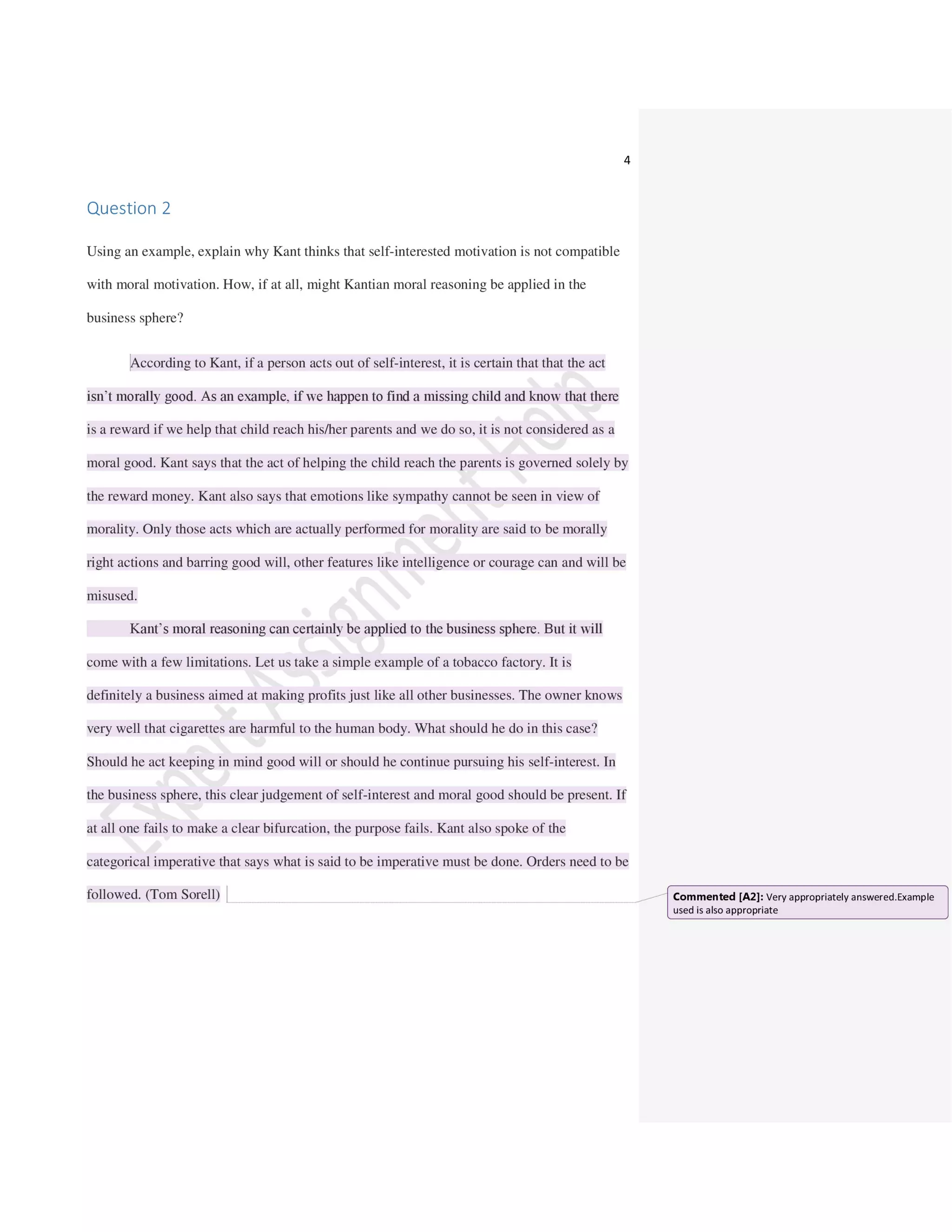
According to Kant, if a person acts out of self-interest, it is certain that that the act isn’t
morally good. As an example, if we happen to find a missing child and know that there is a
reward if we help that child reach his/her parents and we do so, it is not considered as a moral
good. Kant says that the act of helping the child reach the parents is governed solely by the
reward money. Kant also says that emotions like sympathy cannot be seen in view of
morality. Only those acts which are actually performed for morality are said to be morally
right actions and barring good will, other features like intelligence or courage can and will be
misused.
Kant’s moral reasoning can certainly be applied to the business sphere. But it will come with
a few limitations. Let us take a simple example of a tobacco factory. It is definitely a business
aimed at making profits just like all other businesses. The owner knows very well that
cigarettes are harmful to the human body. What should he do in this case?
Issues in Business Ethics and Society Coursework questions

Issues in Business Ethics and Society Coursework questions

  • 1.
    Difference between economiccost-benefit analysis and utilitarian approach to moral reasoning Assignment: Steven Kelman Cost-Benefit Analysis: Self-interested motivation versus moral motivation: general alignment between morality and self-interest Publishedby:https://expertassignmenthelp.com/ Filename:1SAMPLE16C167-economic-cost-benefit-analysis.PDF For more assistance visit: https://expertassignmenthelp.com/marketing-assignment-help/ Uploaded:April 28, 2016 Enjoy  Abstract According to Kant, if a person acts out of self-interest, it is certain that that the act isn’t morally good. As an example, if we happen to find a missing child and know that there is a reward if we help that child reach his/her parents and we do so, it is not considered as a moral good. Kant says that the act of helping the child reach the parents is governed solely by the reward money. Kant also says that emotions like sympathy cannot be seen in view of morality. Only those acts which are actually performed for morality are said to be morally right actions and barring good will, other features like intelligence or courage can and will be misused. Kant’s moral reasoning can certainly be applied to the business sphere. But it will come with a few limitations. Let us take a simple example of a tobacco factory. It is definitely a business aimed at making profits just like all other businesses. The owner knows very well that cigarettes are harmful to the human body. What should he do in this case?