Internet Service Provision: Terminology and
   Principles
   Presentation to the Net Neutrality Working Group of BEREC

   14th February 2012


www.internetsociety.org
Outline

Terminology
     Internet, Internet Service, ISPs, IP-based services, Internet-based
      services

Simple rules for happy users
     As simple as possible, but no simpler

Monitoring service provision
     For the benefit of the end-users
     For the benefit of the Internet


The Internet Society
Terminology, not in isolation

Frequent reference to ITU-T standards in relation to
QoS, QoE

We recommend that when discussing the Internet,
adopting the terminology of the Internet community is
most desirable
     Internet Engineering Task Force


ISOC believes there is a need to develop common
terminology for Internet access, given the commercial
pressures on network operators to undermine the best-
efforts Internet service and give preference to their
managed services.

The Internet Society
The Internet

The Internet is: the system of interconnected networks
that use IETF-specified best current practices and
protocols, including the Internet Protocol, for
communication with resources or endpoints reachable
via a globally unique Internet address.

     IETF defines this technology
     Not just protocols, operational practice is important as well
     Globally unique addressing is integral


The Internet Society
Internet Service

Internet service is: connection of an Internet endpoint or
network to the rest of the Internet with non-
discriminatory, best-effort routing of data packets as
part of the Internet.

     Non-discriminatory by definition
     End systems best placed to figure out relative priorities of competing
      flows
     Networks should simply move the bits along the wire
     Necessary to establish this baseline, to allow for transparency
      through itemisation of exceptions to the baseline
        o  Alternative route of itemising features isn’t practical given dynamic and
            diverse nature of the medium
     Can include application-agnostic congestion management, for
      example, or traffic management to maintain network resilience

The Internet Society
Great minds…
“Internet access should be clearly defined and the use of the term
in marketing restricted to those who provide open access to the
internet. This measure could be implemented nationally under
consumer protection powers.”

‘The open internet – a platform for growth’, a report for the BBC,
  Blinkbox, Channel 4, Skype and Yahoo!, October 2011


“In this scope, using a common frame of reference – for example,
regarding what “Internet access” is supposed to encompass - may
lead to a simpler range of information for customers, such as only
listing the differences between the offer and the reference.”

DRAFT BEREC Guidelines on Net Neutrality and Transparency:
 Best practices and recommended approaches, October 2011


The Internet Society
Internet Service Providers

Internet service providers are: companies that offer
Internet service to customers.

     For example, broadband ISPs that offer Internet service over some
      broadband infrastructure
     May or may not own or maintain that infrastructure — they may
      lease it
     Responsible for the experience of their customers over both the
      broadband infrastructure and the infrastructure that links the ISPs
      network to the rest of the Internet
        o  Not just the access link: peering and transit links also an integral part of
            the overall service provision
     Wireless ISPs are not a special case


The Internet Society
IP-based services (Specialized services)

IP-based services are: services that are built using the
Internet Protocol, but that operate within a restricted set
of networks, or only one network.

     Often optimized for a single service or service type, and rely on a
      single administrative domain controlling the network in order to
      ensure (or enforce) specific service characteristics.
     May not conform to the full set of Internet best practices, including
      network management techniques.
     Examples of IP-based services include video delivery and some
      communications service offerings (such as voice over broadband).


The Internet Society
Internet-based services and applications

Internet-based services and applications are: services
and applications that are delivered over or made
possible by the Internet service direct to end-users.

     Do not rely on administrative control from the network.
     Do rely on the underlying Internet service conforming to
      standardized best practices and non-invasive network management
      techniques.
     Skype is an example of an Internet-based online communications
      application. Blinkbox is an example of an Internet-based video-on-
      demand service.


The Internet Society
Internet is end-user centric

In general, users expect Internet traffic to be conveyed
in a manner that is independent of its source, content or
destination and in a manner that respects their privacy.

Choice and transparency
     at the heart of a user’s Internet experience,
     enabling them to remain in control of their Internet experience, and
      thereby
     allowing them to benefit from, and participate in, the open Internet.


The Internet Society
Internet is sharing

Internet access service enables the user:
     to communicate
     to access content
     to use applications


+ to provide content

+ to develop applications


The Internet Society
Simple rules for happy users

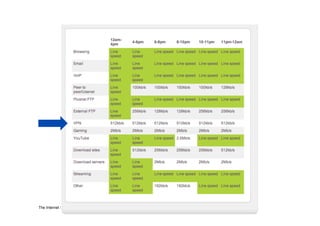
Minimum speed in peak-hour
     A true measure of the quality of service provision

No application-specific blocking*

No destination-specific blocking*

No destination-specific throttling

Application-neutral throttling must be transparently
communicated to the end-user
     Only applicable during busy hour (in response to congestion)
     Only applicable to non-specific ‘background’ traffic
     In-network throttling is a stop-gap measure while better mechanisms
      for end-users and networks to agree about LBE traffic are devised
                                                  *excepting blocks required by law
The Internet Society
Antidisintermediation

Imagine your electricity provider could charge you more
for the electricity you use to light, heat and power ICT
devices in your home office.
     they can’t do that
     if new technology made that possible, would we welcome it?

This has nothing to do with ‘reasonable network
management’ and everything to do with trying to
segment the market for commercial advantage.

It is an abuse of the network operator’s role.


The Internet Society
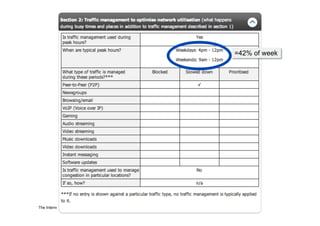
=42% of week


The Internet Society
Internet service monitoring

Competition in the marketplace for ISPs
     helpful to minimise the likelihood of rampant abuse, and to offer consumers a choice,
     insufficient to prevent widespread traffic management practices that are harmful to the
      public-interest goal of maintaining the Internet as an open, transparent, and freely
      accessible platform for global communication and innovation.

Service monitoring is essential
     (Transparency + Competition + low switching costs) is insufficient as users are not
      technically adept
     Combination of detailed technical metrics for market and per-ISP (health of the
      Internet) and broader ‘health of the market’ analysis

Evolutionary trends of the whole market for Internet service must be
watched closely
     Expanding definitions of ‘peak hour’
     Expanding definitions of ‘background traffic’
     Rising numbers of end user complaints about their experience of the service offered


The Internet Society
Implications for metrics

IP-based services vs. Internet services
     Measurements of Internet service performance must be made in the
      presence of bundled IP-based services where present

Peering and transit links
     Measurements must be to a wide range of destinations

Ability to evolve
     Connectivity and throughput tests must use a broad range of
      protocols, applications and destinations
     Testing support for the ‘long tail’


The Internet Society
Internet vs. IP-based services

Apportioning bandwidth between IP-based services and Internet
traffic:
     It is important that Internet service providers are fully transparent to their
      subscribers about the bandwidth being offered for Internet service
     This can best be verified independently by testing throughput to a wide
      variety of Internet destinations at various times of day, and in the presence
      of bundled IP-based services if applicable.


Individual network operators are unlikely to be able to create a
closed service with limited reach and limited content that is more
compelling than an Internet-based alternative, with all the positive
properties that unfettered global communication can bring.


The Internet Society
Inter-ISP links

Historically, considerable effort has been put into ensuring that peering
relationships and network gateways are optimized to allow good quality
access to Internet destinations beyond a given network.

Interface speed says nothing about available bandwidth end-to-end, so
what, if any, obligations do network operators have to provision additional
bandwidth for best-efforts Internet services in the face of rising demand
from their subscribers? Absent a competitive marketplace for ISP services
consumers could expect their Internet access performance to diminish
over time.

Essential that measurements of Internet service performance are made to
as wide a range of destinations as possible to ensure that the quality of
Internet service links doesn’t atrophy over time relative to other IP-based
services.
     replicated at regular intervals
     compared with the stated performance characteristics of the subscribed Internet
      service
     publicized to the relevant stakeholder community.

The Internet Society
Ability to evolve

Measurement methodologies need to verify that popular Internet-
based services and applications perform adequately over any given
Internet service.

Should also verify that a much broader range of less commonly
used protocols, applications and destinations are similarly
functional.
     Selecting destinations at random from a long list.

This is necessary to ensure the continued availability of the Internet
as a general purpose data networking and communications
medium.

To the extent the platform becomes constrained by technical
restrictions applied to shape user experience or behavior (e.g.,
blocking standard ports, blocking DNS responses, inappropriate
traffic management), it loses scope, both for today’s experiences
and as the basis for future development.
The Internet Society
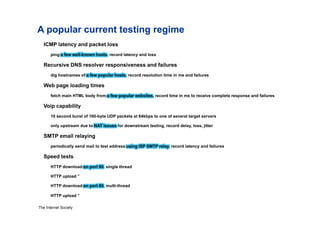
A popular current testing regime


The Internet Society
Analysis paralysis

Detailed consideration of per-application quality
requirements tacitly accepts the widespread existence
of per-application network performance
     this is highly undesirable
     will date quickly

Avoid normalizing negative behaviour
     For example, Internet ‘nutrition labels’ that allow for blocking or
      widespread throttling
     Greater transparency vis-à-vis unwanted practices is necessary, but
      not sufficient


The Internet Society
International measurement standards

Co-operation between Regulators to develop widely
applicable and acceptable measurement methodologies
and standards is highly desirable

Given that the Internet is a global network of networks
that does not adhere to national boundaries, policy
makers should strive to minimize obstacles to network
operators building their networks across national
boundaries

Having to submit to and satisfy multiple different
measurement approaches and quality of service
requirements could be a serious impediment to Internet
growth and investment.

The Internet Society
Future challenges

      More bandwidth will always help, but viewed globally it
      will always be a very diverse environment

      Need to find scalable, global solutions to better
      apportion bandwidth without resorting to network
      ‘smarts’
            Innovation will become more expensive otherwise

      Monitoring regimes should also be forward looking
            IPv6
            Enhanced security features, e.g. DNSSEC


24   The Internet Society        The Health of the Internet, INET London   2010-09-29
Right problem, wrong solution

      Interests of content providers, ISPs and users not
      always well-aligned
            Fair management of congestion is a whole network issue
            Per service charging is antithetical to Internet

            Innovators lose for want of being able to execute
            Content providers lose due to having to manage and service a fee
             structure that's almost as complex as the routing table
            Customers lose as a result of inconsistent and unpredictable
             usability
            ISPs lose as function of customers losing confidence in their ability
             to provide service (to them, it 'just doesn't work for everything').


25   The Internet Society          The Health of the Internet, INET London     2010-09-29
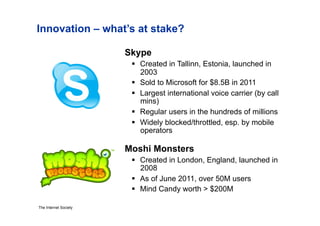
Innovation – what’s at stake?

                       Skype
                          Created in Tallinn, Estonia, launched in
                           2003
                          Sold to Microsoft for $8.5B in 2011
                          Largest international voice carrier (by call
                           mins)
                          Regular users in the hundreds of millions
                          Widely blocked/throttled, esp. by mobile
                           operators

                       Moshi Monsters
                          Created in London, England, launched in
                           2008
                          As of June 2011, over 50M users
                          Mind Candy worth > $200M

The Internet Society
Relevant IETF Work
IPPM Working Group
       Defines metrics and procedures for accurately measuring these metrics
        o    connectivity
        o    one-way delay and loss
        o    round-trip delay.
        o    delay variation
        o    loss patterns
        o    packet reordering
        o    bulk transport capacity
        o    link bandwidth capacity
        o    packet duplication

ALTO, CDNI, CONEX, DECADE, LEDBAT Working Groups
       Better than random peer selection in P2P nets
       Interconnecting separately administered CDN nets
       Exposing the marginal cost of networking – congestion volume
       In-net storage for P2P and other apps
       Congestion control for LBE traffic

RFC6057 Comcast's Protocol-Agnostic Congestion Management System


The Internet Society
Relevant ISOC outputs

Bandwidth Panel
     http://www.internetsociety.org/
      news/isoc-briefing-panel-internet-
      bandwidth-growth-dealing-reality


Submission to OECD/FCC
Broadband Metrics Workshop
     http://www.fcc.gov/events/oecd-
      broadband-metrics-workshop
     In collaboration with, and on behalf
      of OECD Internet Technical
      Advisory Committee


The Internet Society
Conclusions

We must share common terminology of Internet service

Build measurement methodologies designed to reveal
the quality of that service

Develop a 'test harness' for Internet service
     agree a diverse set of Internet applications
     in an automated fashion, test the performance of these applications
      to establish the extent to which functioning Internet service can be
      said to be being delivered.

Testing diversity and global reach are key to ensuring
the long-term viability of the Internet as a platform for
innovation and growth


The Internet Society

Internet service provision_terminology_and_principles

  • 1.
    Internet Service Provision:Terminology and Principles Presentation to the Net Neutrality Working Group of BEREC 14th February 2012 www.internetsociety.org
  • 2.
    Outline Terminology   Internet, Internet Service, ISPs, IP-based services, Internet-based services Simple rules for happy users   As simple as possible, but no simpler Monitoring service provision   For the benefit of the end-users   For the benefit of the Internet The Internet Society
  • 3.
    Terminology, not inisolation Frequent reference to ITU-T standards in relation to QoS, QoE We recommend that when discussing the Internet, adopting the terminology of the Internet community is most desirable   Internet Engineering Task Force ISOC believes there is a need to develop common terminology for Internet access, given the commercial pressures on network operators to undermine the best- efforts Internet service and give preference to their managed services. The Internet Society
  • 4.
    The Internet The Internetis: the system of interconnected networks that use IETF-specified best current practices and protocols, including the Internet Protocol, for communication with resources or endpoints reachable via a globally unique Internet address.   IETF defines this technology   Not just protocols, operational practice is important as well   Globally unique addressing is integral The Internet Society
  • 5.
    Internet Service Internet serviceis: connection of an Internet endpoint or network to the rest of the Internet with non- discriminatory, best-effort routing of data packets as part of the Internet.   Non-discriminatory by definition   End systems best placed to figure out relative priorities of competing flows   Networks should simply move the bits along the wire   Necessary to establish this baseline, to allow for transparency through itemisation of exceptions to the baseline o  Alternative route of itemising features isn’t practical given dynamic and diverse nature of the medium   Can include application-agnostic congestion management, for example, or traffic management to maintain network resilience The Internet Society
  • 6.
    Great minds… “Internet accessshould be clearly defined and the use of the term in marketing restricted to those who provide open access to the internet. This measure could be implemented nationally under consumer protection powers.” ‘The open internet – a platform for growth’, a report for the BBC, Blinkbox, Channel 4, Skype and Yahoo!, October 2011 “In this scope, using a common frame of reference – for example, regarding what “Internet access” is supposed to encompass - may lead to a simpler range of information for customers, such as only listing the differences between the offer and the reference.” DRAFT BEREC Guidelines on Net Neutrality and Transparency: Best practices and recommended approaches, October 2011 The Internet Society
  • 7.
    Internet Service Providers Internetservice providers are: companies that offer Internet service to customers.   For example, broadband ISPs that offer Internet service over some broadband infrastructure   May or may not own or maintain that infrastructure — they may lease it   Responsible for the experience of their customers over both the broadband infrastructure and the infrastructure that links the ISPs network to the rest of the Internet o  Not just the access link: peering and transit links also an integral part of the overall service provision   Wireless ISPs are not a special case The Internet Society
  • 8.
    IP-based services (Specializedservices) IP-based services are: services that are built using the Internet Protocol, but that operate within a restricted set of networks, or only one network.   Often optimized for a single service or service type, and rely on a single administrative domain controlling the network in order to ensure (or enforce) specific service characteristics.   May not conform to the full set of Internet best practices, including network management techniques.   Examples of IP-based services include video delivery and some communications service offerings (such as voice over broadband). The Internet Society
  • 9.
    Internet-based services andapplications Internet-based services and applications are: services and applications that are delivered over or made possible by the Internet service direct to end-users.   Do not rely on administrative control from the network.   Do rely on the underlying Internet service conforming to standardized best practices and non-invasive network management techniques.   Skype is an example of an Internet-based online communications application. Blinkbox is an example of an Internet-based video-on- demand service. The Internet Society
  • 10.
    Internet is end-usercentric In general, users expect Internet traffic to be conveyed in a manner that is independent of its source, content or destination and in a manner that respects their privacy. Choice and transparency   at the heart of a user’s Internet experience,   enabling them to remain in control of their Internet experience, and thereby   allowing them to benefit from, and participate in, the open Internet. The Internet Society
  • 11.
    Internet is sharing Internetaccess service enables the user:   to communicate   to access content   to use applications + to provide content + to develop applications The Internet Society
  • 12.
    Simple rules forhappy users Minimum speed in peak-hour   A true measure of the quality of service provision No application-specific blocking* No destination-specific blocking* No destination-specific throttling Application-neutral throttling must be transparently communicated to the end-user   Only applicable during busy hour (in response to congestion)   Only applicable to non-specific ‘background’ traffic   In-network throttling is a stop-gap measure while better mechanisms for end-users and networks to agree about LBE traffic are devised *excepting blocks required by law The Internet Society
  • 13.
  • 14.
    Antidisintermediation Imagine your electricityprovider could charge you more for the electricity you use to light, heat and power ICT devices in your home office.   they can’t do that   if new technology made that possible, would we welcome it? This has nothing to do with ‘reasonable network management’ and everything to do with trying to segment the market for commercial advantage. It is an abuse of the network operator’s role. The Internet Society
  • 15.
    =42% of week TheInternet Society
  • 16.
    Internet service monitoring Competitionin the marketplace for ISPs   helpful to minimise the likelihood of rampant abuse, and to offer consumers a choice,   insufficient to prevent widespread traffic management practices that are harmful to the public-interest goal of maintaining the Internet as an open, transparent, and freely accessible platform for global communication and innovation. Service monitoring is essential   (Transparency + Competition + low switching costs) is insufficient as users are not technically adept   Combination of detailed technical metrics for market and per-ISP (health of the Internet) and broader ‘health of the market’ analysis Evolutionary trends of the whole market for Internet service must be watched closely   Expanding definitions of ‘peak hour’   Expanding definitions of ‘background traffic’   Rising numbers of end user complaints about their experience of the service offered The Internet Society
  • 17.
    Implications for metrics IP-basedservices vs. Internet services   Measurements of Internet service performance must be made in the presence of bundled IP-based services where present Peering and transit links   Measurements must be to a wide range of destinations Ability to evolve   Connectivity and throughput tests must use a broad range of protocols, applications and destinations   Testing support for the ‘long tail’ The Internet Society
  • 18.
    Internet vs. IP-basedservices Apportioning bandwidth between IP-based services and Internet traffic:   It is important that Internet service providers are fully transparent to their subscribers about the bandwidth being offered for Internet service   This can best be verified independently by testing throughput to a wide variety of Internet destinations at various times of day, and in the presence of bundled IP-based services if applicable. Individual network operators are unlikely to be able to create a closed service with limited reach and limited content that is more compelling than an Internet-based alternative, with all the positive properties that unfettered global communication can bring. The Internet Society
  • 19.
    Inter-ISP links Historically, considerableeffort has been put into ensuring that peering relationships and network gateways are optimized to allow good quality access to Internet destinations beyond a given network. Interface speed says nothing about available bandwidth end-to-end, so what, if any, obligations do network operators have to provision additional bandwidth for best-efforts Internet services in the face of rising demand from their subscribers? Absent a competitive marketplace for ISP services consumers could expect their Internet access performance to diminish over time. Essential that measurements of Internet service performance are made to as wide a range of destinations as possible to ensure that the quality of Internet service links doesn’t atrophy over time relative to other IP-based services.   replicated at regular intervals   compared with the stated performance characteristics of the subscribed Internet service   publicized to the relevant stakeholder community. The Internet Society
  • 20.
    Ability to evolve Measurementmethodologies need to verify that popular Internet- based services and applications perform adequately over any given Internet service. Should also verify that a much broader range of less commonly used protocols, applications and destinations are similarly functional.   Selecting destinations at random from a long list. This is necessary to ensure the continued availability of the Internet as a general purpose data networking and communications medium. To the extent the platform becomes constrained by technical restrictions applied to shape user experience or behavior (e.g., blocking standard ports, blocking DNS responses, inappropriate traffic management), it loses scope, both for today’s experiences and as the basis for future development. The Internet Society
  • 21.
    A popular currenttesting regime The Internet Society
  • 22.
    Analysis paralysis Detailed considerationof per-application quality requirements tacitly accepts the widespread existence of per-application network performance   this is highly undesirable   will date quickly Avoid normalizing negative behaviour   For example, Internet ‘nutrition labels’ that allow for blocking or widespread throttling   Greater transparency vis-à-vis unwanted practices is necessary, but not sufficient The Internet Society
  • 23.
    International measurement standards Co-operationbetween Regulators to develop widely applicable and acceptable measurement methodologies and standards is highly desirable Given that the Internet is a global network of networks that does not adhere to national boundaries, policy makers should strive to minimize obstacles to network operators building their networks across national boundaries Having to submit to and satisfy multiple different measurement approaches and quality of service requirements could be a serious impediment to Internet growth and investment. The Internet Society
  • 24.
    Future challenges More bandwidth will always help, but viewed globally it will always be a very diverse environment Need to find scalable, global solutions to better apportion bandwidth without resorting to network ‘smarts’   Innovation will become more expensive otherwise Monitoring regimes should also be forward looking   IPv6   Enhanced security features, e.g. DNSSEC 24 The Internet Society The Health of the Internet, INET London 2010-09-29
  • 25.
    Right problem, wrongsolution Interests of content providers, ISPs and users not always well-aligned   Fair management of congestion is a whole network issue   Per service charging is antithetical to Internet   Innovators lose for want of being able to execute   Content providers lose due to having to manage and service a fee structure that's almost as complex as the routing table   Customers lose as a result of inconsistent and unpredictable usability   ISPs lose as function of customers losing confidence in their ability to provide service (to them, it 'just doesn't work for everything'). 25 The Internet Society The Health of the Internet, INET London 2010-09-29
  • 26.
    Innovation – what’sat stake? Skype   Created in Tallinn, Estonia, launched in 2003   Sold to Microsoft for $8.5B in 2011   Largest international voice carrier (by call mins)   Regular users in the hundreds of millions   Widely blocked/throttled, esp. by mobile operators Moshi Monsters   Created in London, England, launched in 2008   As of June 2011, over 50M users   Mind Candy worth > $200M The Internet Society
  • 27.
    Relevant IETF Work IPPMWorking Group   Defines metrics and procedures for accurately measuring these metrics o  connectivity o  one-way delay and loss o  round-trip delay. o  delay variation o  loss patterns o  packet reordering o  bulk transport capacity o  link bandwidth capacity o  packet duplication ALTO, CDNI, CONEX, DECADE, LEDBAT Working Groups   Better than random peer selection in P2P nets   Interconnecting separately administered CDN nets   Exposing the marginal cost of networking – congestion volume   In-net storage for P2P and other apps   Congestion control for LBE traffic RFC6057 Comcast's Protocol-Agnostic Congestion Management System The Internet Society
  • 28.
    Relevant ISOC outputs BandwidthPanel   http://www.internetsociety.org/ news/isoc-briefing-panel-internet- bandwidth-growth-dealing-reality Submission to OECD/FCC Broadband Metrics Workshop   http://www.fcc.gov/events/oecd- broadband-metrics-workshop   In collaboration with, and on behalf of OECD Internet Technical Advisory Committee The Internet Society
  • 29.
    Conclusions We must sharecommon terminology of Internet service Build measurement methodologies designed to reveal the quality of that service Develop a 'test harness' for Internet service   agree a diverse set of Internet applications   in an automated fashion, test the performance of these applications to establish the extent to which functioning Internet service can be said to be being delivered. Testing diversity and global reach are key to ensuring the long-term viability of the Internet as a platform for innovation and growth The Internet Society