International Standards
Overview {ISO}
Hello!
I am AHMED SAID BASSYOUNI
I am here because I would talk
about Upcoming changes to in
ISO standards .
Dr. Mohamed Reda
“
creates documents that provide requirements,
specifications, guidelines or characteristics
that can be used consistently to ensure that
materials, products, processes and services
are fit for their purpose.
International Standards Overview
ISO 9001:2015 VS ISO 9001:2008
Quality Management System
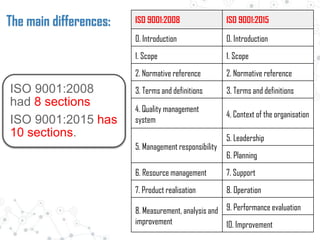
The main differences:
ISO 9001:2008
had 8 sections
ISO 9001:2015 has
10 sections.
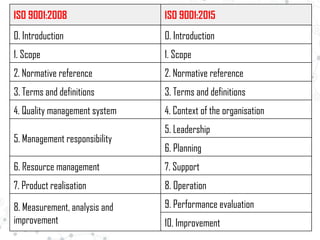
ISO 9001:2008 ISO 9001:2015
0. Introduction 0. Introduction
1. Scope 1. Scope
2. Normative reference 2. Normative reference
3. Terms and definitions 3. Terms and definitions
4. Quality management
system
4. Context of the organisation
5. Management responsibility
5. Leadership
6. Planning
6. Resource management 7. Support
7. Product realisation 8. Operation
8. Measurement, analysis and
improvement
9. Performance evaluation
10. Improvement
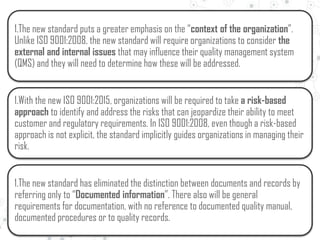
1.The new standard puts a greater emphasis on the “context of the organization”.
Unlike ISO 9001:2008, the new standard will require organizations to consider the
external and internal issues that may influence their quality management system
(QMS) and they will need to determine how these will be addressed.
1.With the new ISO 9001:2015, organizations will be required to take a risk-based
approach to identify and address the risks that can jeopardize their ability to meet
customer and regulatory requirements. In ISO 9001:2008, even though a risk-based
approach is not explicit, the standard implicitly guides organizations in managing their
risk.
1.The new standard has eliminated the distinction between documents and records by
referring only to “Documented information”. There also will be general
requirements for documentation, with no reference to documented quality manual,
documented procedures or to quality records.
The specific requirements for preventive action present in ISO 9001:2008 have been
removed in the new standard. This decision was motivated by the perspective that
prevention is the task of the QMS in its entirety.
Some concepts have been replaced in the new standard, such as the term “product”
is replaced by “goods & services” and “continual” by “continual improvement.
”Purchasing” and “outsourcing” will be replaced by “external provision of goods and
services”.
The new standard also eliminates any reference to a “Management
Representative”. Instead, management duties and responsibilities can now be assigned
directly to top management (to one person in particular or to many)
ISO 9001:2008 ISO 9001:2015
0. Introduction 0. Introduction
1. Scope 1. Scope
2. Normative reference 2. Normative reference
3. Terms and definitions 3. Terms and definitions
4. Quality management system 4. Context of the organisation
5. Management responsibility
5. Leadership
6. Planning
6. Resource management 7. Support
7. Product realisation 8. Operation
8. Measurement, analysis and
improvement
9. Performance evaluation
10. Improvement
Environmental Managment
The main differences:
1.New concepts have been added, such as “supply chain”, “value chain” and
“product life cycle” and existing definitions have been modified to give a
different emphasis and to improve clarity.
1.Two new clauses have been introduced which focuses on an organization’s
context. These require organizations to determine the issues and requirements
that can influence the scope of its EMS and take them into account.
1.There’s a greater emphasis on top management, requiring them to
take the lead in integrating the environmental management practices
into their organization’s core strategies, processes, and priorities.
Regarding environmental policy, organization should be committed to
protecting the environment rather than just preventing its pollution, as stated
in ISO 14001:2004.
1.A greater emphasis is placed on an organization determining its own
risk profile.
1.Organizations are required to control or influence processes and services
associated with significant environmental aspects, organizational risks, lifecycle and
emergency preparedness.
1.There is a greater focus on environmental performance
improvement across the value chain.
1.The DIS does not include specific requirements for preventive action. The new
standard no longer thinks of preventive measures as a separate topic, but rather as a
central component of all environmental-related activities.
1.Environmental objectives have been given a separate sub-clause with
the “planning actions to achieve environmental objectives.”
1.The terms “document” and “record” have both been replaced throughout the DIS
with the term “documented information”. The DIS states that documented information
must be maintained to the extent necessary to have confidence that the processes
have been carried out as planned.
Comparison between
OHSAS 18001- 2008 and OHSAS 45001-2016
 Every 15 seconds, a worker dies from a work-related
accident .
 153 people experience a work-related injury.
 costing over 2.3 million deaths a year.
 Now with ISO 45001,the world is one step closer to a
robust and effective set of processes for improving
work safety
 Designed to help organizations of all sizes and
industries, the future standard is expected to reduce
workplace injuries and illnesses around the world.
Facts:
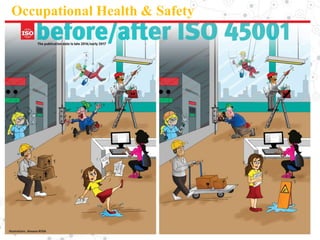
Occupational Health & Safety
In the new standard there is a stronger focus on the “organization’s context".
With ISO 45001, organizations will have to look beyond their own health and
safety issues and consider what the society expects from them, in regard with
health and safety issues.
Some organizations that use OHSAS 18001 delegate health and safety
responsibilities to a safety manager, rather than integrating the system into the
organization’s operations. ISO 45001 requires the incorporation of health and
safety aspects in the overall management system of the organization, thus
driving top management to have a stronger leadership role with respect to the
OH&S management system.
The main differences:
ISO 45001 focuses on identifying and controlling risks rather than
hazards, as it is required in OHSAS 18001.
ISO 45001 requires organizations to take into account
how suppliers and contractors are managing their risks.
In ISO 45001 some fundamental concepts are changed, like risk, worker
and workplace. There are also new definitions of terms such as:
monitoring, measurement, effectiveness, OH&S performance and
process.
The terms “document” and “record” have both been replaced with the
term “documented information” in ISO 45001. The standard also states
that documented information must be maintained to the extent
necessary to have confidence that the processes have been carried out
as planned.
•In spite of these changes, the overall aim of ISO 45001 remains the
same as OHSAS 18001, which is to reduce unacceptable risks and ensure
the safety and wellbeing of everyone involved in an organization’s
activities.
New
Iso14001-2015Iso9001 -2015 OHSAS 45001-2016
Thanks!

Iso standard updates

  • 1.
  • 2.
    Hello! I am AHMEDSAID BASSYOUNI I am here because I would talk about Upcoming changes to in ISO standards . Dr. Mohamed Reda
  • 3.
    “ creates documents thatprovide requirements, specifications, guidelines or characteristics that can be used consistently to ensure that materials, products, processes and services are fit for their purpose.
  • 4.
  • 5.
    ISO 9001:2015 VSISO 9001:2008
  • 6.
  • 7.
    The main differences: ISO9001:2008 had 8 sections ISO 9001:2015 has 10 sections. ISO 9001:2008 ISO 9001:2015 0. Introduction 0. Introduction 1. Scope 1. Scope 2. Normative reference 2. Normative reference 3. Terms and definitions 3. Terms and definitions 4. Quality management system 4. Context of the organisation 5. Management responsibility 5. Leadership 6. Planning 6. Resource management 7. Support 7. Product realisation 8. Operation 8. Measurement, analysis and improvement 9. Performance evaluation 10. Improvement
  • 8.
    1.The new standardputs a greater emphasis on the “context of the organization”. Unlike ISO 9001:2008, the new standard will require organizations to consider the external and internal issues that may influence their quality management system (QMS) and they will need to determine how these will be addressed. 1.With the new ISO 9001:2015, organizations will be required to take a risk-based approach to identify and address the risks that can jeopardize their ability to meet customer and regulatory requirements. In ISO 9001:2008, even though a risk-based approach is not explicit, the standard implicitly guides organizations in managing their risk. 1.The new standard has eliminated the distinction between documents and records by referring only to “Documented information”. There also will be general requirements for documentation, with no reference to documented quality manual, documented procedures or to quality records.
  • 9.
    The specific requirementsfor preventive action present in ISO 9001:2008 have been removed in the new standard. This decision was motivated by the perspective that prevention is the task of the QMS in its entirety. Some concepts have been replaced in the new standard, such as the term “product” is replaced by “goods & services” and “continual” by “continual improvement. ”Purchasing” and “outsourcing” will be replaced by “external provision of goods and services”. The new standard also eliminates any reference to a “Management Representative”. Instead, management duties and responsibilities can now be assigned directly to top management (to one person in particular or to many)
  • 10.
    ISO 9001:2008 ISO9001:2015 0. Introduction 0. Introduction 1. Scope 1. Scope 2. Normative reference 2. Normative reference 3. Terms and definitions 3. Terms and definitions 4. Quality management system 4. Context of the organisation 5. Management responsibility 5. Leadership 6. Planning 6. Resource management 7. Support 7. Product realisation 8. Operation 8. Measurement, analysis and improvement 9. Performance evaluation 10. Improvement
  • 12.
  • 13.
    The main differences: 1.Newconcepts have been added, such as “supply chain”, “value chain” and “product life cycle” and existing definitions have been modified to give a different emphasis and to improve clarity. 1.Two new clauses have been introduced which focuses on an organization’s context. These require organizations to determine the issues and requirements that can influence the scope of its EMS and take them into account. 1.There’s a greater emphasis on top management, requiring them to take the lead in integrating the environmental management practices into their organization’s core strategies, processes, and priorities.
  • 14.
    Regarding environmental policy,organization should be committed to protecting the environment rather than just preventing its pollution, as stated in ISO 14001:2004. 1.A greater emphasis is placed on an organization determining its own risk profile. 1.Organizations are required to control or influence processes and services associated with significant environmental aspects, organizational risks, lifecycle and emergency preparedness. 1.There is a greater focus on environmental performance improvement across the value chain.
  • 15.
    1.The DIS doesnot include specific requirements for preventive action. The new standard no longer thinks of preventive measures as a separate topic, but rather as a central component of all environmental-related activities. 1.Environmental objectives have been given a separate sub-clause with the “planning actions to achieve environmental objectives.” 1.The terms “document” and “record” have both been replaced throughout the DIS with the term “documented information”. The DIS states that documented information must be maintained to the extent necessary to have confidence that the processes have been carried out as planned.
  • 16.
    Comparison between OHSAS 18001-2008 and OHSAS 45001-2016
  • 17.
     Every 15seconds, a worker dies from a work-related accident .  153 people experience a work-related injury.  costing over 2.3 million deaths a year.  Now with ISO 45001,the world is one step closer to a robust and effective set of processes for improving work safety  Designed to help organizations of all sizes and industries, the future standard is expected to reduce workplace injuries and illnesses around the world. Facts:
  • 18.
  • 19.
    In the newstandard there is a stronger focus on the “organization’s context". With ISO 45001, organizations will have to look beyond their own health and safety issues and consider what the society expects from them, in regard with health and safety issues. Some organizations that use OHSAS 18001 delegate health and safety responsibilities to a safety manager, rather than integrating the system into the organization’s operations. ISO 45001 requires the incorporation of health and safety aspects in the overall management system of the organization, thus driving top management to have a stronger leadership role with respect to the OH&S management system. The main differences:
  • 20.
    ISO 45001 focuseson identifying and controlling risks rather than hazards, as it is required in OHSAS 18001. ISO 45001 requires organizations to take into account how suppliers and contractors are managing their risks. In ISO 45001 some fundamental concepts are changed, like risk, worker and workplace. There are also new definitions of terms such as: monitoring, measurement, effectiveness, OH&S performance and process.
  • 21.
    The terms “document”and “record” have both been replaced with the term “documented information” in ISO 45001. The standard also states that documented information must be maintained to the extent necessary to have confidence that the processes have been carried out as planned. •In spite of these changes, the overall aim of ISO 45001 remains the same as OHSAS 18001, which is to reduce unacceptable risks and ensure the safety and wellbeing of everyone involved in an organization’s activities.
  • 22.
  • 23.